
A complete issue · 48 pages · 1914
Life — October 15, 1914
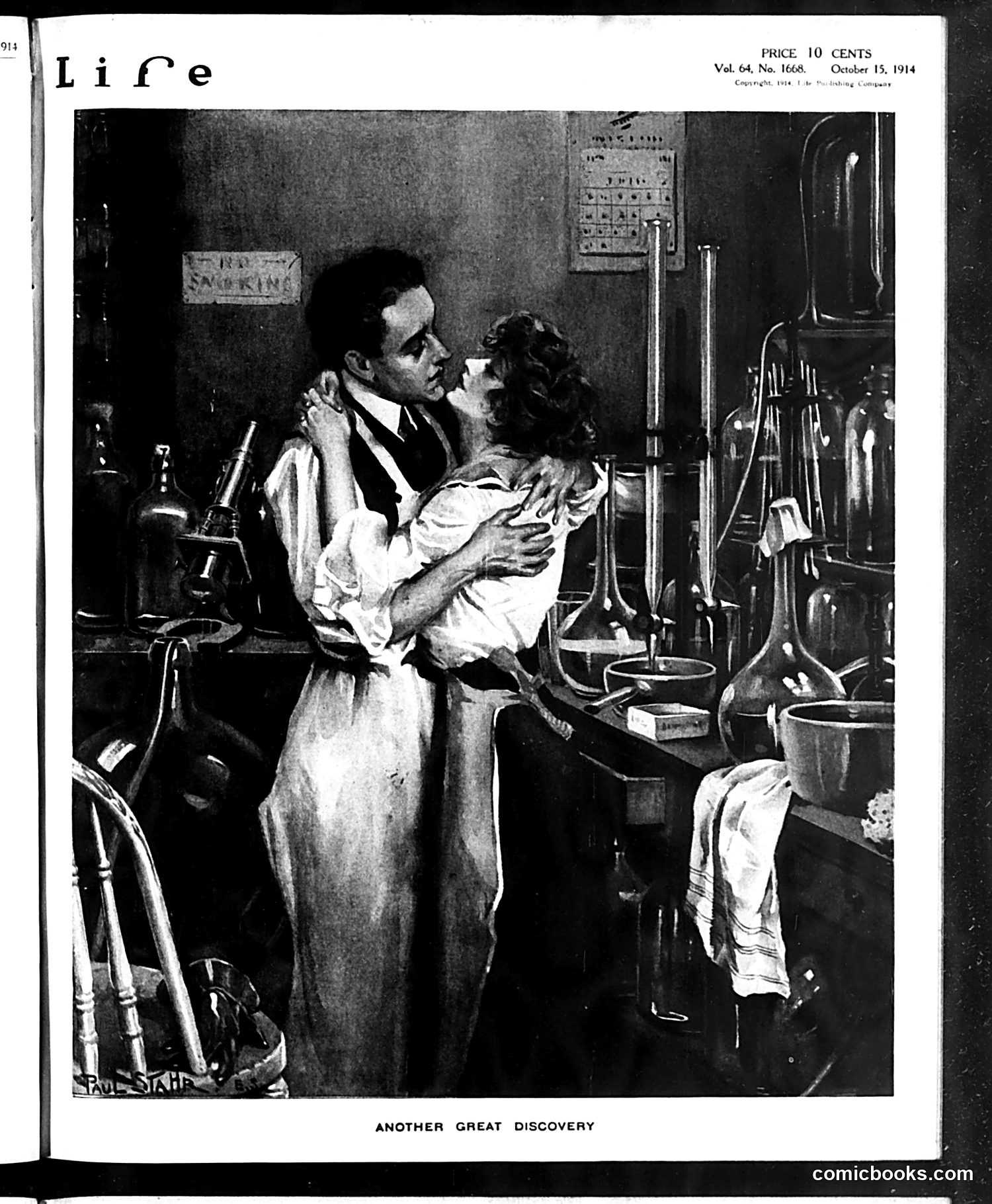
This October 1914 *Life* magazine page depicts a romantic scene in a laboratory setting, captioned "Another Great Discovery." The image appears to be satirical commentary on scientific romance or courtship, showing a couple in an intimate embrace surrounded by laboratory equipment, beakers, and scientific apparatus. The humor likely plays on the double meaning of "discovery"—both scientific breakthrough and romantic discovery. Given the early 20th-century context and *Life*'s satirical nature, this probably mocks either the distraction of romance in serious scientific work, or conversely, presents love itself as a scientific achievement worthy of discovery. The setting and period costume suggest this may reference contemporary attitudes toward workplace romance or the intersection of intellectual and romantic pursuits.
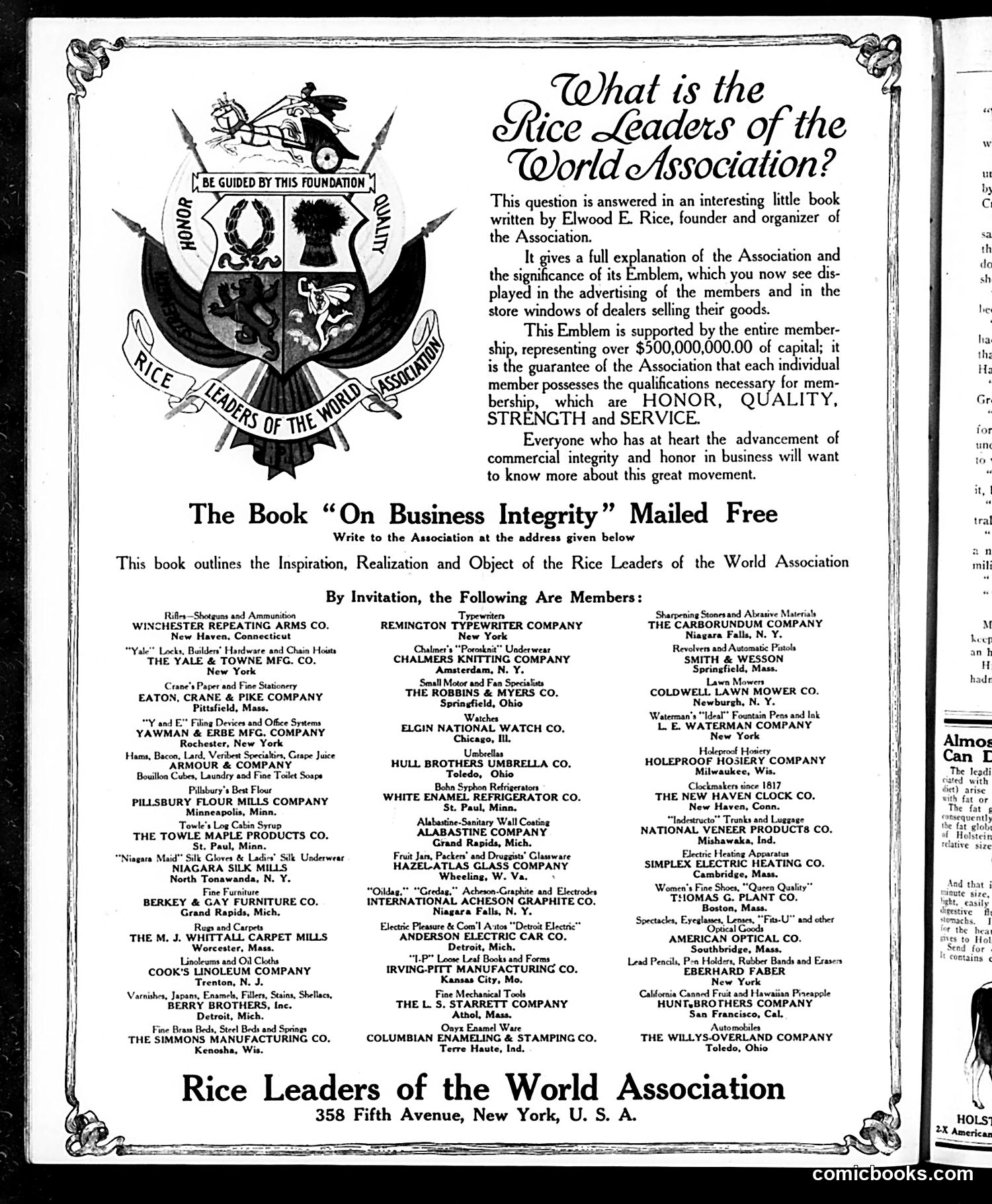
This page is **primarily advertising**, not satire or political commentary. It promotes the "Rice Leaders of the World Association," a business organization claiming to represent $500,000,000 in capital. The elaborate heraldic emblem (shield with eagle, spears, and banner reading "RICE LEADERS OF THE WORLD ASSOCIATION") appears designed to lend legitimacy and prestige to the group. The organization advertises itself as guaranteeing member businesses possess "HONOR, QUALITY, STRENGTH and SERVICE." The page lists dozens of member companies—manufacturers of everything from typewriters to furniture to hosiery—positioned as prestigious endorsements. A free book on "Business Integrity" is offered to interested readers. This represents early 20th-century commercial self-promotion rather than satirical content.
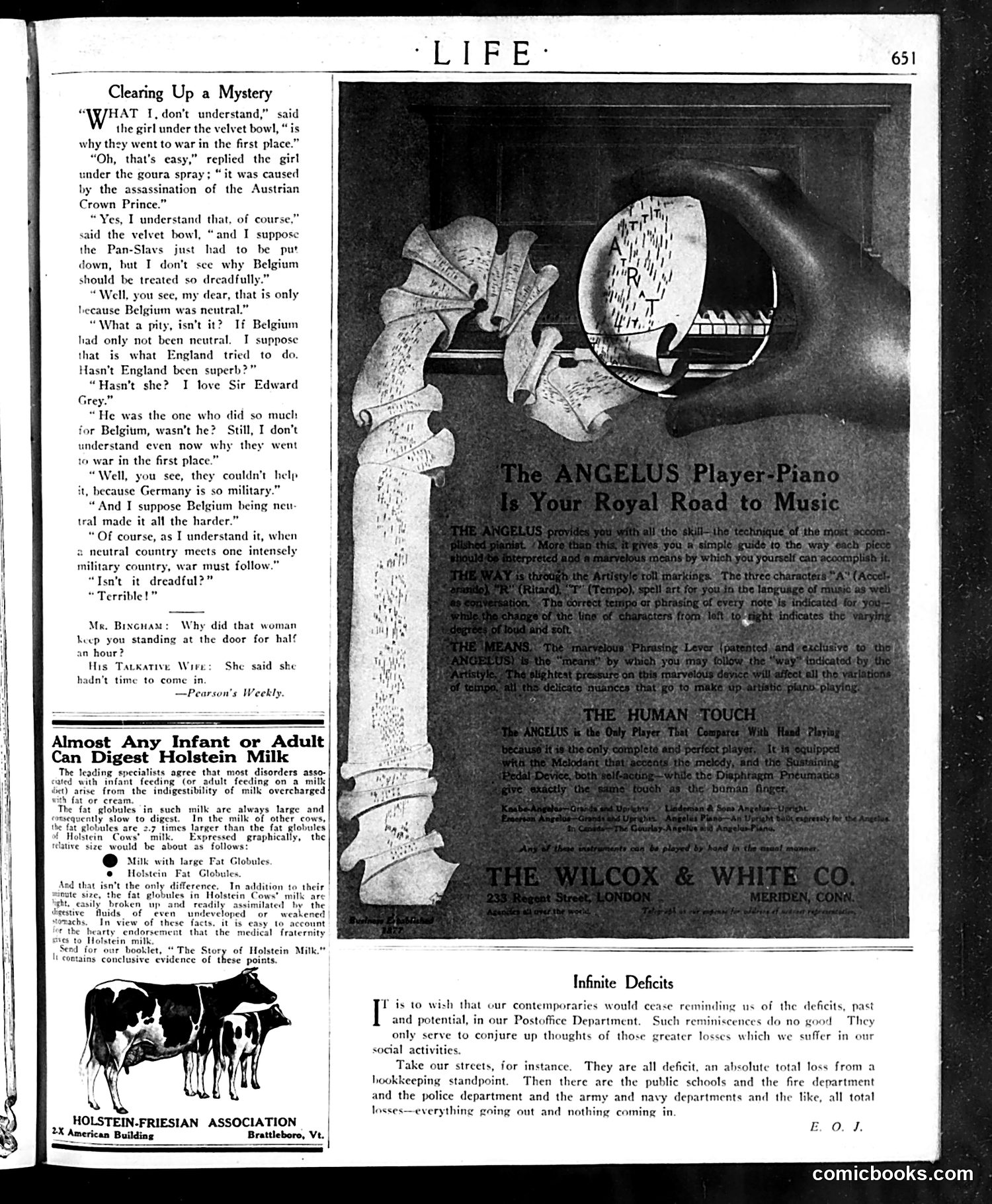
This page is primarily **advertising and editorial content** rather than political satire. The main feature is an advertisement for the **Angelus Player-Piano**, marketed as "Your Royal Road to Music." The accompanying illustration shows hands playing the device, emphasizing its ability to enable musical performance without training. A small dialogue piece titled "Clearing Up a Mystery" discusses **World War I causes**, specifically debating why various nations entered the conflict. Characters reference the assassination of the Austrian Crown Prince and discuss Belgium's neutrality and England's military response—typical of American WWI-era discussions about European geopolitics. Below is an advertisement for **Holstein milk**, promoting its digestibility for infants and adults. The page reflects early 20th-century American consumer culture and wartime discourse.
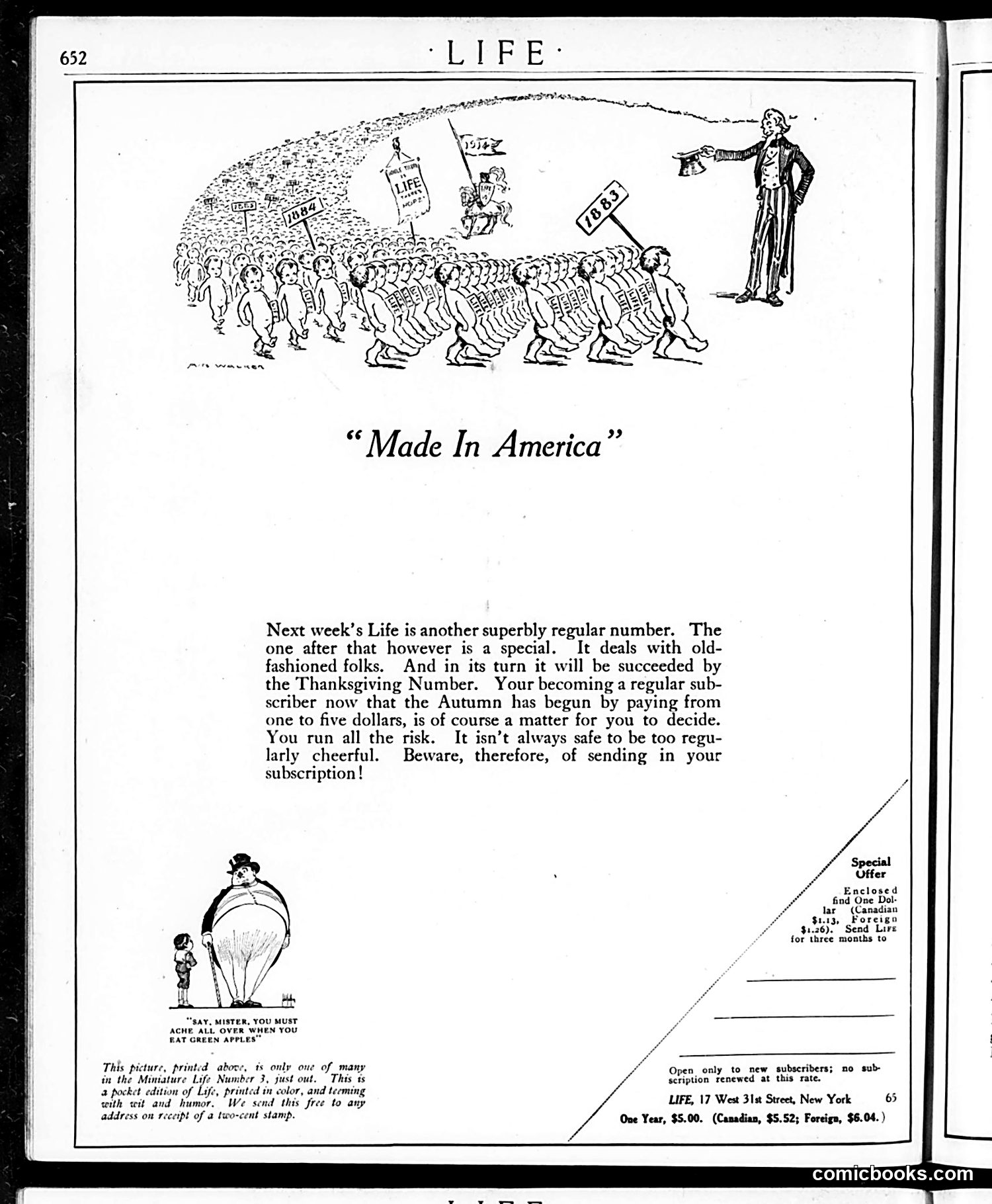
This cartoon satirizes American labor and manufacturing. A tall figure in formal dress (likely representing American industry or capital) stands to the right, directing a large crowd of small workers—depicted as simplified, identical figures carrying "LIFE" signs and other labels. The workers move in lockstep formation, suggesting mechanized, dehumanized labor. The title "Made In America" is ironic: rather than celebrating American manufacturing prowess, the cartoon critiques how American industrial production treats workers as interchangeable, uniform components. The crowd's uniformity and obedience to the figure's command implies workers lack individuality and autonomy, reduced to cogs in an industrial machine. This reflects early-20th-century concerns about factory labor conditions, mass production, and worker exploitation in America.
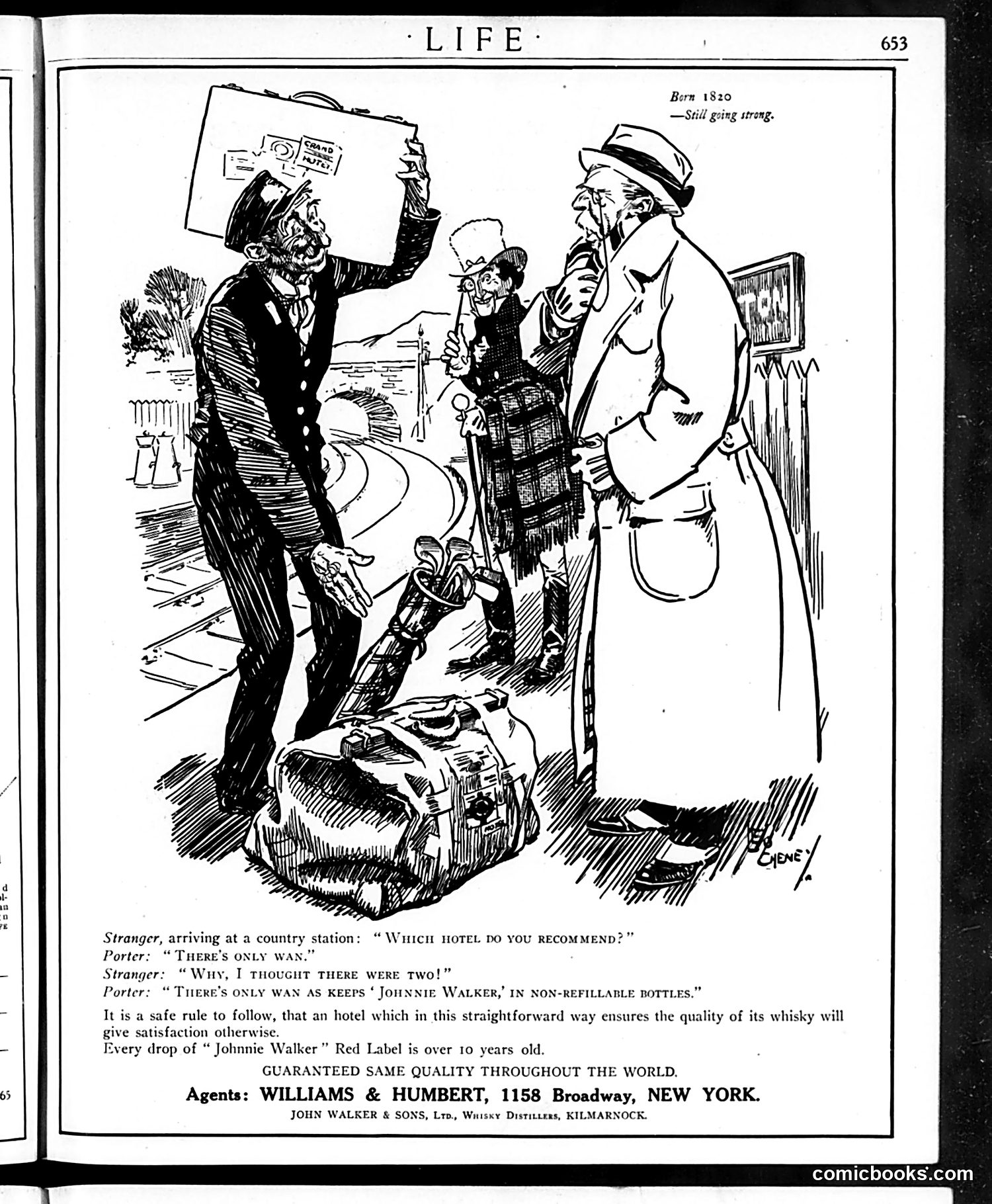
This is primarily a **Johnnie Walker whisky advertisement** disguised as humorous content, appearing in Life magazine's satirical format. The cartoon depicts a hotel porter recommending Johnnie Walker to a confused traveler asking which hotel to stay at. The joke is that there's "only one" good choice—implying the porter only trusts Johnnie Walker whisky, not actual hotels. The advertisement uses this comedic framing to promote the whisky's reliability and consistency worldwide. The "Born 1820 - Still going strong" caption emphasizes the brand's longevity and established reputation. The satire mocks the earnestness of advertising itself by presenting a absurd recommendation (whisky as a hotel criterion), while simultaneously pitching the product to readers through humor—a common advertising technique in early 20th-century magazines.
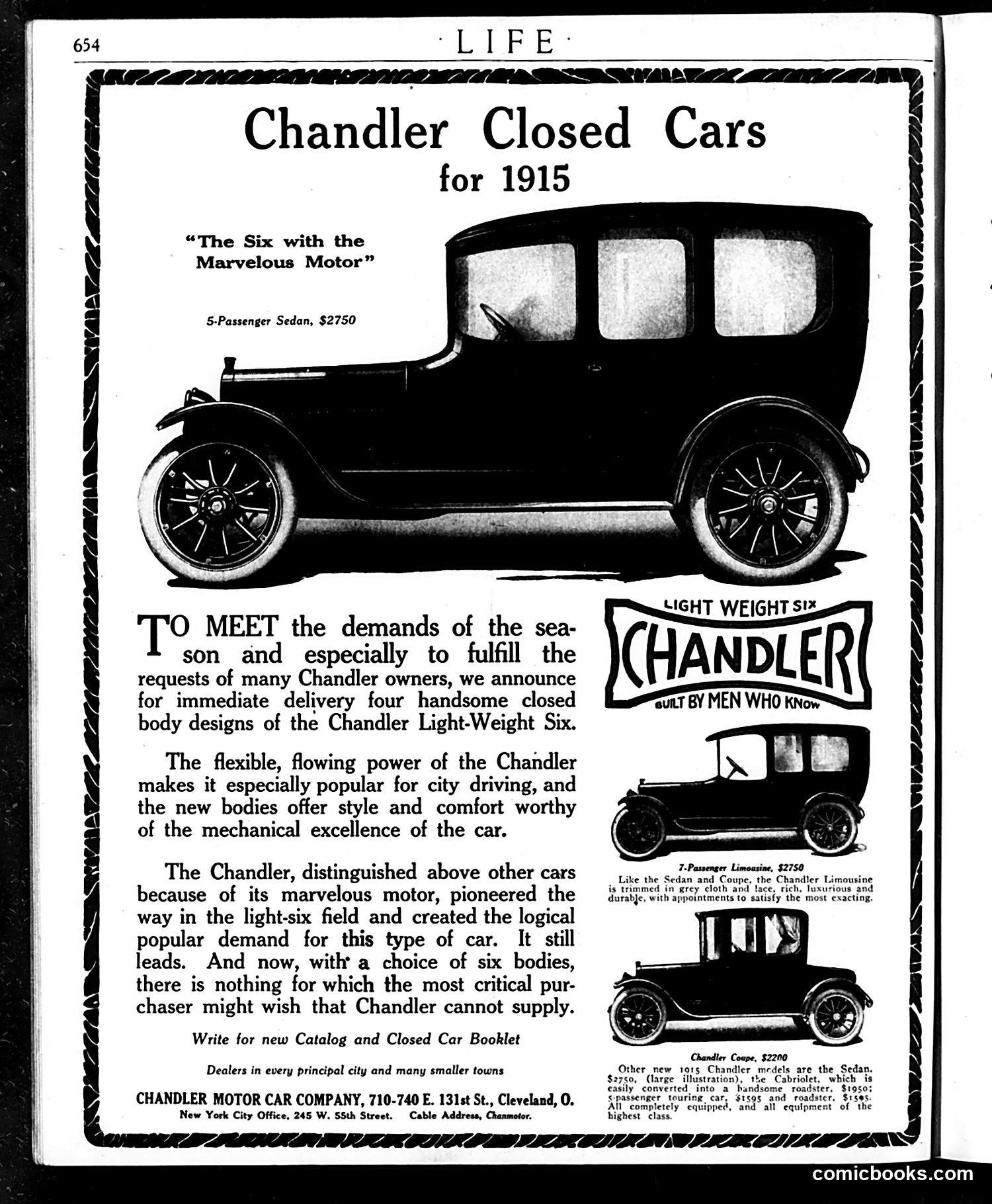
This page is **not a political cartoon or satire**—it's a straightforward automobile advertisement from Life magazine (page 654). The ad promotes Chandler closed cars for 1915, emphasizing their "marvelous motor" and new body styles. It features technical drawings of three vehicle models: a 5-passenger sedan ($2750), a limousine, and a coupe. The marketing copy highlights the Chandler's "light-weight six" engine and its popularity for city driving, positioning it as mechanically superior to competitors. The tagline "Built by Men Who Know" emphasizes engineering quality. This represents early 20th-century automobile advertising targeting middle-to-upper-class buyers, with no political commentary or satire present.
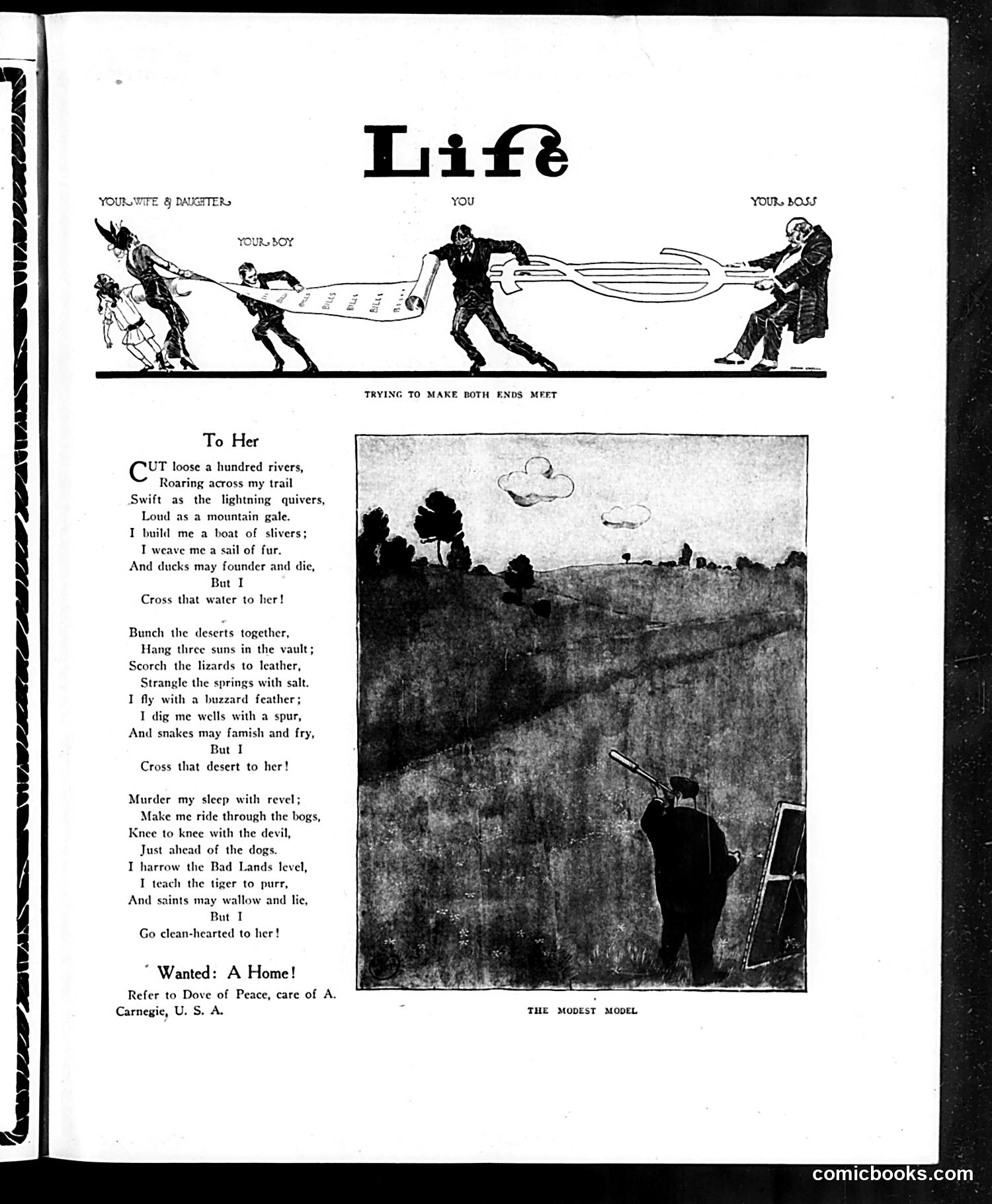
This page satirizes the difficulty of balancing competing demands in life. The top cartoon shows a tug-of-war with a figure labeled "YOU" in the center, pulled in opposite directions by "YOUR WIFE & DAUGHTERS" on one side and "YOUR BOSS" on the other, captioned "TRYING TO MAKE BOTH ENDS MEET." The poem "To Her" below appears to be a romantic/adventurous declaration, with dramatic imagery of crossing rivers and deserts. The photograph labeled "THE MODEST MODEL" shows a man in a field with surveying equipment—likely illustrating the poem's themes of arduous labor and travel to reach an objective. The overall message satirizes the male worker's impossible position: pulled between domestic/family obligations and professional demands, with the implication that meeting both is unachievable—hence "both ends meet" as financial and personal metaphor.
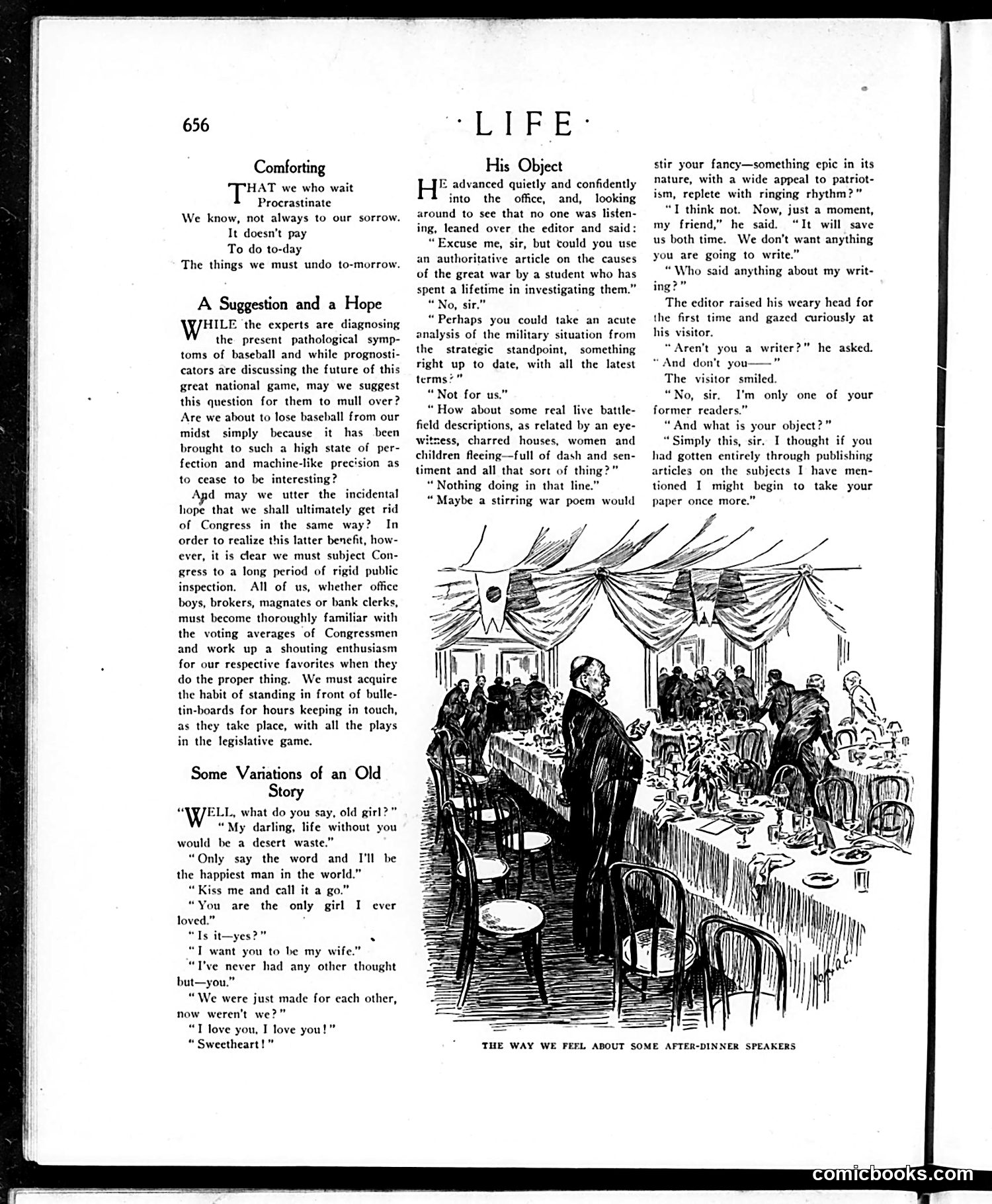
This page contains two satirical pieces. The main illustration captioned "The Way We Feel About Some After-Dinner Speakers" depicts a formal banquet scene with a long-winded speaker addressing a seated audience. The cartoon satirizes the tedium of after-dinner speeches—a common social obligation of the era—showing the speaker's lengthy remarks boring his captive audience. The text sections include brief humorous pieces: "Comforting Thoughts," "A Suggestion and a Hope" (discussing baseball and Congressional reform), and "Some Variations of an Old Story" (romantic clichés). These are typical Life magazine filler content mocking social conventions and predictable behavior patterns familiar to contemporary readers.
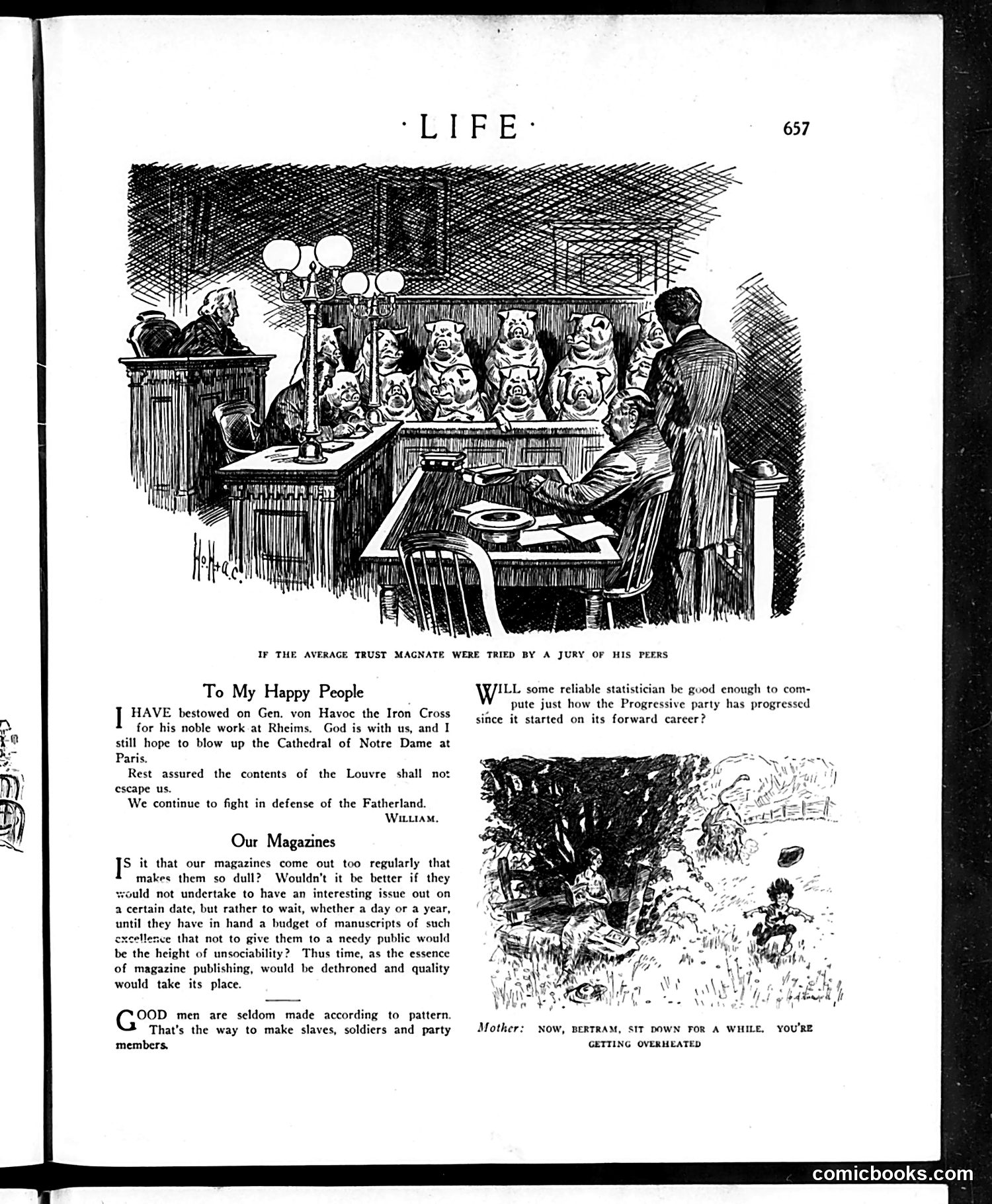
The top cartoon satirizes a courtroom scene where a trust magnate (wealthy businessman) is being tried by a jury of his peers—all depicted with pig faces. The caption reads: "IF THE AVERAGE TRUST MAGNATE WERE TRIED BY A JURY OF HIS PEERS." This is political satire mocking wealthy industrialists and monopoly builders of the era (likely early 1900s Progressive period). The pig imagery suggests these businessmen are greedy, corrupt, or morally debased. The joke is darkly cynical: if tried by actual peers—other wealthy magnates equally compromised—justice would be impossible. The cartoon criticizes both corporate excess and the assumption that the wealthy protect their own. The lower content includes editorial sections on magazines and military matters, plus a domestic humor cartoon about overheating.
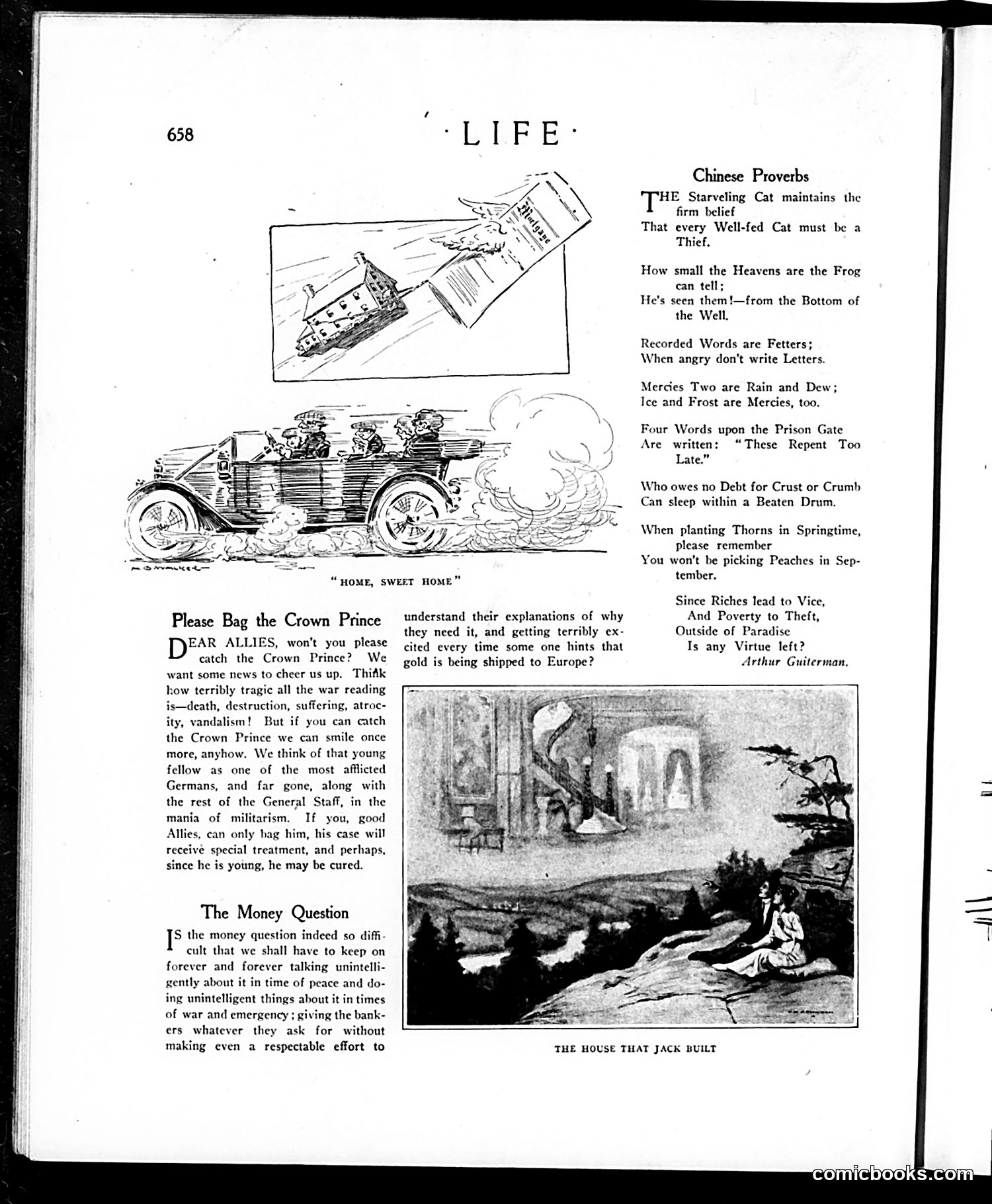
This page contains three distinct sections: 1. **"Home, Sweet Home"** - An illustration shows a crowded, overloaded automobile belching smoke, apparently satirizing post-war civilian life and materialism. 2. **"Please Beg the Crown Prince"** - A letter addressing "Dear Allies" requesting capture of the German Crown Prince, characterizing him as afflicted by militarism. The author suggests he deserves special treatment due to youth and potential for reform—likely satirizing naive Allied hopes for redemption of German leadership. 3. **"The Money Question"** - Commentary on post-war financial difficulties and banking challenges, suggesting perpetual monetary discussion will plague peace and wartime alike. The page also features Chinese proverbs and an illustration titled "The House That Jack Built," though its satirical meaning remains unclear from context alone.
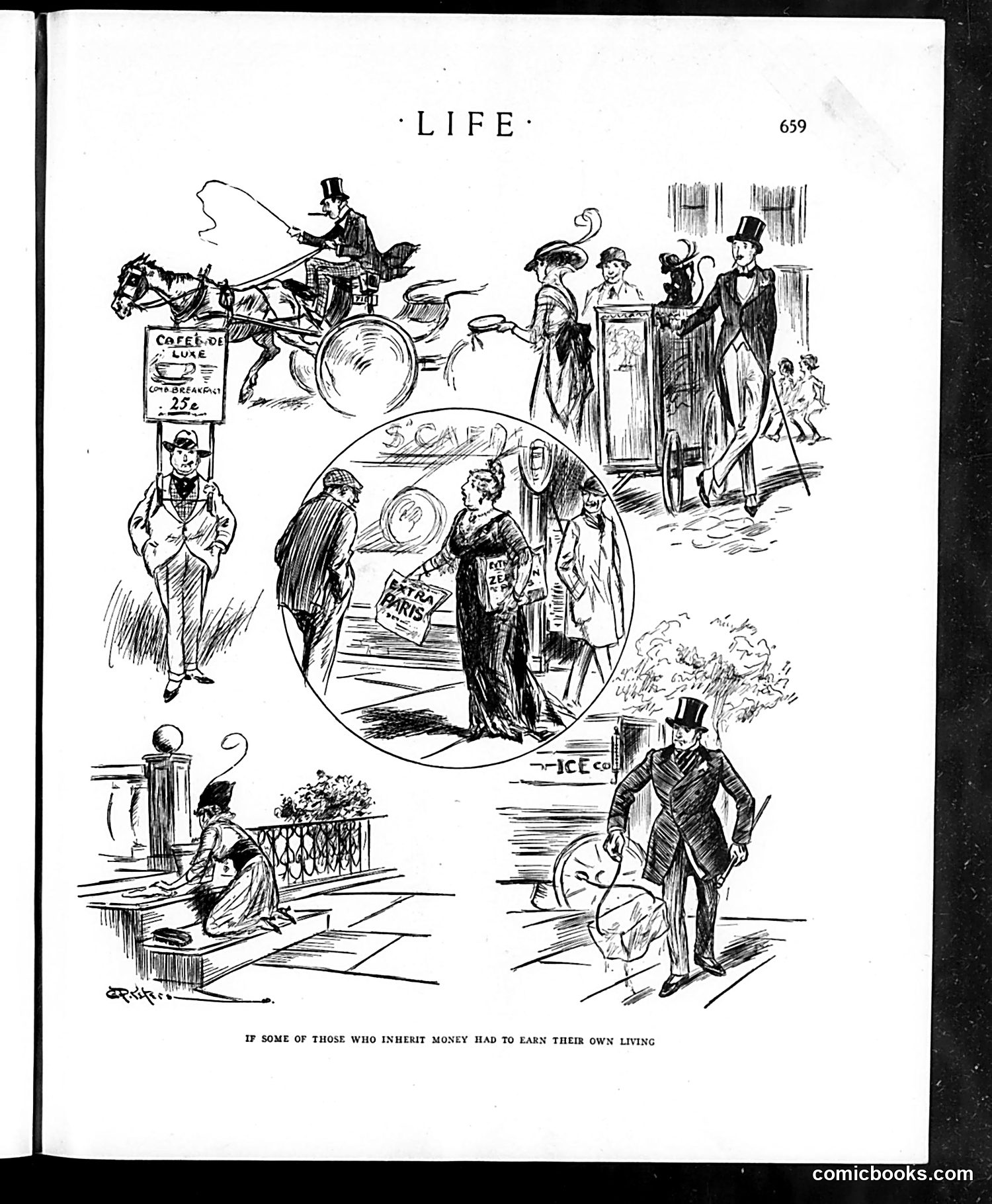
This is a satirical commentary on inherited wealth and labor, titled "If Some of Those Who Inherit Money Had to Earn Their Own Living." The page depicts wealthy individuals attempting various forms of manual work—operating a coffee cart, working as an ice vendor, and performing other humble trades. The central circular vignette shows what appears to be a café or restaurant scene. The satire contrasts the leisured, well-dressed rich (shown in top hats and formal wear) with the working poor. By imagining wealthy heirs forced into street vending and labor, the cartoonist critiques economic inequality and the unfairness of inherited privilege versus earned income. The cartoon suggests that those born into money lack the skills or work ethic to sustain themselves through actual labor—a pointed social commentary on class divisions and economic mobility in early 20th-century America.
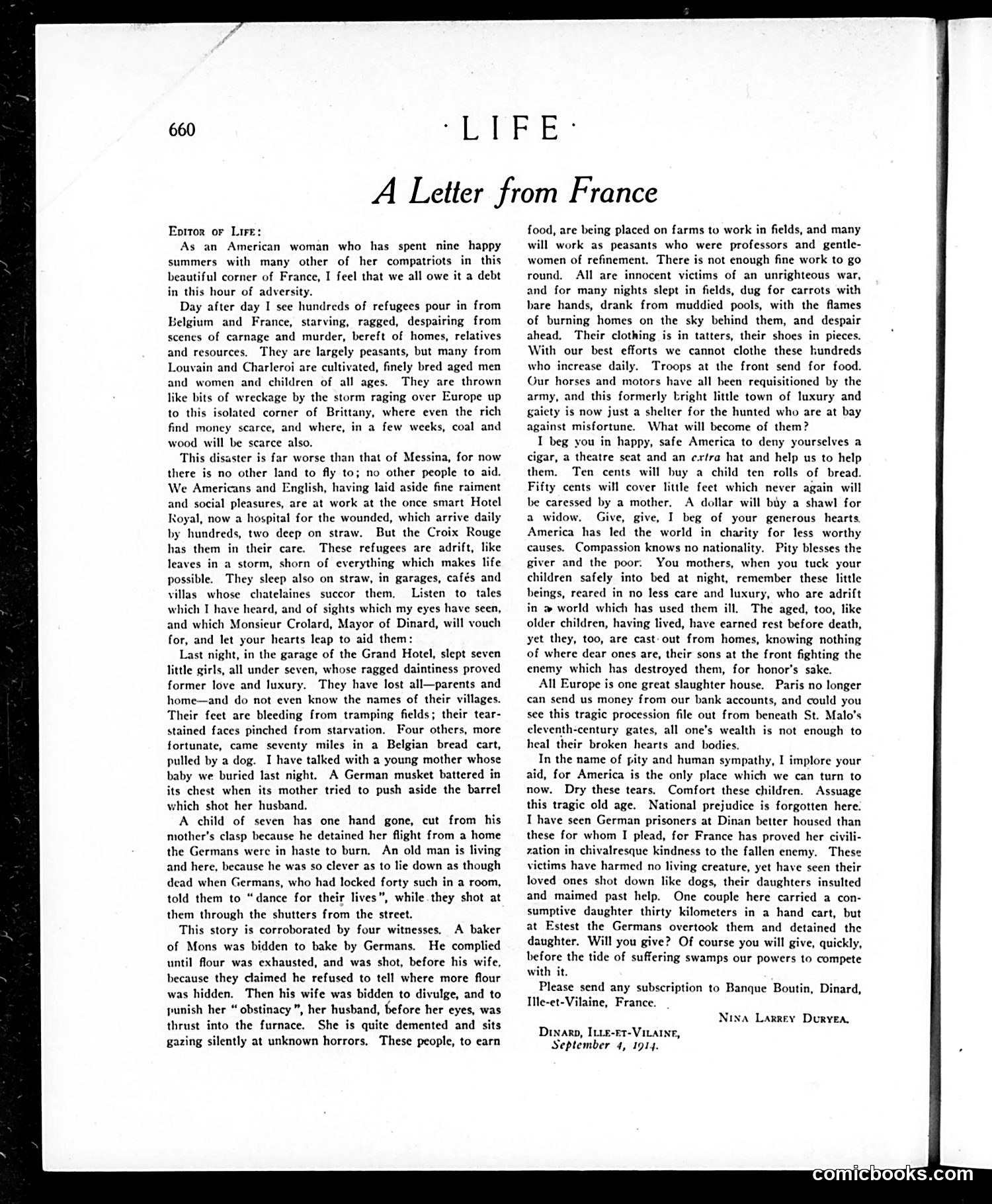
This page contains a letter from France dated September 4, 1914, written by Nina Larrey Duryea to Life's editor. It's not a cartoon but rather a firsthand account of WWI's humanitarian crisis. Duryea describes refugees fleeing Belgium and France—including elderly people, women, and children—experiencing starvation, homelessness, and violence. She contrasts their suffering with America's relative comfort, appealing to American charity. The letter documents specific atrocities: a child's hand cut off, German prisoners treated better than French civilians, and civilians deliberately harmed by German forces. Duryea urges Americans to contribute funds through Banque Boutin in Dinard, France. This represents Life magazine's role in documenting and mobilizing American response to European wartime suffering during the early months of World War I.
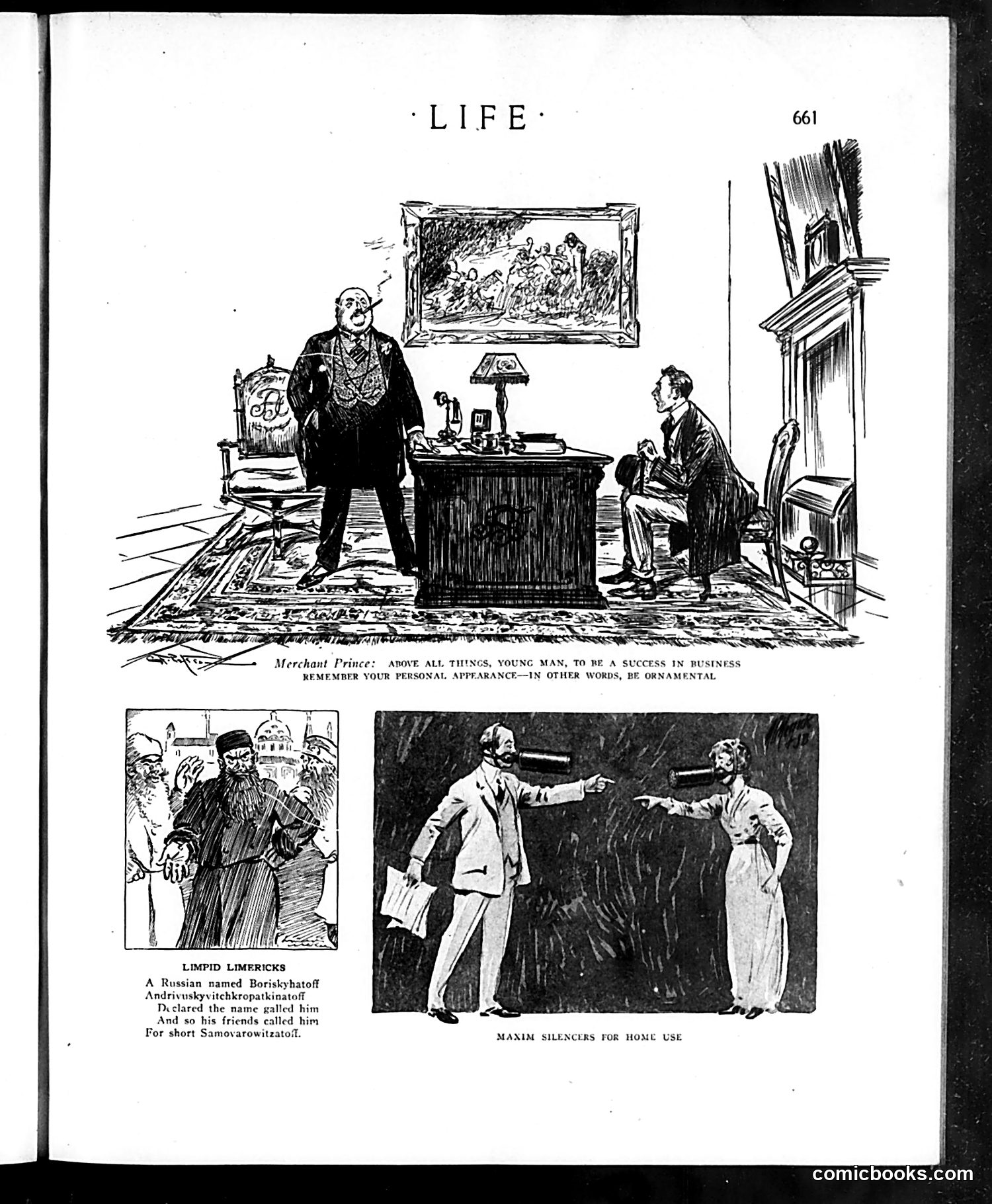
**Top Cartoon - "Merchant Prince":** An older businessman advises a younger man that success in business requires personal appearance above all else—one should be "ornamental." The satire mocks shallow business culture that prioritizes looking presentable over actual competence or merit. **Bottom Left - "Limpid Limericks":** A humorous limerick about a Russian named Boriskyhatoff Andrivusky with an unpronounceable name, mocking Russian names as comically difficult for English speakers. **Bottom Right - "Maxim Silencers for Home Use":** A photograph-style image showing a man and woman with what appear to be silencers, likely satirizing domestic disputes or suggesting products (metaphorically depicted as weapons) for managing household conflicts humorously.
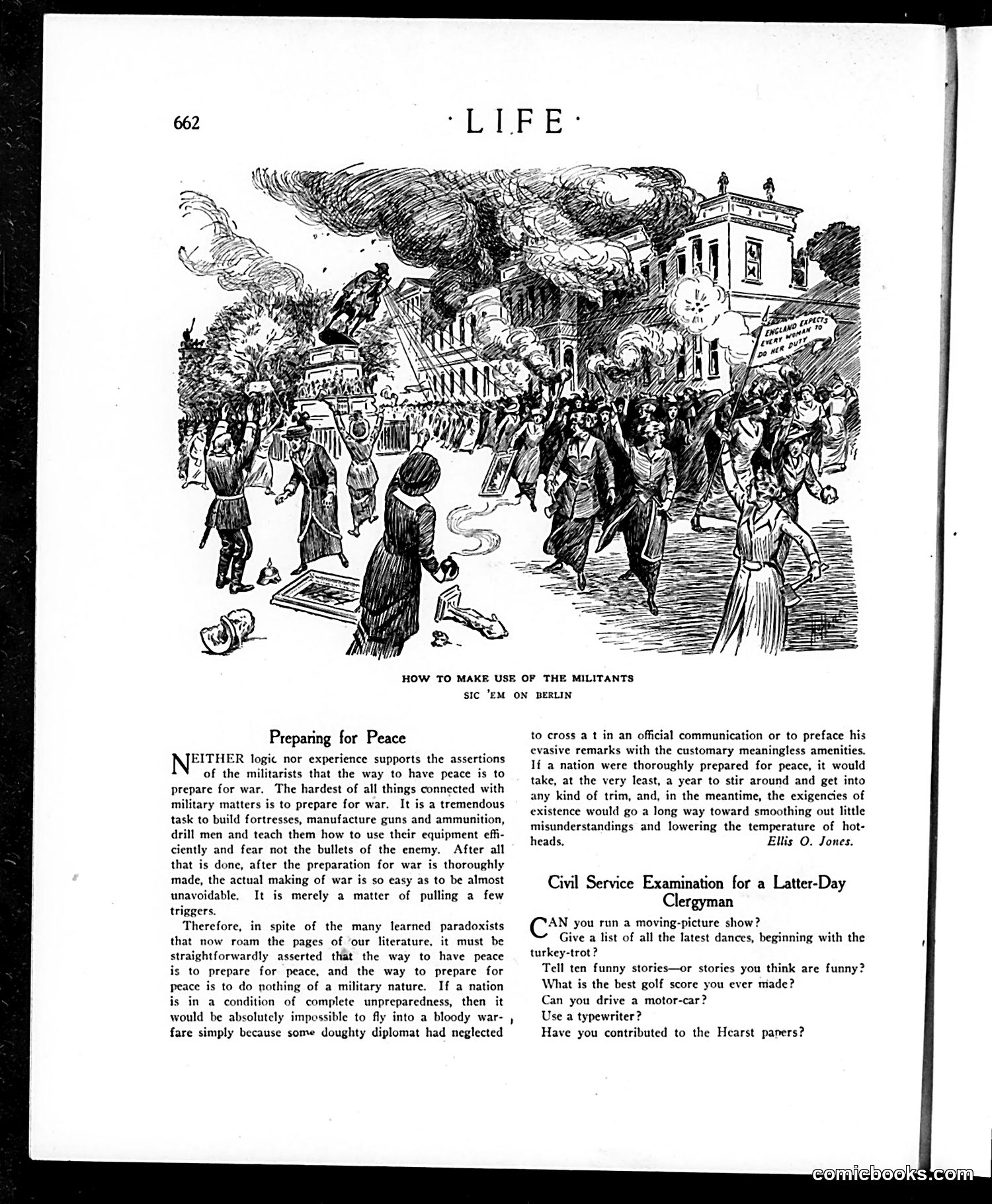
This satirical cartoon depicts a chaotic street scene labeled as advice for using "militants" against Berlin. The sketch shows crowds of people in what appears to be civil unrest or protest activity, with buildings burning in the background. The accompanying article, "Preparing for Peace," ironically argues that military preparedness is necessary to avoid war—that nations must be prepared for conflict to prevent it. The piece critiques the paradox that peace requires military strength. The cartoon's title suggests using activist or militant groups as a weapon against Berlin (likely referring to post-WWI Germany), satirizing the notion of deploying civilian unrest as a political strategy. The chaotic imagery reinforces the satirical tone about the ineffectiveness and dangers of such approaches.
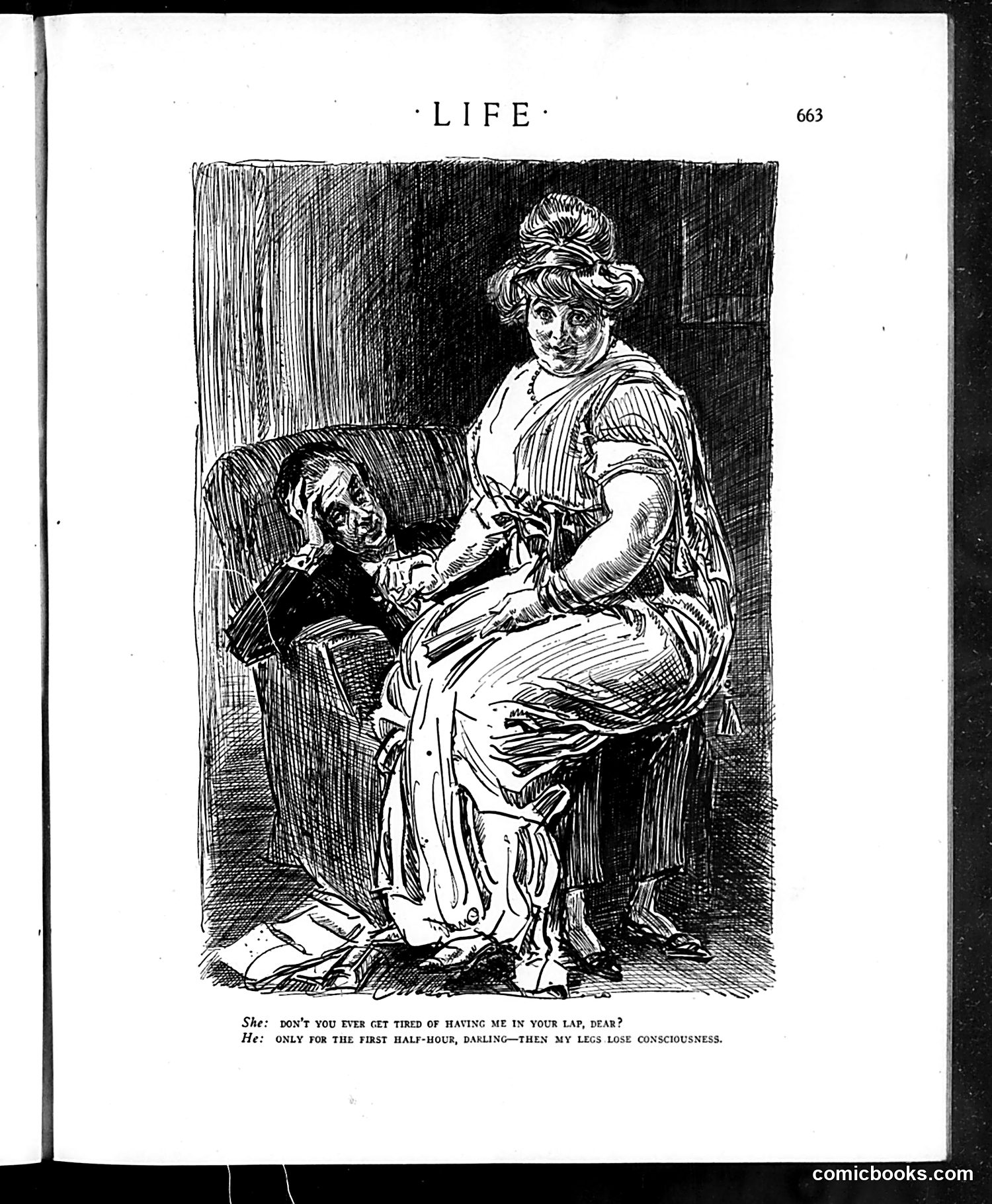
This is a domestic humor cartoon depicting a couple in an intimate moment. The woman sits in the man's lap while he's seated, and asks if he ever tires of this affection. His response jokes that his legs go numb from the physical pressure and weight after about thirty minutes. The humor relies on a relatable physical discomfort—the pins-and-needles sensation ("loss of consciousness") that occurs when circulation is cut off by prolonged pressure on the legs. It's gentle marital comedy about the small inconveniences of physical intimacy, typical of early-to-mid 20th century Life magazine's domestic satire. The joke assumes an audience familiar with this common bodily experience while maintaining affection between spouses.
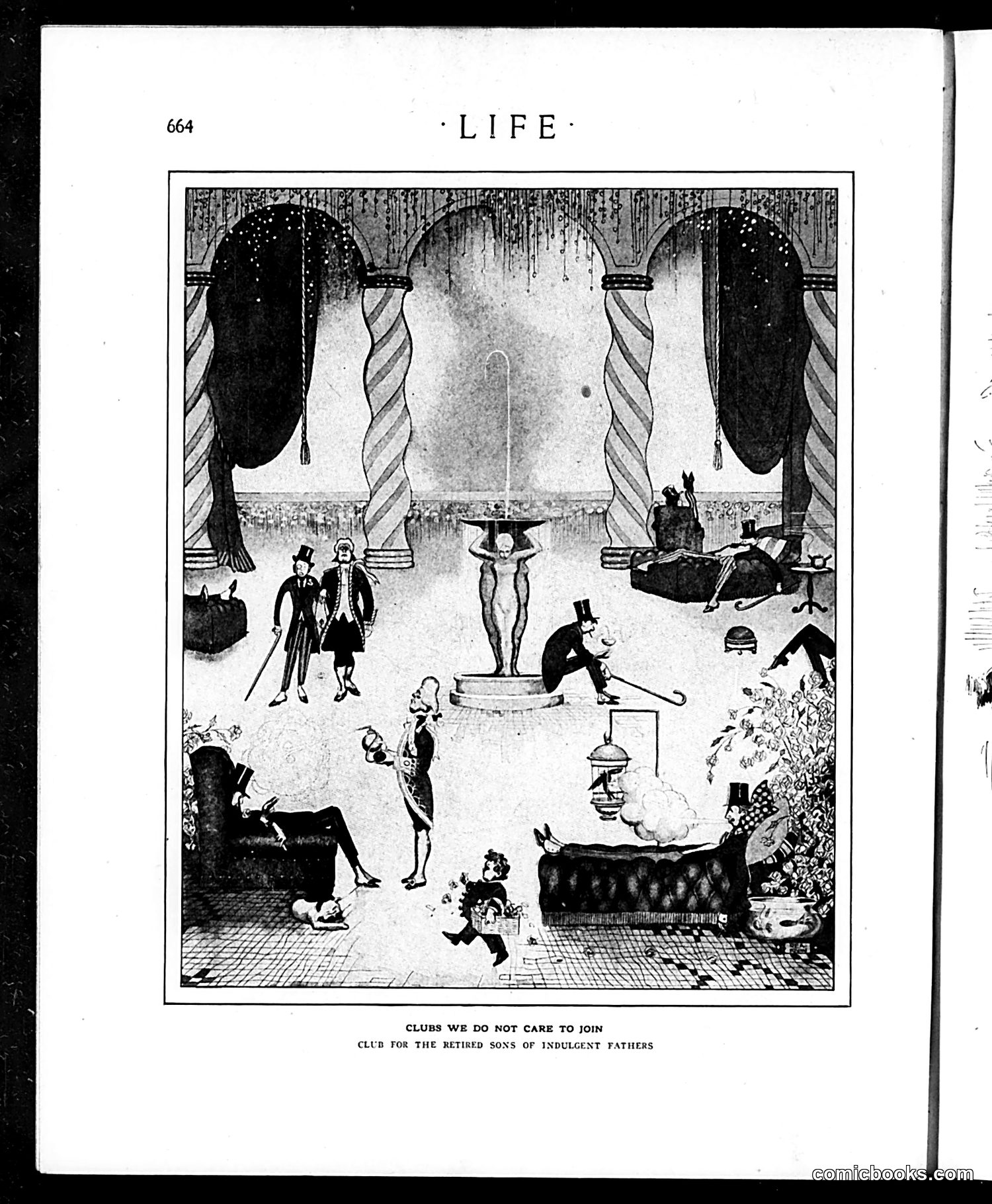
This satirical cartoon depicts an exclusive club for wealthy young men whose fathers have given them money freely. The scene shows various leisured activities: men in top hats lounging, smoking, exercising with boxing equipment, and relaxing on furniture. The satire targets a specific social class—sons of the wealthy who inherit rather than earn their positions. The "club" setting implies exclusivity and pretense, while the subtitle "Retired Sons of Indulgent Fathers" mocks these men as idle and unproductive, living off paternal wealth rather than through personal effort or merit. The cartoonist suggests these privileged young men are frivolous and undeserving of their comfort—a critique of inherited wealth and the leisure class that appears designed to appeal to working readers of *Life* magazine.
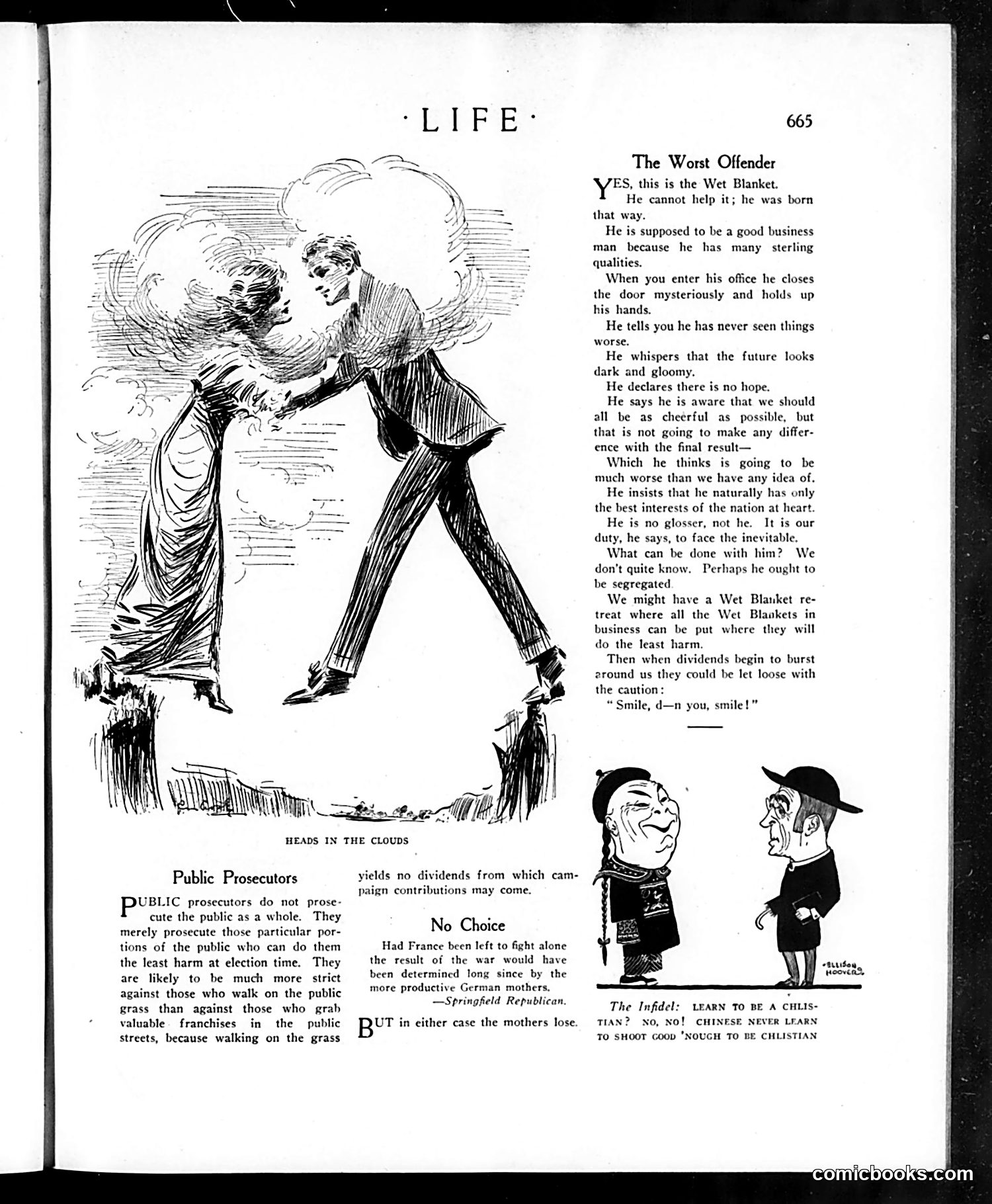
This Life magazine page targets pessimistic businessmen ("Wet Blankets") who spread doom and gloom while claiming patriotic concern. The main cartoon shows such a figure literally wringing clouds—depicting defeatist talk as harmful to public morale and business confidence, likely during or after WWI. The "Public Prosecutors" section attacks selective law enforcement: authorities punish minor infractions (trampling grass) while ignoring corruption (franchise theft) by wealthy contributors. This exposes how campaign donations shield the powerful. The "No Choice" commentary on France and the war references maternal productivity—a crude eugenic argument about why Germany nearly prevailed. The small cartoon labeled "The Infidel" is a racist joke about Chinese people, playing on missionary conversion efforts. It's incomprehensible without understanding period prejudices. All three pieces use satire to critique hypocrisy: false patriotism masking self-interest, selective justice, and bigotry presented as humor.
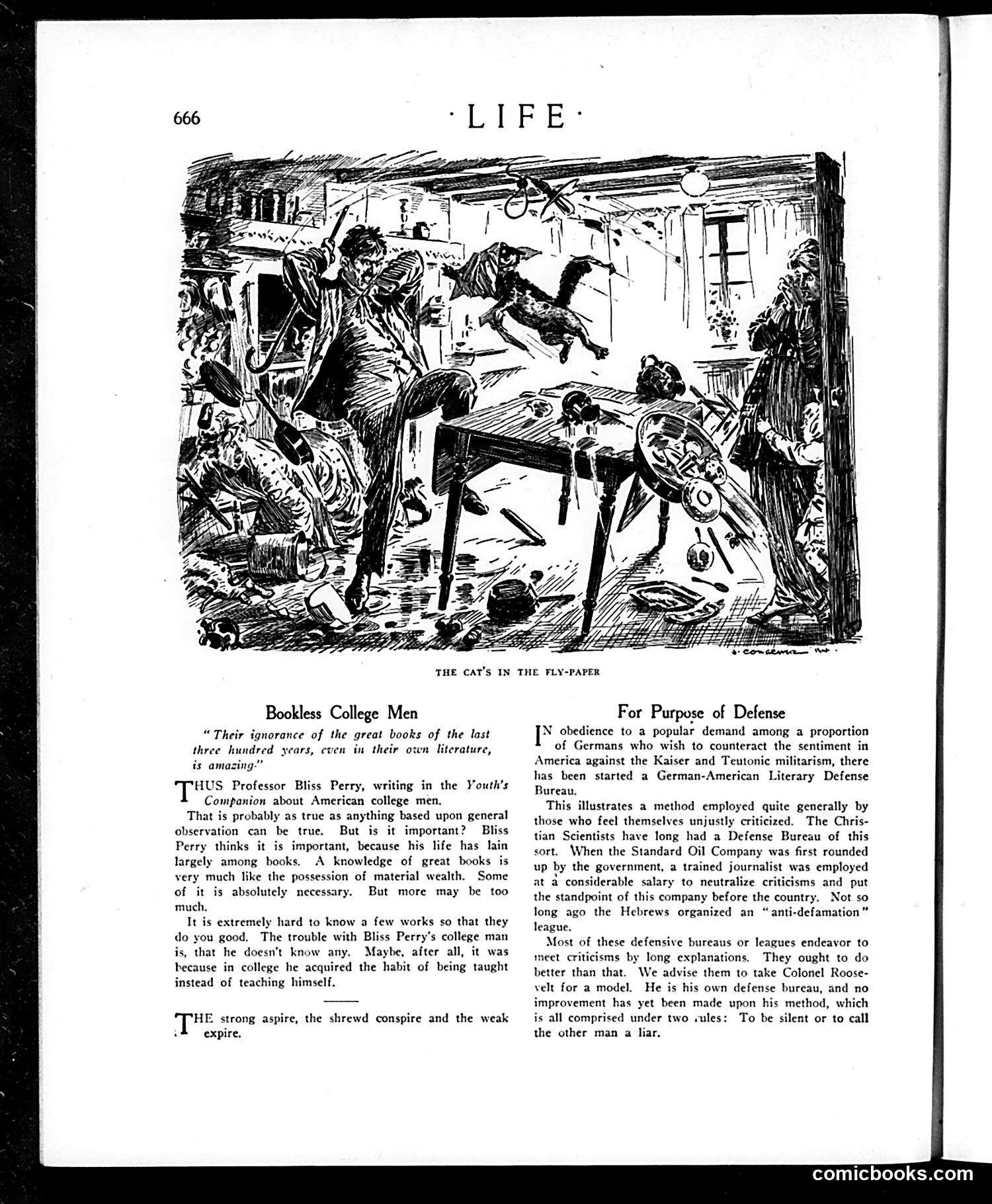
The cartoon "The Cat's in the Fly-Paper" illustrates the chaos of a household where a cat has gotten stuck in flypaper—a visual metaphor for being trapped or entangled. The page contains two separate satirical articles: **"Bookless College Men"** mocks Professor Bliss Perry's criticism that American college students haven't read classic literature. The author argues Perry overvalues book knowledge and suggests college men's real problem is passively accepting instruction rather than self-education. **"For Purpose of Defense"** critiques the newly formed German-American Literary Defense Bureau (appearing during WWI tensions). Life sarcastically compares defensive PR operations—used by Christian Scientists, Standard Oil, and Jewish organizations—to Colonel Roosevelt's blunt communication style. The satire suggests these defensive bureaus fail because they over-explain; Roosevelt succeeds by either staying silent or attacking critics directly. The piece mocks both the bureau's propaganda efforts and American corporate/institutional damage control generally.
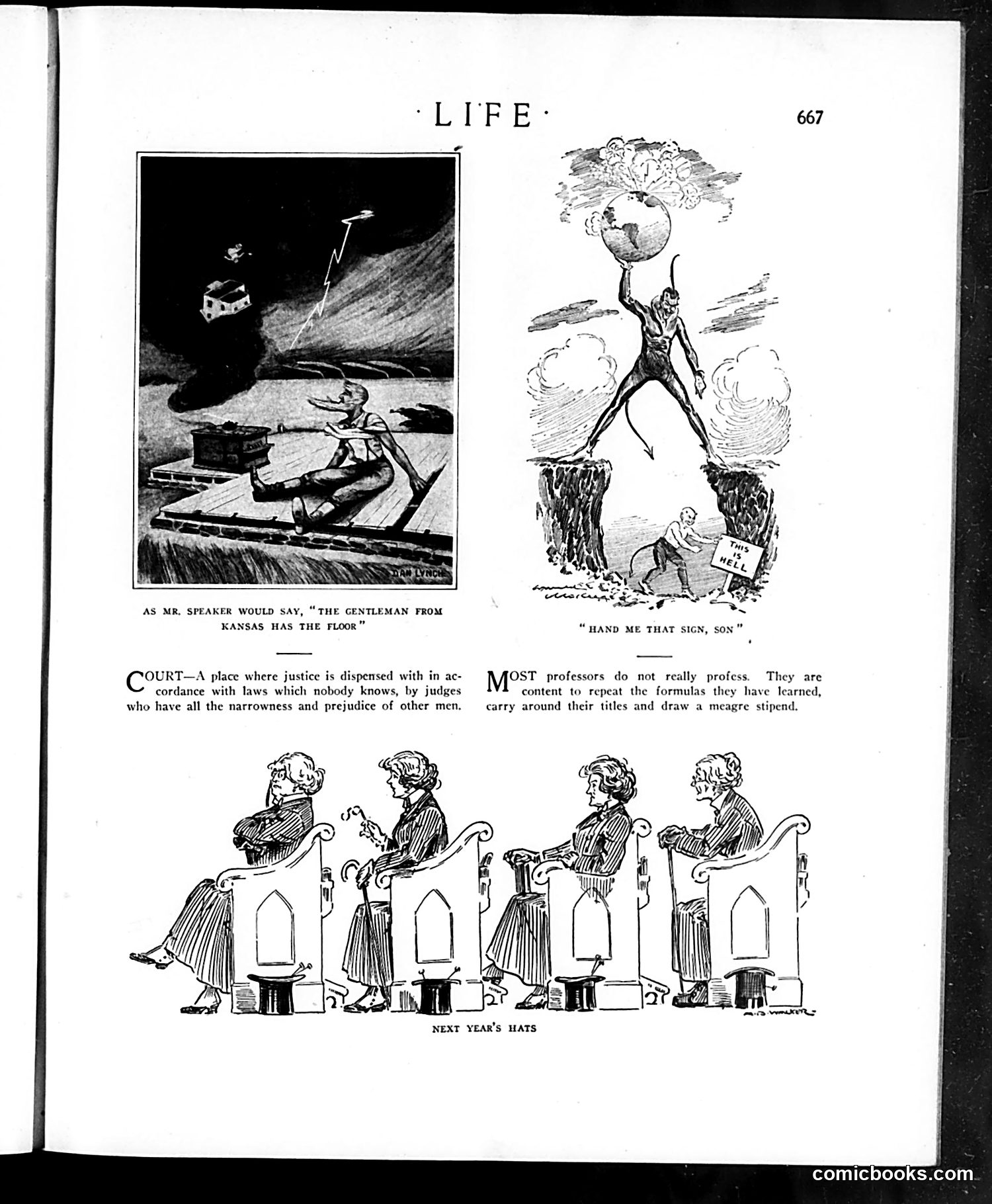
This Life magazine page contains three satirical cartoons critiquing American institutions: **Top left:** References "the gentleman from Kansas" and the Speaker of the House—likely mocking a specific Kansas congressman's prominent role or speaking style in Congress. **Top right:** "Hand Me That Sign, Son" depicts ambition and deception. A figure holds an enormous globe while standing on tree stumps, with someone below offering a "THIS WAY TO HELL" sign. This satirizes social climbers or false prophets promising impossible rewards. **Bottom:** "Next Year's Hats" shows women at hat-making machines producing identical bonnets with bell-shaped forms. This mocks either the fashion industry's repetitive standardization or women's perceived conformity in fashion choices. The page also includes dictionary-style definitions lampooning "COURT" (justice as arbitrary prejudice) and professors (as title-carriers who merely repeat formulas rather than teach genuinely). The overall tone criticizes institutional hypocrisy, conformity, and false authority.
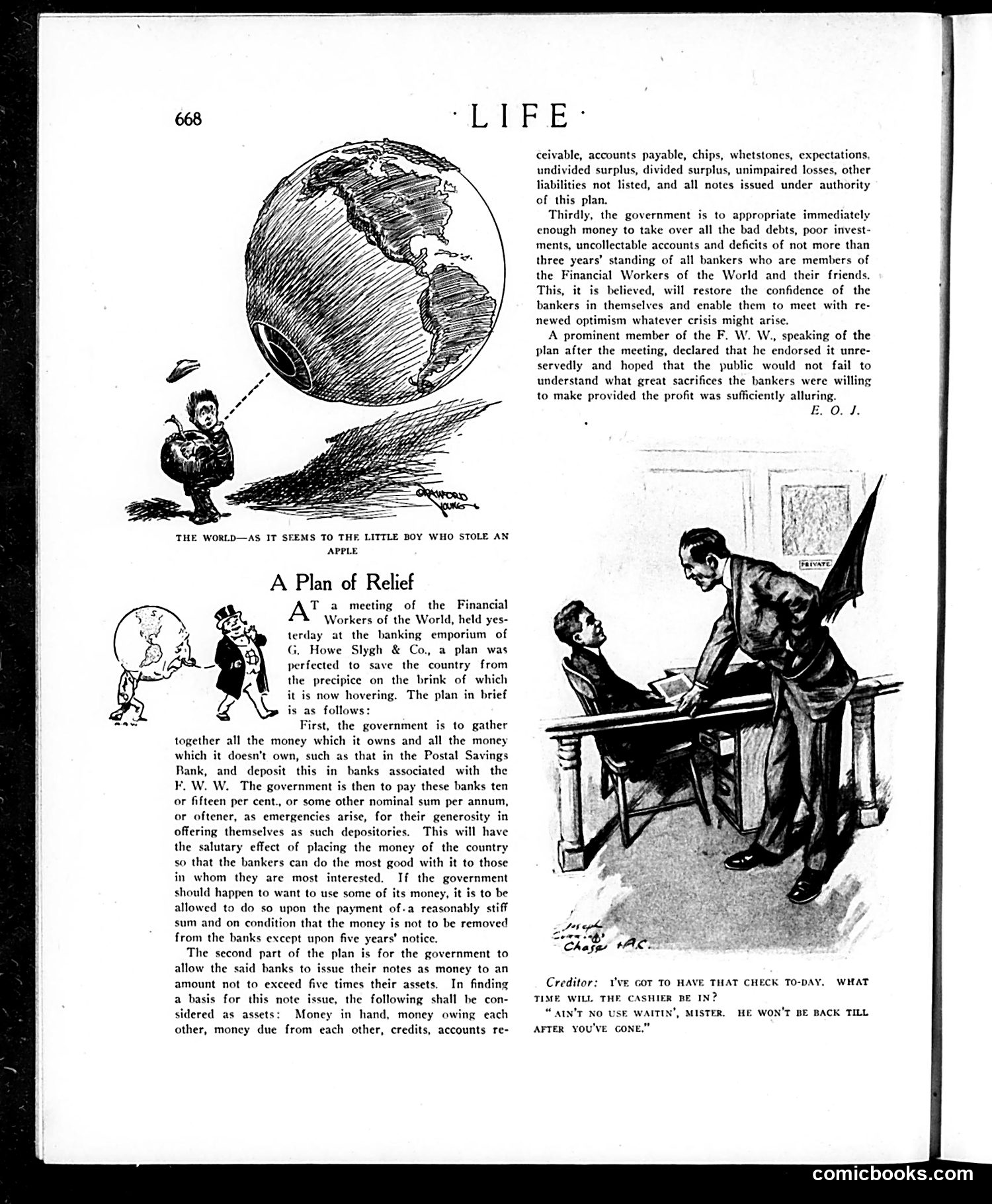
This page satirizes a proposed government bailout plan for banks during an financial emergency (likely post-WWI era). The top cartoon shows a small boy who stole an apple facing a globe-sized world of consequences—illustrating the hypocrisy at the article's core. The main text mocks a "Financial Workers of the World" plan that would have the government: 1. Deposit all public money (including postal savings) into member banks at nominal interest rates 2. Allow banks to issue notes worth five times their actual assets The satire's point: bankers demand strict accountability and harsh consequences for ordinary people's wrongdoing, yet propose schemes allowing themselves massive government subsidies and loose credit practices with minimal oversight. The bottom cartoon reinforces this—a creditor demands immediate payment while the debtor (bank) won't return until the creditor is gone, mirroring the asymmetrical power dynamics the plan would cement.
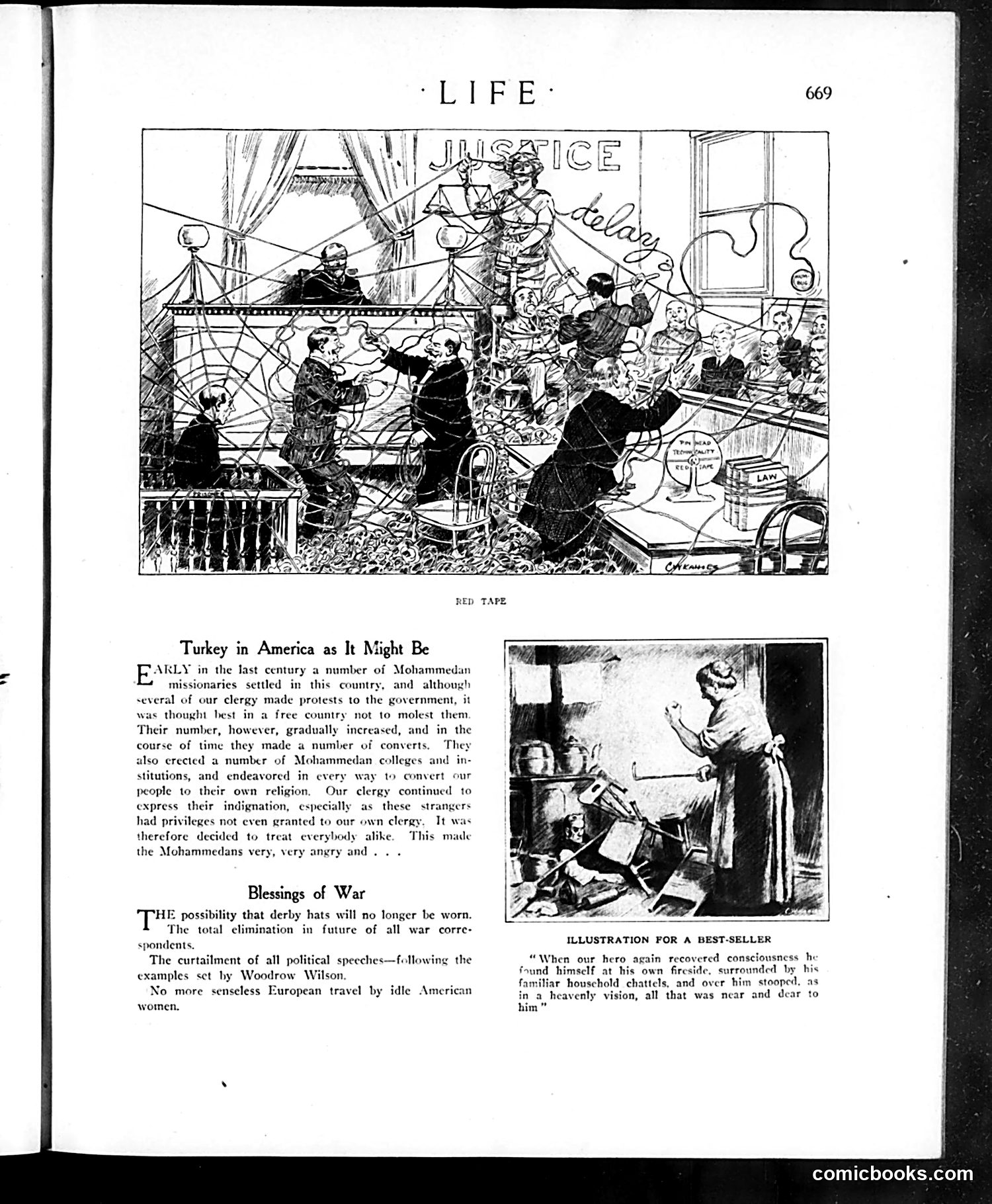
The top cartoon satirizes bureaucratic absurdity in a courtroom or government proceeding. A "Justice" figure presides while officials and citizens engage in what appears to chaotic legal debate, with various papers and red tape literally tangling the scene—a visual pun on bureaucratic obstruction. Below, "Turkey in America as It Might Be" presents a speculative satire imagining Islamic missionaries converting Americans and establishing religious institutions with government protections equal to Christian clergy. The piece mocks fears of religious pluralism and equal treatment, presenting this hypothetical scenario as something that would make "Mohammedans very, very angry" when America treats all religions alike. "Blessings of War" offers dark humor listing war's supposed benefits: eliminating derby hats, removing war correspondents, ending political speeches (crediting Woodrow Wilson), and preventing wealthy American women from traveling to Europe—satirizing how people rationalize war's consequences. The illustration accompanies a bestselling novel excerpt describing a domestic vision.
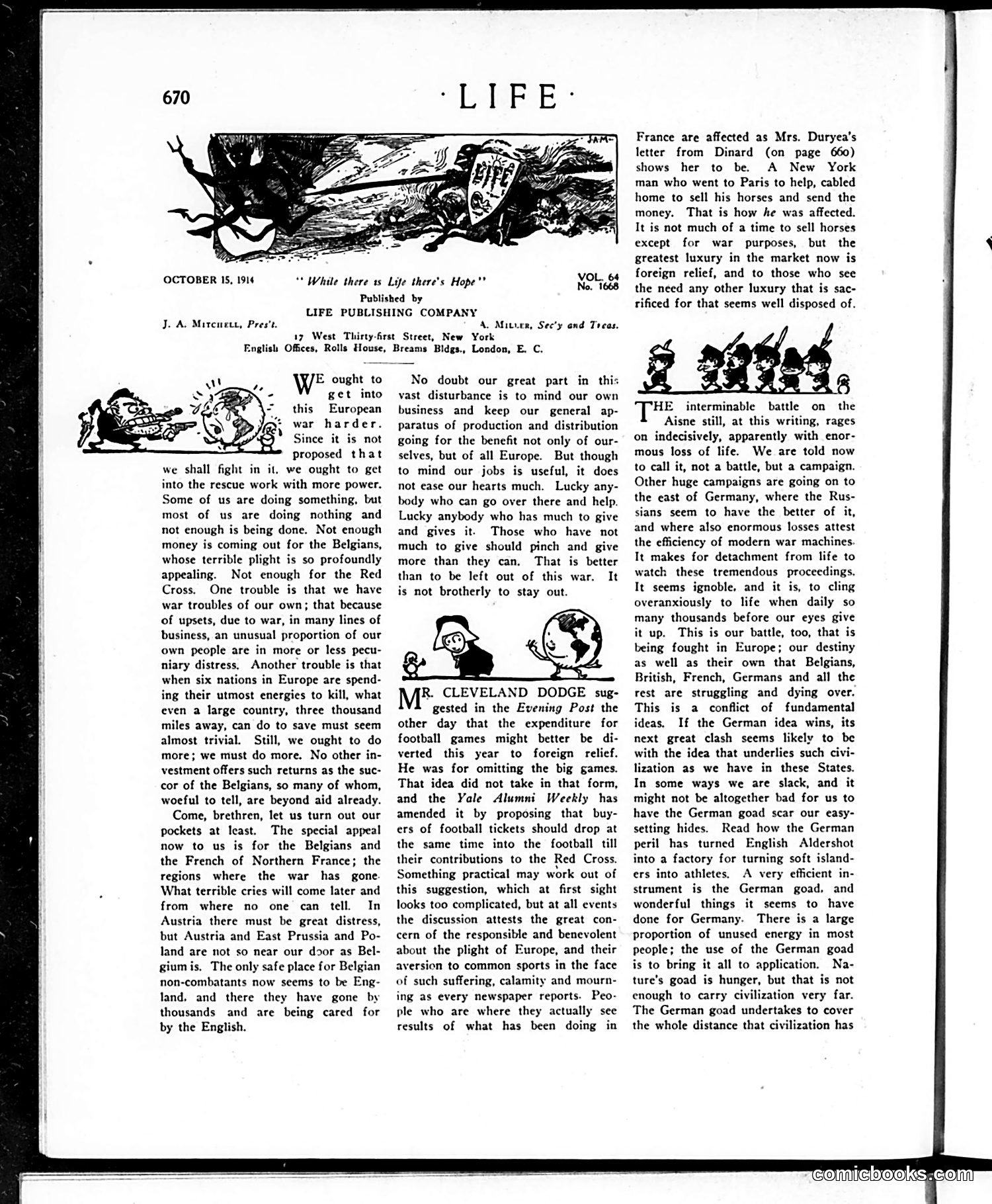
This page from Life magazine addresses American charitable response to World War I, which had begun months earlier in Europe. The editorial argues Americans should increase financial relief efforts for Belgian and French civilians displaced by the war, despite America's official neutrality. The cartoons appear to show a figure (likely representing America or Americans) being urged toward action. The text references Cleveland Dodge's proposal to divert football game expenditures to foreign relief, and mentions Yale Alumni Weekly's compromise: donations to the Red Cross collected at football ticket gates. The central argument: while America shouldn't enter the war militarily, Americans with resources have a moral obligation to provide humanitarian aid. The editorial emphasizes that financial contributions—even personal sacrifice like selling horses—represent meaningful engagement with European suffering. The overall tone combines moral pressure with practical fundraising appeals, reflecting Progressive-era activism channeled toward wartime charity.
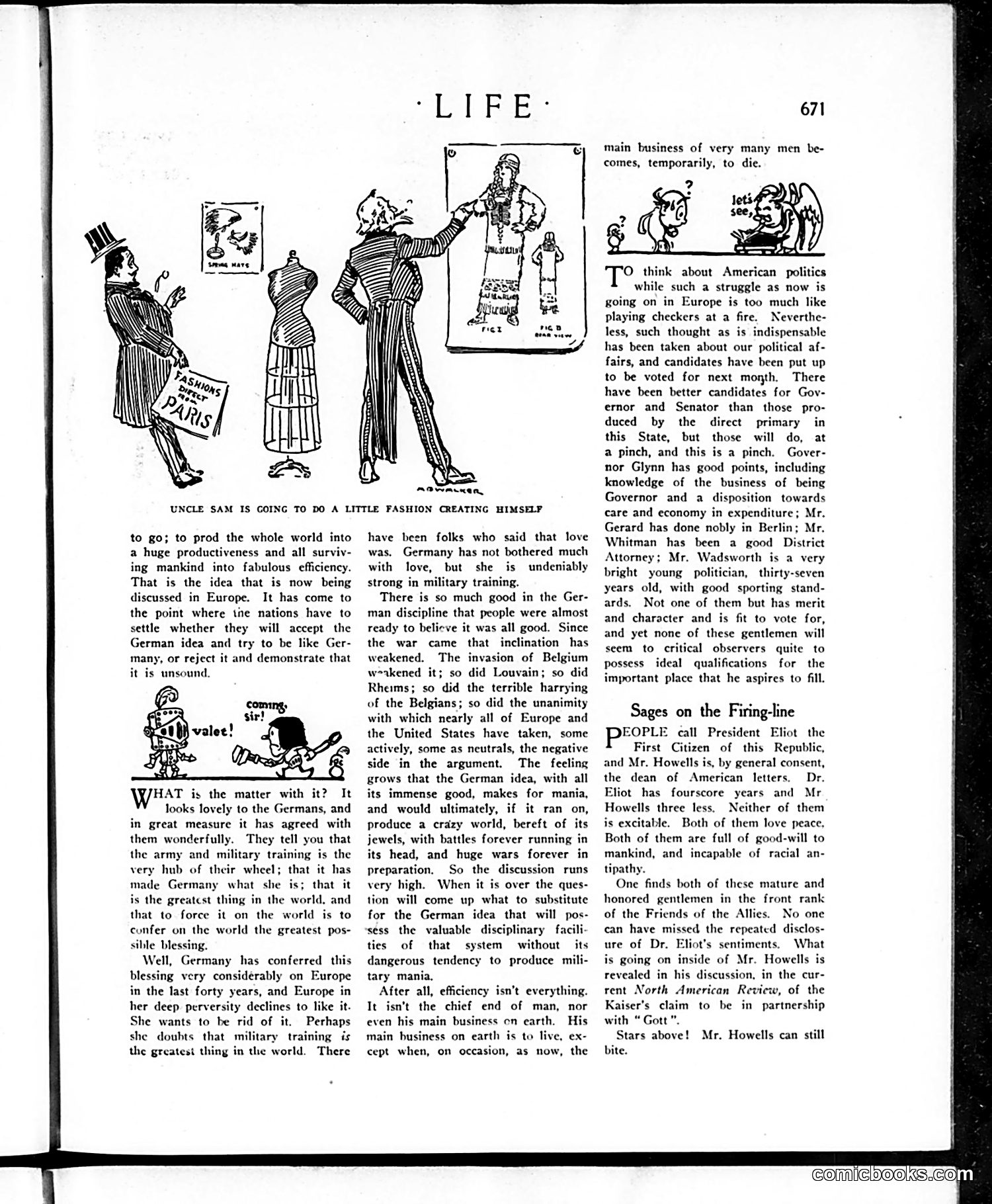
**The Cartoon:** "Uncle Sam is Going to do a Little Fashion Creating Himself" depicts Uncle Sam (personified America) as a tailor examining German military fashion/ideology. The image satirizes American consideration of adopting German-style militarism. **Context:** Written during WWI, the text debates whether America should embrace German military discipline and efficiency—Germany's stated strength. The author acknowledges German organizational excellence but argues it produces dangerous "military mania," evidenced by Belgium's invasion, destruction of Louvain and Rheims, and widespread European/American opposition. **The Point:** The satire warns that blind adoption of German methods—however efficient—risks corrupting American values. The "fashion" metaphor suggests American temptation to copy Germany's system, but the tailoring imagery implies Uncle Sam should create his own approach, not merely imitate. **Secondary content** briefly discusses 1916 gubernatorial candidates (Glynn, Gerard, Whitman, Wadsworth), praising their merits while noting none perfectly fills the role—a secondary satirical point about American politics during wartime.
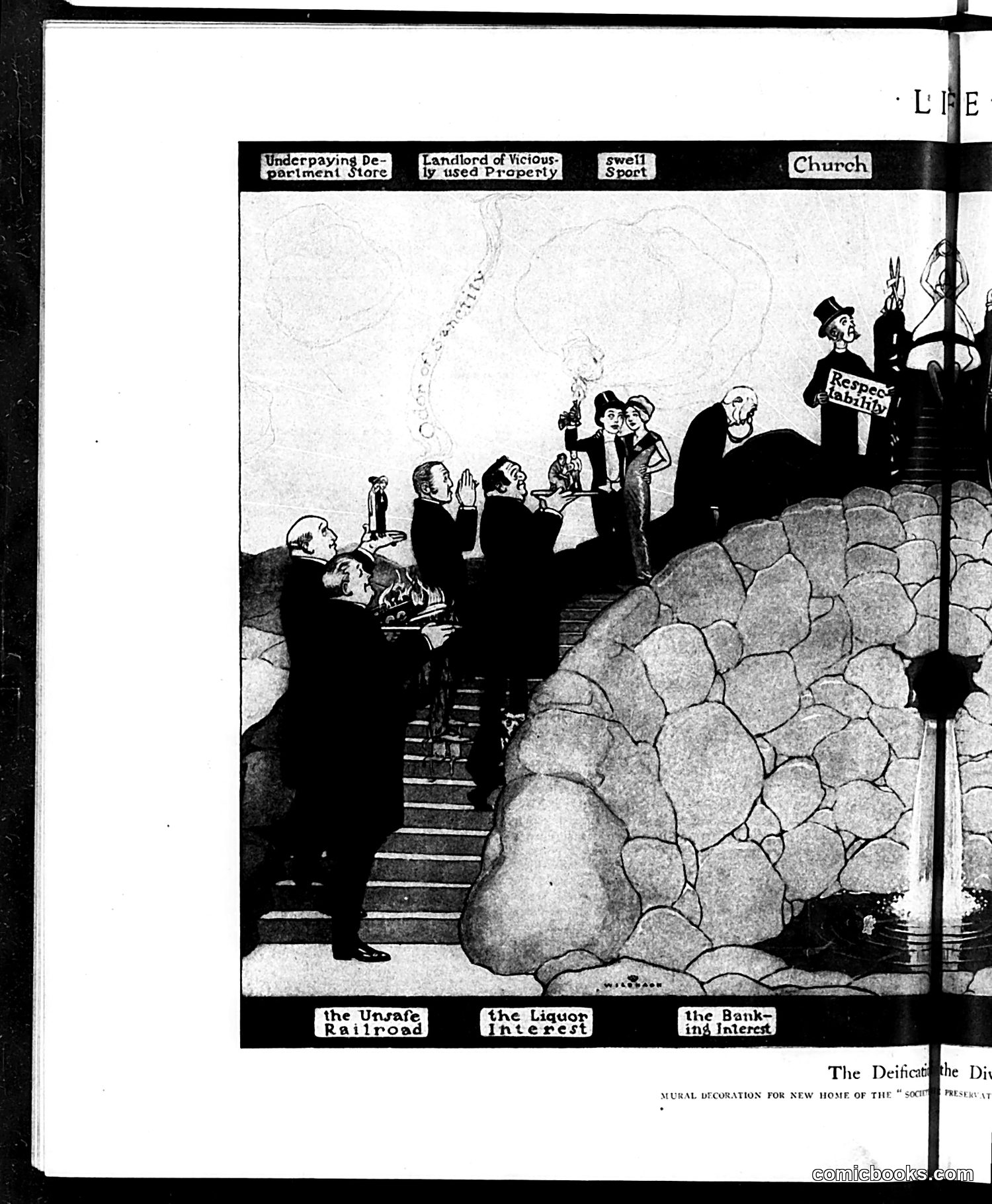
This political cartoon depicts social problems as demons or dark forces blocking the entrance to a church. The labeled figures represent contemporary societal ills: an "Underpaying Department Store" employer, a "Landlord of Viciously used Property," an "Unsafe Railroad," "Liquor Interest," and "Banking Interest." The cartoon critiques how these institutions and practices—exploitative labor, slumlord conditions, unsafe transportation, alcohol, and financial corruption—present moral obstacles to the Church's mission. The stumbling, well-dressed men approaching the church symbolize society struggling against these vices. This appears to be early 20th-century muckraking satire, attacking capitalism's abuses and calling for social reform through religious/moral renewal.
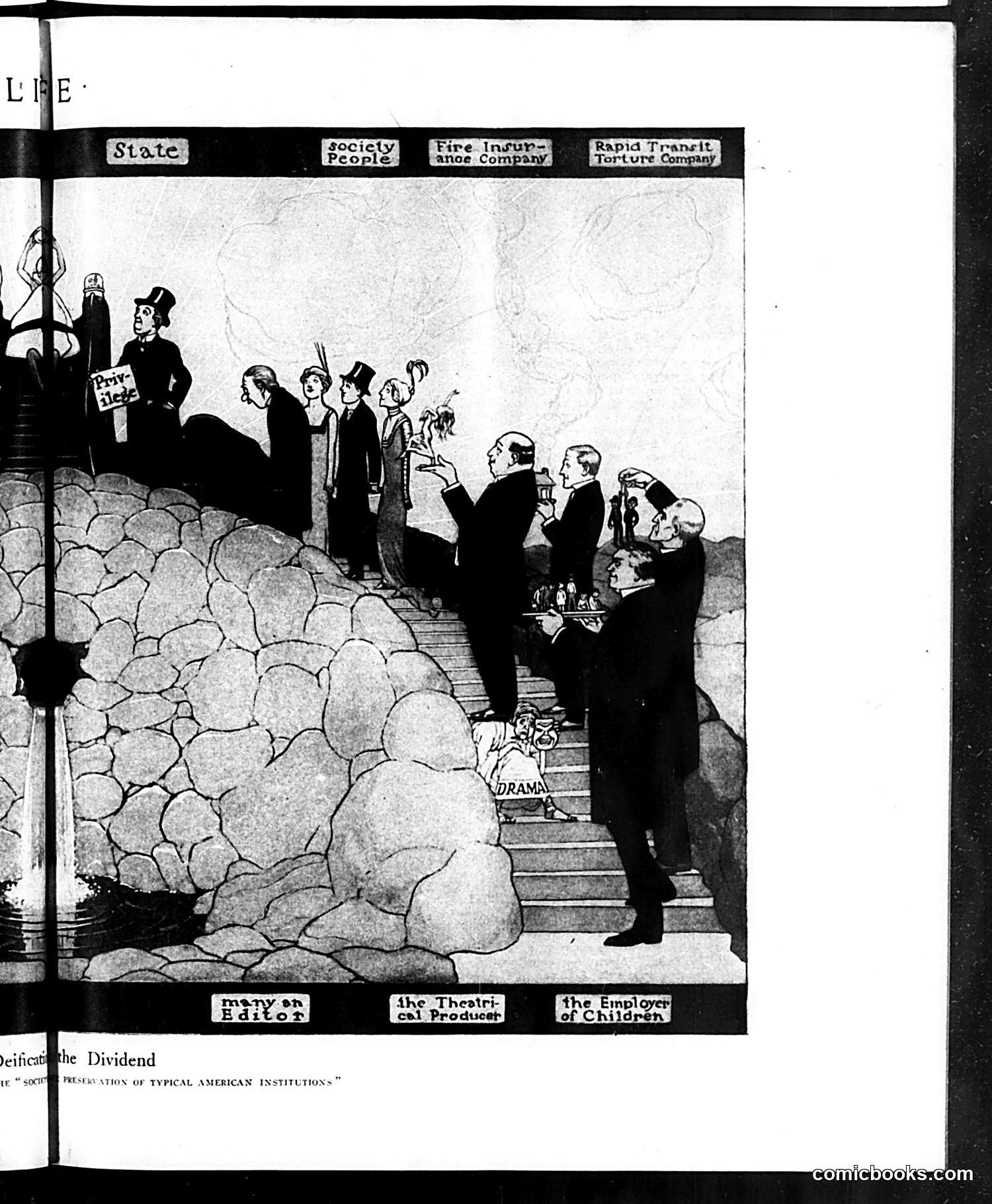
This Life magazine cartoon satirizes American institutions as fundamentally corrupt and exploitative. The labeled figures at the top of a stone wall represent various societal powers: **State, Society People, Fire Insurance Company, and Rapid Transit Torture Company**. Below them, suited men in formal dress appear to be dividing profits or assets—depicted as a game of chess or similar transaction marked "DRAMA." The cartoon's title, "Preservation of Typical American Institutions," is deeply ironic. It suggests these institutions exist primarily to extract wealth and control from ordinary people. The theatrical framing (references to "Editor," "Theatrical Producer," "Employer of Children") implies this exploitation is performed as if legitimate. The massive stone wall symbolizes the barrier between powerful institutions and the public they serve—or prey upon.
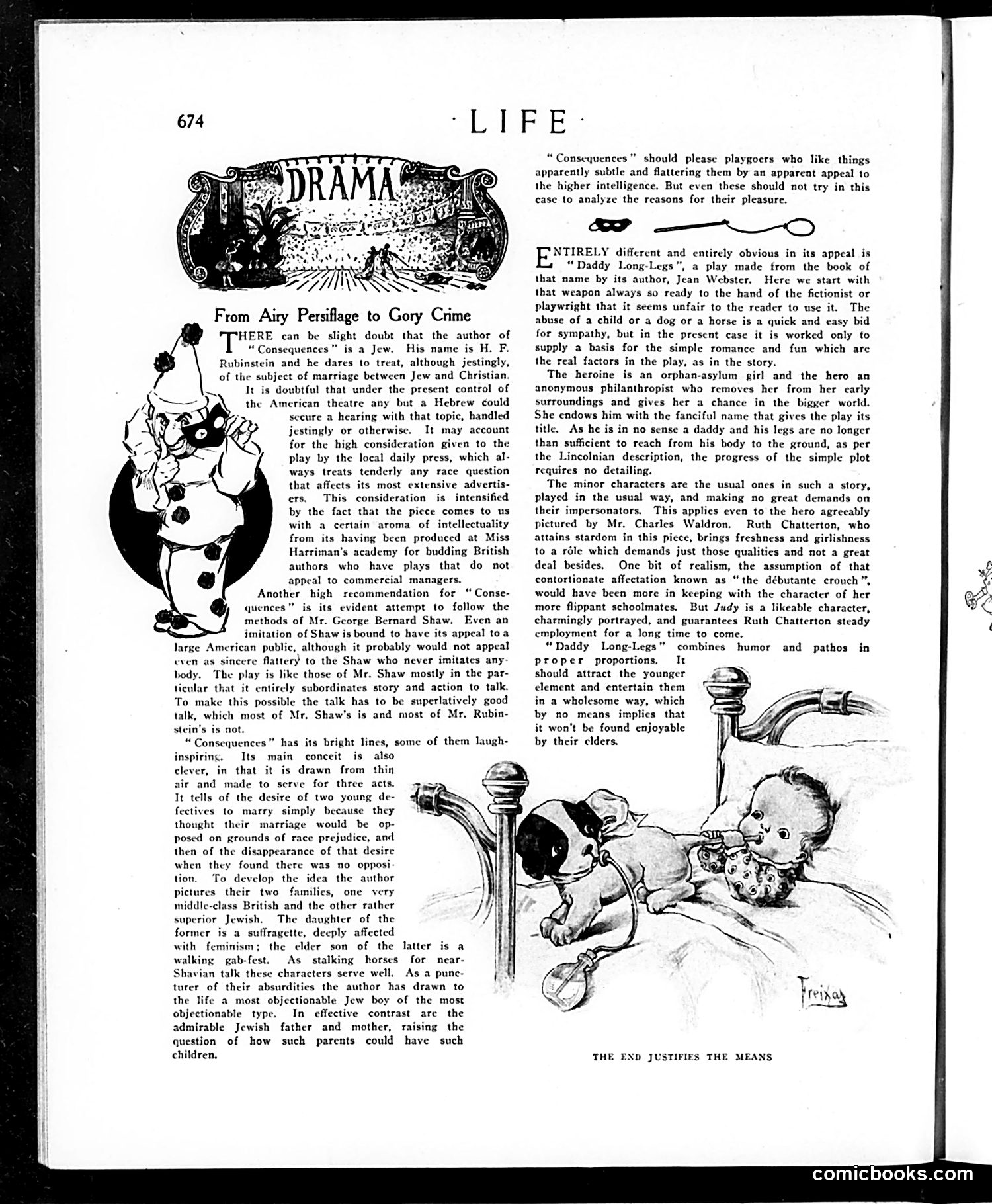
This Life magazine drama review page critiques two plays: "Consequences" by H.F. Rubinstein and "Daddy Long-Legs" adapted by Jean Webster. The "Consequences" review is notably hostile to Rubinstein for being Jewish and daring to treat intermarriage between Jews and Christians as comedy material. The critic suggests only a Hebrew could get American theaters to hear such a topic, and attributes the play's favorable press coverage to Jewish advertising influence rather than merit. He praises its Shaw-like intellectualism while dismissing its execution, and objects to its portrayal of "a most objectionable Jew boy" while praising the Jewish parents—reflecting the era's casual antisemitic stereotyping. The "Daddy Long-Legs" review is more straightforward, praising its sentimental orphan-girl story and romance as wholesome entertainment for younger audiences. The cartoons illustrate both plays with period-style drawings.
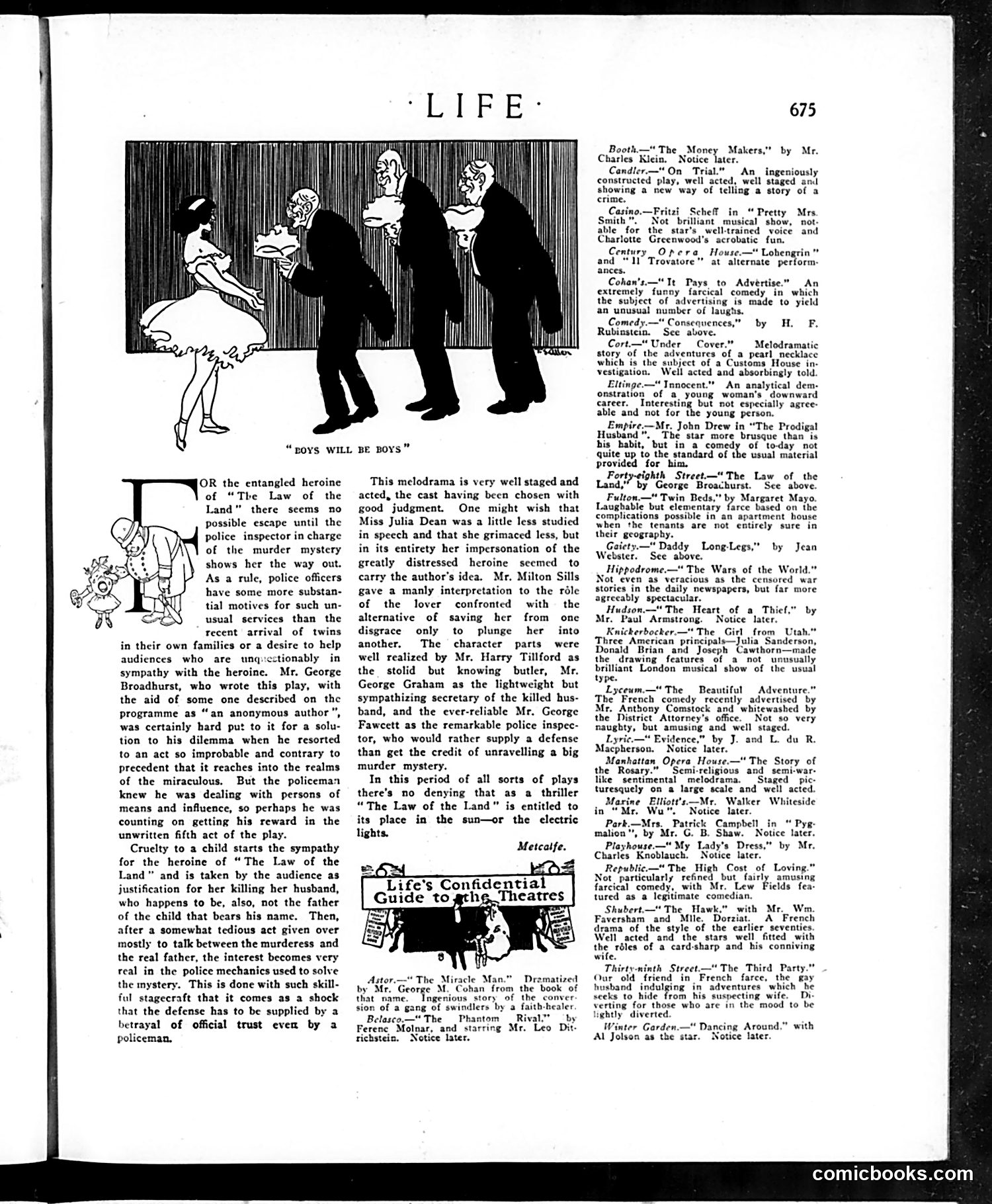
This page reviews "The Law of the Land," a melodrama about a woman who kills her unfaithful husband. The cartoon's caption "Boys Will Be Boys" sarcastically comments on the plot's central absurdity: a police inspector solves the murder but then *betrays his official duty* to help the guilty heroine escape, apparently expecting future favors or reward. The reviewer criticizes this implausible resolution as "improbable and contrary to precedent," occurring only because the heroine comes from a wealthy, influential family. The satire targets both the play's contrived plotting and the corruption it depicts—a policeman prioritizing personal gain over justice. The cartoon depicts three pompous gentlemen, likely representing the complicit male characters (butler, secretary, inspector) enabling her escape through their "stagecraft."
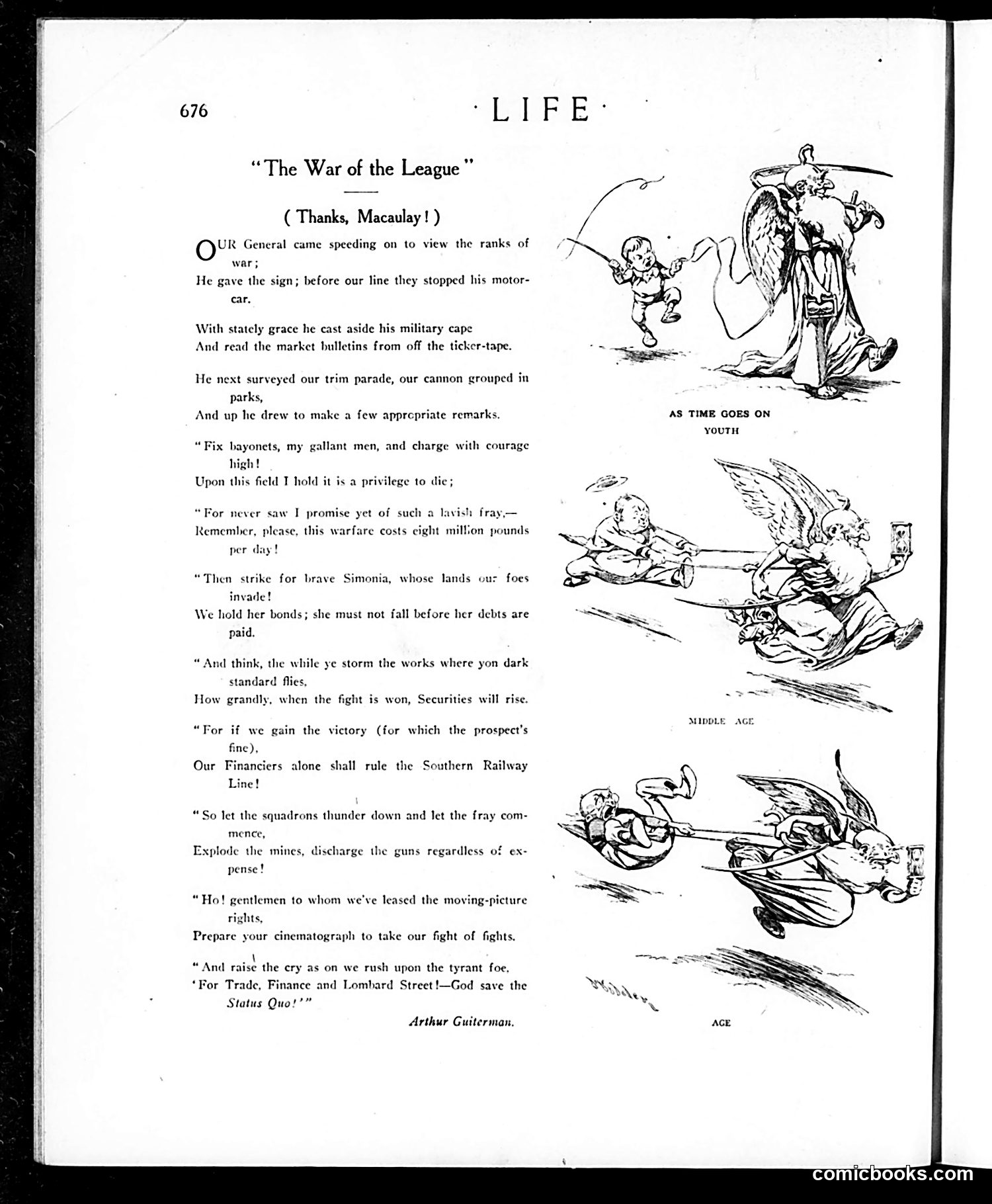
This satirical poem by Arthur Guiterman mocks how financial interests drive military decisions. A general arrives to inspect troops but ignores military matters, instead reading stock market bulletins. His speech to soldiers reveals the satire's target: he motivates them not by patriotism but by cynical financial incentives. The war costs "eight million pounds per day," troops fight to protect financial "bonds" held by investors, and victory will benefit "Financiers" who control railways and gain from rising securities. The final lines crystallize the critique: soldiers are urged to fight for "Trade, Finance and Lombard Street" (London's financial district) while preserving the status quo—suggesting the wealthy wage war to protect their wealth and power, not national interests. The accompanying comic illustrations show cupid/cherub figures aging into increasingly aggressive warriors, visually reinforcing how war corrupts innocence.
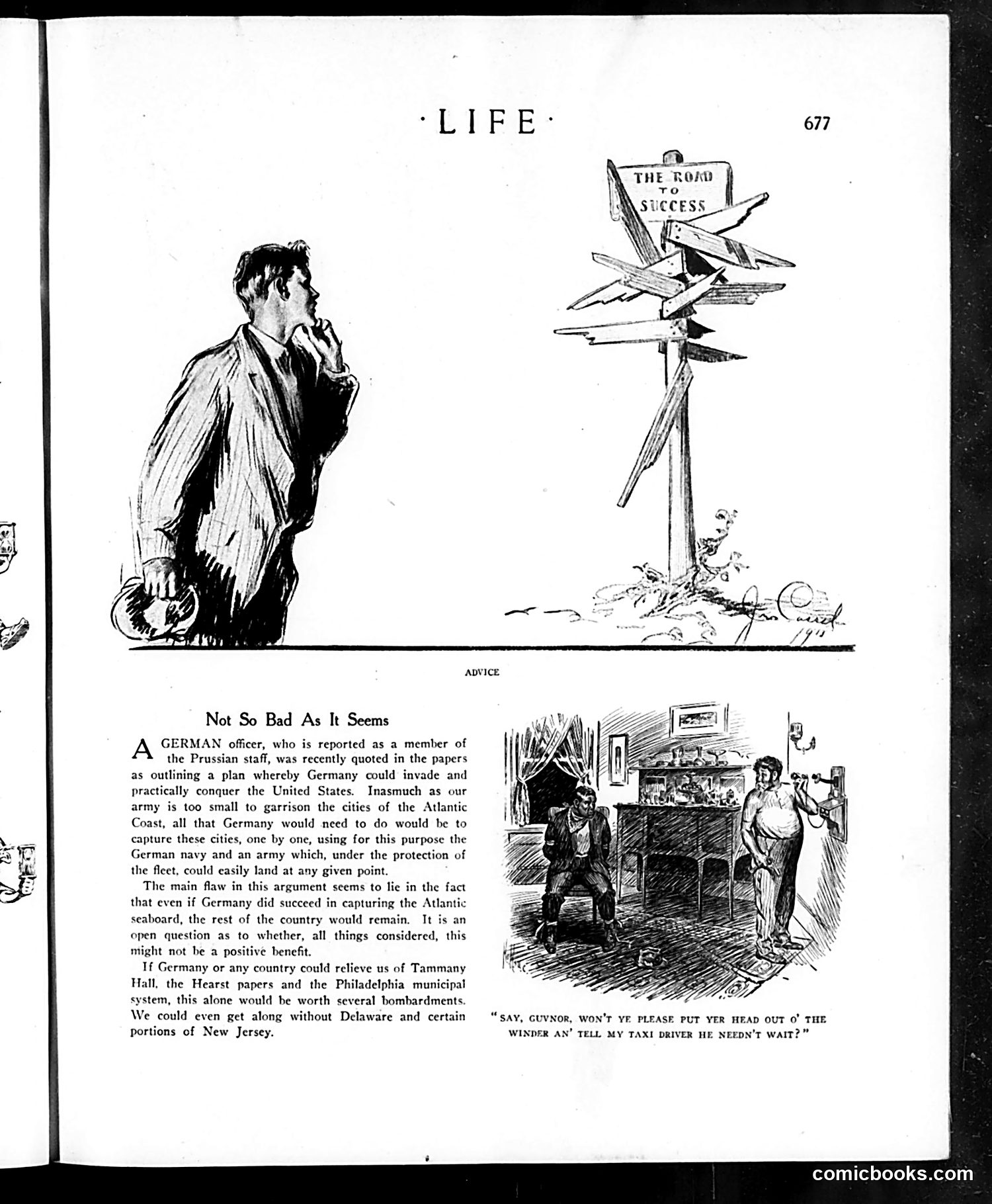
This page satirizes a German general's reported invasion plan against the United States. The top cartoon shows a confused man studying a signpost labeled "The Road to Success" with conflicting directional arrows—illustrating the article's point that Germany's strategy is fundamentally flawed. The article argues that even if Germany conquered Atlantic coastal cities, it would be a dubious victory since "the rest of the country would remain." It then pivots to dark humor: the writer suggests Germany could actually *benefit* America by eliminating local nuisances—specifically **Tammany Hall** (New York's corrupt Democratic machine), **Hearst papers** (William Randolph Hearst's influential but sensationalist media empire), Philadelphia's municipal government, plus Delaware and parts of New Jersey. The bottom illustration depicts an Irish immigrant stereotypically telling a taxi driver not to wait—presumably because the passenger would be conquered. This mocks contemporary anxieties about foreign invasion while poking fun at urban governance problems of the era. The overall message: America's greatest threats aren't external military invasion, but internal political corruption.
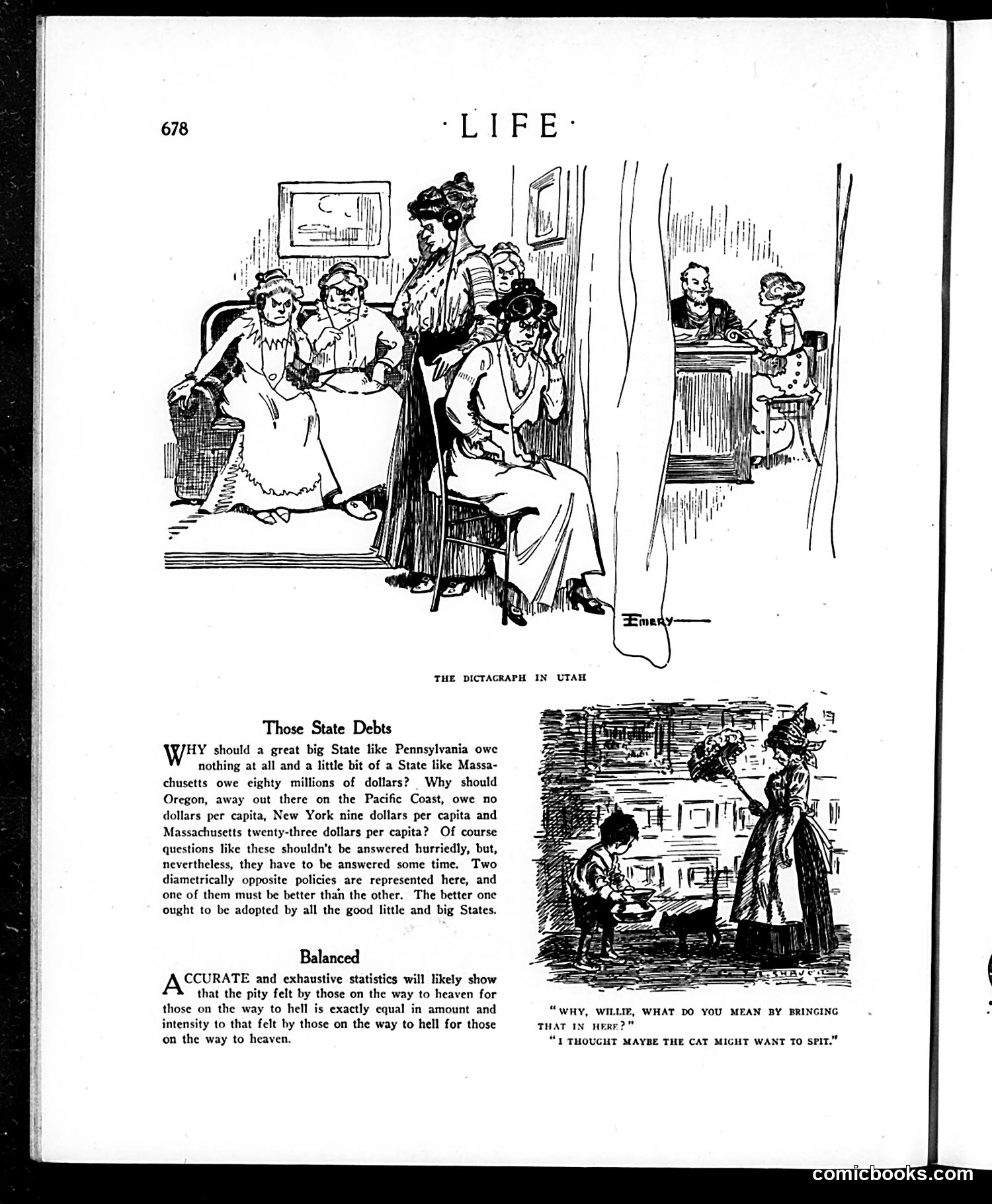
**Top cartoon ("The Dictagraph in Utah"):** This depicts a dictaphone or recording device being used in Utah—likely referencing contemporary concerns about surveillance or eavesdropping technology in that state, though the specific context is unclear. **"Those State Debts" section:** This editorial argues for standardizing state fiscal policy. It questions why states have vastly different per-capita debts (Pennsylvania zero, Massachusetts $80 million, New York $9 per capita versus Massachusetts $23), advocating that the better fiscal approach should be adopted uniformly across all states. **"Balanced" section:** A philosophical aside suggesting that mutual indifference between the saved and damned in the afterlife is perfectly symmetrical. **Bottom cartoon:** A domestic humor strip where a child brings in a cat, planning to make it spit at a guest—a simple sight gag about childhood mischief, unrelated to the state debt discussion above.
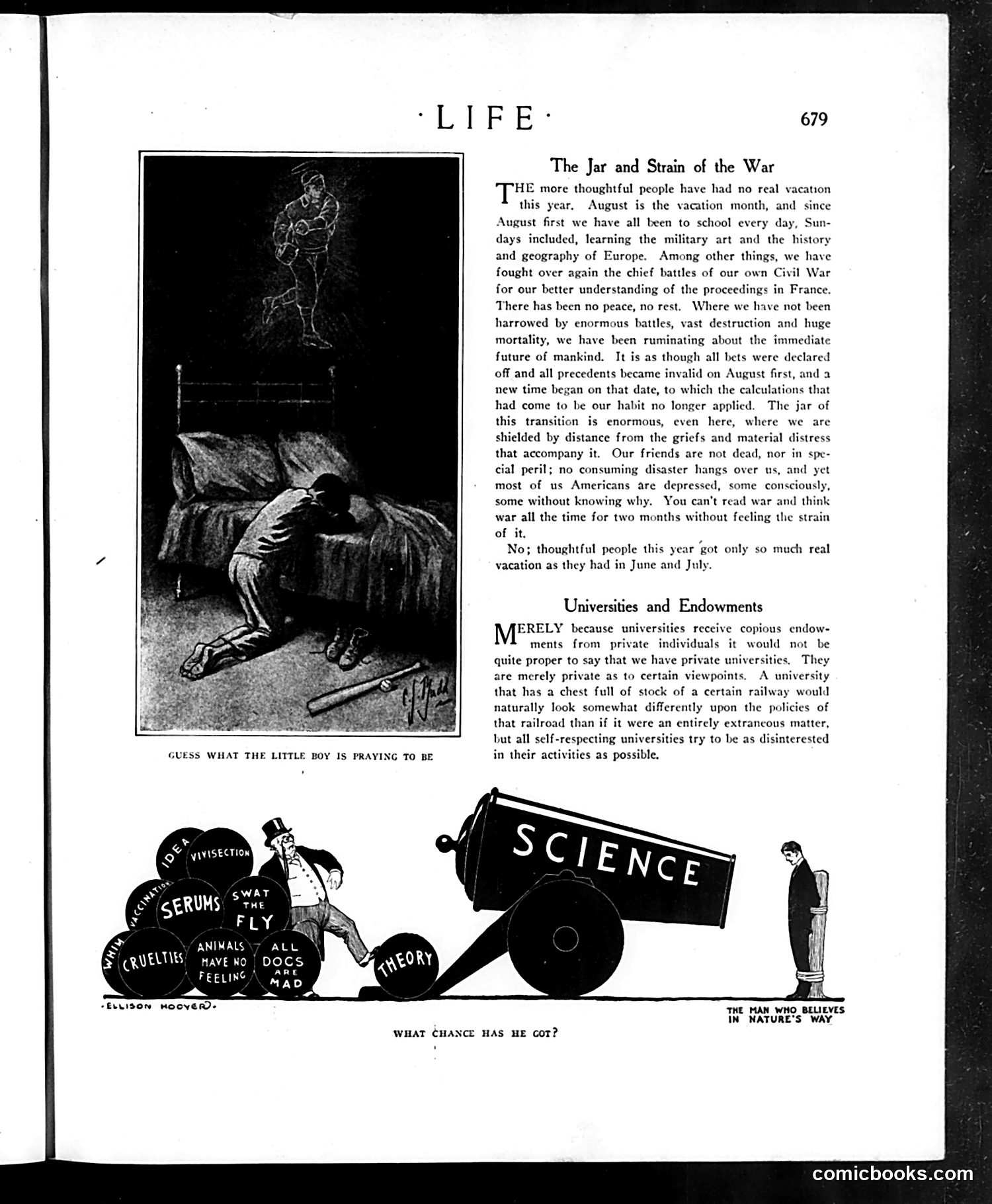
**Top Editorial:** "The Jar and Strain of the War" reflects American anxiety during World War I (likely 1918, given "August first" reference and mention of "proceedings in France"). The author argues that intellectually engaged Americans cannot truly vacation because they're psychologically consumed by war news and its implications for humanity's future. The piece critiques how even distant Americans feel the psychological weight of the conflict. **Bottom Cartoon:** This Elinor Hoover illustration satirizes pseudo-scientific racism and Social Darwinism. A man pushes a massive cannon labeled "SCIENCE" over figures representing crude prejudices (labeled "CRUELTY," "SERUMS," "DOCS ARE MAD," etc.), crushing them. The "man who believes in Nature's way" stands unbothered on the right—suggesting such prejudiced thinking survives despite science's supposed advancement. The caption "What chance has he got?" is darkly ironic: the cannon of science appears powerless against entrenched bigotry.
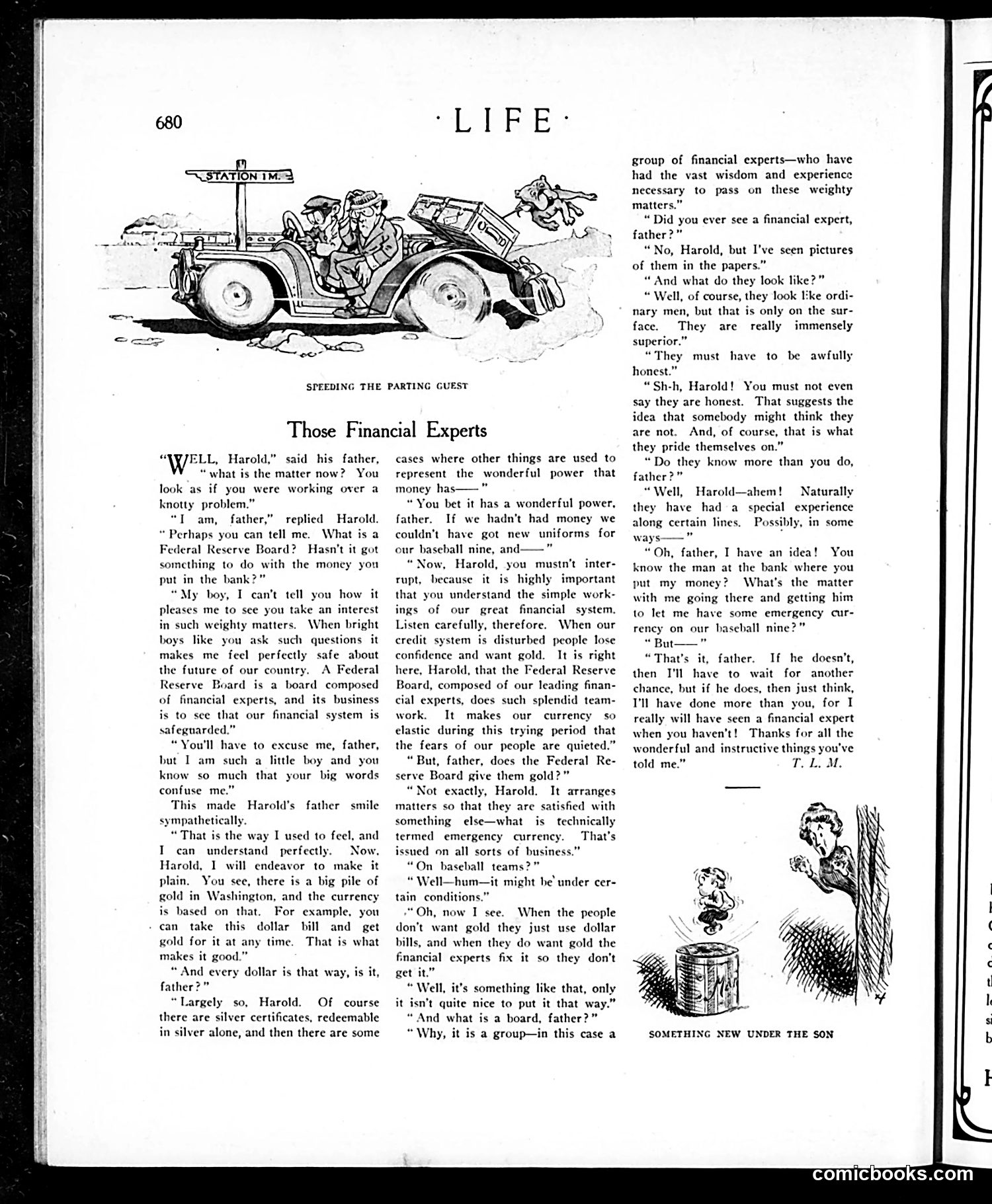
This page satirizes the Federal Reserve System through a father-son dialogue. The father struggles to explain the Federal Reserve Board's function in accessible terms, ultimately revealing through the boy's naive questions that the system is circular and obscure: financial experts manipulate currency to prevent people from demanding actual gold, rather than ensuring they can obtain it. The cartoon above ("Speeding the Parting Guest") depicts a car overloaded with luggage, visually echoing the text's theme—the "financial experts" are like unwelcome guests being hurried away with their accumulated baggage. The satire targets post-WWI confusion about banking systems and suggests the Federal Reserve operates through obfuscation rather than transparent principles. The boy's innocent logic exposes the gap between the father's reverent description of these "immensely superior" experts and their actual function: managing public confidence rather than guaranteeing financial security. The humor lies in how easily the elaborate system collapses under simple questioning.
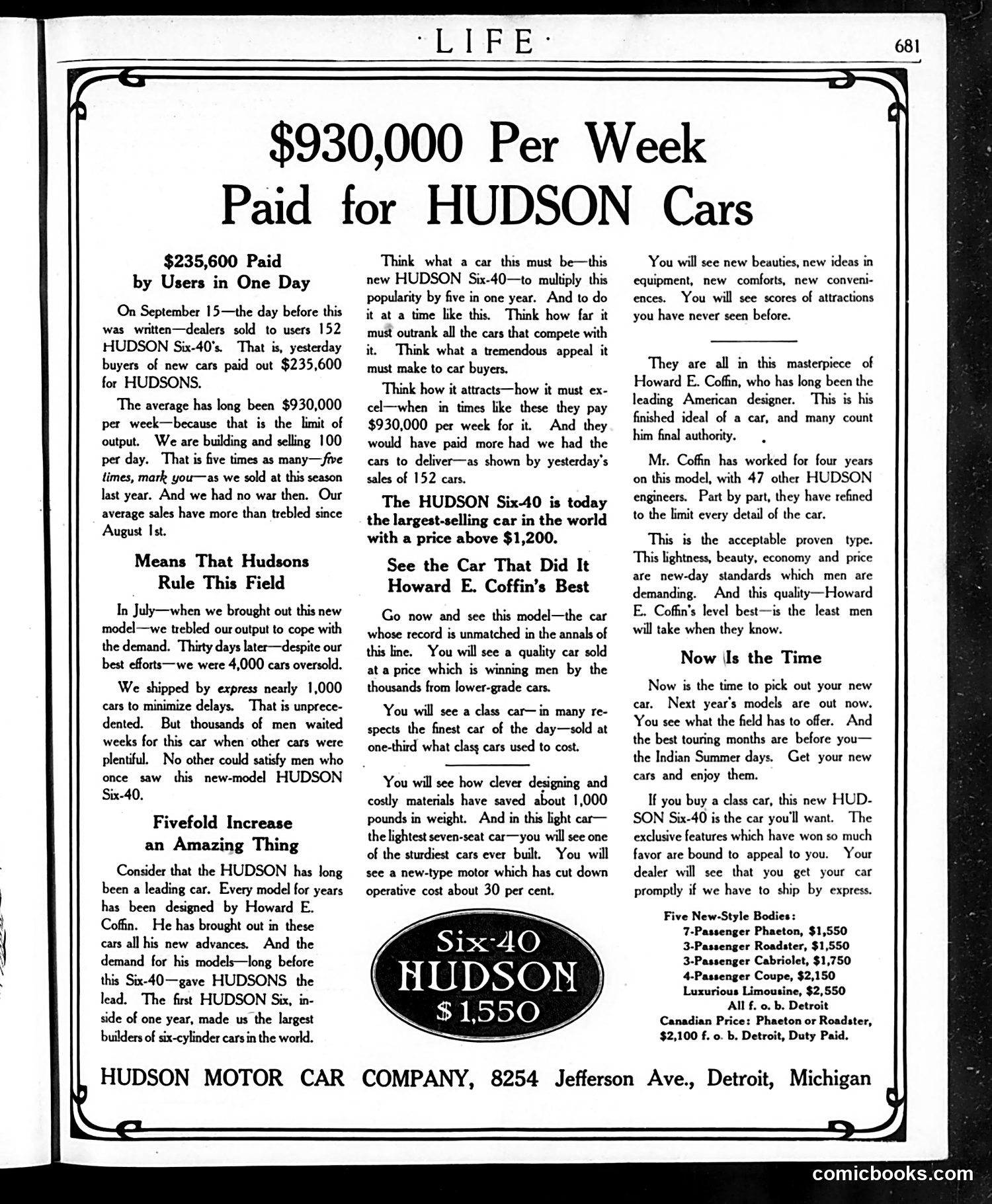
This is **not a cartoon but an advertisement** disguised as news reporting in Life magazine. The page promotes Hudson Motor Car Company's Six-40 automobile. The ad uses pseudo-journalistic language to present sales figures ($930,000 weekly, 152 cars sold in one day) as evidence of the car's superiority. It emphasizes that demand so far exceeds supply that customers must wait weeks—a scarcity tactic presented as proof of desirability. The designer **Howard E. Coffin** is repeatedly credited as an authority figure lending credibility. The ad claims the Six-40 represents innovation: lighter weight, lower operating costs, and features previously unavailable at this price point ($1,550). The real pitch: buy now because next year's models are available and summer driving season approaches. This exploits post-war (likely WWI era) pent-up demand for automobiles when production had been limited. The "satire" label may be misapplied—this reads as straightforward, if aggressive, marketing masquerading as objective reporting.
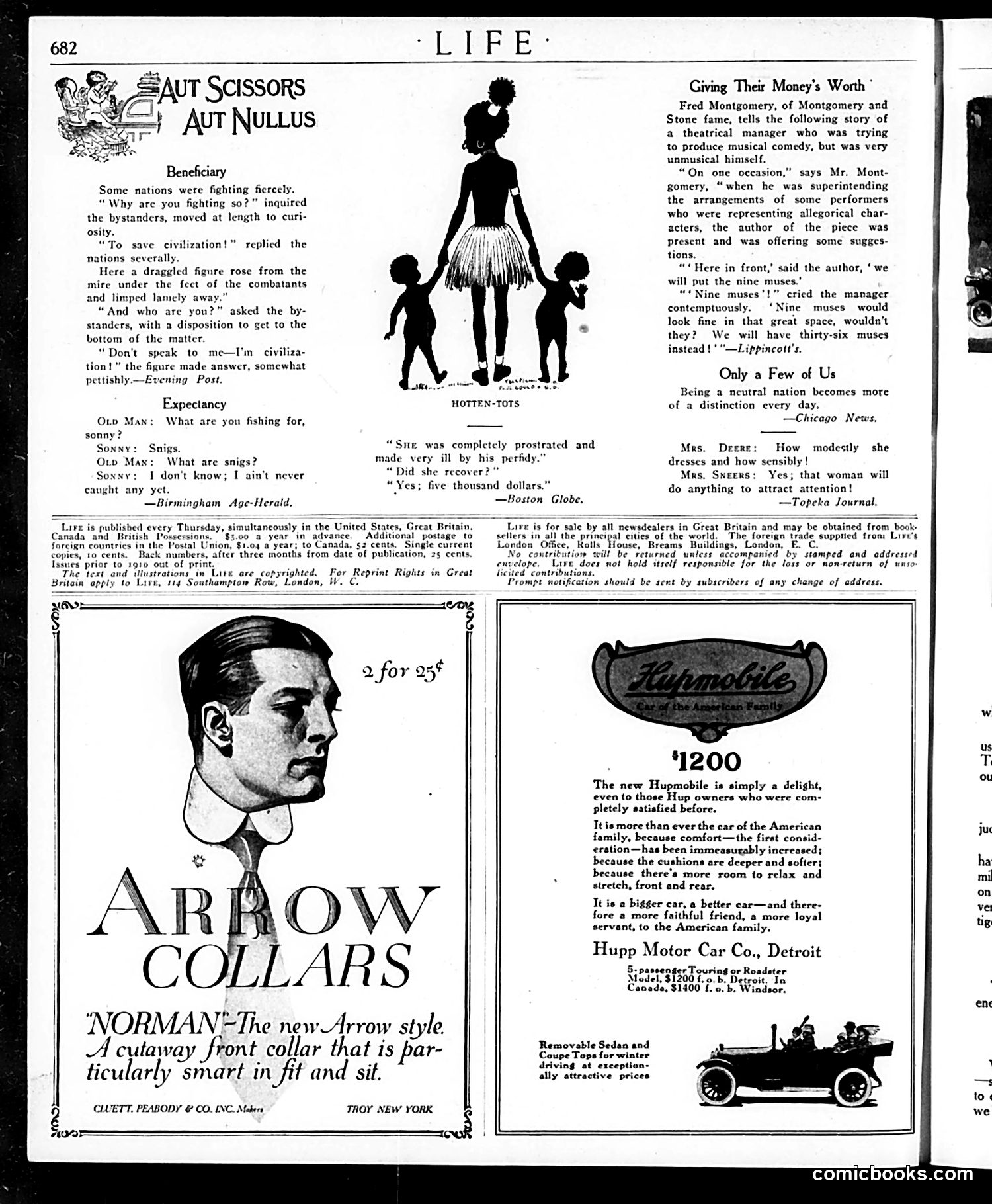
This page contains several satirical pieces typical of Life's early 20th-century humor: **"Aut Scissors Aut Nullus"** (top left): A sardonic cartoon about World War I. Nations claim they fight "to save civilization," yet when an actual figure representing Civilization appears—exhausted and trampled—it angrily tells them not to speak to it. The satire critiques the hypocrisy of warring nations invoking noble ideals while causing destruction. **"Hotten-Tots"** (center illustration): A silhouette cartoon about a woman and two children, accompanying a brief anecdote mocking theatrical producers' lack of artistic sensibility. **Other brief humor pieces** scattered throughout mock everyday absurdities: a man fishing for "snigs" (nonsense), a woman attracting attention through excessive modesty, and a theatrical manager wanting 36 muses instead of 9. The page also includes period advertisements for Arrow Collars and Hupmobile automobiles, typical of Life's revenue model. The overall tone reflects pre-WWI American satirical journalism—clever, cynical about institutions, and focused on social pretension and wartime irony.
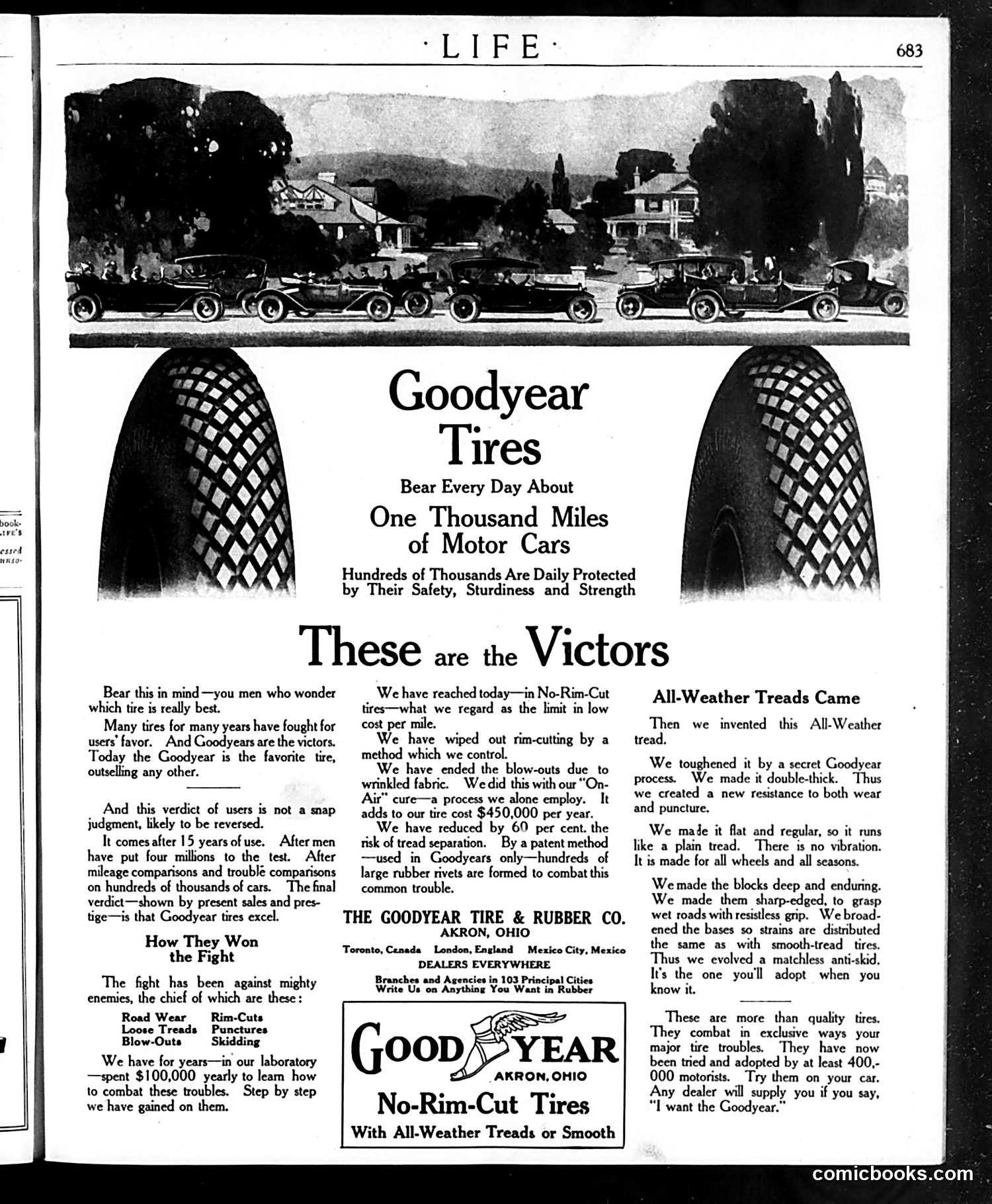
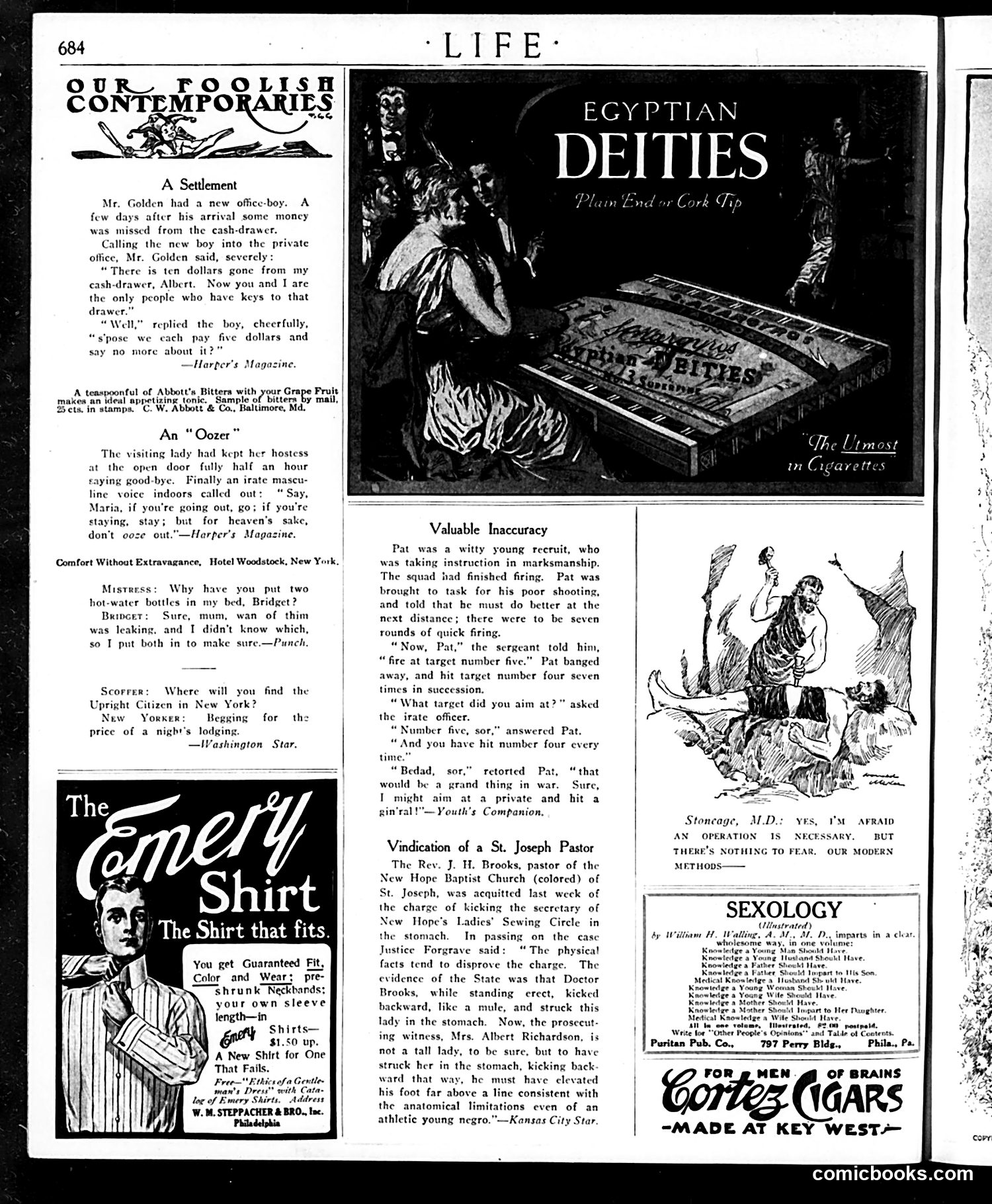
This page contains **humorous anecdotes and advertisements** rather than political cartoons. The main jokes satirize **human nature and social situations**: 1. **"A Settlement"** mocks a dishonest office boy who brazenly proposes splitting the stolen cash with his employer rather than denying the theft—absurdist humor about audacity. 2. **"An Oozer"** jokes about a guest who won't leave, forcing the exasperated host to literally shout her out. 3. **"Valuable Inaccuracy"** presents an Irish recruit (Pat) whose terrible marksmanship is defended through circular logic—he aimed at target five but hit four; the sergeant notes that in war, hitting the wrong target (a general instead of a private) might be advantageous. These are gentle satirical pieces mocking incompetence, rudeness, and absurd reasoning—typical early-20th-century magazine humor. The page is otherwise filled with **period advertisements** (Emery Shirts, Abbott's Bitters, Cortes Cigars) and classified content unrelated to satire.
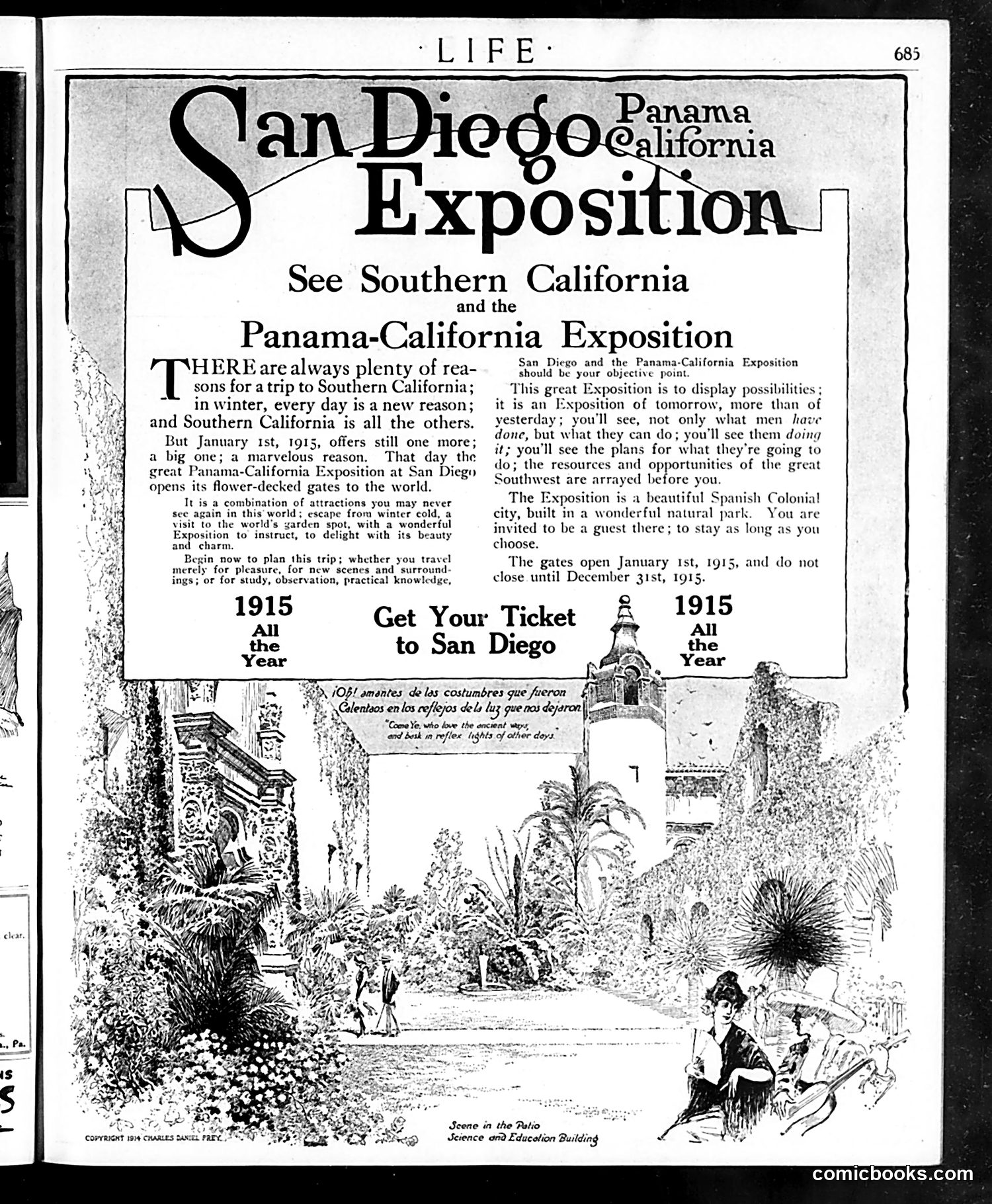
This is **not a political cartoon or satire**—it's a straightforward advertisement for the 1915 Panama-California Exposition in San Diego. The page promotes a world's fair opening January 1, 1915, aimed at winter-weary Americans. The exposition is described as showcasing "possibilities" and "tomorrow"—emphasizing progress, innovation, and the resources of the American Southwest. It's framed as both a tourist destination (escape from winter cold) and an educational venue featuring exhibits on science and industry. The illustration shows a Spanish Colonial-style courtyard with visitors, reflecting the exposition's architectural theme. The inclusion of Spanish text suggests the exposition's focus on Spanish colonial heritage and the Panama Canal connection (relevant given the canal's 1914 opening). This is essentially promotional copy: no satire, no political commentary, just encouragement to attend what was genuinely a major cultural event of its era.
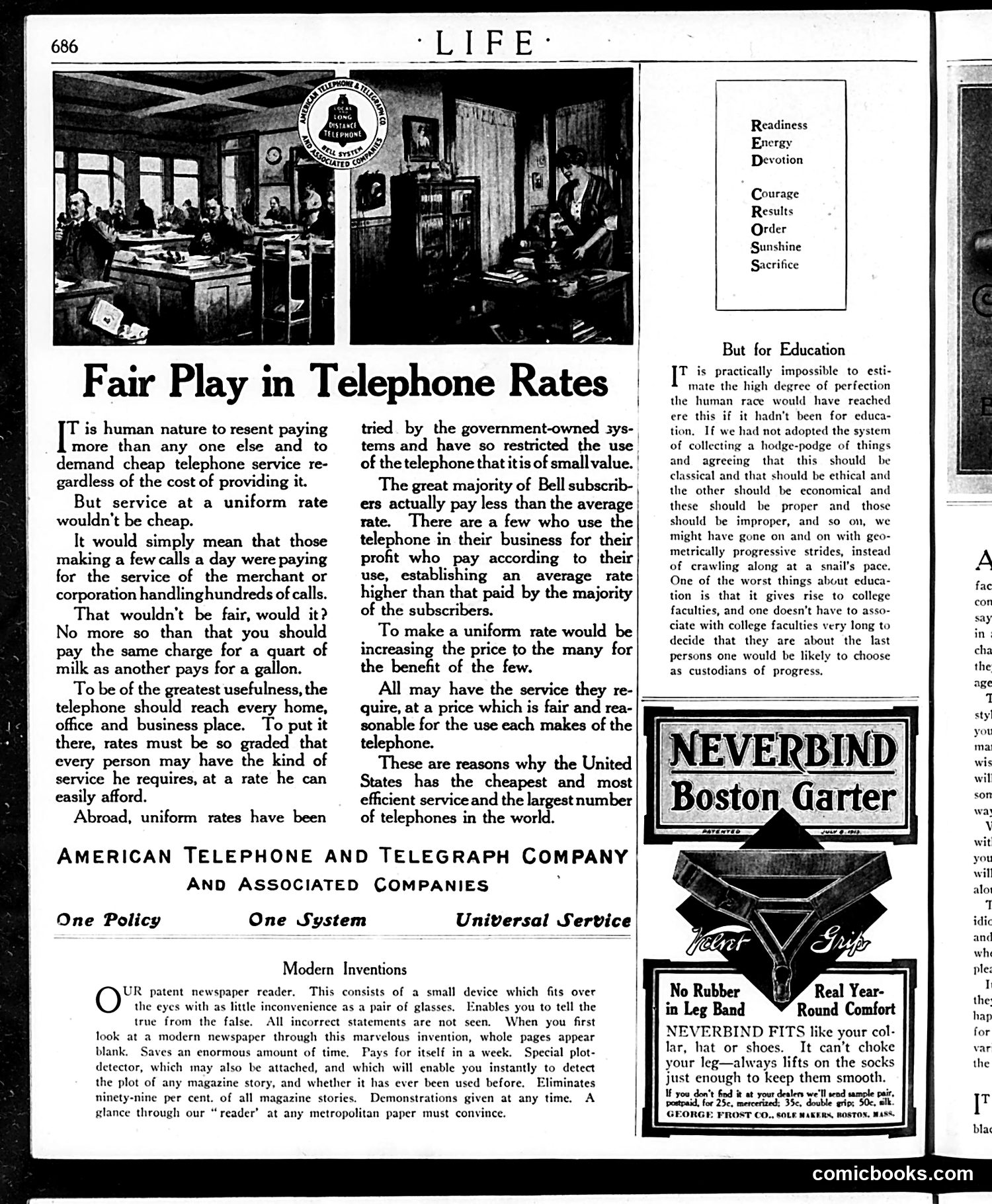
This page is primarily **corporate advertising** for AT&T disguised as editorial content, with satirical sidebars. ## Main Content: "Fair Play in Telephone Rates" AT&T defends **tiered pricing** against public pressure for uniform rates. The argument: charging everyone the same would make light users subsidize heavy users (unfairly), so graduated rates based on usage are actually more equitable. The piece claims this system keeps U.S. telephone service cheaper and more widespread than government-run systems abroad. ## Satirical Sidebars: "Modern Inventions" Life mocks this corporate propaganda with two fake inventions: 1. A "patent newspaper reader" that removes false statements—leaving blank pages when applied to modern newspapers 2. A magazine plot detector that eliminates 99% of stories as recycled **The satire's point**: The main AT&T article itself is the kind of misleading corporate messaging these devices would filter out. Life is ironically suggesting readers need protection from exactly this type of propaganda masquerading as reasoned argument.
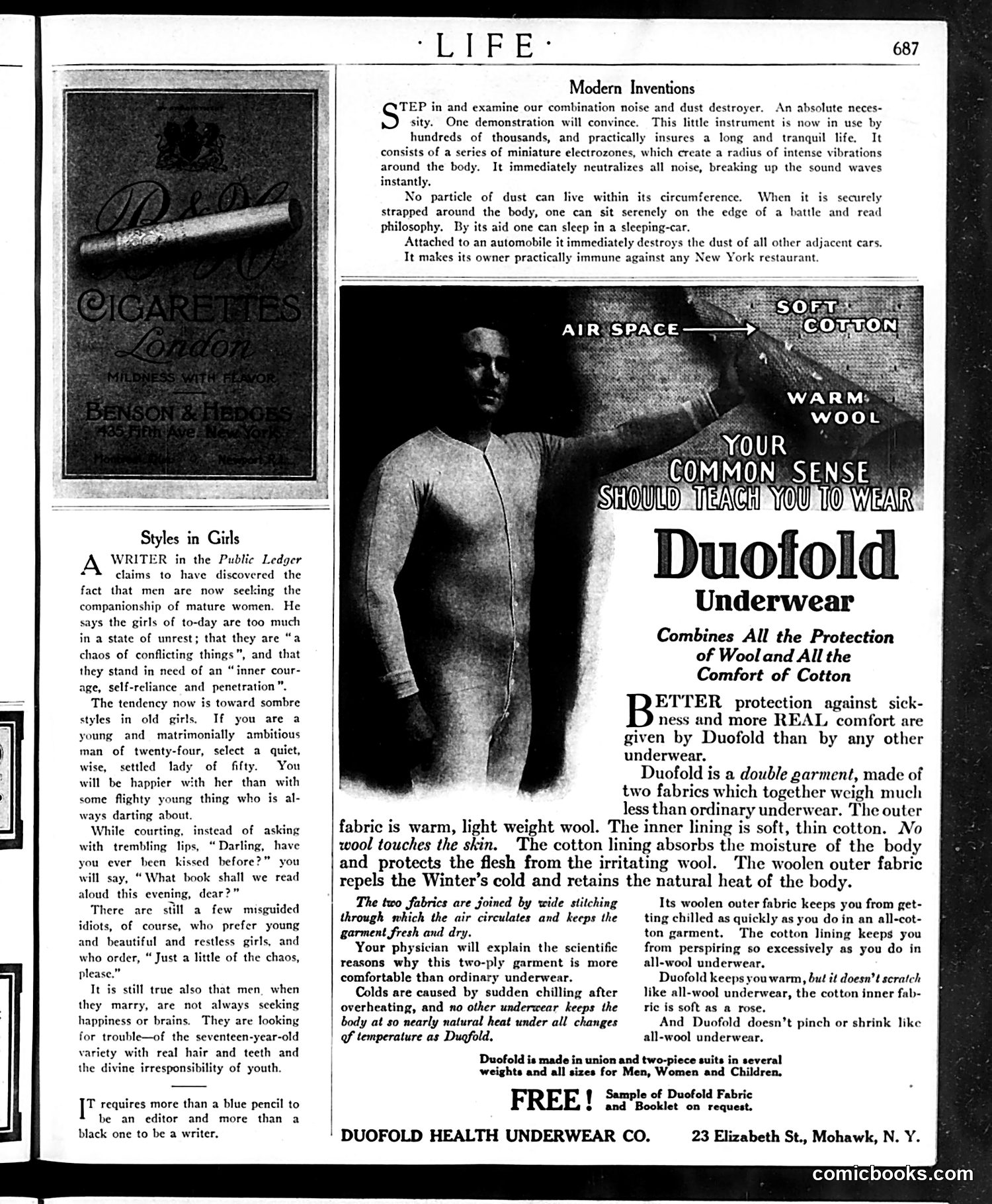
This page contains a satirical editorial mocking contemporary dating advice. A writer from the *Public Ledger* has claimed men now prefer mature women (age 50) over young girls, praising older women's stability and "inner courage." The satire ridicules this notion by pointing out the obvious contradiction: men claiming to seek mature companionship while actually desiring young, beautiful, "irresponsible" girls. The piece suggests this advice is unrealistic—men pursue "trouble" in youth, not wisdom in age. The final aphorism ("requires more than a blue pencil to be an editor") mocks the editorial itself as poorly reasoned. The page also contains period advertisements (cigarettes, a fictional "noise and dust destroyer," and Duofold underwear), typical of *Life* magazine's mixed editorial and advertising content from the early 20th century.
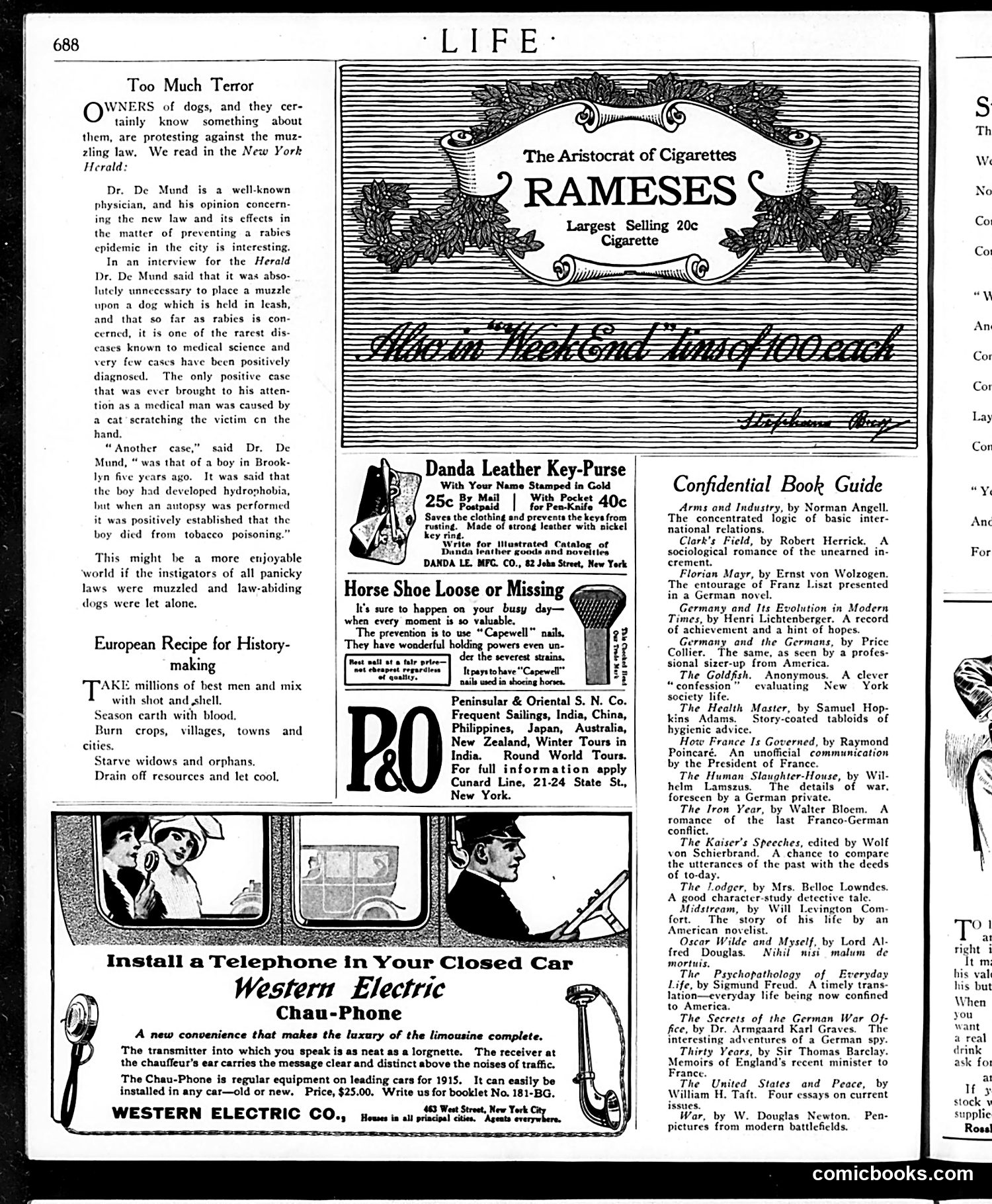
This page's lead article satirizes NYC's mandatory dog-muzzling ordinance. The piece quotes Dr. De Mund arguing the law is unnecessary panic: rabies is rare, and he cites absurd counterexamples (a boy died of tobacco poisoning, not hydrophobia; a cat caused one case). The satire's point: well-meaning but overreactive public health laws harm innocent parties (leashed dogs) based on irrational fear rather than medical evidence. The closing line drives this home—if we muzzled the "instigators of panicky laws" instead of law-abiding dogs, the world would be better. Below this, a dark "European Recipe for History-making" lists war's brutalities (mixing men with shot/shell, burning crops, starving widows) as if formula, likely critiquing the ongoing Great War as mechanized slaughter. The rest is advertisements.
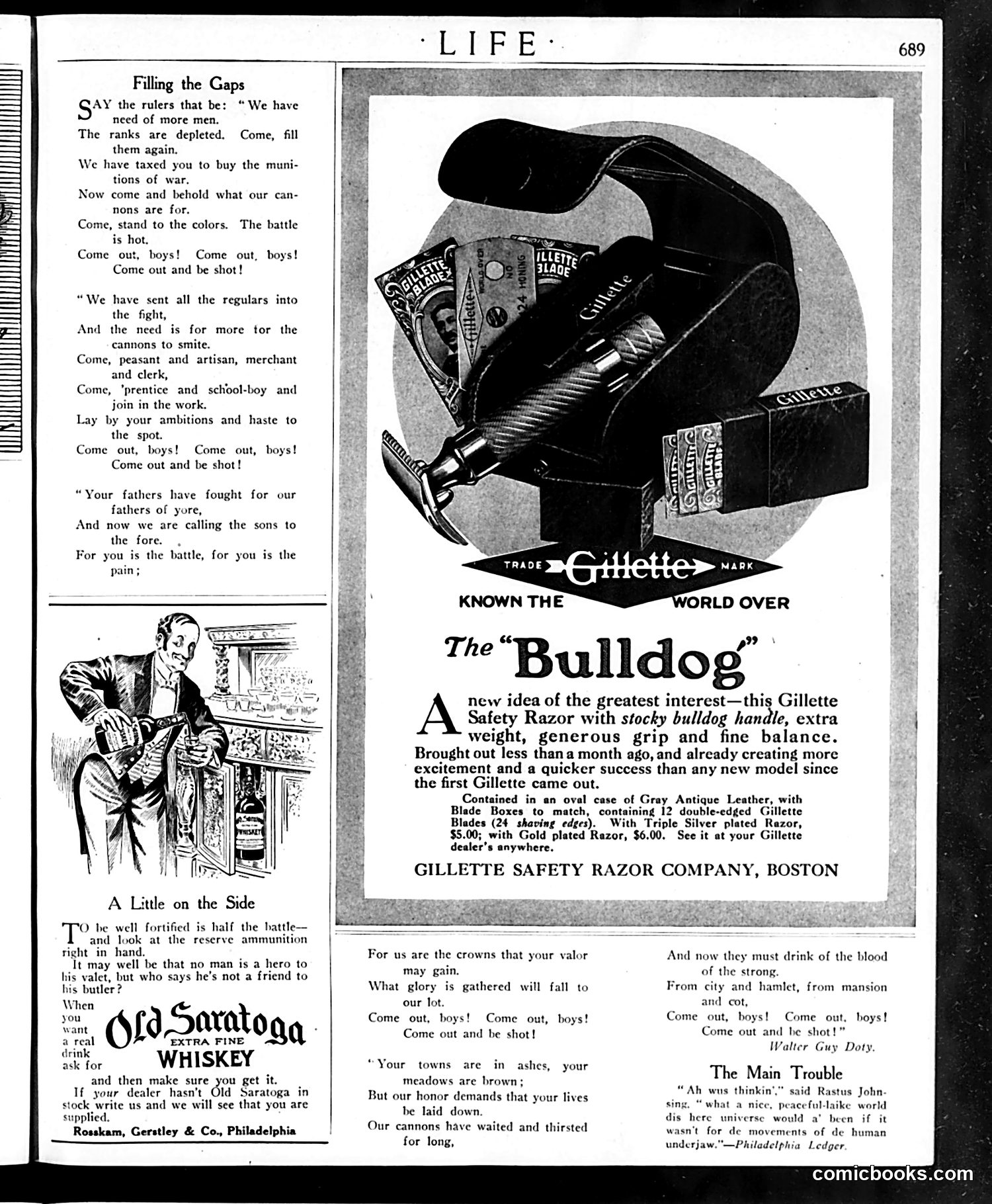
This page contains anti-war poetry mocking military recruitment propaganda. The poem "Filling the Gaps" uses bitter repetition of "Come out, boys! Come out and be shot!" to expose how authorities demand ordinary citizens—peasants, clerks, apprentices, schoolboys—sacrifice themselves to replenish depleted military ranks. The verses systematically strip away recruitment rhetoric: rulers claim honor, glory, and patriotic duty, but the poem reveals the actual transaction—citizens' lives exchanged for cannons' ammunition and national prestige ("the glory...will fall to our lot" belongs to rulers, not soldiers). The page appears from WWI era (references to "fathers have fought," destroyed towns). The satire's point: recruitment propaganda masks brutal mathematics where common people provide the bodies while elites reap benefits. The accompanying advertisements for whiskey and razors create ironic contrast with wartime sacrifice appeals—consumerism versus cannon fodder.
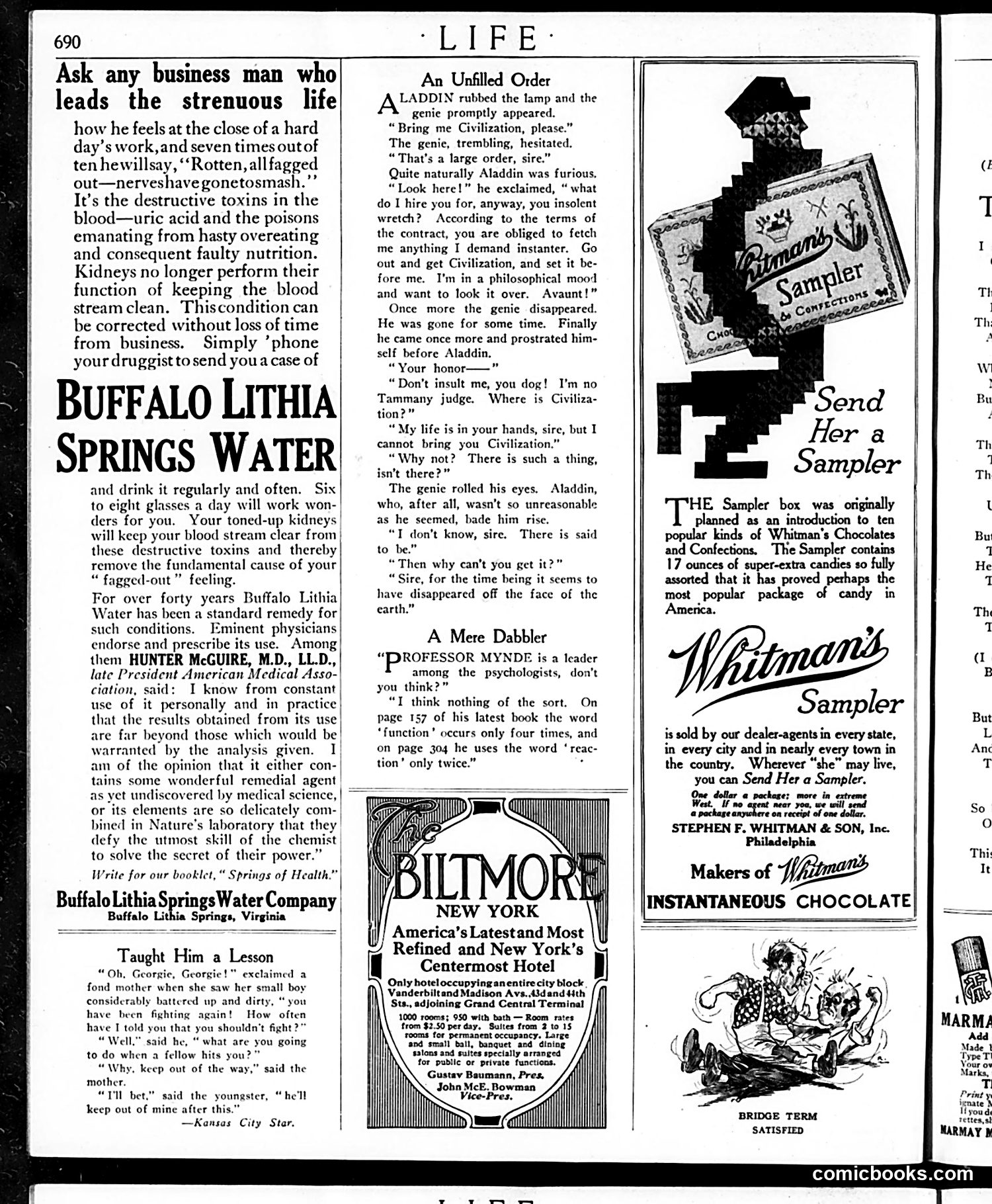
This page mixes satirical fiction with period advertising. The main cartoon story, "An Unfilled Order," retells Aladdin's lamp as modern social satire. When Aladdin demands the genie fetch him "Civilization," the genie cannot—it has "disappeared off the face of the earth." The joke critiques contemporary society: despite claims of progress, "civilization" remains elusive. This reflects early-20th-century anxieties about industrialization, urban chaos, and whether material advancement equaled genuine social improvement. The surrounding advertisements—Buffalo Lithia Springs Water (marketed to overworked businessmen with "fagged-out" feelings) and Whitman's Sampler chocolates—reinforce the page's theme: modern life exhausts people, requiring purchased remedies. A minor anecdote, "Taught Him a Lesson," depicts a mother counseling her son on fighting, reflecting period attitudes about masculine toughness and parental discipline.
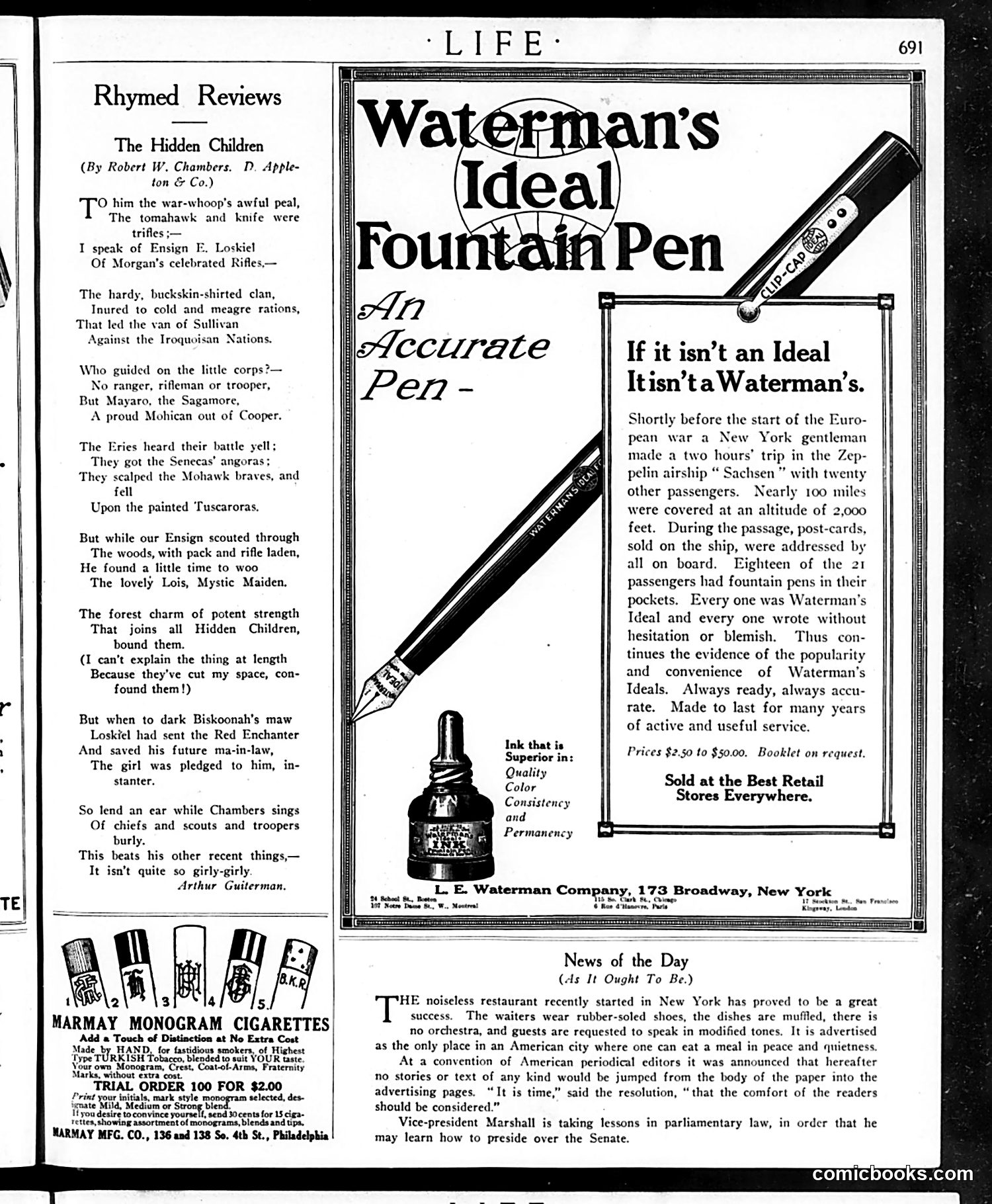
This page is primarily **advertising and light satirical content**, not political cartooning. **Left column:** A book review in verse by Arthur Guiterman of Robert W. Chambers' novel *The Hidden Children*. It's a romantic adventure set during the American Revolutionary War featuring Ensign Loskiel, Native American characters (Mayaro the Sagamore, various tribes), and a "Mystic Maiden" named Lois. Guiterman notes this work is less "girly-girly" than Chambers' recent output. **Center/Right:** A full-page **Waterman's Ideal Fountain Pen advertisement** featuring a pre-WWI anecdote: New York passengers on a German Zeppelin airship all used Waterman pens to address postcards, demonstrating the product's reliability and popularity. **Bottom:** Light satirical "News of the Day" items: a New York restaurant advertising silence (no music, muffled dishes), newspaper editors pledging not to interrupt stories with ads, and a joke about Vice-President Marshall needing to learn parliamentary procedure to preside over the Senate. No specific political figures are caricatured. This is a **magazine filler page** mixing book reviews, advertisements, and gentle humor.
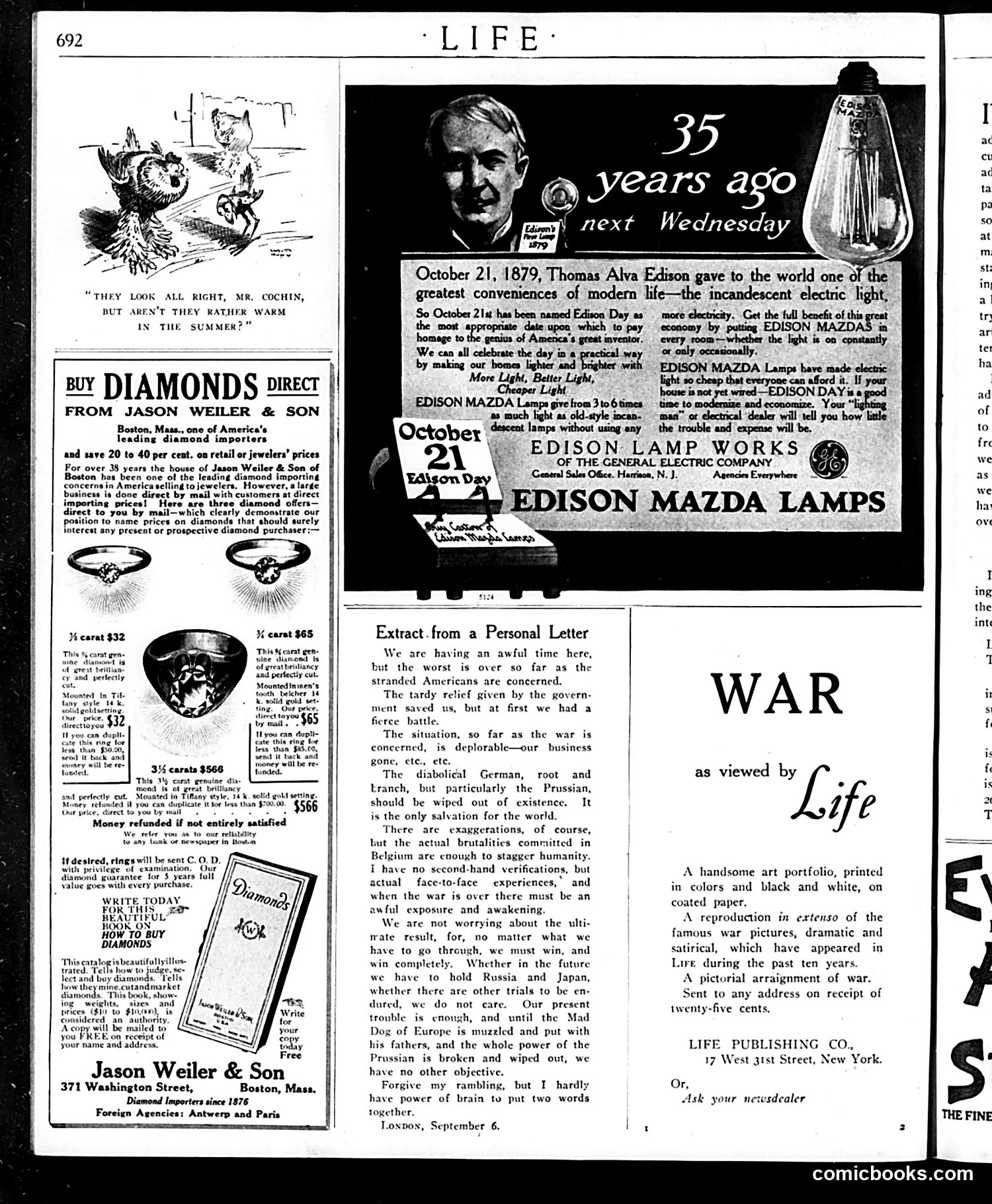
This page mixes advertisements with World War I commentary. The cartoon at top left (by artist Cochin) depicts two figures discussing what appear to be fur coats—the joke being they look fine but are impractically warm for summer, likely mocking some absurd fashion or wartime decision. The dominant content is advertisements for diamonds (Jason Weiler & Son) and Edison lightbulbs, celebrating "Edison Day" (October 21st), marking the incandescent bulb's invention 35 years prior. The substantive editorial element is a personal letter from someone in a war zone (appears to be Belgium, given WWI context) describing American relief efforts, business collapse, and visceral anti-German sentiment. The writer expresses outrage at Prussian brutality in Belgium and advocates for Germany's complete destruction as "the only salvation for the world." This reflects American anxiety during early WWI, before U.S. entry (1917), when American civilians abroad experienced the conflict firsthand and American public opinion grew increasingly hostile toward Germany.
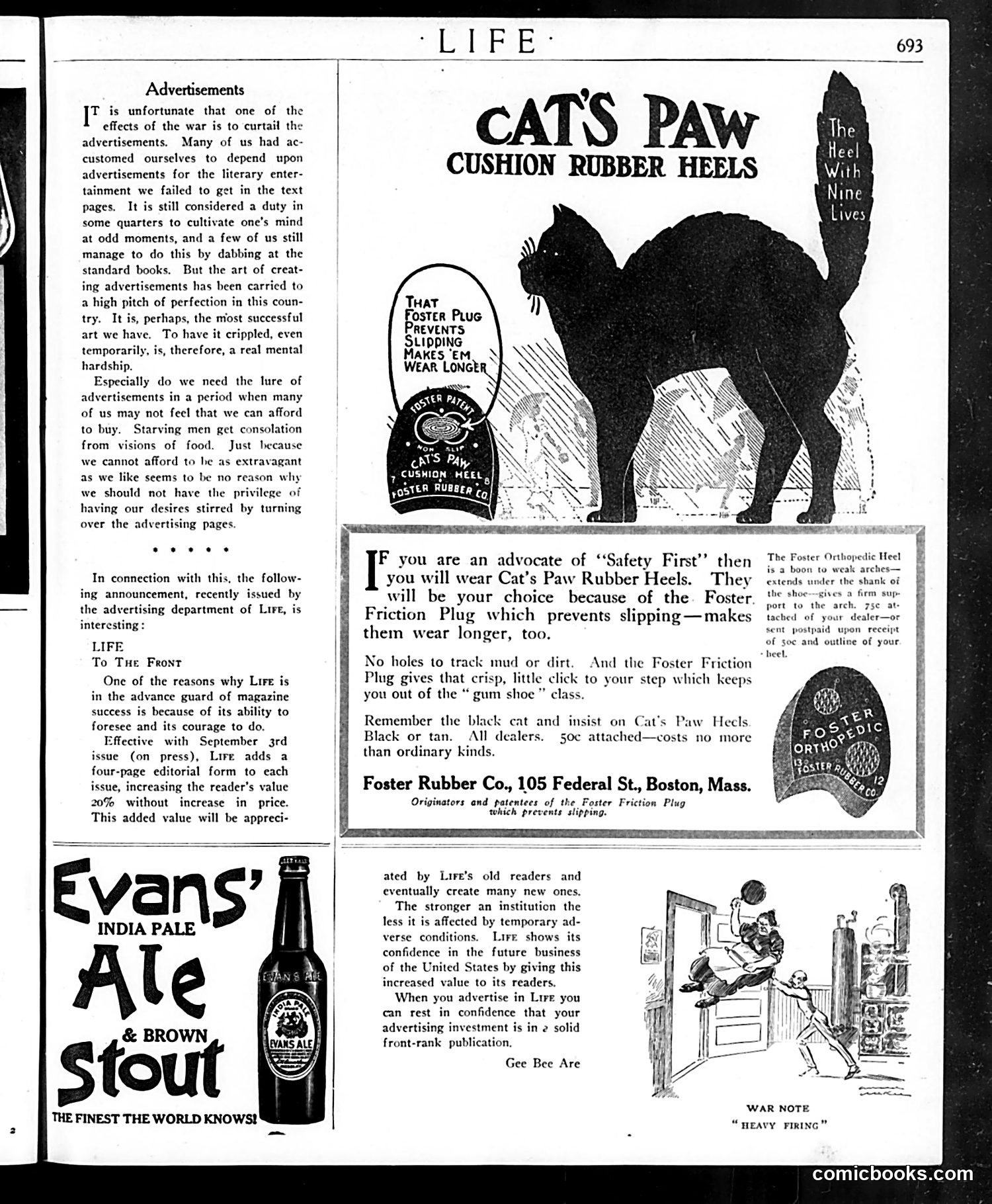
This page is primarily **advertising content** from a WWI-era *Life* magazine, framed by editorial commentary about wartime advertising. **The Editorial Context:** The left column discusses how advertisements provide mental stimulation during economic hardship—"starving men get consolation from visions of food." The magazine announces it's adding four pages of editorial content despite wartime cutbacks, positioning itself as confident in America's economic future. **The Main Advertisement:** The large "Cat's Paw Cushion Rubber Heels" ad features a black cat and promotes rubber shoe heels with a "Foster Friction Plug" that prevents slipping. The copy emphasizes "Safety First"—a contemporary progressive-era slogan. **Supporting Ads:** Include Evans' India Pale Ale and Brown Stout (British beverages, likely illustrating continued transatlantic trade despite the war). **The War Note Cartoon:** Shows "Heavy Firing"—a humorous sketch of a woman in a chair, likely depicting domestic life during wartime rationing or labor shortages. The page reflects WWI-era consumer culture and how advertising sustained morale during economic uncertainty.
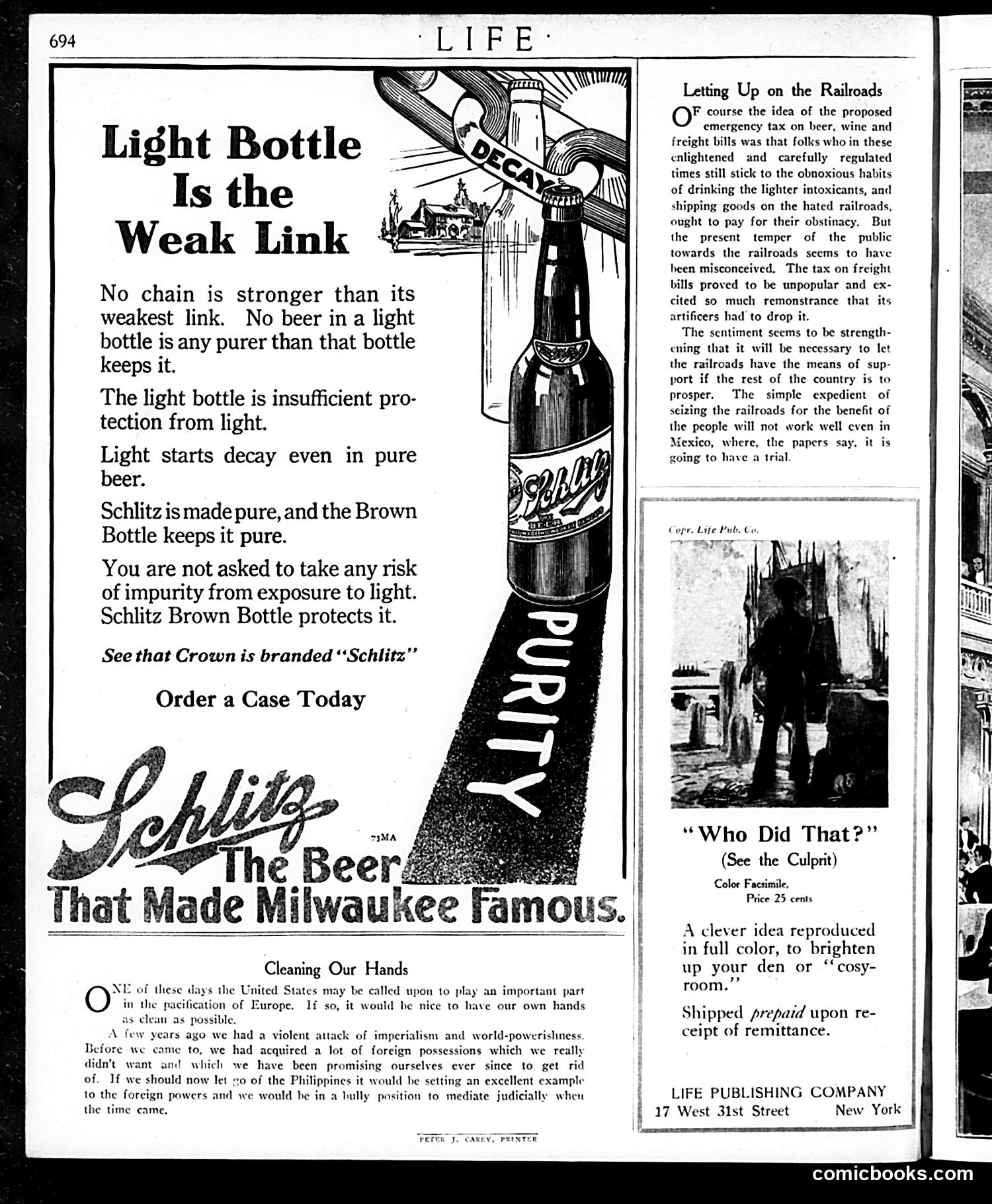
This page contains three distinct pieces: **1. Schlitz Beer Advertisement** (left): A commercial claiming brown bottles protect beer from light decay better than clear ones. The imagery shows a bottle in sunlight, emphasizing the protective quality of dark glass. **2. "Cleaning Our Hands" Editorial** (bottom left): Political commentary on American imperialism. The writer argues the U.S. should relinquish the Philippines (acquired years earlier during imperial expansion) to establish moral credibility when mediating European affairs. It's a call for the nation to "clean" itself of colonial possessions. **3. "Letting Up on the Railroads"** (right): Commentary on a proposed emergency tax on beer, wine, and freight. The piece notes the tax proved unpopular—particularly the freight charges—forcing its abandonment. It argues railroads need financial support for the country's prosperity, and dismisses radical solutions like seizing railroads (referenced humorously as attempted in Mexico). The page reflects early 20th-century American political debates: imperialism, taxation, and railroad regulation.
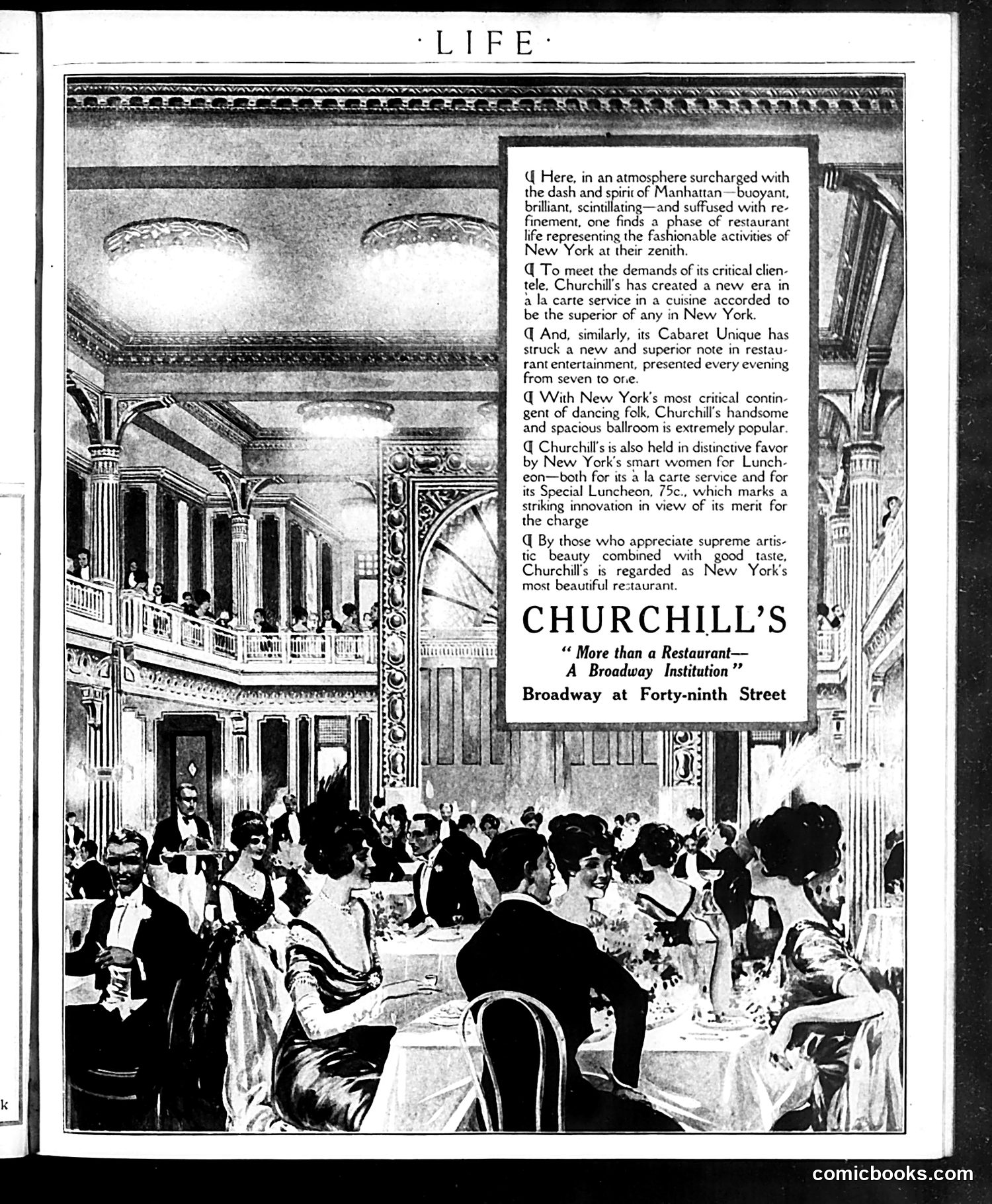
This is **not a cartoon or satire**, but rather a **full-page advertisement** for Churchill's restaurant in New York City, located at Broadway and 49th Street. The image shows an elegant dining scene with well-dressed patrons in a luxurious, ornate ballroom with classical columns and multiple tiers. The accompanying text markets Churchill's as a premier establishment offering superior à la carte cuisine, a nightly cabaret show (7pm-1am), and a spacious ballroom popular with the city's sophisticated dancing crowd. The ad emphasizes exclusivity and refinement, targeting New York's wealthy elite by highlighting the restaurant's beauty, superior service, and appeal to "smart women" and "critical" diners. The $0.75 "Special Luncheon" price point (expensive for the era) reinforces its upscale positioning. This appears to be vintage advertising from the 1910s-1920s era, when such establishments were major social venues for Manhattan's fashionable set.
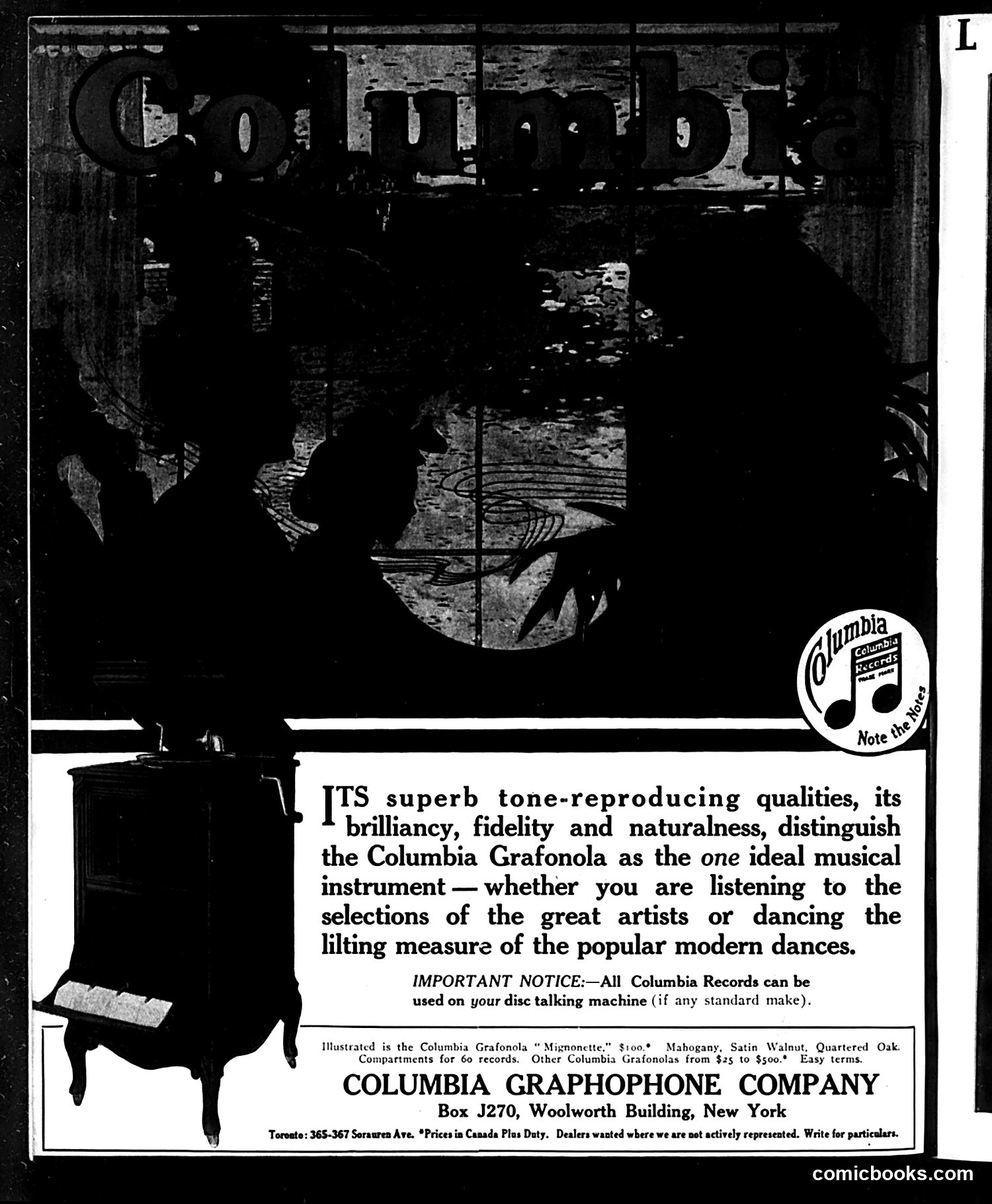
This page is **primarily an advertisement**, not a political cartoon. It promotes the Columbia Grafonola, an early gramophone (phonograph), circa 1910s-1920s based on styling and reference to "popular modern dances." The ad emphasizes the machine's superior sound quality—"tone-reproducing qualities," "brilliancy, fidelity and naturalness"—positioning it as ideal for both serious classical music and contemporary dance music. The "Mignonctte" model pictured is a cabinet-style gramophone with decorative wooden furniture. Prices ranged from $25 to $500, suggesting models for different economic classes. A notable detail: the ad includes an "IMPORTANT NOTICE" that Columbia Records work on "any standard make" of disc talking machine—an early competitive claim emphasizing compatibility across brands. The Columbia logo and "Note the Notes" slogan appear in the upper right corner. **No satire or political content is present.** This is straightforward commercial advertising from Life magazine.