
Life, 1914-10-15 · page 40 of 48
Life — October 15, 1914 — page 40: what you’re looking at
What you’re looking at
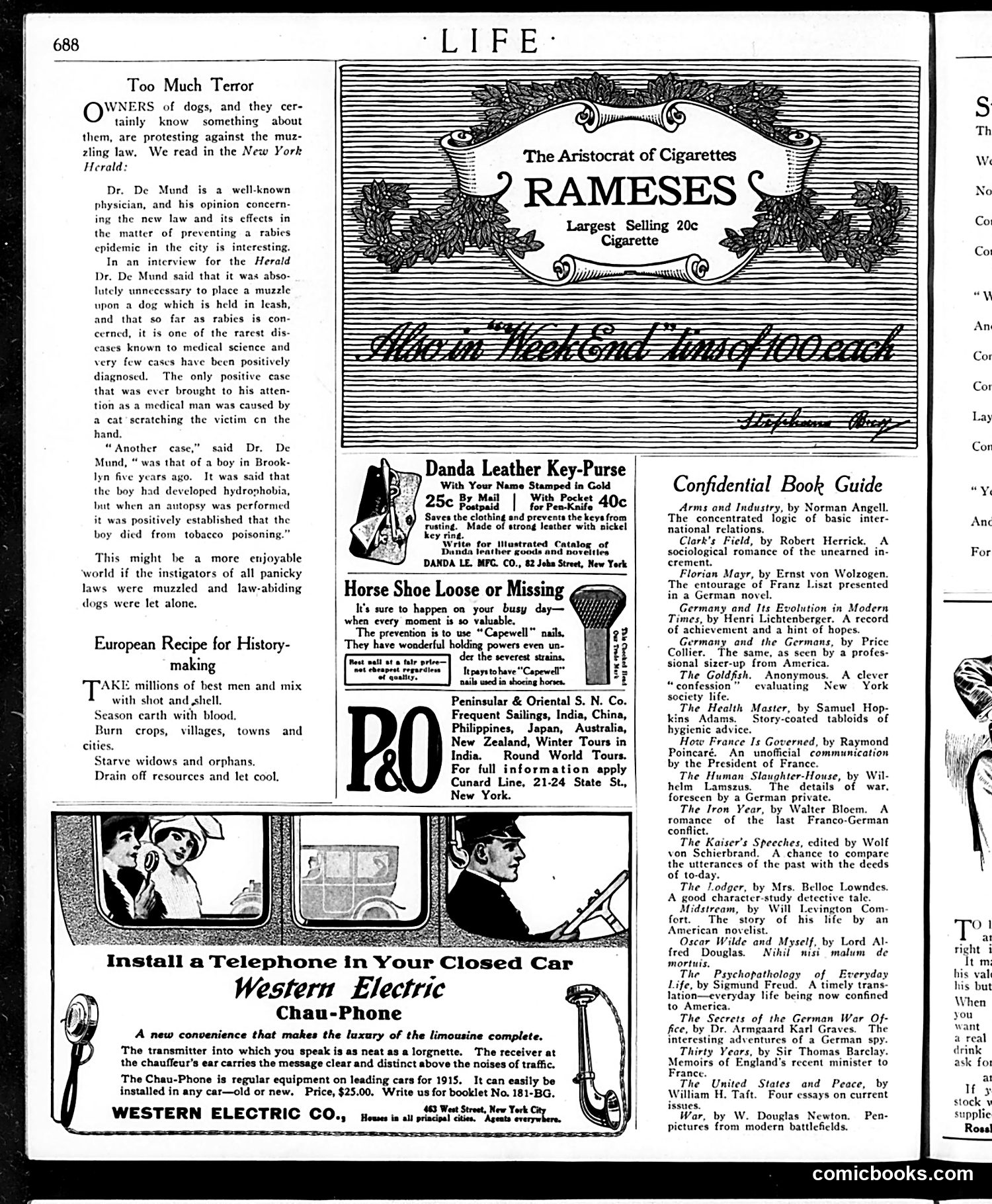
This page's lead article satirizes NYC's mandatory dog-muzzling ordinance. The piece quotes Dr. De Mund arguing the law is unnecessary panic: rabies is rare, and he cites absurd counterexamples (a boy died of tobacco poisoning, not hydrophobia; a cat caused one case). The satire's point: well-meaning but overreactive public health laws harm innocent parties (leashed dogs) based on irrational fear rather than medical evidence. The closing line drives this home—if we muzzled the "instigators of panicky laws" instead of law-abiding dogs, the world would be better. Below this, a dark "European Recipe for History-making" lists war's brutalities (mixing men with shot/shell, burning crops, starving widows) as if formula, likely critiquing the ongoing Great War as mechanized slaughter. The rest is advertisements.
📄 Transcribed text from this page (OCR, searchable)
Machine-transcribed from the original scan — historical spelling and the odd misread are preserved.
Too Much Terror WNERS of dogs, and they cer- tainly know something about them, are protesting against the muz- zling law. We read in the New York Herald: Dr. De Mund is a well-known physician, and his opinion concern- ing the new law and its effects in the matter of preventing a rabies epidemic in the city is interesting. In an interview for the Herald Dr. De Mund said that it was abso- lutely unnecessary to place a muzzle upon a dog which is held in leash, and that so far as rabies is con- cerned, it is one of the rarest dis- cases known to medical science and very few cases have been positively diagnosed. The only p ve case that was ever brought to his atten- tion as a medical man was caused by a cat scratching the victim cn the hand, “Another case,” said Dr, De Mund, “ was that of a boy in Brook- lyn five years ago. It was said that the boy had developed hydrophobia, but when an autopsy was performed it was positively established that the boy died from tobacco poisoning.” This might be a more enjoyable world if the instigators of all panicky laws were muzzled and law-abiding dogs were let alone. European Recipe for History- making ass millions of best men and mix with shot and shell. Season earth with blood. Burn crops, villages, towns and cities, Starve widows and orphans. Drain off resources and let cool. Horse Shoe Loose or Missing They have wonderful holding powers even un- The Aristocrat of Cigarettes RAMESES Largest Selling 20c Cigarette Danda Leather Key-Purse With Your Name Stamped in Gold By Mail With Pocket 25c Plupaid | forPexknite 40¢ Saves the clothing and prevents the keys from f ing. Made of strong leather with nickel Y Wilte for illustrated Catalog of Brite for ditectrnds’ Gauatog, ot DANDA LE. MPC. CO., 82 Joba Street, New York I's sure to happen on your busy day— when every moment is s0 ¥. te The prevention is to use “Capewell™ nails, der the severest strains, Itpaystohave“Capewell” ails used ia shoeing horses. Peninsular & Oriental S. N. Co. Frequent Sailings, India, Ch Philippines, Japan, Australi New Zealand, Winter Tours in India. Round World Tours. For full information apply Cunard Line, 21-24 State St. New York. Install a Telepho Western Electric Chau-Phone A new convenience that makes the luxury of the limousine comple! ‘The transmitter into which you speak is as neat as a lorgnette. The receiver at the chauffeur’s ear carries the message clear and distinct above the noises of traffic. The Chau-Phone is regular equipment on leading cars for 1915. It can easily be installed in any car—old or new. Price, $25.00. Write us for booklet No. 181-BG. WESTERN ELECTRIC CO., steaee in a te net Confidential Book Guide Arms and Industry, by Norman Angell. The concentrated logic of basic inter- national relations. Clark's Field, by Robert Herrick. A sociological romance of the unearned in- crement. Florian Mayr, by Ernst von Wolzogen. The entourage of Franz Liszt presented in a German novel. Germany and Its Evolution in Modern Times, by Henri Lichtenberger. A record of achievement and a hint of hopes. Germany and the Germans, by Price Collier. The same, as seen by a profes- sional sizer-up from America. The Goldfish. Anonymous. A clever “confession” evaluating New York society life. The Health Master, by Samuel Hop- kins Adams, Story-coated tabloids of hygienic advice. How France Is Governed, by Raymond Poincaré. An unofficial communication by the President of France. The Human Slaughter-House, by Wil- helm Lamszus, The details of war, foreseen by a German private. The Iron Year, by Walter Bloem. A romance of the last Franco-German conflict. The Kaiser's Speeches, edited by Wolf von Schierbrand. A chance to compare the utterances of the past with the deeds of to-day. The Jodger, by Mrs. Belloc Lowndes. A good character-study detective tale. Midstream, by Will Levington Com- fort. The story of his life by an American novelist. Oscar Wilde and Myself, by Lord Al- fred Douglas. Nihil nisi malum de mortuis. The Psychopathology of Everyday Life, by Sigmund Freud. A timely trans- lation—everyday life being now confined to America. The Secrets of the German War Of- fice, by Dr. Armgaard Karl Graves. The interesting adventures of a German spy. Thirty Years, by Sir Thomas Barclay. Memoirs of England's recent minister to France. The United States and Peace, by William H. Taft. Four essays on current issues. War, by W. Douglas Newton. Pen- pictures from modern battlefields. Th We No “v An Cor Cor Lay Cor Anc For right i Tt m: his val his but When you want a real drink ask for supplic Ross! comicbooks.com