
Life, 1914-10-15 · page 27 of 48
Life — October 15, 1914 — page 27: what you’re looking at
What you’re looking at
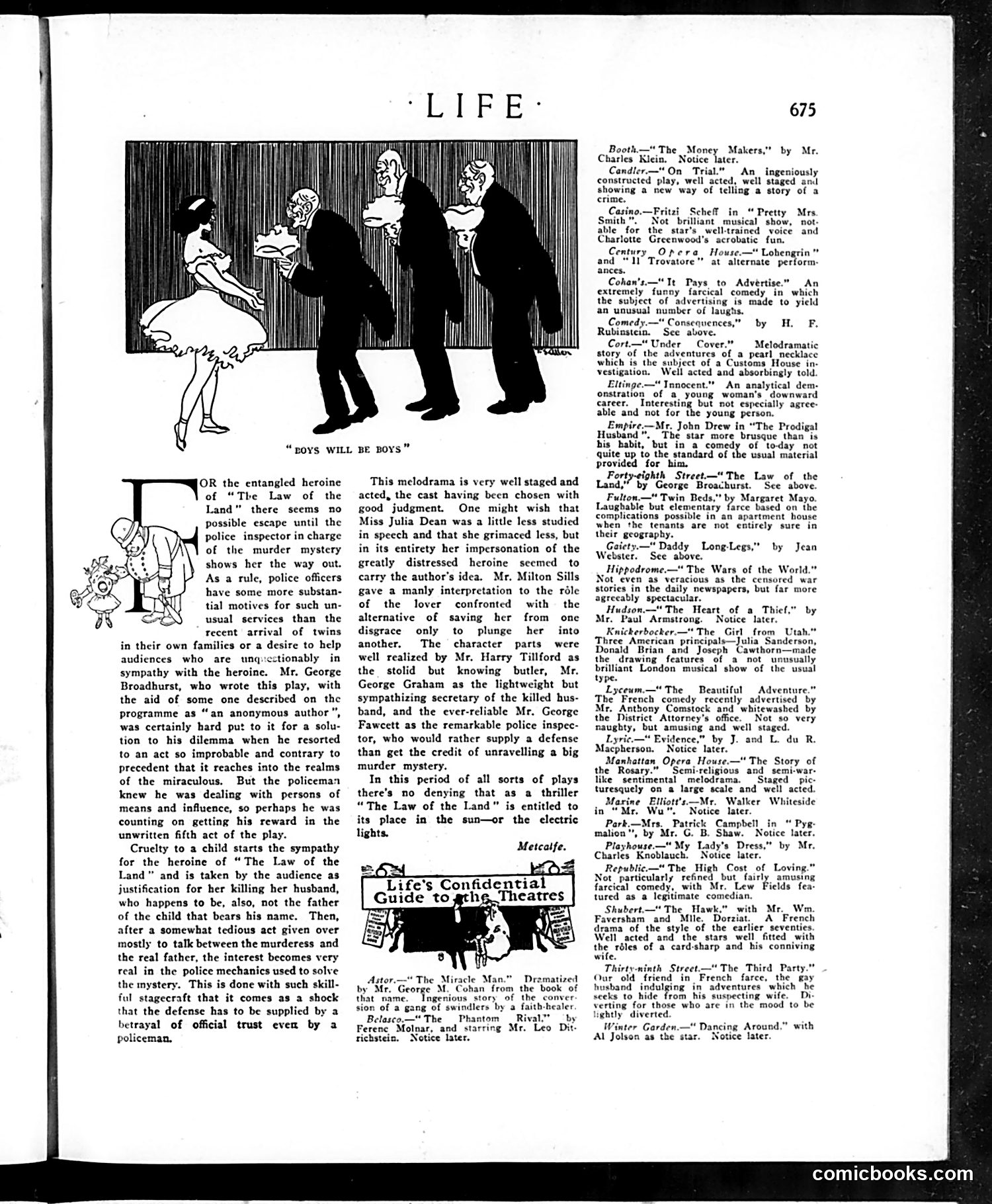
This page reviews "The Law of the Land," a melodrama about a woman who kills her unfaithful husband. The cartoon's caption "Boys Will Be Boys" sarcastically comments on the plot's central absurdity: a police inspector solves the murder but then *betrays his official duty* to help the guilty heroine escape, apparently expecting future favors or reward. The reviewer criticizes this implausible resolution as "improbable and contrary to precedent," occurring only because the heroine comes from a wealthy, influential family. The satire targets both the play's contrived plotting and the corruption it depicts—a policeman prioritizing personal gain over justice. The cartoon depicts three pompous gentlemen, likely representing the complicit male characters (butler, secretary, inspector) enabling her escape through their "stagecraft."
📄 Transcribed text from this page (OCR, searchable)
Machine-transcribed from the original scan — historical spelling and the odd misread are preserved.
} | | ith | AEA, “poys WILL OR the entangled heroine of “The Law of the Land" there seems no possible escape until the police inspector in charge of the murder mystery shows her the way out. As a rule, police officers have some more substan- tial motives for such un- usual services than the recent arrival of twins in their own families or a desire to help audiences who are unq::cctionably in sympathy with the heroine. Mr. George Broadhurst, who wrote this play, with the aid of some one described on the programme as “an anonymous author", was certainly hard put to it for a solu- tion to his dilemma when he resorted to an act so improbable and contrary to precedent that it reaches into the realms of the miraculous, But the policeman knew he was dealing with persons of means and influence, so perhaps he was counting on getting his reward in the unwritten fifth act of the play. Cruelty to a child starts the sympathy for the heroine of “The Law of the Land" and is taken by the audience as justification for her killing her husband, who happens to be, also, not the father of the child that bears his name. Then, after a somewhat tedious act given over mostly to talk between the murderess and the real father, the interest becomes very real in the police mechanics used to solve the mystery. This is done with such skill- ful stagecraft that it comes as a shock that the defense has to be supplied by a betrayal of official trust even by a policeman. IN | | This melodrama is very well staged and acted, the cast having been chosen with good judgment. One might wish that Miss Julia Dean was a little less studied in speech and that she grimaced less, but in its entirety her impersonation of the greatly distressed heroine seemed to carry the author's idea. Mr. Milton Sills gave a manly interpretation to the réle of the lover confronted with the alternative of saving her from one disgrace only to plunge her into another. The character parts were well realized by Mr. Harry Tillford as the stolid but knowing butler, Mr. George Graham as the lightweight but sympathizing secretary of the killed hus- band, and the ever-reliable Mr. George Fawcett as the remarkable police inspec- tor, who would rather supply a defense than get the credit of unravelling a big murder mystery. In this period of all sorts of plays there’s no denying that as a. thriller “The Law of the Land” is entitled to its place in the sun—or the electric lights. bal | BE Boys” Metcalfe. Life's Confidentia Guide to gthg Theatres —" The Miracle Man.” Drematized eorge M. Cohan from the book of fame. Ingenious story of the conver a gang of swindlers by a faith-healer —“The Phantom | Rival.” _by Molnar, and starring Mr. Leo Dit- richstein. Notice later. 675 Booth—" The Money Makers," by Mr. Charles Klein. Notice later. Candter.—"On Trial.” An ingeniously constructed play, well acted, well staged and showing a new way of telling a story of a crime. Casino.—Fritzi Scheff in “Pretty Mrs Smith.” Not brilliant musical show, not- able for the star's well-trained voice and Charlotte Greenwood’s acrobatic fun. Century Opera, House.—" Lobengrin” and “11 Trovatore" at alternate perform: ances. Cohan’s.—""Tt Pays to Advertise.” An extremely funny farcical comedy in which the subject of advertising is made to yield an unusual number of laughs. Comedy.—" Consequences,” by H. F. Rubinstein. See above. Cort—" Under Cover.” Melodramatic story of the adventures of a pearl necklace which is the subject of a Customs House in- vestigation. Well acted and absorbingly told. Eltinge.—" Innocent.” An analytical dem- onstration of a young woman's downward career. Interesting but not especially agree- able and not for the young person. Empire.—Mr. John Drew in “The Prodigal Husband *, “The star more brusque than is his habit, but in a comedy of today not quite up to the standard of the usual material provided for him. he Law of the Forty-eighth Street. Land: ‘See above. J" by George Broacburst. Fulton.—" Twin Beds by, Margaret Mayo. Laughable but elementary farce based on the complications possible in an apartment house when the tenants are not entirely sure in their geography. Goiety.—" Daddy Long-Legs," by Webster. See above. Hippodrome.—" The Wars, of the World.” Not even as veracious as the censored war stories in the daily newspapers, but far more agreeably spectacular. Hudson.—" The Heart of a. Thief.” by Paul Armstrong. Notice later. Knickerbocker.- The Girl from Utah.” Three American principals—Julia Sanderson, Donald Brian and Joseph Cawthorn—made the drawing features of a not. unusually brilliant London musical show of the usual type. Lyceum.—" The Beautiful Adventure.” The French comedy recently advertised by Mr. Anthony Comstock and whitewashed by the District Attorney's office. Not so very naughty, but amusing and well staged. Lyrie.—“ Evidence,” by J. and L. du R. Macpherson. Notice later. Manhattan Opera House.—" The Story of the Rosary.” Semi-religious and. semi-war- like sentimental melodrama. Staged. pi turesquely on a large scale and well acted. Marine Elliott's:—Mr. Walker Whiteside in “Mr. Wu”. Notice later. Mrs. Patrick Campbell in “ Pyg- Mr. G. B. Shaw. Notice later. Playhouse-—" My Lady's Dress,” by Mr. Charles Knoblauch. Notice later. Republic.—* The High Cost of Loving.” Not ‘particularly refined. but fairly amusing farcical comedy, with Mr. Lew Fields fear tured as a legitimate comedian, Shubert.—" The Hawk.” with Mr. Wm. Faversham and Mile. Dorzi A French drama of the style of the earlier. seventies Well acted and the stars well fitted with the réles of a card-sharp and his conniving wife. Thirty-ninth Street.—" The Third Party.” Our old friend in French farce, the gay husband indulging in adventures which he seeks to hide from his suspecting wife. Di- verting for those who are in the mood to be lightly diverted Winter Garden.—" Dancing Around,” with Al Jolson as the star. Notice later. Jean comicbooks.com