
Life, 1914-10-15 · page 18 of 48
Life — October 15, 1914 — page 18: what you’re looking at
What you’re looking at
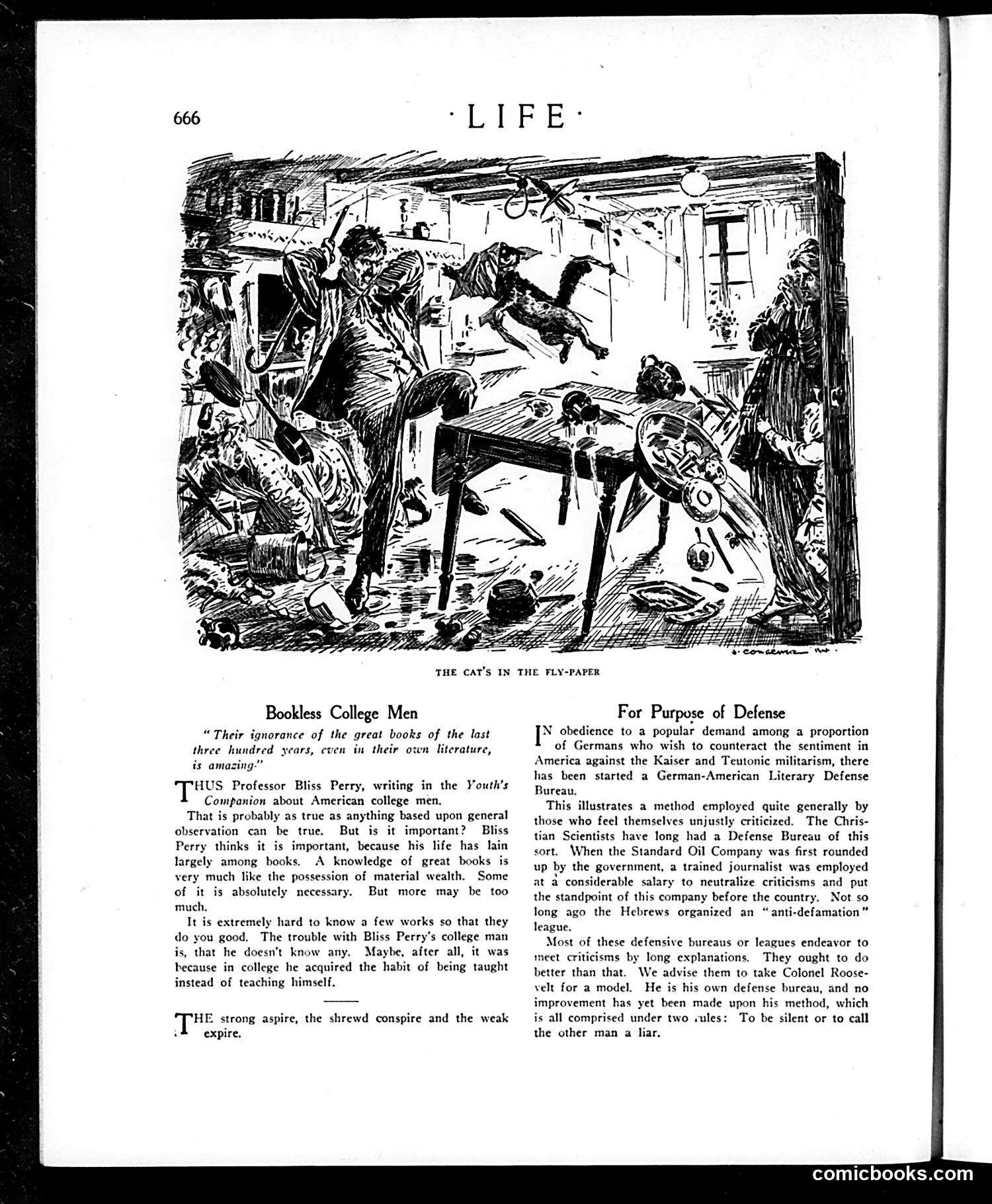
The cartoon "The Cat's in the Fly-Paper" illustrates the chaos of a household where a cat has gotten stuck in flypaper—a visual metaphor for being trapped or entangled. The page contains two separate satirical articles: **"Bookless College Men"** mocks Professor Bliss Perry's criticism that American college students haven't read classic literature. The author argues Perry overvalues book knowledge and suggests college men's real problem is passively accepting instruction rather than self-education. **"For Purpose of Defense"** critiques the newly formed German-American Literary Defense Bureau (appearing during WWI tensions). Life sarcastically compares defensive PR operations—used by Christian Scientists, Standard Oil, and Jewish organizations—to Colonel Roosevelt's blunt communication style. The satire suggests these defensive bureaus fail because they over-explain; Roosevelt succeeds by either staying silent or attacking critics directly. The piece mocks both the bureau's propaganda efforts and American corporate/institutional damage control generally.
📄 Transcribed text from this page (OCR, searchable)
Machine-transcribed from the original scan — historical spelling and the odd misread are preserved.
THE CAT'S IN THE FLY-PAPER Bookless College Men “Their ignorance of the great books of the last three hundred years, even in their own literature, is amazing-” THs Professor Bliss Perry, writing in the Youth's Companion about American college men. That is probably as true as anything based upon general observation can be true. But is it important? Bliss Perry thinks it is important, because his life has lain largely among books. A knowledge of great books is very much like the possession of material wealth. Some of it is absolutely necessary. But more may be too much, It is extremely hard to know a few works so that they do you good. The trouble with Bliss Perry’s college man is, that he doesn’t know any. Maybe, after all, it was because in college he acquired the habit of being taught instead of teaching himself. HE strong aspire, the shrewd conspire and the weak expire, For Purpose of Defense IX obedience to a popular demand among a proportion of Germans who wish to counteract the sentiment in America against the Kaiser and Teutonic militarism, there has been started a German-American Literary Defense Bureau. This illustrates a method employed quite generally by those who feel themselves unjustly criticized. The Chris- tian Scientists have long had a Defense Bureau of this sort. When the Standard Oil Company was first rounded up by the government, a trained journalist was employed at a considerable salary to neutralize criticisms and put the standpoint of this company before the country. Not so long ago the Hebrews organized an “anti-defamation” league. Most of these defensive bureaus or leagues endeavor to meet criticisms by long explanations. They ought to do better than that. We ad them to take Colonel Roose- velt for a model. He is his own defense bureau, and no improvement has yet been made upon his method, which is all comprised under two cules: To be silent or to call the other man a liar. comicbooks.com