
Life, 1914-10-15 · page 23 of 48
Life — October 15, 1914 — page 23: what you’re looking at
What you’re looking at
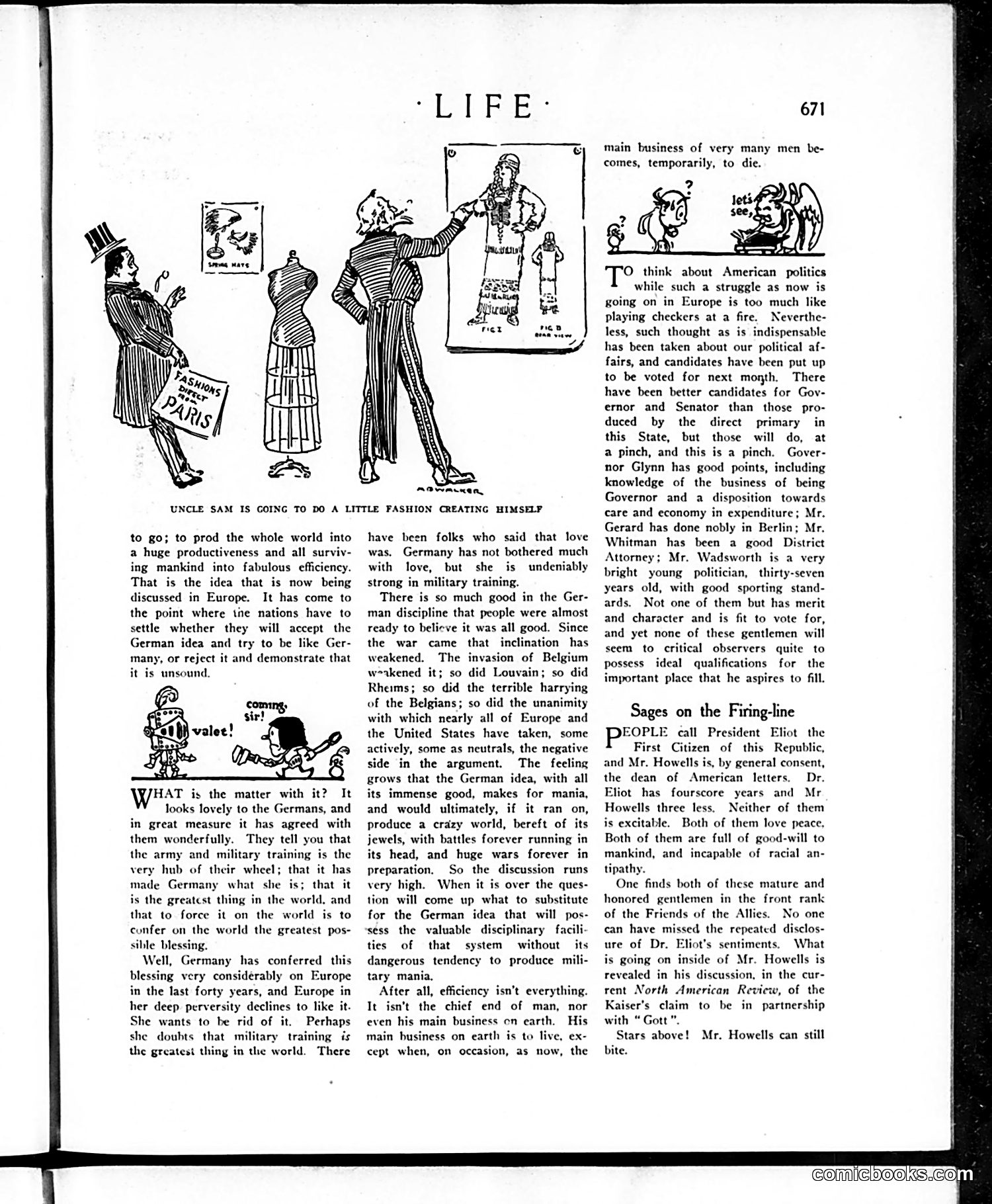
**The Cartoon:** "Uncle Sam is Going to do a Little Fashion Creating Himself" depicts Uncle Sam (personified America) as a tailor examining German military fashion/ideology. The image satirizes American consideration of adopting German-style militarism. **Context:** Written during WWI, the text debates whether America should embrace German military discipline and efficiency—Germany's stated strength. The author acknowledges German organizational excellence but argues it produces dangerous "military mania," evidenced by Belgium's invasion, destruction of Louvain and Rheims, and widespread European/American opposition. **The Point:** The satire warns that blind adoption of German methods—however efficient—risks corrupting American values. The "fashion" metaphor suggests American temptation to copy Germany's system, but the tailoring imagery implies Uncle Sam should create his own approach, not merely imitate. **Secondary content** briefly discusses 1916 gubernatorial candidates (Glynn, Gerard, Whitman, Wadsworth), praising their merits while noting none perfectly fills the role—a secondary satirical point about American politics during wartime.
📄 Transcribed text from this page (OCR, searchable)
Machine-transcribed from the original scan — historical spelling and the odd misread are preserved.
Ranma, UNCLE SAM IS GOING TO DO A LITTLE FASHION CREATING HIMSELF to go; to prod the whole world into a huge productiveness and all survi ing mankind into fabulous efficiency. That is the idea that is now being discussed in Europe. It has come to the point where the nations have to settle whether they will accept the German idea and try to be like Ger- many, or reject it and demonstrate that it is unsound. HAT is the matter with it? It looks lovely to the Germans, and in great measure it has agreed with them wonderfully. They tell you that the army and military training is the very hub of their wheel; that it has made Germany what she is; that it is the greatest thing in the world, and that to force it on the world is to confer on the world the greatest pos- sible blessing. Well, Germany has conferred this blessing very considérably on Europe in the last forty years, and Europe in her deep perversity declines to like it. She wants to be rid of it. Perhaps she doubts that military training is the greatest thing in the world. There have been folks who said that love was. Germany has not bothered much with love, but she is undeniably strong in military training. There is so much good in the Ger- man discipline that people were almost ready to believe it was all good. Since the war came that inclination has weakened. The invasion of Belgium weakened it; so did Louvain; so did Rheims; so did the terrible harrying of the Belgians; so did the unanimity with which nearly all of Europe and the United States have taken, some actively, some as neutrals, the negative side in the argument. The feeling grows that the German idea, with all its immense good, makes for mania, and would ultimately, if it ran on, produce a crdzy world, bereft of its jewels, with battles forever running in its head, and huge wars forever in preparation. So the discussion runs very high. When it is over the ques- tion will come up what to substitute for the German idea that will pos- sess the valuable disciplinary faci ties of that system without its dangerous tendency to produce mili- tary mania, After all, efficiency isn’t everything. It isn’t the chief end of man, nor even his main business cn earth. His main business on earth is to live, ex- cept when, on occasion, as now, the 671 main business of very many men be- comes, temporarily, to die. T° think about American politics while such a struggle as now is going on in Europe is too much like playing checkers at a fire. Neverthe- less, such thought as is indispensable has been taken about our political af- fairs, and candidates have been put up to be voted for next month, There have been better candidates for Gov- ernor and Senator than those pro- duced by the direct primary in this State, but those will do, at a pinch, and this is a pinch. Gover- nor Glynn has good points, including knowledge of the business of being Governor and a disposition towards care and economy in expenditure; Mr. Gerard has done nobly in Berlin; Mr. Whitman has been a good District Attorney; Mr. Wadsworth is a very bright young politician, thirty-seven years old, with good sporting stand- ards. Not one of them but has merit and character and is fit to vote for, and yet none of these gentlemen will seem to critical observers quite to possess ideal qualifications for the important place that he aspires to fill. Sages on the Firing-line EOPLE call President Eliot First Citizen of this Republic, and Mr. Howells is, by general consent, the the dean of American letters. Dr. Eliot has fourscore years and Mr Howells three less. Neither of them is excitable. Both of them love peace, Both of them are full of good-will to mankind, and incapable of racial an- tipathy. One finds both of these mature and honored gentlemen in the front rank of the Friends of the Allies. No one can have missed the repeated disclos- ure of Dr. Eliot's sentiments. What is going on inside of Mr. Howells is revealed in his discussion, in the cur- rent North American Review, of the Kaiser's claim to be in partnership with “Gott”. Stars above! bite. Mr. Howells can still