
Life, 1914-10-15 · page 32 of 48
Life — October 15, 1914 — page 32: what you’re looking at
What you’re looking at
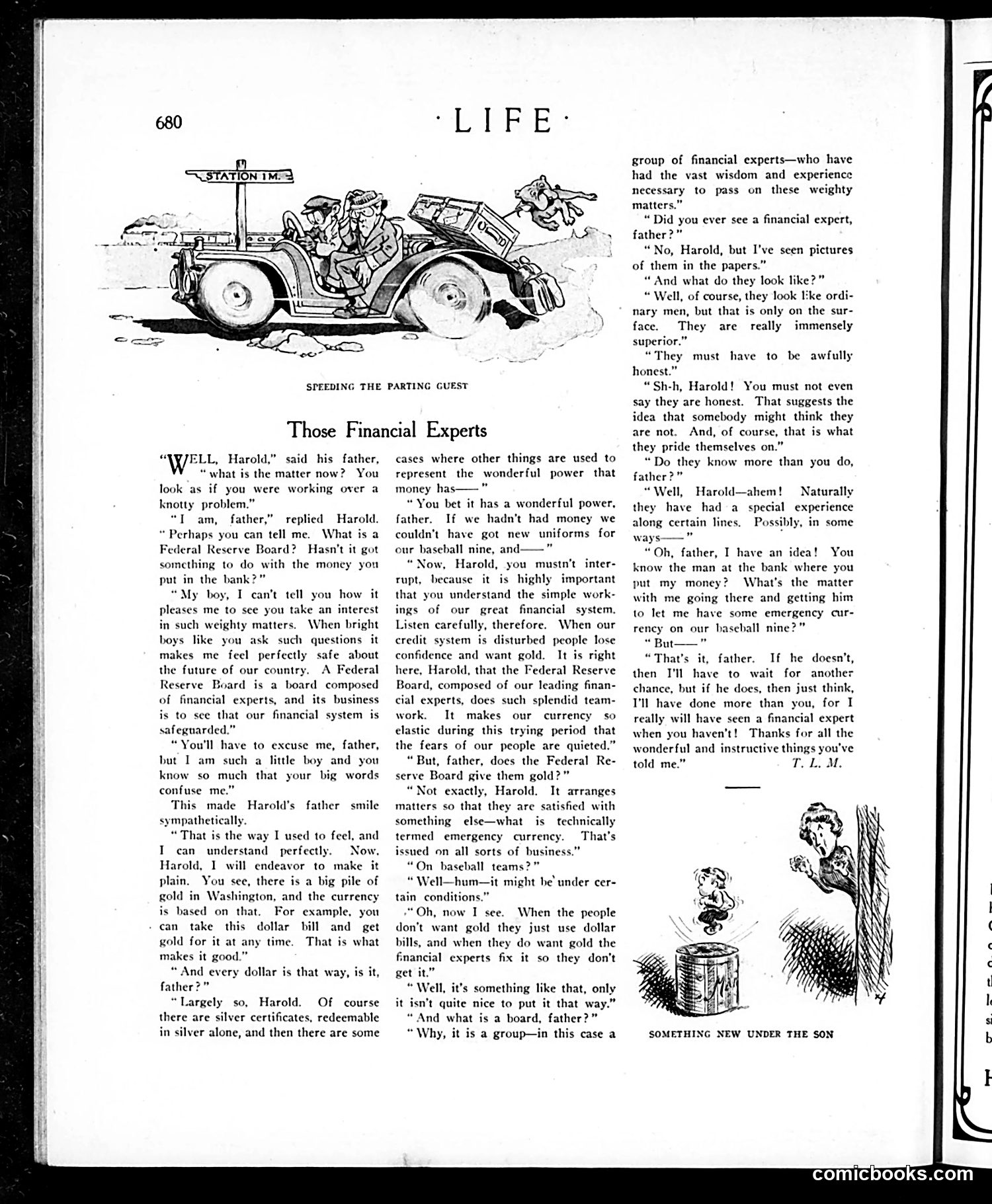
This page satirizes the Federal Reserve System through a father-son dialogue. The father struggles to explain the Federal Reserve Board's function in accessible terms, ultimately revealing through the boy's naive questions that the system is circular and obscure: financial experts manipulate currency to prevent people from demanding actual gold, rather than ensuring they can obtain it. The cartoon above ("Speeding the Parting Guest") depicts a car overloaded with luggage, visually echoing the text's theme—the "financial experts" are like unwelcome guests being hurried away with their accumulated baggage. The satire targets post-WWI confusion about banking systems and suggests the Federal Reserve operates through obfuscation rather than transparent principles. The boy's innocent logic exposes the gap between the father's reverent description of these "immensely superior" experts and their actual function: managing public confidence rather than guaranteeing financial security. The humor lies in how easily the elaborate system collapses under simple questioning.
📄 Transcribed text from this page (OCR, searchable)
Machine-transcribed from the original scan — historical spelling and the odd misread are preserved.
SPEEDING THE PARTING GUEST Those Financial Experts L, Harold,” said his father, “what is the matter now? You look as if you were working over a knotty problem.” “Tam, father,” replied Harold. * Perhaps you can tell me. What is a Federal Reserve Board? Hasn't it got something to do with the money you put in the bank?” “My boy, I can’t tell you how it pleases me to sce you take an interest in such weighty matters. When bright boys like you ask such questions it makes me feel perfectly safe about the future of our country. A Federal Reserve Board is a board composed of financial experts, and its business is to see that our financial system is safeguarded.” You'll have to excuse me, father, but 1 am such a little boy and you know so much that your big words confuse me.” This made Harold's father smile sympathetically “That is the I used to feel, and I can understand perfectly. Now. Harold, 1 will endeavor to make it plain. You see, there is a big pile of gold in Washington, and the currency is based on that. For example, you can take this dollar bill and get gold for it at any time. That is what makes it good. “And every dollar is that way, is it, father?” “Largely so, Harold. Of course there are silver certificates, redeemable in silver alone, and then there are some cases where other things are used to represent the wonderful power that money has—” “You bet it has a wonderful power, father. If we hadn't had money we couldn't have got new uniforms for our baseball nine, and—”" “Now, Harold, you mustn't inter- rupt, because it is highly important that you understand the simple work- ings of our great financial system. Listen carefully, therefore. When our credit system is disturbed people lose confidence and want gold. It is right here, Harold, that the Federal Reserve Board, composed of our leading finan- cial experts, does such splendid team- work. It makes our currency so elastic during this trying period that the fears of our people are quieted.” “But, father, does the Federal Re- serve Board give them gold?” “Not exactly, Harold. It arranges matters so that they are satisfied with something else—what is technically termed emergency currency. That's issued on all sorts of business.” “On baseball teams?” “ Well—hum—it might be under cer- tain conditions.” “Oh, now I see. When the people don’t want gold they just use dollar bills, and when they do want gold the financial experts fix it so they don't get it.” “Well, it’s something like that, only it isn’t quite nice to put it that way.” “And what is a board, father? “Why, it is a group—in this case a group of financial experts—who have had the vast wisdom and experience necessary to pass on these weighty matters.” “ Did you ever see a financial expert, father?” “No, Harold, but I've seen pictures of them in the papers.” “And what do they look like?” “Well, of course, they look ke ordi- nary men, but that is only on the sur- face. They are really immensely superior.” “They must have to be awfully honest.” “$Sh-h, Harold! You must not even say they are honest. That suggests the idea that somebody might think they are not. And, of course, that is what they pride themselves on.’ “Do they know more than you do, father?” “Well, Harold—ahem! — Naturally they have had a special experience along certain lines. Possibly, in some ways——” . “Oh, father, I have an idea! You know the man at the bank where you put my money? What's the matter with me going there and getting him to let me have some emergency cur- rency on our baseball nine?” “But——" “That's it, father. If he doesn’t, then I'll have to wait for another chance, but if he does, then just think, I'll have done more than you, for I really will have seen a financial expert when you haven't! Thanks for all the wonderful and instructive things you've SOMETHING NEW UNDER THE SON comicbooks.com