
Life, 1914-10-15 · page 26 of 48
Life — October 15, 1914 — page 26: what you’re looking at
What you’re looking at
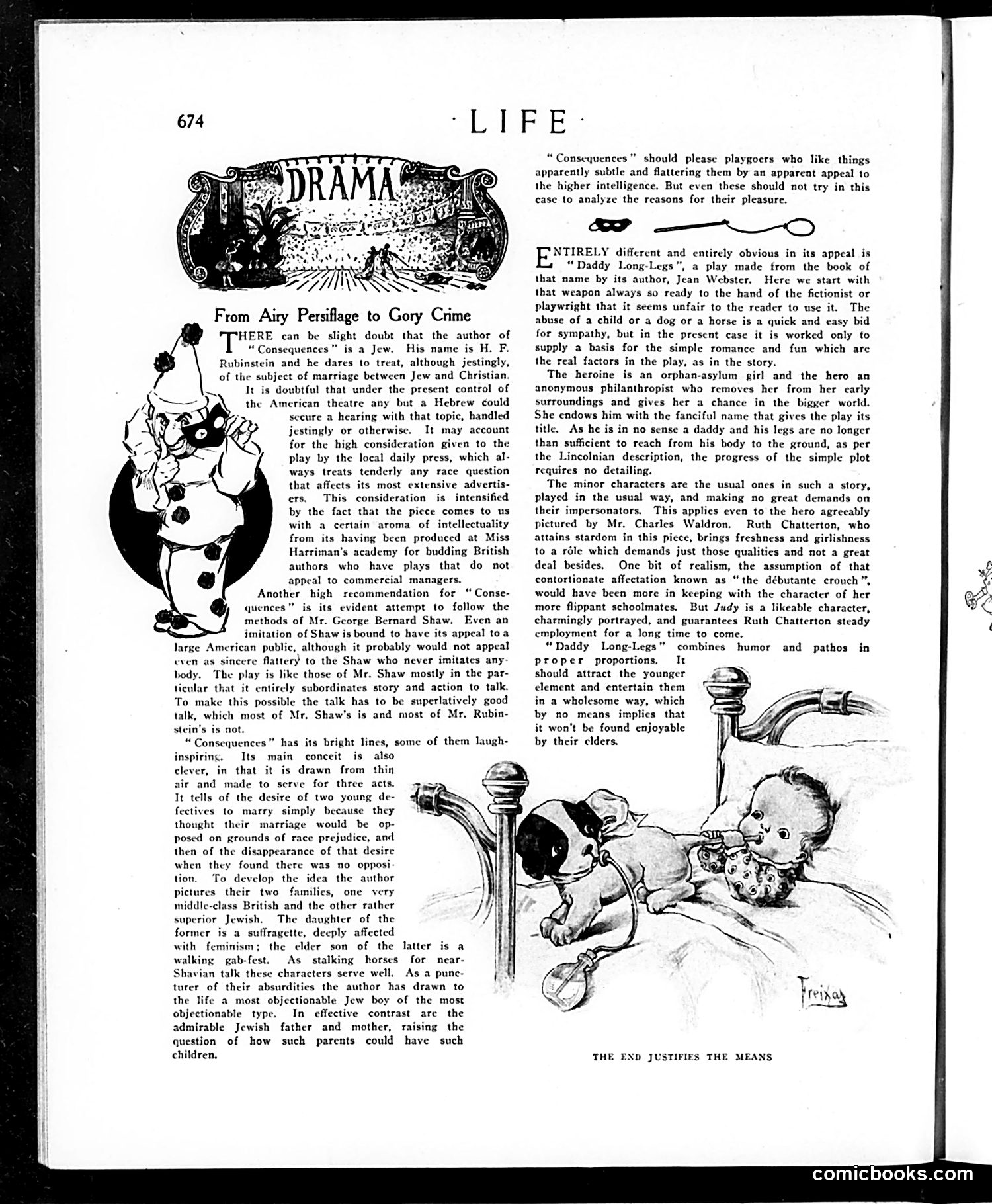
This Life magazine drama review page critiques two plays: "Consequences" by H.F. Rubinstein and "Daddy Long-Legs" adapted by Jean Webster. The "Consequences" review is notably hostile to Rubinstein for being Jewish and daring to treat intermarriage between Jews and Christians as comedy material. The critic suggests only a Hebrew could get American theaters to hear such a topic, and attributes the play's favorable press coverage to Jewish advertising influence rather than merit. He praises its Shaw-like intellectualism while dismissing its execution, and objects to its portrayal of "a most objectionable Jew boy" while praising the Jewish parents—reflecting the era's casual antisemitic stereotyping. The "Daddy Long-Legs" review is more straightforward, praising its sentimental orphan-girl story and romance as wholesome entertainment for younger audiences. The cartoons illustrate both plays with period-style drawings.
📄 Transcribed text from this page (OCR, searchable)
Machine-transcribed from the original scan — historical spelling and the odd misread are preserved.
“LDF EB From Airy Persiflage to Gory Crime HERE can be slight doubt that the author of “Consequences” is a Jew. His name is H. F. Rubinstein and he dares to treat, although jestingly, of the subject of marriage between Jew and Christian. It is doubtful that under the present control of the American theatre any but a Hebrew could secure a hearing with that topic, handled jestingly or otherwise. It may account for the high consideration given to the play by the local daily press, which al- ways treats tenderly any race question that affects its most extensive advertis- ec This consideration is intensified by the fact that the piece comes to us with a certain aroma of intellectuality from its having been produced at Miss Harriman’s academy for budding British authors who have plays that do not appeal to commercial managers. Another high recommendation for “ Conse- quences" is its evident attempt to follow the methods of Mr. George Bernard Shaw. Even an imitation of Shaw is bound to have its appeal toa large American public, although it probably would not appeal even as sincere flattery to the Shaw who never imitates any- body. The play is like those of Mr. Shaw mostly in the par- ticular that it entirely subordinates story and action to talk. To make this possible the talk has to be superlatively good talk, which most of Mr. Shaw's is and most of Mr. Rubin- 's is not. “ Consequences” has its bright line: inspiring. Its main conceit is also clever, in that it is drawn from thin air and made to serve for three acts. It tells of the desire of two young de- fectives to marry simply because they thought their marriage would be op- posed on grounds of race prejudice, and then of the disappearance of that desire when they found there was no opposi tion. To develop the idea the author pictures their two families, one very middle-class British and the other rather superior Jewish. The daughter of the former is a suffragette, deeply affected some of them laugh- / /\ with feminis the elder son of the latter is a | walking gab-fest. As stalking horses for near- | Shavian talk these characters serve well. Asa punc- — { turer of their absurdities the author has drawn to the life a most objectionable Jew boy of the most objectionable type. In effective contrast are the admirable Jewish father and mother, raising the question of how such parents could have such children, “Consequences” should please playgoers who like things apparently subtle and flattering them by an apparent appeal to the higher intelligence. But even these should not try in this case to analyze the reasons for their pleasure. er o_O ENaIREty different and entirely obvious in its appeal is “Daddy Long-Legs", a play made from the book of that name by its author, Jean Webster. Here we start with that weapon always so ready to the hand of the fictionist or playwright that it seems unfair to the reader to use it. The abuse of a child or a dog or a horse is a quick and easy bid for sympathy, but in the present case it is worked only to supply a basis for the simple romance and fun which arc the real factors in the play, as in the story, The heroine is an orphan-asylum girl and the hero an anonymous philanthropist who removes her from her early surroundings and gives her a chance in the bigger world. She endows him with the fanciful name that gives the play its title, As he is in no sense a daddy and his legs are no longer than sufficient to reach from his body to the ground, as per the Lincolnian description, the progress of the simple plot requires no detailing. The minor characters are the usual ones in such a story, played in the usual way, and making no great demands on their impersonators. This applies even to the hero agreeably pictured by Mr. Charles Waldron. Ruth Chatterton, who attains stardom in this piece, brings freshness and girlishness to a réle which demands just those qualities and not a great deal besides, One bit of realism, the assumption of that contortionate affectation known as “the débutante crouch”, would have been more in keeping with the character of her more flippant schoolmates. But Judy is a likeable character, charmingly portrayed, and guarantees Ruth Chatterton steady employment for a long time to come. “Daddy Long-Legs” combines humor Proper proportions. It should attract the younger element and entertain them a wholesome way, which by no means implies that it won't be found enjoyable by their elders. and pathos in THE END JUSTIFIES THE MEANS comicbooks.com