
Life, 1914-10-15 · page 8 of 48
Life — October 15, 1914 — page 8: what you’re looking at
What you’re looking at
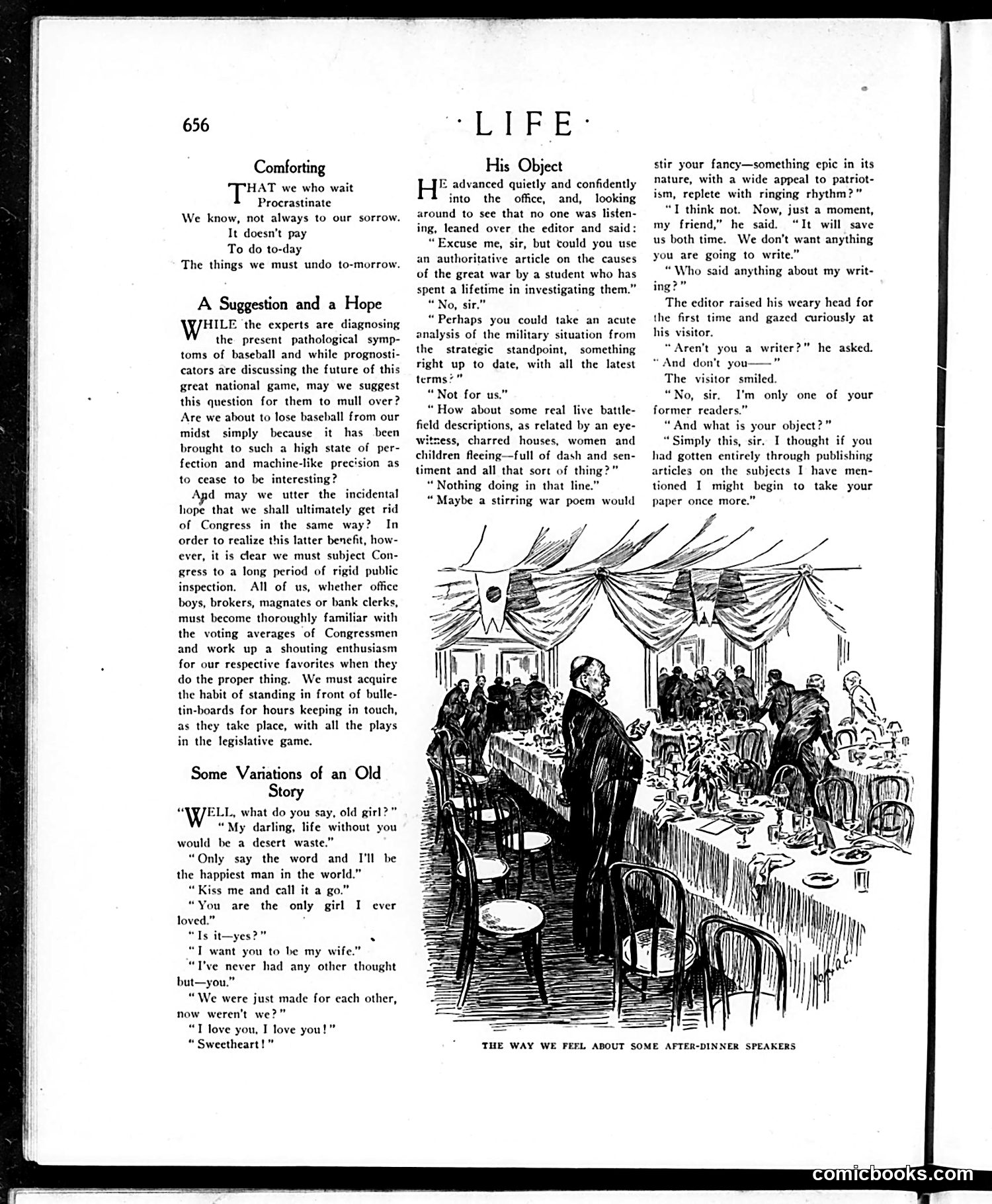
This page contains two satirical pieces. The main illustration captioned "The Way We Feel About Some After-Dinner Speakers" depicts a formal banquet scene with a long-winded speaker addressing a seated audience. The cartoon satirizes the tedium of after-dinner speeches—a common social obligation of the era—showing the speaker's lengthy remarks boring his captive audience. The text sections include brief humorous pieces: "Comforting Thoughts," "A Suggestion and a Hope" (discussing baseball and Congressional reform), and "Some Variations of an Old Story" (romantic clichés). These are typical Life magazine filler content mocking social conventions and predictable behavior patterns familiar to contemporary readers.
📄 Transcribed text from this page (OCR, searchable)
Machine-transcribed from the original scan — historical spelling and the odd misread are preserved.
Comforting HAT we who wait Procrastinate We know, not always to our sorrow. It doesn’t pay To do to-day The things we must undo to-morrow. A Suggestion and a Hope 'HILE the experts are diagnosing the present pathological symp- toms of baseball and while prognosti- cators are discussing the future of this great national game, may we suggest this question for them to mull over? Are we about to lose baseball from our midst simply because it has been brought to such a high state of per- fection and machine-like precision as to cease to be interesting? Apd may we utter the incidental hope that we shall ultimately get rid of Congress in the same way? In order to realize this latter benefit, how- ever, it is dear we must subject Con- gress to a long period of rigid public inspection. All of us, whether office boys, brokers, magnates or bank clerks, must become thoroughly familiar with the voting averages of Congressmen and work up a shouting enthusiasm for our respective favorites when they do the proper thing. We must acquire the habit of standing in front of bulle- tin-boards for hours keeping in touch, as they take place, with all the plays in the legislative game. Some Variations of an Old Story LL, what do you say, old girl?” “My darling, life without you would be a desert waste.” “Only say the word and I'll be the happiest man in the world.” “Kiss me and call it a go.” “You are the only girl loved.” s it—yes?” . “T want you to be my wife.” “T've never had any other thought but—you.” “We were just made for each other, now weren't we?” “T love you, I love you!” “ Sweetheart!" 1 ever oS LeIPUE:,* His Object HE atvanced quietly and confidently into the office, and, looking around to see that no one was listen- ing, leaned over the editor and said: “Excuse me, sir, but tould you use an authoritative article on the causes of the great war by a student who has spent a lifetime in investigating them.” “No, sir.” “Perhaps you could take an acute analysis of the military situation from the strategic standpoint, something right up to date, with all the latest terms?" “Not for us.” “How about some real live battle- field descriptions, as related by an eye- witness, charred houses, women and children fleeing—full of dash and sen- timent and all that sort of thing?” “Nothing doing in that line.” “Maybe a stirring war poem would stir your fancy—something epic in its nature, with a wide appeal to patriot- ism, replete with ringing rhythm?” “I think not. Now, just a moment, my friend,” he said. “It will save us both time. We don’t want anything you are going to write.” “Who said anything about my writ- ing?” The editor raised his weary head for the first time and gazed curiously at his visitor. “Aren't you a writer?” he asked. “And don't you——” The visitor smiled. “No, sir. I'm only one of your former readers.” “And what is your object?” “Simply this, sir. I thought if you had gotten entirely through publishing articles on the subjects I have men- tioned I might begin to take your paper once more.” THE WAY WE FEEL ABOUT SOME AFTER-DINNER SPEAKERS