
Life, 1914-10-15 · page 22 of 48
Life — October 15, 1914 — page 22: what you’re looking at
What you’re looking at
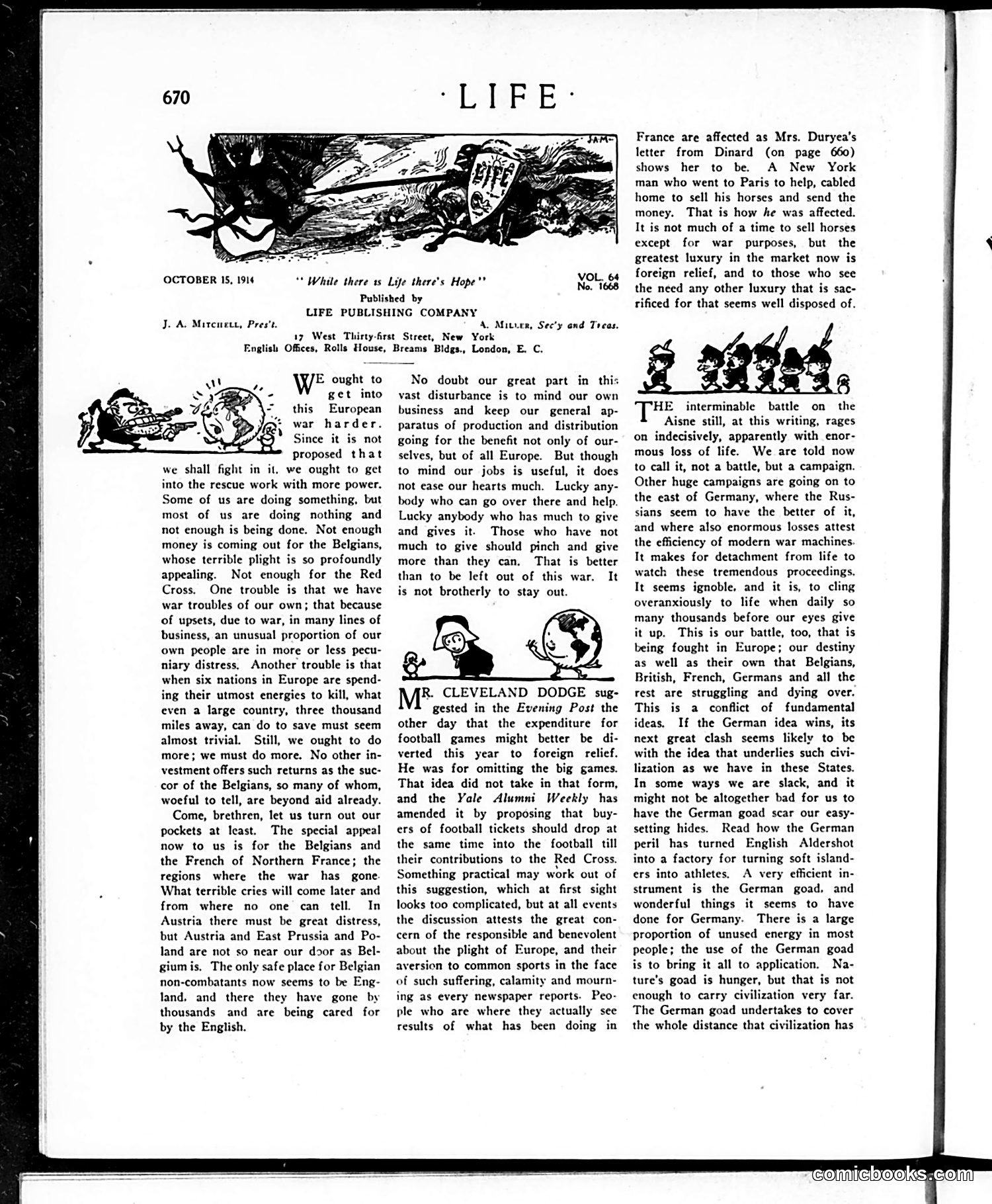
This page from Life magazine addresses American charitable response to World War I, which had begun months earlier in Europe. The editorial argues Americans should increase financial relief efforts for Belgian and French civilians displaced by the war, despite America's official neutrality. The cartoons appear to show a figure (likely representing America or Americans) being urged toward action. The text references Cleveland Dodge's proposal to divert football game expenditures to foreign relief, and mentions Yale Alumni Weekly's compromise: donations to the Red Cross collected at football ticket gates. The central argument: while America shouldn't enter the war militarily, Americans with resources have a moral obligation to provide humanitarian aid. The editorial emphasizes that financial contributions—even personal sacrifice like selling horses—represent meaningful engagement with European suffering. The overall tone combines moral pressure with practical fundraising appeals, reflecting Progressive-era activism channeled toward wartime charity.
📄 Transcribed text from this page (OCR, searchable)
Machine-transcribed from the original scan — historical spelling and the odd misread are preserved.
OCTOBER 15, 191¢ “While there 1s Life there's Hope"* Published by LIFE PUBLISHING COMPANY J. A. Mircnett, Pres’t. A. Miner, Sec’y and Treas. 17 West Thirty-first Street, New York English Offices, Rolls House, Breams Bldgs., London, E. C. E ought to get into this European war harder. Since it is not Proposed that we shall fight in it, we ought to get into the rescue work with more power. Some of us are doing something, but most of us are doing nothing and not enough is being done. Not enough money is coming out for the Belgians, whose terrible plight is so profoundly appealing. Not enough for the Red Cross. One trouble is that we have war troubles of our own; that because of upsets, due to war, in many lines of business, an unusual proportion of our own people are in more or less pecu- niary distress, Another trouble is that when six nations in Europe are spend- ing their utmost energies to kill, what even a large country, three thousand miles away, can do to save must seem almost trivial. Still, we ought to do more; we must do more. No other in- vestment offers such returns as the suc- cor of the Belgians, so many of whom, woeful to tell, are beyond aid already. Come, brethren, let us turn out our pockets at Icast. The special appeal now to us is for the Belgians and the French of Northern France; the regions where the war has gone. What terrible cries will come later and from where no one can tell. In Austria there must be great distress, but Austria and East Prussia and Po- land are not so near our door as Bel- giumis, The only safe place for Belgian non-combatants now seems to be Eng- land. and there they have gone by thousands and are being cared for by the English. No doubt our great part in this vast disturbance is to mind our own business and keep our general ap- paratus of production and distribution going for the benefit not only of our- selves, but of all Europe. But though to mind our jobs is useful, it does not ease our hearts much. Lucky any- body who can go over there and help. Lucky anybody who has much to give and gives it. Those who have not much to give should pinch and give more than they can. That is better than to be left out of this war. It is not brotherly to stay out. R. CLEVELAND DODGE sug- gested in the Evening Post the other day that the expenditure for football games might better be di- verted this year to foreign relief. He was for omitting the big games. That idea did not take in that form, and the Yale Alumni Weekly has amended it by proposing that buy- ers of football tickets should drop at the same time into the football till their contributions to the Red Cross. Something practical may work out of this suggestion, which at first sight looks too complicated, but at all events the discussion attests the great con- cern of the responsible and benevolent about the plight of Europe, and their aversion to common sports in the face of such suffering, calamity and mourn- ing as every newspaper reports. Peo- ple who are where they actually see results of what has been doing in France are affected as Mrs. Duryea’s letter from Dinard (on page 660) shows her to be. A New York man who went to Paris to help, cabled home to sell his horses and send the money. That is how he was affected. It is not much of a time to sell horses except for war purposes, but the greatest luxury in the market now is foreign relief, and to those who see the need any other luxury that is sac- rificed for that seems well disposed of. HE interminable battle on the Aisne still, at this writing, rages on indecisively, apparently with enor- mous loss of life. We are told now to call it, not a battle, but a campaign. Other huge campaigns are going on to the east of Germany, where the Rus- sians seem to have the better of it, and where also enormous losses attest the efficiency of modern war machines. It makes for detachment from life to watch these tremendous proceedings. It seems ignoble, and it is, to cling overanxiously to life when daily so many thousands before our eyes give it up. This is our battle, too, that is being fought in Europe; our destiny as well as their own that Belgians, British, French, Germans and all the rest are struggling and dying over. This is a conflict of fundamental ideas. If the German idea wins, its next great clash seems likely to be with the idea that underlies such civi- lization as we have in these States. In some ways we are slack, and it might not be altogether bad for us to have the German goad scar our easy- setting hides. Read how the German peril has turned English Aldershot into a factory for turning soft island- ers into athletes. A very efficient in- strument is the German goad, and wonderful things it seems to have done for Germany. There is a large Proportion of unused energy in most people; the use of the German goad is to bring it all to application. Na- ture’s goad is hunger, but that is not enough to carry civilization very far. The German goad undertakes to cover the whole distance that civilization has