
Life, 1914-10-15 · page 20 of 48
Life — October 15, 1914 — page 20: what you’re looking at
What you’re looking at
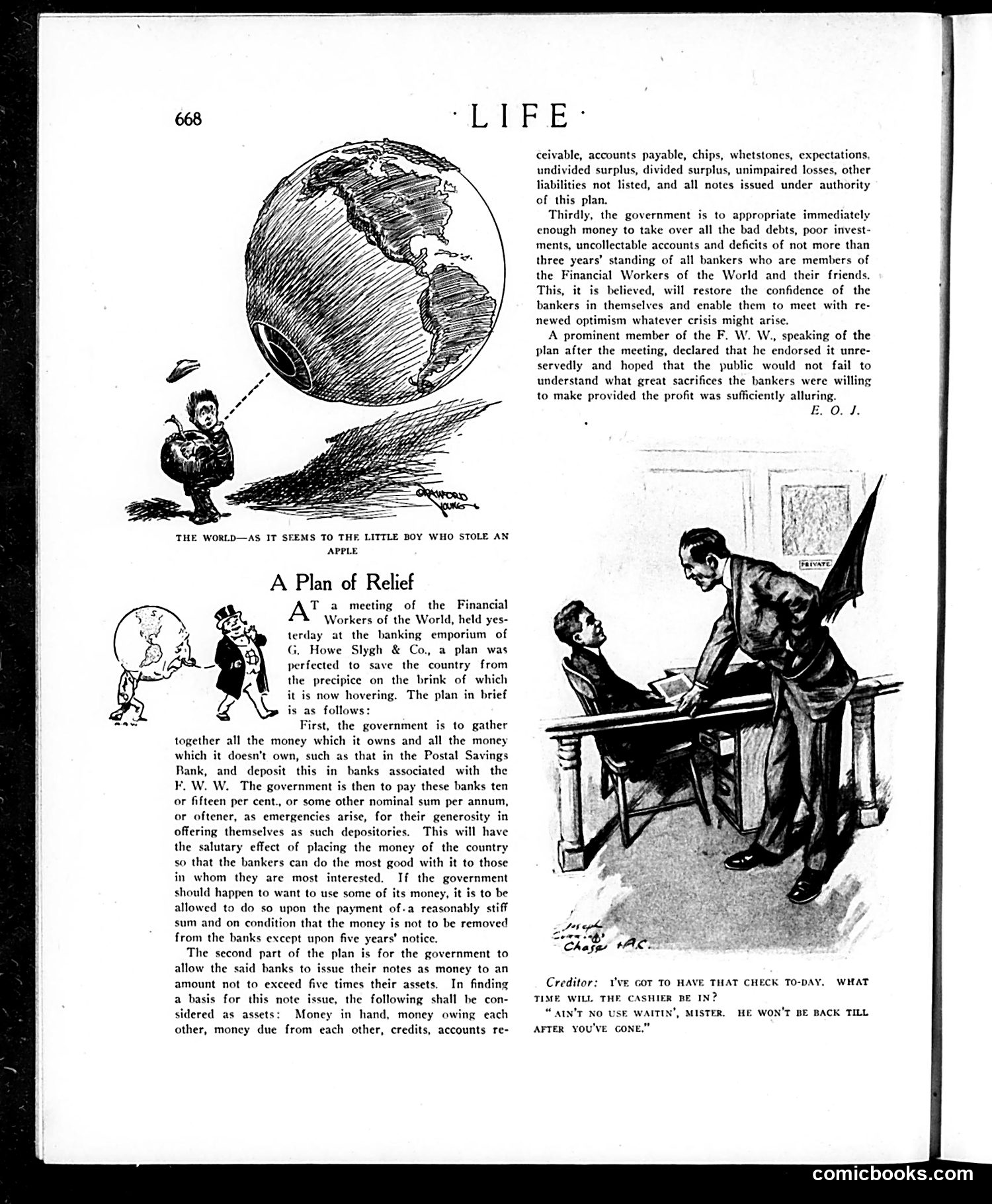
This page satirizes a proposed government bailout plan for banks during an financial emergency (likely post-WWI era). The top cartoon shows a small boy who stole an apple facing a globe-sized world of consequences—illustrating the hypocrisy at the article's core. The main text mocks a "Financial Workers of the World" plan that would have the government: 1. Deposit all public money (including postal savings) into member banks at nominal interest rates 2. Allow banks to issue notes worth five times their actual assets The satire's point: bankers demand strict accountability and harsh consequences for ordinary people's wrongdoing, yet propose schemes allowing themselves massive government subsidies and loose credit practices with minimal oversight. The bottom cartoon reinforces this—a creditor demands immediate payment while the debtor (bank) won't return until the creditor is gone, mirroring the asymmetrical power dynamics the plan would cement.
📄 Transcribed text from this page (OCR, searchable)
Machine-transcribed from the original scan — historical spelling and the odd misread are preserved.
ceivable, accounts payable, chips, whetstones, expectations, led surplus, divided surplus, unimpaired losses, other liabilities not listed, and all notes issued under authority of this plan. Thirdly, the government is to appropriate immediately enough money to take over all the bad debts, poor invest- ments, uncollectable accounts and deficits of not more than three years’ standing of all bankers who are members of the Financial Workers of the World and their friends. This, it is believed, will restore the confidence of the bankers in themselves and enable them to meet with re- newed optimism whatever crisis might arise. A prominent member of the F. W. W., speaking of the plan after the meeting, declared that he endorsed it unre- servedly and hoped that the public would not fail to understand what great sacrifices the bankers were willing to make provided the profit was sufficiently alluring. £. 0.4. THE WORLD—AS IT SFEMS TO THE LITTLE BOY WHO STOLE AN APPLE A Plan of Relief T a meeting of the Financial Workers of the World, held yes- terday at the banking emporium of G. Howe Slygh & Co., a plan was perfected to save the country from the precipice on the brink of which cit is now hovering. The plan in brief g is as follows: First, the government is to gather together all the money which it owns and all the money which it doesn’t own, such as that in the Postal Savings Rank, and deposit this in banks associated with the F, W. W. The government is then to pay these banks ten or fifteen per cent., or some other nominal sum per annum, or oftener, as emergencies arise, for their generosity in offering themselves as such depositories. This will have the salutary effect of placing the money of the country so that the bankers can do the most good with it to those in whom they are most interested. If the government should happen to want to use some of its money, it is to be allowed to do so upon the payment of-a reasonably stiff sum and on condition that the money is not to be removed s from the banks except upon five years’ notice. Cat! ‘Ac. The second part of the plan is for the government to ad allow the said banks to issue their notes as money to an amount not to exceed five times their assets. In finding Creditor: ve GoT TO HAVE THAT CHECK TO-DAY, WHAT a basis for this note issue, the following shall be con- TIME WILL THE CASHIER BE IN? sidered as assets: Money in hand, money owing each AIN’T NO USE N’, MISTER, HE WON'T BE BACK TILL other, money due from each other, credits, accounts re- AFTER YOU'VE GON comicbooks.com