
Life, 1914-10-15 · page 12 of 48
Life — October 15, 1914 — page 12: what you’re looking at
What you’re looking at
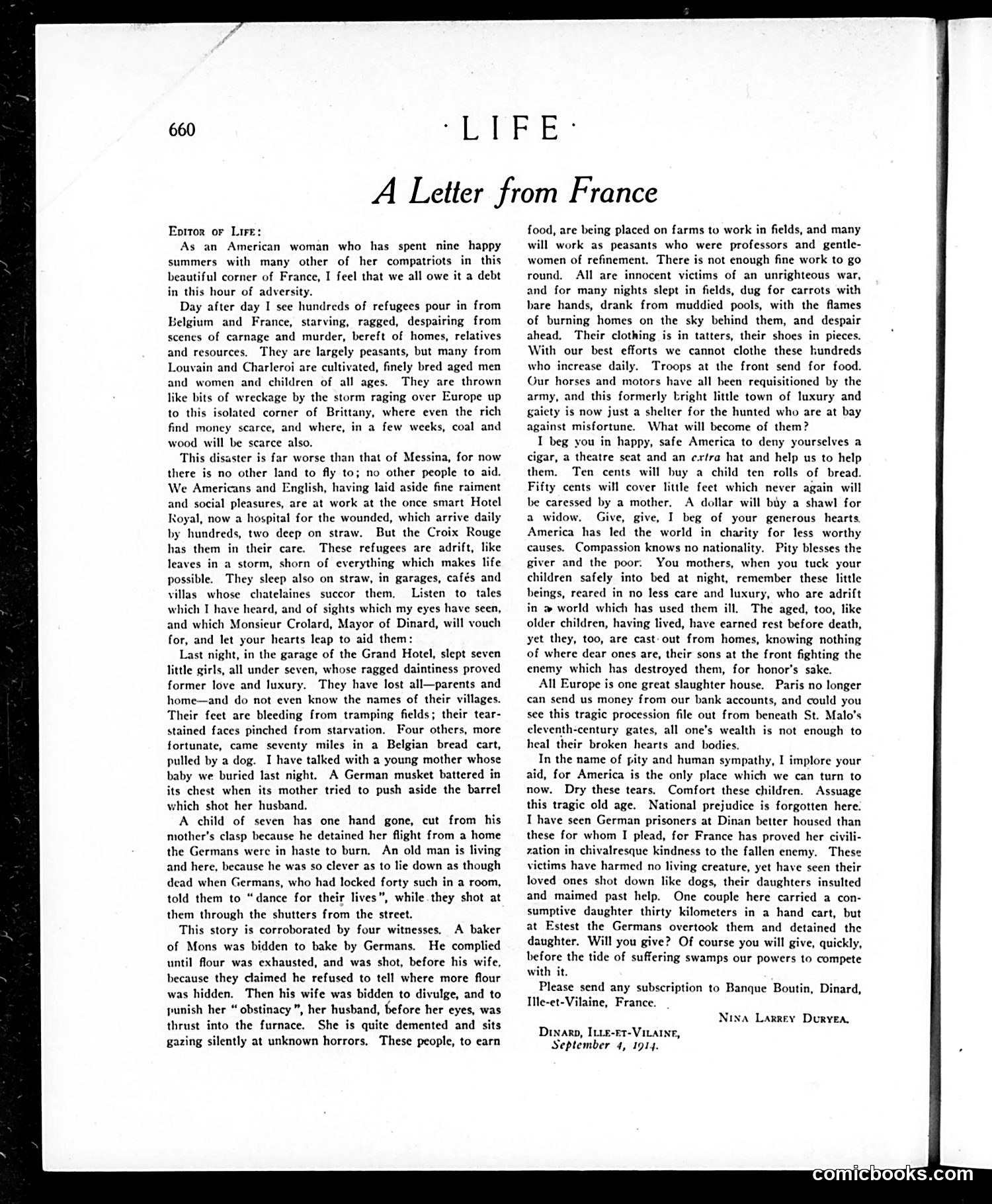
This page contains a letter from France dated September 4, 1914, written by Nina Larrey Duryea to Life's editor. It's not a cartoon but rather a firsthand account of WWI's humanitarian crisis. Duryea describes refugees fleeing Belgium and France—including elderly people, women, and children—experiencing starvation, homelessness, and violence. She contrasts their suffering with America's relative comfort, appealing to American charity. The letter documents specific atrocities: a child's hand cut off, German prisoners treated better than French civilians, and civilians deliberately harmed by German forces. Duryea urges Americans to contribute funds through Banque Boutin in Dinard, France. This represents Life magazine's role in documenting and mobilizing American response to European wartime suffering during the early months of World War I.
📄 Transcribed text from this page (OCR, searchable)
Machine-transcribed from the original scan — historical spelling and the odd misread are preserved.
“LUPE ° A Letter from France Eprtor or Lire: As an American woman who has spent nine happy summers with many other of her compatriots in this beautiful corner of France, I feel that we all owe it a debt in this hour of adversity. Day after day I see hundreds of refugees pour in from Belgium and France, starving, ragged, despairing from scenes of carnage and murder, bereft of homes, relatives and resources. They are largely peasants, but many from Louvain and Charleroi are cultivated, finely bred aged men and women and children of all ages. They are thrown like bits of wreckage by the storm raging over Europe up to this isolated corner of Brittany, where even the rich find money scarce, and where, in a few weeks, coal and wood will be scarce also. This disaster is far worse than that of Messina, for now there is no other land to fly to; no other people to aid. We Americans and English, having laid aside fine raiment and social pleasures, are at work at the once smart Hotel Koyal, now a hospital for the wounded, which arrive daily by hundreds, two deep on straw. But the Croix Rouge has them in their care. These refugees are adrift, like leaves in a storm, shorn of everything which makes life possible. They sleep also on straw, in garages, cafés and villas whose chatelaines succor them, Listen to tales which I have heard, and of sights which my eyes have seen, and which Monsieur Crolard, Mayor of Dinard, will vouch for, and let your hearts leap to aid them: Last night, in the garage of the Grand Hotel, slept seven little girls, all under seven, whose ragged daintiness proved former love and luxury. They have lost all—parents and home—and do not even know the names of their villages. Their feet are bleeding from tramping fields; their tear- stained faces pinched from starvation. Four others, more fortunate, came seventy miles in a Belgian bread cart, pulled by a dog. I have talked with a young mother whose baby we buried last night. A German musket battered in its chest when its mother tried to push aside the barrel which shot her husband. A child of seven has one hand gone, cut from his mother’s clasp because he detained her flight from a home the Germans were in haste to burn, An old man is living and here, because he was so clever as to lie down as though dead when Germans, who had locked forty such in a room, told them to “dance for their lives”, while they shot at them through the shutters from the street. This story is corroborated by four witnesses. A baker of Mons was bidden to bake by Germans. He complied until flour was exhausted, and was shot, before his wife, because they claimed he refused to tell where more flour was hidden. Then his wife was bidden to divulge, and to punish her “ obstinacy ”, her husband, before her eyes, was thrust into the furnace. She is quite demented and sits gazing silently at unknown horrors, These people, to earn food, are being placed on farms to work in fields, and many will work as peasants who were professors and gentle- women of refinement. There is not enough fine work to go round, All are innocent victims of an unrighteous war, and for many nights slept in fields, dug for carrots with bare hands, drank from muddied pools, with the flames of burning homes on the sky behind them, and despair ahead, Their clothing is in tatters, their shoes in pieces. With our best efforts we cannot clothe these hundreds who increase daily. Troops at the front send for food. Our horses and motors have all been requisitioned by the army, and this formerly bright little town of luxury and gaicty is now just a shelter for the hunted who are at bay against misfortune. What will become of them? I beg you in happy, safe America to deny yourselves a cigar, a theatre scat and an extra hat and help us to help them. Ten cents will buy a child ten rolls of bread. Fifty cents will cover little feet which never again will be caressed by a mother, A dollar will buy a shawl for a widow, Give, give, I beg of your generous hearts. America has led the world in charity for less worthy causes. Compassion knows no nationality. Pity blesses the giver and the poor. You mothers, when you tuck your children safely into bed at night, remember these little beings, reared in no less care and luxury, who are adrift in » world which has used them ill, The aged, too, like older children, having lived, have earned rest before death, yet they, too, are cast-out from homes, knowing nothing of where dear ones are, their sons at the front fighting the enemy which has destroyed them, for honor's sake. All Europe is one great slaughter house. Paris no longer can send us money from our bank accounts, and could you see this tragic procession file out from beneath St. Malo’s eleventh-century gates, all one’s wealth is not enough to heal their broken hearts and bodies. In the name of pity and human sympathy, I implore your aid, for America is the only place which we can turn to now. Dry these tears. Comfort these children. Assuage this tragic old age. National prejudice is forgotten here. I have seen German prisoners at Dinan better housed than these for whom I plead, for France has proved her civili- zation in chivalresque kindness to the fallen enemy. These victims have harmed no living creature, yet have seen their loved ones shot down like dogs, their daughters insulted and maimed past help. One couple here carried a con- sumptive daughter thirty kilometers in a hand cart, but at Estest the Germans overtook them and detained the daughter. Will you give? Of course you will give, quickly, before the tide of suffering swamps our powers to compete with it. Please send any subscription to Banque Boutin, Dinard, Ille-et-Vilaine, France. Nina Larrey Duryea, Diaro, Itte-et-VILarne, September 4, 1914.