
A complete issue · 60 pages · 1913
Life — March 27, 1913
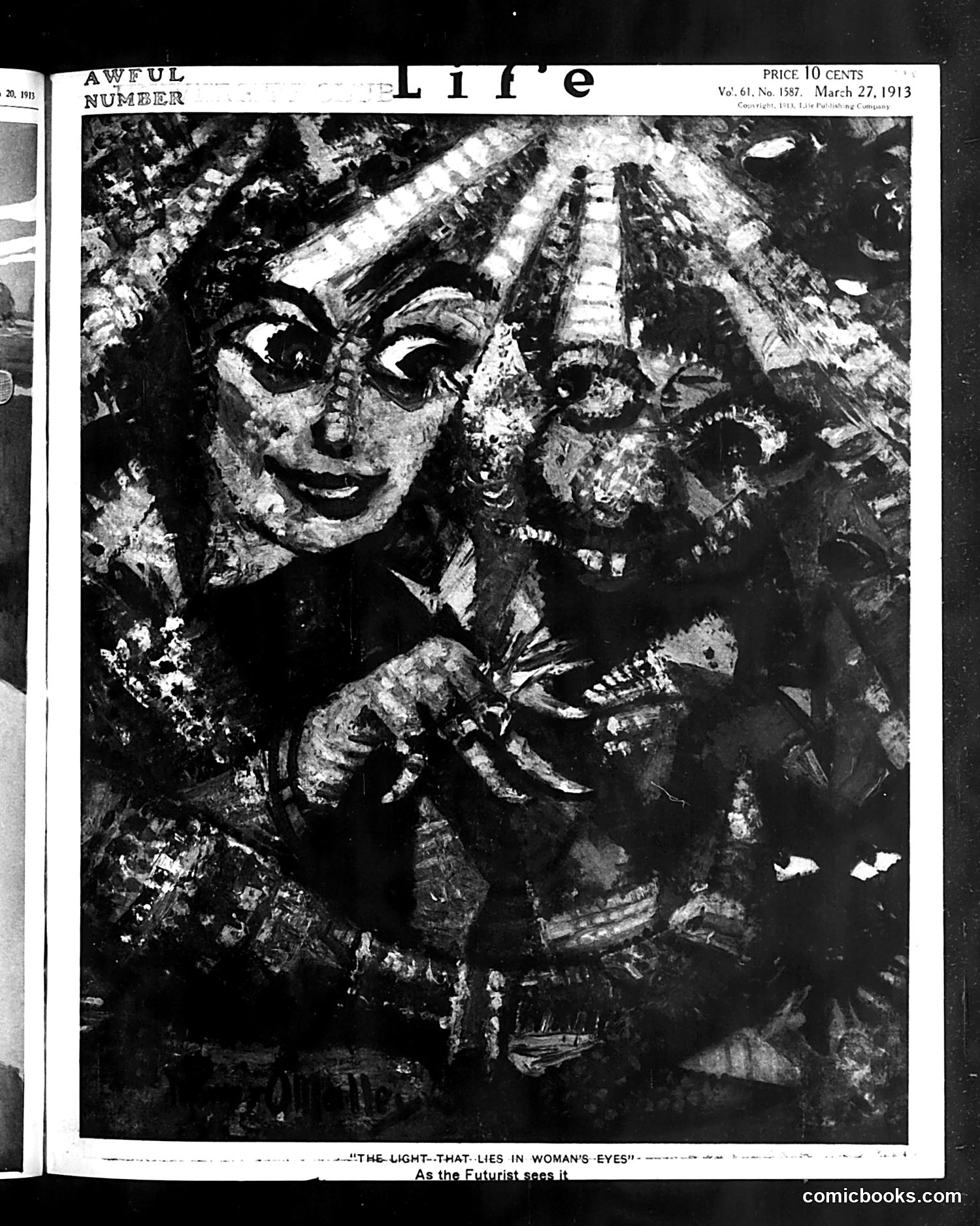
This is a satirical artwork mocking Futurism, an early 20th-century avant-garde art movement known for celebrating technology, violence, and rejecting traditional beauty standards. The caption suggests the image represents how Futurists would reimagine romantic subjects. The grotesque, distorted faces—with exaggerated features, mechanical or fragmented qualities—parody Futurism's rejection of classical aesthetics. Where conventional art portrayed "the light in woman's eyes" romantically, Futurists would depict it as something jarring and unbeautiful, emphasizing speed and abstraction over harmony. The satire mocks Futurism as aesthetically repellent, suggesting their avant-garde rebellion against tradition produces only ugliness rather than genuine artistic progress.
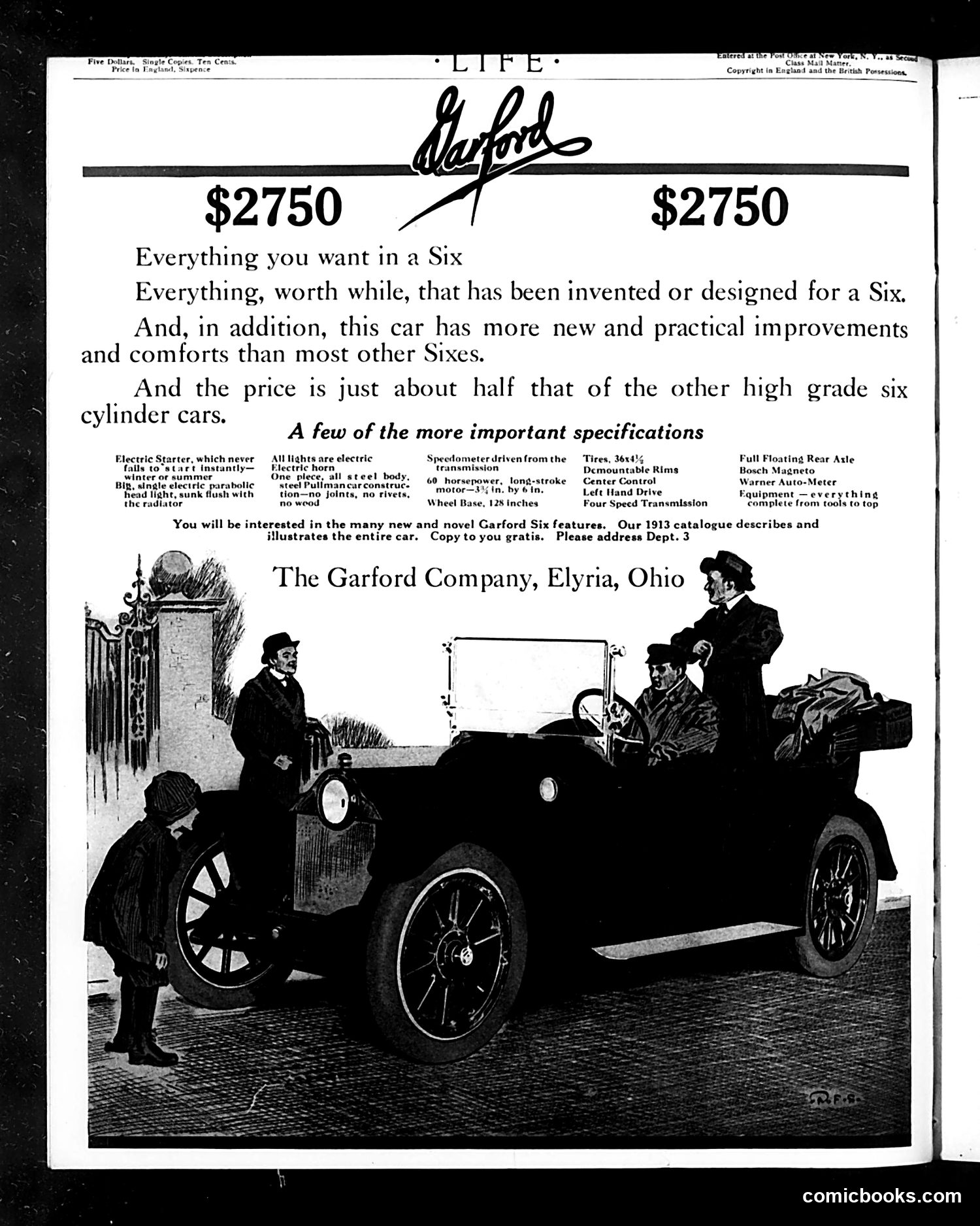
This page is primarily an **advertisement for a Garford automobile**, not political satire. The text promotes a six-cylinder car priced at $2,750, claiming it offers "everything you want in a Six" at roughly half the price of competing luxury vehicles. The illustration depicts well-dressed men and a woman examining or boarding the car, suggesting affluence and respectability. This was typical advertising imagery of the era—showing the automobile as a status symbol for genteel society. There is **no political cartoon or satire present**. The page represents straightforward early automotive marketing in *Life* magazine, which published both humorous content and commercial advertisements to fund operations.
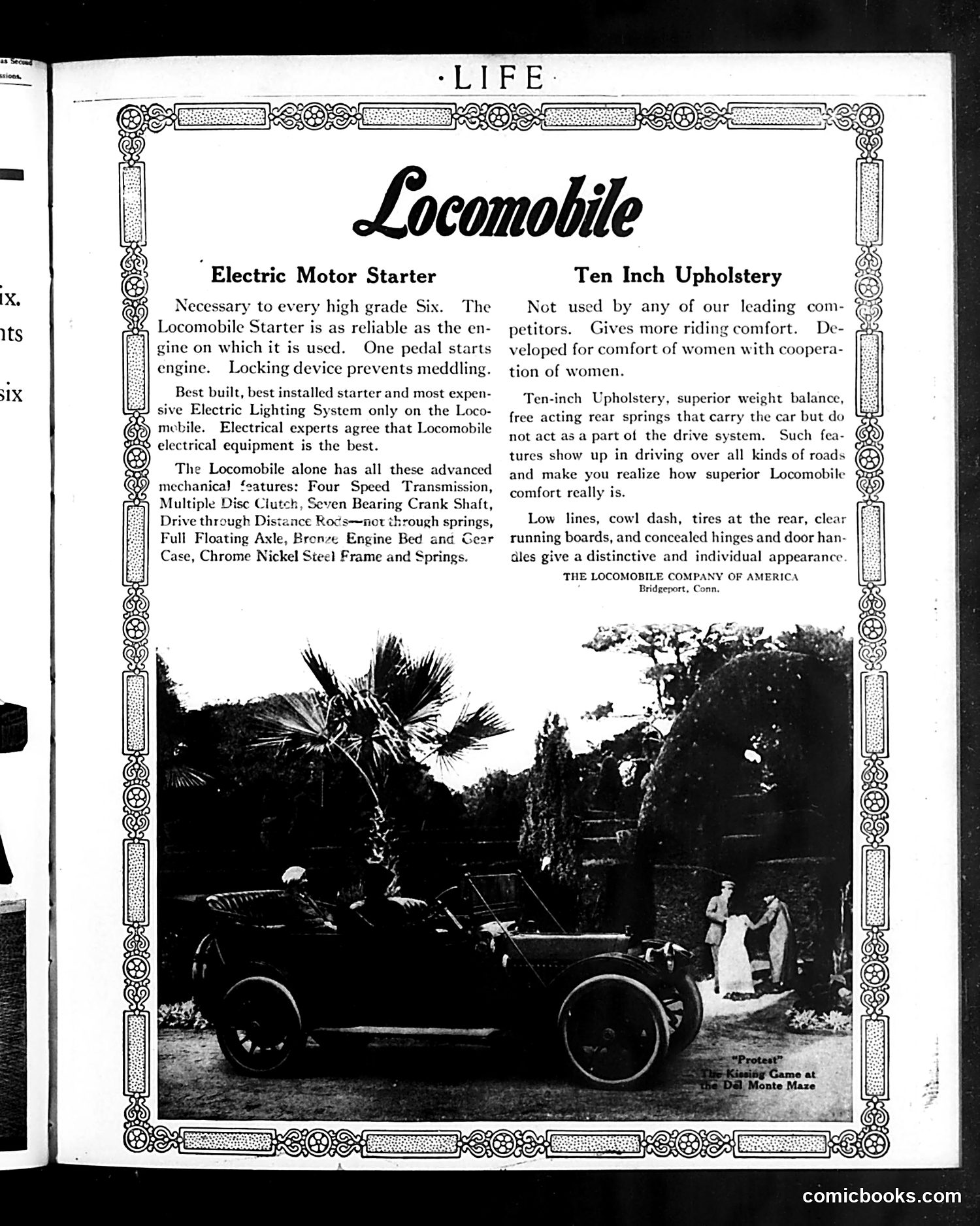
This page is **not a political cartoon or satirical content**—it's a straightforward advertisement for the Locomobile automobile, published in *Life* magazine. The ad promotes two features: an electric motor starter (marketed as reliable and convenient) and ten-inch upholstery (emphasizing comfort). The accompanying photograph shows a luxury automobile from the early 1900s with passengers in period dress, positioned in an elegant garden setting with palm trees. The only potential social commentary is implicit: the ad targets wealthy consumers by emphasizing comfort "for women" and featuring well-dressed figures in refined surroundings. However, this reflects period marketing rather than satire. *Life* magazine regularly carried high-end advertising alongside its satirical content.
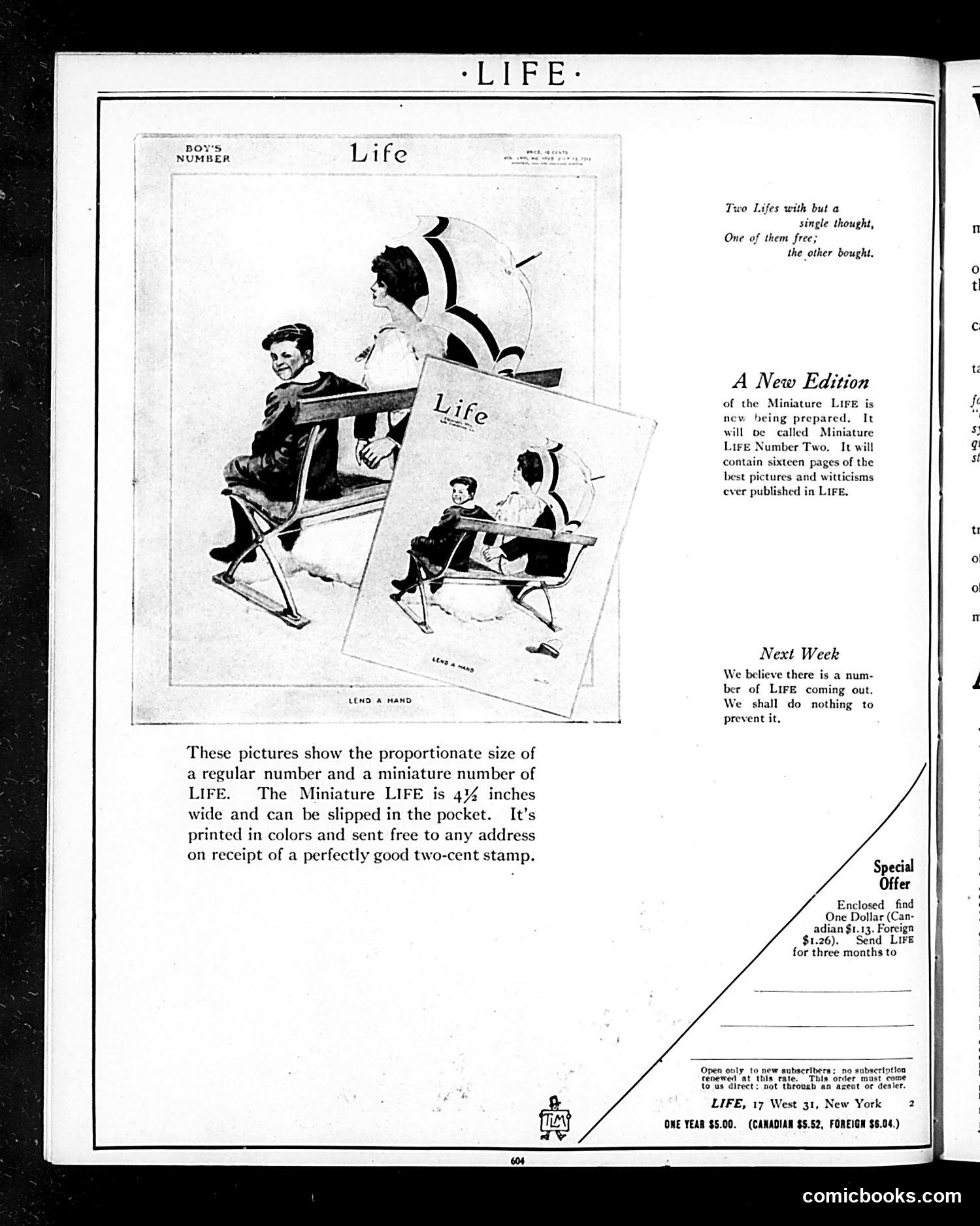
This page is primarily **advertising** for Life magazine itself, not political commentary. The central image shows three overlapping covers of Life magazine in different sizes, illustrating the new "Miniature LIFE" edition being promoted. The illustrations depict people in casual poses—reading, relaxing in chairs—rendered in a simple, humorous style typical of Life's visual approach. The text explains that this pocket-sized version measures 4½ inches wide, prints in color, and costs only a two-cent stamp to receive. A "Special Offer" section advertises a three-month subscription for one dollar. The epigraph at top—"Two Lives with but a single thought, / One of them free; / the other bought"—is a playful reference to a famous romantic poem, adapted here as wordplay promoting the magazine's dual editions.
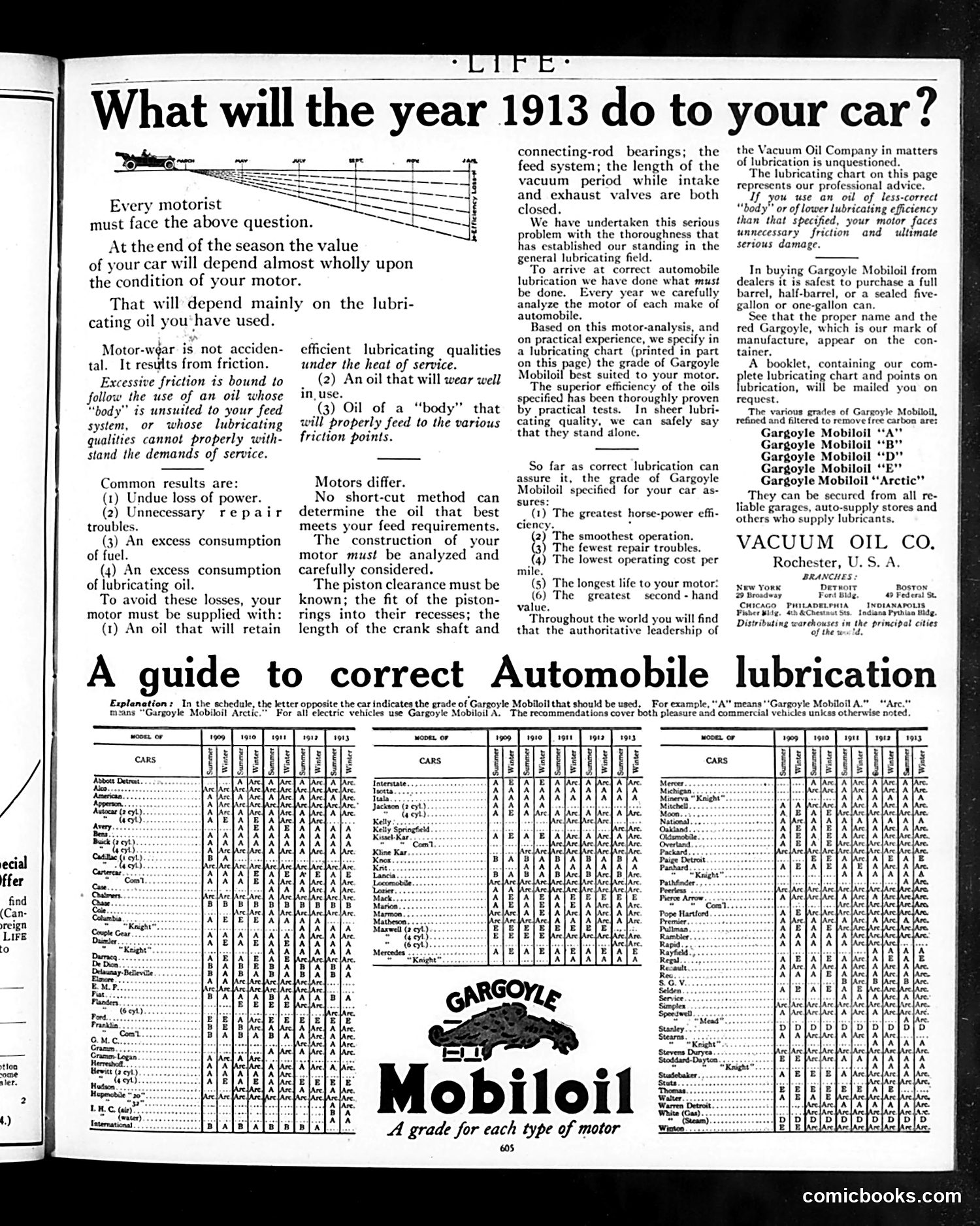
This page is **not a political cartoon or satire**—it's primarily **advertising content** disguised as advice. The article "A guide to correct Automobile lubrication" presents itself as practical motoring advice, explaining that motor wear results from friction and that proper oil selection is crucial. However, the entire piece functions as an extended advertisement for **Gargoyle Mobiloil**, a lubricating oil brand. The tables listing car makes and recommended oil grades (A, B, C, D, "Arctic") are essentially product placement, guiding consumers toward specific Gargoyle products. The Vacuum Oil Company (Mobiloil's manufacturer) positioned this as editorial guidance while promoting brand loyalty. For modern readers: this represents early **advertorial marketing**—blending commercial messaging within seemingly authoritative consumer guidance, a practice that remains common today.
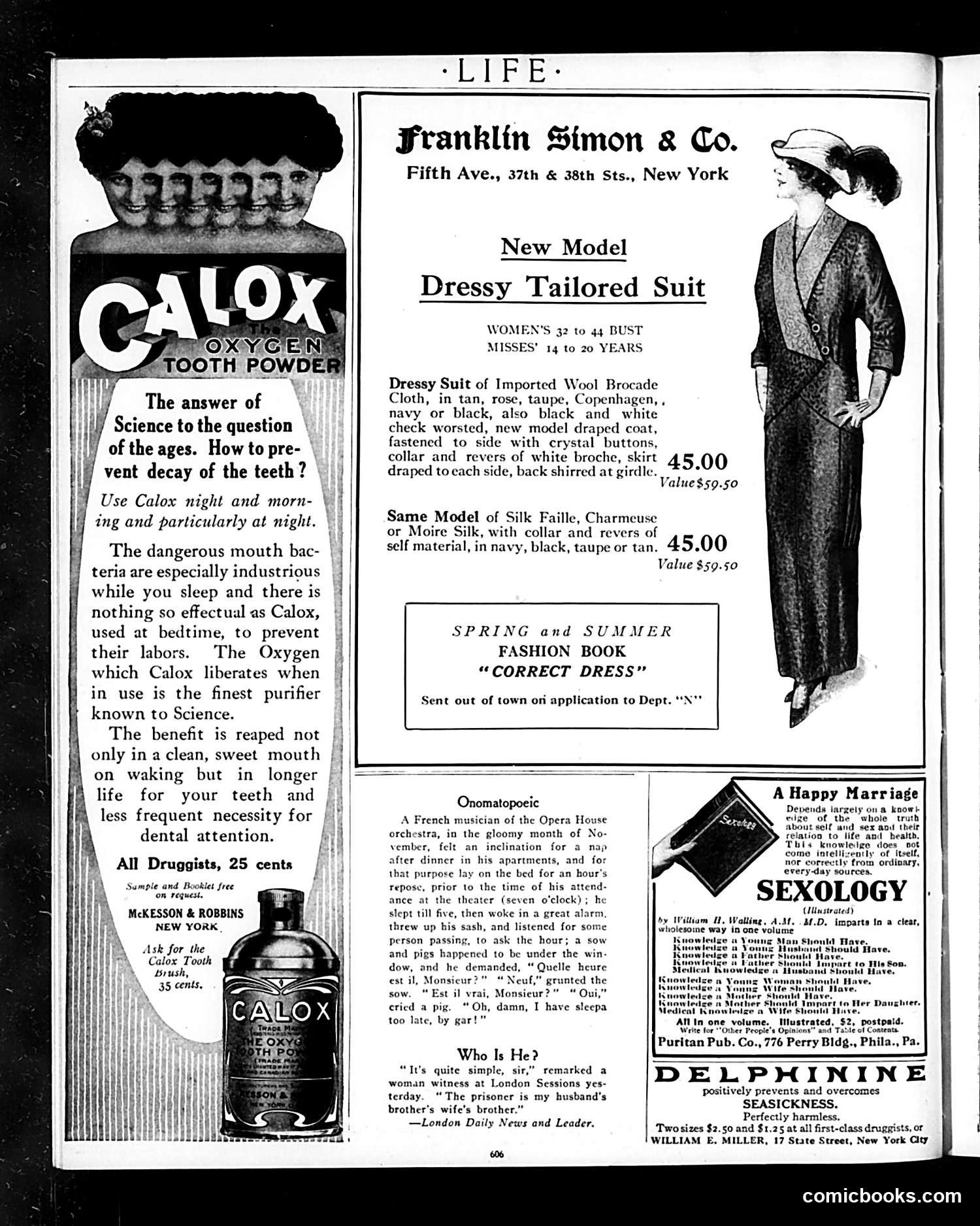
This page is **primarily advertising** rather than satirical content. It contains: 1. **Calox Tooth Powder ad** (left): A pseudo-scientific pitch claiming the product prevents tooth decay through "oxygen" liberation—typical early 20th-century marketing hype before modern FDA regulation. The multiple faces suggest freshness or purity. 2. **Franklin Simon & Co. suit advertisement** (center-right): A straightforward fashion ad for women's tailored suits, priced at $45.00. 3. **Three smaller ads** (bottom): Including a humorous anecdote about an opera musician, a "Sexology" book ad (offering sexual knowledge), and Delphinine for seasickness. The page reflects early 1900s consumer culture, unregulated health claims, and period attitudes toward women's fashion and "scientific" remedies. No political satire is evident.
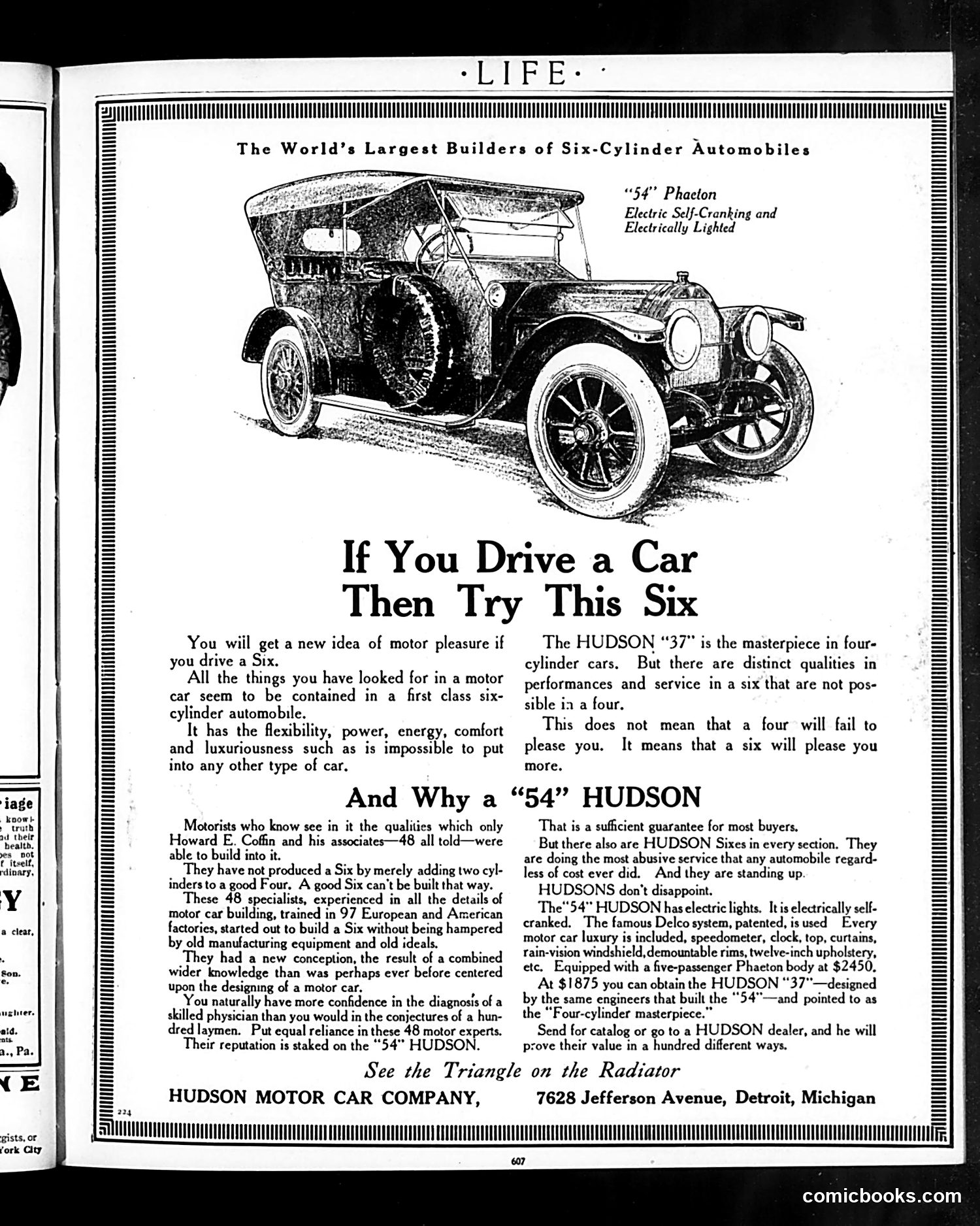
This is **not a cartoon or satire page**, but rather a **straightforward advertisement** for Hudson automobiles, specifically promoting their "54" Phaeton model and "37" six-cylinder line. The ad targets car owners by arguing that six-cylinder engines offer superior qualities (flexibility, power, comfort, luxury) compared to four-cylinder models. It emphasizes that Hudson employed 48 specialized motor-building experts and offers features like electric self-cranking and Delco electrical systems. The piece functions as standard early 20th-century automotive marketing, positioning Hudson as "the world's largest builders of six-cylinder automobiles." There are no political references, caricatures, or satirical elements—this is commercial advertising dressed in the formal rhetoric typical of *Life* magazine's paid content from this era.
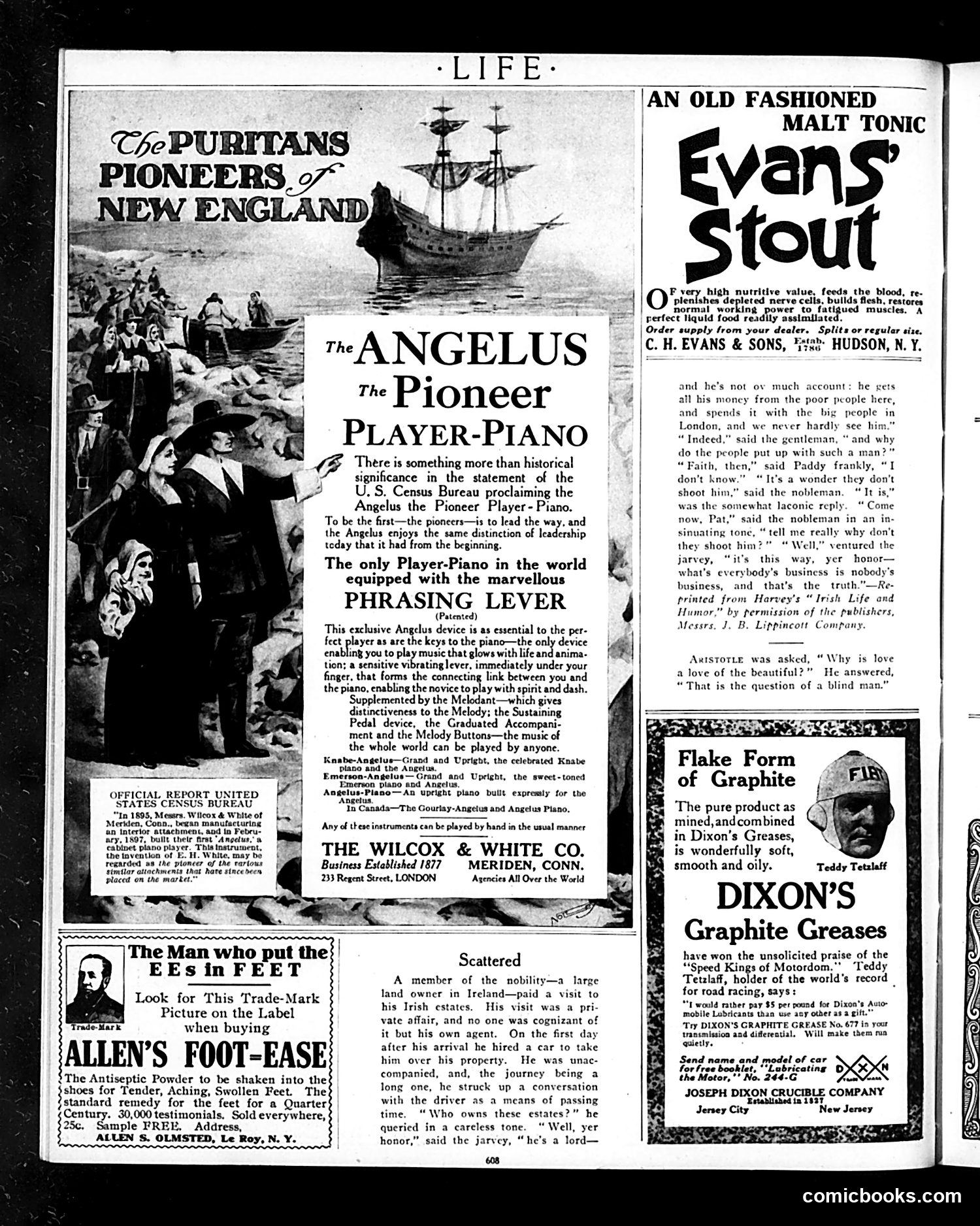
This page is primarily **advertising**, not satire or political commentary. It features ads for: 1. **The Angelus Pioneer Player-Piano** — marketed as historically significant for American progress, with emphasis on its exclusive "phrasing lever" mechanism 2. **Evans' Stout** — a malt tonic claiming nutritional/medicinal benefits 3. **Allen's Foot-Ease** — an antiseptic powder for foot problems 4. **Dixon's Graphite Greases** — industrial lubricants The left side includes an illustration labeled "The Puritans: Pioneers of New England" with a colonial ship, establishing a nostalgic American heritage theme that the piano ad echoes. There's a brief fictional story snippet ("Scattered") about an Irish landowner, unrelated to any satire. This is a typical early 20th-century Life magazine page mixing commercial advertisements with light entertainment content.
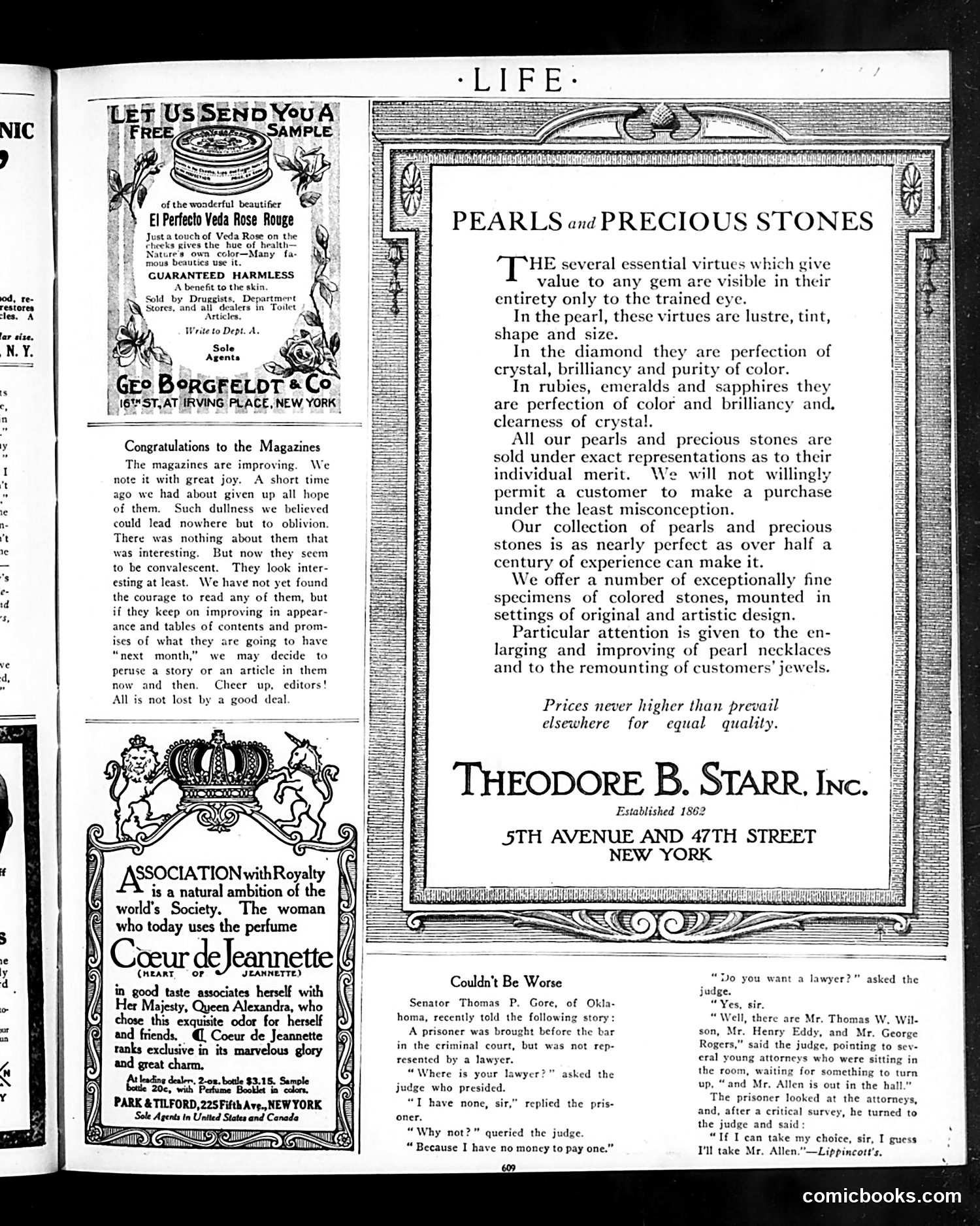
This page is primarily **advertising and editorial content** rather than political satire. **Left side** contains three ads: Pierpont Irish Moss Beautifier, Geo. Borgfeldt & Co. (toys/novelties), and Cœur de Jeannette perfume—all with ornate period styling typical of early 20th-century magazine ads. **Center** is an editorial note congratulating magazines on improving their content and appearance, praising their courage to publish interesting material. **Right side** is a full-page ad for Theodore B. Starr, Inc. (established 1862), a jewelry business specializing in pearls and precious stones, located at 5th Avenue and 47th Street, New York. **Bottom right** contains a brief anecdote ("Couldn't Be Worse") about a poor prisoner without a lawyer—a mild humorous story rather than political commentary. The page reflects **turn-of-century luxury marketing** and magazine culture.
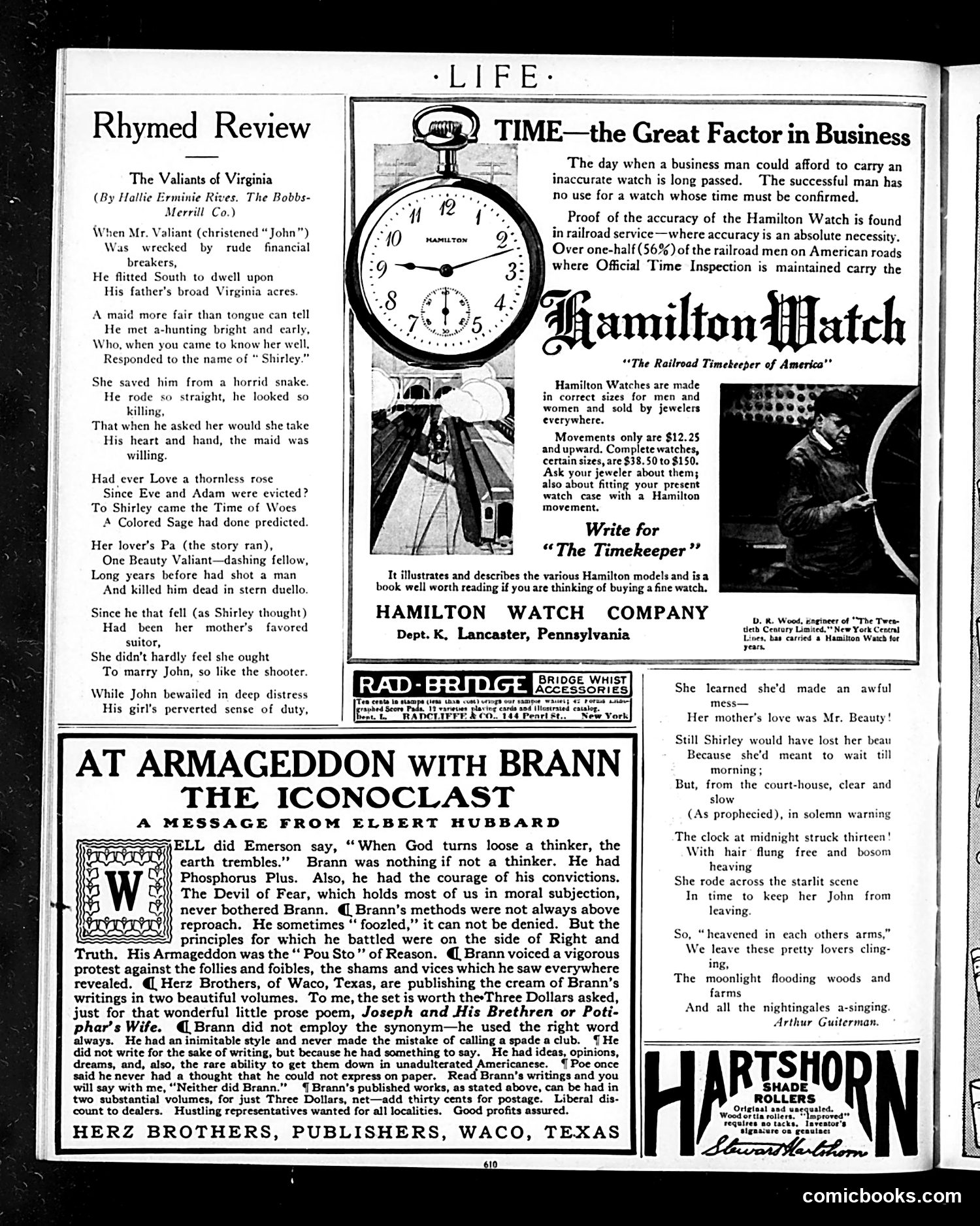
This page contains primarily **advertising and literary content** rather than political satire. The top section features a **"Rhymed Review"** about "The Valiants of Virginia," a romantic narrative poem about a Civil War-era couple named John and Shirley. The poem describes their tragic love story—John is killed in a duel, and Shirley must choose between marrying another man or remaining faithful to his memory. Below that is a substantial advertisement for **Hamilton Watch Company**, emphasizing the watch's accuracy and railroad industry adoption. The bottom half contains **"At Armageddon with Brann the Iconoclast,"** a message from Elbert Hubbard praising William Cowper Brann, a Texas publisher known for his provocative writings attacking social hypocrisy. The piece promotes Brann's published works. This is primarily a **commercial and cultural magazine page**, not political commentary.
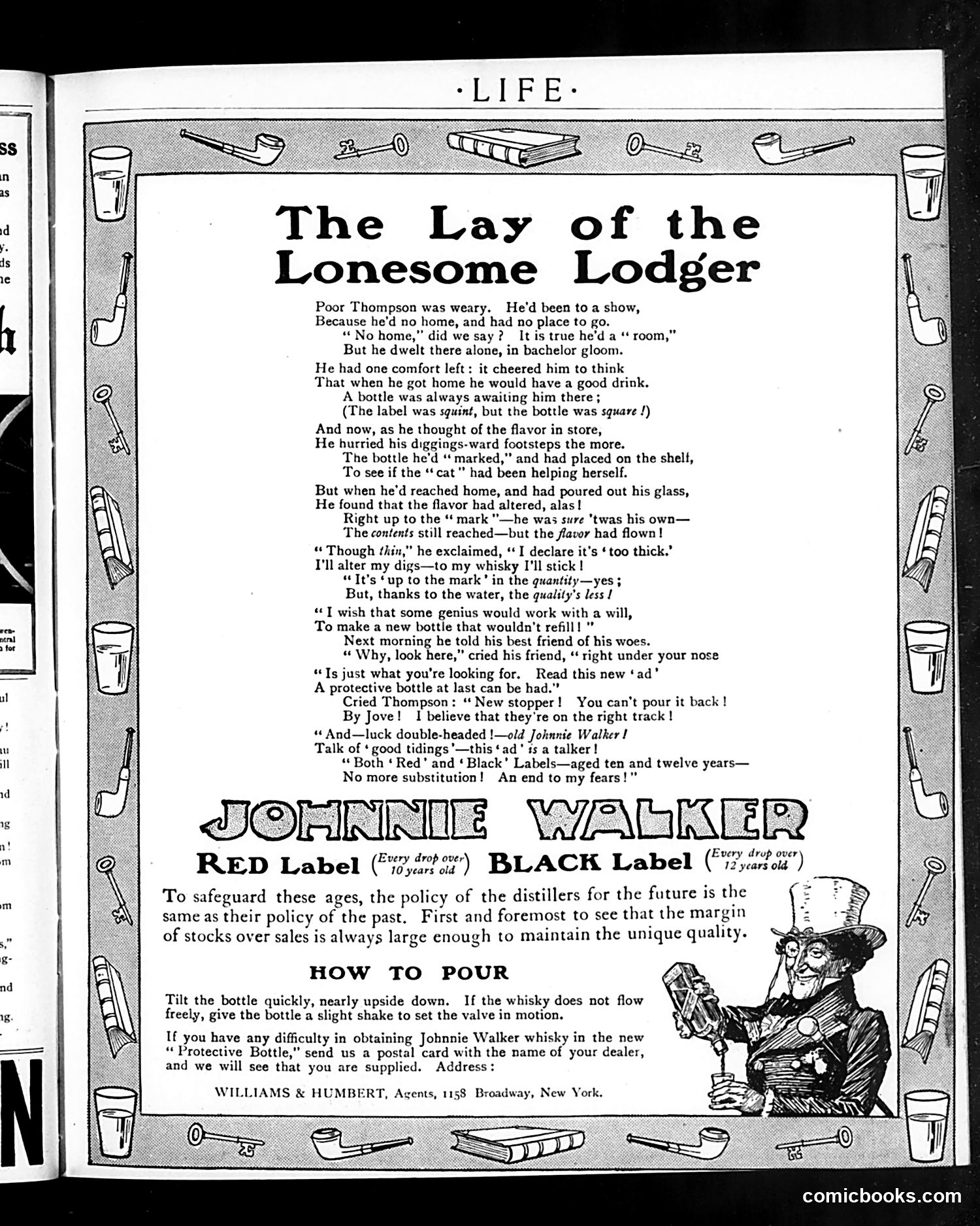
This is a Johnnie Walker whisky advertisement disguised as humorous verse. The "lay" (poem) tells of "Poor Thompson," a lonely boarding-house resident whose sole comfort is anticipating whisky at home. The joke: Thompson's bottle has been tampered with—the contents evaporated or were replaced with water, leaving only the label's promise. The satire targets Prohibition-era substitution fraud. During Prohibition, legitimate bottles were often refilled with inferior products. The ad promotes Johnnie Walker's "Protective Bottle" with a tamper-proof stopper, claiming it prevents adulteration. The caricatured "old Johnnie Walker" character appears at bottom, hawking the Red and Black Label varieties as reliable solutions to contamination problems consumers actually faced.
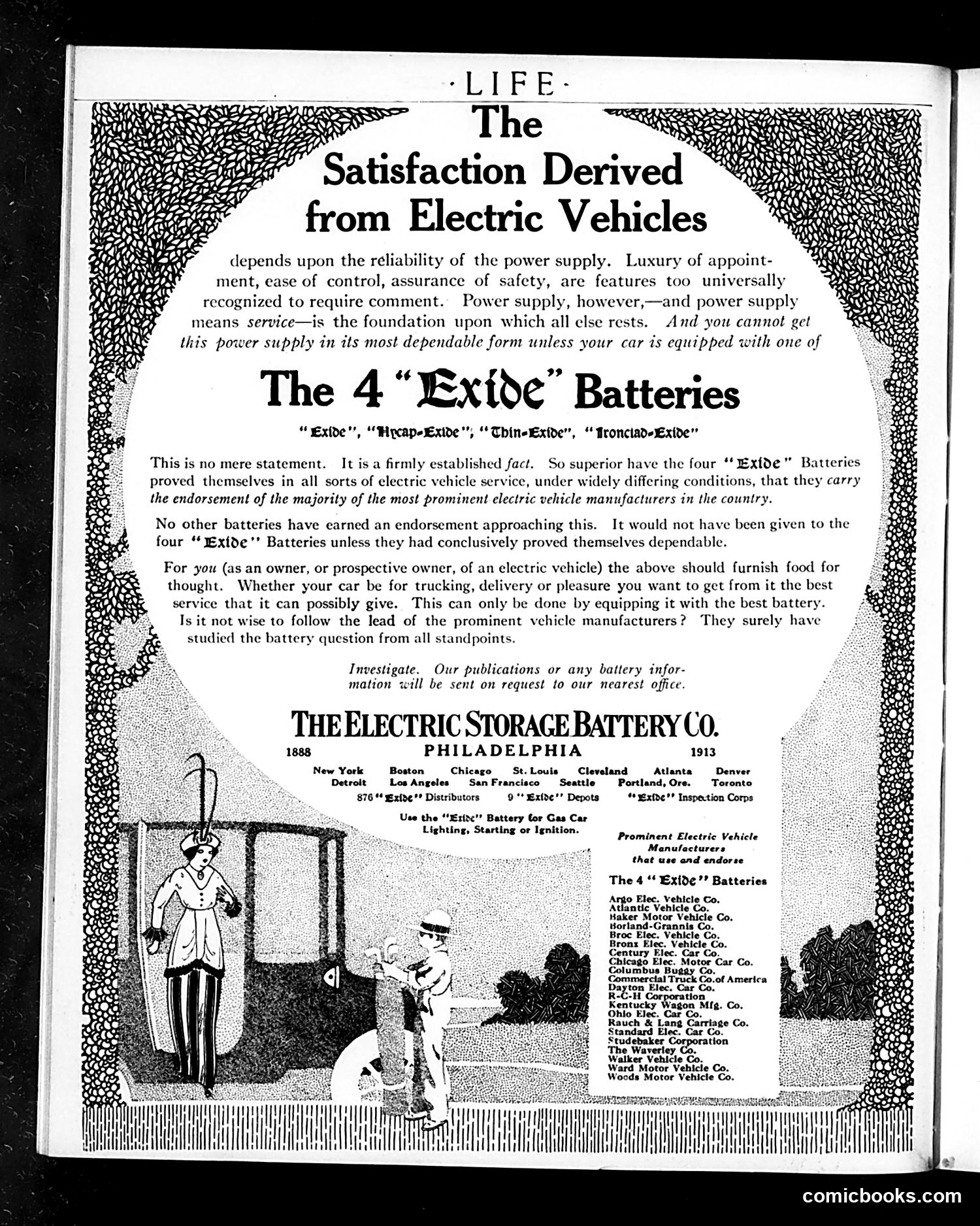
This page is primarily **advertising**, not satire or political commentary. It promotes "Exide" batteries for electric vehicles, published by The Electric Storage Battery Co. in Philadelphia. The illustration depicts a domestic scene: a woman stands at a house entrance while a man (appearing to be a delivery driver or serviceman) works on an early electric vehicle. This imagery appeals to the target market—affluent households interested in modern automotive technology. The ad emphasizes reliability and "service" as essential features. It lists prominent electric vehicle manufacturers endorsing Exide batteries, suggesting widespread industry trust. **Historical context**: This advertisement dates from the early 1900s, when electric vehicles competed seriously with gasoline cars before internal combustion engines dominated the market.
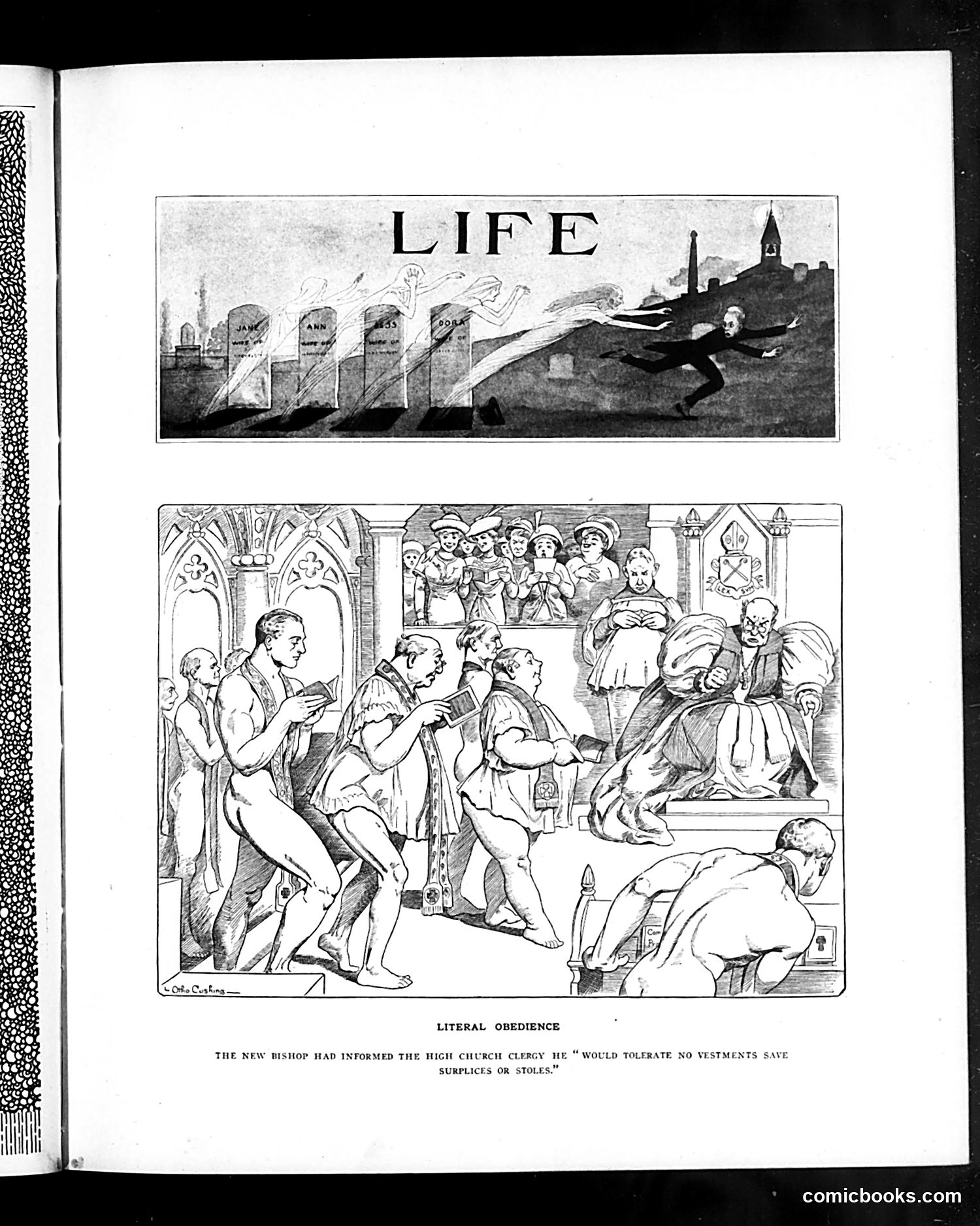
This satirical cartoon critiques a new bishop's strict church policy. The caption explains: "The new bishop had informed the high church clergy he 'would tolerate no vestments, save surplices or stoles.'" The cartoon depicts clergy members literally obeying this command by wearing *only* surplices and stoles—and nothing else. Naked or near-naked clergy perform religious duties before shocked onlookers in a church setting. The satire mocks the bishop's overly literal interpretation of his own rules and the clergy's absurd compliance. It's religious humor targeting ecclesiastical authority and the dangers of rigid, unreasonable enforcement of regulations. The joke relies on the audience understanding church vestment terminology and finding the visual absurdity of nearly-nude priests performing sacred functions comedic.
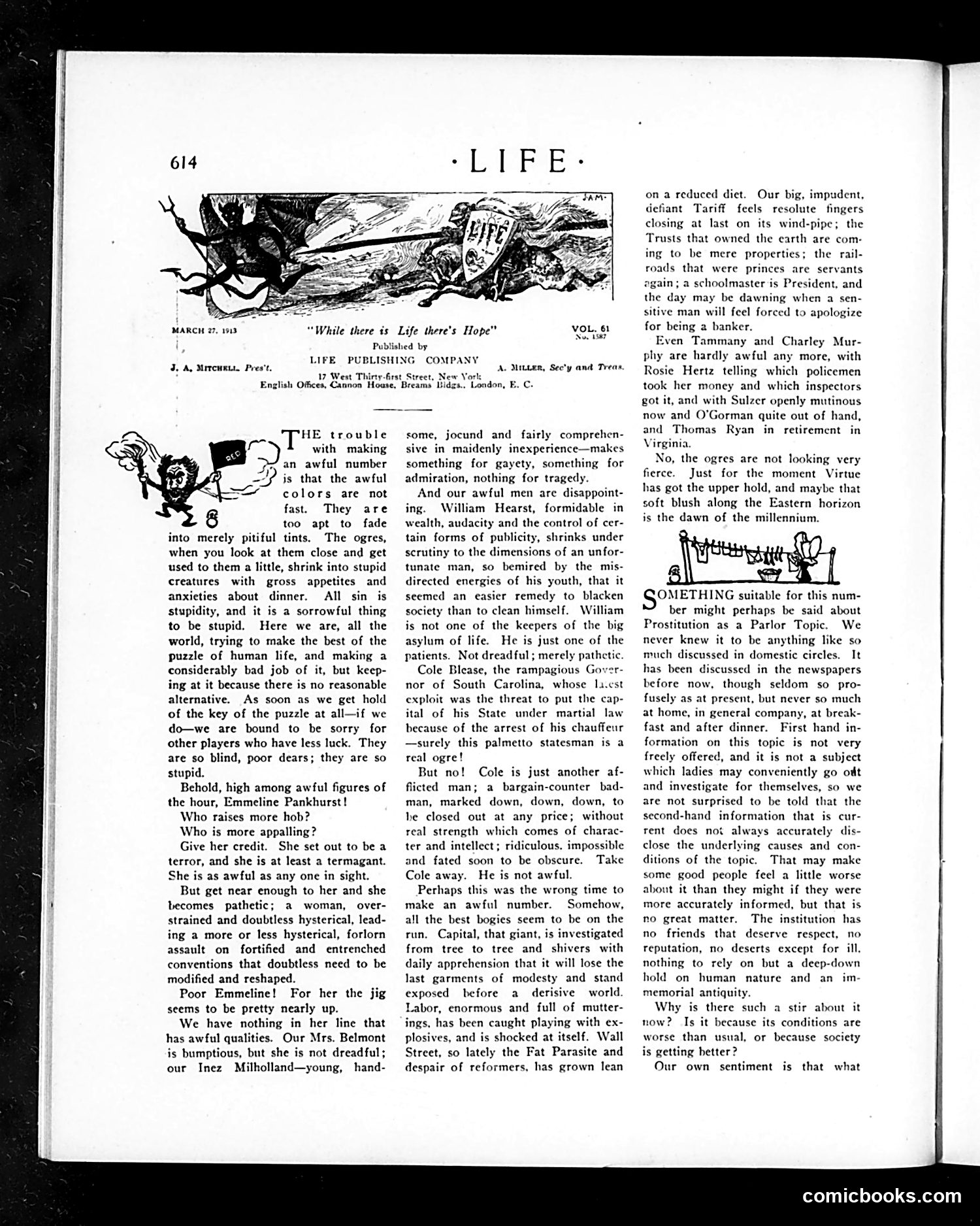
This page contains editorial commentary on American political and social figures of the era. The text criticizes several public figures as "awful" - specifically William Hearst (the newspaper magnate), Cole Blease (Governor of South Carolina), and Capital/Wall Street interests. The author argues these figures are not genuinely "awful" or tragic, but rather pathetic and ridiculous—lacking real character or strength. The cartoons (visible at top and side) appear to be satirical illustrations accompanying this critique, though specific details are difficult to discern in the image quality provided. The overall tone suggests Life magazine's characteristic progressive-era skepticism toward wealthy industrialists and political figures perceived as lacking integrity or genuine ability.
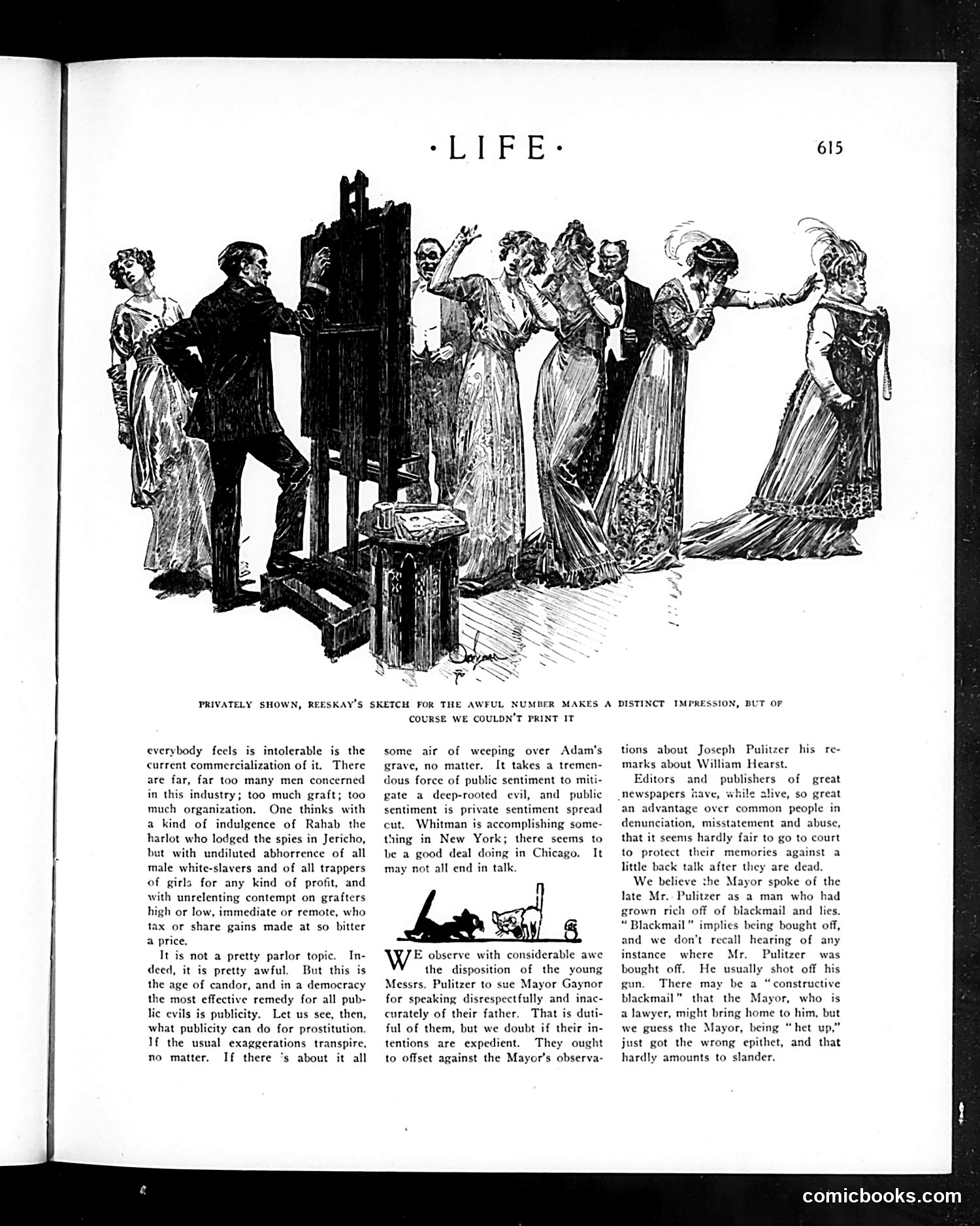
This page discusses **prostitution reform** and a **media lawsuit**, not primarily through the sketch above but through editorial commentary. The sketch (by "Reeskay") depicts what appears to be a social gathering, captioned as depicting "the awful number"—likely referencing a controversial performance or artwork deemed too scandalous to print. The text argues for **publicity as a reform tool** against prostitution and sex trafficking, citing activists like Whitman working in New York and Chicago. It contrasts historical tolerance (Biblical Rahab) with modern condemnation of traffickers. The editorial also addresses a lawsuit by **Joseph Pulitzer's sons** against **Mayor Gaynor** for insulting their deceased father's reputation. The writer suggests Gaynor (though "heated") used imprecise language—calling Pulitzer's wealth "blackmail" when the newspaper magnate typically used his power directly rather than extortion. The piece argues that powerful media figures shouldn't sue for defamation after death, given their advantage in controlling narratives while alive.
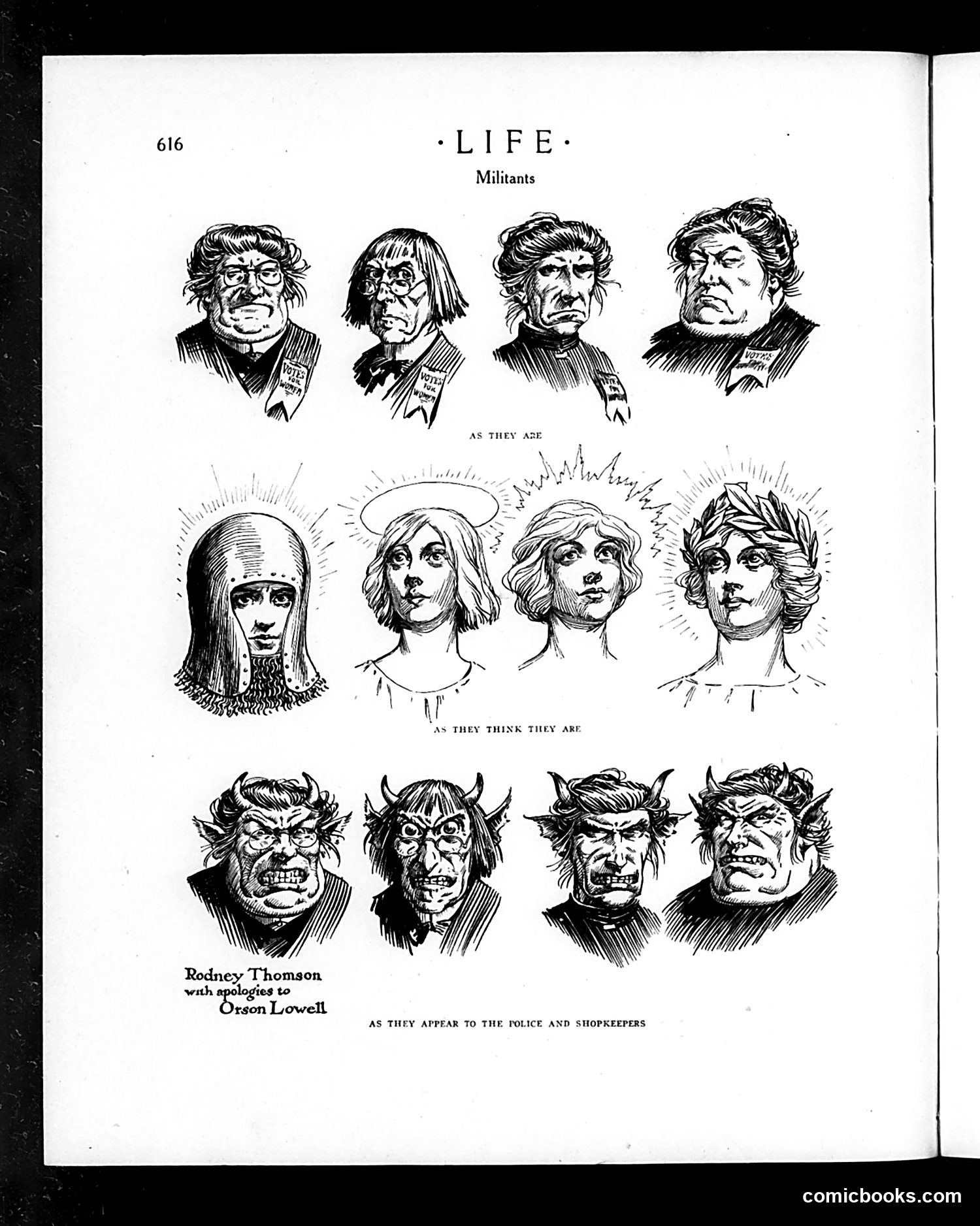
This Life magazine cartoon satirizes political militants through three contrasting depictions: first, realistic portraits labeled "As They Age"; second, idealized versions with halos labeled "As They Think They Are"; and third, demonic caricatures with horns labeled "As They Appear to the Police and Shopkeepers." The satire mocks the disconnect between militants' self-perception and how authorities and the public view them. The artist, Rodney Thomson, credits an apology to Orson Lowell, suggesting this parodies or responds to another work. The cartoon critiques radical activists by suggesting they see themselves as righteous crusaders while police and merchants perceive them as dangerous threats. It reflects early-20th-century anxieties about political radicalism and civil unrest through exaggerated visual contrast.
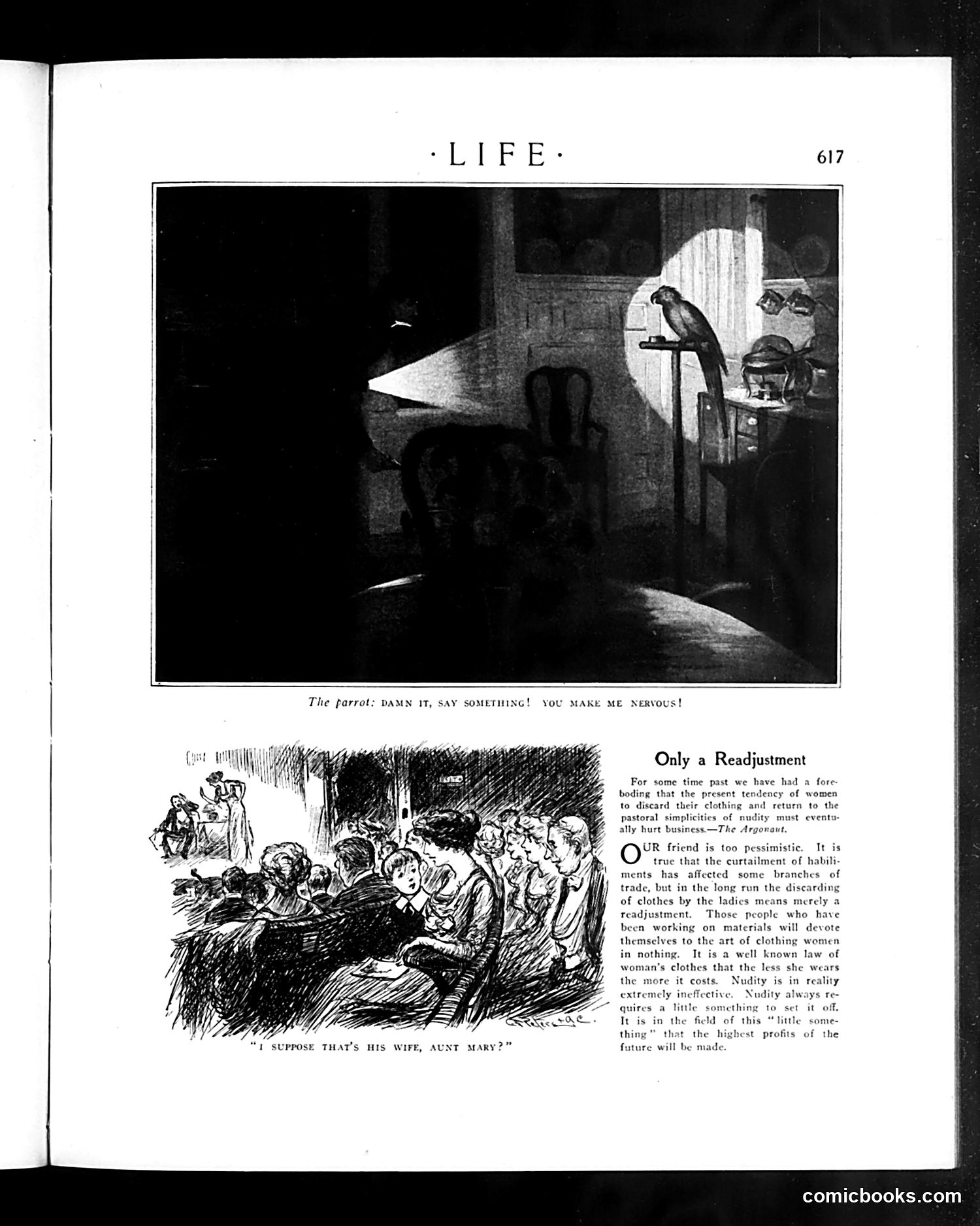
This page satirizes 1920s anxieties about women's fashion and morality. The top cartoon shows a parrot refusing to speak—the joke being the parrot's silence mirrors a husband's embarrassment about his wife (Aunt Mary), likely implying she's dressed immodestly or scandalously by period standards. The article "Only a Readjustment" mocks conservative concerns about women discarding clothing. It sardonically argues that while the fashion industry loses material sales, women will spend *more* money on accessories and minimal garments—turning nudity into a profitable enterprise. The satire targets both prudish alarm about women's liberation AND the fashion industry's ability to monetize even less clothing. This reflects 1920s debates over "flapper" culture, shorter hemlines, and changing women's roles—with Life magazine using humor to critique both moral panic and capitalist opportunism.
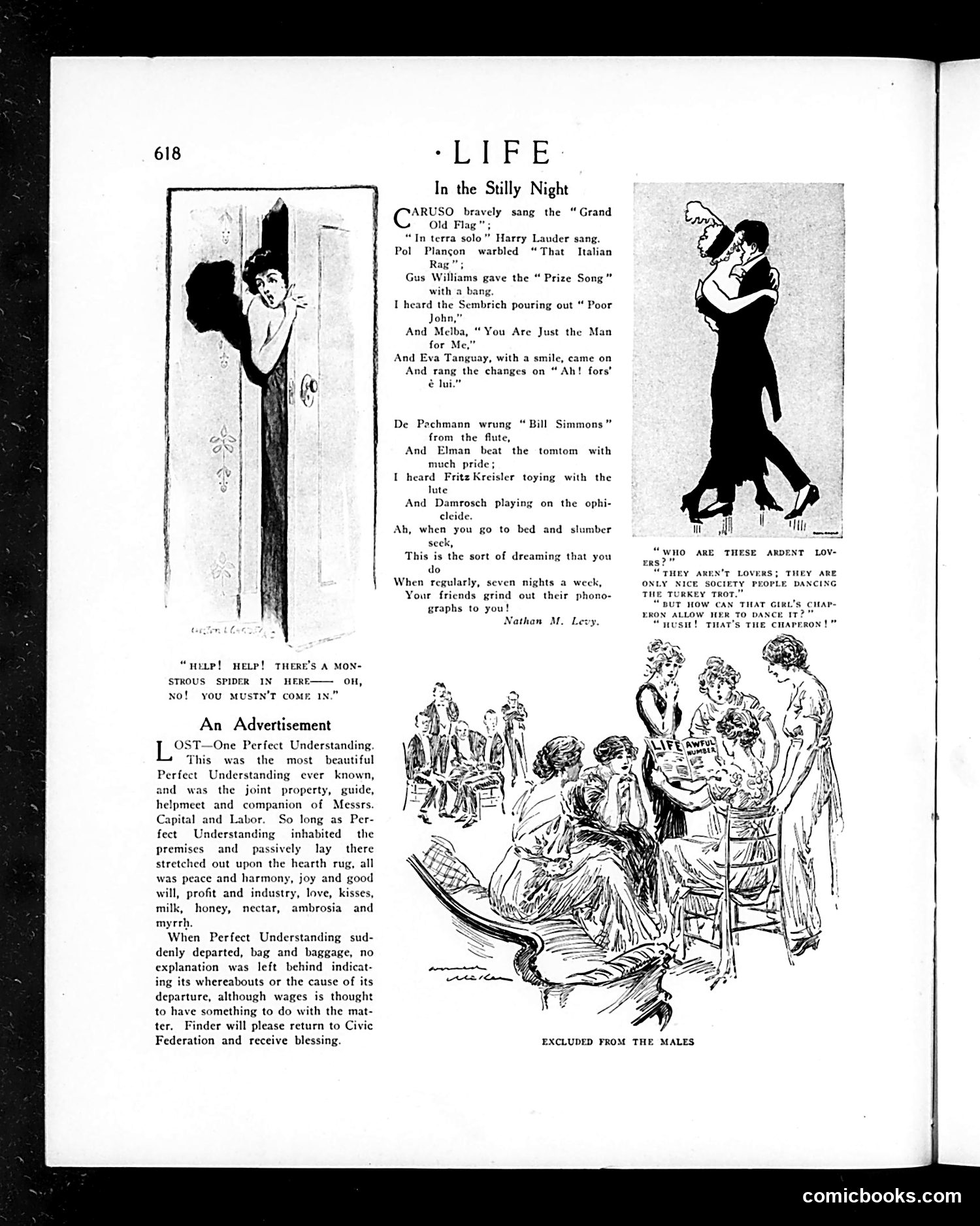
This page combines social satire with entertainment commentary from the early 1900s. **"An Advertisement" (left):** A mock lost-and-found notice for "Perfect Understanding"—the imagined harmonious relationship between Capital and Labor. The satire suggests this understanding has vanished, with wages disputes likely responsible. It's directed at the Civic Federation, implying labor-capital relations were fractured during this period of industrial unrest. **"In the Stilly Night" (center):** A humorous poem listing famous musicians and singers (Caruso, Harry Lauder, Gus Williams, Damrosch, Kreisler, etc.) performing their hit songs. The joke: these phonograph recordings play endlessly at night, torturing the listener—a complaint about the new technology's social impact. **Right cartoon:** Satirizes modern dance and morality. The "Turkey Trot" was a scandalous new dance considered indecent. The joke mocks how society people justify it while chaperoning, with the caption revealing the chaperone herself is dancing it—hypocrisy about "respectable" behavior.
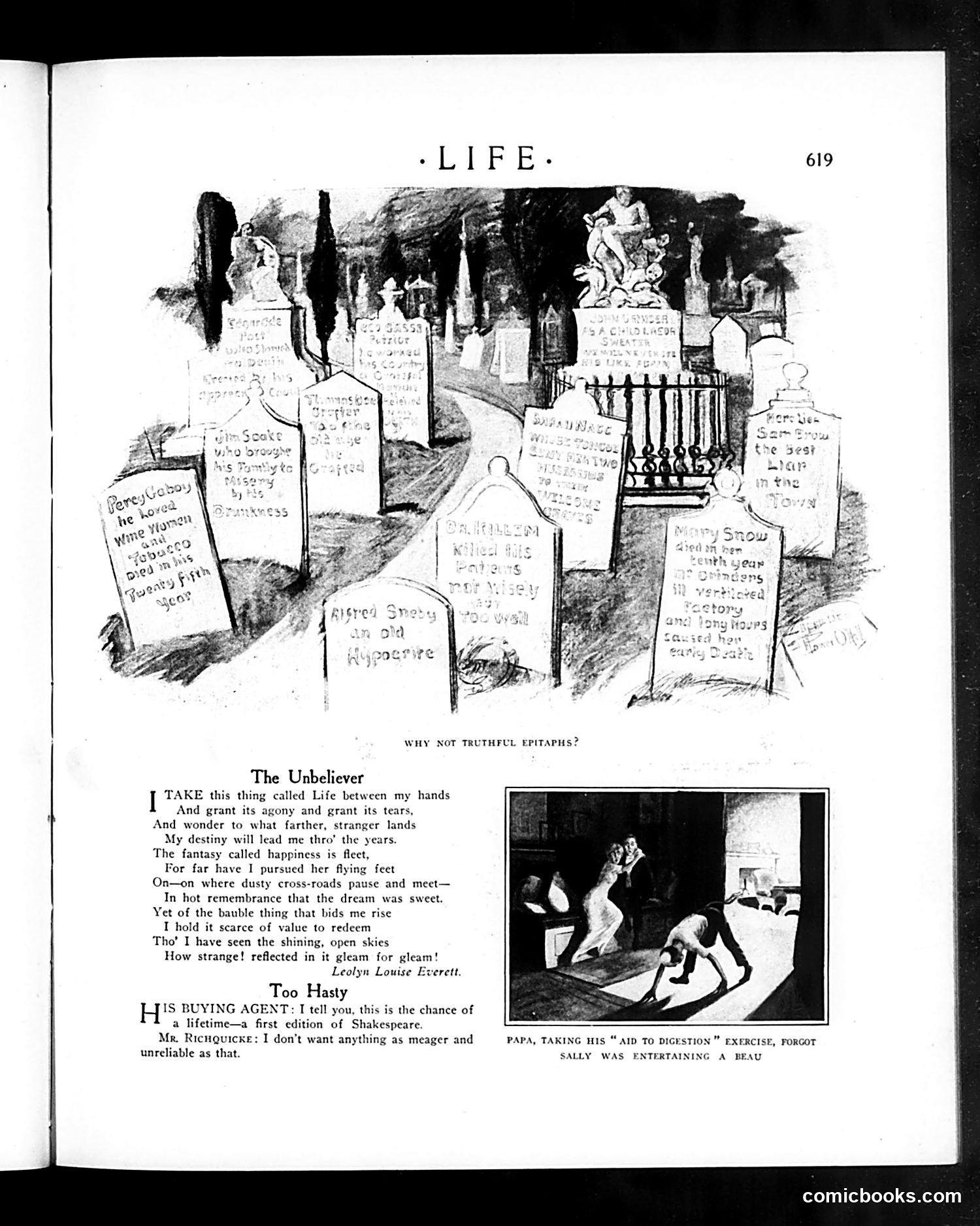
This page combines satirical poetry with humorous illustrations typical of early 20th-century Life magazine. **Top cartoon**: "Why Not Truthful Epitaphs?" shows a cemetery with gravestones bearing the names of literary and cultural figures (partially legible). The heading suggests satire about dishonest commemorations—mocking how epitaphs typically flatter the deceased rather than honestly assess their lives. **"The Unbeliever"**: A poem by Leolyn Louise Everett presenting an existential, pessimistic worldview—life as suffering with fleeting happiness, suggesting skepticism about conventional values. **"Too Hasty"**: A two-panel joke where a buying agent pitches a Shakespeare first edition as a lifetime opportunity, but the prospect (Mr. Richuguicke) dismissively refuses anything "meager and unreliable." The accompanying illustration shows a father exercising vigorously while his daughter entertains a suitor—implying the father's obliviousness to propriety creates chaos. The satire targets both pretension (rare book dealing) and middle-class domestic absurdity.
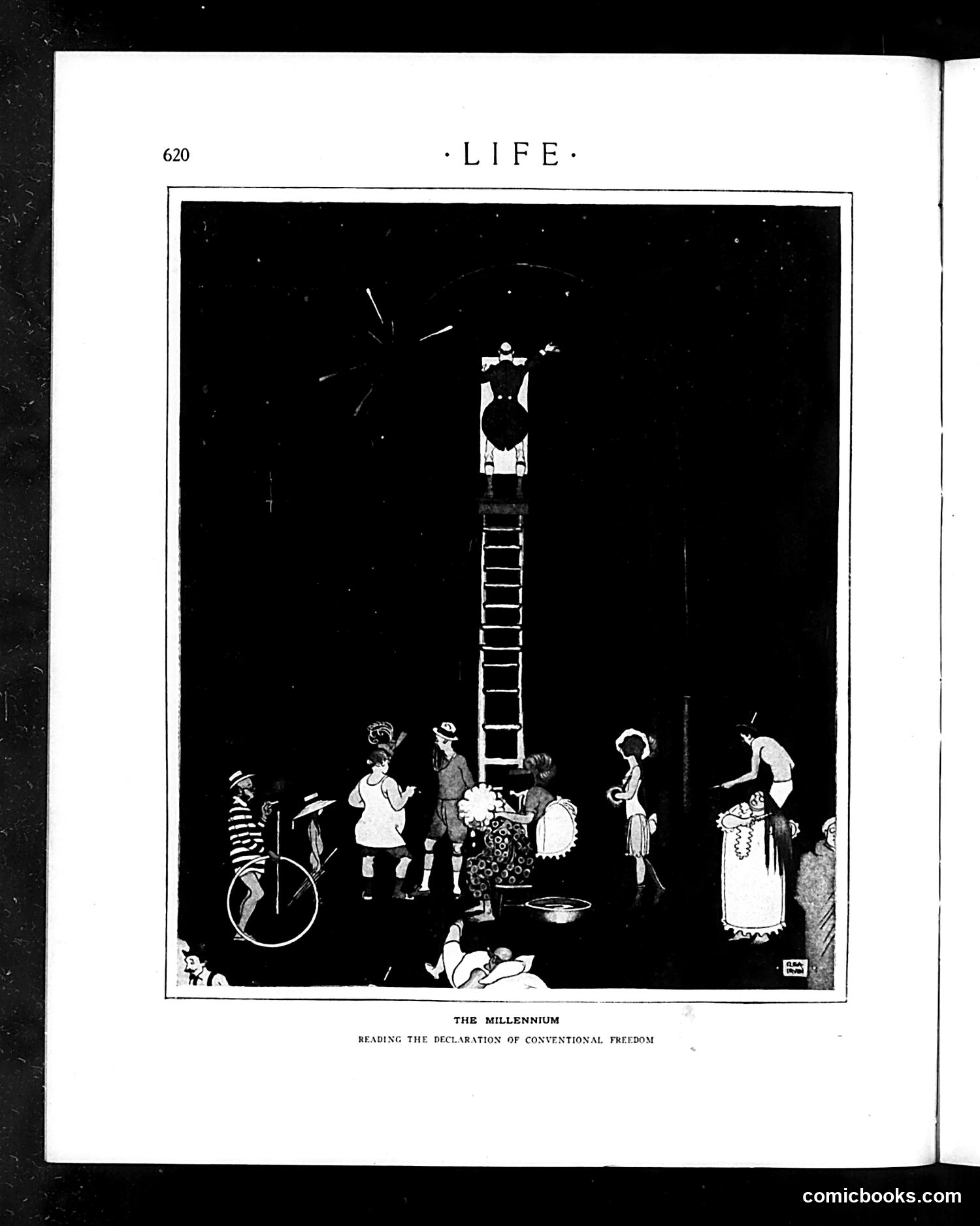
This silhouette illustration depicts a utopian future scene where various figures gather beneath a tall ladder to read a declaration. The composition suggests an idealized, peaceful moment of collective freedom and enlightenment. The title references "conventional freedom"—likely satirizing how societies define and celebrate liberty. The silhouette style, popular in early 20th-century Life magazine, creates a dreamlike quality appropriate to depicting an imagined future. The diverse group—including adults, children, and figures on bicycles—represents broad social participation in this promised freedom. However, without additional context from Life's publication date and surrounding articles, the specific political or social targets of this satire remain unclear. It appears to comment on public ideals of democracy and equality, though whether critically or hopefully cannot be determined from the image alone.
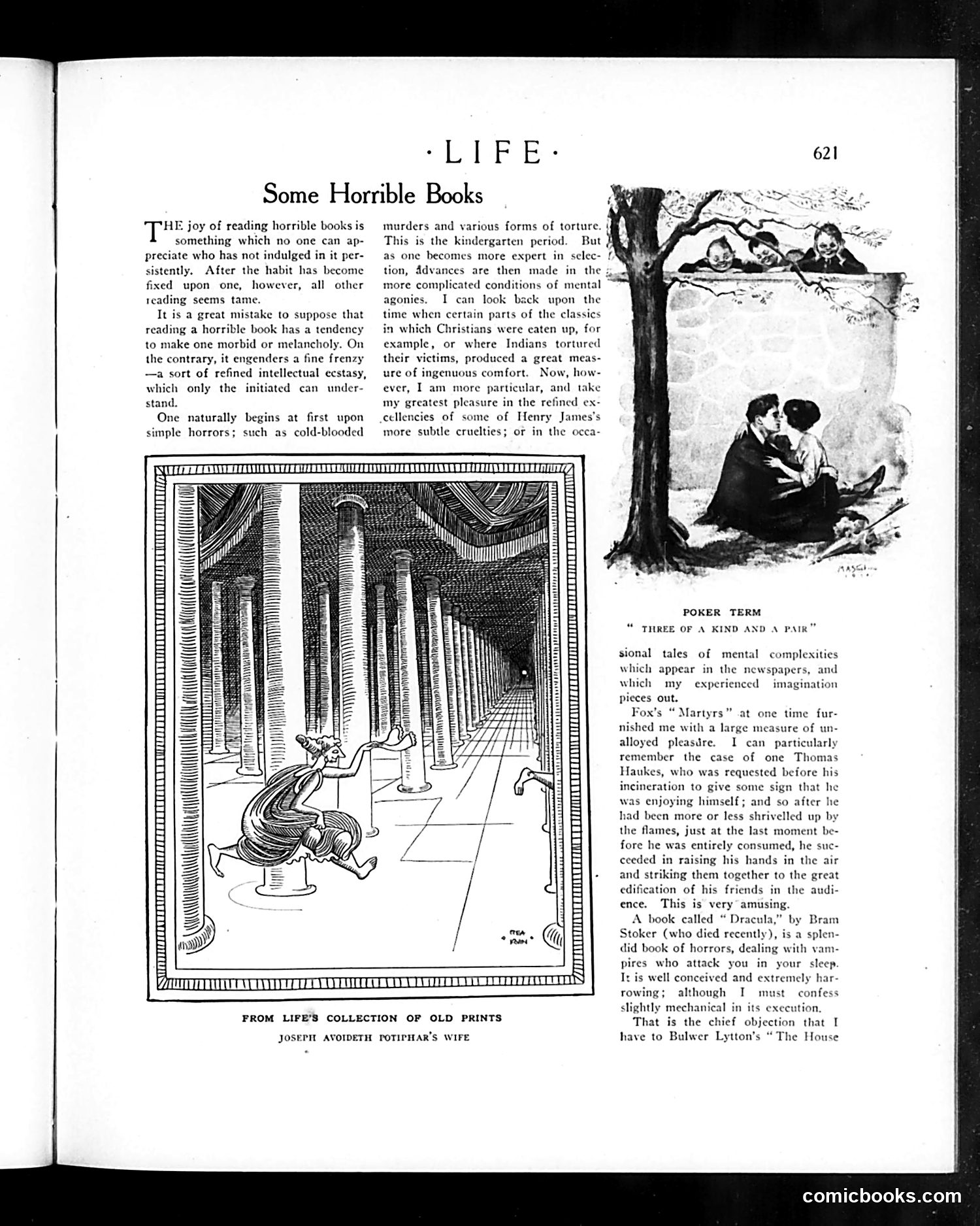
This satirical essay mocks readers who obsessively consume sensational, grotesque literature. The author argues that "horrible books" provide intellectual pleasure to those addicted to them, progressing from simple horrors (murders, torture) to more psychologically complex torments—particularly Henry James's subtle cruelties. The accompanying cartoons illustrate this theme: the lower print shows "Joseph Avoideth Potiphar's Wife" (a biblical reference to sexual temptation), while the upper illustration depicts people in distress in a columned hall, visualizing the "mental agonies" discussed. The satire targets Victorian-era readers' appetite for sensational Gothic fiction and lurid tales, suggesting this taste represents both refined intellectualism *and* morbid excess—a contradiction the author playfully explores. References to Bram Stoker's *Dracula* and historical martyr accounts underscore how society simultaneously celebrates and denies its fascination with human suffering.
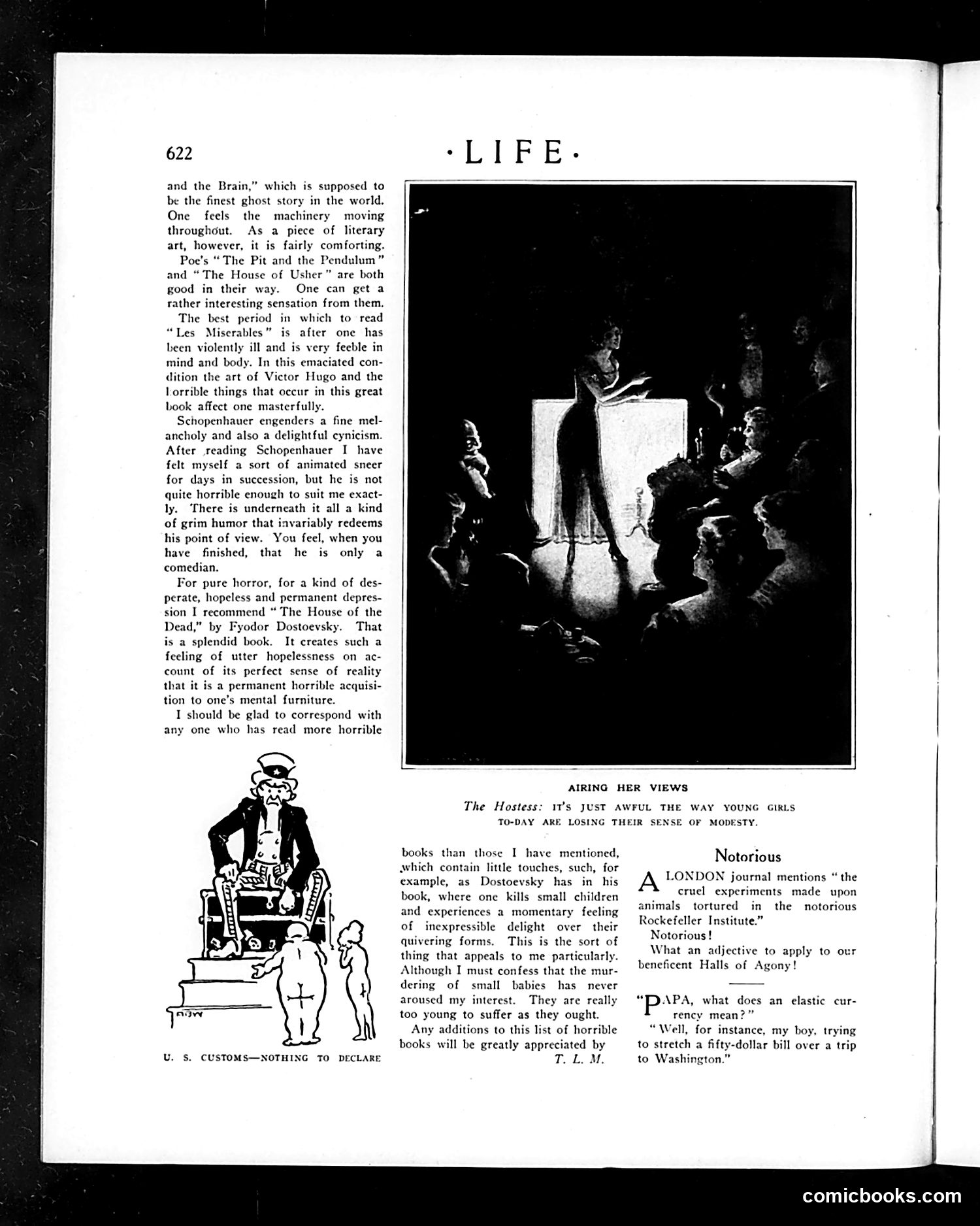
The left column contains a book review recommending works of dark literature—Poe, Hugo, Schopenhauer, and especially Dostoevsky's *The House of the Dead*—praising their capacity to induce despair and hopelessness. The reviewer explicitly admires depictions of child suffering, claiming babies are "too young to suffer as they ought." This appears to be satirical dark humor, likely mocking morbid intellectualism. The cartoon below shows Uncle Sam (identifiable by his top hat and patriotic dress) declaring "Nothing to Declare" while apparently smuggling disturbing ideas or influences. The right column contains two brief satirical pieces: one mocking a hostess lamenting young women's lost modesty (with an illustration suggesting the opposite), and another joke about economic "elasticity"—stretching a fifty-dollar bill inadequately to cover Washington travel expenses, satirizing inflation or financial strain.
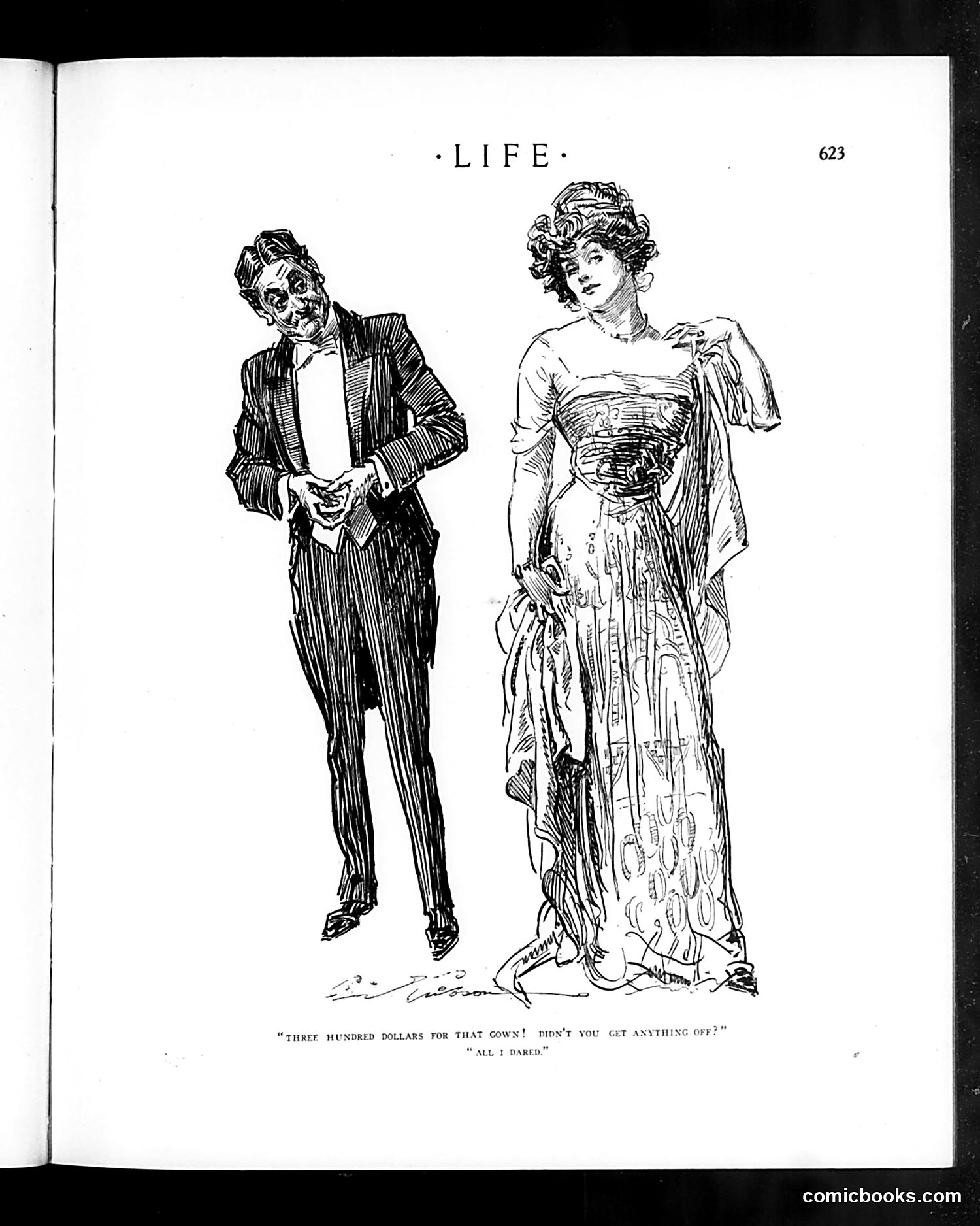
This is a single-panel cartoon satirizing gender relations and consumer culture. A well-dressed man in a tuxedo stands beside an elegantly dressed woman in an elaborate gown. The caption reads: "THREE HUNDRED DOLLARS FOR THAT GOWN! DIDN'T YOU GET ANYTHING OFF?" with her response: "ALL I DARED." The joke mocks husbands' complaints about wives' expensive clothing purchases. The phrase "anything off" suggests a discount, but the woman's reply—"all I dared"—implies she got the maximum discount possible while still purchasing an expensive item, thus defending her extravagance as fiscally responsible. The cartoon satirizes both marital tension over spending and the social expectation that wives justify luxury purchases to their husbands.
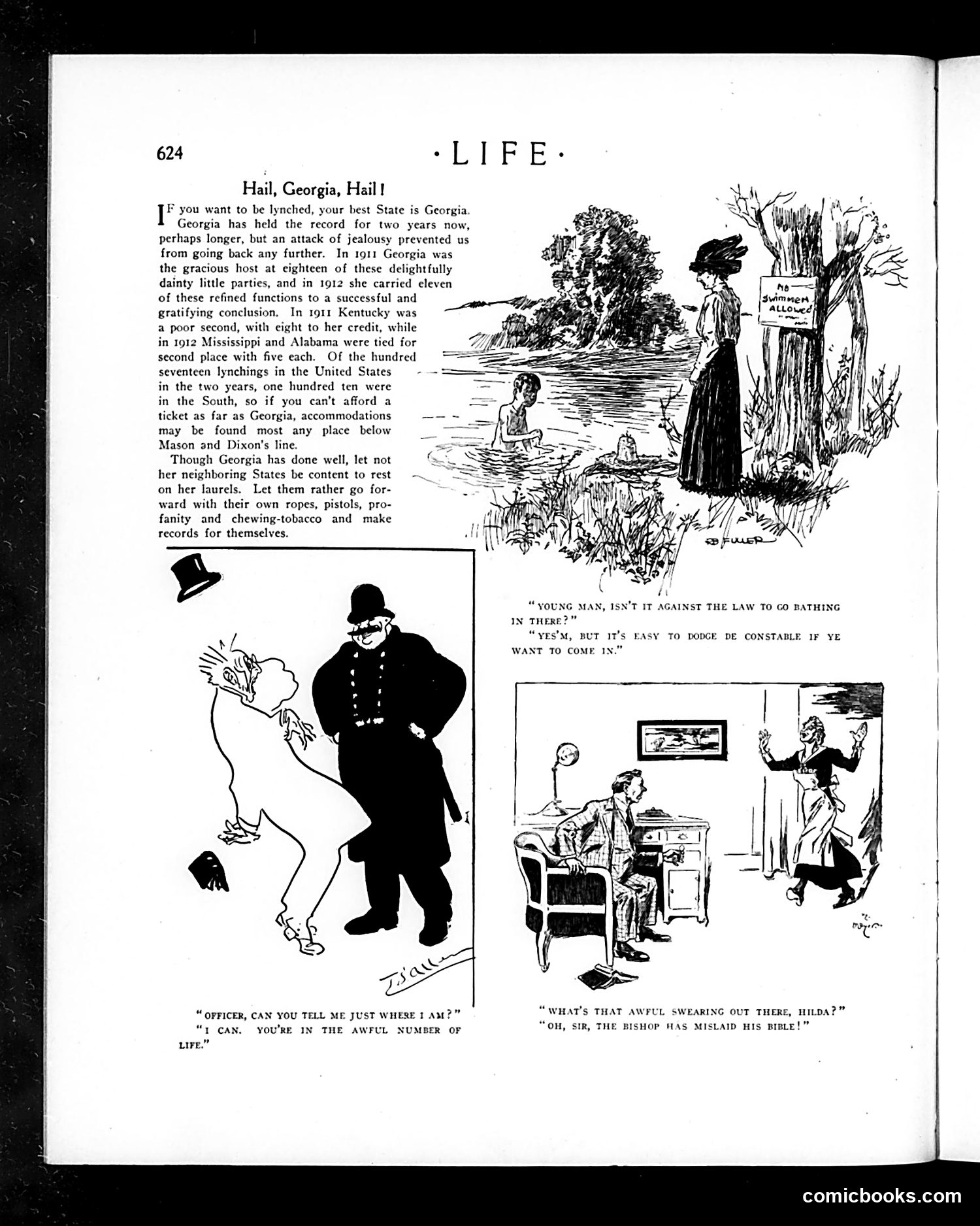
This satirical piece brutally mocks the epidemic of lynching in the American South during the early 1910s. The article presents Georgia's lynching statistics (18 in 1911, 11 in 1912) as though they were competitive sporting achievements, sarcastically encouraging neighboring Southern states to "make records for themselves." The text cites 117 lynchings across two years, with 110 occurring in the South—documenting a horrific pattern of racialized violence. The three cartoon panels employ dark humor to contrast with this grim reality: they depict trivial scenarios (bathing illegally, a mislaid bible) to show how casual lawbreaking is in the South, implying that murder by mob goes equally unpunished. The satire's point is clear: Life magazine is exposing and condemning the South's systemic failure to prosecute lynchers while aggressively enforcing trivial laws—revealing the racist hypocrisy of Southern justice.
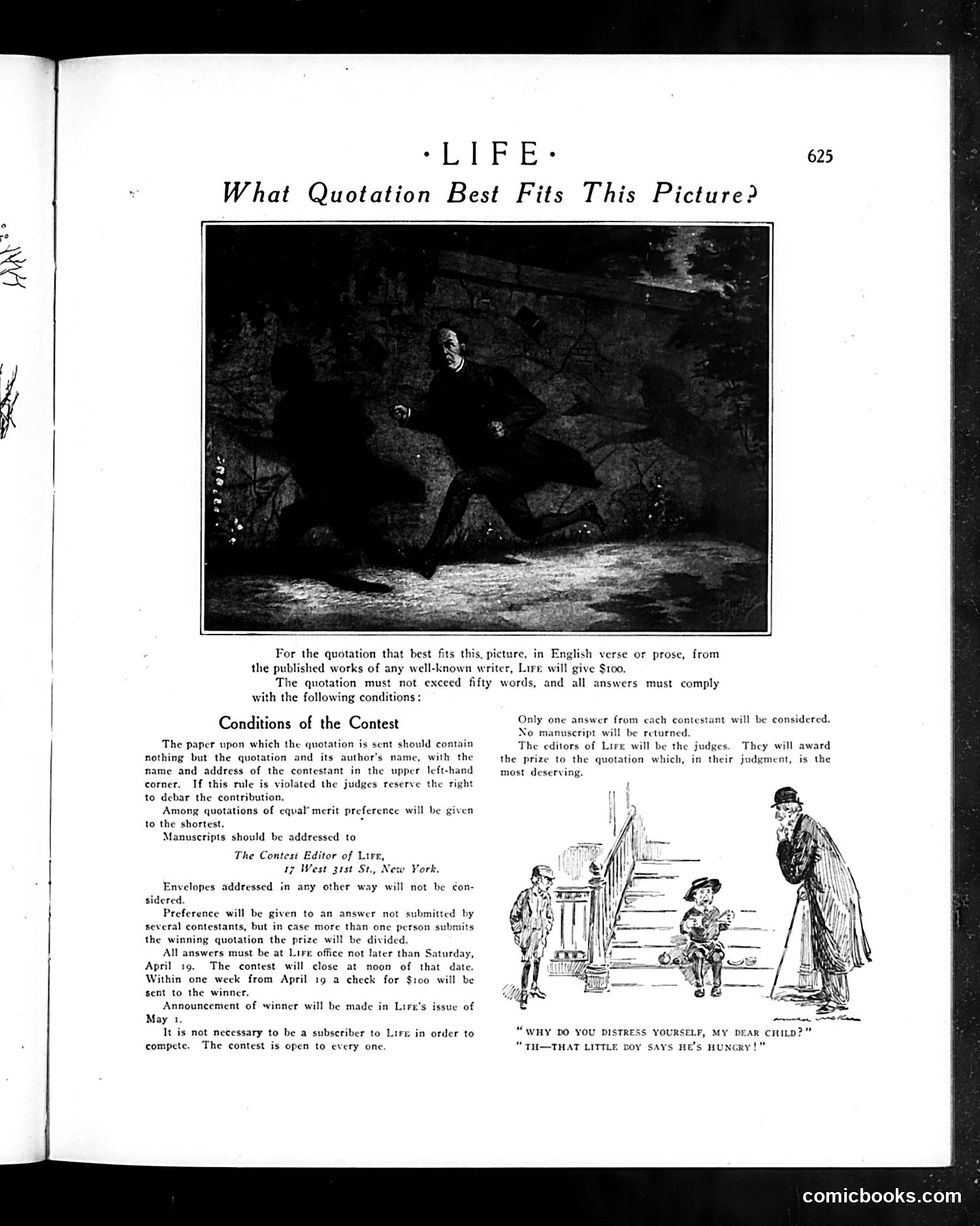
This page announces a **quotation-matching contest** rather than displaying editorial cartoons. The main image shows a dramatic scene of what appears to be a distressed adult and child in dark, possibly impoverished circumstances—likely depicting poverty or hardship. The accompanying illustration below shows a well-dressed woman questioning a child about his appearance, with the caption revealing the child claims he's hungry. This appears to satirize **class hypocrisy**: wealthy individuals expressing surprise or dismissal of poverty's realities. The contest invites readers to submit literary quotations (under 50 words) from published writers that best fit the main photograph, with a $100 prize. This was a common early-20th-century *Life* magazine feature, engaging readers while testing their cultural literacy and interpretive skills. The satire likely critiques indifference to poverty among the privileged classes.
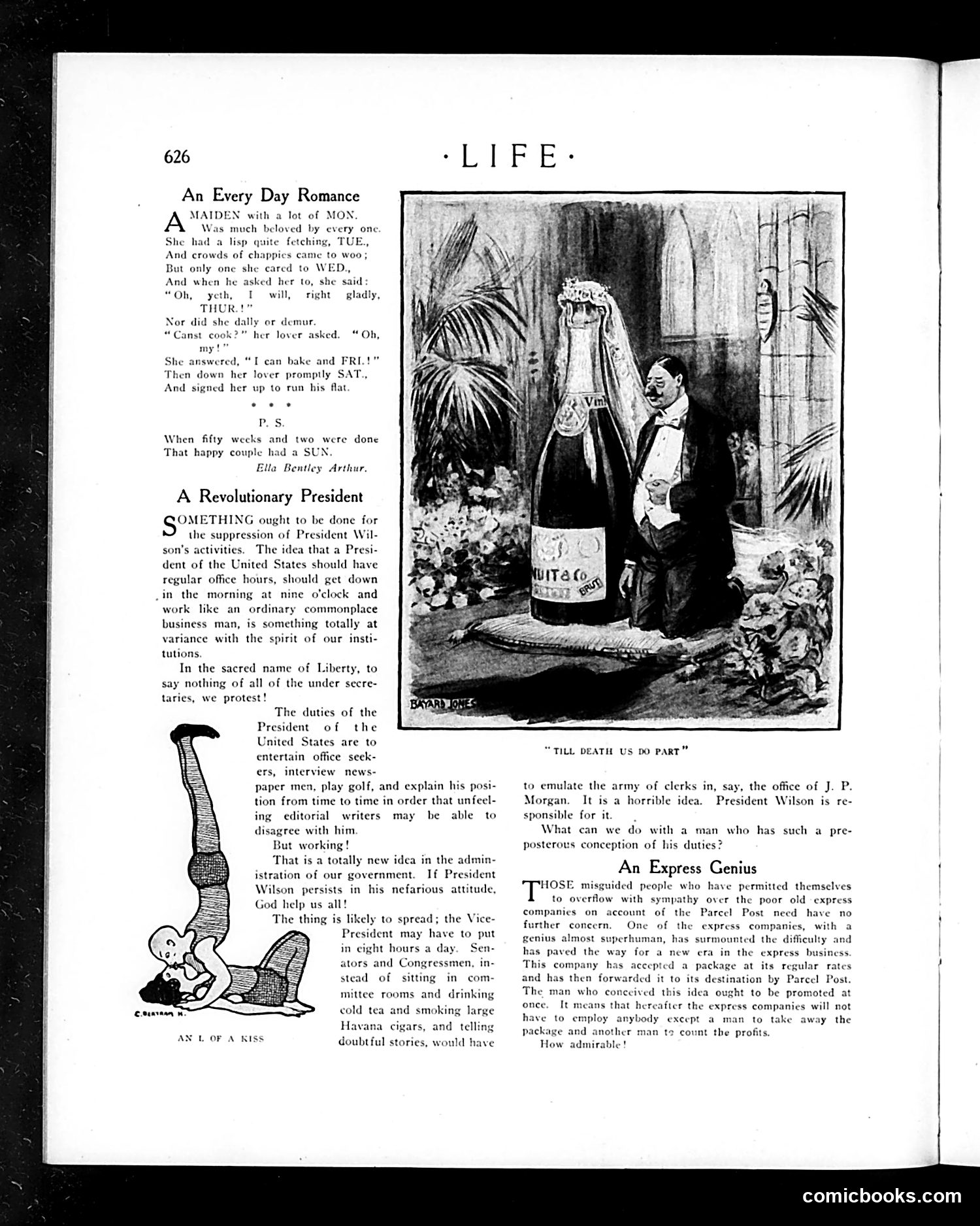
This page contains two satirical pieces criticizing President Woodrow Wilson's administration (circa 1913-1921, based on references). **"An Every Day Romance"** is a light verse joke playing on days of the week (MON-day, TUE-sday, WED-nesday, THU-rsday, FRI-day, SUN-day), following a woman courted by many suitors who marries one man and produces a child. **"A Revolutionary President"** is the page's main political satire. It mocks Wilson for introducing the radical practice of *actually working*—arriving at 9 a.m. and conducting business like a commonplace businessman. The author sarcastically protests that a U.S. President should instead entertain office-seekers, play golf, and grant interviews. This is satirical criticism: Wilson's work ethic is presented as dangerously revolutionary and contrary to tradition. **"An Express Genius"** briefly praises an express company for accepting parcels at regular rates and forwarding them via Parcel Post—a practical solution sarcastically called "admirable." The cartoons mock both Wilson's efficiency-focused presidency and broader institutional complacency.
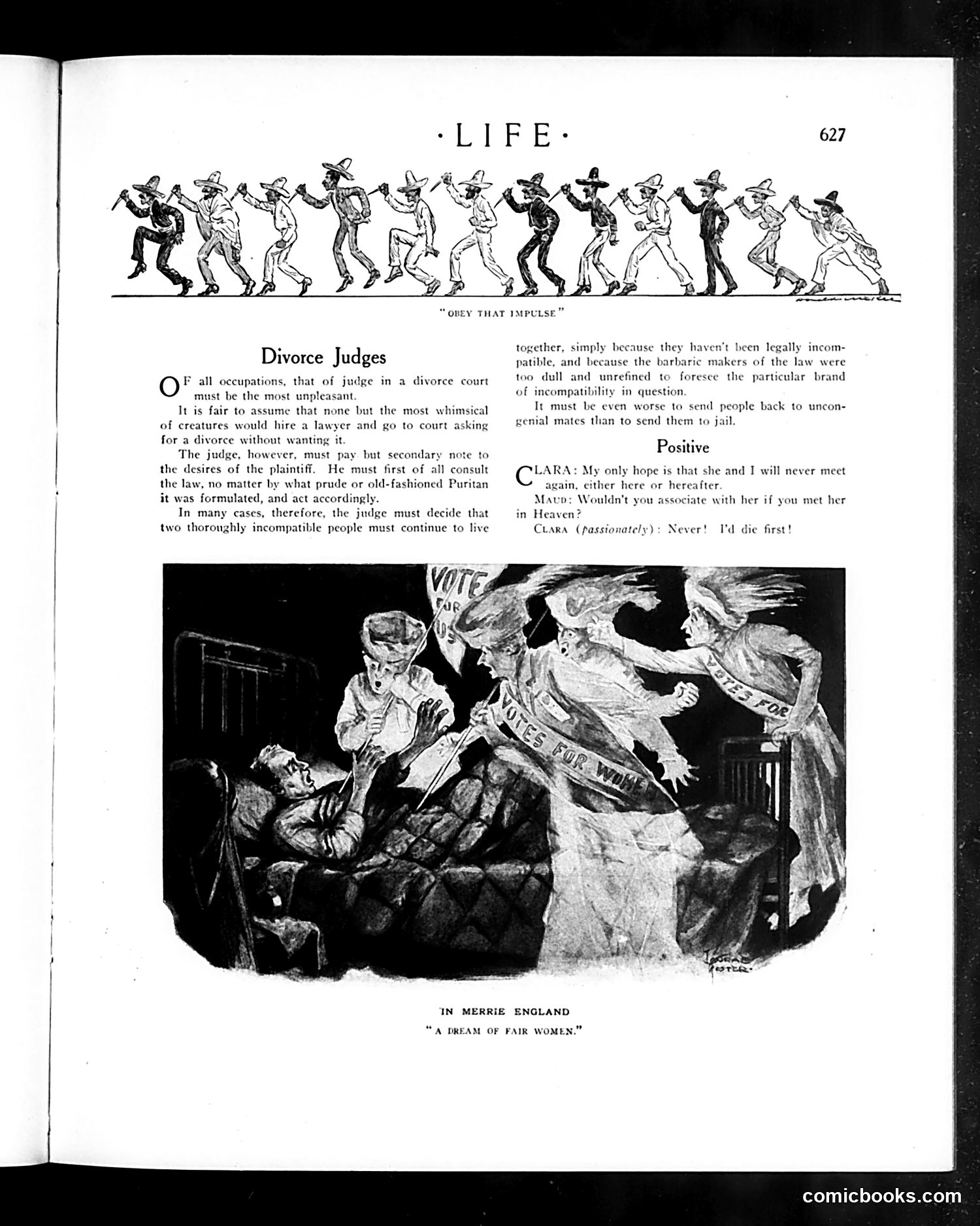
The page contains two satirical elements about divorce: **Main Article ("Divorce Judges"):** A serious commentary arguing that divorce court judges face an impossible ethical position. The text critiques outdated laws that force "thoroughly incompatible people" to remain married against their wishes, calling this punishment worse than jail. It suggests legal frameworks were written by "dull and unrefined" lawmakers who couldn't foresee modern relationship incompatibilities. **Cartoon ("In Merrie England"):** Depicts a domestic quarrel scene where a woman passionately declares she'd "die first" rather than meet her estranged husband in Heaven. The cartoon satirizes the irony of being forced by law to stay married to someone you actively despise—so much so that eternal separation is preferable to eternal togetherness. **Context:** This reflects early-to-mid 20th century debates over divorce law reform. The satire targets restrictive marriage laws that trapped unhappy couples together, treating this as social cruelty rather than moral righteousness.
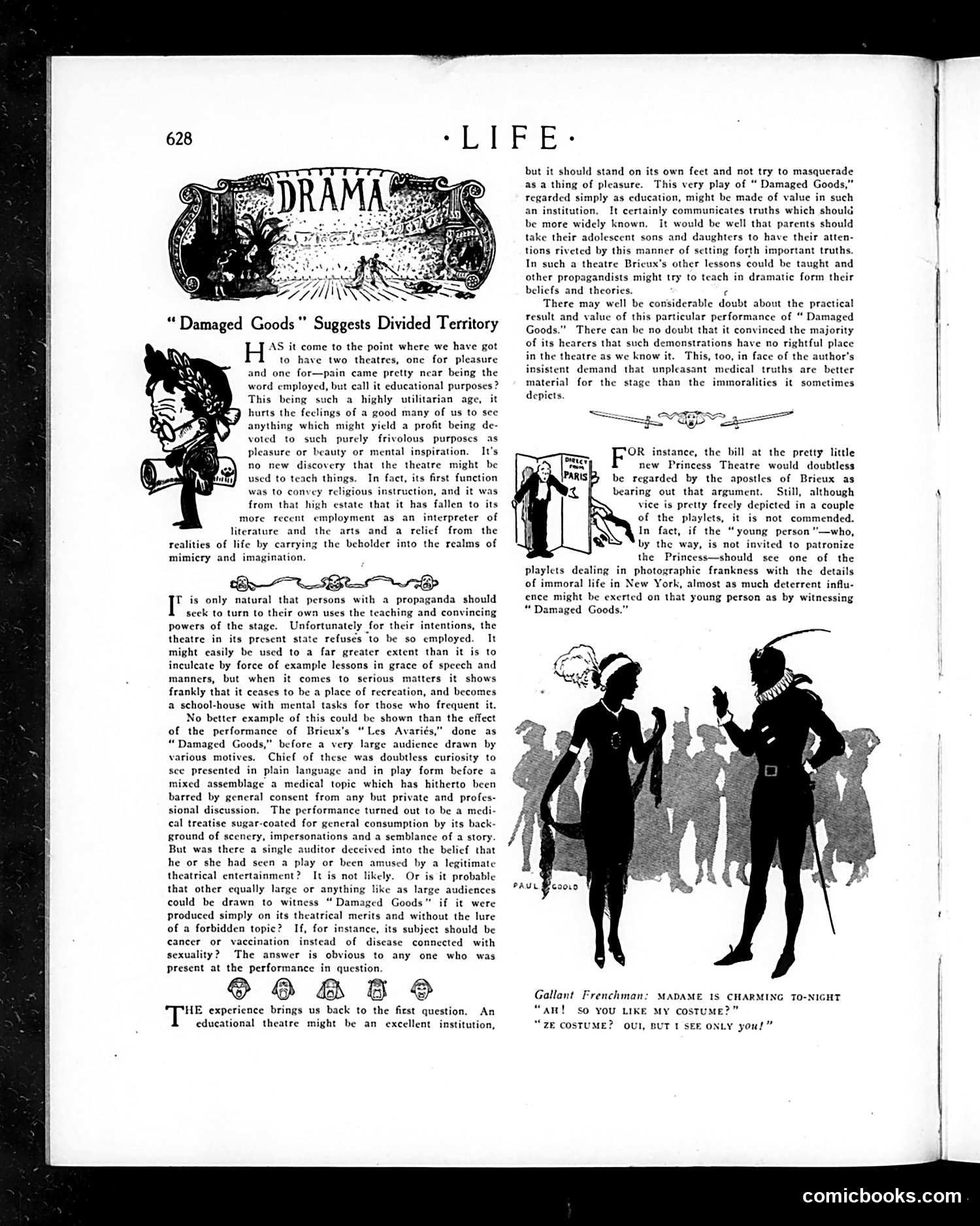
This 1913 *Life* magazine article critiques the play "Damaged Goods" (Brieux's *Les Avariés*), which tackled syphilis—a taboo medical topic rarely discussed publicly. The cartoon depicts a Frenchman flirting, illustrating the play's sexual subject matter. The author argues that audiences were drawn by curiosity about forbidden content rather than theatrical merit. He contends the play functions as a medical lecture disguised as entertainment, not genuine drama. While acknowledging its educational value—particularly for parents teaching adolescents about serious health matters—the critic insists such material belongs in dedicated educational theaters, not pleasure venues. The satire targets both propagandists misusing theatre and audiences' hypocrisy: they claim to seek instruction but actually crave scandal. The piece reflects early 20th-century tensions between theatre as art/entertainment versus moral instruction, and Victorian discomfort discussing sexuality even for educational purposes.
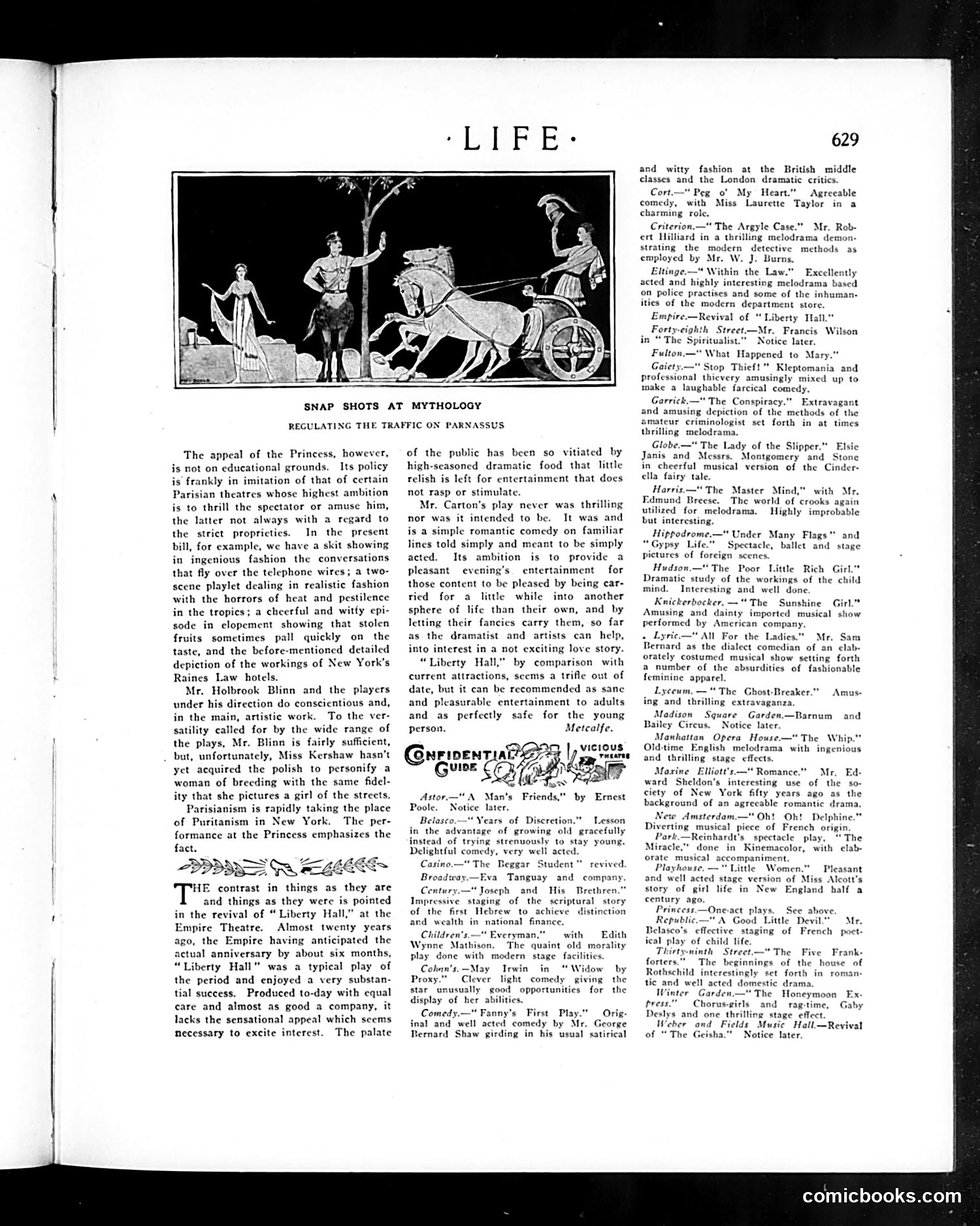
The cartoon depicts classical mythological figures (suggesting Mount Parnassus, home of the Muses) in modern contexts—likely representing theatrical productions and entertainment trends. The title suggests satire about how contemporary theater is "regulating" or reshaping classical artistic standards. The accompanying text criticizes the Princess Theatre's programming for prioritizing sensationalism over substance. The reviewer argues that New York audiences have become so accustomed to "high-seasoned dramatic food" that they've lost appetite for genteel entertainment. The piece contrasts this with the revival of "Liberty Hall"—a twenty-year-old romantic comedy now seeming quaint by comparison. The satire targets the shift from Puritan restraint toward "Parisianism"—meaning Continental decadence—in American theater, reflecting anxieties about changing cultural values and audience taste becoming corrupted by vulgar spectacle rather than elevated art.
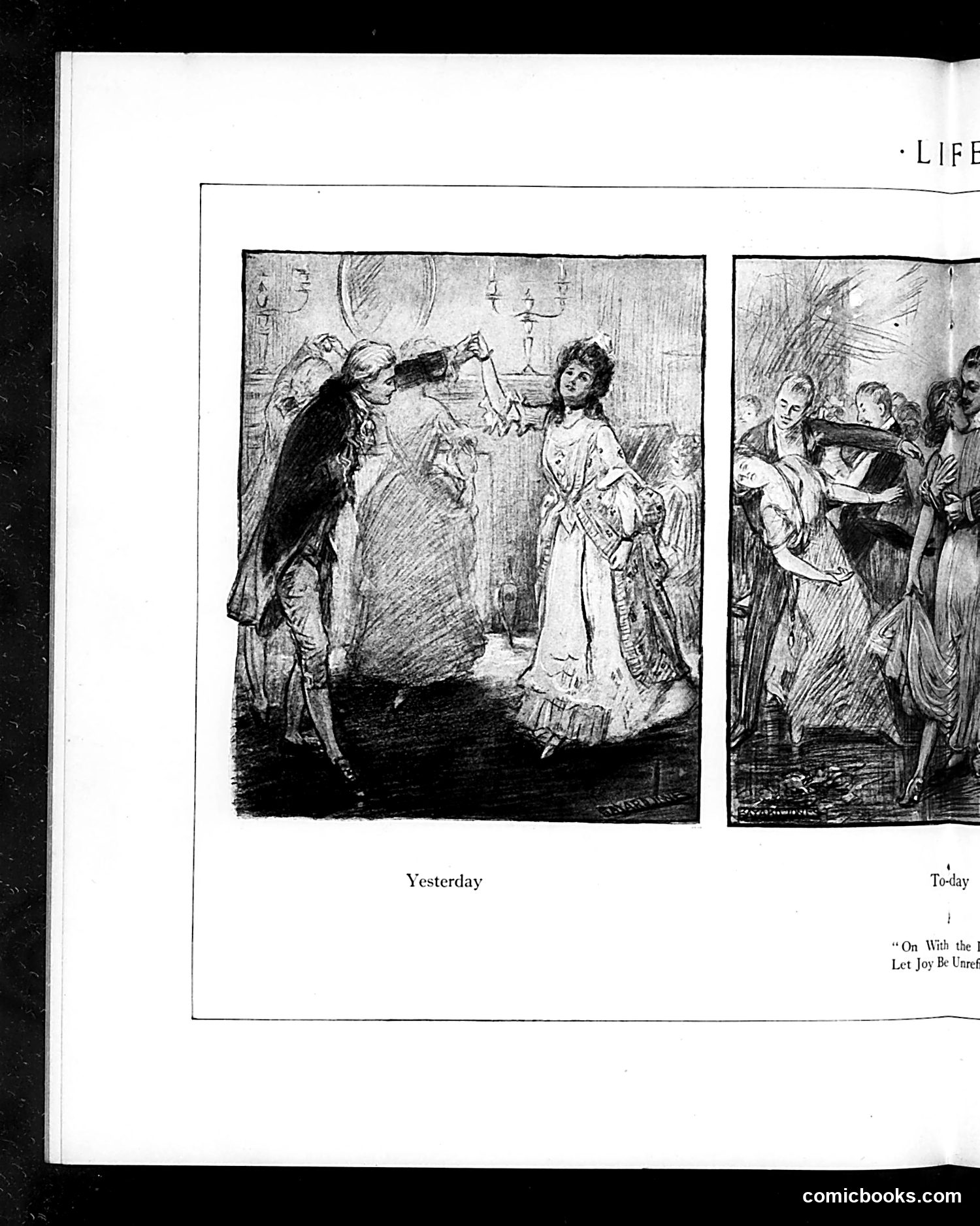
This page presents a two-panel comparison titled "Yesterday" and "Today," depicting social attitudes toward romance or courtship. The left panel shows a woman being courted by a man in formal dress, observed by a chaperone—representing traditional Victorian-era propriety where romantic interactions were heavily supervised and constrained. The right panel labeled "Today" illustrates a more relaxed modern scene where couples interact freely in a social gathering without strict oversight, reflecting early 20th-century changes in social customs and gender relations. The visible caption fragment ("Let Joy Be Unref[strained]") suggests the satire celebrates or ironizes this liberation from Victorian constraints. This cartoon likely appealed to Life's readers by humorously contrasting outdated social restrictions with contemporary freedoms in courtship and socializing.
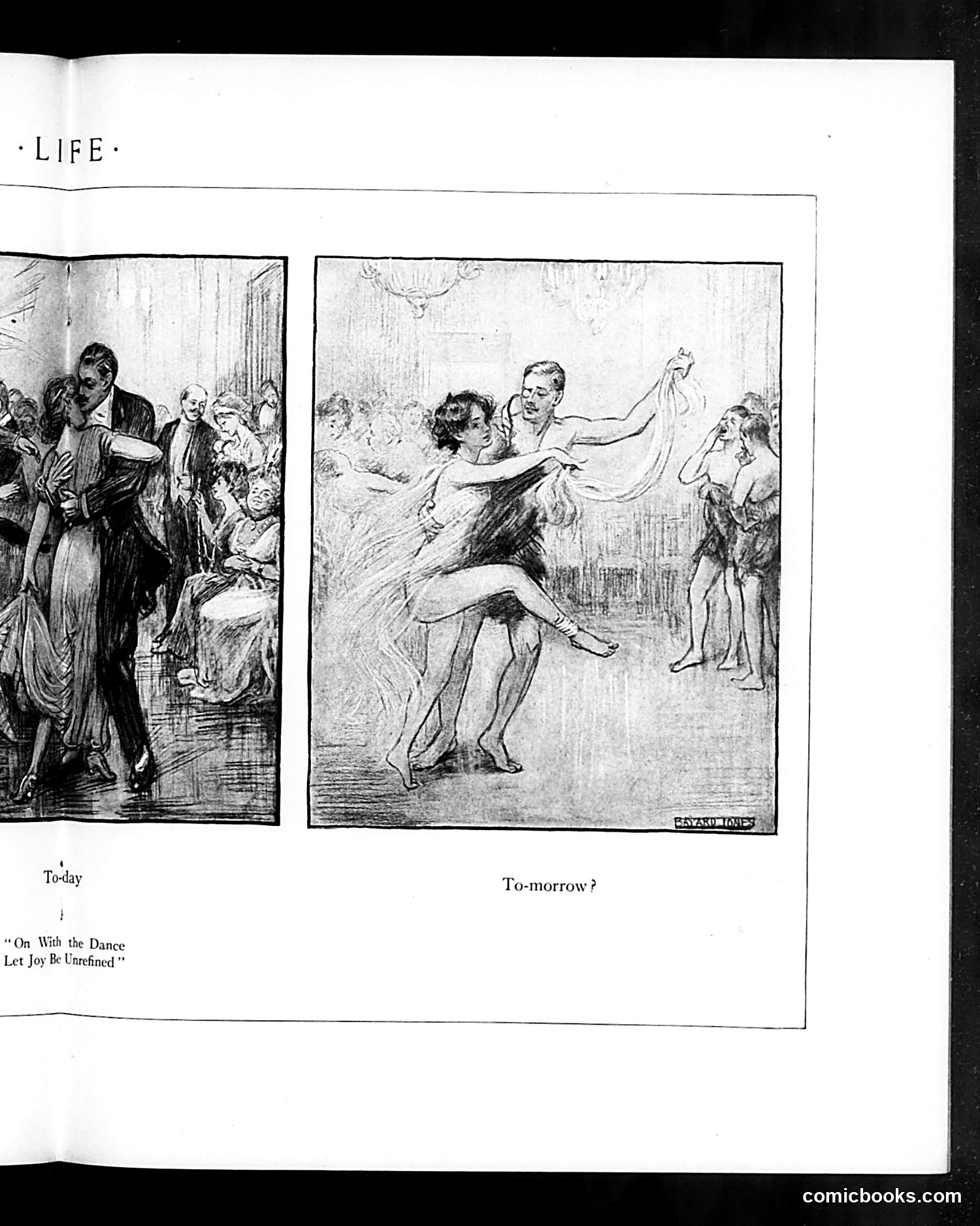
This two-panel satirical cartoon contrasts social propriety with potential future looseness. The left panel ("To-day") shows a formally dressed gathering with restrained behavior—men in suits, women in modest dress, maintaining decorum. The right panel ("To-morrow?") depicts a woman dancing energetically in minimal clothing while men watch, suggesting increasingly uninhibited behavior. The caption quotes a provocative phrase about unrefined joy and dancing, implying social anxiety about moral decline. This appears to be commentary on 1920s Jazz Age culture—the perceived loosening of Victorian standards, shorter skirts, and liberated social behavior that alarmed conservative observers. The satire warns that contemporary social changes might lead to even more dramatic departures from tradition, expressing generational anxiety common to that era.
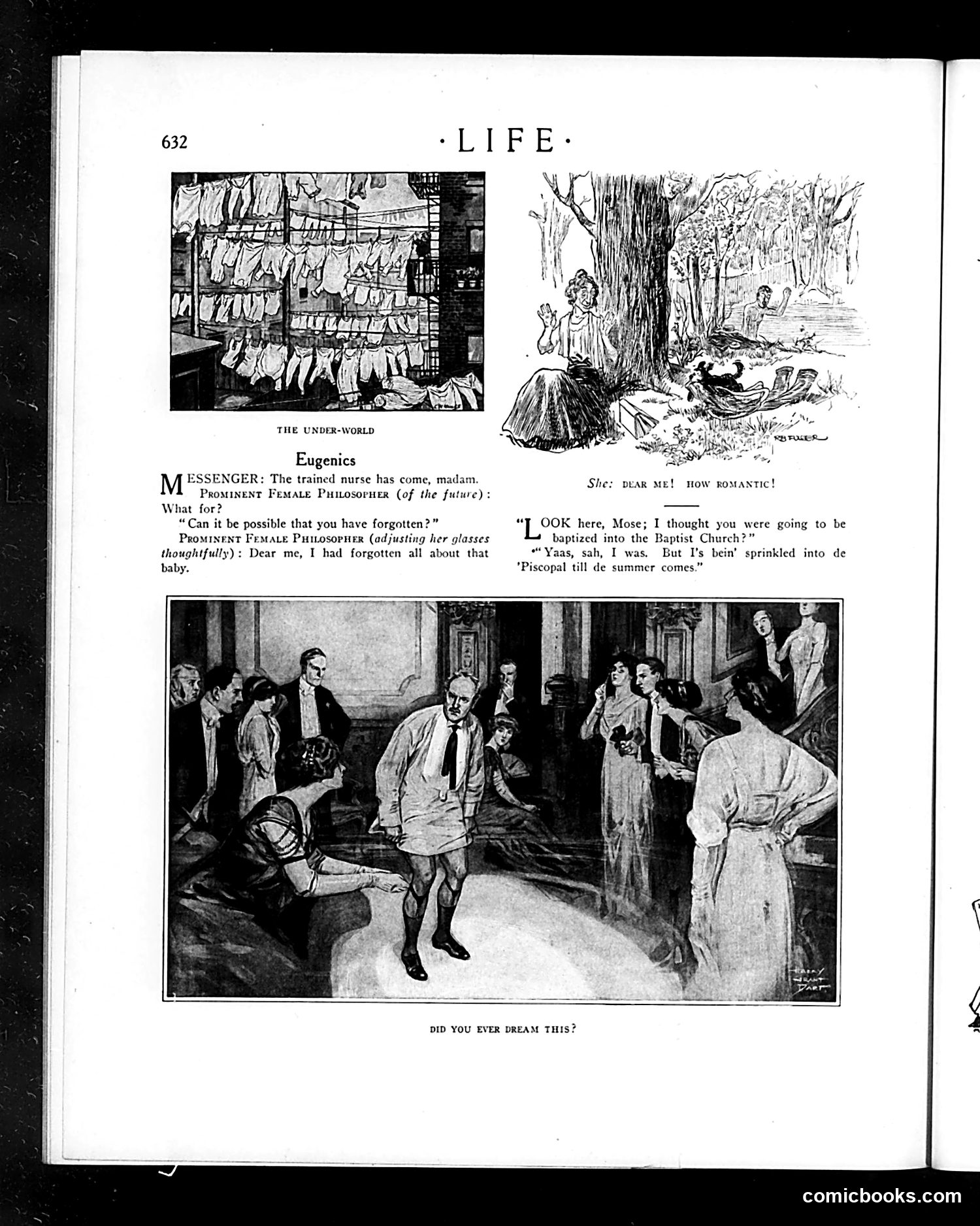
This page satirizes the early 20th-century eugenics movement through two distinct sketches. **Top section ("Eugenics"):** A prominent female philosopher has forgotten why a trained nurse visited—implying she's forgotten about her own baby. The joke mocks intellectual women of "the future" as so absorbed in philosophy they neglect motherhood, satirizing both the eugenics obsession with "fitness" for reproduction and anxieties about educated women's roles. **Bottom section ("Did You Ever Dream This?"):** This depicts an absurdist party scene where a man appears to be performing gymnastics or undignified physical stunts while well-dressed guests observe. The title questions whether readers ever imagined such behavior at polite gatherings, likely satirizing some contemporary fad or social phenomenon (unclear which specific trend from context). **The small comic dialogue** about Baptist versus Episcopal baptism timing is a separate ethnic/religious joke unrelated to the main themes.
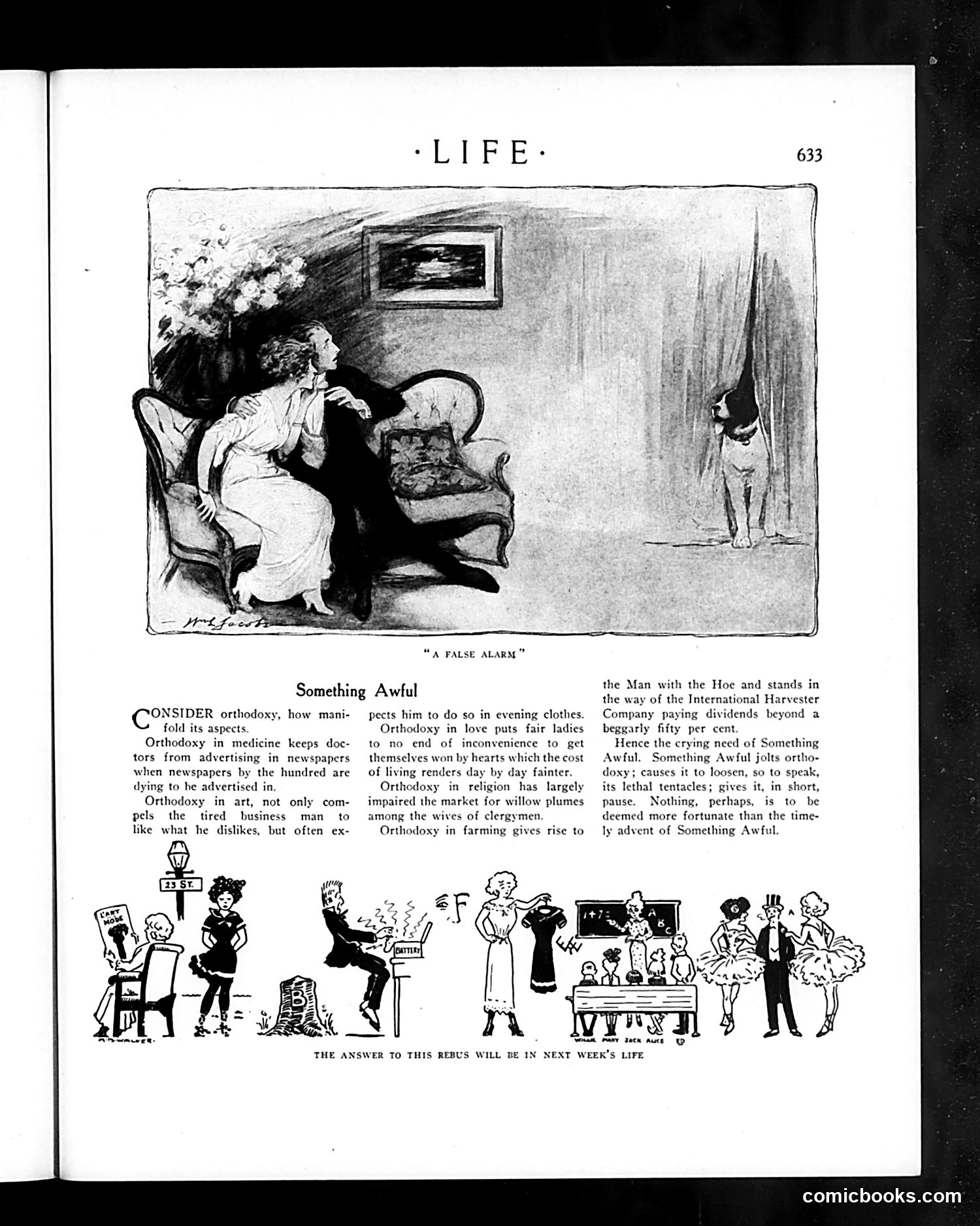
The top cartoon shows a woman startled in her chair while a man enters a room—the "false alarm" of the title. The joke concerns **social propriety and scandal**: the woman's shocked reaction suggests fear of compromising her reputation, though the man's casual entrance indicates there's nothing actually improper occurring. The accompanying essay satirizes **"orthodoxy"**—rigid adherence to conventional rules across medicine, art, fashion, religion, and agriculture. The author argues orthodoxy is stifling: doctors won't advertise though papers need revenue; businessmen must dress formally to appreciate art they dislike; love is hampered by economic constraints; clergy wives can't wear fashionable plumes; farming efficiency is blocked by traditional methods. The essay concludes that "Something Awful"—presumably disruption or scandal—is needed to shake loose these paralyzing conventions. The bottom panel appears to be a visual rebus puzzle for readers to solve in the next week's issue. This reflects early-20th-century progressive critique of Victorian social restrictions.
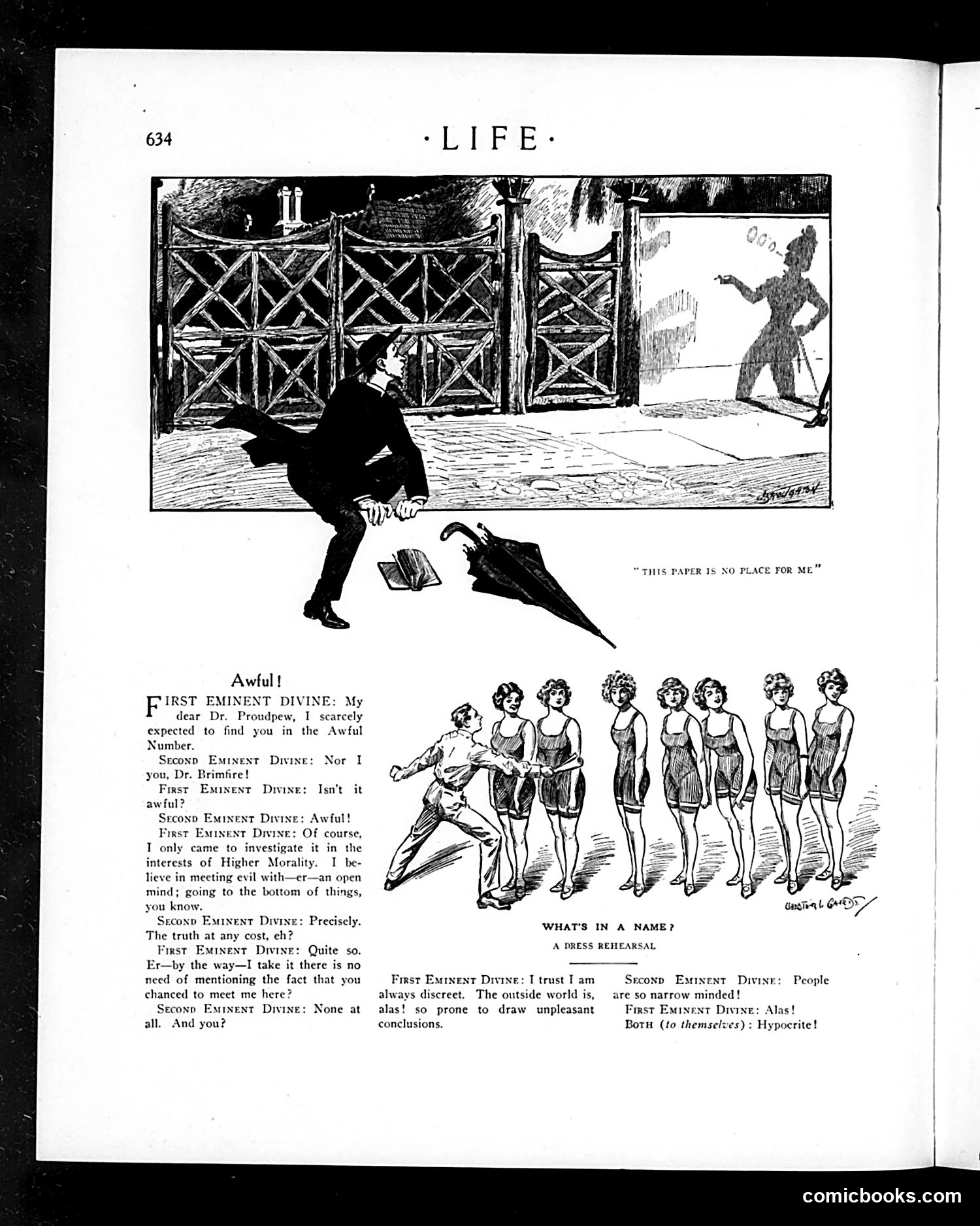
This page satirizes hypocrisy among religious leaders ("Eminent Divines"). The top cartoon shows a man discarding a newspaper labeled "Awful Number" while his shadow reveals him reading it—visual metaphor for secret vice. The dialogue below mocks two clergymen who encounter each other buying this scandalous issue. Each claims to investigate it purely for "Higher Morality" and moral instruction, while actually seeking entertainment. They nervously agree to keep their meeting secret, fearing public scandal. The right panel shows a "dress rehearsal"—a line of chorus girls—suggesting the "Awful Number" likely contained risqué content. The clergymen's final hypocrisy: they simultaneously condemn people as "narrow minded" while hiding their own consumption of such material. The satire targets sanctimonious religious figures who publicly denounce vice while privately indulging it, and who fear losing moral authority if their true interests were exposed.
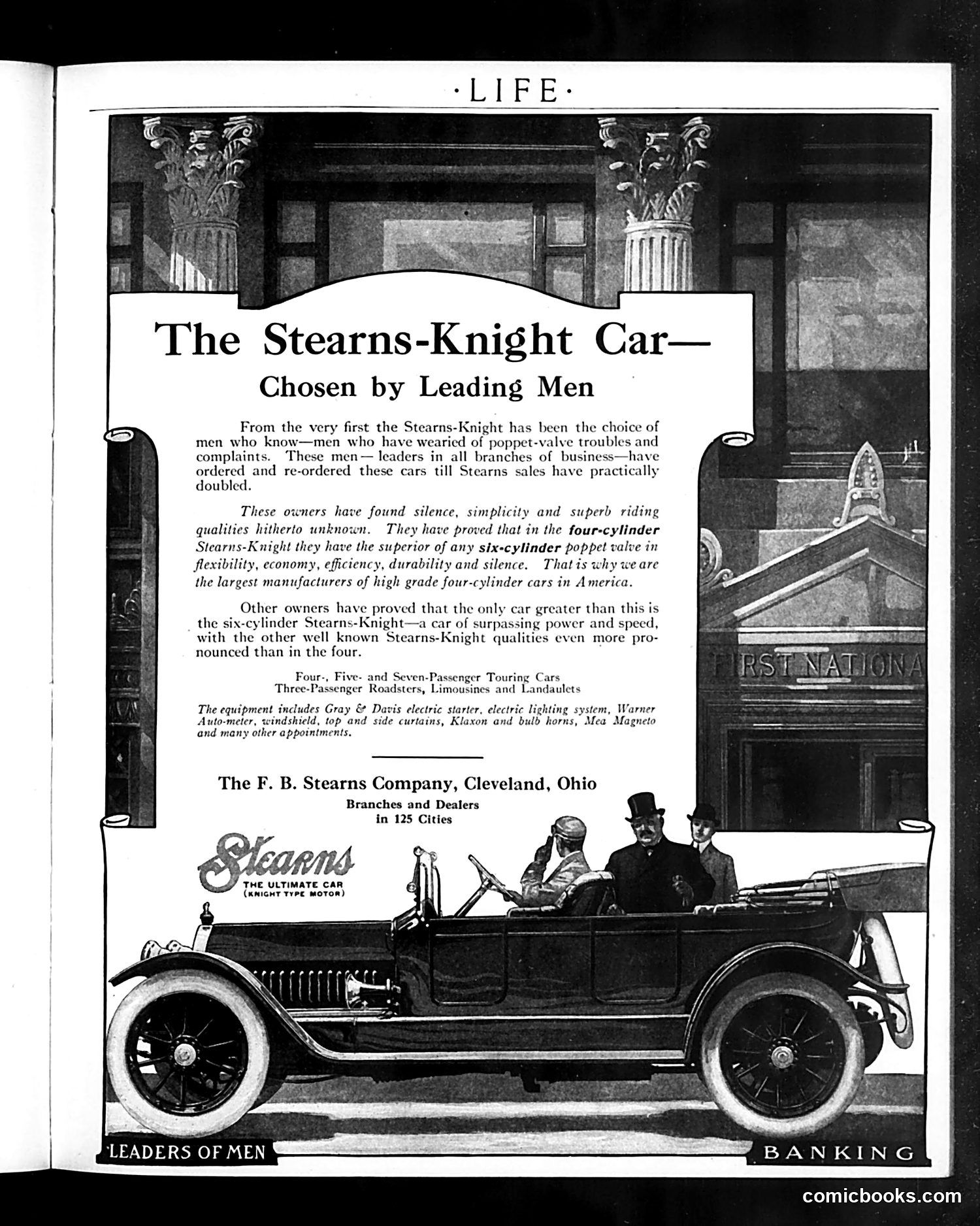
This is a **full-page advertisement**, not satire. It promotes the Stearns-Knight automobile manufactured by The F.B. Stearns Company of Cleveland, Ohio. The ad uses a marketing strategy common to the era: associating the product with success and authority. The illustration shows three well-dressed men (appearing to represent "leaders of men" in business and banking, per the bottom caption) riding in the car, implying that prestigious figures endorse this vehicle. The text emphasizes technical superiority—particularly the four-cylinder engine's advantages over six-cylinder competitors in "silence, simplicity and superb riding qualities." It claims the company is "the largest manufacturers of high grade four-cylinder cars in America." The phrase "LEADERS OF MEN" and "BANKING" at the bottom suggests aspirational marketing: buying this car associates the owner with successful businessmen. There is no political cartoon or satire present—this is straightforward early automotive advertising leveraging status and male authority figures to sell vehicles.
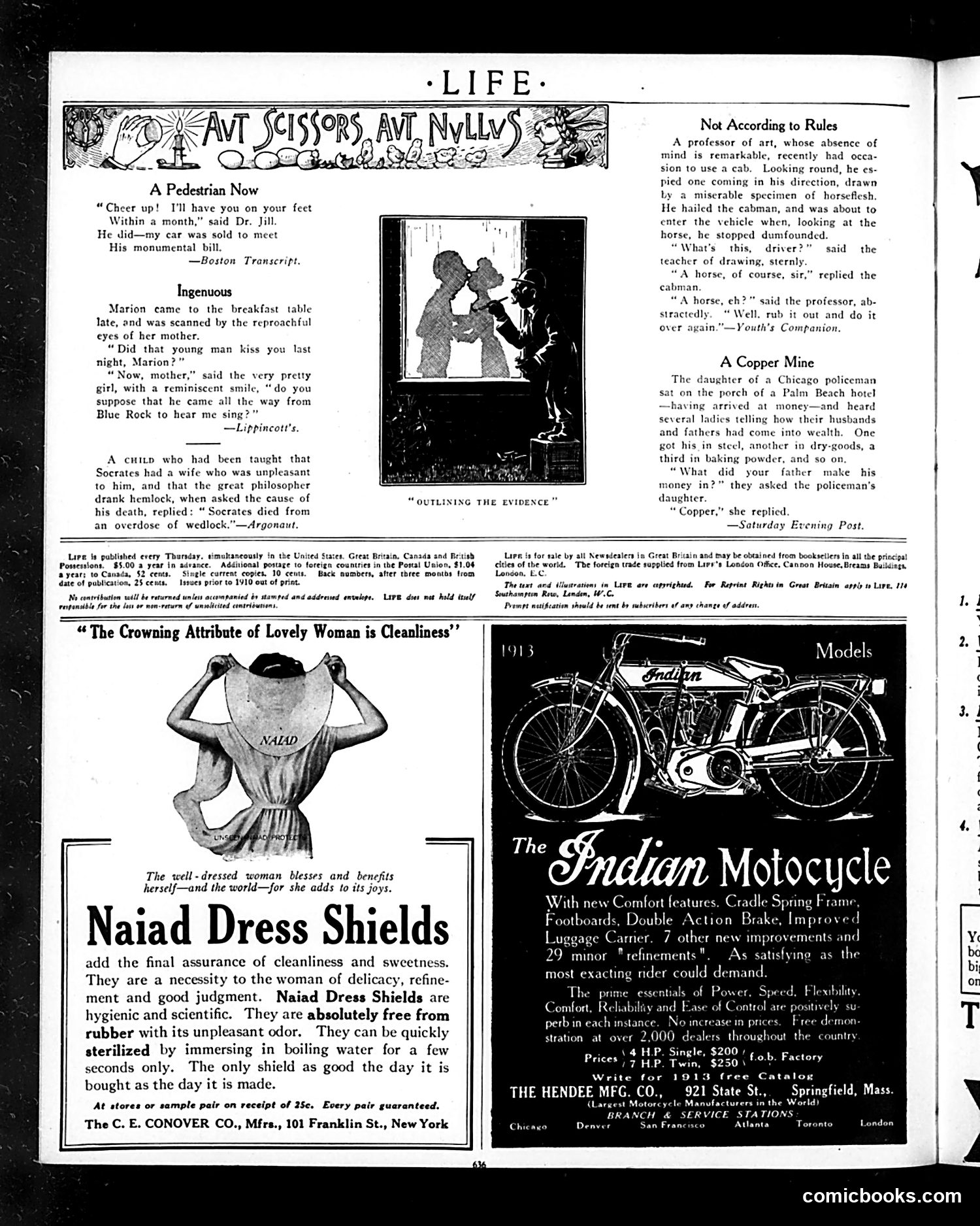
This page from *Life* contains several brief satirical jokes typical of early 20th-century American humor magazines: **"A Pedestrian Now"** mocks expensive medical bills—a doctor cures the narrator's injury but charges so much that he must sell his car to pay. **"Ingenuous"** plays on a young woman's euphemistic explanation for her suitor's visit, implying romantic rather than purely social intentions. **"A Child"** jokes about misunderstanding Socrates' death, twisting "hemlock" (poison) into a pun about marriage ("wedlock"). **"Outlining the Evidence"** shows an absent-minded art professor who, seeing a poorly-drawn horse pulling a cab, instructs the cabman to "rub it out and do it over again"—confusing reality with a sketch. **"A Copper Mine"** puns on the word "copper" (police officer), where a policeman's daughter says her father made his money "in copper." The page is primarily **humorous filler content and advertising** rather than political satire. The jokes rely on wordplay, irony, and everyday social observations familiar to early 1900s readers.
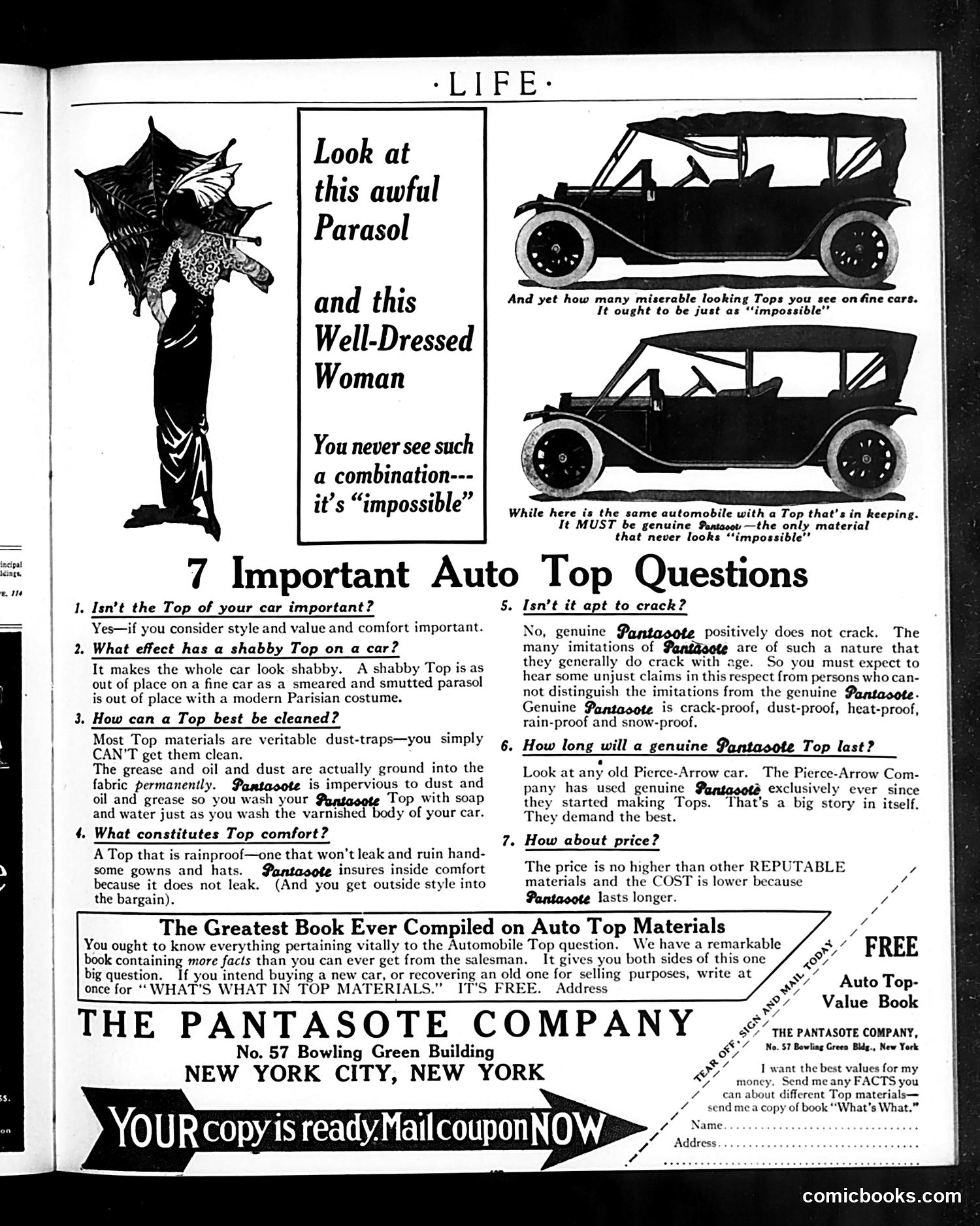
This is primarily a **product advertisement**, not political satire. The page compares a woman with an unfashionable parasol to a car with a shabby convertible top—both appearing incongruous with otherwise elegant appearances. The satire is purely commercial: just as a fine woman wouldn't pair herself with an ugly parasol, a quality automobile shouldn't have an inferior top. The ad addresses seven consumer concerns about car tops (cleaning, durability, waterproofing, longevity), promoting **Pantasote** brand material as superior to competitors. It emphasizes that Pantasote doesn't crack, dust, or leak—unlike cheap imitations. The Pierce-Arrow automobile is cited as proof of durability. The page includes a mail-in coupon offering a free book about top materials, a standard advertising tactic of the early automobile era (likely 1910s-1920s). This is commercial rhetoric disguised as consumer education, not social commentary.
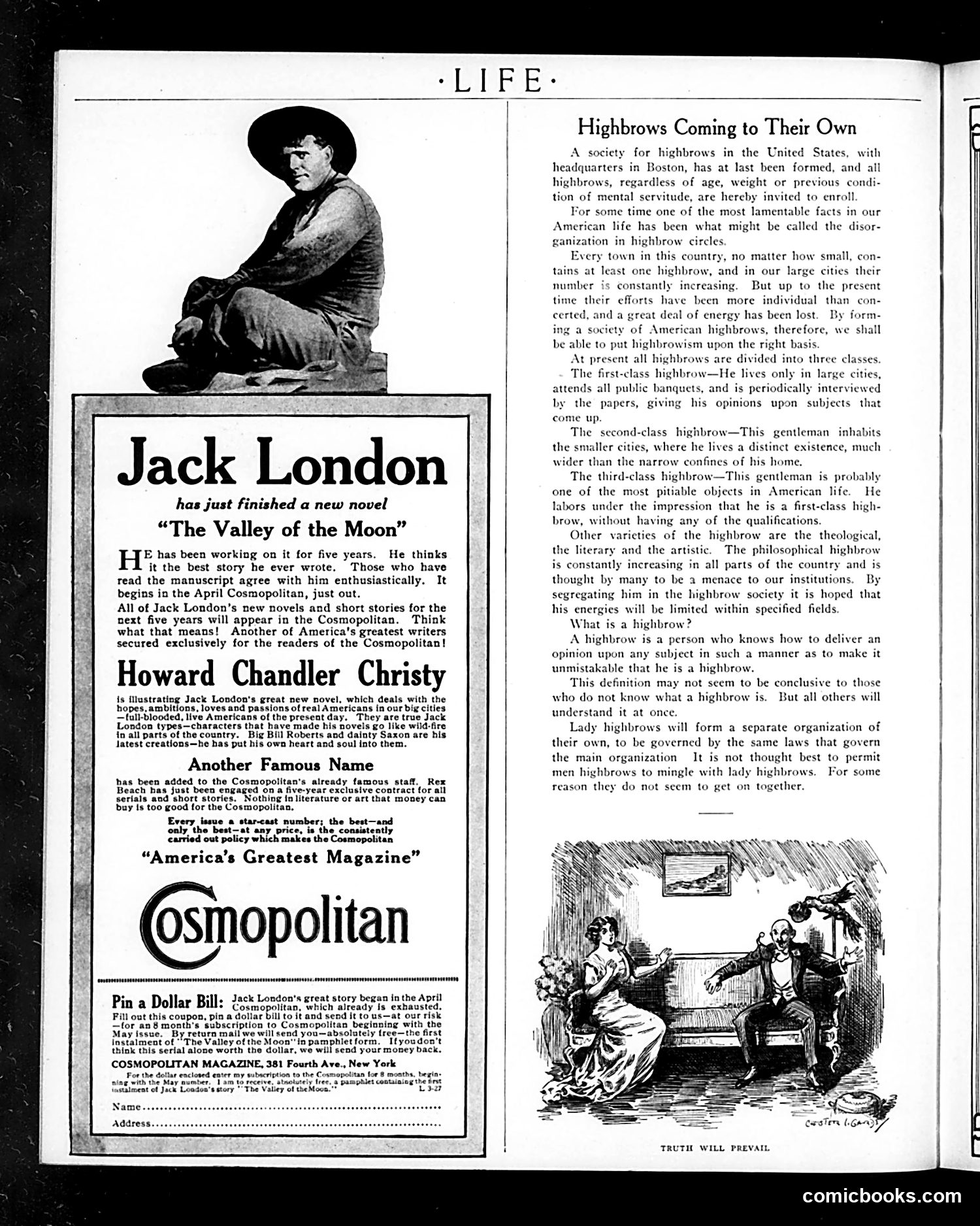
This page (appears to be early 1910s) combines **advertising with satirical commentary**. The left side heavily promotes Jack London's new novel "The Valley of the Moon" and Cosmopolitan Magazine's exclusive publishing contracts with famous authors like London and Rex Beach. It's a straightforward marketing push. The right side satirizes American "highbrows"—intellectuals or pretentious cultural elites. The article mockingly announces a new Boston society for highbrows and categorizes them into three classes based on social prominence and access to attention. The satire suggests that highbrows are self-important, status-conscious people who need formal organization to feel significant. The small cartoon at bottom (captioned "Truth Will Prevail") appears to show social commentary, though the specific reference is unclear from the visible portion. This reflects turn-of-the-century American tension between celebrating literary culture (via the London promotion) while simultaneously mocking intellectual pretension.
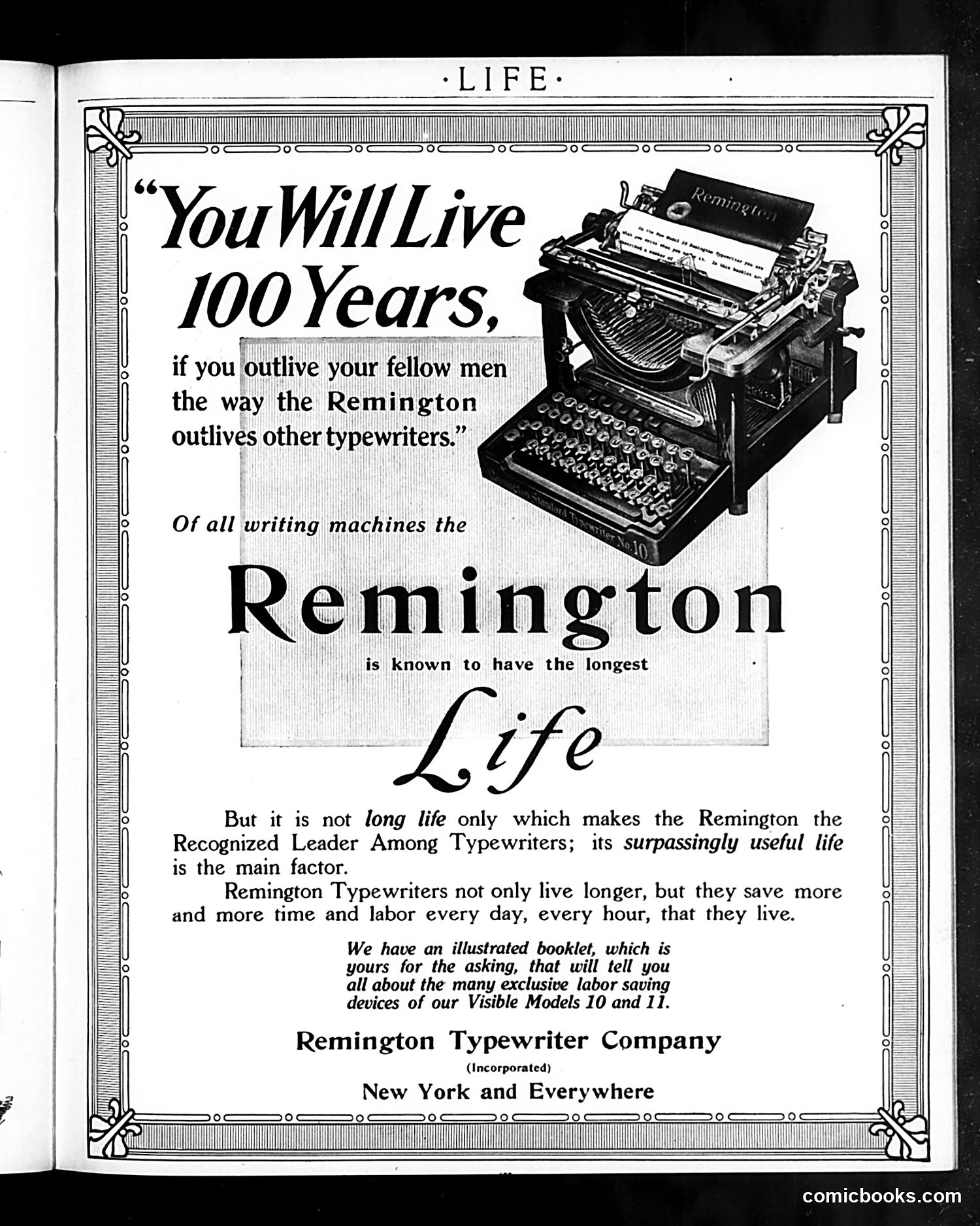
This is a **Remington typewriter advertisement**, not political satire or a cartoon. The page uses a humorous analogy to market the product: just as a Remington typewriter outlasts competitors, a person who "outlives" rivals through superior performance will live 100 years. The ad's logic is promotional rather than satirical—it claims Remington machines have exceptional durability and efficiency, saving "time and labor every day, every hour." The company promises an illustrated booklet detailing labor-saving features of their Visible Models 10 and 11. The vintage typewriter illustration dominates the right side. The rhetoric reflects early-20th-century business marketing: positioning a product as industry-leading and emphasizing productivity gains. There is no political commentary or social satire present—this is straightforward commercial advertising from Life magazine's pages.
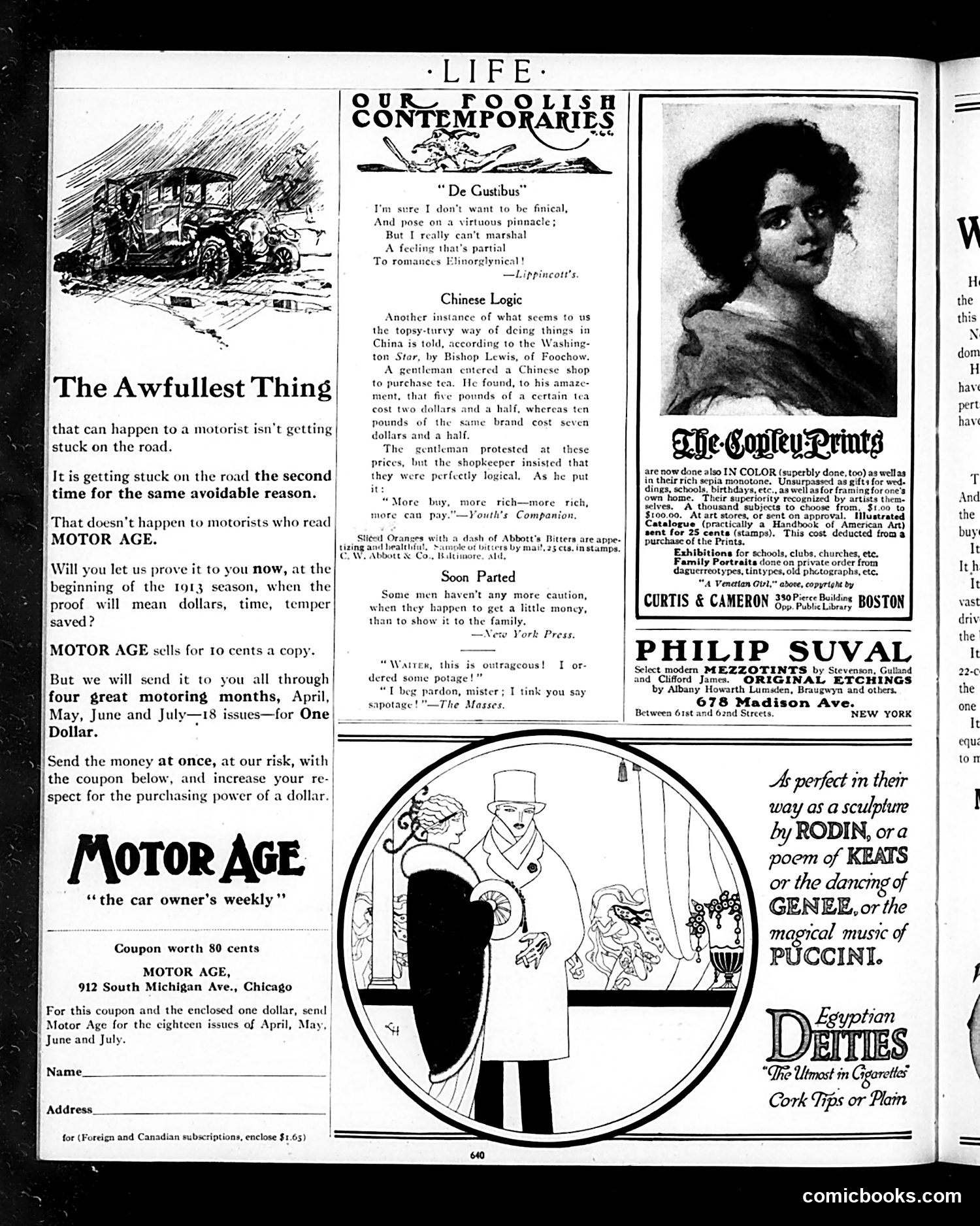
This page from Life (circa 1913) contains satirical commentary on contemporary absurdities: **"Our Foolish Contemporaries"** section mocks three modern oddities: 1. **"De Gustibus"** (a poem) ridicules overly romantic fiction, specifically "Elinor Glyn"-style romance novels—Glyn was a famous (and controversial) romance writer of the era. 2. **"Chinese Logic"** satirizes supposed Eastern illogic: a Chinese shopkeeper charges more for larger quantities of tea, reasoning backwards that more goods equal higher customer wealth, therefore higher prices. This reflects Western stereotypes about Chinese business practices. 3. **"Soon Parted"** humorously notes that some men lack restraint when they get money, immediately showing it to their families—implying they'll lose it quickly. The page also advertises Motor Age magazine, positioning it as essential reading for 1913 motorists to avoid roadside breakdowns. The remaining space contains art advertisements and gallery notices—typical of Life's mixed editorial-advertising format.
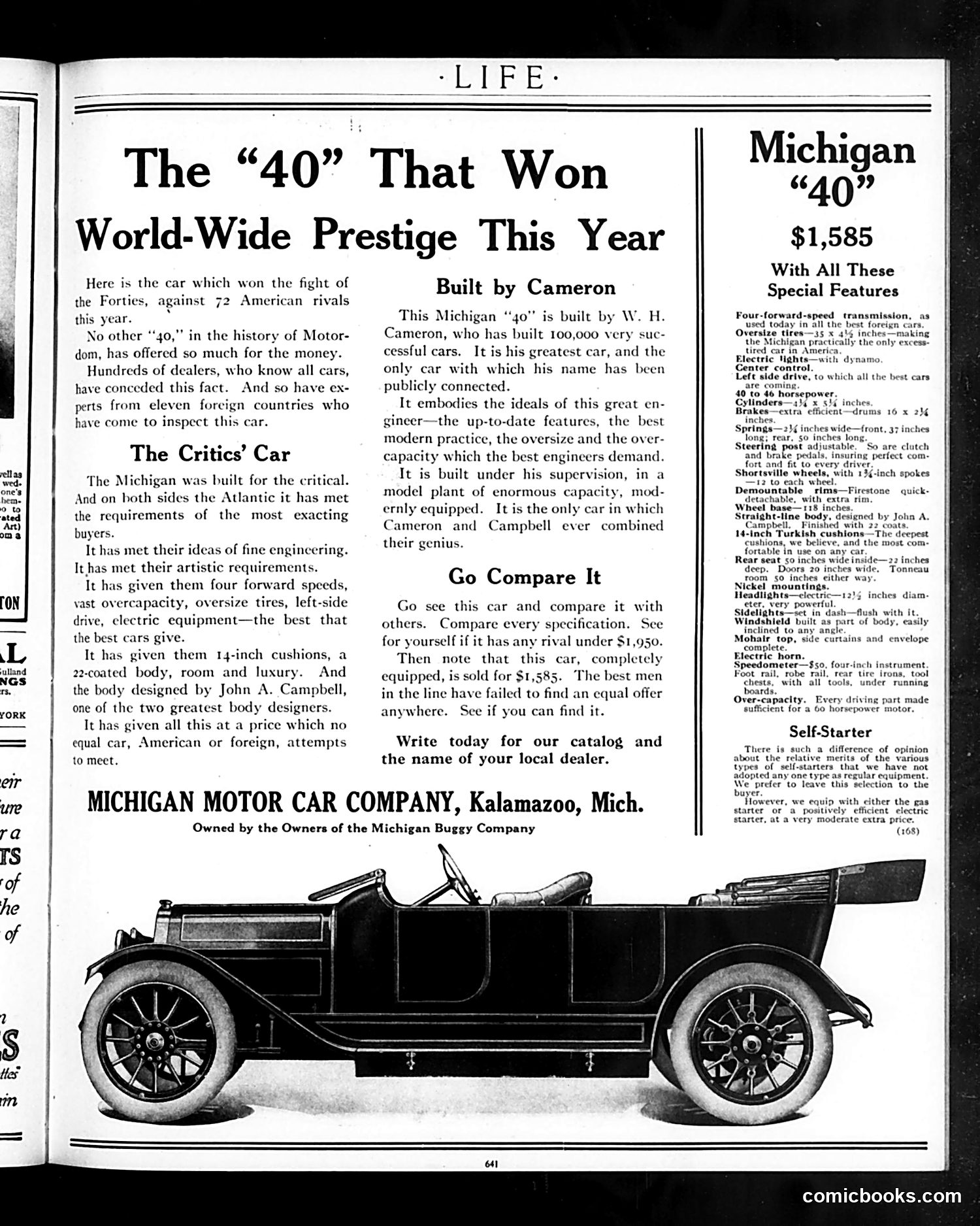
This is **automobile advertising**, not satire or political commentary. It's a full-page ad for the Michigan "40" automobile from the Michigan Motor Car Company in Kalamazoo, Michigan. The page promotes a car that allegedly "won" competition against 72 American rivals by offering superior engineering, luxury features, and value—priced at $1,585 when competitors cost $1,950 or more. The ad emphasizes endorsements from dealers and "experts from eleven foreign countries," positioning the Michigan as a critically acclaimed vehicle. Key selling points include: four forward speeds, electric lights, 14-inch cushions, a 22-coat body finish, left-side drive, and oversize tires. Designer John A. Campbell is credited as one of "the two greatest body designers." The accompanying illustration shows a simple side-view silhouette of an open-air touring car typical of the 1910s-1920s era. This represents early automotive marketing emphasizing engineering credentials and comparative value rather than style or speed.
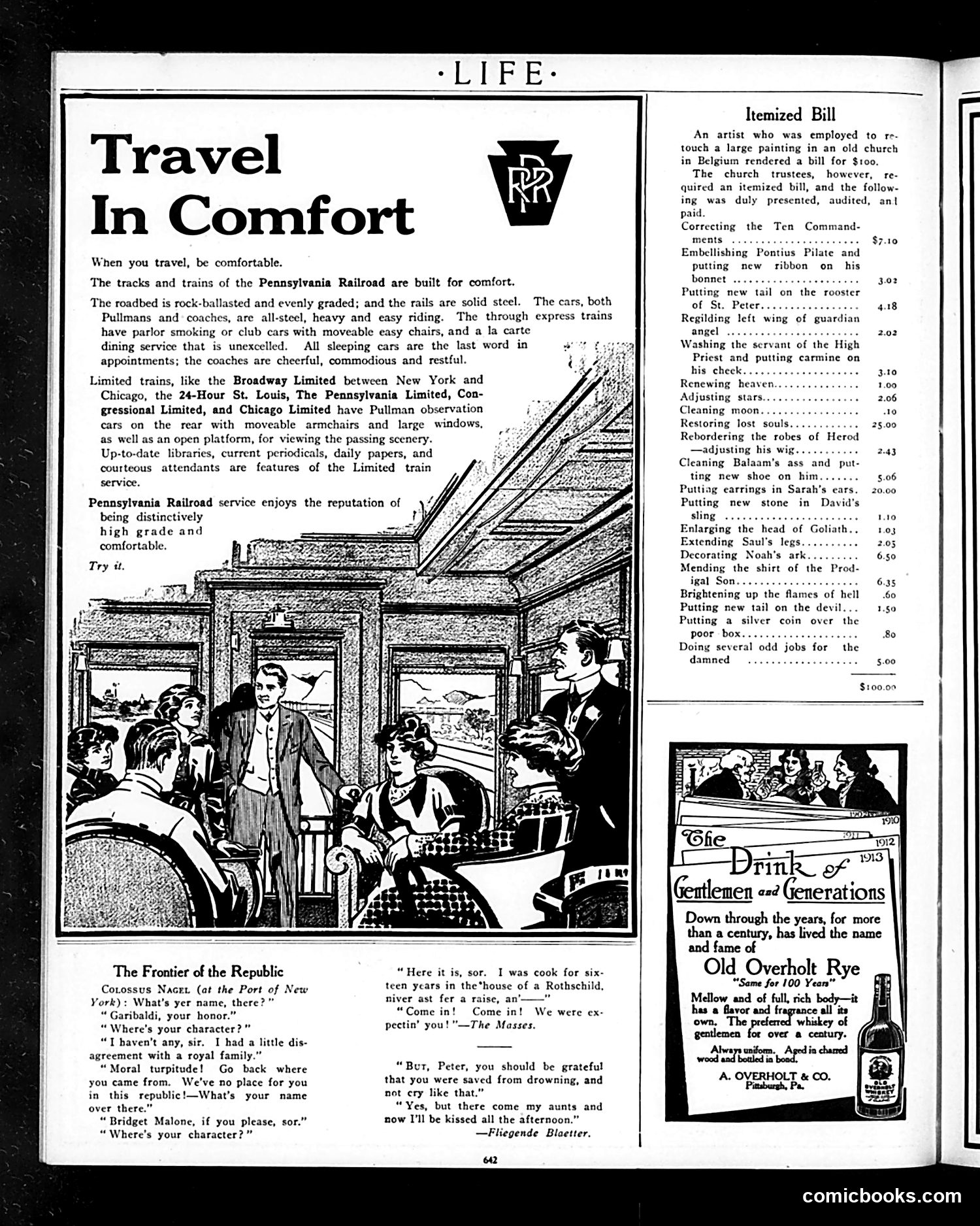
This page contains three distinct items: **"Travel in Comfort"** (left): A Pennsylvania Railroad advertisement featuring an illustration of well-dressed passengers in a luxurious observation car, emphasizing comfort and amenities for travelers. **"The Frontier of the Republic"** (bottom left): A political cartoon satirizing immigration policy. It depicts a customs official at a U.S. port interrogating two arrivals: "Garibaldi" (referencing the Italian revolutionary), rejected for lacking "character" despite his distinguished background, and "Bridget Malone," an Irish immigrant accepted because she served wealthy employers without complaint. The satire critiques America's hypocritical immigration standards—rejecting famous political figures while welcoming those of servile disposition. **"Itemized Bill"** (right): A humorous listing of absurd church restoration charges, mocking both overzealous art restoration and organized religion through absurdities like "regilding left wing of guardian angel" and "brightening up the flames of hell." The page also includes an Old Overholt Rye whiskey advertisement.
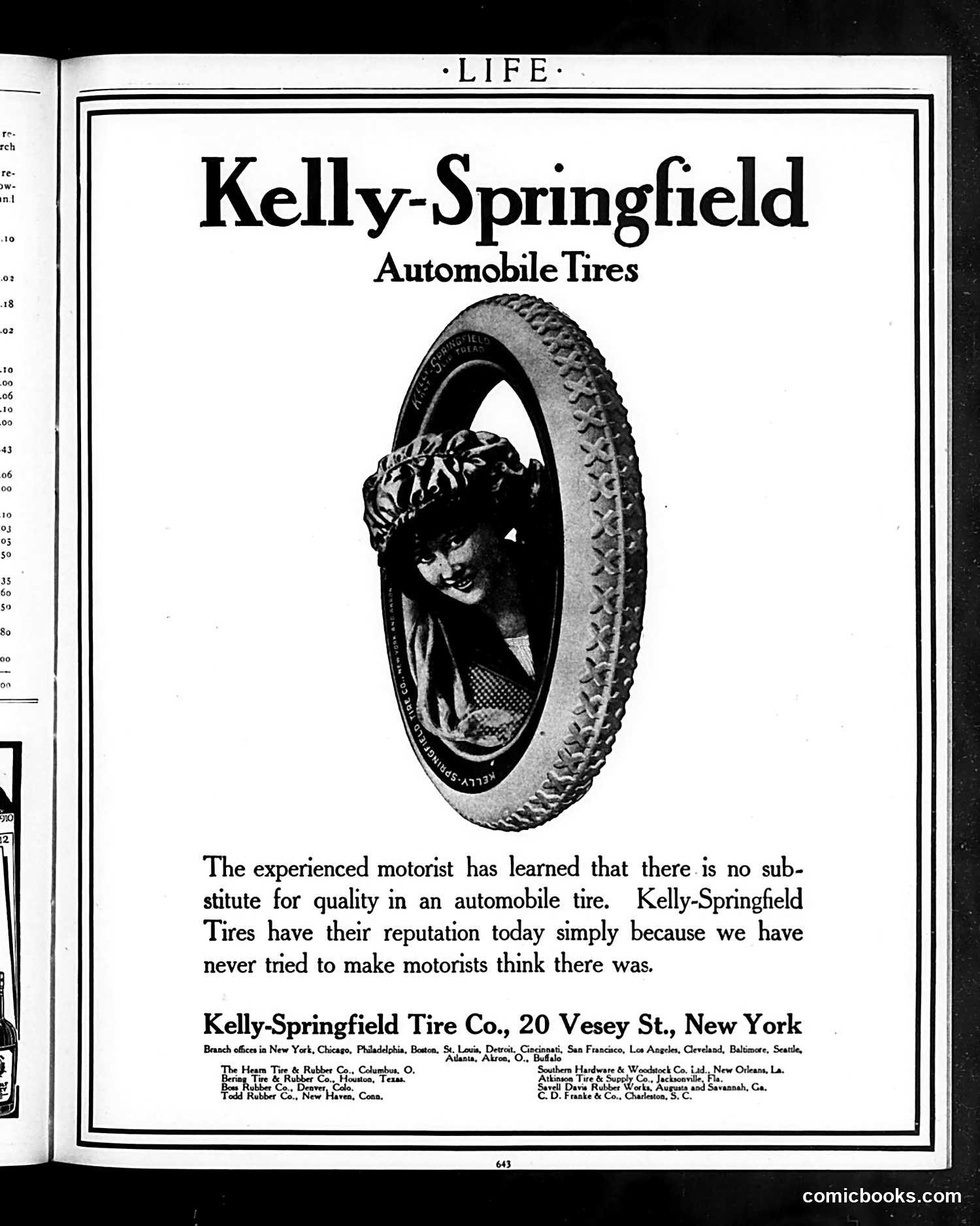
This is a straightforward **product advertisement**, not political satire. It promotes Kelly-Springfield tires through a photograph of a woman's face framed within a tire—a visual metaphor emphasizing the product's quality and reliability. The ad's messaging targets "the experienced motorist," arguing that tire quality cannot be faked or oversold. The tagline claims Kelly-Springfield earned its reputation honestly: "we have never tried to make motorists think there was" a substitute for quality—essentially positioning the brand as truthful rather than deceptive. The imagery appears designed to be eye-catching and memorable, though modern viewers might find the framing of a woman's face within the tire objectifying by contemporary standards. This reflects early 20th-century advertising conventions.
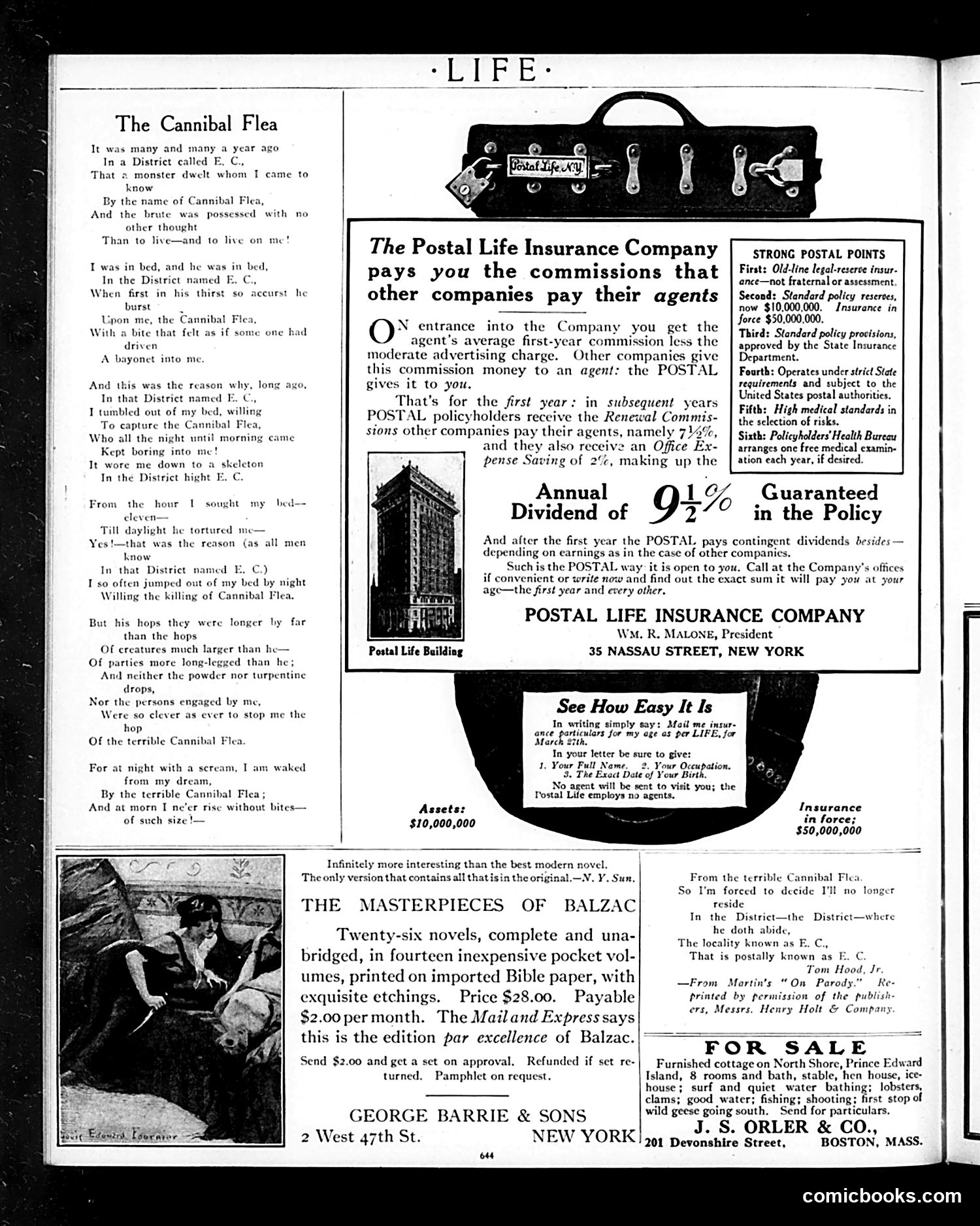
This page mixes editorial and advertising content. The main text is a humorous poem titled "The Cannibal Flea," written in the style of Edgar Allan Poe's "Annabel Lee." It's a satirical complaint about a parasitic pest (the "Cannibal Flea") that infests the narrator in a place called "District E.C." (likely the East End of London, a notorious slum). The joke equates a small, persistent pest with larger social problems—the flea becomes a metaphor for urban poverty or disease. The bulk of the page is advertising: a large Postal Life Insurance Company advertisement emphasizing customer benefits and competitive commission structures. Below that are smaller ads for Balzac's collected works and a furnished cottage for sale. The page contains no political cartoons in the traditional sense, but rather uses the flea poem as light satirical commentary on urban living conditions, wrapped around commercial advertisements typical of early 20th-century Life magazine.
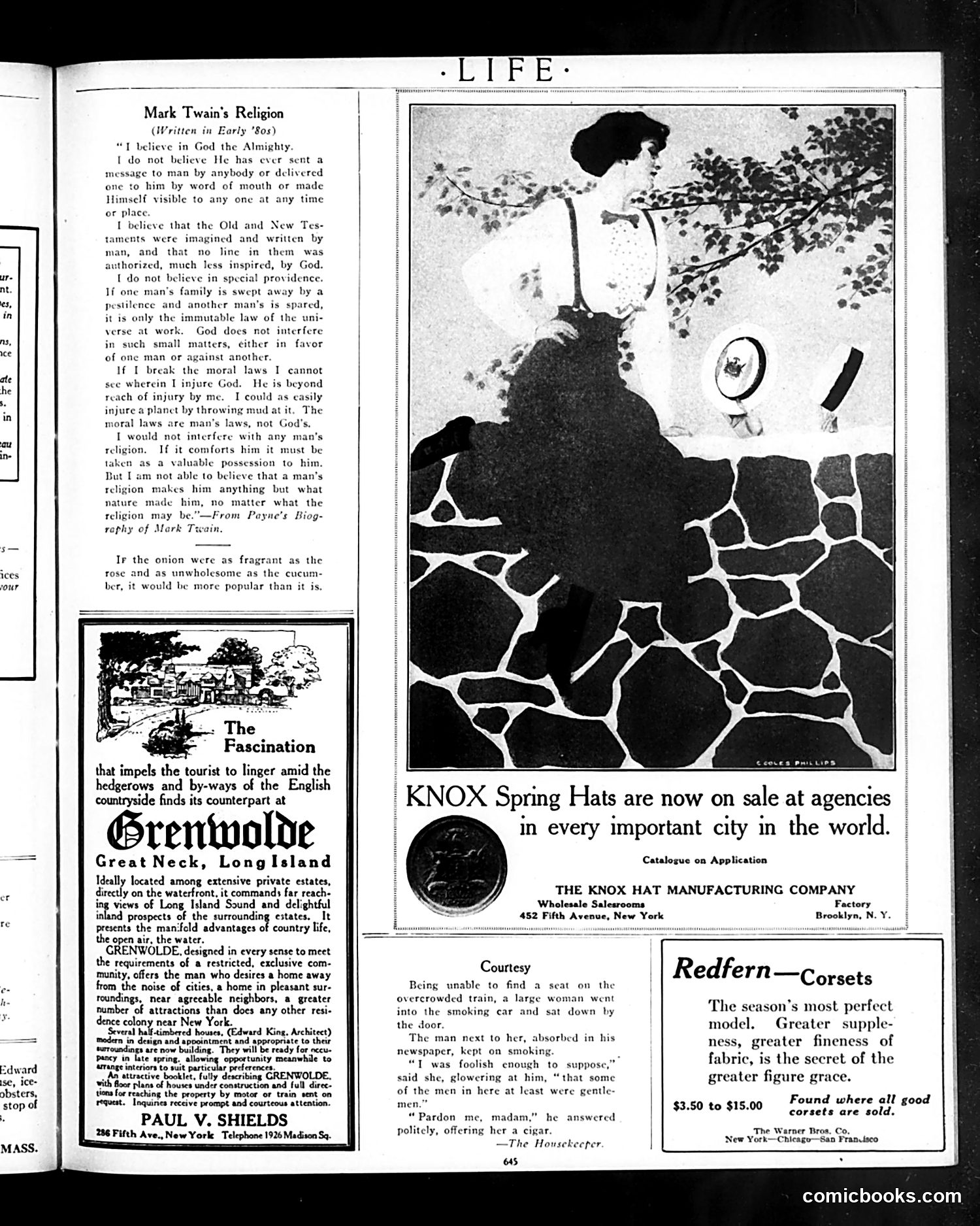
This page mixes editorial content with period advertising. The main substantive feature is Mark Twain's religious philosophy from the 1880s, presenting his skepticism about divine intervention, biblical authority, and supernatural claims—while affirming belief in God and moral law. It reflects late-19th-century freethinker arguments common among intellectuals. The humor appears in a brief anecdote about "Courtesy": a woman enters a smoking car on a crowded train and, unable to find a seat, sits next to a man smoking. She sarcastically suggests men should be gentlemen. He responds by politely *offering her a cigar*—turning her complaint into a clever, deflating riposte that assumes she wants to smoke rather than be sheltered from smoke. The joke plays on expectations about "gentlemanly" behavior and female propriety of the era. The remaining content consists of advertisements for real estate (Grenwolde), hats (Knox), and corsets (Redfern)—typical period commercial messaging emphasizing luxury, location, and fashion.
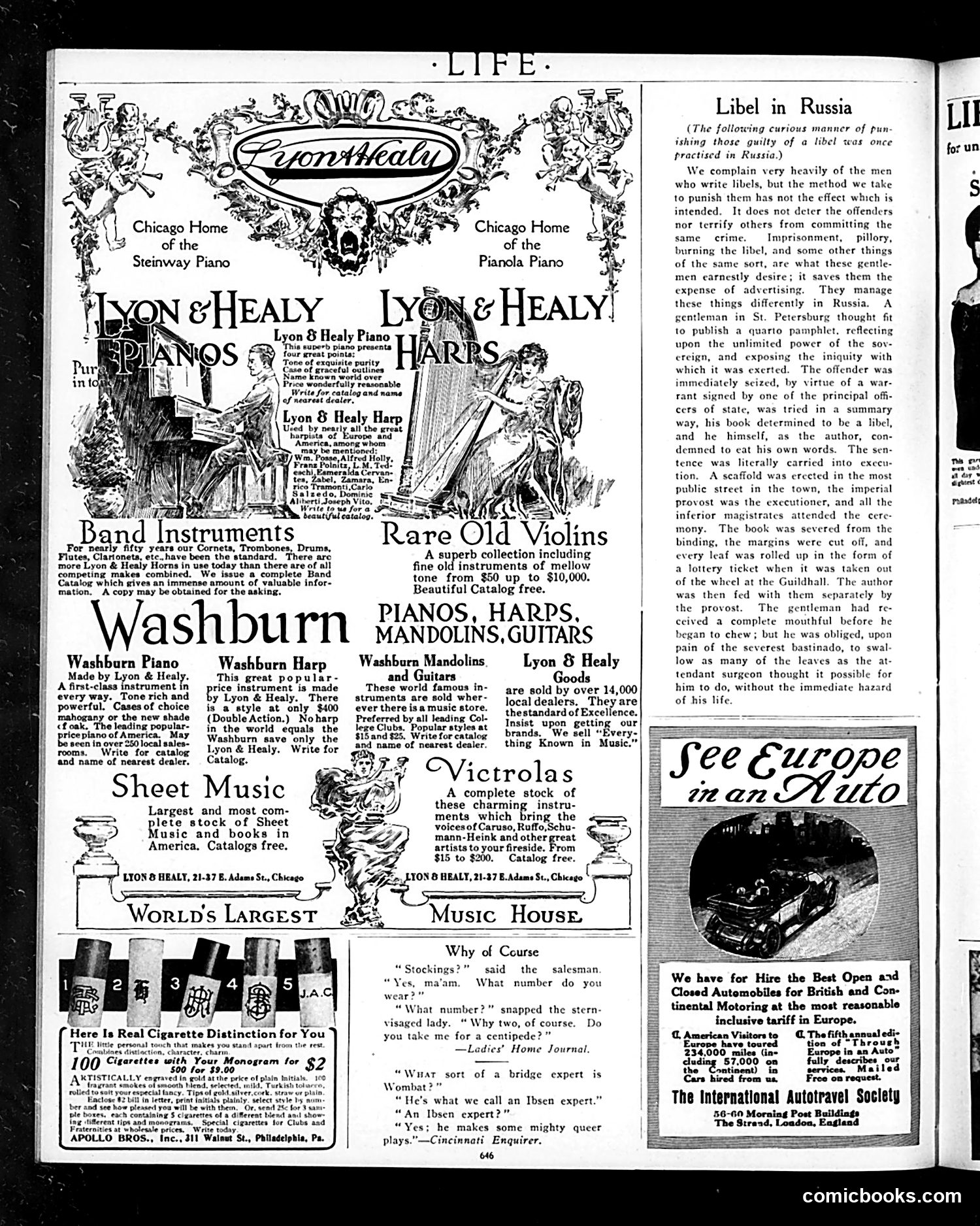
This page is primarily **advertising**, featuring Lyon & Healy's music business promoting pianos, harps, band instruments, and mandolins as "World's Largest Music House." The decorative art nouveau design dominates the layout. The only non-advertising content is a brief historical anecdote titled "Libel in Russia" describing an alleged 18th-century Russian punishment method. According to the text, a St. Petersburg author who published a pamphlet criticizing the Tsar's absolute power was sentenced to literally eat his own book—pages were rolled like lottery tickets and force-fed to him via bastinado (beating) if he refused. **Context for modern readers:** This passage reflects Western fascination with Russian authoritarianism and legal brutality. Whether historically accurate or exaggerated, it served contemporary readers as evidence of Russia's despotic governance. The gruesome image of forced consumption of one's own words dramatized the dangers of criticizing autocracy—a theme relevant given Russia's reputation for suppressing dissent. The anecdote appears disconnected from surrounding content, likely included as a curiosity piece typical of Life's satirical-magazine format.
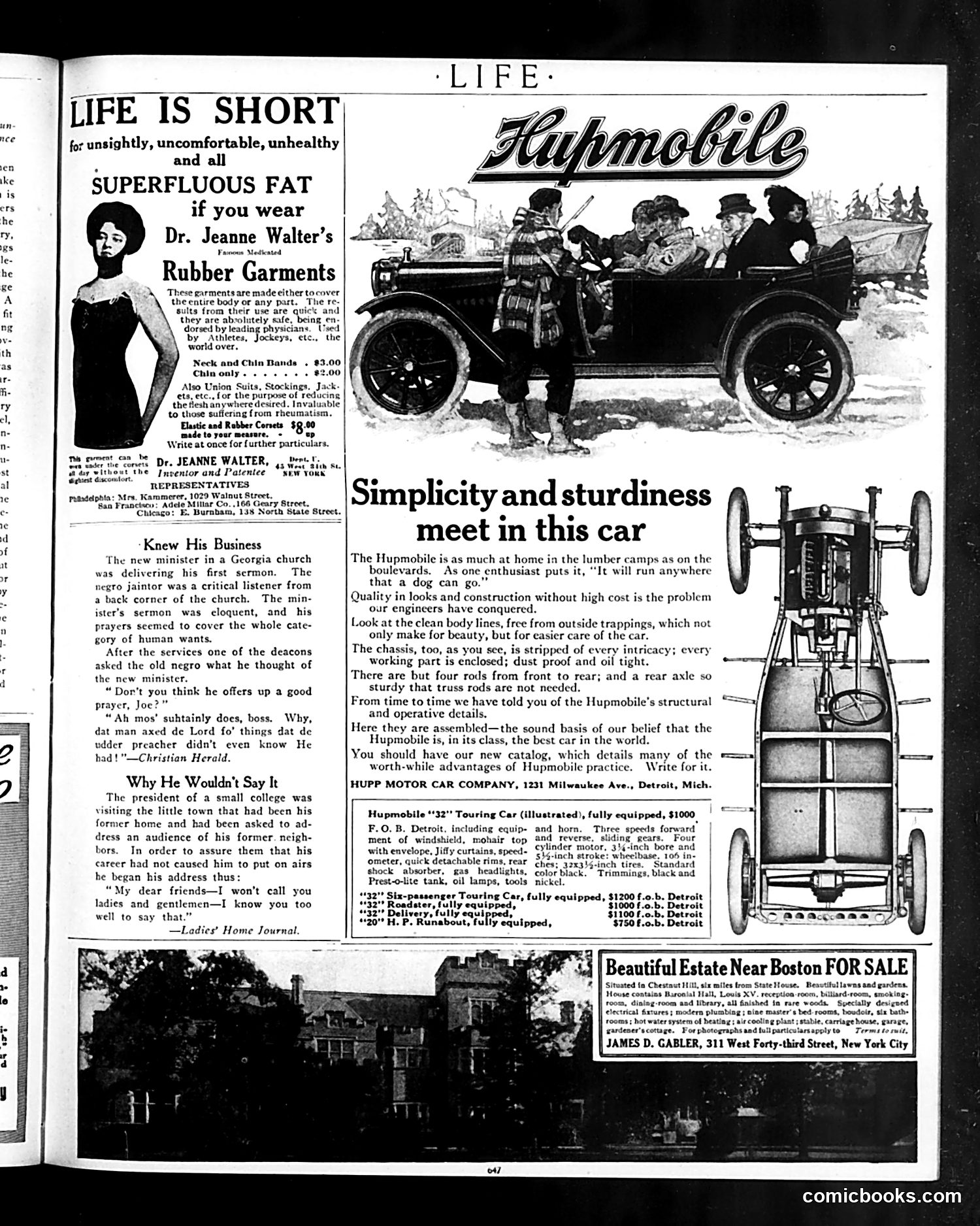
This page is primarily **advertisements and humor pieces**, not political cartoons. The top-left contains an ad for Dr. Jeanne Walter's rubber garments—corset-like devices marketed to reduce "superfluous fat," endorsed by physicians and used by athletes. This reflects early 20th-century attitudes about weight reduction and women's body standards. The center features a **Hupmobile automobile advertisement** emphasizing simplicity, durability, and affordability—qualities appealing to middle-class buyers. The car is pitched as practical for both luxury boulevards and rough lumber camps. Below are two brief **humorous anecdotes**: one about a Black church janitor complimenting a new minister's prayers for requesting things "de udder preacher didn't even know He had," playing on dialect humor; another about a college president awkwardly avoiding calling his former neighbors "ladies and gentlemen." The page reflects early 1900s consumer culture, gender norms around appearance, and period racial stereotyping in its humor.
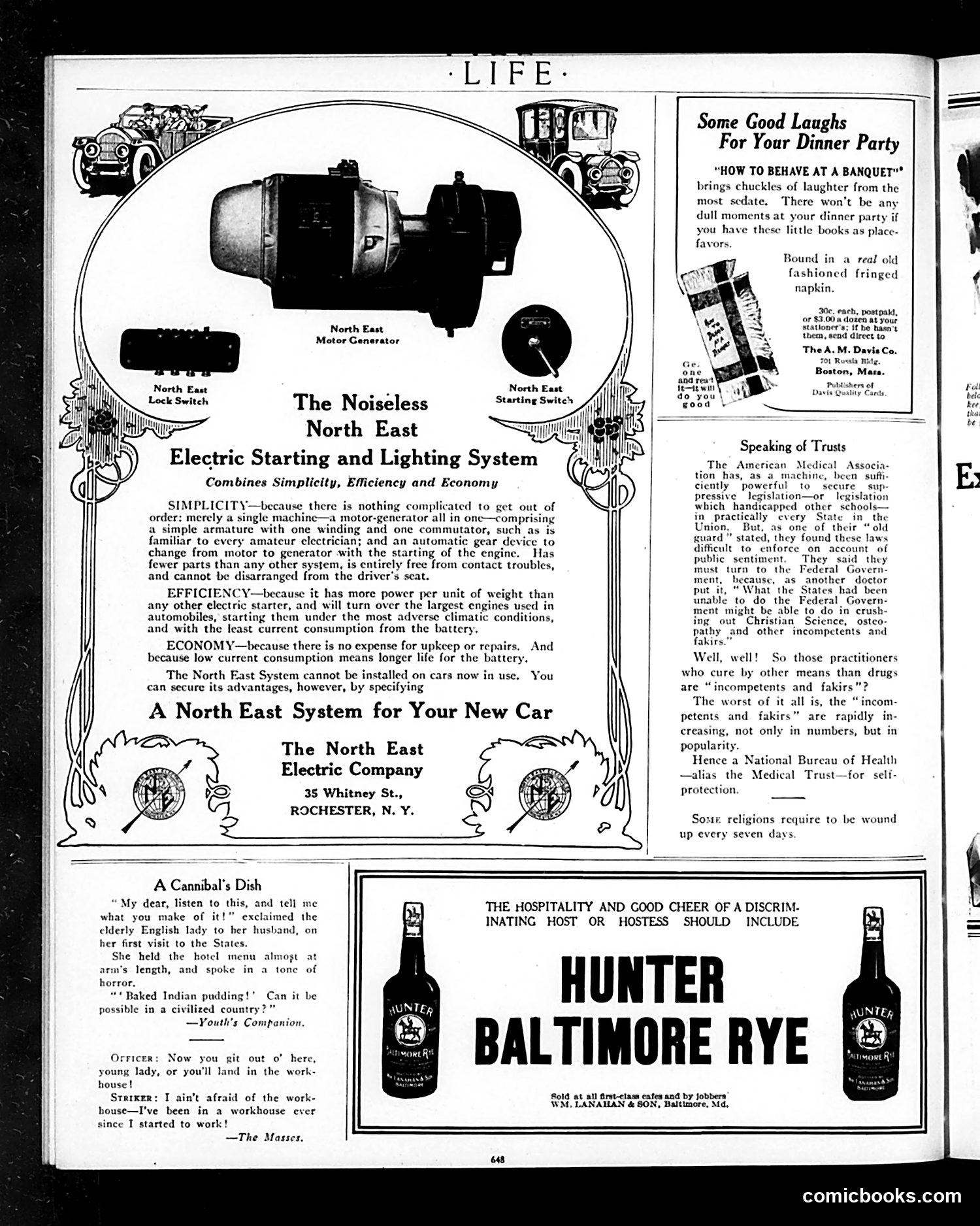
This page contains **primarily advertisements and humor pieces** rather than political satire. The main content advertises the **North East Electric Starting and Lighting System** for automobiles, emphasizing its simplicity, efficiency, and economy—typical early automotive marketing. The humor pieces are light social comedy: - **"A Cannibal's Dish"** jokes about an elderly English visitor's shock at "Baked Indian pudding" on an American hotel menu—a play on words treating the unfamiliar dish as potentially cannibalistic. - **"A Cannibal's Dish" (bottom)** features a brief exchange between an officer and a striker, with working-class humor about workhouse conditions. There's also an **editorial column "Speaking of Trusts"** criticizing medical practitioners and osteopaths as "incompetents and fakirs," advocating for federal health regulation. This reflects Progressive Era skepticism toward unregulated alternative medicine. The **Hunter Baltimore Rye advertisement** appears at bottom—alcohol marketing typical of the pre-Prohibition era. This is a commercial magazine page mixing product ads with genteel period humor and mild social commentary.
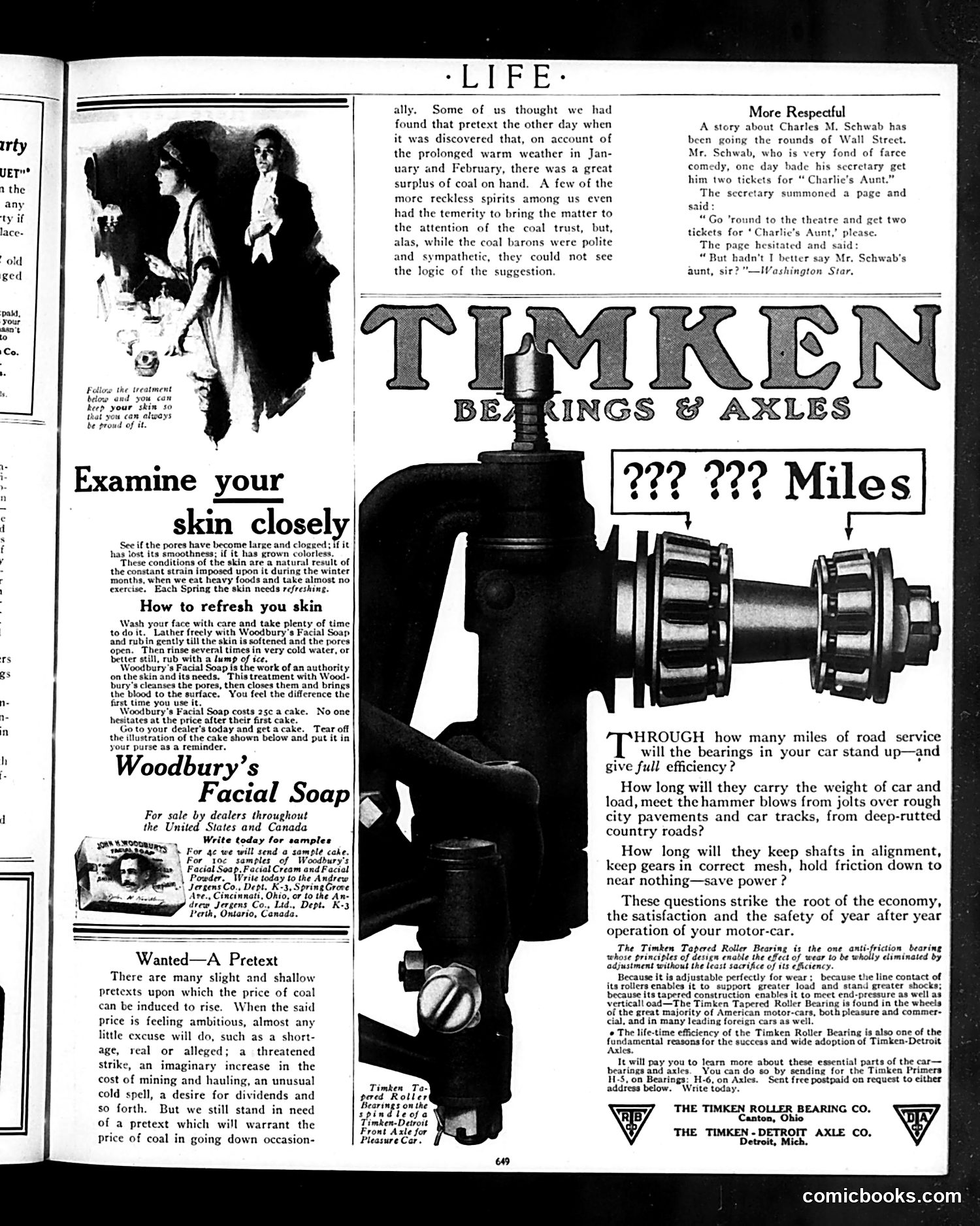
This Life magazine page contains three distinct pieces: 1. **Woodbury's Facial Soap Advertisement**: A typical early-20th-century beauty ad promoting skin care with claims about pore cleansing and refreshing winter-damaged skin. Standard marketing language of the era. 2. **"Wanted—A Pretext"**: A short satirical piece criticizing coal industry pricing practices. It mocks how coal companies use minor excuses (shortages, cold weather) to raise prices but refuse to lower them when conditions improve (surplus coal during warm January/February). This reflects contemporary frustration with monopolistic business practices during the Progressive Era. 3. **Timken Bearings Advertisement**: An industrial ad posed as educational content, using rhetorical questions about automotive bearings' durability and efficiency to promote Timken products as essential for reliable cars. The page primarily functions as advertising wrapped around light social satire about business manipulation.
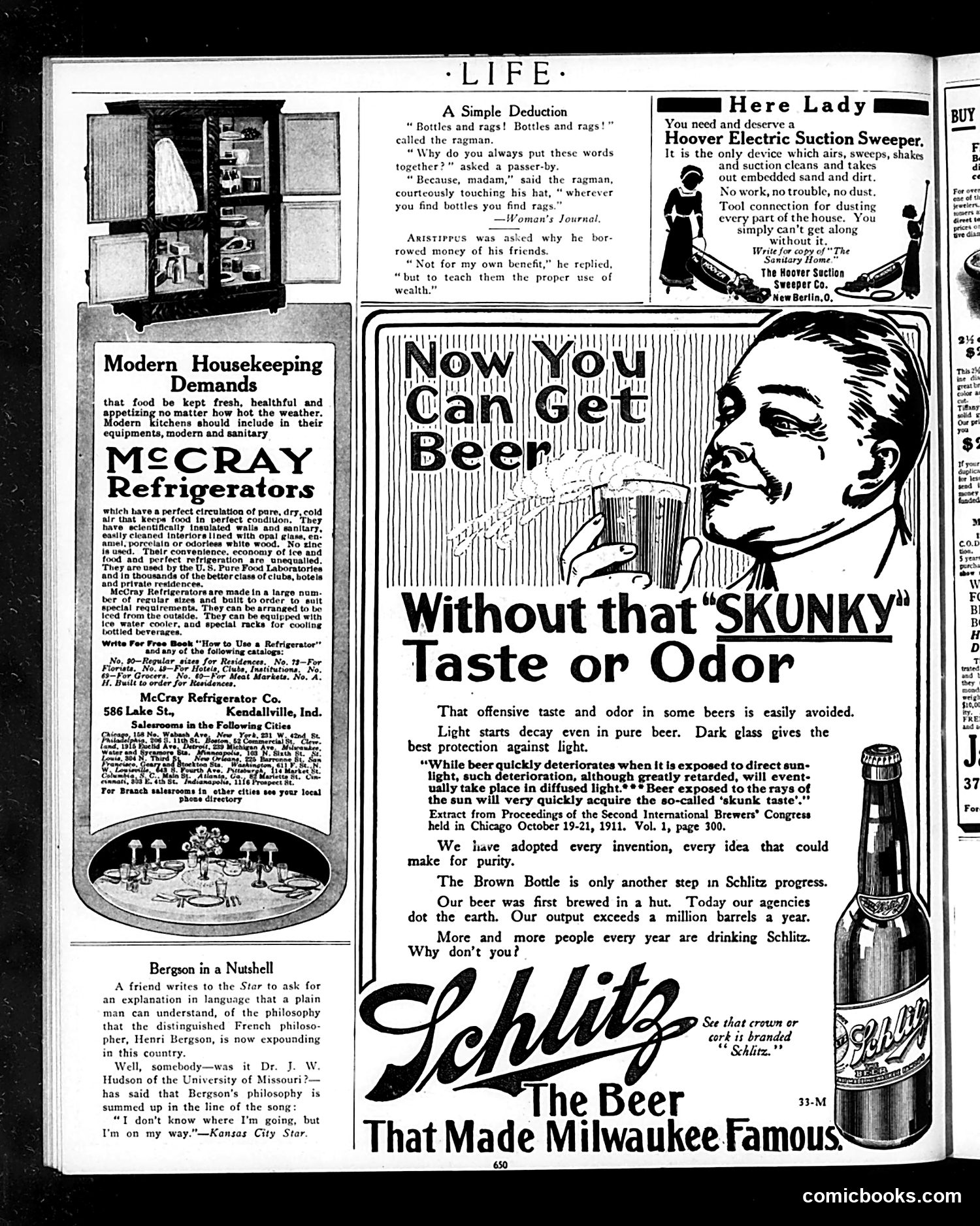
This page contains mostly **advertisements** with brief humorous text pieces interspersed. The main advertisements promote: - **McCray Refrigerators** (left side) — emphasizing modern housekeeping demands for food preservation - **Hoover Electric Suction Sweeper** (top right) — a new cleaning device - **Schlitz Beer** (center-right, largest) — addressing a technical concern about beer quality The **Schlitz ad** is particularly notable: it explains that the brown bottle protects beer from light exposure, which causes an undesirable "skunky" taste and odor. The ad cites scientific proceedings to legitimize this claim, positioning the brown bottle as progress in brewing. This reflects early 20th-century marketing that used emerging science to sell consumer goods. Small humor pieces appear on the left ("A Simple Deduction," "Aristippus," "Bergson in a Nutshell"), offering brief jokes or philosophical observations typical of Life magazine's satirical content. The overall page reflects 1910s consumer culture, modern appliances, and science-based advertising claims.
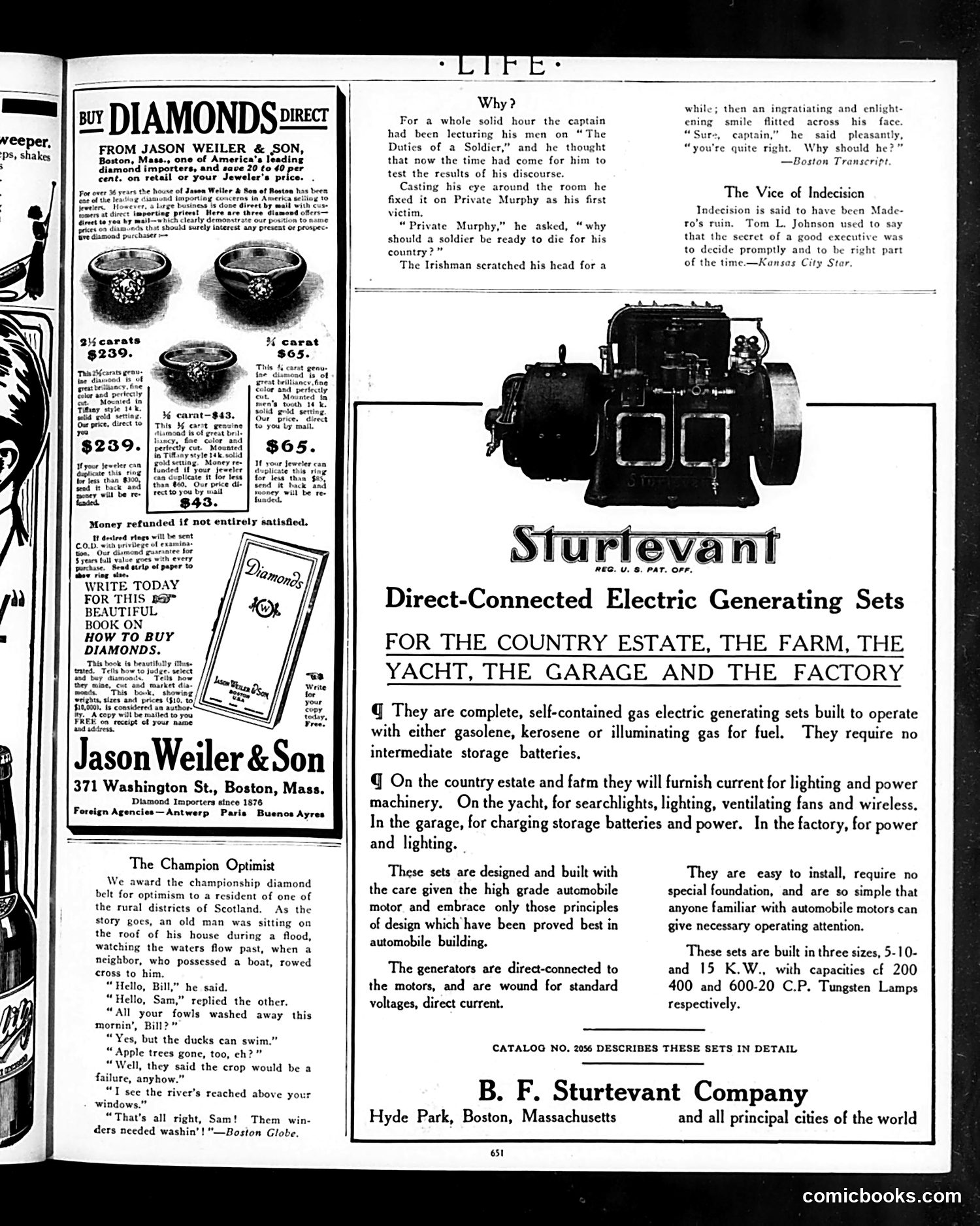
This page is primarily **advertising**, not editorial satire. The dominant content features two major ads: Jason Weiler & Son diamonds (left) and B. F. Sturtevant Company electric generators (right). The small cartoon/humor pieces are brief anecdotes rather than political satire: 1. **"Why?"** - A military joke: A captain lectures soldiers on duty, then tests Private Murphy's understanding by asking why soldiers should be ready to die for their country. Murphy scratches his head, unable to answer—the humor lying in the soldier's confusion. 2. **"The Champion Optimist"** - A Scottish dialect humor piece about an old man watching a flood destroy his property (fowl, trees, crops). When a neighbor expresses concern, the man remains cheerfully indifferent, joking that at least "them winders needed washin'"—absurdist humor through rural optimism. Neither piece contains political commentary or caricature. The page reflects early 20th-century Life magazine's mix of light humor and commercial advertising.
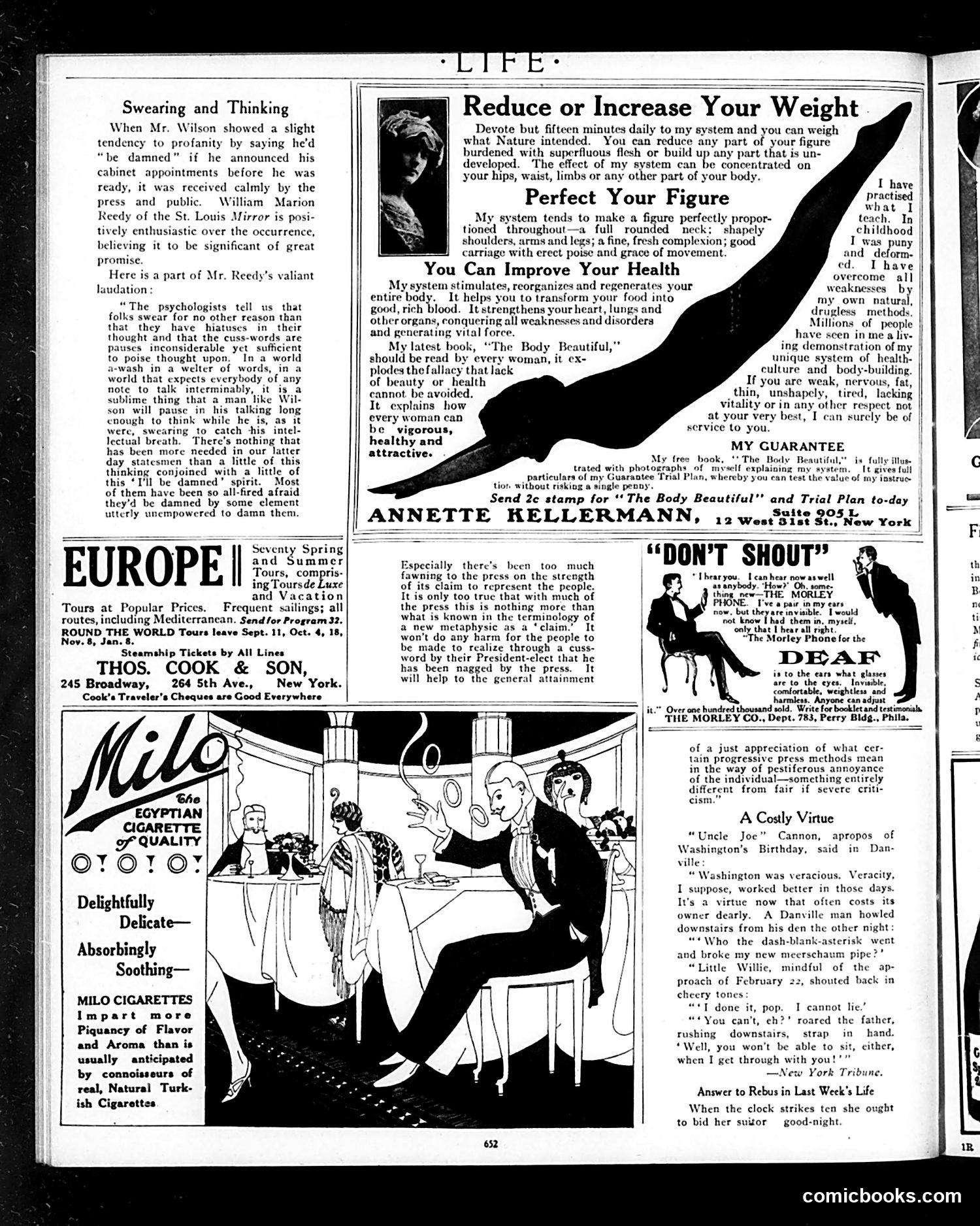
This page contains commentary on President Woodrow Wilson's mild profanity regarding his cabinet appointments. William Marion Reedy (editor of *St. Louis Mirror*) praises Wilson's swearing as evidence of *thinking*—arguing that curse words allow pauses for genuine intellectual reflection rather than the constant empty speechmaking expected of politicians. The satire targets two things: (1) the press's obsession with Wilson's every utterance, treating minor profanity as newsworthy, and (2) contemporary politicians' tendency toward verbose, thoughtless rhetoric. Reedy ironically celebrates Wilson's brief vulgarity as a sign of intellectual honesty—a refreshing break from the sanctimonious posturing typical of public figures. The remaining page content is advertising (weight-reduction system, travel tours, cigarettes) unrelated to the political commentary.
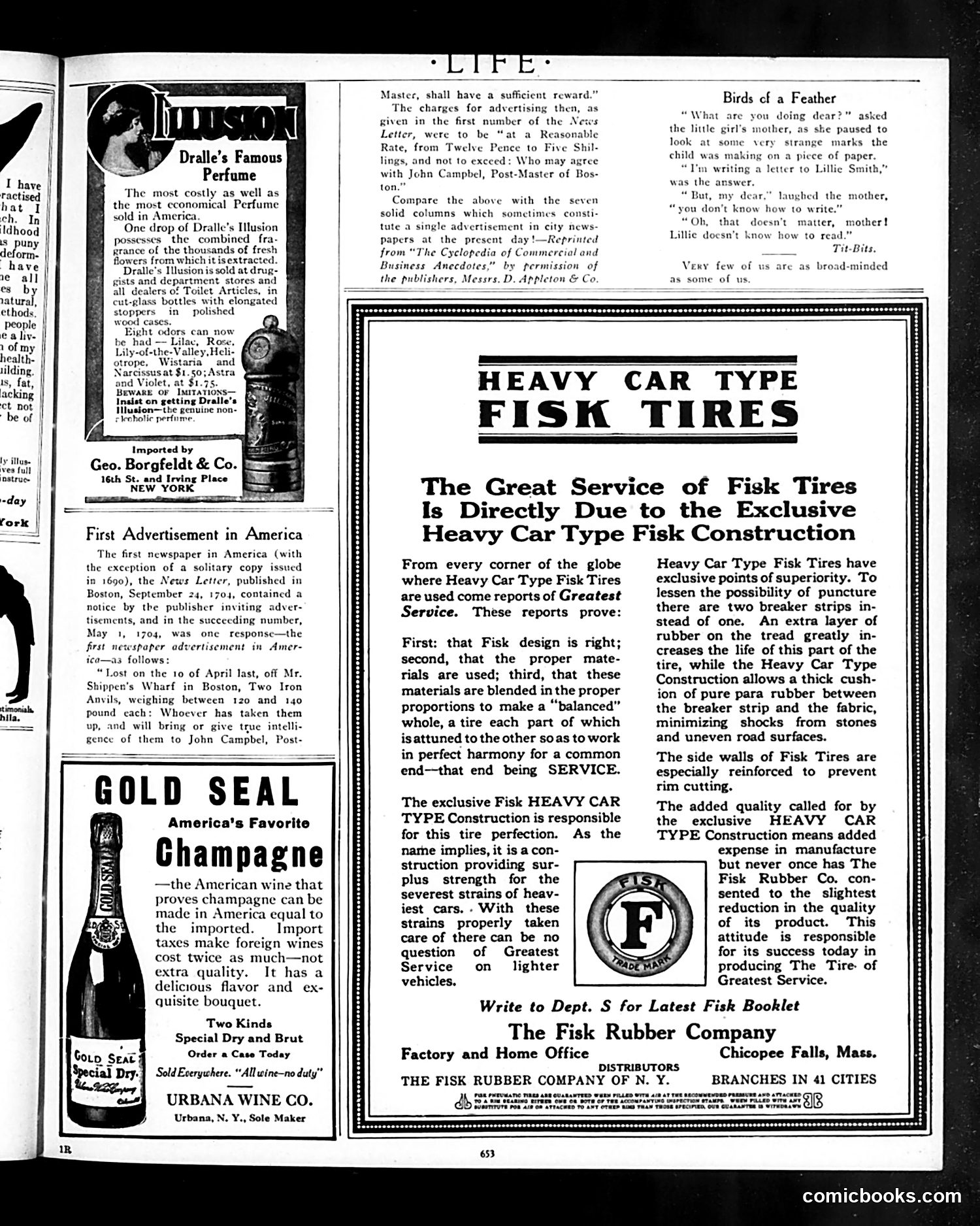
This page contains primarily **advertisements and a brief humorous anecdote**, not political satire. The main content includes: **"Birds of a Feather"** — a short joke about a child writing an illegible letter to a friend. The humor relies on the child's innocent logic: when the mother protests that the recipient can't read, the child responds that it doesn't matter because the friend can't read anyway. It's gentle domestic humor about childhood. **Advertisements** dominate the page: Dralle's Illusion Perfume, Gold Seal Champagne, and a substantial Fisk Tires advertisement emphasizing "Heavy Car Type" construction for durability. A historical note discusses **America's first newspaper advertisement** (1704), showing how commercial notices evolved from simple lost-and-found notices. There is **no political cartoon or satire** on this page—it's a typical early 20th-century Life magazine layout mixing light humor with commercial content. The "satire" element Life was known for appears absent here.
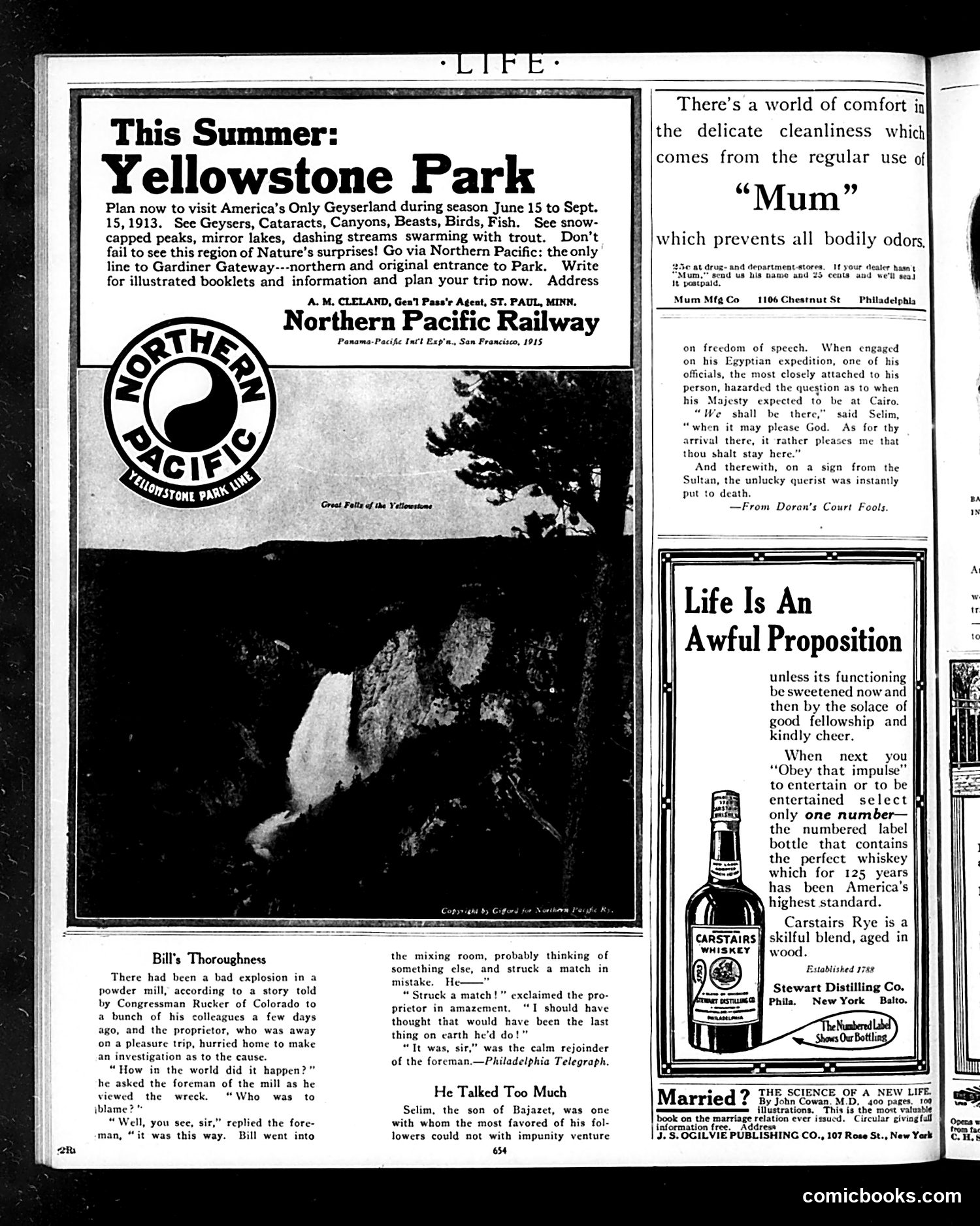
This page is primarily **advertising and filler content** rather than political satire. The dominant feature is a Northern Pacific Railway advertisement promoting Yellowstone Park visits during summer 1913, featuring a photograph of the Grand Falls. The text content consists of three **humorous anecdotes**: 1. **"Bill's Thoroughness"**: A joke about a powder mill explosion where the foreman reveals the worker struck a match in the mixing room—described as "the last thing on earth he'd do" because it killed him. 2. **"He Talked Too Much"**: A historical anecdote about Selim, son of Ottoman sultan Bajazet, executing an official who dared question when the court would reach Cairo, illustrating autocratic intolerance of speech. The page also contains period advertisements for deodorant ("Mum"), Carstairs Rye whiskey, and a marriage advice book. **No political cartoon appears here**—just miscellaneous humor and commerce typical of *Life* magazine's mixed editorial/advertising format from this era.
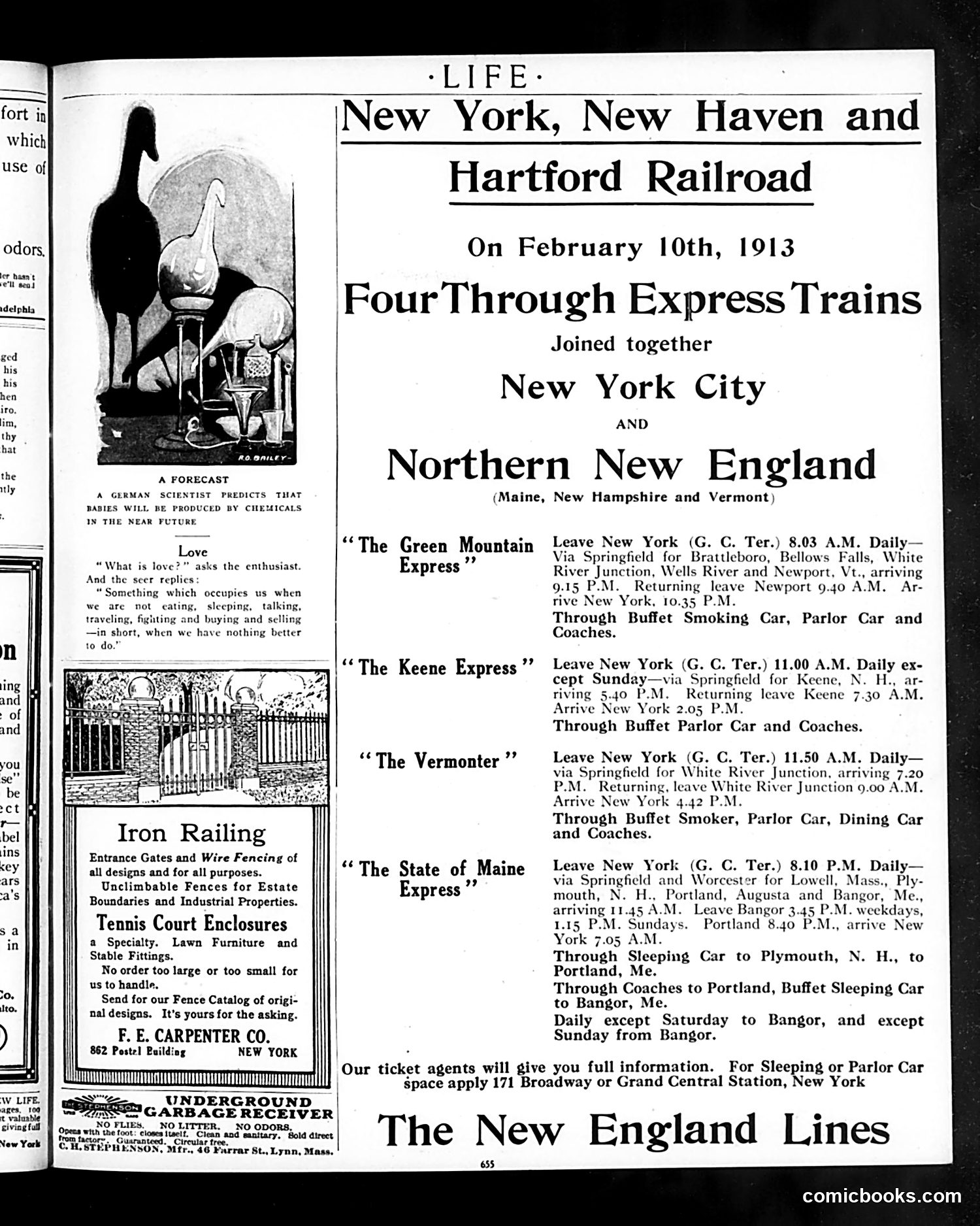
This page is primarily **railroad advertising** for the New York, New Haven and Hartford Railroad, announcing four new express trains connecting New York City to Northern New England. The cartoon at top left is satirical: titled "A Forecast," it depicts storks delivering babies produced by chemicals, illustrating a German scientist's prediction about future reproduction. The joke mocks futuristic scientific speculation—the absurdity of replacing natural reproduction with chemical manufacturing. This reflects early-20th-century anxieties about rapid technological advancement and its potential to disrupt fundamental aspects of human life. Below is a brief philosophical piece titled "Love," offering a humorous definition of love as something filling idle time when we're not engaged in practical activities like traveling, fighting, buying, or selling. The remainder consists of railroad schedules for trains named "The Green Mountain Express," "The Keene Express," "The Vermonter," and "The State of Maine Express," along with advertisements for iron railings and fence designs.
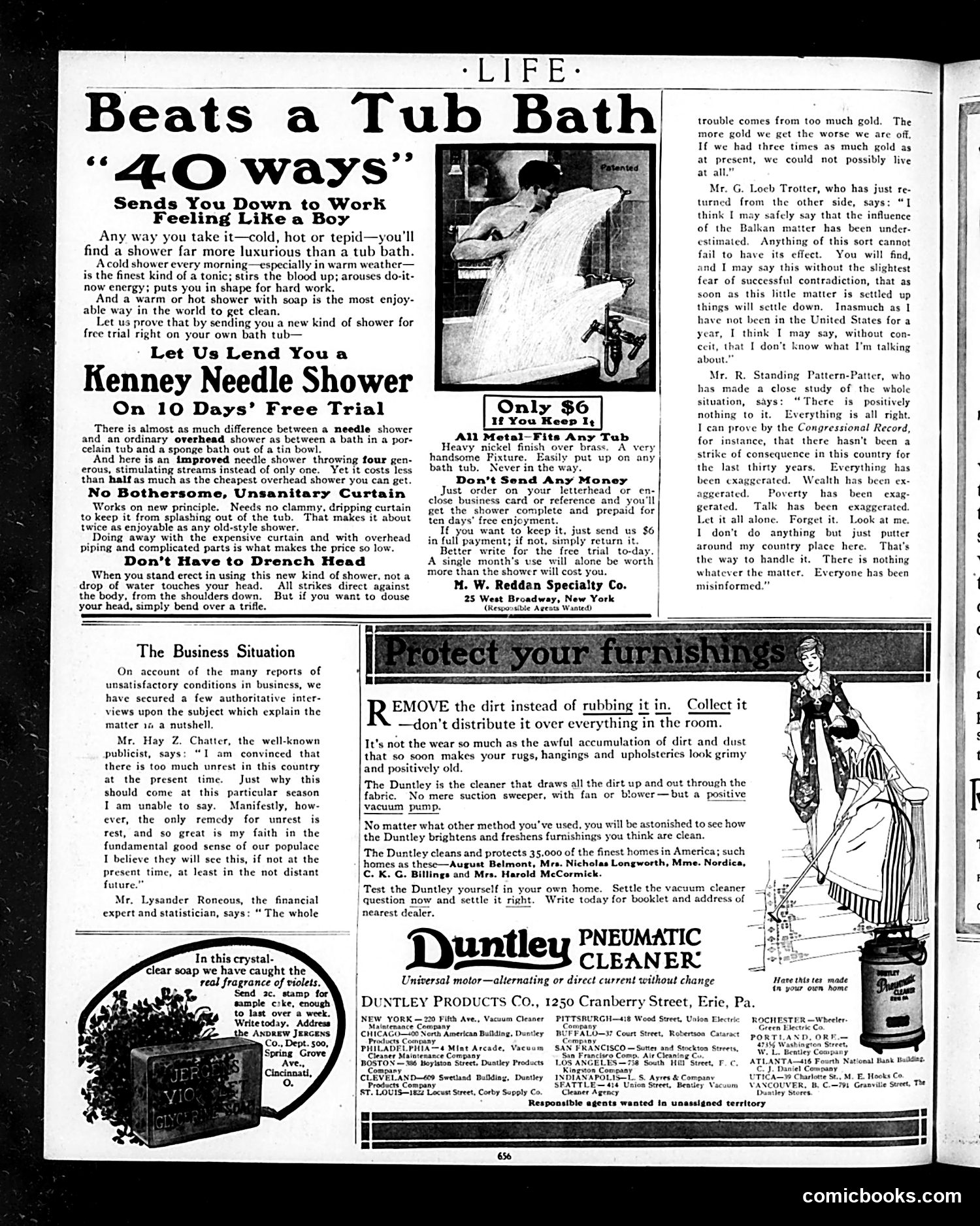
This page contains satirical commentary on 1920s American business and optimism. The main piece, "The Business Situation," mocks public figures offering contradictory explanations for economic uncertainty. The quoted experts—including "R. Standing Pattern-Patter" (a transparently ironic name suggesting empty rhetoric)—represent different responses to reported business troubles. Pattern-Patter's absurd advice to "just putter around" while denying any real problems exemplifies the satire: wealthy, disconnected businessmen dismissing legitimate concerns while claiming everything is exaggerated. The text implies these aren't real names but rather caricatures of typical business commentary—officials using the Congressional Record to deny obvious strikes, or suggesting complaints are merely "misinformation." This reflects post-WWI American anxiety about economic stability, mocking how establishment figures gaslighted public concerns rather than addressing them seriously. The satire targets the gap between official reassurance and workers' lived experience.
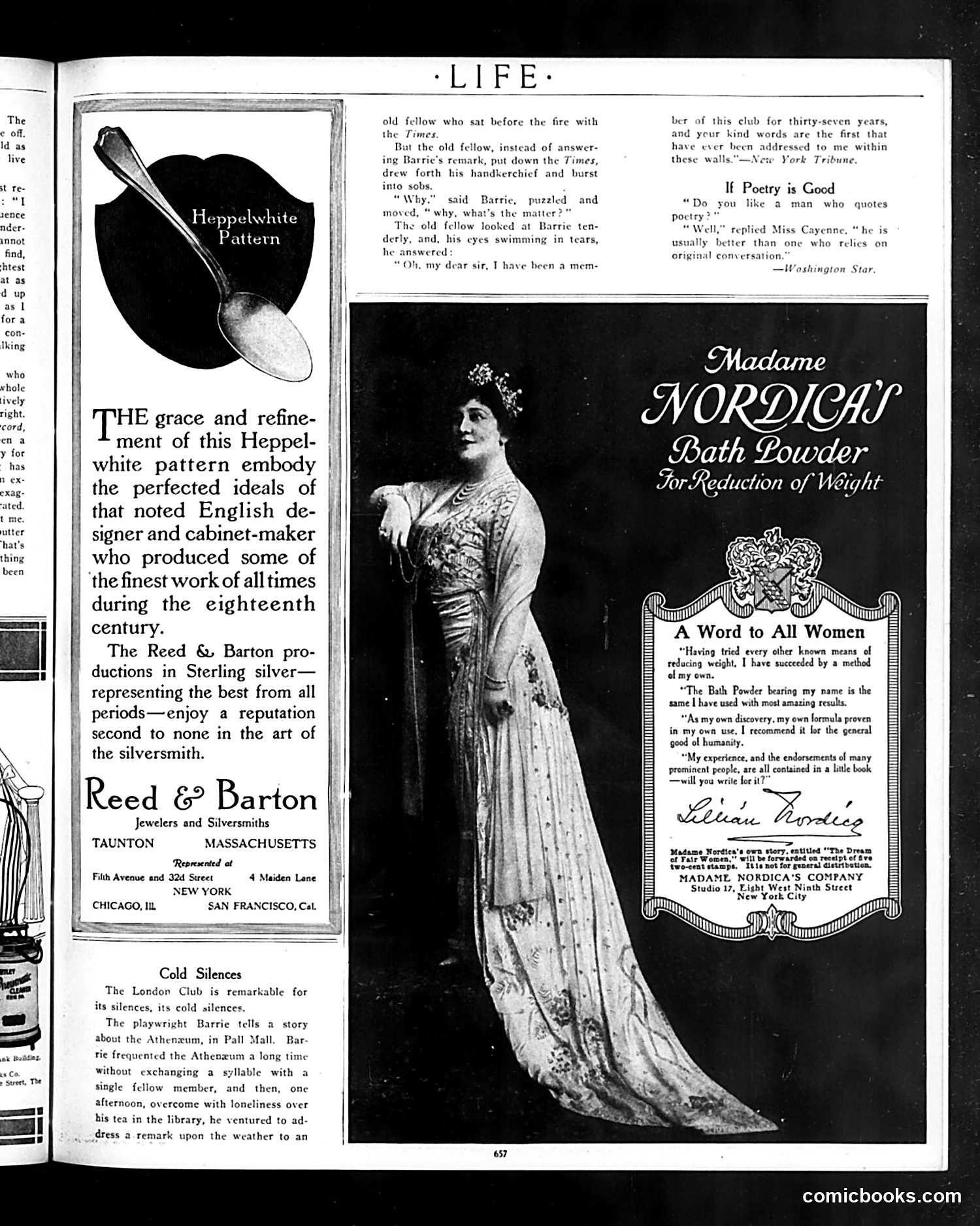
This page contains **no political cartoon**—it's primarily advertising and brief humor pieces. The left side advertises **Reed & Barton silverware**, emphasizing Hepplewhite pattern design and the company's reputation for fine craftsmanship. The right side features an advertisement for **Madame Nordica's Bath Powder for Weight Reduction**, endorsed by the famous opera singer Lillian Nordica (1857-1914). The ad claims she personally developed the formula and achieved weight loss results, appealing to women's beauty standards of the era. Between these ads are two satirical anecdotes: one about playwright J.M. Barrie's experience at London's Athenzeum club, where a member breaks into tears after thirty-seven years of silence—mocking the club's cold, antisocial culture—and another brief joke about preferring poetry quoters to those relying on "original conversation." The page reflects early-20th-century consumer culture mixing product endorsement with celebrity authority and social commentary.
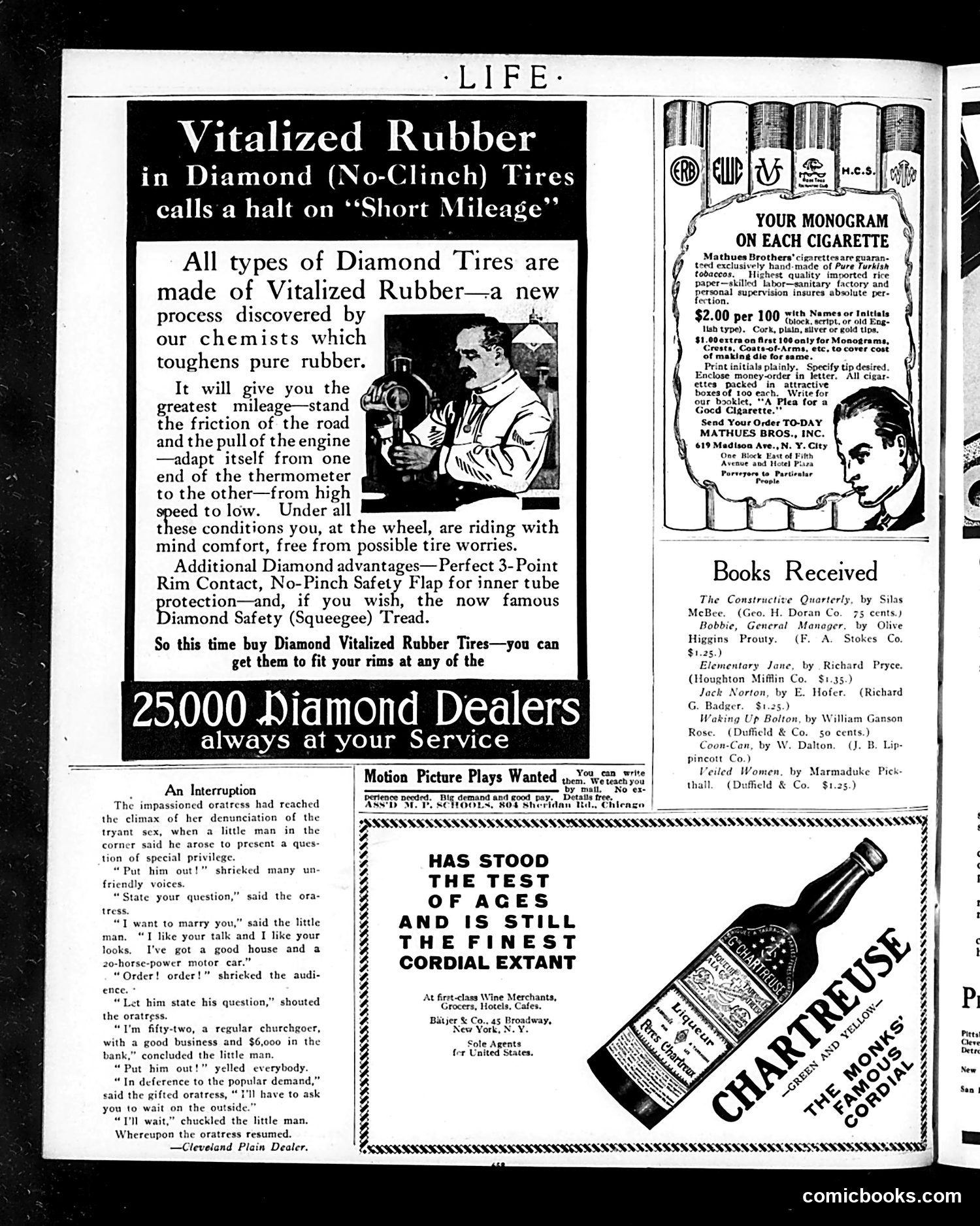
This page mixes **advertising and satirical humor** typical of early 20th-century Life magazine. The main cartoon (credited to Cleveland Plain Dealer) satirizes **feminist suffrage speakers and women's rights activists**. A female orator denounces men as tyrants while addressing a crowd. When a humble, modest man interrupts to propose marriage—offering a house, car, money, and respectability—the crowd demands his removal. Only when he adds financial credentials ($6,000 in savings) do they reluctantly tolerate him. The joke mocks both the oratress's contradictory rejection of a sincere, qualified suitor and suggests women's actual priorities contradict their rhetoric about equality. The surrounding content includes ads for **Diamond Tires** (with "Vitalized Rubber"), cigarette monograms, and **Chartreuse liqueur**—standard period advertising. A "Books Received" section lists contemporary publications. The satire reflects **anti-suffrage sentiment** common in 1910s-era humor, portraying female activists as hypocritical or self-interested rather than principled.
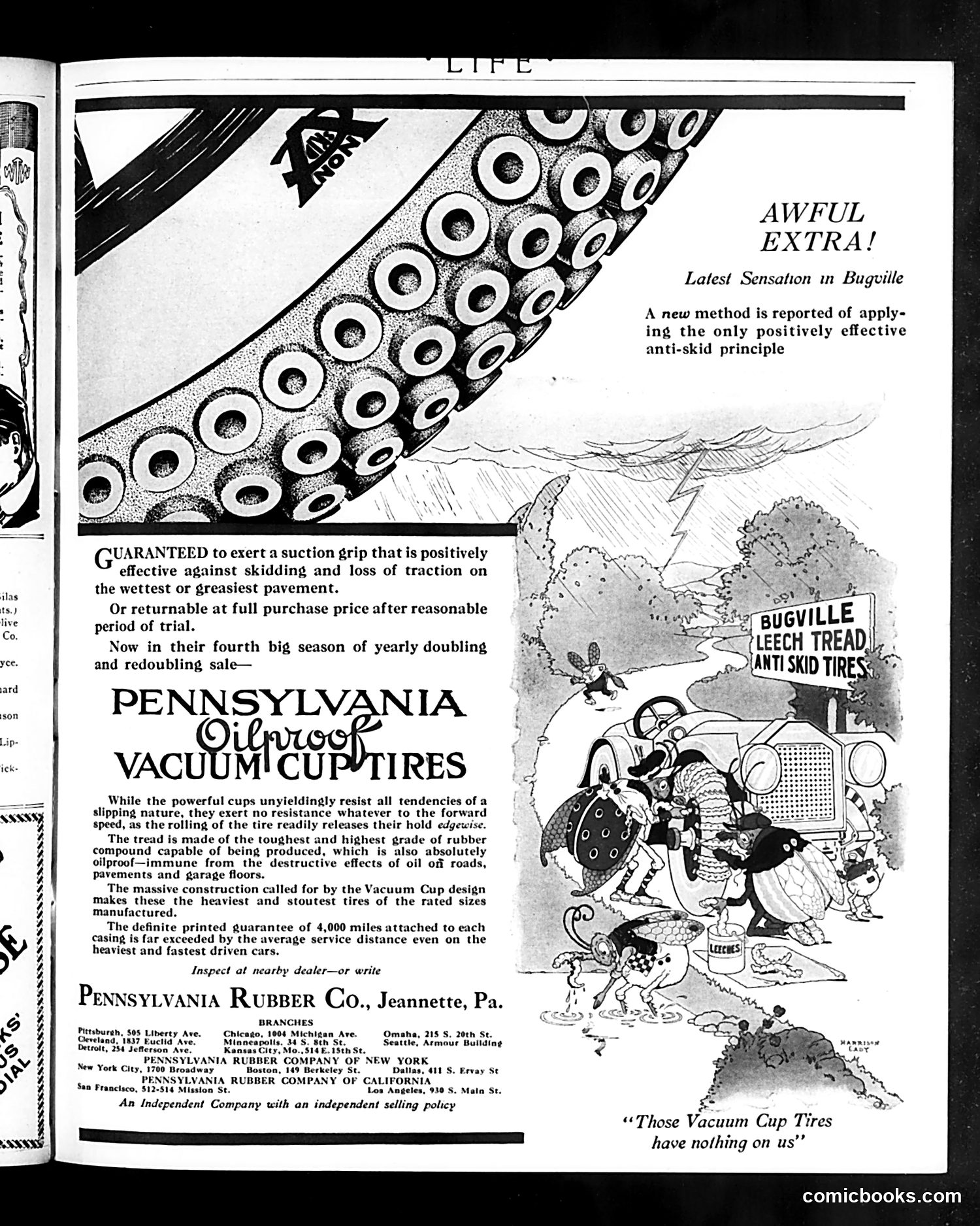
This page is primarily a **tire advertisement** disguised as humorous editorial content, not political satire. The "Bugville" framing uses anthropomorphic insects (bugs) as characters in a cartoon scenario where they discuss Pennsylvania Vacuum Cup Tires' anti-skid technology. The joke plays on the term "bug" — the tire company is literally addressing bugs/insects to demonstrate their product's grip on slippery surfaces. The main cartoon shows what appears to be cartoon insects discovering or discussing these tires, with the caption "Those Vacuum Cup Tires have nothing on us" — a pun suggesting the bugs' natural adhesive abilities rival the tire technology. This is **not political commentary** but rather a creative advertising approach: Life magazine's satirical format allowed manufacturers to present product pitches as tongue-in-cheek editorial features, making advertisements more entertaining and memorable to readers than straightforward marketing copy.
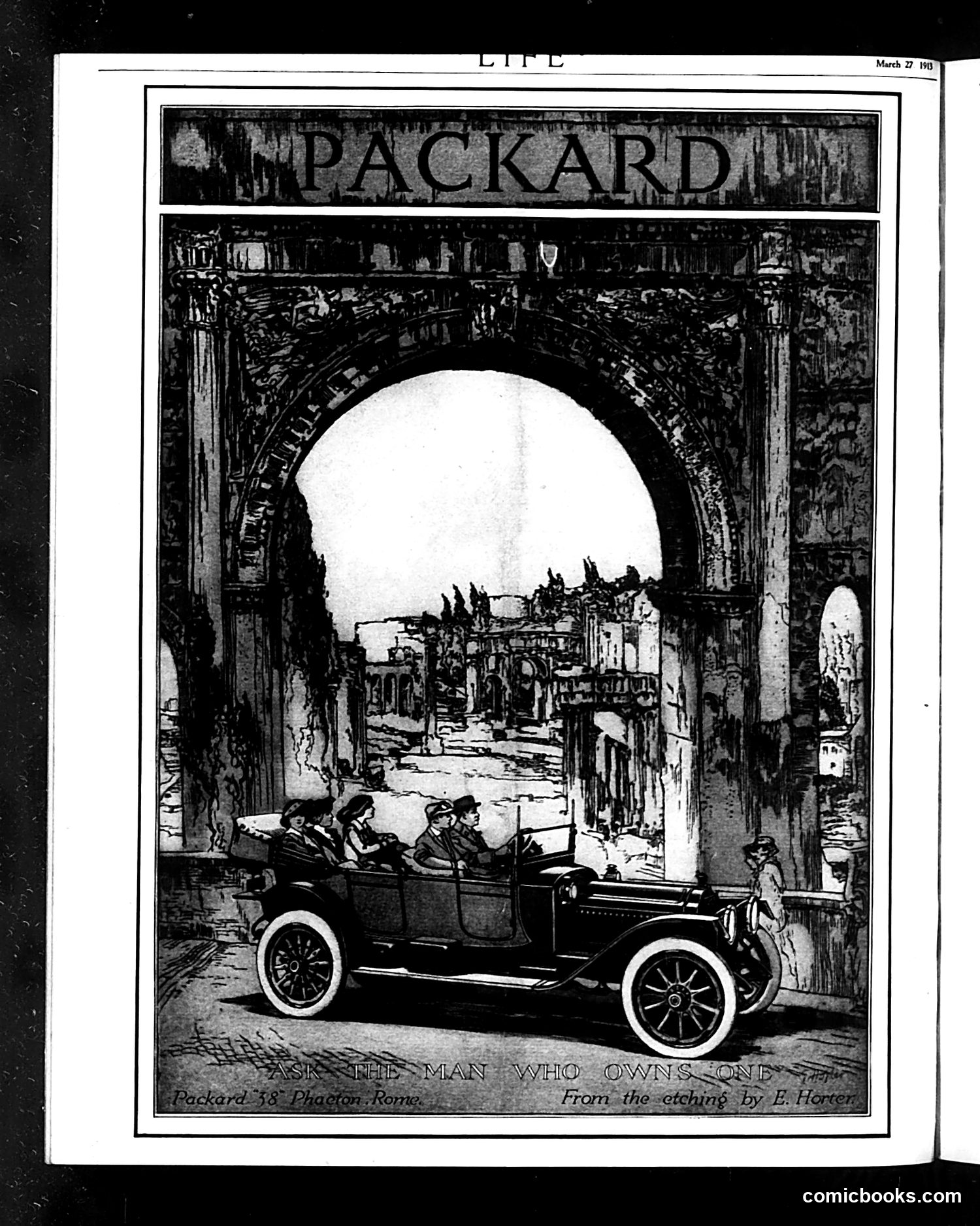
This is a Packard automobile advertisement disguised as editorial content. The image shows a Packard 38 Phaeton automobile driving through what appears to be a classical Roman arch (the Phaeton of Rome reference), with passengers visible in the car. The caption reads "Ask the man who owns one," which was Packard's actual advertising slogan of the era. The subtitle credits "From the etching by E. Horter," suggesting this is illustrated advertising rather than journalism. For modern readers: This represents early 20th-century luxury car marketing that positioned the Packard as sophisticated and aspirational—literally driving through classical civilization to suggest quality and prestige. The "ask the owner" tagline implied satisfied customers would vouch for the product's excellence.