
Life, 1913-03-27 · page 14 of 60
Life — March 27, 1913 — page 14: what you’re looking at
What you’re looking at
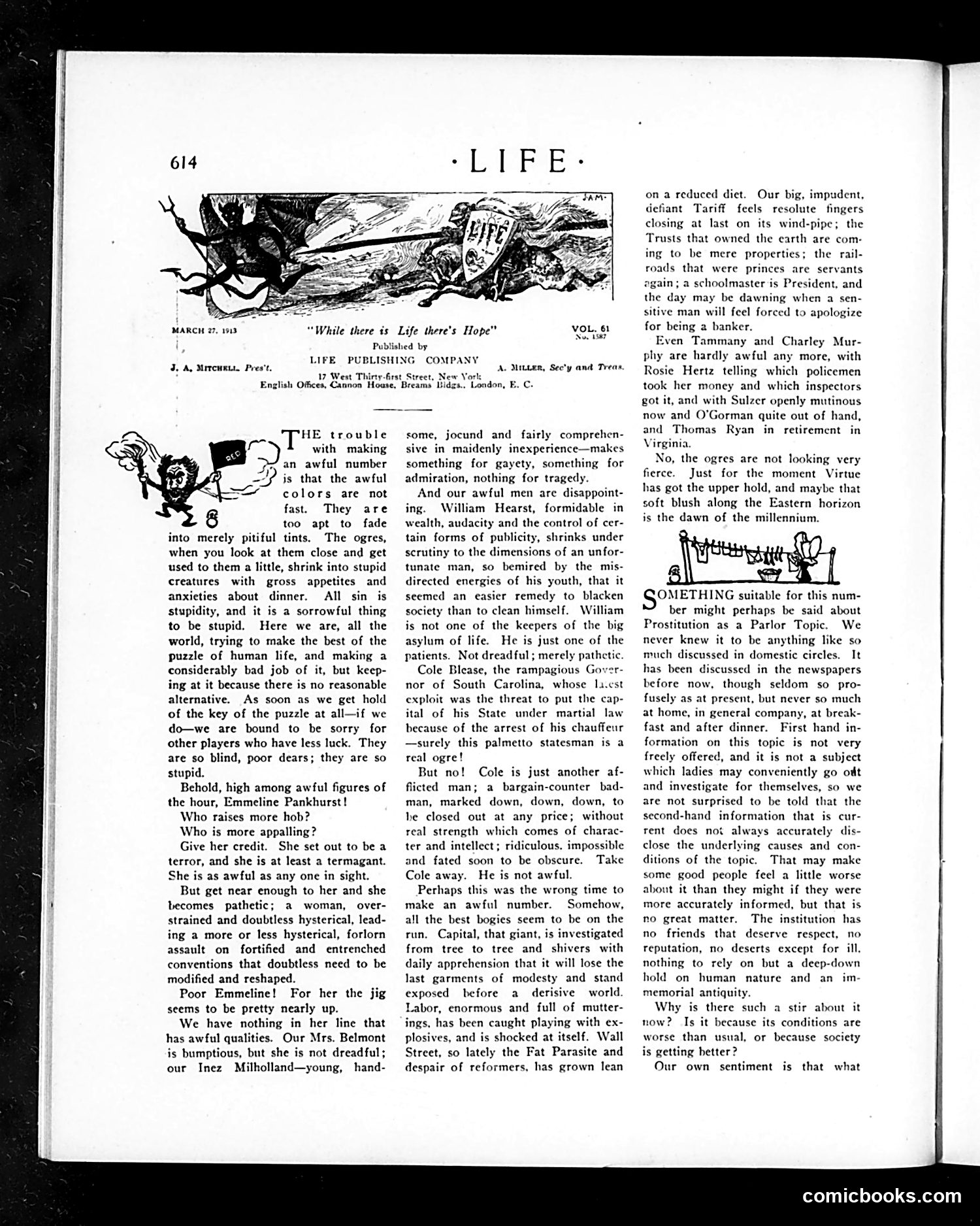
This page contains editorial commentary on American political and social figures of the era. The text criticizes several public figures as "awful" - specifically William Hearst (the newspaper magnate), Cole Blease (Governor of South Carolina), and Capital/Wall Street interests. The author argues these figures are not genuinely "awful" or tragic, but rather pathetic and ridiculous—lacking real character or strength. The cartoons (visible at top and side) appear to be satirical illustrations accompanying this critique, though specific details are difficult to discern in the image quality provided. The overall tone suggests Life magazine's characteristic progressive-era skepticism toward wealthy industrialists and political figures perceived as lacking integrity or genuine ability.
📄 Transcribed text from this page (OCR, searchable)
Machine-transcribed from the original scan — historical spelling and the odd misread are preserved.
MARCH 27, 1913 “While there is Life there's Hope" Published by LIFE PUBLISHID 17 West Thirty-first Street, English Offices, Cannon House, Breams’ Ii 3. A, Mircunts. Pres’ 3 COMPAY A. Mitten, Sec'y and Treas. New York, .. London, E. C. HE trouble with making px an awful number =I? is that the awful =~ colors are not fast. They are 8 too apt to fade into merely pitiful tints. The ogres, when you look at them close and get used to them a little, shrink into stupid creatures with gross appetites and anxieties about dinner. All sin is stupidity, and it is a sorrowful thing to be stupid. Here we are, all the world, trying to make the best of the puzzle of human life, and making a considerably bad job of it, but keep- ing at it because there is no reasonable alternative. As soon as we get hold of the key of the puzzle at all—if we do—we are bound to be sorry for other players who have less luck. They are so blind, poor dears; they are so stupid. Behold, high among awful figures of the hour, Emmeline Pankhurst! Who raises more hob? Who is more appalling? e her credit. She set out to be a terror, and she is at least a termagant. She is as awful as any one in sight. But get near enough to her and she becomes pathetic; a woman, over- strained and doubtless hysterical, lead- ing a more or less hysterical, forlorn assault on fortified and entrenched conventions that doubtless need to be modified and reshaped. Poor Emmeline! For her the jig seems to be pretty nearly up. We have nothing in her line that has awful qualities. Our Mrs. Belmont is bumptious, but she is not dreadful; our Inez Milholland—young, hand- some, jocund and fairly comprehen- sive in maidenly inexperience—makes something for gayety, something for admiration, nothing for tragedy. And our awful men are disappoint- ing. William Hearst, formidable in wealth, audacity and the control of cer- tain forms of publicity, shrinks under scrutiny to the dimensions of an unfor- tunate man, so bemired by the mi: directed energies of his youth, that it seemed an easier remedy to blacken society than to clean himself. William is not one of the keepers of the big asylum of life. He is just one of the patients. Not dreadful ; merely pathetic Cole Blease, the rampagious Gor nor of South Carolina, whose la.cst exploit was the threat to put the cap- ital of his State under martial law because of the arrest of his chauffeur —surely this palmetto statesman is a real ogre! But no! Cole is just another af- flicted man; a bargain-counter bad- man, marked down, down, down, to he closed out at any price; without real strength which comes of charac- ter and intellect; ridiculous. impossible and fated soon to be obscure. Take Cole away. He is not awful. Perhaps this was the wrong time to make an awful number. Somehow, all the best bogies seem to be on the run, Capital, that giant, is investigated from tree to tree and shivers with daily apprehension that it will lose the last garments of modesty and stand exposed before a derisive world. Labor, enormous and full of mutter- ings, has been caught playing with ex- plosives, and is shocked at itself. Wall Street, so lately the Fat Parasite and despair of reformers, has grown lean on a reduced diet. Our big, impudent, defiant Tariff feels resolute fingers closing at last on its wind-pipe; the Trusts that owned the earth are com- ing to be mere properties; the rail- roads that were princes are servants again; a schoolmaster is President, and the day may be dawning when a sen- sitive man will feel forced to apologize for being a banker. Even Tammany and Charley Mur- phy are hardly awful any more, with Rosie Hertz telling which policemen took her money and which inspectors got it, and with Sulzer openly mutinous now and O'Gorman quite out of hand, and Thomas Ryan in retirement in Virginia. No, the ogres are not looking very fierce. Just for the moment Virtue has got the upper hold, and maybe that soft blush along the Eastern horizon is the dawn of the millennium. OMETHING suitable for this num- ber might perhaps be said about Prostitution as a Parlor Topic. We never knew it to be anything like so much discussed in domestic circles. It has been discussed in the newspapers before now, though seldom so pro- fusely as at present, but never so much at home, in general company, at bre: fast and after dinner. st hand in- formation on this topic is not very freely offered, and it is not a subject which ladies may conveniently go ot and investigate for themselves, so we are not surprised to be told that the second-hand information that is cur- rent does not always accurately dis- close the underlying causes and con- ditions of the topic. That may make some good people feel a little worse about it than they might if they were more accurately informed, but that is no great matter. The institution has no friends that deserve respect, no reputation, no deserts except for ill, nothing to rely on but a deep-down hold on human nature and an im- memorial antiquity Why is there such a stir about it now? Is it because its conditions are worse than usual, or because society is getting better? Our own sentiment is that what comicbooks.com