
Life, 1913-03-27 · page 22 of 60
Life — March 27, 1913 — page 22: what you’re looking at
What you’re looking at
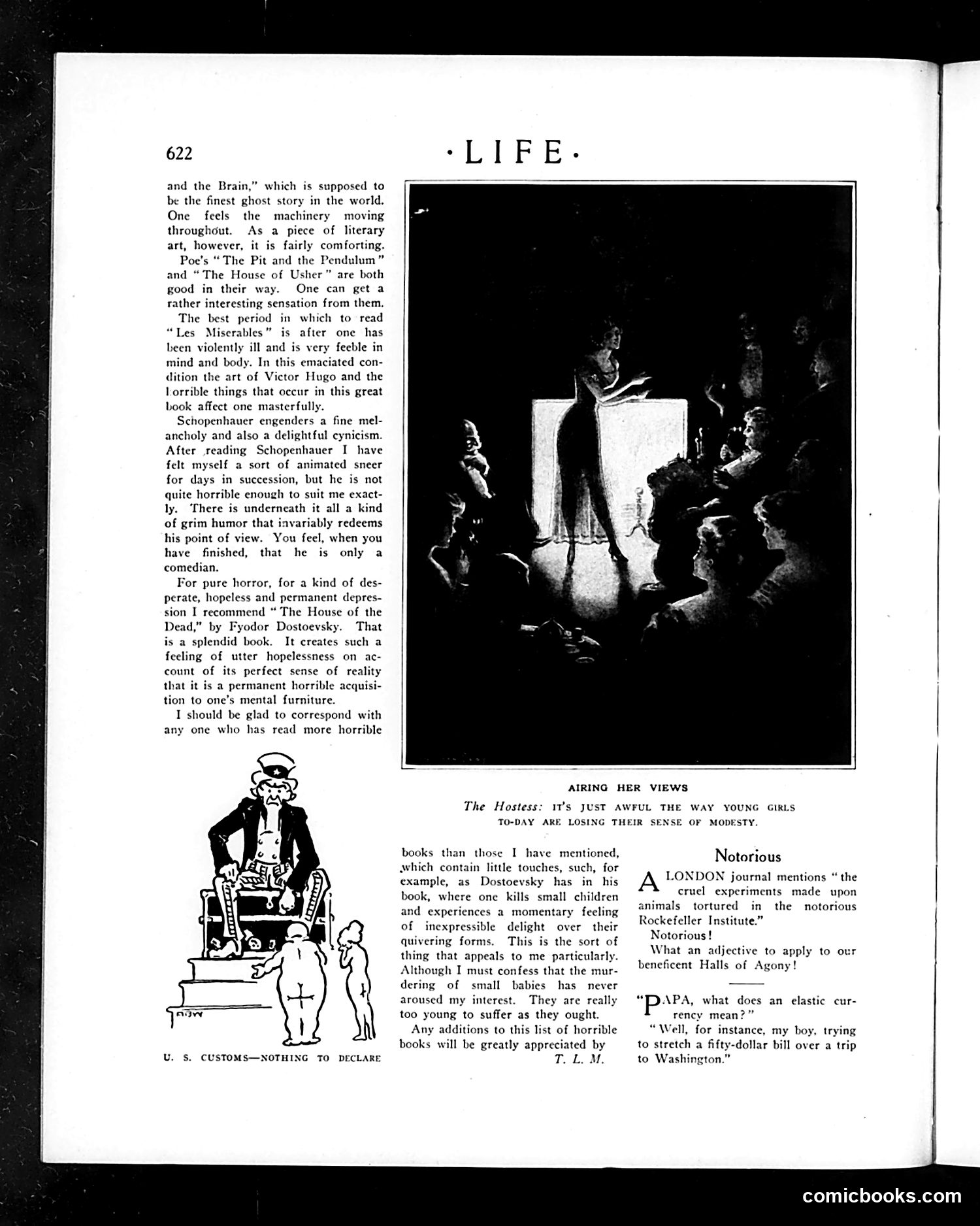
The left column contains a book review recommending works of dark literature—Poe, Hugo, Schopenhauer, and especially Dostoevsky's *The House of the Dead*—praising their capacity to induce despair and hopelessness. The reviewer explicitly admires depictions of child suffering, claiming babies are "too young to suffer as they ought." This appears to be satirical dark humor, likely mocking morbid intellectualism. The cartoon below shows Uncle Sam (identifiable by his top hat and patriotic dress) declaring "Nothing to Declare" while apparently smuggling disturbing ideas or influences. The right column contains two brief satirical pieces: one mocking a hostess lamenting young women's lost modesty (with an illustration suggesting the opposite), and another joke about economic "elasticity"—stretching a fifty-dollar bill inadequately to cover Washington travel expenses, satirizing inflation or financial strain.
📄 Transcribed text from this page (OCR, searchable)
Machine-transcribed from the original scan — historical spelling and the odd misread are preserved.
622 and the Brain,” which is supposed to be the finest ghost story in the world. One feels the machinery moving throughout. As a piece of literary art, however, it is fairly comforting. Poe’s “The Pit and the Pendulum” and “The House of Usher” are both good in their way. One can get a rather interesting sensation from them. The best period in which to read “Les Miserables” is after one has Leen violently ill and is very feeble in mind and body. In this emaciated con- dition the art of Victor Hugo and the Lorrible things that occur in this great Look affect one masterfully. Schopenhauer engenders a fine mel- ancholy and also a delightful cynicism. After reading Schopenhauer I have felt myself a sort of animated sneer for days in succession, but he is not quite horrible enough to suit me exact- ly. There is underneath it all a kind of grim humor that invariably redeems his point of view. You feel, when you have finished, that he is only a comedian. For pure horror, for a kind of des- perate, hopeless and permanent depres- sion I recommend “ The House of the Dead,” by Fyodor Dostoevsky. That is a splendid book. It creates such a feeling of utter hopelessness on ac- count of its perfect sense of reality that it is a permanent horrible acquisi- tion to one’s mental furniture. I should be glad to correspond with any one who has read more horrible books than those I have mentioned, which contain little touches, such, for example, as Dostoevsky has in his book, where one kills small children and experiences a momentary feeling of inexpressible delight over their quivering forms. This is the sort of thing that appeals to me particularly. Although I must confess that the mur- dering of small babies has never aroused my interest. They are really too young to suffer as they ought. books will be greatly appreciated by U.S. CUSTOMS—NOTHING TO DECLARE T. L. M. AIRING HER VIEWS The Hostess: 1s JUST AWFUL THE WAY YOUNG GIRLS TO-DAY ARE LOSING THEIR SENSE OF MODESTY. Notorious A LONDON journal mentions “ the cruel experiments made upon tortured in the itute.” animals notorious Rockefeller Ins Notorious! What an adjective to apply to our beneficent Halls of Agony! “PAPA, what does an elastic eur- rency mean?” “Well, for instance, my boy, trying to stretch a fifty-dollar bill over a trip to Washington.” comicbooks.com