
Life, 1913-03-27 · page 27 of 60
Life — March 27, 1913 — page 27: what you’re looking at
What you’re looking at
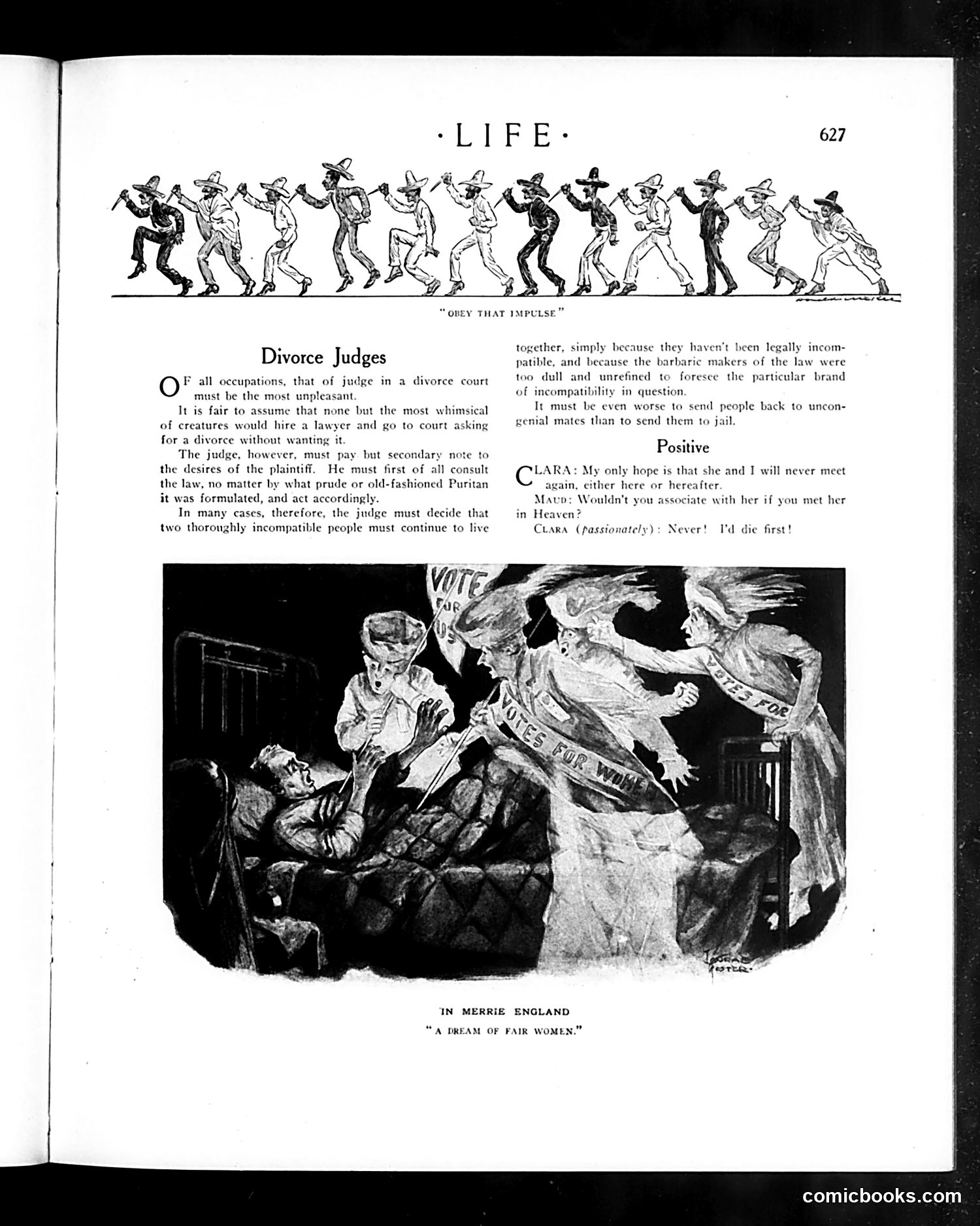
The page contains two satirical elements about divorce: **Main Article ("Divorce Judges"):** A serious commentary arguing that divorce court judges face an impossible ethical position. The text critiques outdated laws that force "thoroughly incompatible people" to remain married against their wishes, calling this punishment worse than jail. It suggests legal frameworks were written by "dull and unrefined" lawmakers who couldn't foresee modern relationship incompatibilities. **Cartoon ("In Merrie England"):** Depicts a domestic quarrel scene where a woman passionately declares she'd "die first" rather than meet her estranged husband in Heaven. The cartoon satirizes the irony of being forced by law to stay married to someone you actively despise—so much so that eternal separation is preferable to eternal togetherness. **Context:** This reflects early-to-mid 20th century debates over divorce law reform. The satire targets restrictive marriage laws that trapped unhappy couples together, treating this as social cruelty rather than moral righteousness.
📄 Transcribed text from this page (OCR, searchable)
Machine-transcribed from the original scan — historical spelling and the odd misread are preserved.
Divorce Judges oO F all occupations, that of judge in a divorce court must be the most unpleasant. It is fair to assume that none but the most whimsical of creatures would hire a lawyer and go to court asking for a divorce without wanting it. The judge, however, must pay but secondary note to the desires of the plaintiff. He must first of all consult the law, no matter by what prude or old-fashioned Puritan it was formulated, and act accordingly. In many cases, therefore, the judge must decide that two thoroughly incompatible people must continue to live “OEY THAT IMPULSE” together, simply because they haven't been legally incom- patible, and because the barbaric makers of the law were too dull and unrefined tc foresee the particular brand of incompatibility in question It must be even worse to send people back to uncon- genial mates than to send them to jail. Positive CEARA: My only hope is that she and I will never mect again, either here or hereafter ¢ with her if you met her Mavo: Wouldn't you ass« in Heaven? Ciara (passionately) Never! I'd die first! IN MERRIE ENGLAND “A DREAM OF FAIR WOMEN.” comicbooks.com