
Life, 1913-03-27 · page 28 of 60
Life — March 27, 1913 — page 28: what you’re looking at
What you’re looking at
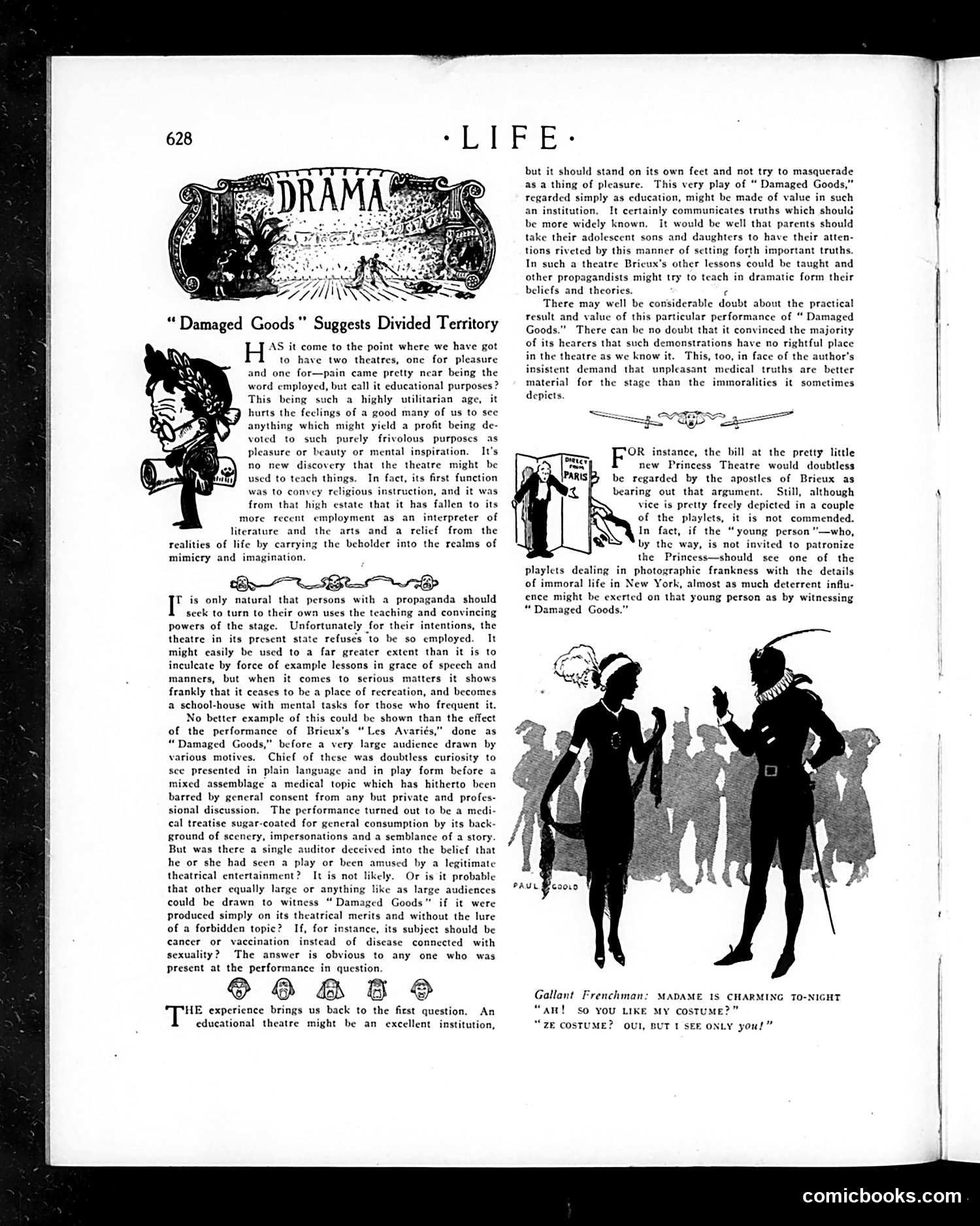
This 1913 *Life* magazine article critiques the play "Damaged Goods" (Brieux's *Les Avariés*), which tackled syphilis—a taboo medical topic rarely discussed publicly. The cartoon depicts a Frenchman flirting, illustrating the play's sexual subject matter. The author argues that audiences were drawn by curiosity about forbidden content rather than theatrical merit. He contends the play functions as a medical lecture disguised as entertainment, not genuine drama. While acknowledging its educational value—particularly for parents teaching adolescents about serious health matters—the critic insists such material belongs in dedicated educational theaters, not pleasure venues. The satire targets both propagandists misusing theatre and audiences' hypocrisy: they claim to seek instruction but actually crave scandal. The piece reflects early 20th-century tensions between theatre as art/entertainment versus moral instruction, and Victorian discomfort discussing sexuality even for educational purposes.
📄 Transcribed text from this page (OCR, searchable)
Machine-transcribed from the original scan — historical spelling and the odd misread are preserved.
“Damaged Goods” Suggests Divided Territory AS it come to the point where we have got to have two theatres, one for pleasure and one for—pain came pretty near being the word employed, but call it educational purposes? This being such a highly utilitarian age, it hurts the feelings of a good many of us to see anything which might yield a profit being de- voted to such purely frivolous purposcs as pleasure or beauty or mental inspiration. It's no new discovery that the theatre might be ed to teach things. In fact, its first function was to convey religious instruction, and it was from that high estate that it has fallen to its more recent employment as an interpreter of literature and the arts and a relief from the realities of life by carrying the beholder into the realms of mimicry and imagination. BAR SGI T is only natural that persons with a propaganda should seek to turn to their own uses the teaching and convincing powers of the stage. Unfortunately for their intentions, the theatre in its present state refuses to be so employed. It might easily be used to a far greater extent than it is to inculcate by force of example lessons in grace of specch and manners, but when it comes to serious matters it shows frankly that it ceases to be a place of recreation, and becomes a school-house with mental tasks for those who frequent it. No better example of this could be shown than the effect of the performance of Bricux’s “Les Avariés,” done as “Damaged Goods,” before a very large audience drawn by various motives. Chief of these was doubtless curiosity to sce presented in plain language and in play form before a mixed assemblage a medical topic which has hitherto been barred by general consent from any but private and profes- sional discussion. The performance turned out to be a medi- cal treatise sugar-coated for general consumption by its back- ground of scenery, impersonations and a semblance of a story But was there a single auditor deceived into the belief that he or she had scen a play or been amused by a legitimate theatrical entertainment? It is not likely. Or is it probable that other equally large or anything like as large audiences could be drawn to witness “Damaged Goods” if it were produced simply on its theatrical merits and without the lure of a forbidden topic? If, for instance, its subject should be cancer or vaccination instead of discase connected with sexuality? The answer is obvious to any one who was present at the performance in question oO & B > HE experience brings us back to the first question. An educational theatre might be an excellent institution, =e but it should stand on its own feet and not try to masquerade asa thing of pleasure. This very play of “ Damaged Goods,” regarded simply as education, might be made of value in such an institution. It certainly communicates truths which should be more widely known. it would be well that parents should take their adolescent sons and daughters to have their atten- tions riveted by this manner of setting forth important truths. In such a theatre Bricux’s other lessons could be taught and other propagandists might try to teach in dramatic form their beliefs and theories. ¢ There may well be considerable doubt about the practical result and value of this particular performance of “ Damaged Goods.” There can be no doubt that it convinced the majority of its hearers that such demonstrations have no rightful place in the theatre as we know it. This, too, in face of the author's insistent demand that unpleasant medical truths are better material for the stage than the immoralities it sometimes depicts. Tr — OR instance, the bill at the pretty little new Princess Theatre would doubtless be regarded by the apostles of Brieux as bearing out that argument. Still, although vice is pretty freely depicted in a couple of the playlets, it is not commended. In fact, if the “young person "—who, by the way, is not invited to patronize the Princess—should see one of the playlets dealing in photographic frankness with the details of immoral life in New York, almost as much deterrent influ- ence might be exerted on that young person as by witnessing “ Damaged Goods.” PAUL Boonie Gallant Frenchman: MADAME 1S CHARMING TO-NIGHT Au! so YOU LIKE MY CosTUME?” ZE COSTUME? OUI, BUT I SEE ONLY you!” comicbooks.com