
Life, 1913-03-27 · page 15 of 60
Life — March 27, 1913 — page 15: what you’re looking at
What you’re looking at
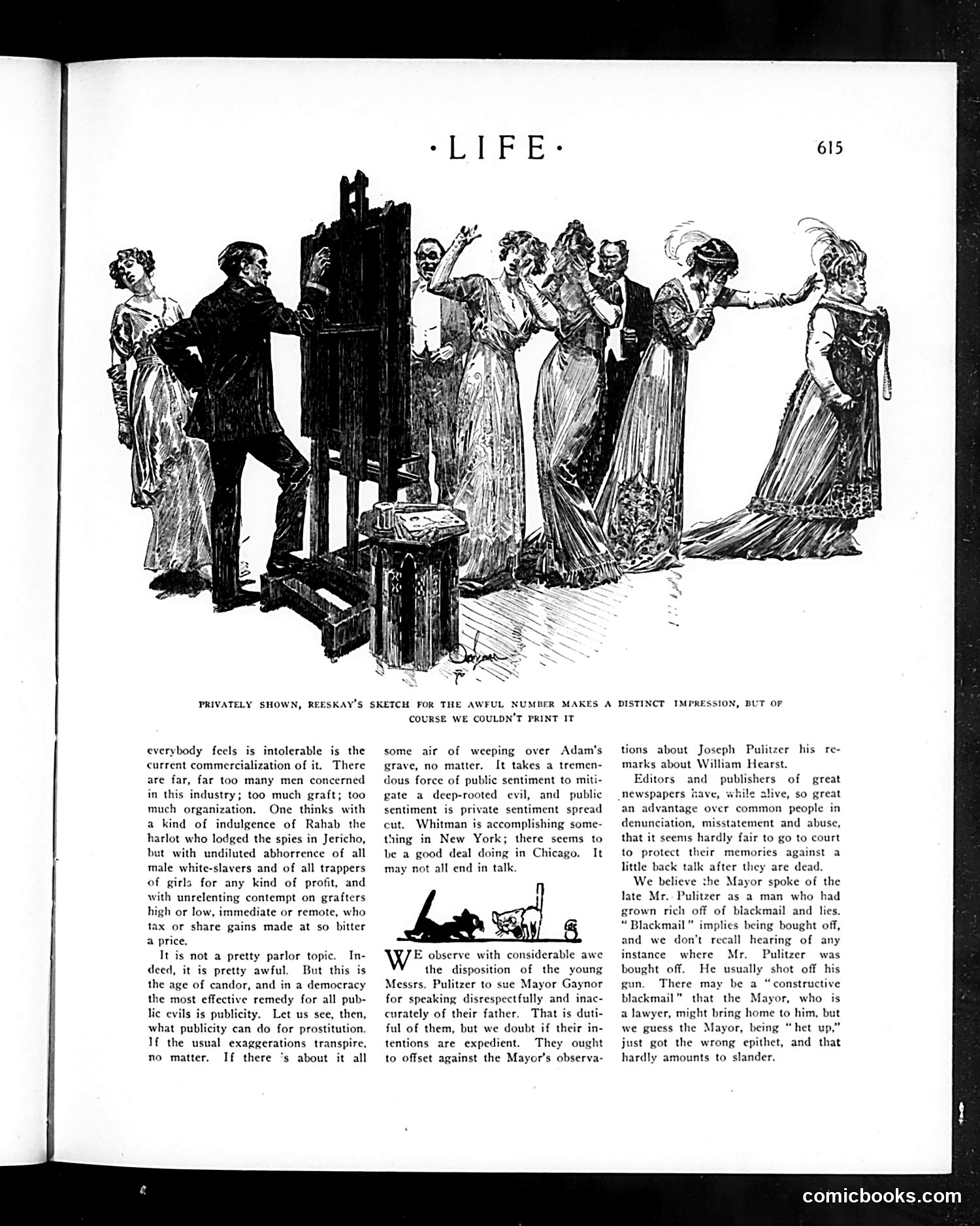
This page discusses **prostitution reform** and a **media lawsuit**, not primarily through the sketch above but through editorial commentary. The sketch (by "Reeskay") depicts what appears to be a social gathering, captioned as depicting "the awful number"—likely referencing a controversial performance or artwork deemed too scandalous to print. The text argues for **publicity as a reform tool** against prostitution and sex trafficking, citing activists like Whitman working in New York and Chicago. It contrasts historical tolerance (Biblical Rahab) with modern condemnation of traffickers. The editorial also addresses a lawsuit by **Joseph Pulitzer's sons** against **Mayor Gaynor** for insulting their deceased father's reputation. The writer suggests Gaynor (though "heated") used imprecise language—calling Pulitzer's wealth "blackmail" when the newspaper magnate typically used his power directly rather than extortion. The piece argues that powerful media figures shouldn't sue for defamation after death, given their advantage in controlling narratives while alive.
📄 Transcribed text from this page (OCR, searchable)
Machine-transcribed from the original scan — historical spelling and the odd misread are preserved.
PRIVATELY SHOWN, REESKAY’S SKETCH FOR THE AWFUL NUMBER MAKES A DISTINCT IMPRESSION, BUT OF everybody feels is intolerable is the current commercialization of it. There are far, far too many men concerned in this industry; too much graft; too much organization. One thinks with a kind of indulgence of Rahab the harlot who lodged the spies in Jericho, but with undiluted abhorrence of all male white-slavers and of all trappers of girls for any kind of profit, and with unrelenting contempt on grafters high or low, immediate or remote, who tax or share gains made at so bitter a price. It is not a pretty parlor topic. In- deed, it is pretty awful. But this is the age of candor, and in a democracy the most effective remedy for all pub- lic evils is publicity. Let us see, then, what publicity can do for prostitution. If the usual exaggerations transpire, no matter. If there ‘s about it all COURSE WE COULDN’T PRINT IT some air of weeping over Adam's grave, no matter. It takes a tremen- dous force of public sentiment to miti- gate a deep-rooted evil, and public sentiment is private sentiment spread cut. Whitman is accomplishing some- thing in New York; there seems to be a good deal doing in Chicago. It may not all end in talk. W* observe with considerable awe the disposition of the young Messrs, Pulitzer to sue Mayor Gaynor for speaking disrespectfully and inac- curately of their father. That is duti- ful of them, but we doubt if their in- tentions are expedient. They ought to offset against the Mayor’s observa- tions about Joseph Pulitzer his re- marks about William Hearst. Editors and publishers of great newspapers have, while alive, so great an advantage over common people in denunciation, misstatement and abuse, that it seems hardly fair to go to court to protect their memories against a little back talk after they are dead. We believe the Mayor spoke of the late Mr. Pulitzer as a man who had grown rich off of blackmail and lies. “Blackmail” implies being bought off, and we don't recall hearing of any instance where Mr. Pulitzer was bought off. He usually shot off his gun. There may be a “constructive blackmail” that the Mayor, who is a lawyer, might bring home to him, but we guess the Mayor, being “het up,” just got the wrong epithet, and that hardly amounts to slander. comicbooks.com