
Life, 1913-03-27 · page 21 of 60
Life — March 27, 1913 — page 21: what you’re looking at
What you’re looking at
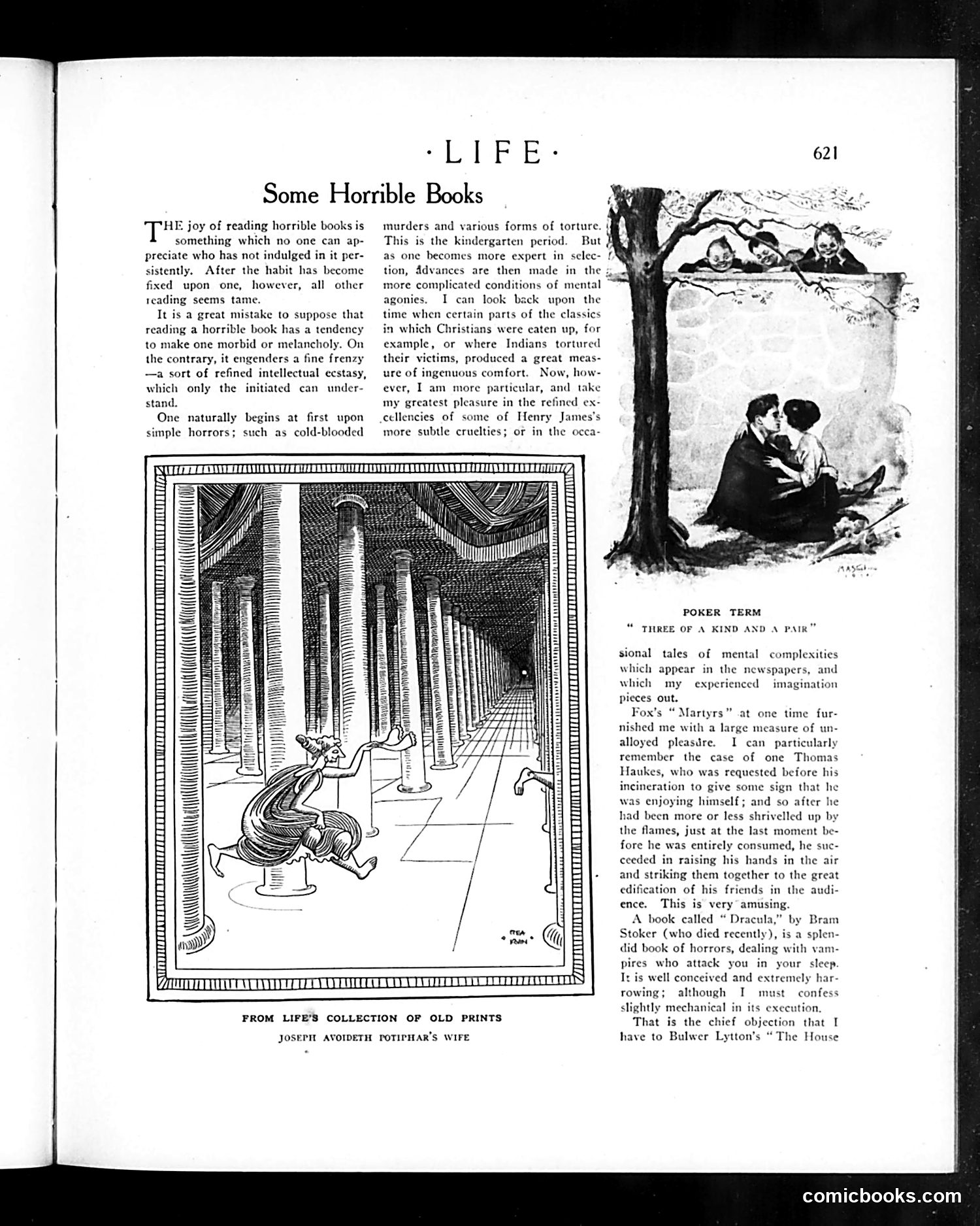
This satirical essay mocks readers who obsessively consume sensational, grotesque literature. The author argues that "horrible books" provide intellectual pleasure to those addicted to them, progressing from simple horrors (murders, torture) to more psychologically complex torments—particularly Henry James's subtle cruelties. The accompanying cartoons illustrate this theme: the lower print shows "Joseph Avoideth Potiphar's Wife" (a biblical reference to sexual temptation), while the upper illustration depicts people in distress in a columned hall, visualizing the "mental agonies" discussed. The satire targets Victorian-era readers' appetite for sensational Gothic fiction and lurid tales, suggesting this taste represents both refined intellectualism *and* morbid excess—a contradiction the author playfully explores. References to Bram Stoker's *Dracula* and historical martyr accounts underscore how society simultaneously celebrates and denies its fascination with human suffering.
📄 Transcribed text from this page (OCR, searchable)
Machine-transcribed from the original scan — historical spelling and the odd misread are preserved.
HE joy of reading horrible books is something which no one can ap- preciate who has not indulged in it per- sistently, After the habit has become fixed upon one, however, all other reading seems tame. It is a great mistake to suppose that reading a horrible book has a tendency to make one morbid or melancholy. On the contrary, it engenders a fine frenzy —a sort of refined intellectual ecstasy, which only the initiated can under- stand. One naturally begins at first upon simple horrors; such as cold-blooded Uc LA ccc Ct 4 Ug Z, Some Horrible Books ‘LIP Bs murders and various forms of torture. | This is the kindergarten period. But as one becomes more expert in selec- tion, Advances are then made in the more complicated conditions of mental agonies. I can look back upon the time when certain parts of the classics in which Christians were eaten up, for example, or where Indians tortured their victims, produced a great meas- ure of ingenuous comfort. Now, how- ever, Iam more particular, and take my greatest pleasure in the refined cellencies of some of Henry James's more subtle cruelties; or in the occa- POKER TERM H “ THREE OF A KIND AND A PAIR” aH sional tales of mental complexities EA: which appear in the newspapers, Eas which my experienced a pieces out. F Martyrs” .at one time fur- nished me with a large measure of un- alloyed pleasdre. I can_ particularly remember the case of one Thomas Haukes, who was requested before his incineration to give some sign that he was enjoying himself; and so after he had been more or less shrivelled up by the flames, just at the last moment be- fore he was entirely consumed, he suc- ceeded in raising his hands in the air and striking them together to the great edification of his friends in the audi- ence. This is very amusing. A book called “ Dracula,” by Bram Stoker (who died recently), is a splen- did book of horrors, dealing with vam- pires who attack you in your sleep. FROM LIFE’S COLLECTION OF OLD PRINTS JOSEPT AVOIDETH POTIPHAR'S WIFE Ir is well conceived and extremely rowing; although IT must slightly mechanical in its execution, That is the chief objection that I have to Bulwer Lytton’s “The House confess comicbooks.com