
A complete issue · 44 pages · 1913
Life — March 20, 1913
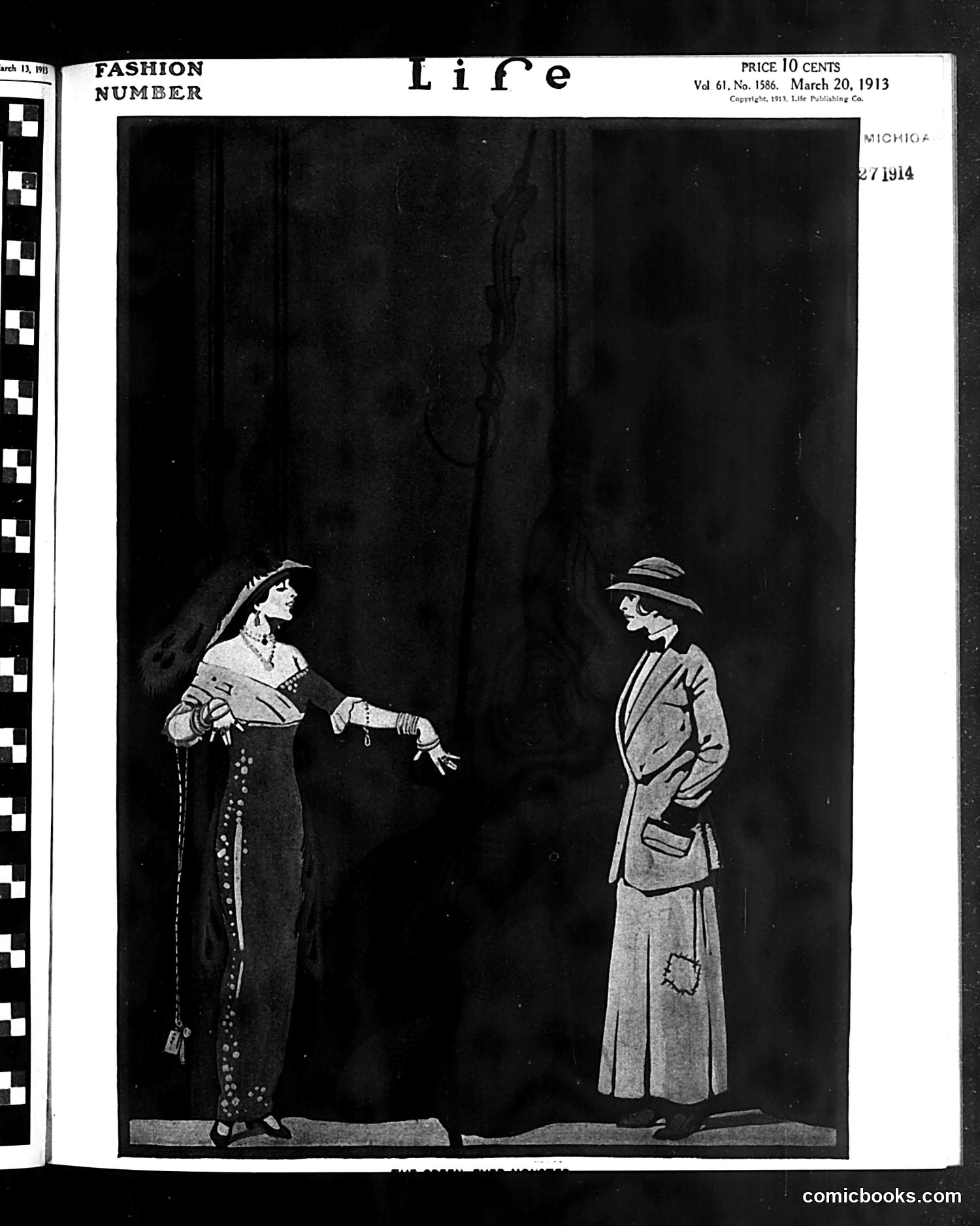
This illustration depicts two fashionable women in contrasting 1913 styles. The figure on the left wears an ornate, heavily decorated dark gown with embellishments and a feathered hat—representing elaborate, traditional Edwardian fashion. The woman on the right sports a simpler, more streamlined suit jacket and skirt with a wide-brimmed hat, embodying the emerging modern silhouette. The satire likely comments on the fashion transition of 1913, when women's clothing was beginning to shed the restrictive, ornamental styles of the previous decade for more practical, athletic lines. This shift reflected broader social changes as women gained more independence and mobility. The contrasting figures humorously illustrate this generational divide in taste and fashion sensibility during the early 20th century.
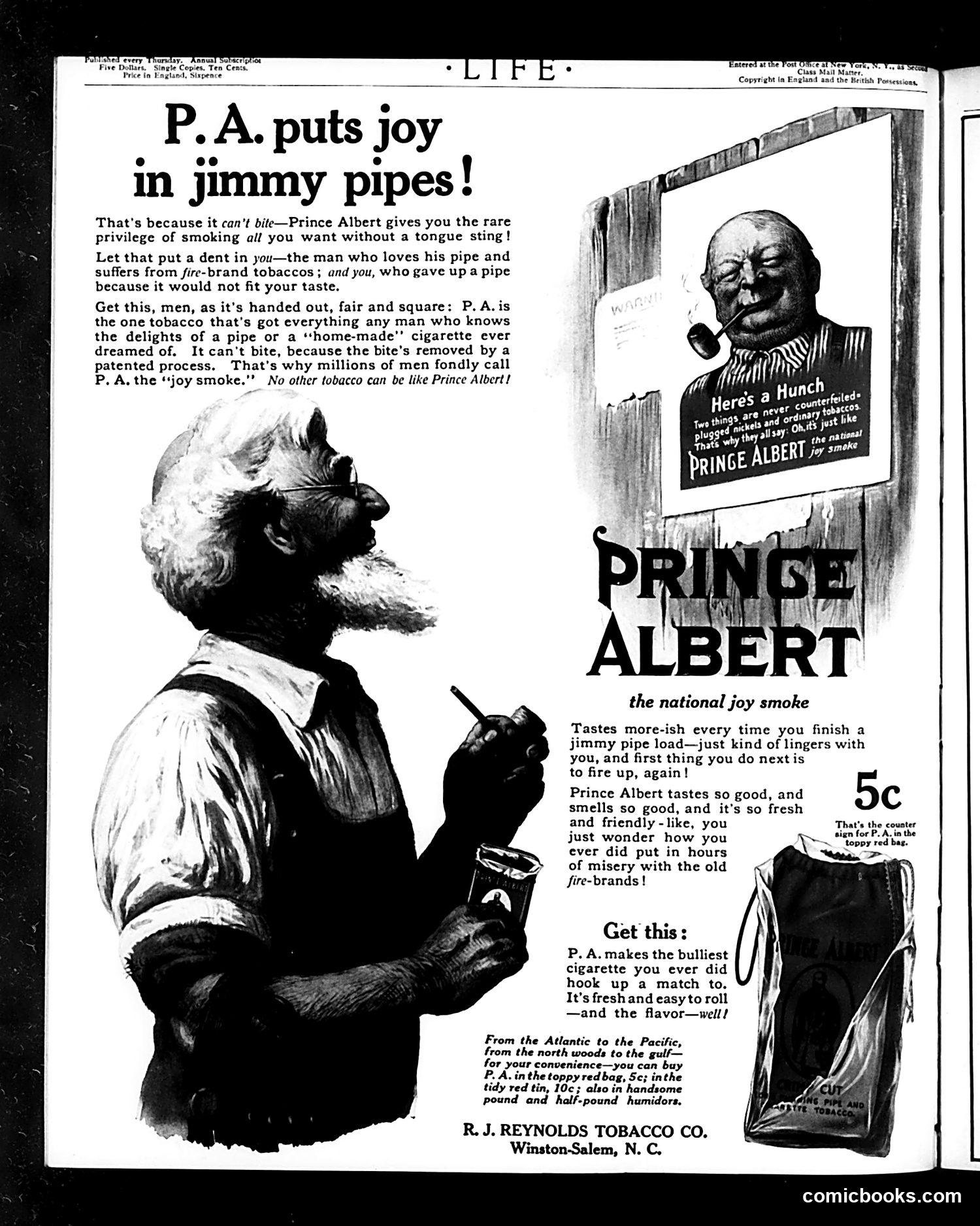
This page is primarily a **tobacco advertisement**, not political satire. It promotes Prince Albert pipe tobacco and rolling tobacco by R.J. Reynolds Tobacco Co. The central image shows an elderly man with a white beard smoking a pipe—likely meant to evoke a working-class or rural figure to suggest authenticity and tradition. The ad's humor relies on casual stereotyping rather than satire: the character appears designed to seem folksy and trustworthy. The advertisement emphasizes that Prince Albert "can't bite" and won't irritate smokers' mouths, contrasting it with unspecified inferior "fire-brand tobaccos." The price point (5 cents) and distribution claims suggest this targets mass-market consumers across America. This is commercial marketing using nostalgic imagery, not political commentary.
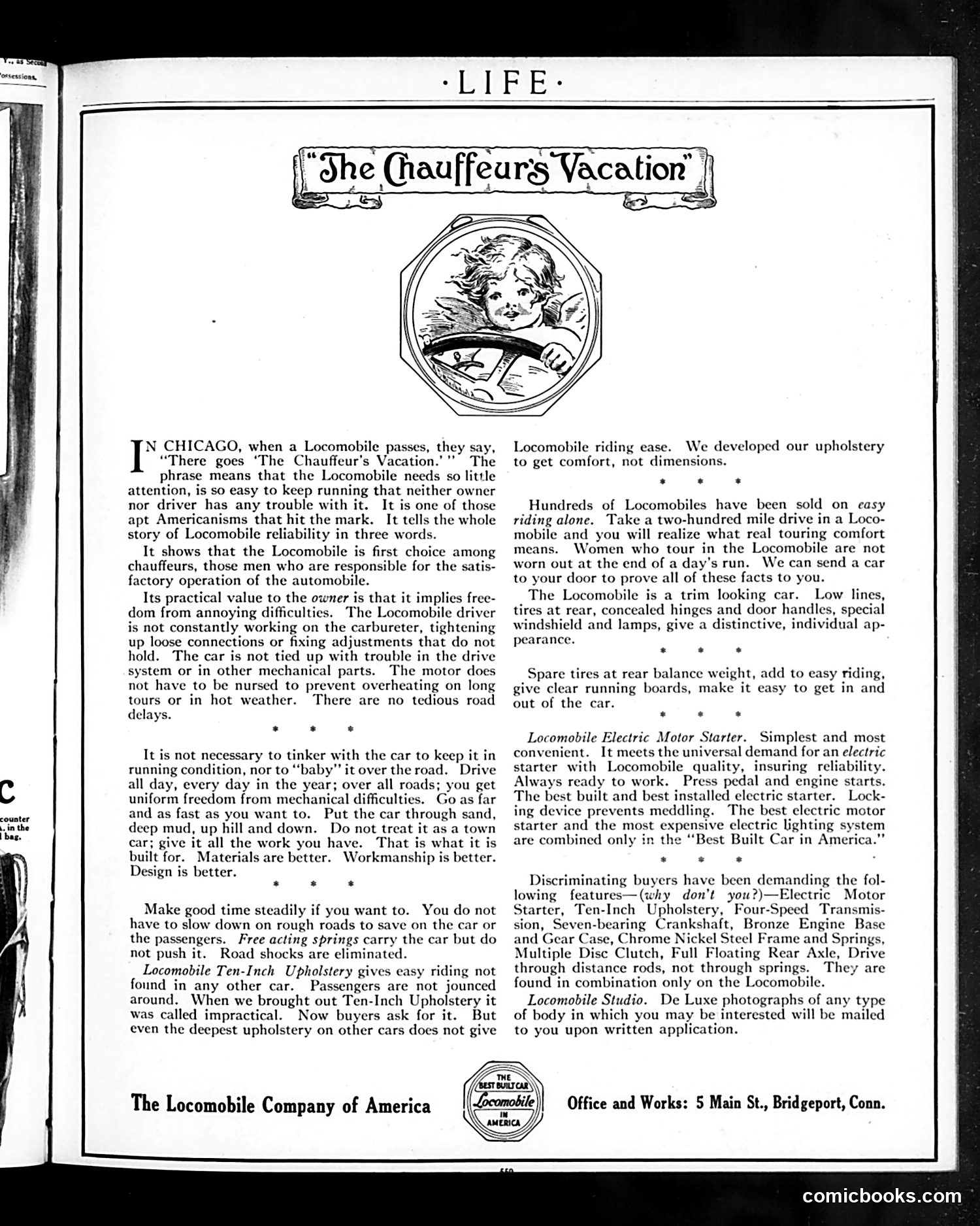
This page is **primarily advertising**, not satire or political commentary. The title "She Chauffeur's Vacation" presents a humorous illustration of a young woman driving a car, presumably on holiday. The ad promotes the **Locomotile automobile**, emphasizing its reliability and ease of operation. The text argues that the car requires minimal maintenance and driver skill—key selling points for early automobiles when mechanical expertise was expected. The humor lies in the contemporary novelty of a woman as the primary driver. The ad suggests that if a female chauffeur can handle the Locomotile effortlessly on vacation, anyone can operate it. This targets middle-class buyers seeking "freedom from annoying difficulties" and reliable transportation. The Locomotile Company of America used this gentle gender-based humor to market automotive accessibility and dependability to emerging consumer audiences.
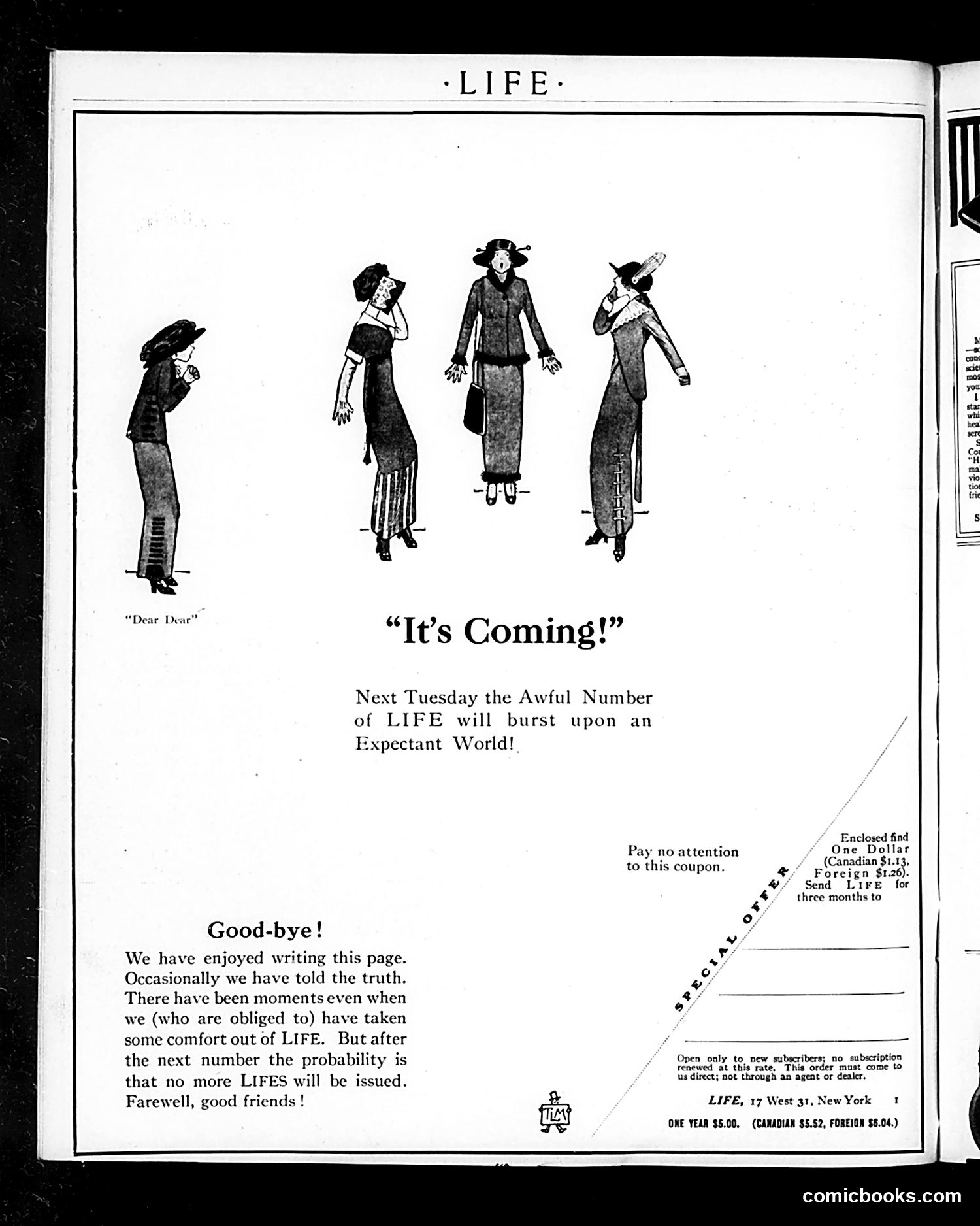
This page from *Life* magazine appears to be a farewell announcement disguised as teasing promotion. The four illustrated figures show progressively dressed-up women, captioned "It's Coming!" with text promising that "Next Tuesday the Awful Number of LIFE will burst upon an Expectant World!" However, the actual message is a goodbye: the editors admit they've "occasionally told the truth" while writing this page, and declare that after the next issue, "no more LIFES will be issued. Farewell, good friends!" This represents *Life* magazine's final publication. The "awful number" refers to their last issue. The fashionable women figures and teasing tone create ironic contrast with the announcement of closure. The bottom includes subscription information and a coupon for new subscribers—likely included before the editors knew the magazine would end.
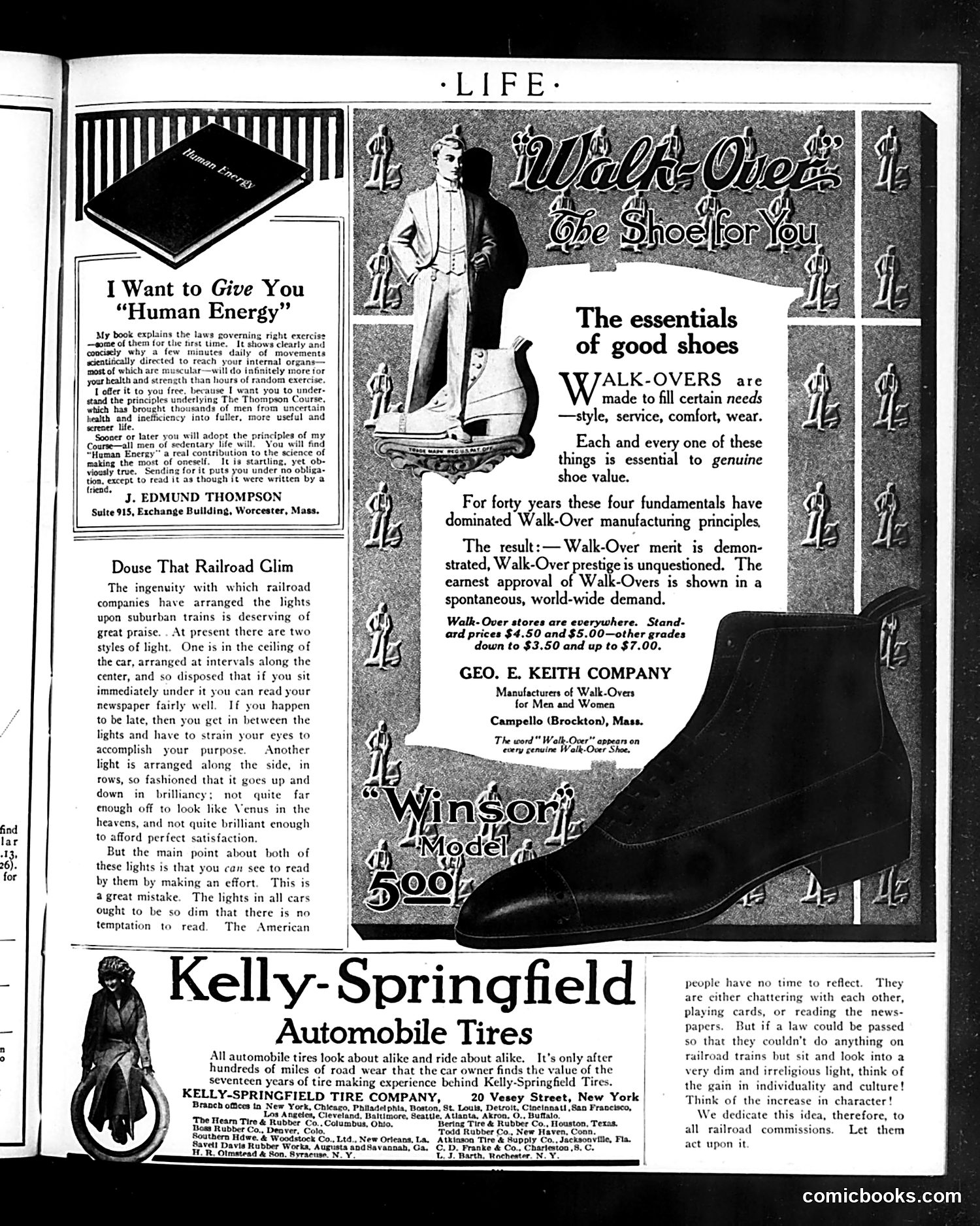
This page is primarily **advertising rather than satire or political commentary**. The layout contains three advertisements: 1. **"Human Energy" book ad** (left): Edmund Thompson promotes his self-help course on personal vitality and life principles. 2. **Walk-Over shoes ad** (center/right): The dominant advertisement features a woman's leg and shoe, emphasizing that Walk-Over shoes meet four essentials: style, service, comfort, and wear. The ad highlights forty years of manufacturing reputation and lists retail locations and prices. 3. **Kelly-Springfield Automobile Tires ad** (bottom): Promotes tire durability through road-tested value, listing branch offices and tire dealers across North America. There is also a brief editorial piece criticizing railroad car lighting design. The page reflects early 20th-century consumer advertising aimed at middle-class readers.
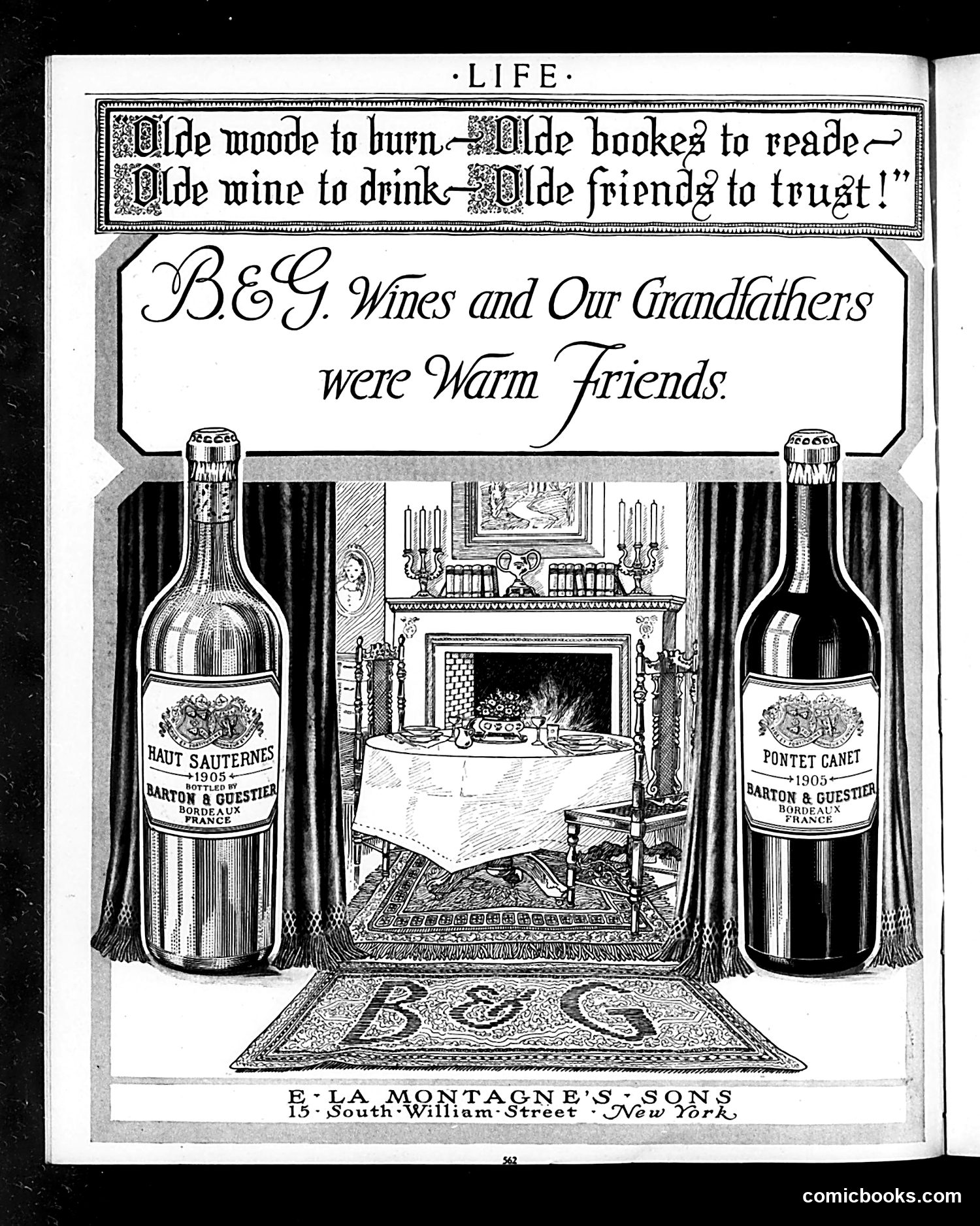
This is primarily a **wine advertisement** rather than political satire. The page advertises B&G Wines (Barton & Guestier), a French wine merchant, using the slogan "B&G Wines and Our Grandfathers were Warm Friends." The advertisement features two wine bottles (Haut Sauternes 1903 and Pontet Canet) flanking an elegant fireplace scene, evoking warmth, tradition, and hospitality. The decorative header quotes old English expressions valuing wood for burning, books for reading, wine for drinking, and friends for trust—positioning wine-drinking as a genteel, longstanding custom. The company's New York address (15 South William Street) suggests this targets American consumers with nostalgic appeals to European sophistication and family heritage. It's commercial promotion, not political commentary.
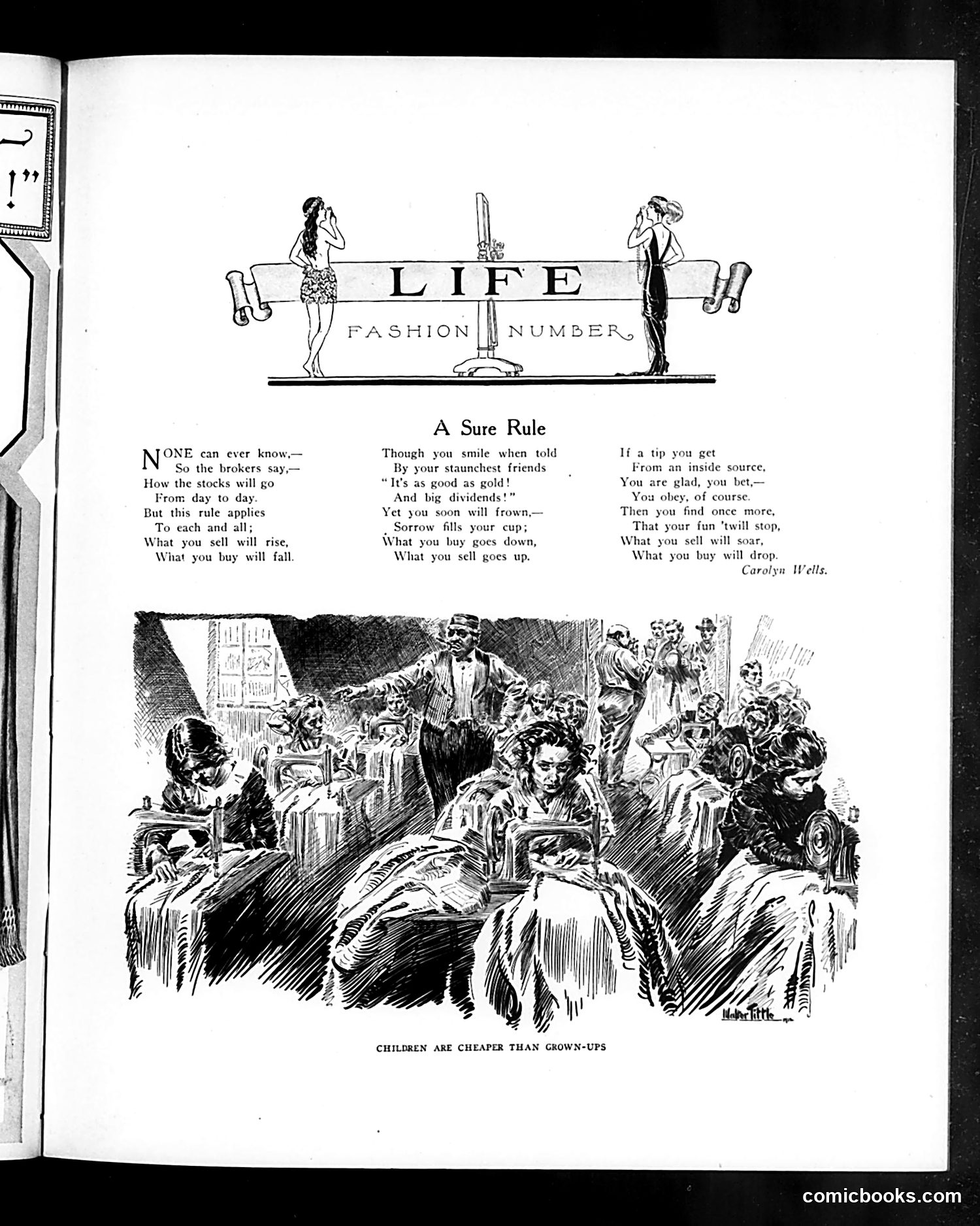
This page from *Life* magazine's "Fashion Number" contains a poem titled "A Sure Rule" by Carolyn Wells, paired with a satirical illustration about financial speculation. The poem offers investing advice in three stanzas: what you buy will either rise or fall; buying leads to losses; tips from inside sources create temporary gains before inevitable drops. The illustration below shows a crowded stock exchange or trading floor, with "CHILDREN ARE CHEAPER THAN GROWN-UPS" as its caption. The image depicts financial chaos—multiple figures in frantic activity, suggesting frenzy or panic trading. Together, the poem and cartoon satirize stock market speculation and get-rich-quick schemes popular in the era. The caption's dark humor suggests people gamble away fortunes chasing profits. This appears to critique financial recklessness and the illusion of easy wealth.
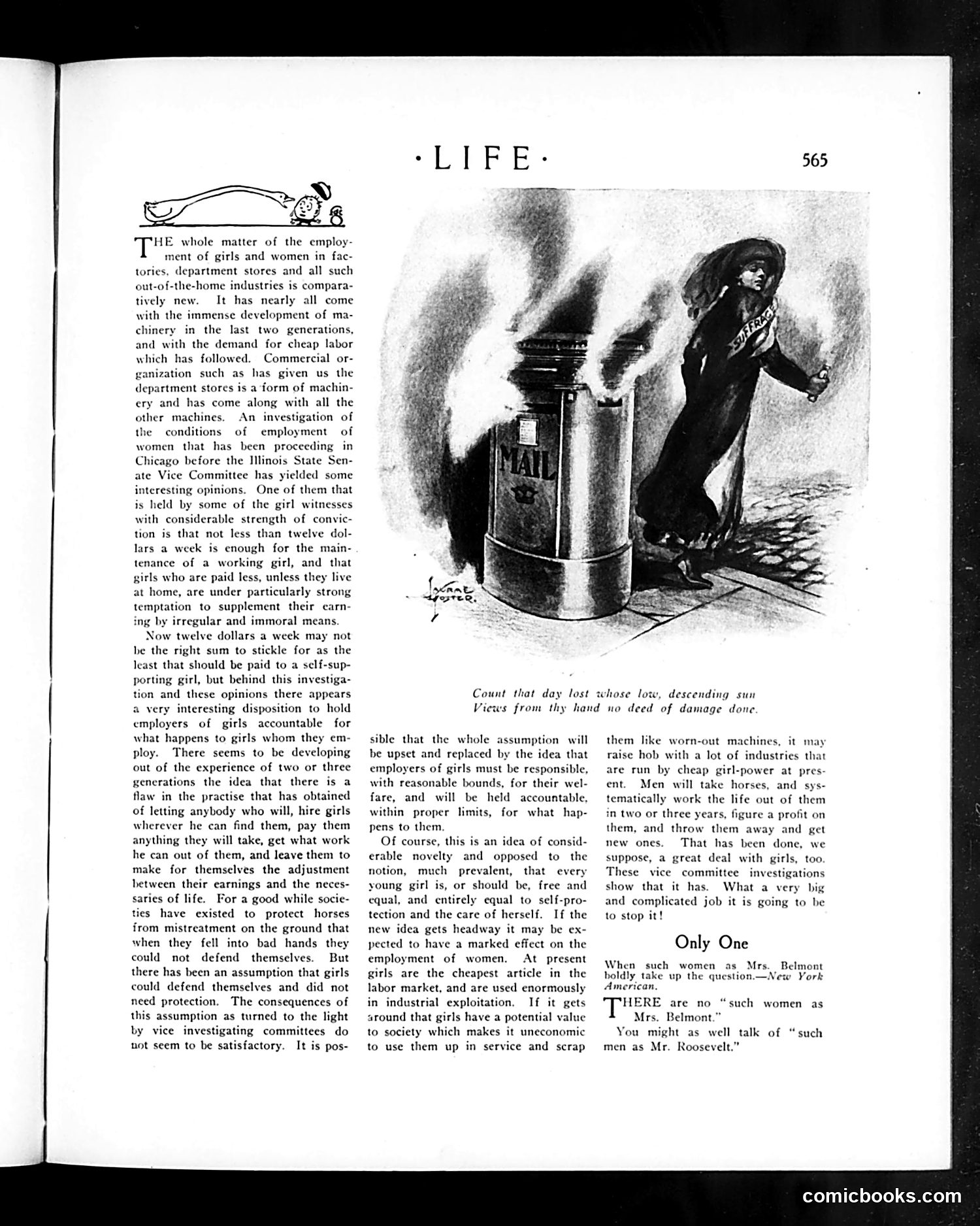
The main illustration depicts a woman in dark clothing standing beside a factory smokestack, looking distressed or contemplative. The caption references loss and damage, suggesting commentary on industrial working conditions. The accompanying text discusses employment of women and girls in factories and department stores, examining wages (twelve dollars weekly mentioned as minimum) and working conditions. The article addresses a concern that poorly-paid working girls might resort to "irregular and immoral means" to supplement income—a Victorian-era anxiety about female factory workers' vulnerability. The piece debates employer responsibility for workers' welfare and whether women should be economically independent. A section titled "Only One" references Mrs. Belmont's views on exceptional women, contrasting her with typical working women. The overall satire critiques both exploitative labor practices and paternalistic attitudes toward female workers.
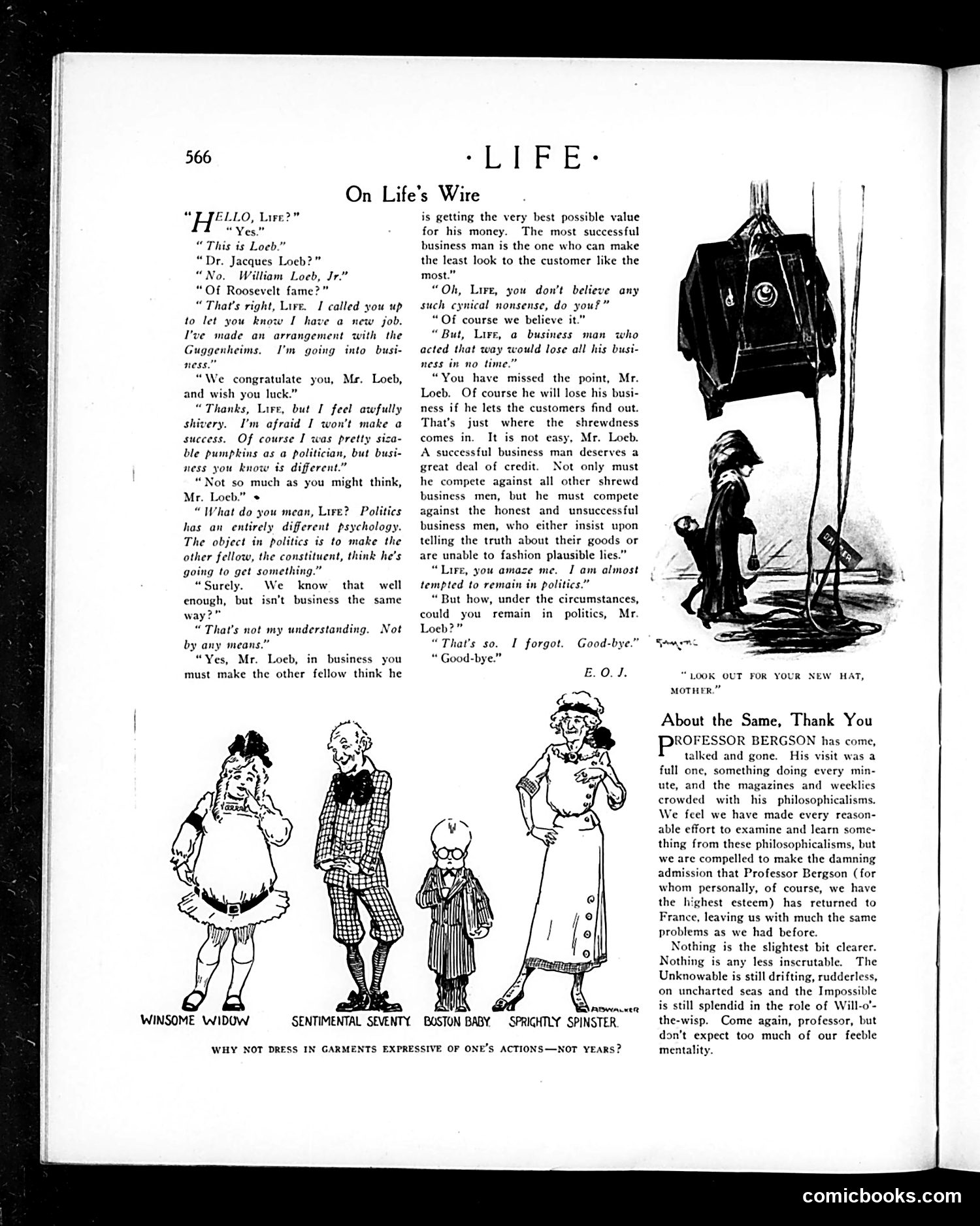
This page contains two satirical pieces: **"On Life's Wire"** is a dialogue between Life magazine and "Mr. Loeb" (likely referring to a notable businessman of the era). The conversation criticizes business ethics, suggesting successful businessmen must deceive customers while maintaining appearances. Life questions whether such dishonesty differs fundamentally from politics, noting both require "making the other fellow think" one thing while pursuing personal gain. **"Why Not Dress in Garments Expressive of One's Actions"** features four cartoon characters labeled by stereotyped female types: "Winsome Widow," "Sentimental Severity," "Boston Baby," and "Sprightly Spinster." This cartoon satirizes women's fashion as potentially misleading—suggesting clothing should honestly reflect character rather than projecting false impressions. Both pieces critique deception in American society.
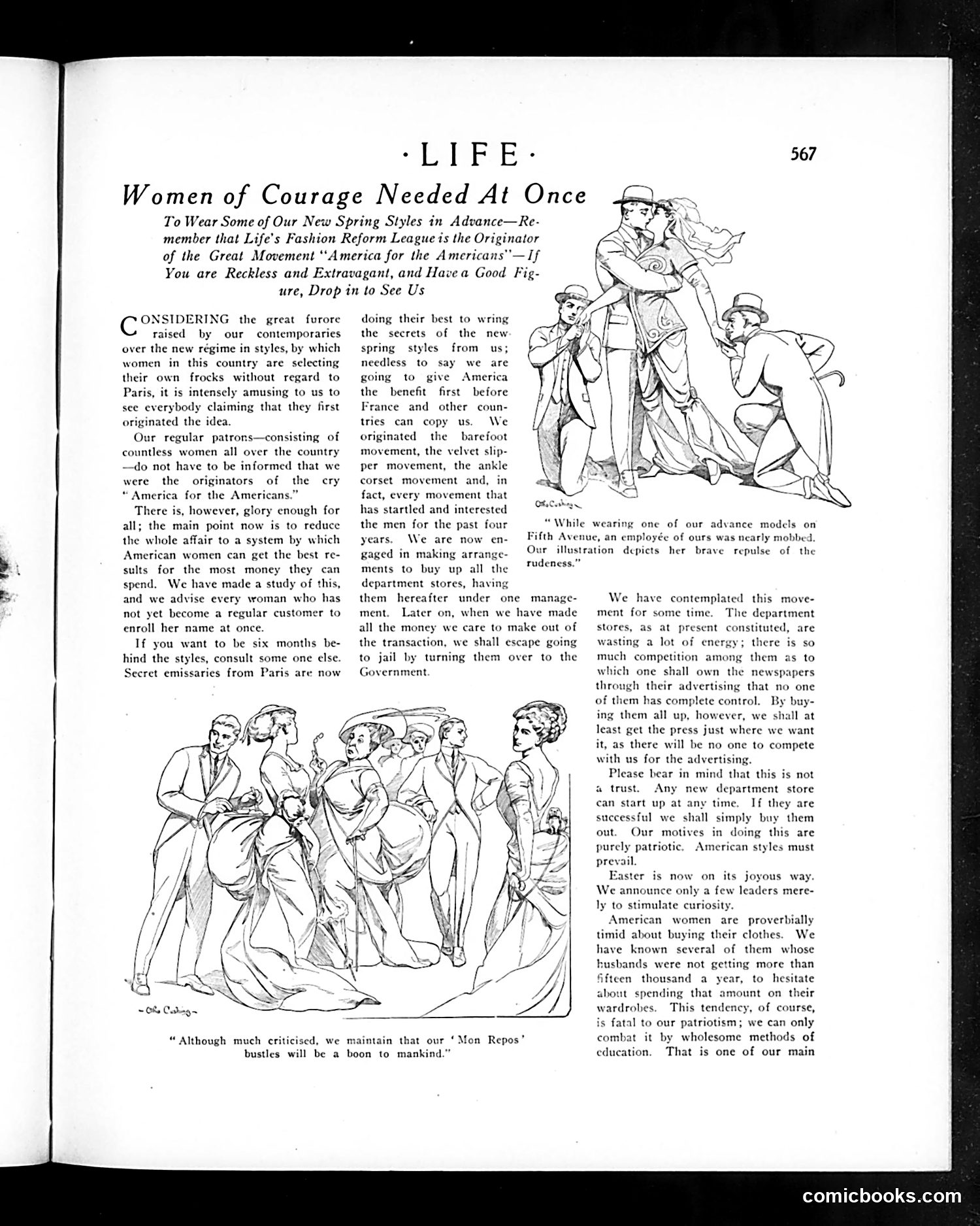
This satirical article critiques American women's hesitation to adopt new spring fashions. The text argues that women—particularly those with husbands earning under $15,000 annually—are too timid about purchasing clothing, calling this "fatal to our patriotism." The cartoons illustrate the tension: the upper sketch shows fashionable women proudly displaying avant-garde styles, while the lower cartoon depicts a group of women in conversation, captioned with ironic praise for the "Mon Repos" corset movement as "a boon to mankind." The satire mocks the notion that buying expensive clothing constitutes patriotic duty. By framing fashion consumption as an economic and patriotic obligation, the article exposes how commercial interests dress up consumerism as national service—a critique relevant to modern advertising tactics.
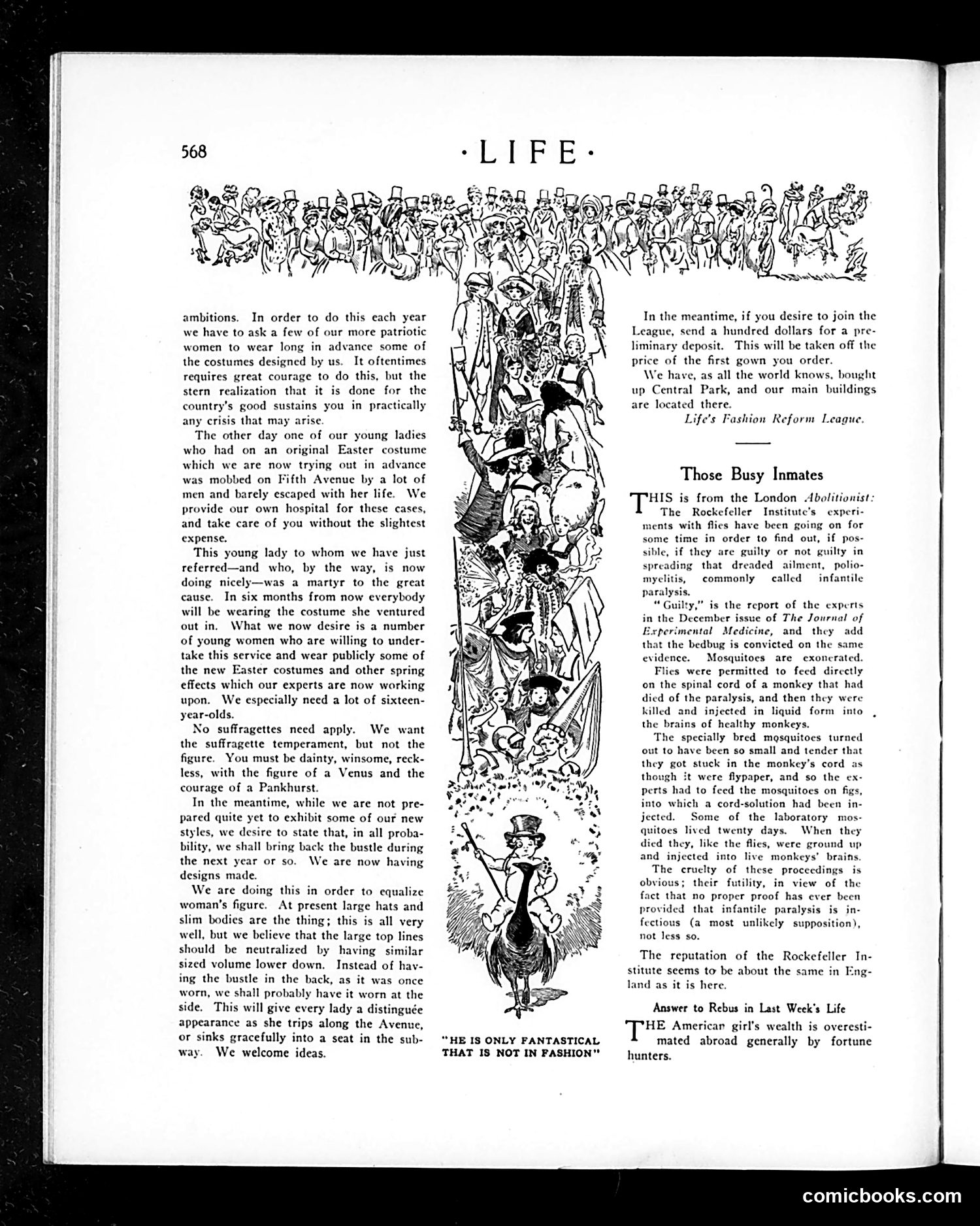
This page contains two distinct sections: **Left column:** Discusses Life's Fashion Reform League, advocating for practical Easter costumes and spring fashions. It argues against tight corsets and excessive ornamentation, proposing instead that women wear looser silhouettes with neutral volume ("large hat lines...neutralized by having similar sized volume lower down"). The text appeals for volunteers to model new designs. **Right section:** "Those Busy Inmates" reports on Rockefeller Institute experiments using mosquitoes to study infantile paralysis (polio). Scientists fed mosquitoes on infected monkeys to study disease transmission. The text critiques these experiments' cruelty while acknowledging their scientific purpose. **Central cartoon:** A large satirical illustration depicts a woman in an exaggerated bustle dress descending stairs, captioned "He is only fantastical that is not in fashion," mocking the absurdity of extreme fashion trends.
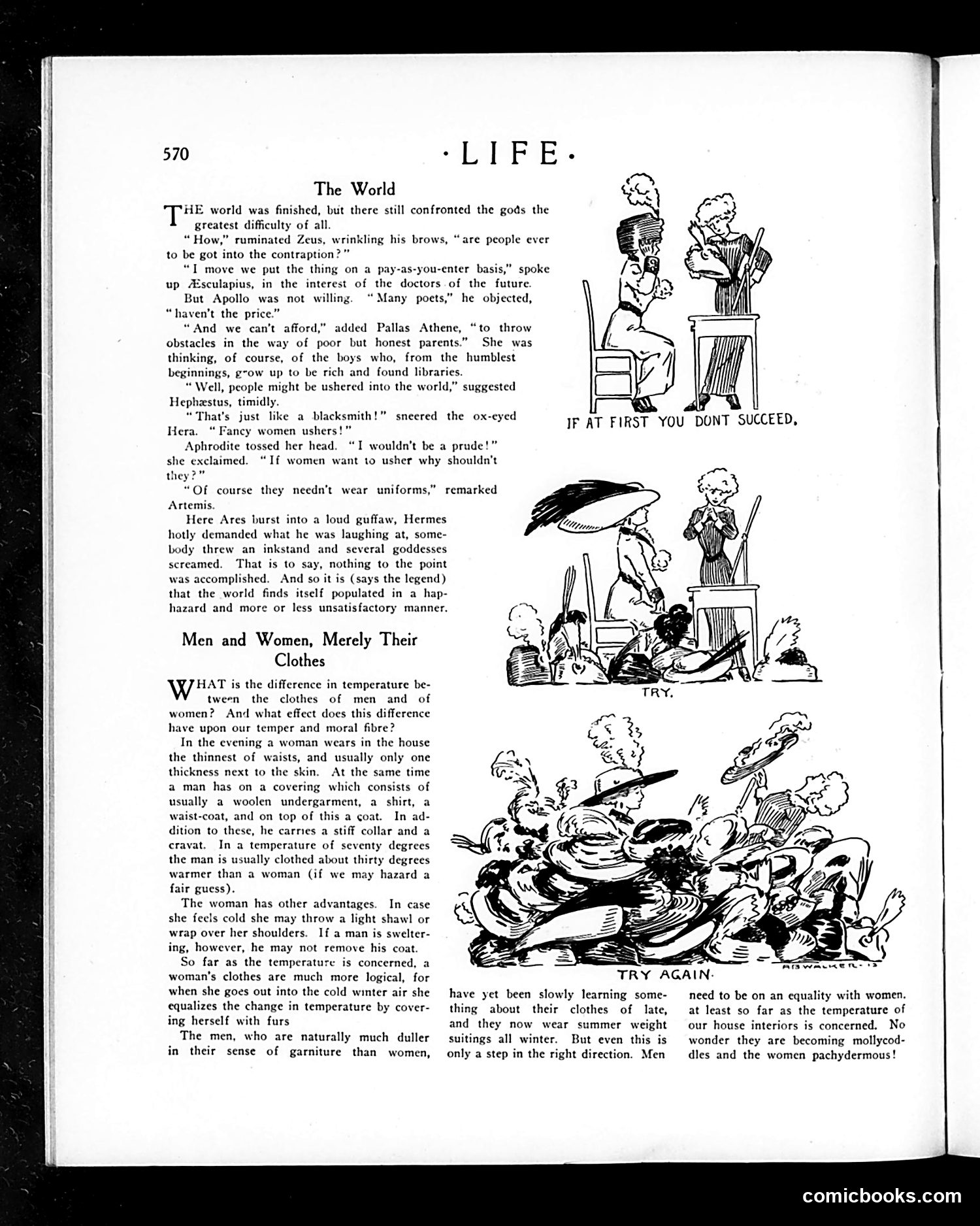
This page satirizes the gods' difficulty populating the world, debating solutions like ushering, libraries, and uniforms. The accompanying cartoons illustrate the section "Men and Women, Merely Their Clothes," which argues that clothing differences between sexes are primarily practical rather than inherent. The illustrations show figures attempting various physical activities—climbing, falling, and struggling—with the captions "IF AT FIRST YOU DON'T SUCCEED, TRY" and "TRY AGAIN." These cartoons humorously depict the challenges of daily life while supporting the text's argument: women's clothing is actually more logical for temperature regulation than men's, contradicting contemporary assumptions about gender differences being natural rather than sartorial.
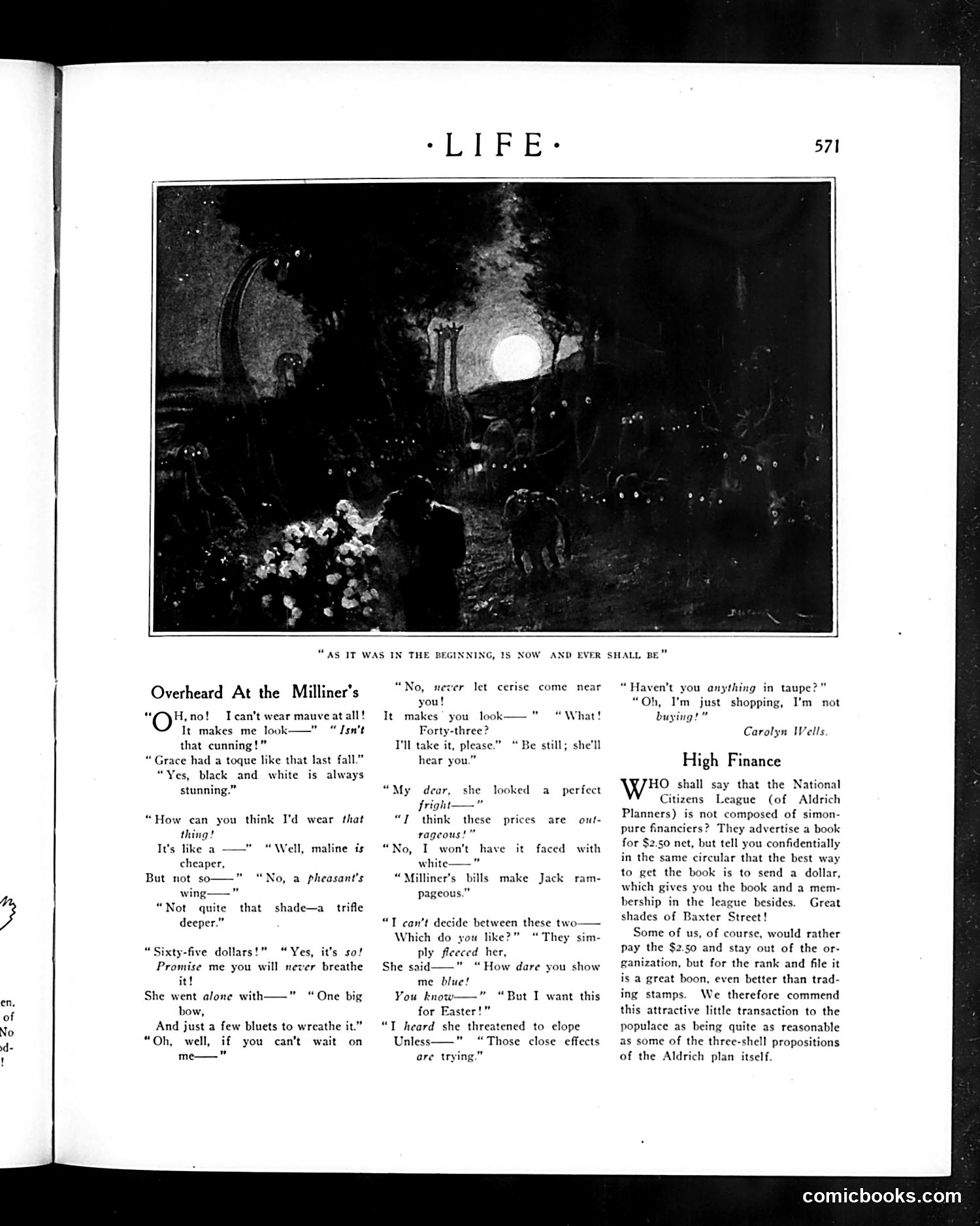
This page contains two satirical pieces from *Life* magazine: **"Overheard at the Milliner's"** depicts women shopping for hats, mocking their obsessive concern with fashion details (colors, materials, prices) and their gossip. The humor relies on the shallow conversation—endless chatter about whether mauve or black suits them, complaints about $65 hats, and catty remarks about other women's appearances. **"High Finance"** critiques the National Citizens League associated with Senator Nelson Aldrich (a powerful Republican financier), who proposed banking reforms. The satire exposes a deceptive scheme: they advertise a $2.50 book but suggest sending $1 instead, which includes league membership—essentially offering a false bargain. The author compares this to shell games and "three-shell propositions," suggesting the Aldrich financial plan itself is similarly fraudulent. The piece mocks the league's pretense of legitimacy while engaging in questionable financial practices. Both pieces use humor to critique contemporary society: women's vanity and consumerism, and elite financial manipulation.
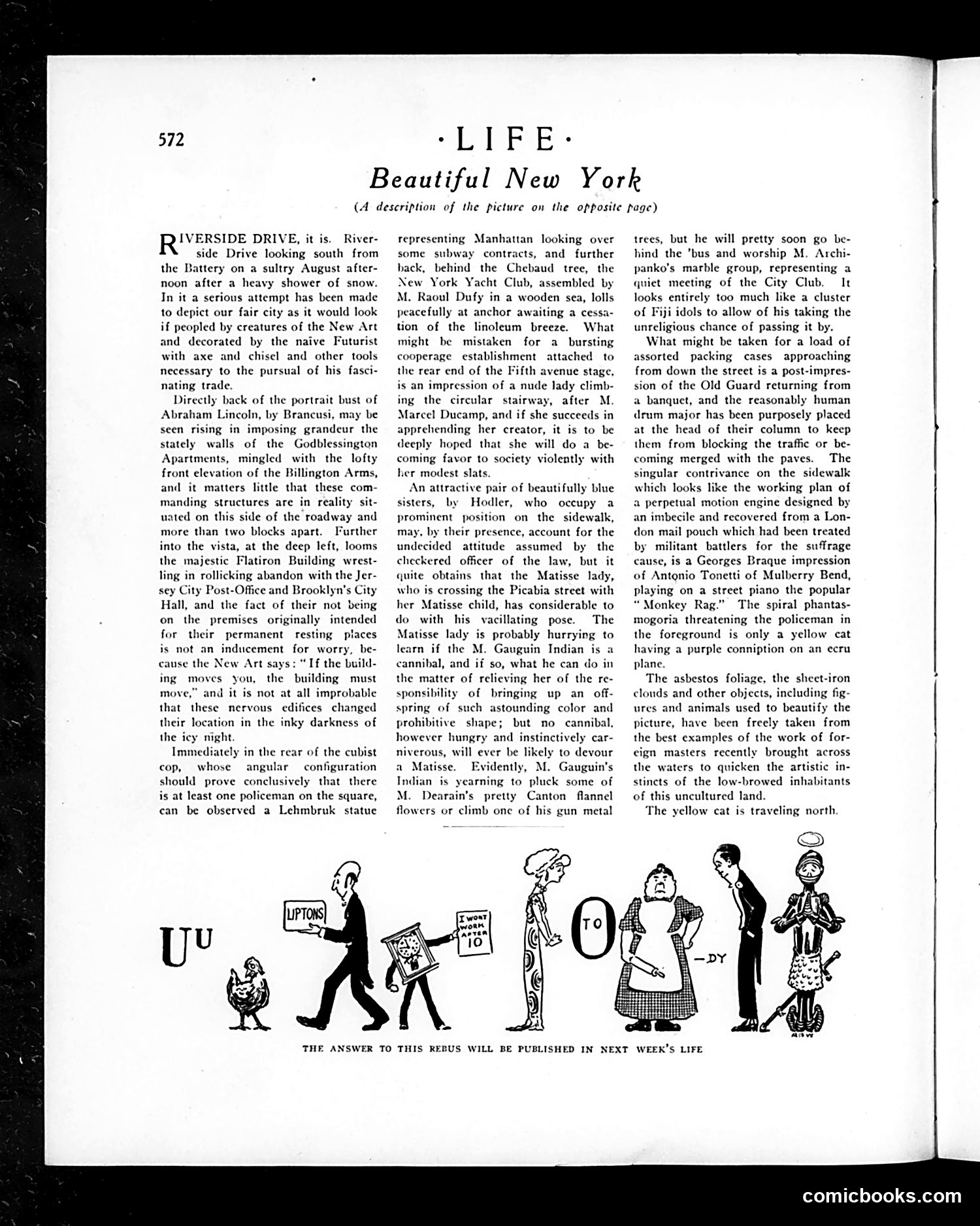
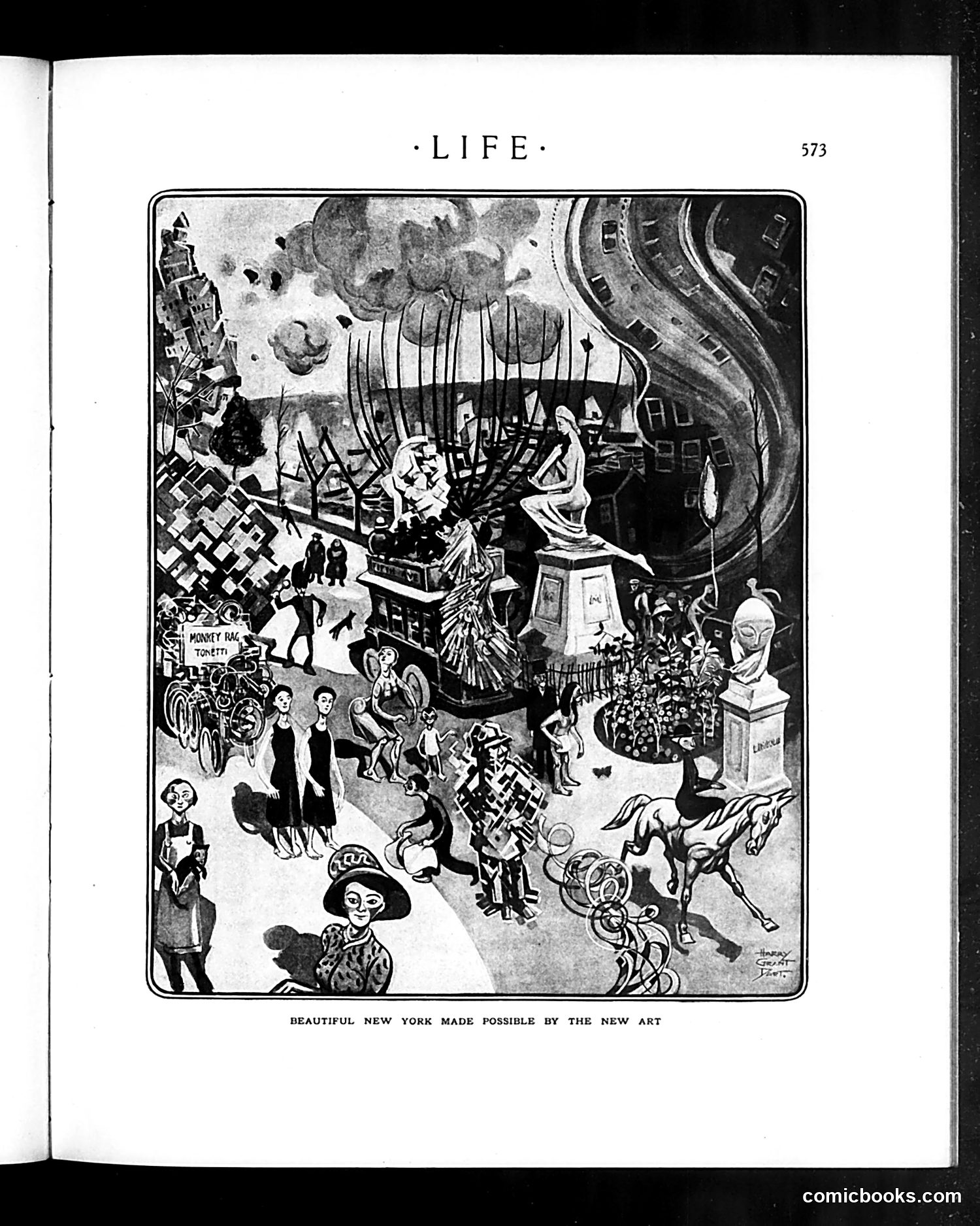
This is a scathing satirical description of a Futurist/Cubist reimagining of New York City. The text mocks early modernist art movements—Cubism, Futurism, and Post-Impressionism—by describing absurd distortions of Manhattan landmarks. The piece ridicules named artists including Brancusi, Marcel Duchamp, Raoul Dufy, Hodler, Matisse, Picabia, and Gauguin, presenting their artistic styles as nonsensical when applied to urban reality. It jabs at the Cubist "cop" with "angular configuration," Matisse's "prohibitive shape," and buildings that move because "if the building moves you, the building must move"—a parody of modernist logic. The rebus/puzzle at the bottom (with symbols and figures) appears to be a visual joke readers were invited to solve. **The satire's point**: Life magazine dismisses avant-garde European art as pretentious absurdity unfit for depicting recognizable American reality. The mockery reflects early 20th-century American resistance to modernism.
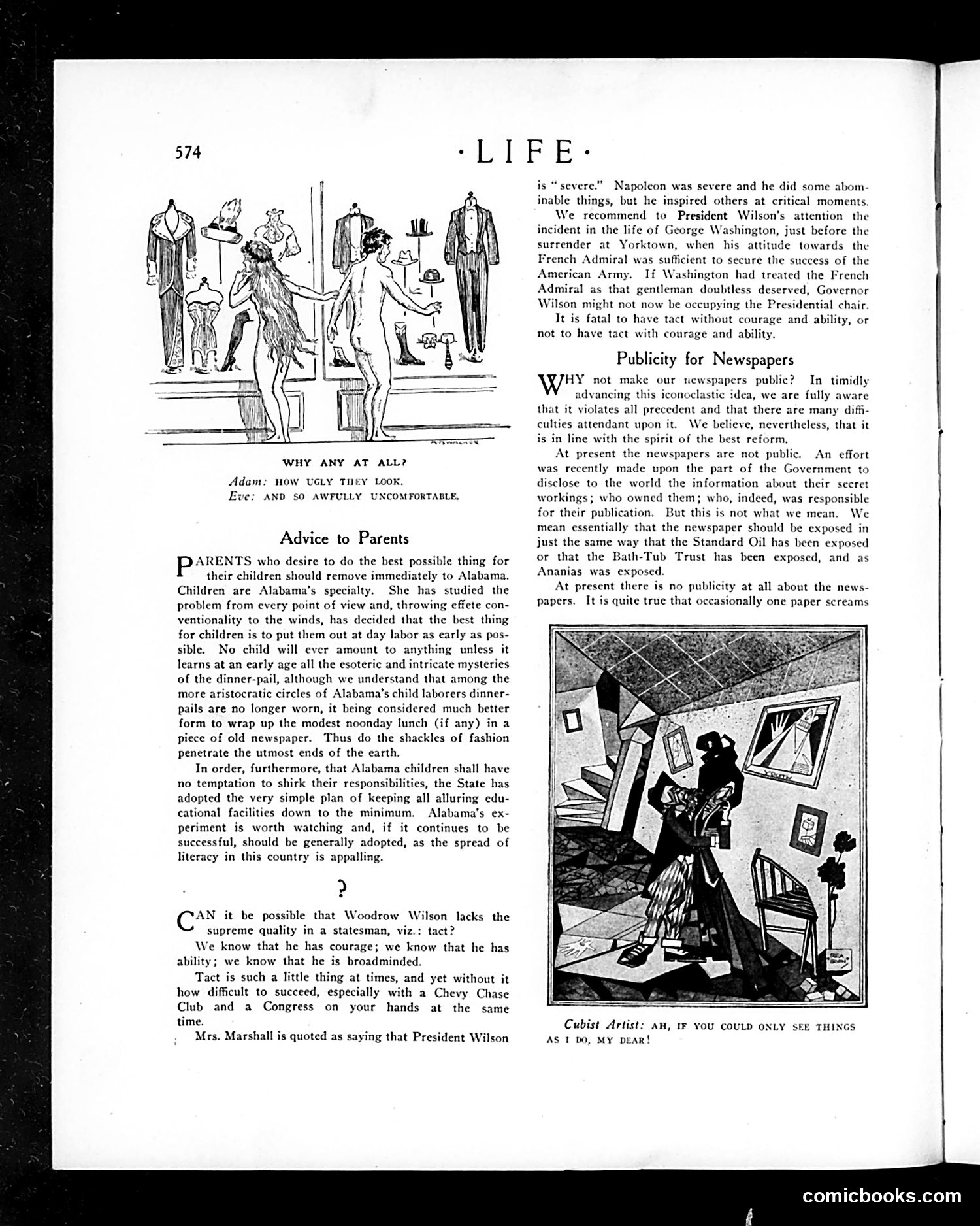
**Top Cartoon ("Why Any at All?"):** Adam and Eve comment on clothing's ugliness and discomfort. This is satirical commentary on fashion conventions—mocking that people accept uncomfortable, ugly dress codes simply from tradition. **"Advice to Parents":** Heavy-handed satire attacking Alabama's child labor practices and inadequate education system. Life mocks Alabama's policy of putting children to work early while deliberately keeping educational facilities minimal, presenting this backwards approach as if it were progressive reform. **Wilson Section:** Critiques President Woodrow Wilson's lack of tact, despite acknowledging his courage and ability. References Mrs. Marshall (likely Vice President's wife) calling him "severe," comparing him unfavorably to Washington's diplomatic skill with French allies. Questions whether Wilson can effectively manage Congress. **"Publicity for Newspapers":** Advocates for newspaper transparency—that papers should disclose ownership and operations like the Standard Oil and "Bath-Tub Trust" exposés. Satirizes current newspaper secrecy as unaccountable. **Bottom Cartoon:** Cubist artist explains distorted perspective, satirizing modernist art's incomprehensibility to ordinary viewers.
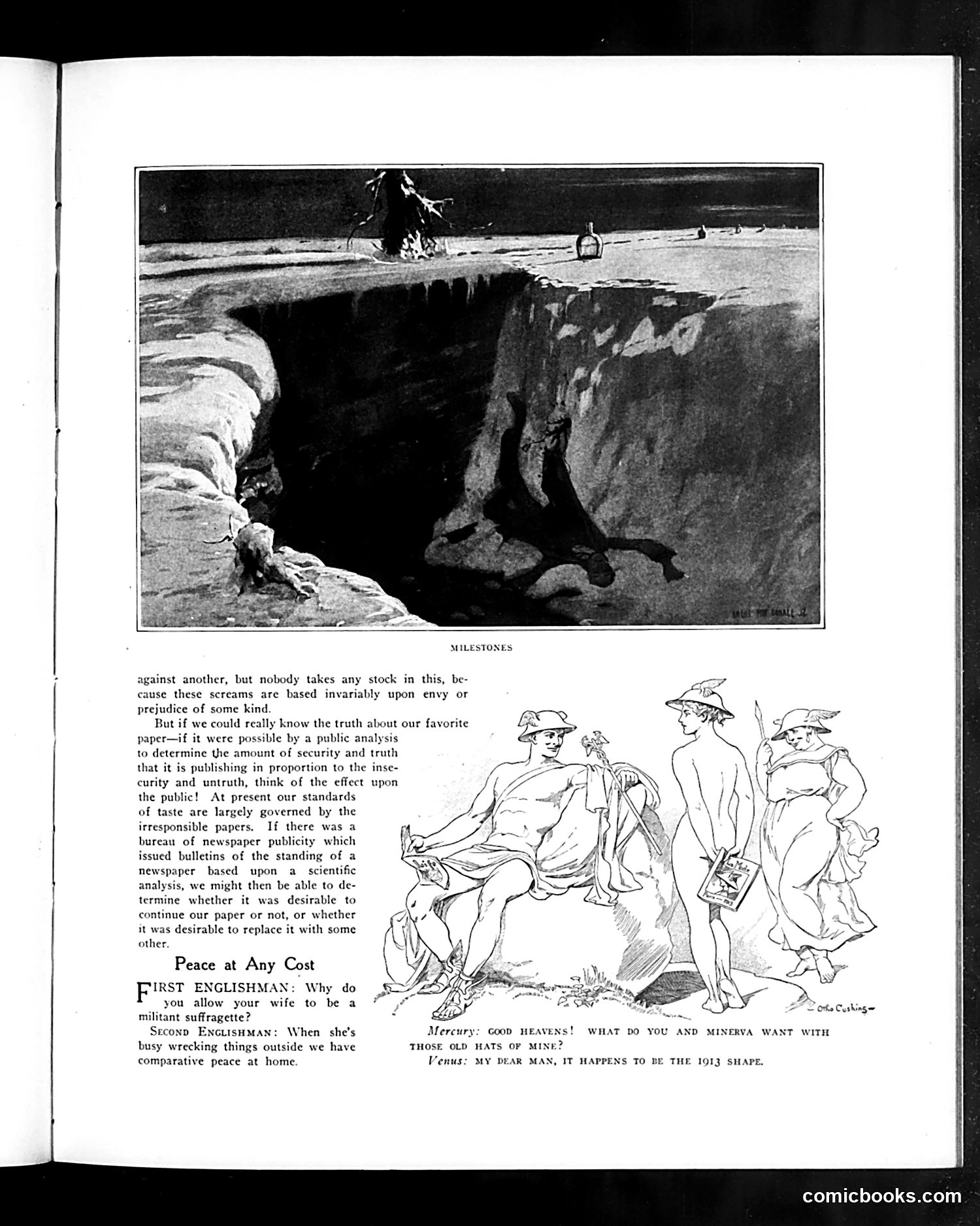
This page contains two satirical pieces from Life magazine: **Top Section ("Milestones"):** Editorial commentary on newspaper standards. The author argues for a scientific bureau to rate newspapers' truthfulness and security, noting that current taste standards are governed by "irresponsible papers." This reflects Progressive Era concerns about media accountability. **Bottom Cartoon ("Peace at Any Cost"):** A dialogue joke about militant suffragettes. The first Englishman asks why his colleague tolerates his wife being a suffragette; the second replies that when she's outside "wrecking things," at least there's peace at home. The joke sardonically treats suffragette activism as destructive nuisance-making, mocking both the activism and the husband's acquiescence to it. **Mythological Figures:** Mercury, Minerva, and Venus discuss "1913 shape" hats—likely satirizing fashion fads and perhaps associating women's fashion concerns with classical mythology, possibly to mock or belittle them. The page reflects anti-suffragette attitudes common in mainstream American humor of this era.
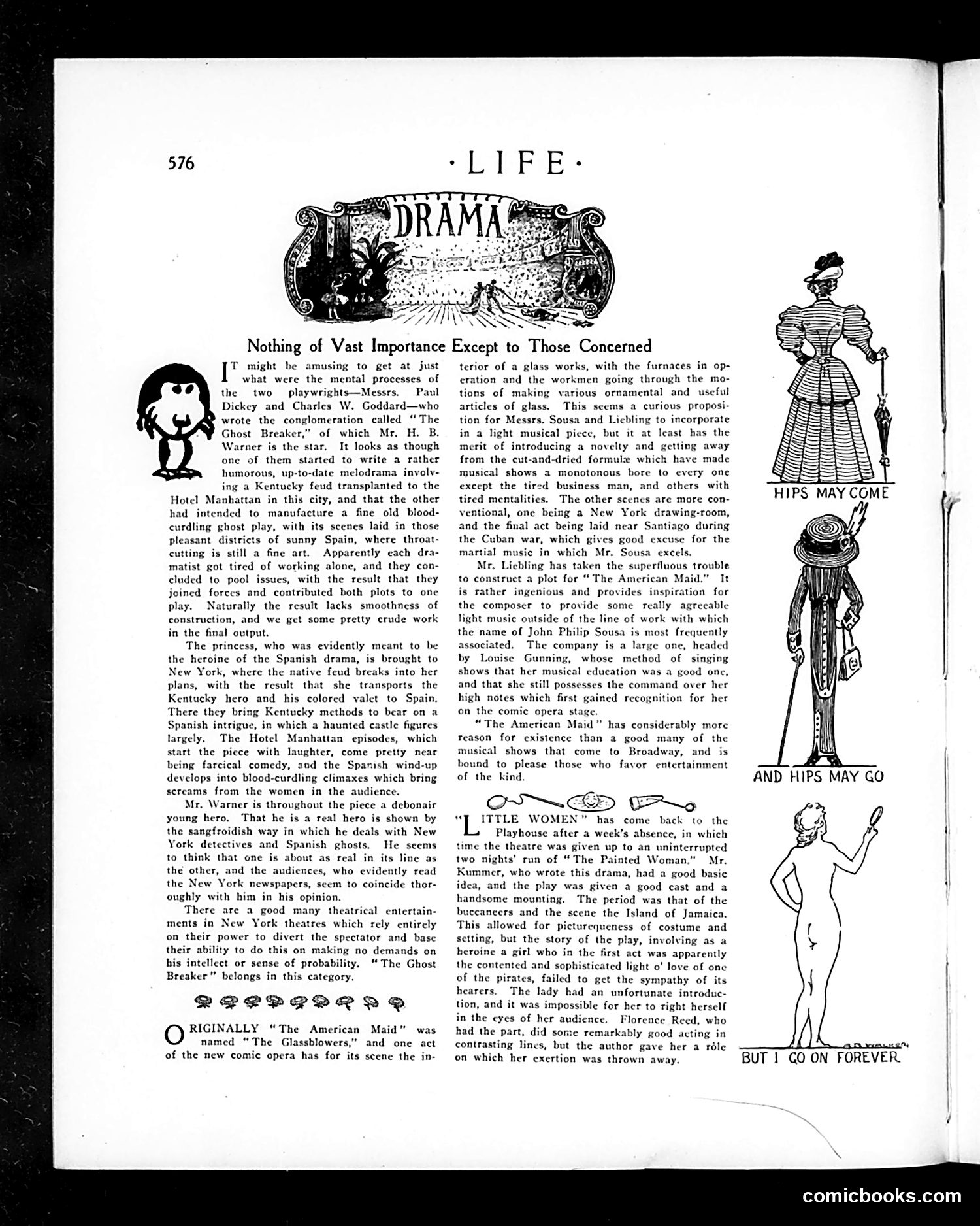
This page reviews theatrical productions with characteristic early-1900s satirical commentary. The main critique concerns "The Ghost Breaker," starring H.B. Warner, which the reviewer argues lazily combines two incompatible plots: a Kentucky feudal melodrama and a Spanish ghost story. The satire mocks the play's lack of coherence—two playwrights apparently gave up collaborating and simply merged both scripts, creating crude entertainment that demands nothing intellectually from audiences. The illustrations on the right appear to be fashion sketches ("Hips May Come and Hips May Go," "But I Go On Forever"), typical Life magazine content satirizing women's changing silhouettes and fashion trends of the era. A secondary review discusses "The American Maid," a comic opera by Sousa and Liebling, noting its unusual inclusion of a glass factory scene, praising its novelty while acknowledging most audiences prefer conventional musical theater formulas.
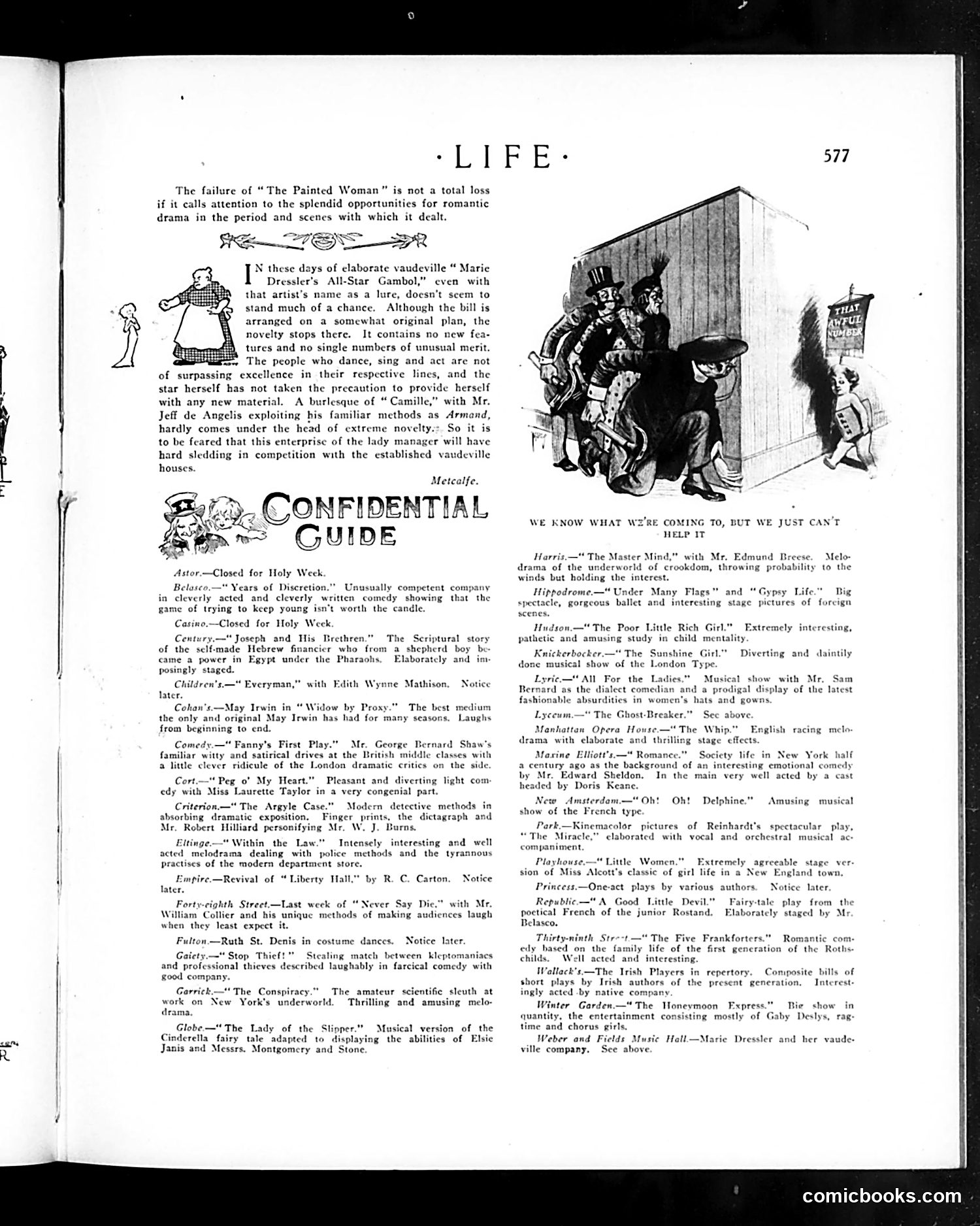
This page from *Life* magazine contains theater reviews and a single political cartoon titled "We Know What We're Coming To, But We Just Can't Help It." The cartoon depicts what appears to be **political or social corruption**—figures clustered around a door marked "VITAL INTERESTS," suggesting backroom dealings or self-serving machinations by those in power. The caption's resigned tone ("we know what we're coming to, but we just can't help it") suggests **public cynicism about inevitable governmental or institutional malfeasance**—the sense that corruption or mismanagement will proceed regardless of public awareness or opposition. The surrounding text is a "Confidential Guide" to New York theaters, listing current productions with brief critical commentary. This juxtaposition—placing cynical political commentary alongside entertainment reviews—was typical of *Life*'s satirical approach: mixing social critique with cultural commentary to suggest that distraction (theater) coexists with public complacency about serious problems. The specific "vital interests" referenced remain unclear without additional historical context.
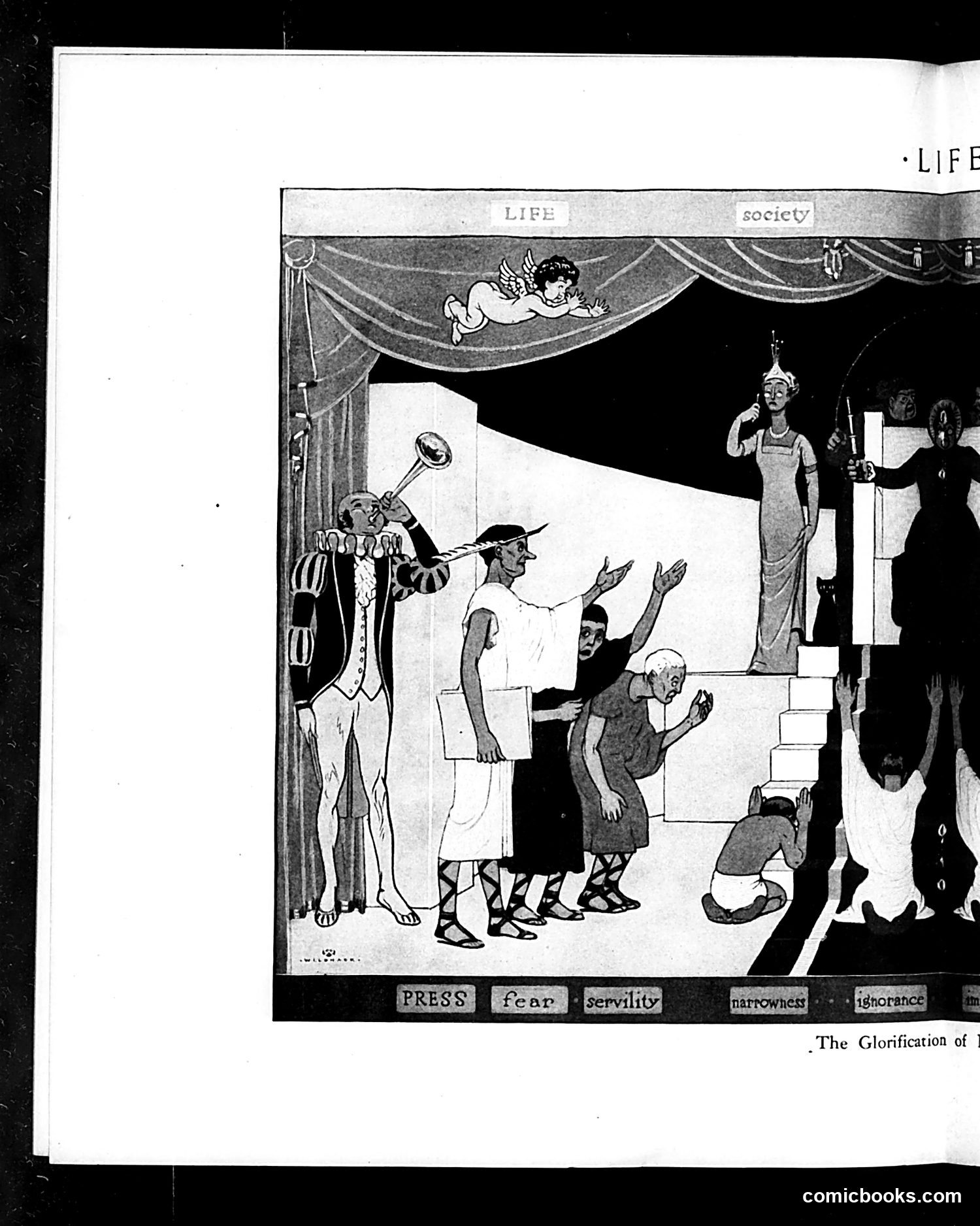
This satirical cartoon from *Life* magazine depicts "The Glorification of" (title incomplete) as a theatrical stage scene. A tall figure on the left—appearing to be a caricatured deity or exaggerated authority figure—receives worship from various common people. The labels at the bottom—"PRESS," "fear," "servility," "narrowness," "ignorance"—identify the forces supposedly elevating this figure. The satire critiques how media manipulation, public fear, and widespread ignorance combine to glorify undeserving figures or ideas. The theatrical stage framing emphasizes the performative, artificial nature of this "glorification." The pointing trumpet-wielding figure suggests propaganda or public proclamation. The cartoon warns against how society's baser impulses—fear, servility, ignorance—enable the elevation of questionable authority.
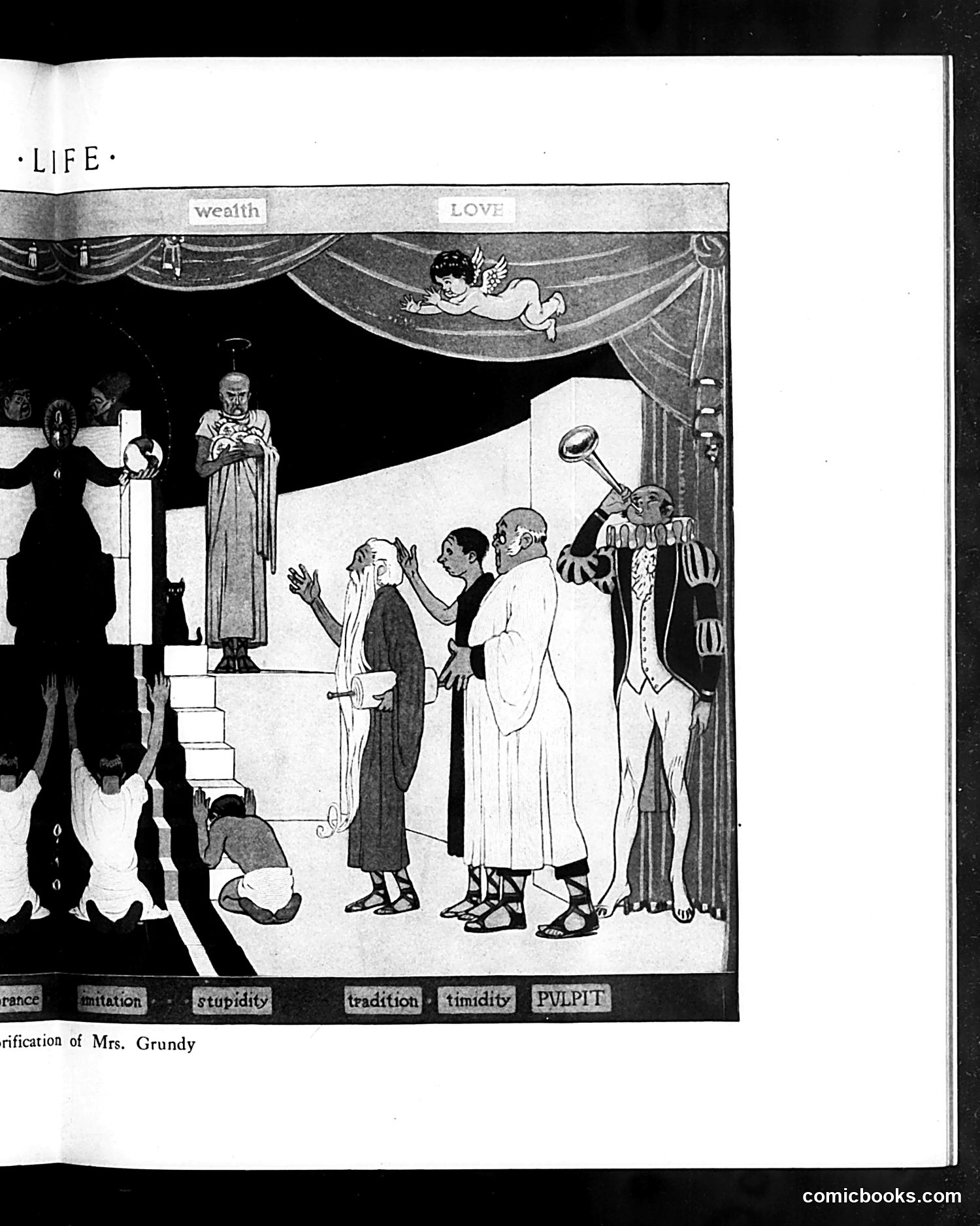
This page shows an allegorical theatrical scene titled "Life," depicting the "Glorification of Mrs. Grundy." Mrs. Grundy is a literary figure representing rigid social propriety and moral conventionality. The illustration stages her as a deity being worshipped by various human vices and flaws labeled at the bottom: "Ignorance," "Imitation," "Stupidity," "Tradition," "Timidity," and "Pulpit." A cupid hovers above, while on stage, figures in various dress (including what appears to be a priest or clergy member on the right) engage in reverent gestures toward an elevated, robed woman. The satire critiques how society worships outdated moral conventions and how institutions like religion perpetuate conformity through fear and unthinking adherence to tradition rather than reason.
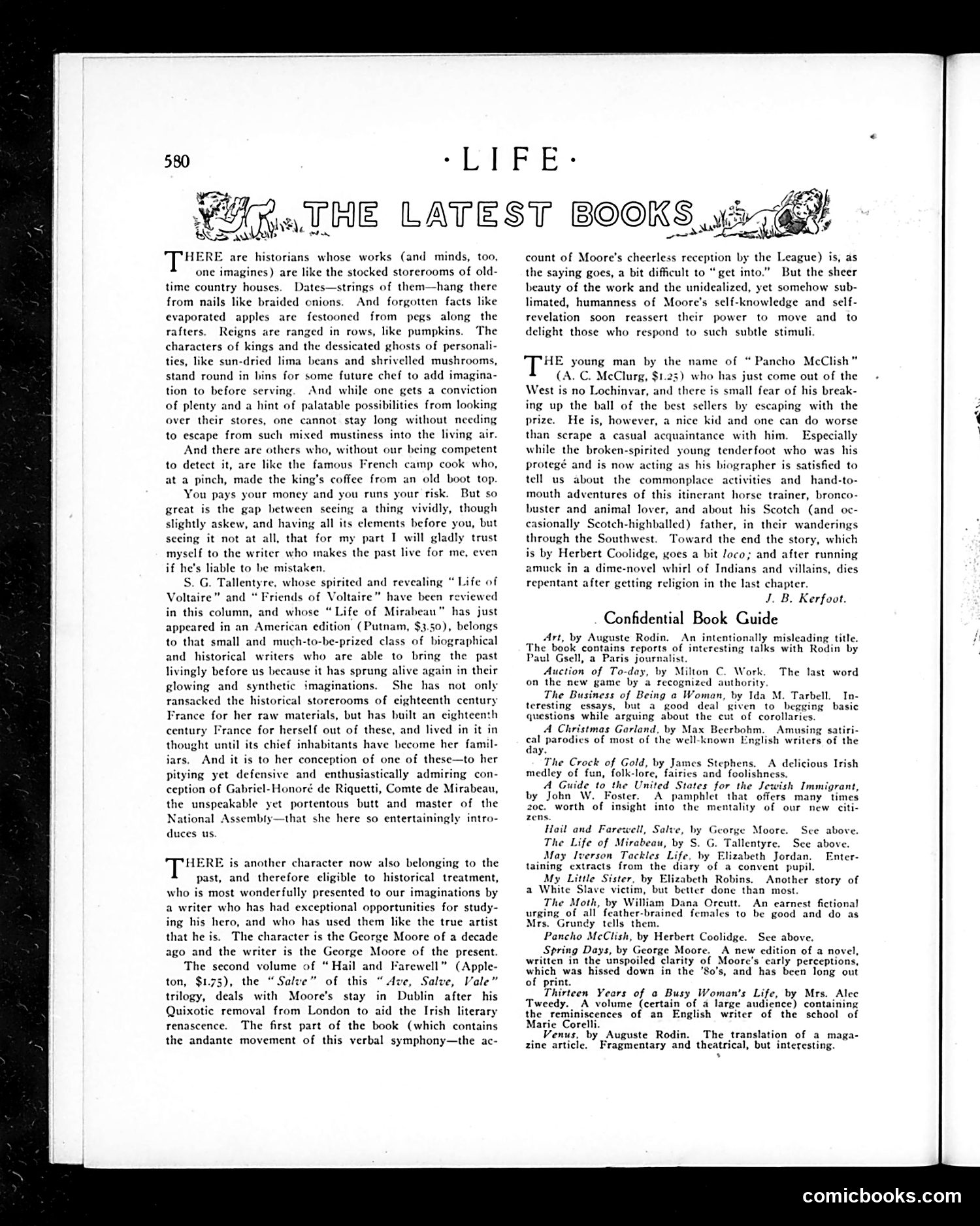
This page is primarily a **book review section** titled "The Latest Books," not a political cartoon page. It contains literary criticism rather than satirical illustrations. The page discusses three historical works: 1. **"Life of Voltaire" and "Life of Mirabeau"** by S. G. Tallentyre—praised for bringing eighteenth-century French history vividly to life through imaginative synthesis 2. **"Hail and Farewell" (volume 2, "Salve")** by George Moore—a semi-autobiographical trilogy about Moore's return to Dublin to support Irish literary revival, described as initially difficult but ultimately moving 3. **"Pancho McClish"** by A. C. McClurg—a Western novel about a young man from the West who, despite being "a nice kid," offers no threat to bestseller status The satirical tone targets pretentious historical writing versus accessible narrative, and gently mocks Moore's self-aggrandizing memoir. This is **literary satire**, not political commentary.
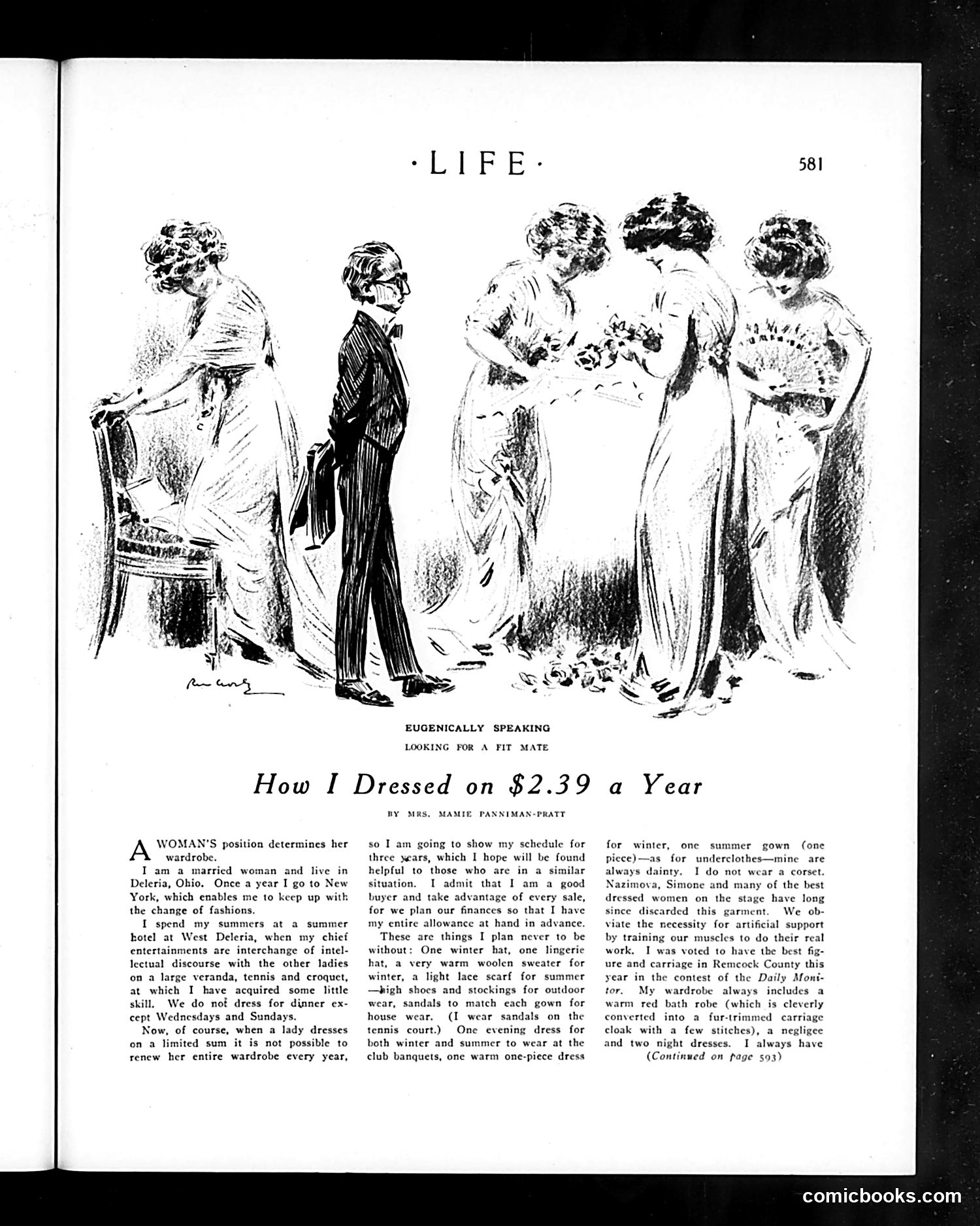
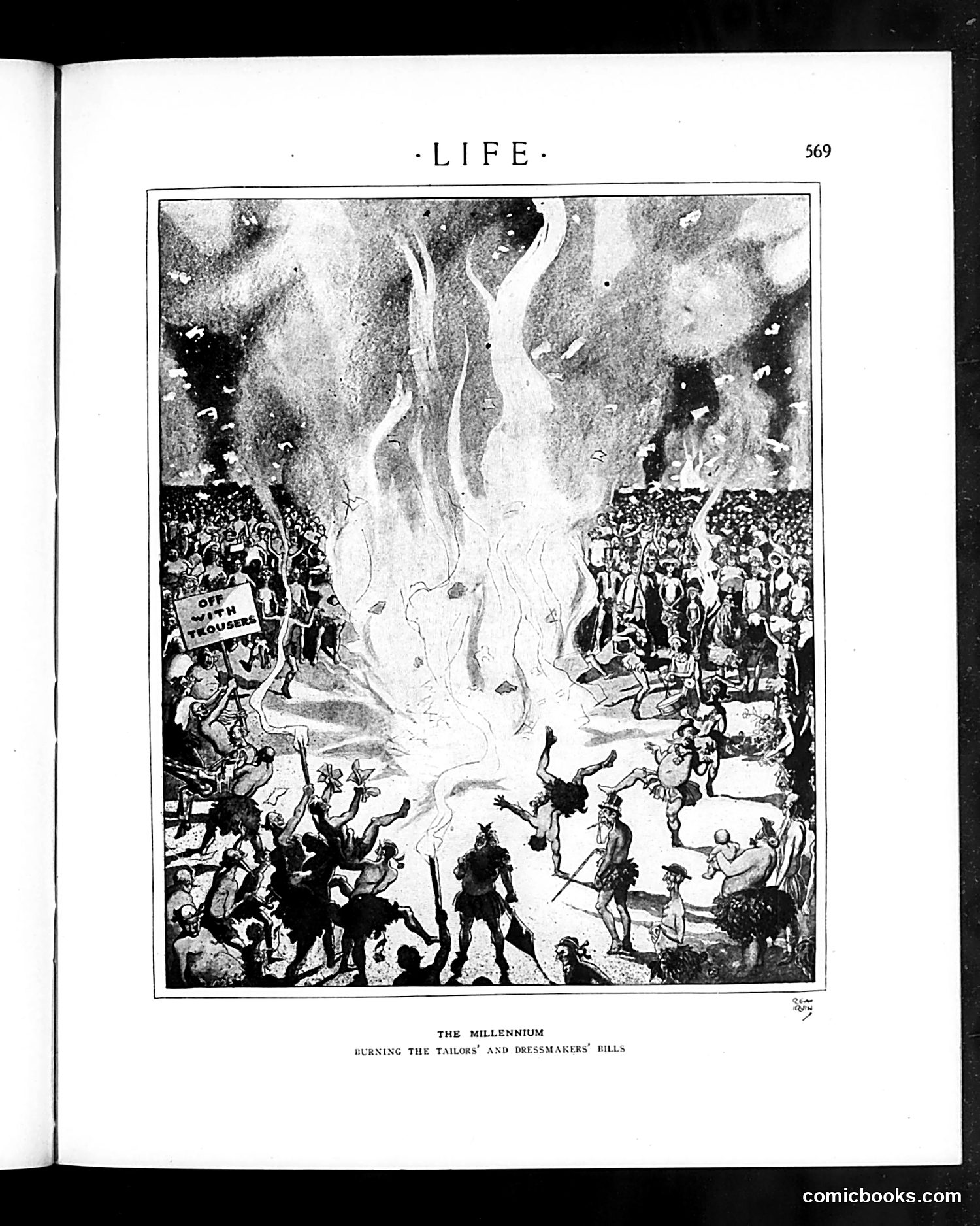
The cartoon's caption "Eugenically Speaking—Looking for a Fit Mate" satirizes the early 20th-century eugenics movement, which promoted "selective breeding" based on perceived genetic superiority. The sketch shows fashionably dressed women and a man, mocking how eugenics advocates evaluated potential mates through a pseudo-scientific lens focused on physical appearance and "fitness." The accompanying article by Mrs. Mamie Panniman-Pratt describes dressing stylishly on minimal budget while name-dropping actresses like Nazimova and rejecting corsets—reflecting progressive 1920s attitudes about women's bodies and liberation from restrictive fashion. Together, the page satirizes both the pseudoscience of eugenics and the performative "scientific" justifications some used to discuss women's appearance and marriageability, while the fashion advice offers a counterpoint celebrating women's autonomy in dress choices.
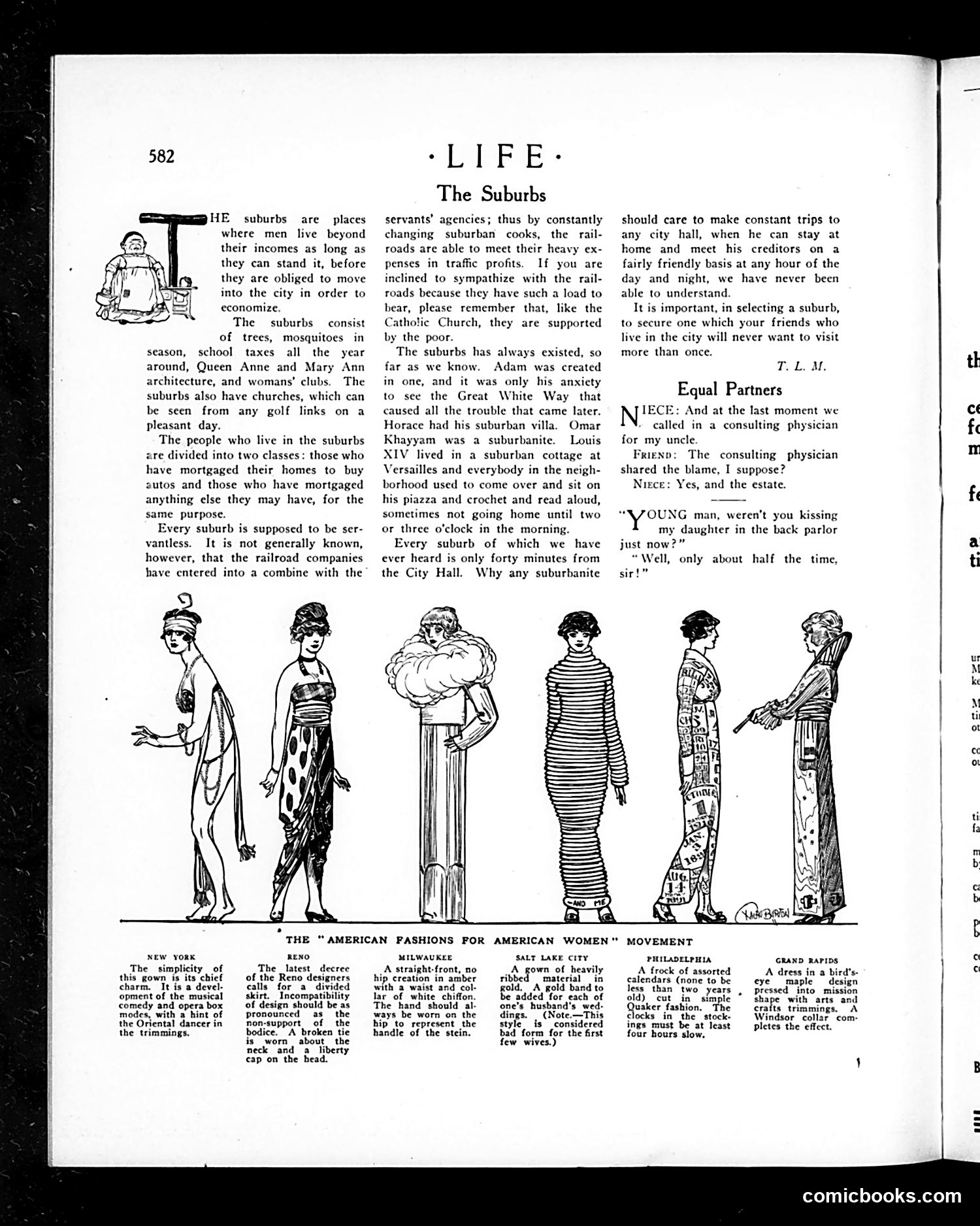
This page satirizes suburban American life and fashion trends circa the 1920s. **"The Suburbs" Essay:** The unsigned editorial (bylined T.L.M.) mocks suburban culture as economically unsustainable—residents "live beyond their incomes" and mortgage homes for automobiles. It critiques the suburban ideal by noting that suburbanites constantly commute to the city despite claiming independence, and that railroads exploit suburb-to-city traffic while blaming their expenses on poor servants. The tone is sharply satirical, suggesting suburbs are pretentious illusions. **"Equal Partners" Jokes:** These brief comedic exchanges mock marriage dynamics—one implies a wife's infidelity is split with a consulting physician (who shares the estate), the other jokes about a suitor's divided attention kissing a daughter. **Fashion Cartoon:** The "American Fashions for American Women Movement" ridicules regional fashion absurdities—Reno's "broken" bodice, Milwaukee's beer-stein-inspired waist, Salt Lake City's polygamy reference ("husband's weddings"), and Philadelphia's calendar-fabric dress. The satire targets American regionalism and women's fashion pretension.
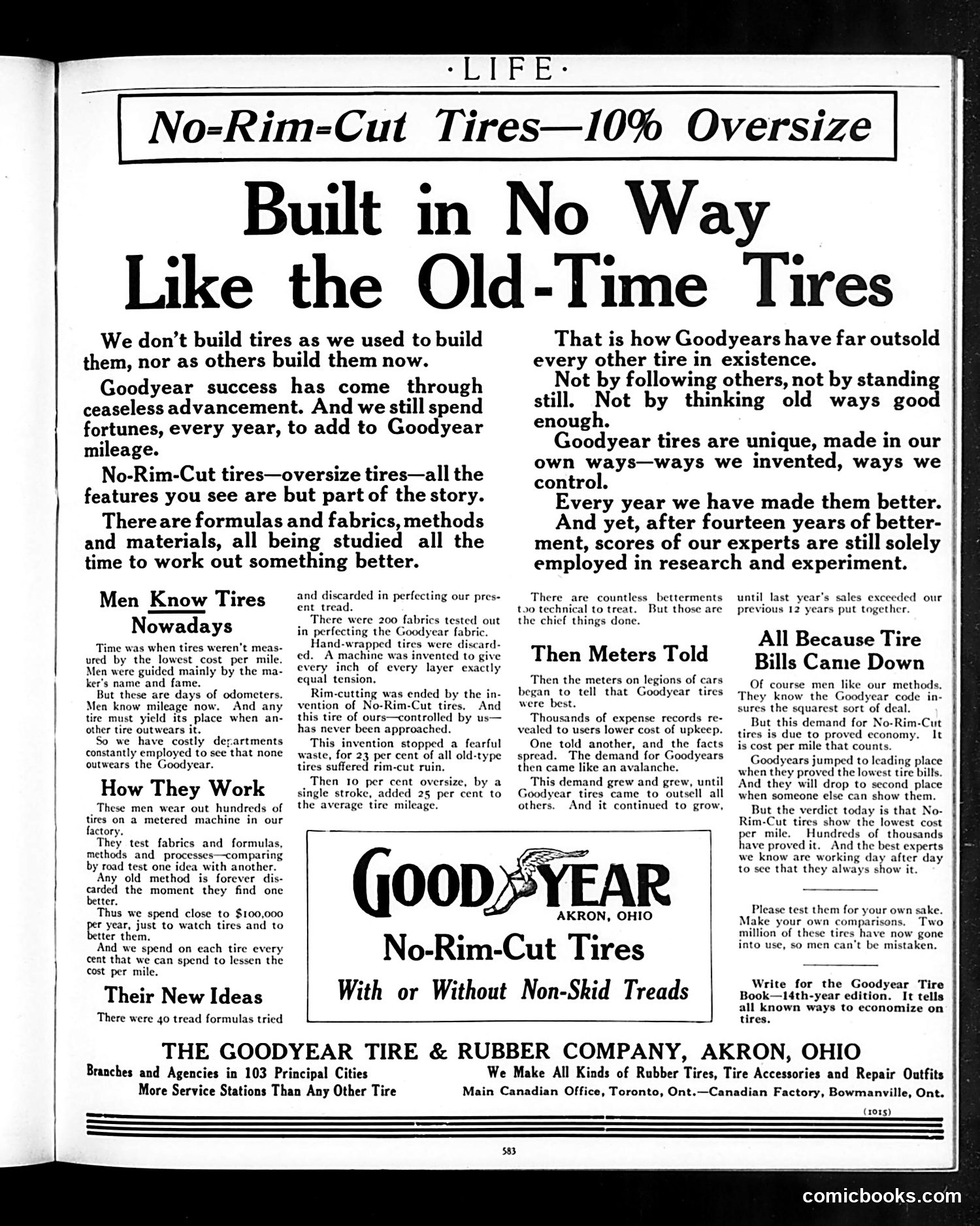
This is primarily a **corporate advertisement**, not satire or political commentary. Goodyear presents itself as an innovative tire manufacturer that continually improves products through scientific research rather than following tradition. The page emphasizes Goodyear's competitive advantage: they invest $100,000 annually in testing, have developed the "No-Rim-Cut" tire (which prevents a common failure mode), and offer 10% oversize tires that increase mileage by 25%. The company appeals to modern consumer logic—men now measure tires by "cost per mile" using odometers rather than brand loyalty alone. The implicit message: Goodyear outsells competitors because their tires demonstrably outlast others, proven by metered testing and customer experience. Success comes through continuous innovation ("40 tread formulas tried"), not tradition. This reflects early 20th-century corporate confidence in science and progress as marketing tools.
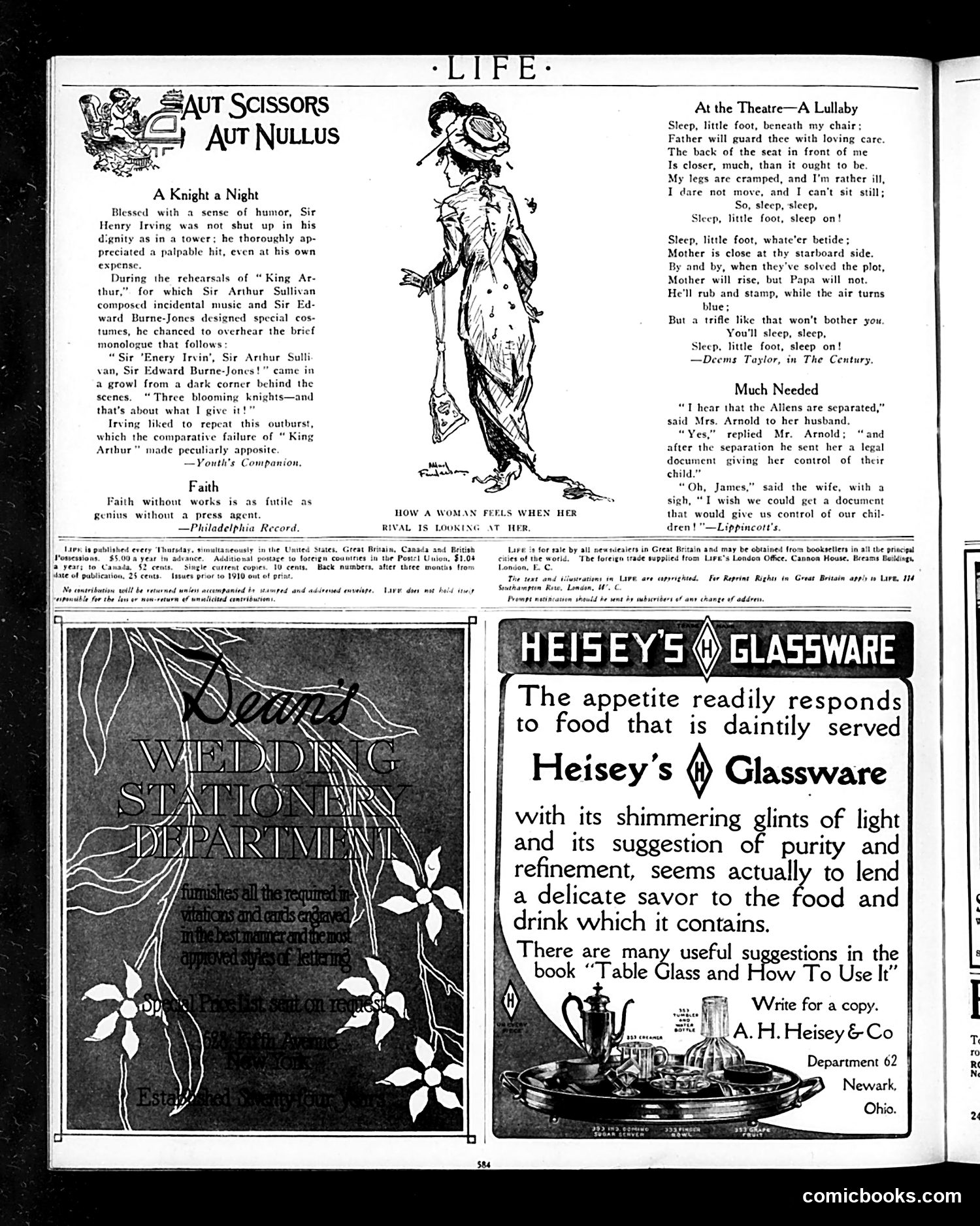
This page contains three distinct humor pieces targeting social situations of the era: **"A Knight a Night"** recounts actor Henry Irving's appreciation for self-deprecating humor. During rehearsals for "King Arthur" (with composer Arthur Sullivan and designer Edward Burne-Jones), Irving overhears a stage worker dismiss the production: "Three blooming knights—and that's about what I give it!" The joke celebrates Irving's good nature in tolerating frank criticism. **"At the Theatre—A Lullaby"** satirizes the physical discomfort of theater attendance, particularly for women whose legs are cramped in tight spaces. The poem humorously addresses a woman's feet as if soothing a baby, mocking the resigned suffering expected of female theatergoers. **"Much Needed"** is a brief domestic joke: after a couple's separation, the husband grants the wife legal custody of their child. The wife wishes they could get such a document for their *living* children, implying parental exhaustion. The page also includes a Heisey's Glassware advertisement emphasizing refined table presentation.
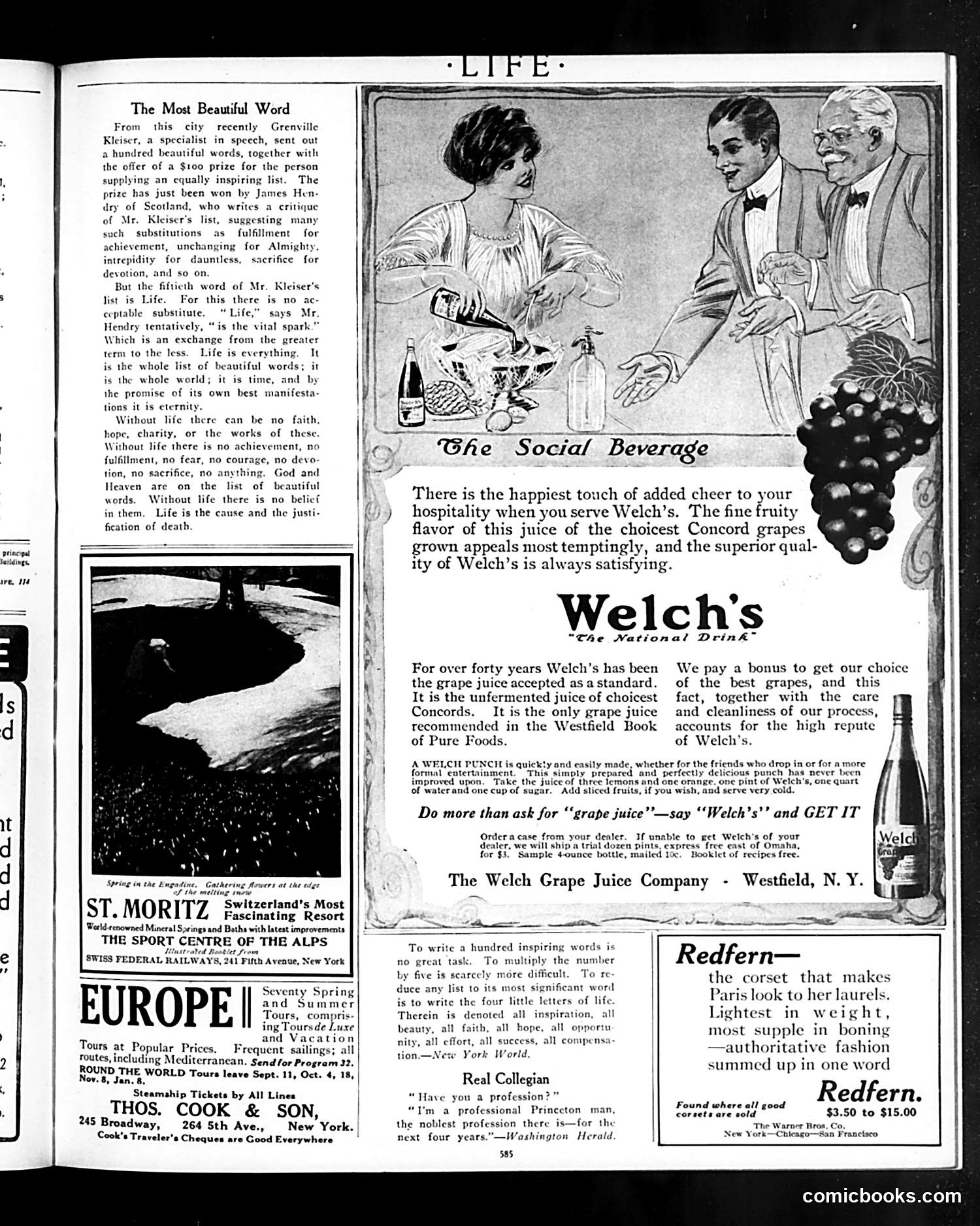
This page combines editorial content with period advertising, typical of early 20th-century Life magazine. **"The Most Beautiful Word"** is an essay-style piece discussing a speech competition where Grenville Kleiser offered a $100 prize for beautiful words. Scottish winner James Hendry critiqued Kleiser's list, suggesting substitutions. The article argues that "Life" is the ultimate beautiful word—encompassing all others (faith, hope, charity, achievement). It's philosophical rather than satirical. **The cartoon** ("The Social Beverage") shows a woman serving Welch's grape juice to two men at what appears to be a social gathering. This is **prohibition-era advertising**: Welch's promoted non-alcoholic grape juice as a respectable social beverage during alcohol restrictions (1920-1933). The image normalizes serving juice at formal social occasions. **Additional content** includes travel advertisements and a brief "Real Collegian" joke about a Princeton graduate claiming his education itself is his profession. The page reflects early 20th-century concerns: philosophy of language, social respectability during prohibition, and leisure tourism.
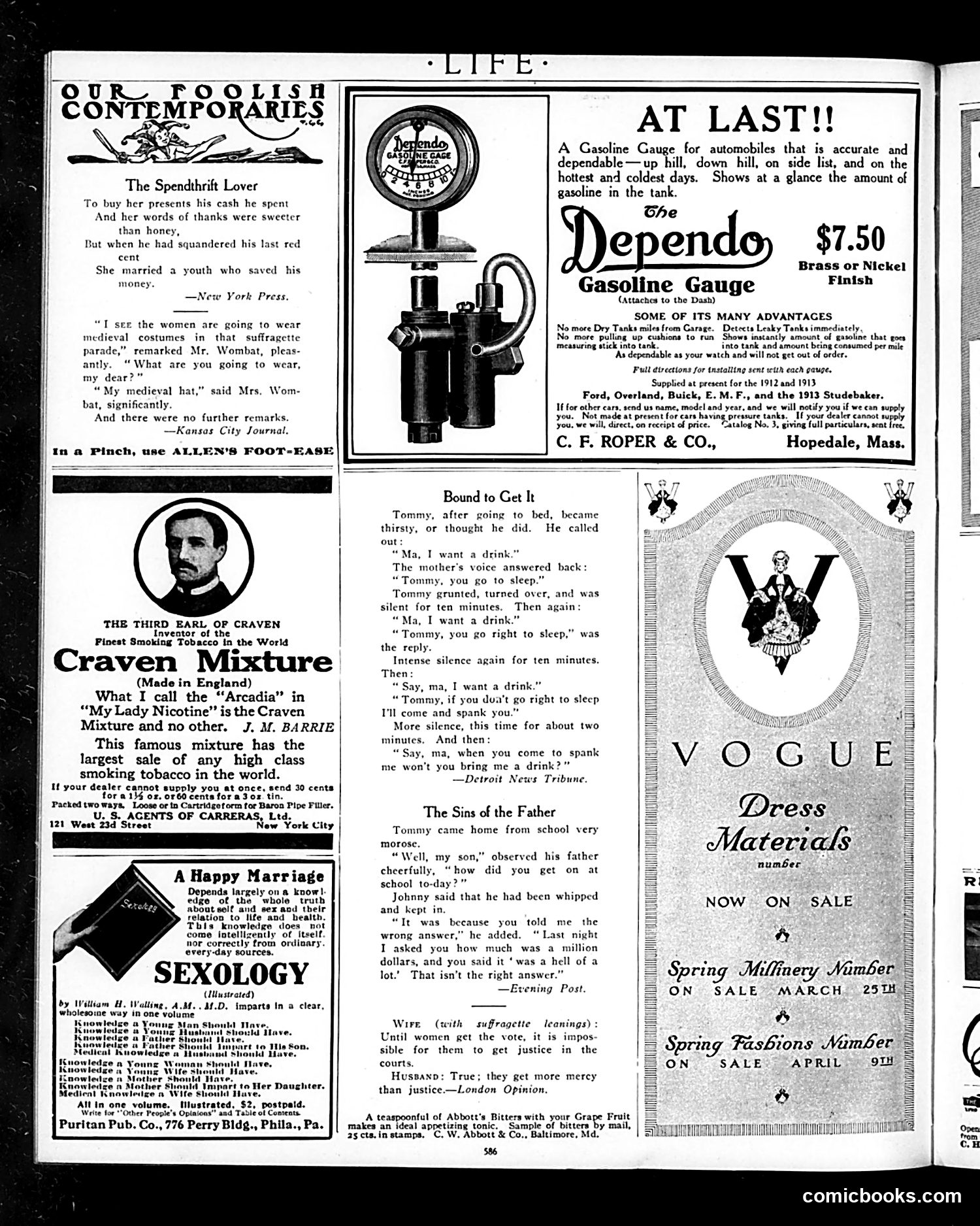
This **Life magazine page** (circa 1912-1913) contains satirical short pieces and period advertisements: **"The Spendthrift Lover"** mocks a financially irresponsible man who lavishes gifts on a woman, then loses her to a thrifty suitor—a commentary on marriage as economic transaction. **The medieval costume joke** references the contemporary **suffragette movement**: women demanding voting rights held public parades in period dress. The satire suggests wives adopted the fashion without understanding its political meaning. **"Bound to Get It"** is children's humor about a persistent child manipulating his mother into fetching water through emotional leverage. **"The Sins of the Father"** satirizes parental hypocrisy: a father beats his son for arithmetic errors, then admits to losing money through poor judgment. **The suffragette wife quip** dismisses women's justice concerns, suggesting voting rights are their only real grievance—typical anti-suffragette sentiment of the era. The page is primarily **advertising** (gasoline gauges, tobacco, advice books), with humor serving as filler content between commercial pitches.
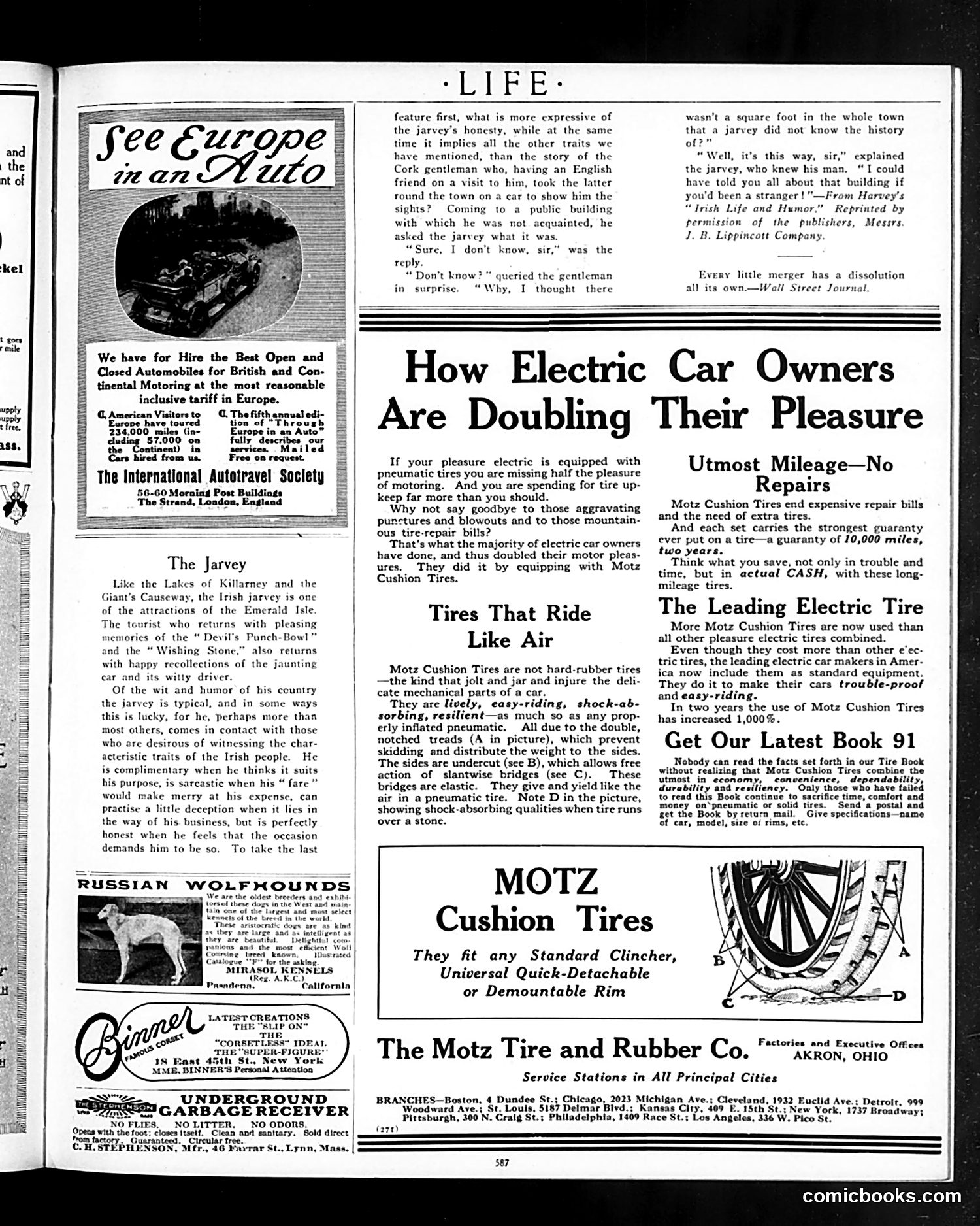
This page is primarily **advertising content** rather than political satire. However, it contains one brief humorous anecdote: **"The Jarvey" Section**: This reprints an Irish joke about a Dublin cab driver (jarvey). An English visitor asks the driver about an unfamiliar public building. The driver admits ignorance, then cleverly explains he could have provided details "if you'd been a stranger!"—implying he fabricates colorful stories for tourists but maintains honesty with locals. The joke plays on the Irish stereotype of charming deception and highlights the commercialized tourist experience in early 1900s Ireland. **Main Content**: The bulk of the page advertises Motz Cushion Tires for electric automobiles, emphasizing their durability, smooth ride, and 10,000-mile guarantee. This reflects the era when electric vehicles competed with gasoline cars. Supporting ads include Irish tourism, Russian wolfhounds, and garbage services—typical of a general-interest magazine's revenue model. The page offers no political commentary, simply entertainment and commercial messaging typical of *Life* magazine's hybrid editorial-advertising format.
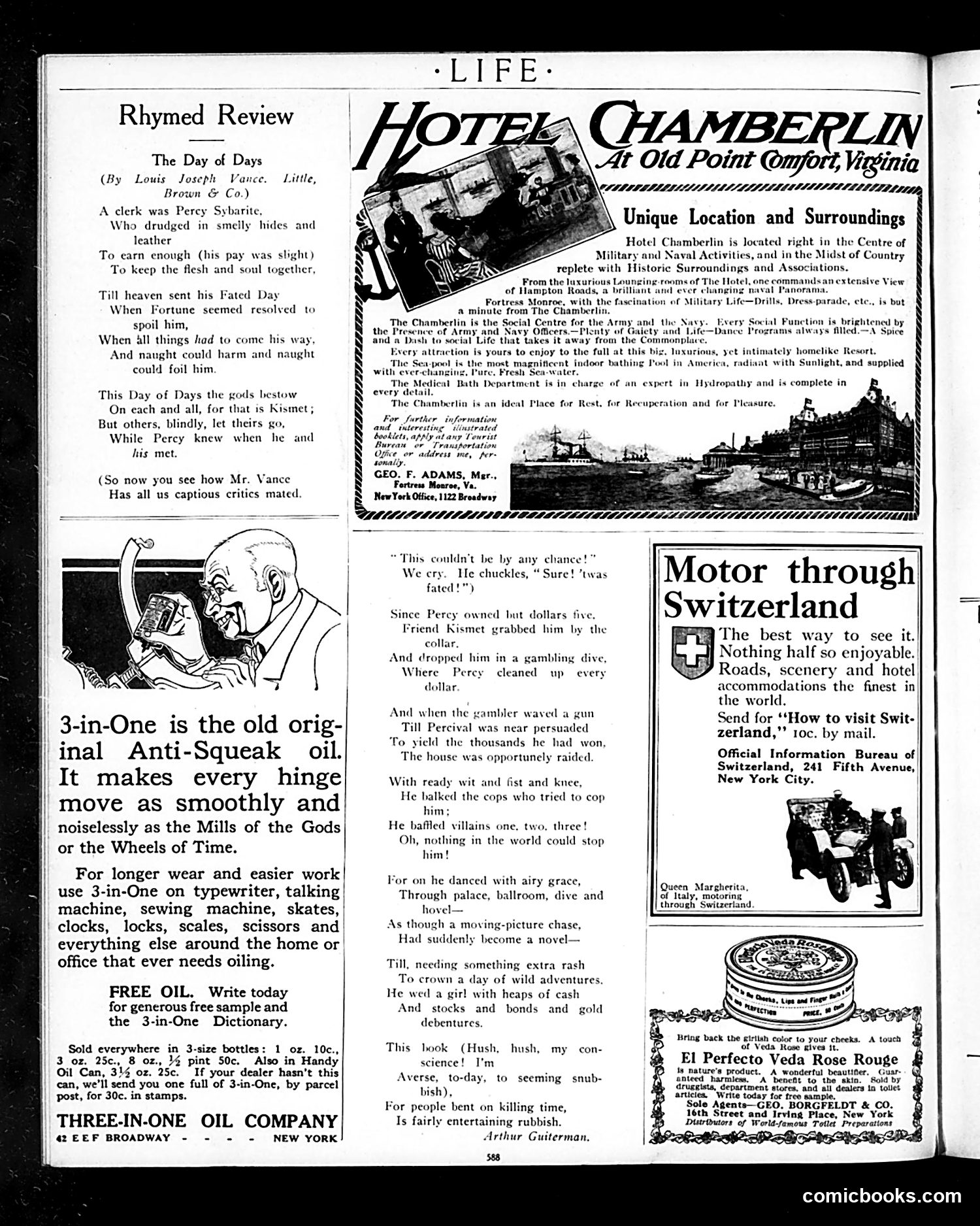
This page is primarily **advertising with a satirical poem as filler content**. The main visual element is a small cartoon showing a man examining something closely (likely illustrating the 3-in-One Oil ad below it). The "Rhymed Review" section presents Louis Joseph Vance's book "The Day of Days"—a satirical poem about Percy, a poor clerk who experiences one magical day when fortune favors him. He gambles, wins thousands, outwits villains, and marries a wealthy woman. The satire appears to mock both the coincidence-driven plots of popular fiction and perhaps the naive belief that luck alone can solve poverty. The page is dominated by **period advertisements**: 3-in-One Oil (emphasizing smooth, noiseless operation), Hotel Chamberlin (a luxury resort near Fortress Monroe, Virginia), Motor tours through Switzerland, and cosmetics. These ads reflect early 20th-century consumer culture targeting middle and upper-class readers. The cartoon itself is unremarkable—simply supporting the oil advertisement's claims about smooth mechanical function.
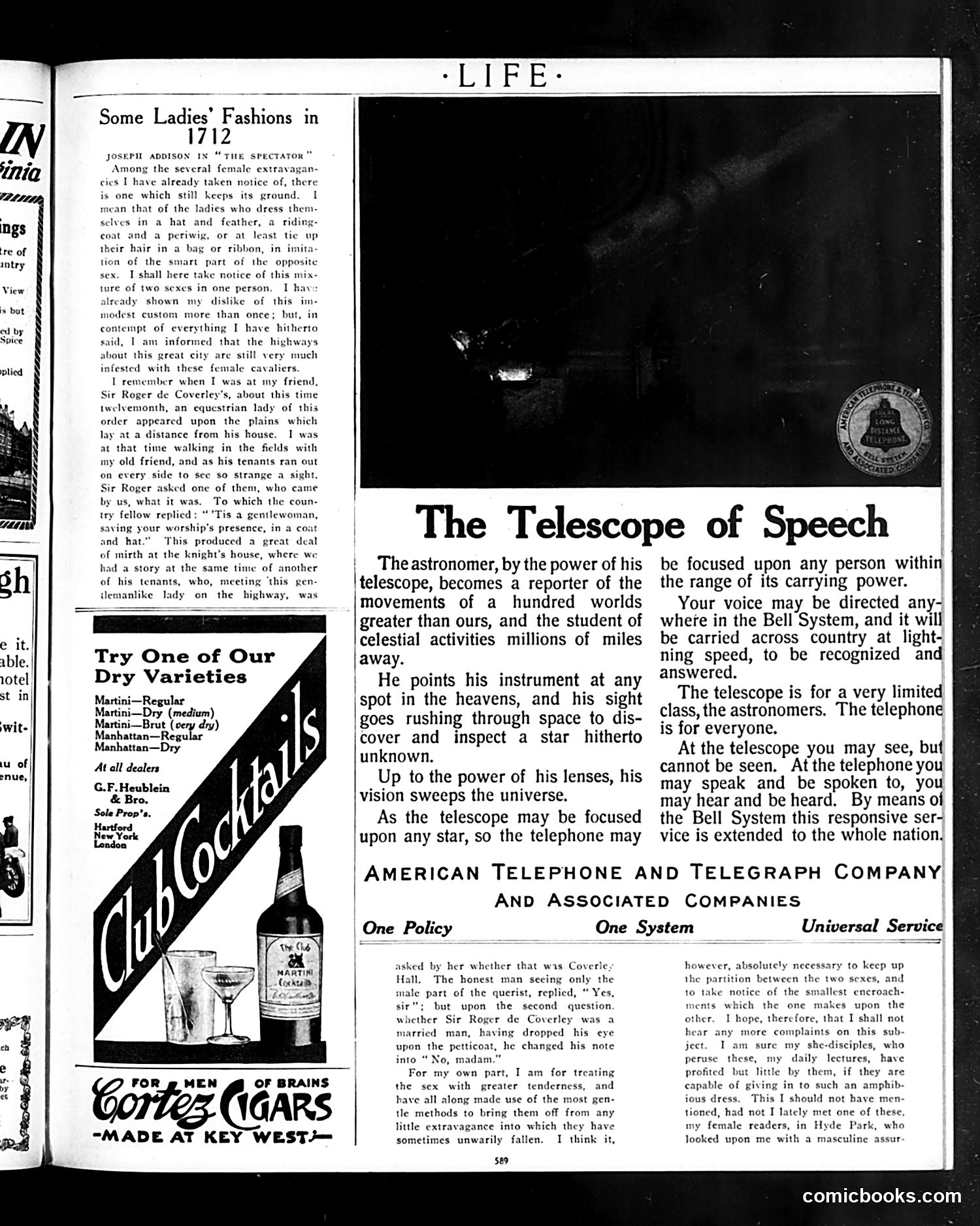
This page primarily features **advertising and social commentary**, not political cartoons. The left column reprints an 18th-century essay by Joseph Addison from *The Spectator* (1712) mocking women who adopted masculine fashion—wearing hats with feathers, riding coats, and wigs. Addison satirizes this gender-blending as ridiculous; a country tenant famously mistakes a dressed-up woman for a man until seeing her petticoat. The essay treats cross-dressing fashions as an absurd social problem requiring gentle correction. **The irony for modern readers**: This 1712 essay appears in a *1920s-era* Life magazine, likely to humorously contrast historical prudishness about gender presentation with contemporary society. The adjacent advertisements (Heublein cocktails, Cortez cigars) suggest the magazine's sophisticated, modern audience. The right page features a Bell Telephone advertisement comparing the telephone to a telescope—both extending human reach beyond normal limits, though phones democratically serve everyone versus telescopes serving only astronomers.
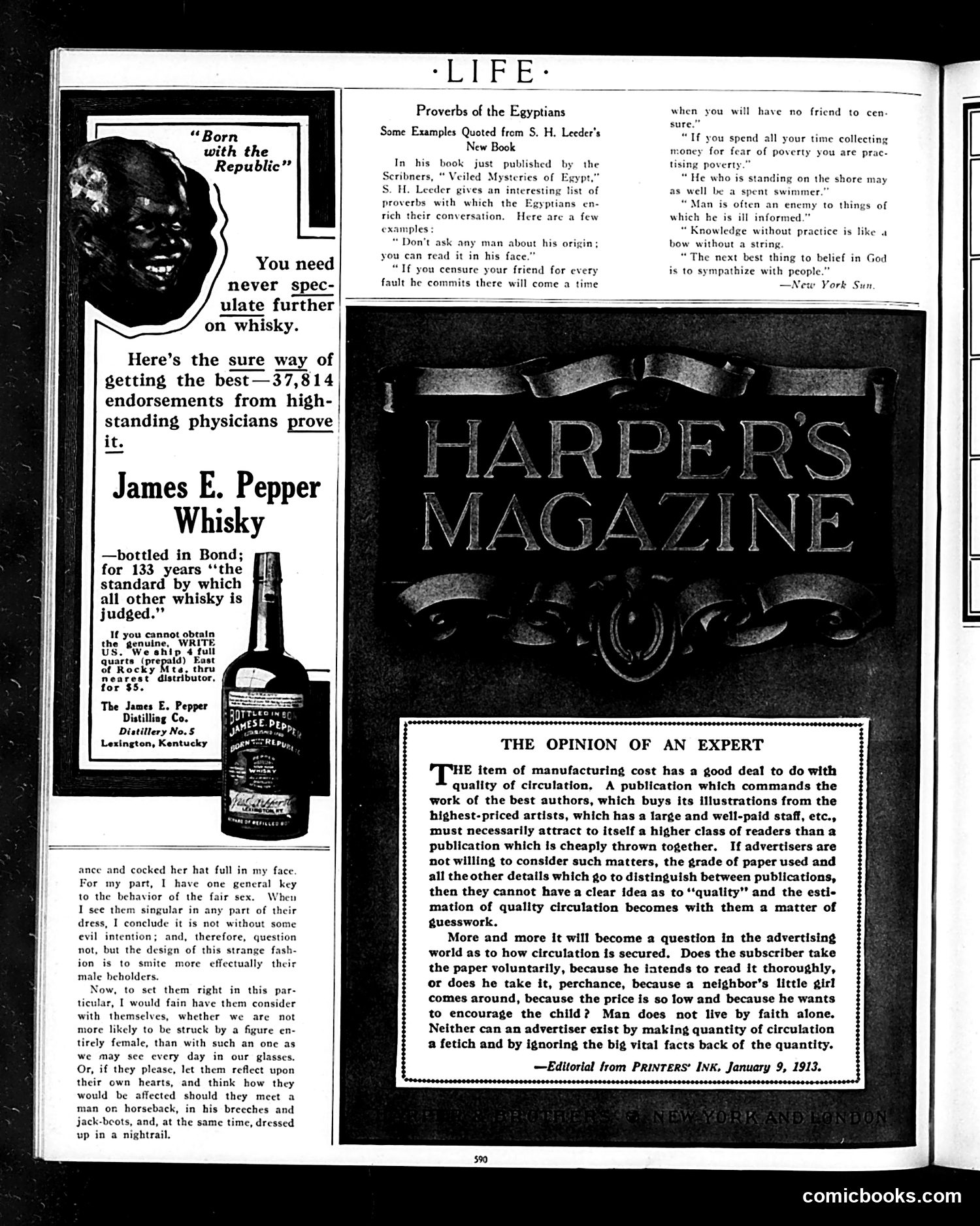
This page is primarily **advertising and editorial content** rather than political satire. The main advertisement promotes **James E. Pepper Whisky**, claiming 37,814 physician endorsements and 133 years as "the standard by which all other whisky is judged." This reflects pre-Prohibition era marketing (the page predates 1920). The upper section reprints Egyptian proverbs from S.H. Leeder's book—moral sayings about friendship, knowledge, and human nature—offering no satirical commentary. The significant content is **"The Opinion of an Expert,"** an editorial from *Printers' Ink* (January 9, 1913) critiquing advertising practices. It argues that **quality publication costs attract quality readers**, and advertisers shouldn't obsess over raw circulation numbers without considering *how* readers acquire the publication. The editorial warns against treating circulation as mere "fetich" while ignoring whether readers genuinely want the content. This reflects early 20th-century debates about advertising ethics and publication value—relevant to Life's own business model.
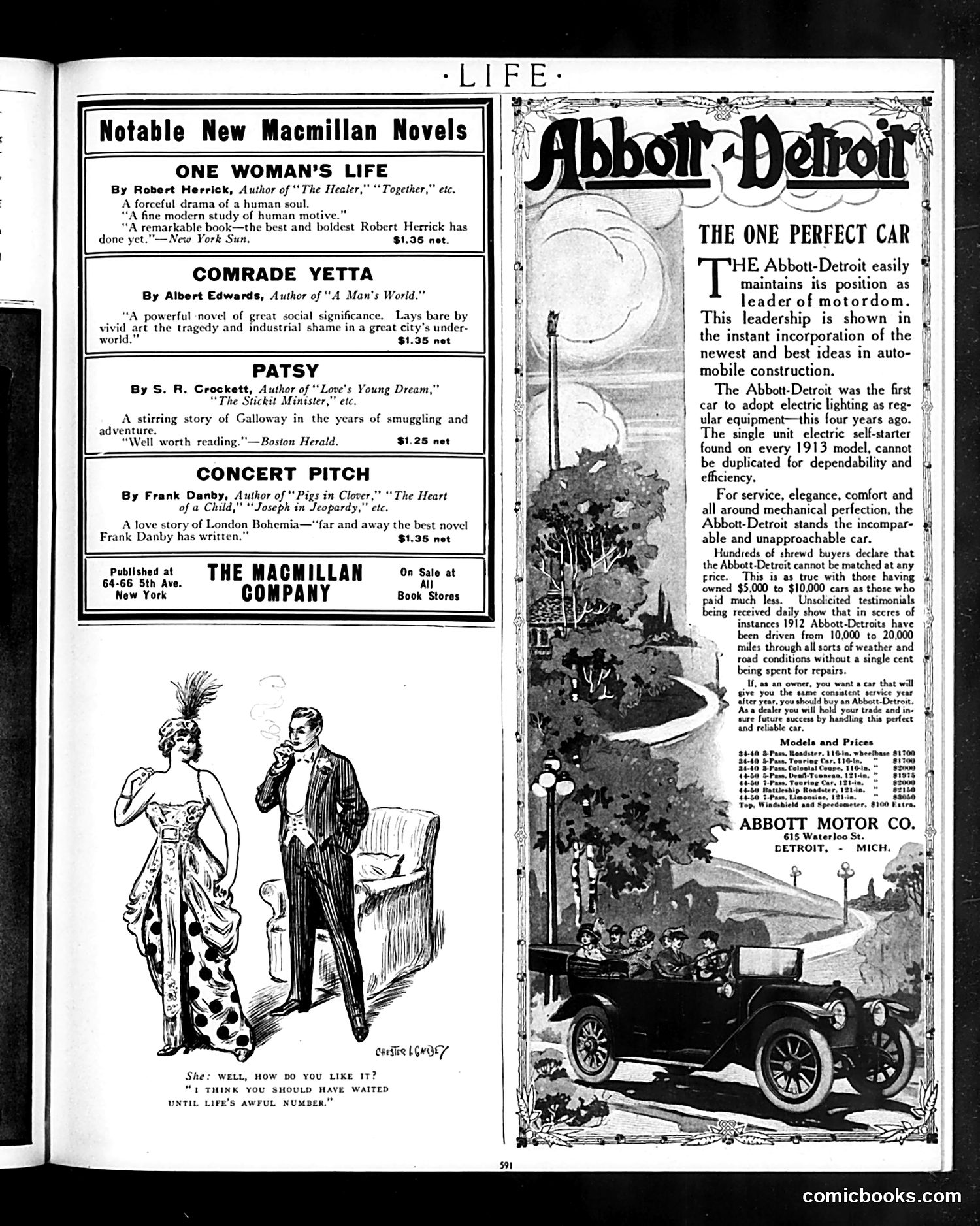
This page contains book advertisements on the left and an Abbott-Detroit automobile advertisement on the right, with one small cartoon. **The Cartoon:** At bottom left, a woman in an evening gown asks a man in formal attire "Well, how do you like it?" He responds: "I think you should have waited until Life's awful number." The joke is a play on *Life* magazine itself—he's suggesting she should have unveiled her new outfit in the magazine's special "awful number" (likely a humorous annual issue). It's a self-referential gag promoting the magazine to readers. **The Advertisements:** The left side promotes four Macmillan novels dealing with serious social themes (industrial tragedy, human motivation, adventure). The right side is a lengthy automobile advertisement emphasizing the Abbott-Detroit's technical superiority, reliability, and status as "leader of motordom"—claiming superior electrical systems and durability through extreme weather conditions. The page reflects early 1910s priorities: serious literary fiction alongside emerging consumer goods marketed through technological claims and social prestige.
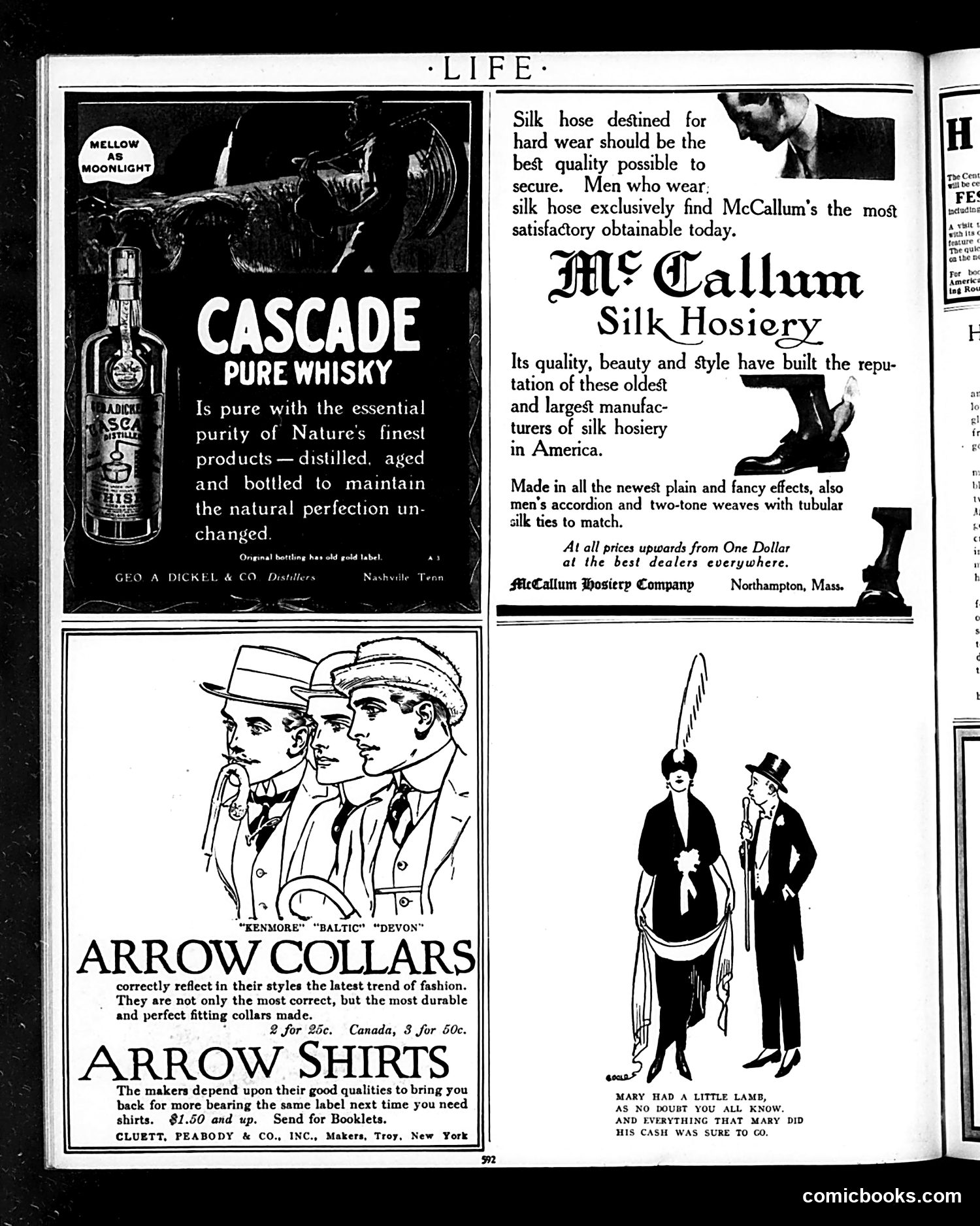
This is primarily an **advertising page** from an early 20th-century American magazine, not a political cartoon. The page contains four separate product advertisements: 1. **Cascade Pure Whisky** — promotes quality distilled whiskey with romantic imagery ("Mellow by Moonlight") 2. **McCallum Silk Hosiery** — advertises men's silk socks as durable quality products 3. **Arrow Collars and Shirts** — features three collar style names (Kenmore, Baltic, Devon) and promotes them as fashionable, durable, and correctly-fitted 4. **Humorous verse** — a parody of "Mary Had a Little Lamb" making a joke about cash expenditure, likely referencing the various products' prices The page reflects early 1900s consumer culture: products marketed to men emphasizing quality, style, and durability. The verse at bottom appears to be satirical commentary on spending on these goods—the joke being that just as everything Mary had was "sure to go," so too was customers' cash.
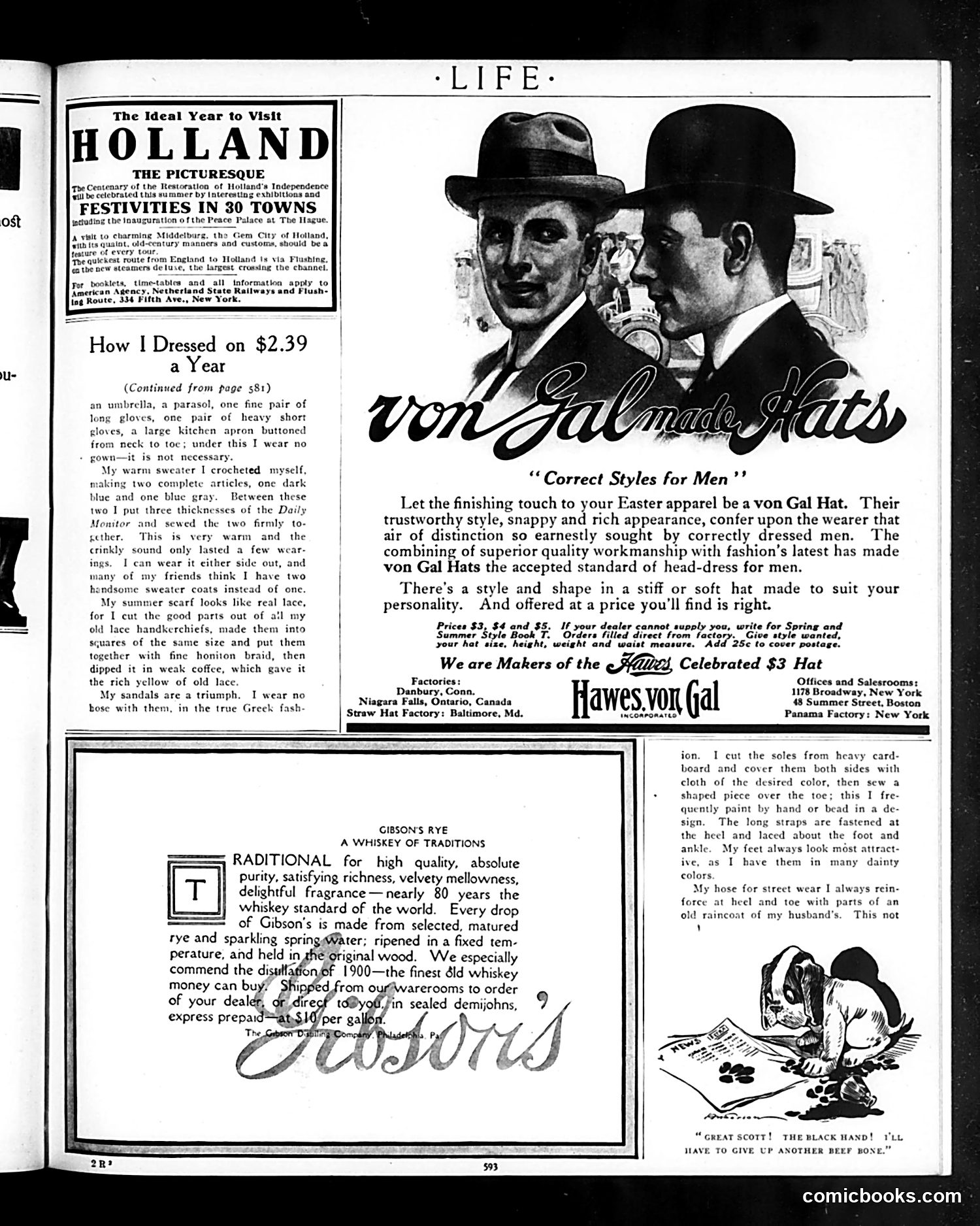
This page is primarily **advertising and lifestyle content**, not political satire. The main elements are: **Von Gal Hats Advertisement**: Features two men in fedoras. The ad emphasizes that von Gal Hats are "the accepted standard of head-dress for men," appealing to properly dressed gentlemen seeking distinction. This reflects early 20th-century menswear conventions where hat choice signaled respectability. **"How I Dressed on $2.39 a Year"**: A practical lifestyle article about economical dressing—darning clothes, repurposing lace, crocheting sweaters with newspaper insulation. This reflects Depression-era or wartime frugality. **Other Advertisements**: Gibson's Rye whiskey (emphasizing 80-year tradition) and Holland tourism (promoting centennial celebrations and the Peace Palace). **Cartoon Fragment**: Lower right shows a card-playing scene with dialogue "Great Scott! The Black Hand! I'll have to give up another beef bone"—likely a comedic reference to the mafia or gambling debts, though context is cut off. The page reflects **1920s-1930s consumer culture** blending luxury goods advertising with Depression-era practical advice.
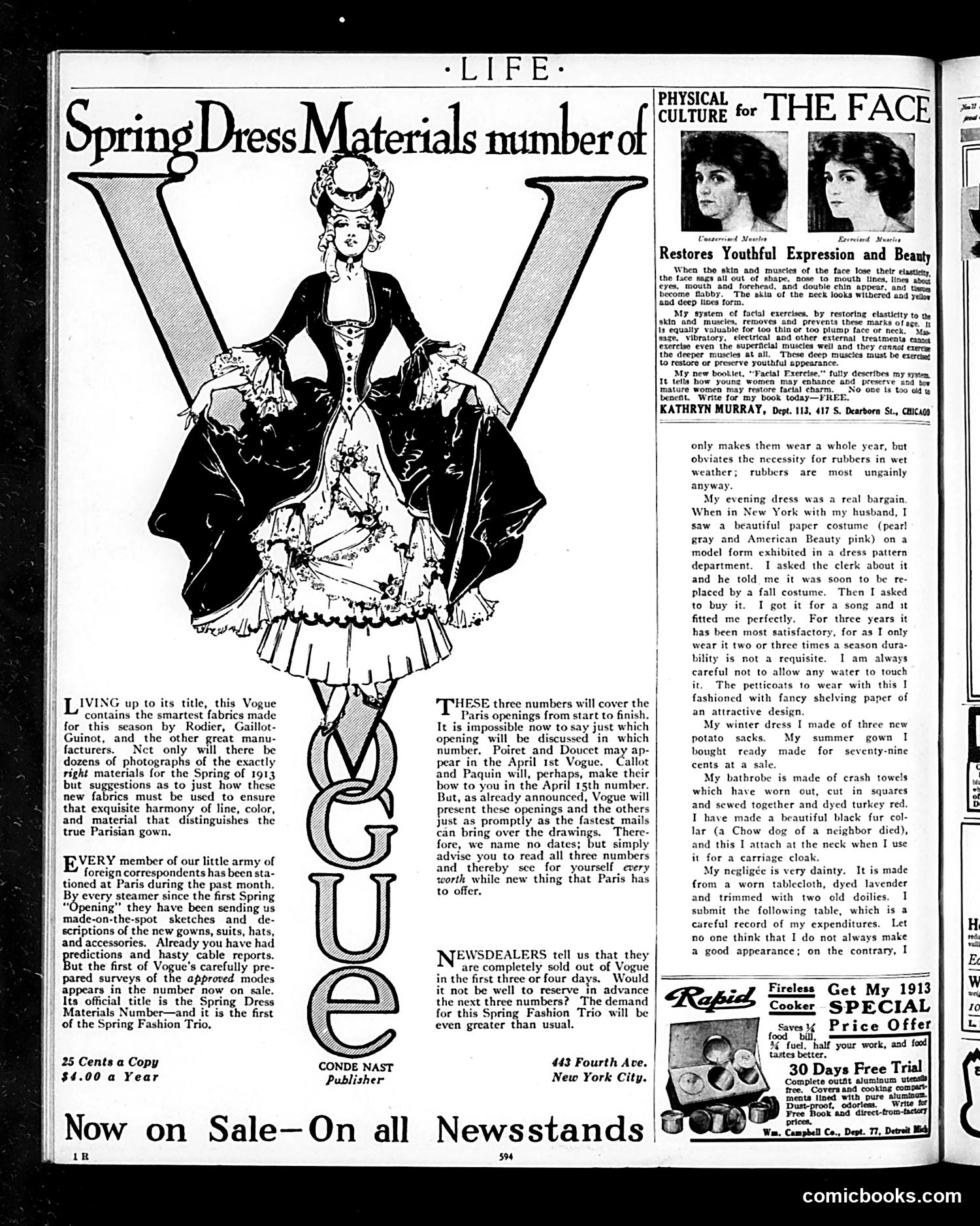
This page is primarily **advertising and fashion editorial**, not political satire. The large central illustration depicts a fashionable woman in an elaborate spring gown—the "Vogue" Spring Dress Materials Number being promoted. The ornate lettering spells "VOGUE." The content announces Vogue magazine's coverage of Paris fashion openings for spring 1913, featuring designs from prominent couturiers like Poiret, Doucet, Callot, and Paquin. The text emphasizes that Vogue's Paris correspondents will report the latest fashions "as promptly as the fastest mails can bring over the drawings." The right sidebar advertises Kathryn Murray's facial exercise system and a Rapid Fireless Cooker stove. This represents typical early-20th-century Life magazine content: fashion promotion mixed with advertisements targeting affluent readers interested in beauty products and domestic conveniences. There is no political cartoon or satire present.
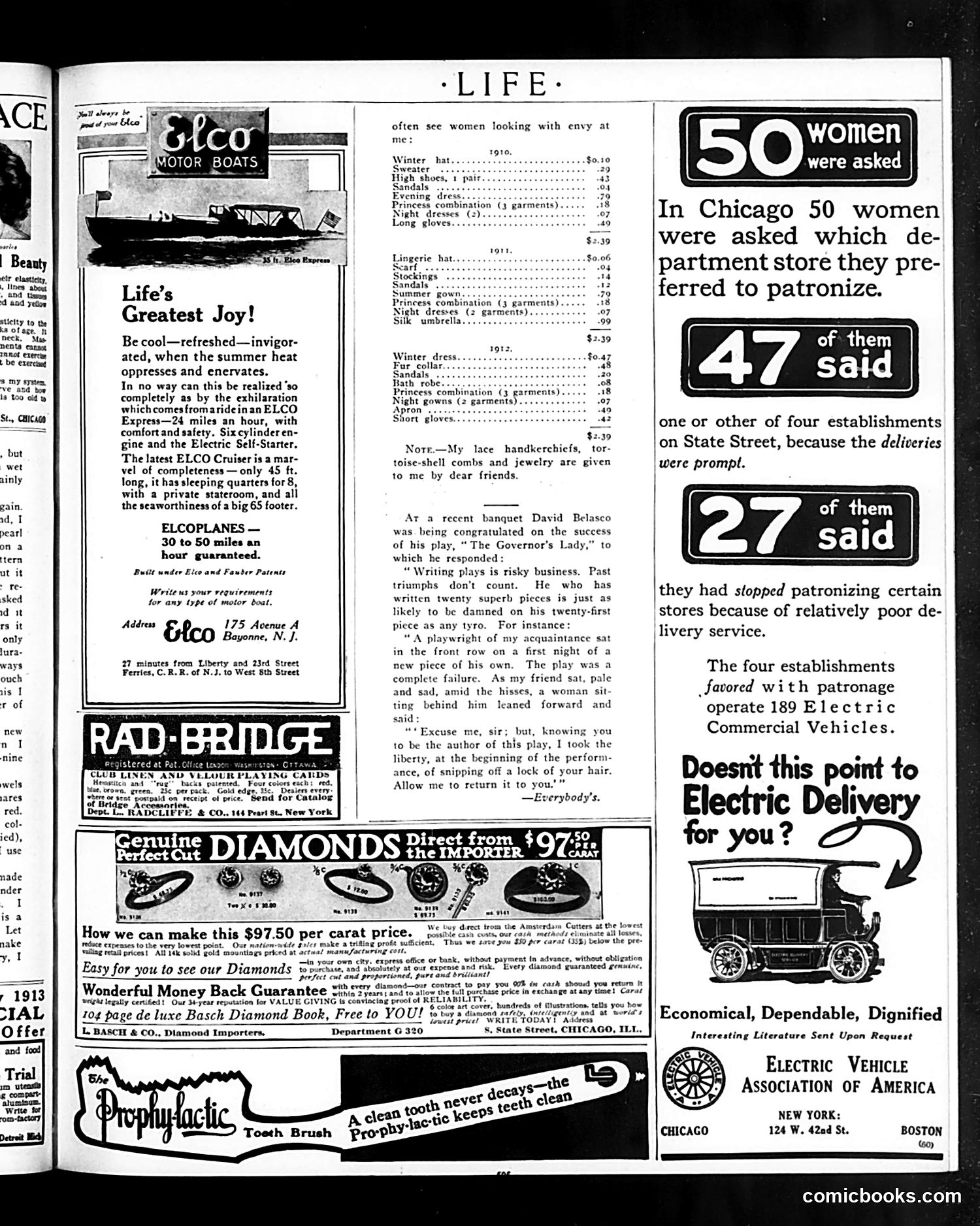
This page is primarily **advertising content** from circa 1913, with one satirical anecdote embedded in the text. ## The Satire The main humor appears in the David Belasco story: a playwright whose new play was a complete failure sits in the front row during opening night. A woman behind him reveals she cut off a lock of his hair at the performance's start—as a good-luck charm—and now returns it, implying his hair couldn't help the doomed production. The joke mocks both theatrical superstition and the brutal unpredictability of the theater business. ## The Advertisements The page features product ads for motorboats (Elco), diamonds, a toothbrush, and—notably—**electric delivery vehicles**. The electric vehicle ad prominently displays survey data: 50 Chicago women were asked about preferred department stores; 47 cited one of four State Street establishments specifically because of their **prompt delivery service** using electric vehicles. This represents early 20th-century marketing showing how modern technology (electric vehicles) influenced consumer loyalty. The page reflects pre-WWI consumer culture and emerging advertising techniques using statistical claims.
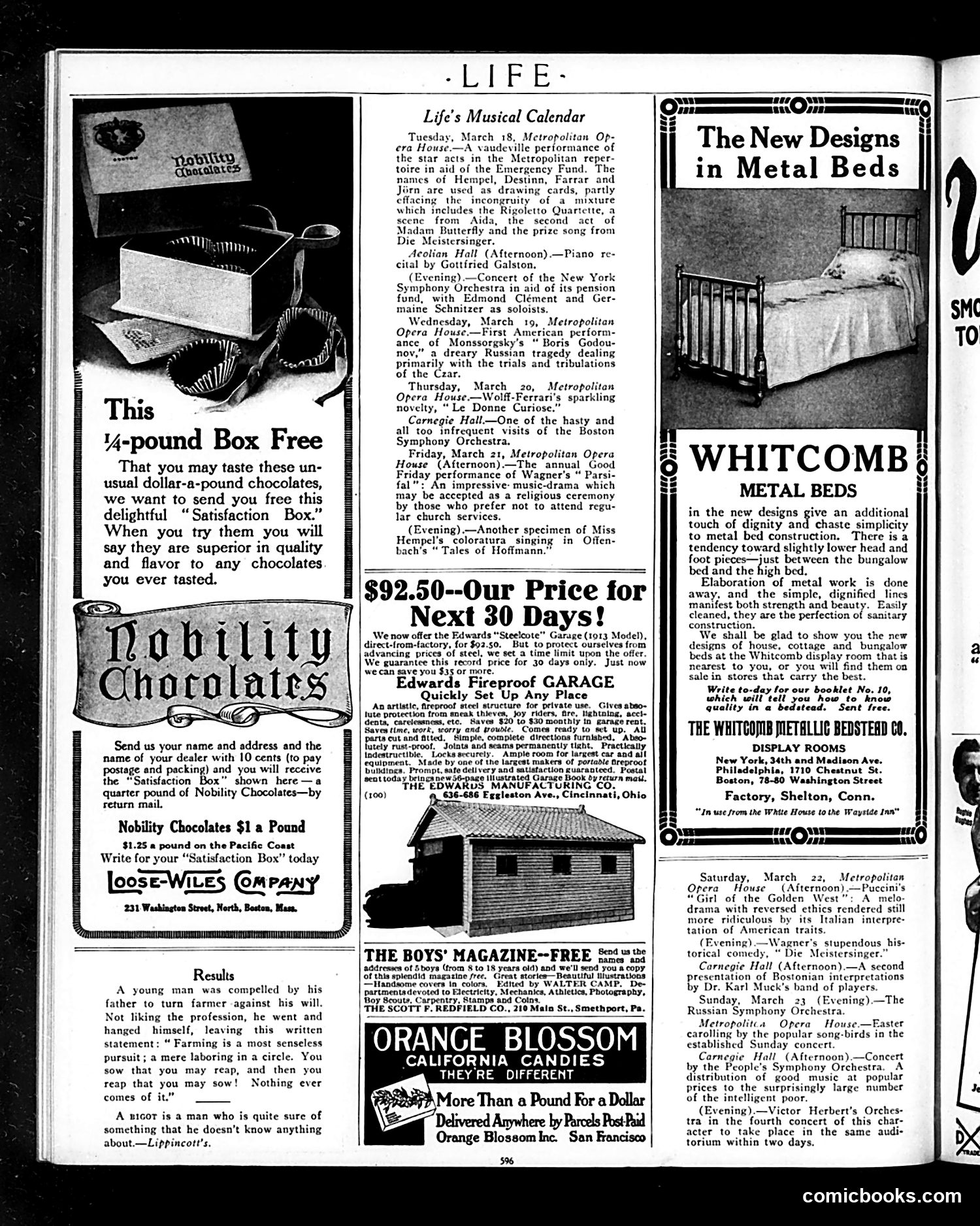
This page is primarily **advertising and light entertainment** rather than political satire. The content includes: **Advertisements:** - Nobility Chocolates (offering a free sample box) - Edwards Fireproof Garage (steel structure for cars, $92.50 for 30 days) - Whitcomb Metal Beds (new designs) - Orange Blossom Candies **Editorial Content:** - "Life's Musical Calendar" — a listing of New York cultural events (opera, concerts) featuring performers like Enrico Caruso and Geraldine Farrar - Two brief humorous items: one mocking farmers ("farming is a senseless pursuit"), another defining a "nicot" as someone confident about things he doesn't understand The page reflects early 1900s consumer culture and New York's thriving arts scene. There is **no political cartoon or social satire** visible — just commercial messaging and mild domestic humor typical of Life magazine's mix of advertising and light editorial content.
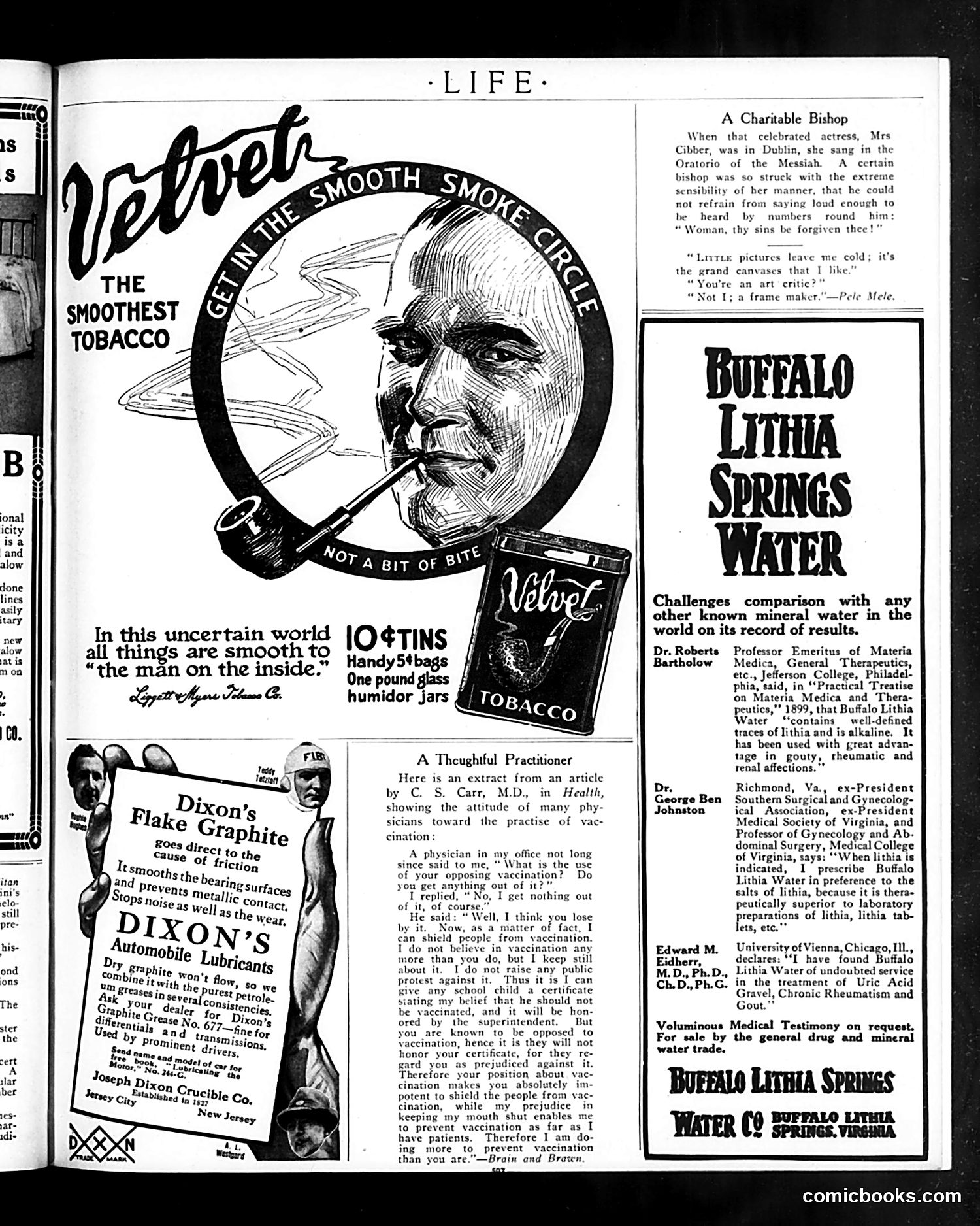
This page consists primarily of **period advertisements** rather than satirical content. The dominant image is a **Velvet tobacco ad** featuring a man's head in profile smoking a pipe, with the slogan "the smoothest tobacco" and "not a bit of bite." Other ads promote Dixon's Graphite (lubricants) and Buffalo Lithia Springs water. The editorial content includes a **brief anecdote about vaccination attitudes** among physicians—describing a doctor who privately opposes vaccination but stays silent publicly, thus retaining influence to shield patients, versus an outspoken opponent rendered powerless by his known bias. This satirizes medical hypocrisy and the strategic value of discretion. A short humorous **dialogue** mocks an art critic who claims small pictures leave him cold but only likes grand canvases—revealed to be a picture-frame maker (implying financial rather than aesthetic motivation). The page reflects early 20th-century concerns: vaccination debates, nostrum medicine (lithia water marketed for gout and rheumatism), and satirical observations on professional pretense.
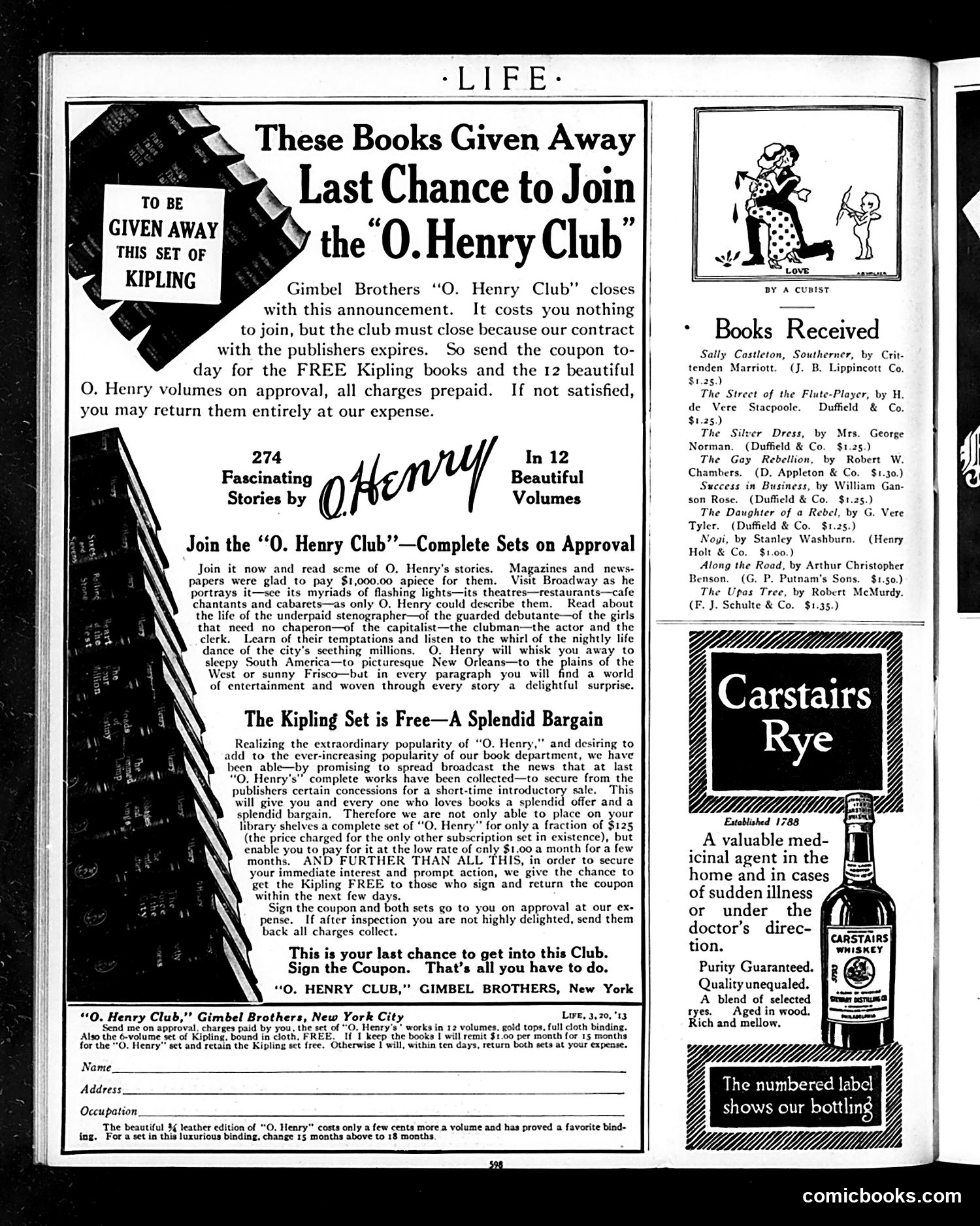
This page is primarily **advertising for book club memberships**, not satire or political commentary. The main content promotes Gimbel Brothers' "O. Henry Club," offering free Rudyard Kipling books and discounted complete sets of O. Henry stories (12 volumes for $1/month). The ad emphasizes O. Henry's popularity and vivid descriptions of urban life, theater, and American landscapes. The small cartoon labeled "By a Cubist" shows a man with a child—a stylistic joke about modern art rather than political satire. The "Carstairs Rye" whiskey advertisement occupies the right column. This is essentially a **mail-order book promotion** typical of early 20th-century magazine advertising, using the appeal of popular authors (O. Henry, Kipling) and payment plans to encourage subscriptions. There is no discernible political message.
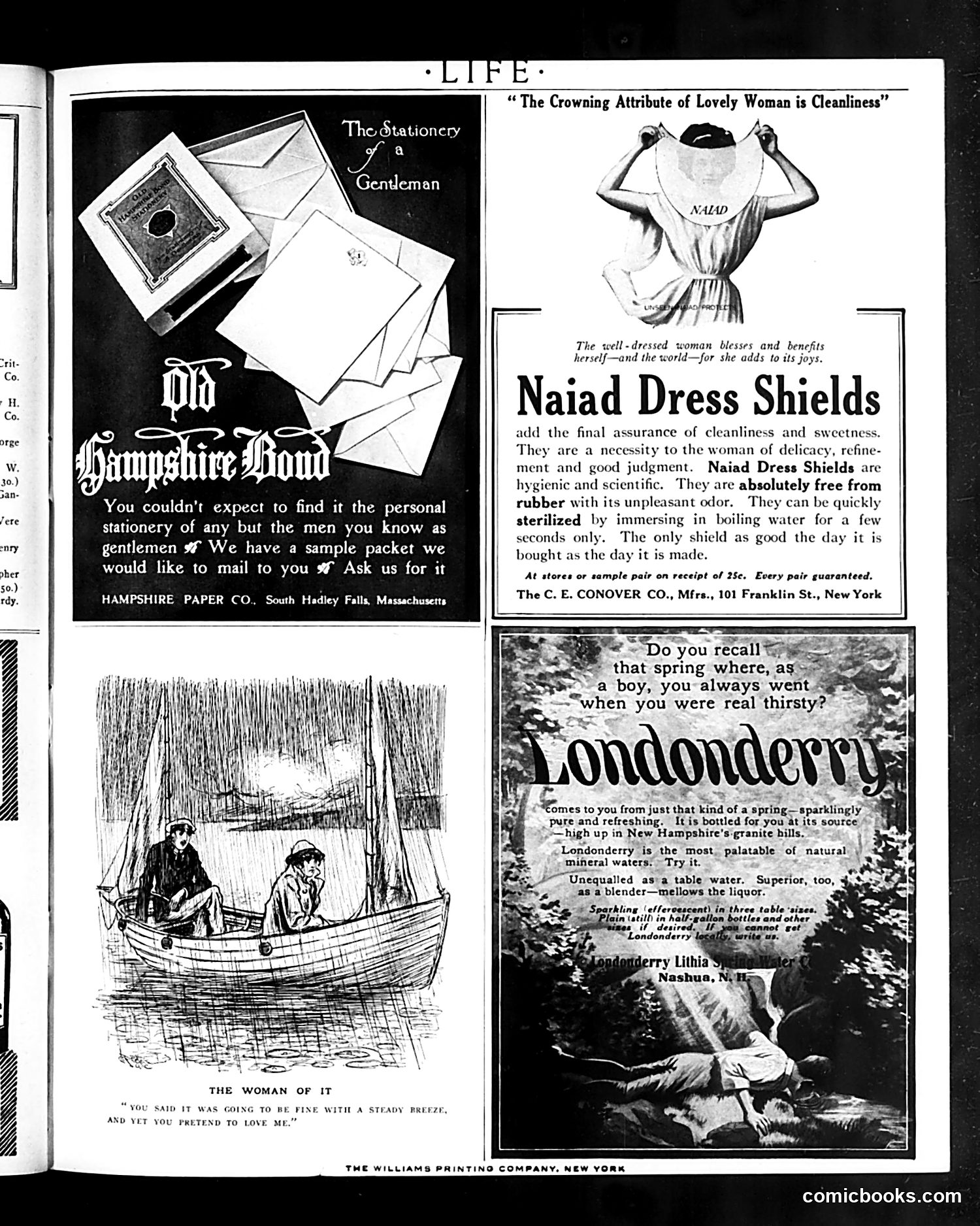
This page is primarily **advertising**, not editorial satire. It contains four commercial advertisements from the early 20th century: 1. **Old Hampshire Bond stationery** — promotes gentlemen's writing paper, offering sample packets 2. **Naiad Dress Shields** — undergarment inserts marketed to women as hygienic products that prevent sweat stains and odors 3. **Londonderry mineral water** — bottled spring water from New Hampshire, emphasizing natural purity 4. **A small illustration captioned "The Woman of It"** — a sketch of a couple in a boat with a romantic complaint about broken promises regarding weather The page reflects period advertising conventions: emphasizing cleanliness and hygiene (especially for women), natural sourcing, and genteel consumption. The tagline "The Crowning Attribute of Lovely Woman is Cleanliness" exemplifies early 1900s gender norms about feminine virtue tied to domestic/physical purity. The boat illustration appears to be a humorous domestic scene rather than political commentary—a woman's gentle rebuke of her companion's failed weather prediction.
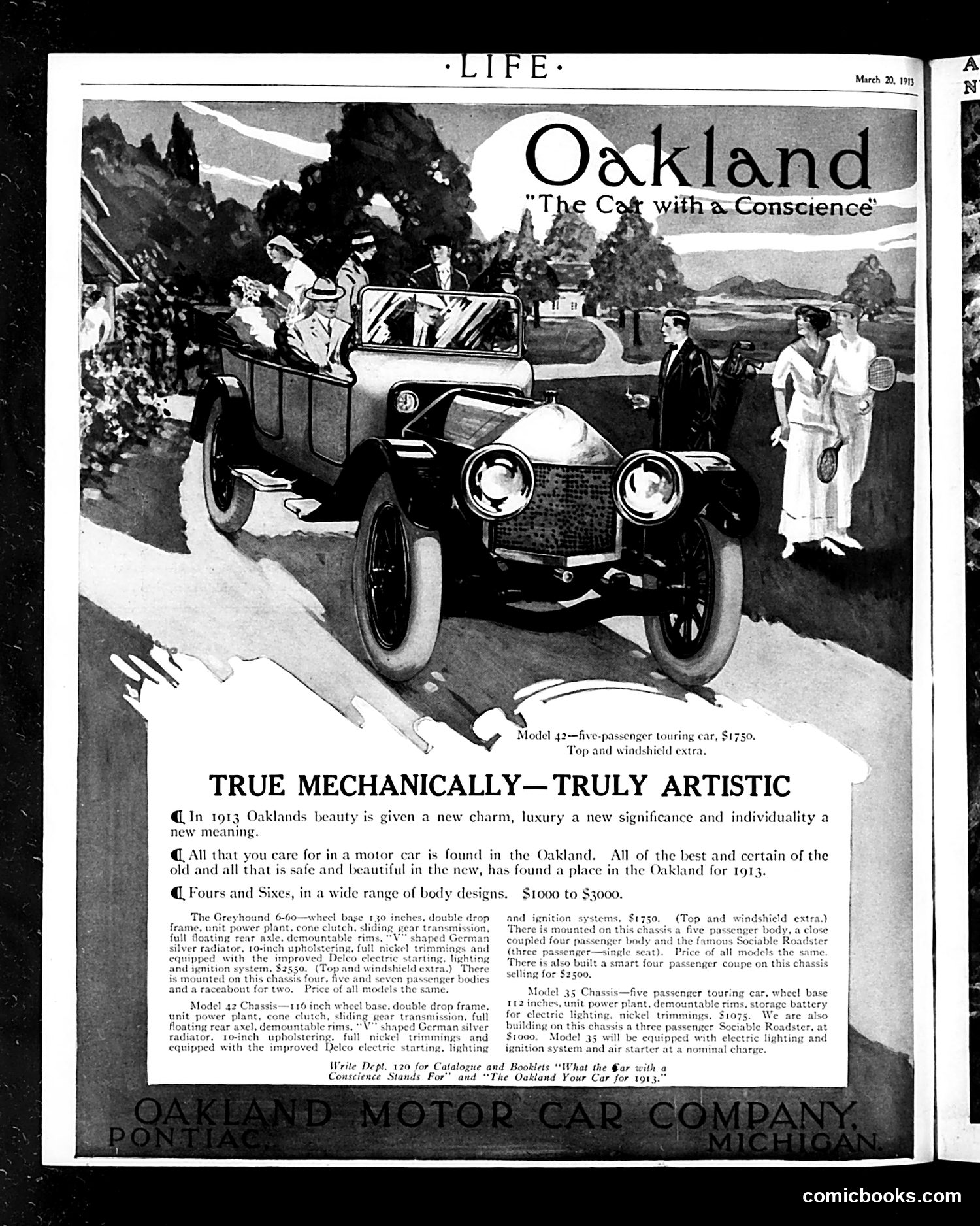
This is **not a cartoon or satire**—it's a straightforward automobile advertisement for the Oakland Motor Car Company of Pontiac, Michigan. The page promotes Oakland's 1913 model year vehicles with the slogan "The Car with a Conscience," emphasizing that the brand combines mechanical reliability with artistic design. The tagline "True Mechanically—Truly Artistic" appeals to consumers wanting both practical engineering and aesthetic appeal. The advertisement features an illustrated scene of well-dressed passengers in and around an Oakland touring car in a scenic landscape, positioning the vehicle as aspirational and sophisticated. Pricing ranges from $1,000 to $3,000, with detailed specifications about chassis options, engines, and electrical features. This represents early automotive advertising strategy: marketing cars not merely as transportation but as symbols of modernity, taste, and social status.