
Life, 1913-03-20 · page 24 of 44
Life — March 20, 1913 — page 24: what you’re looking at
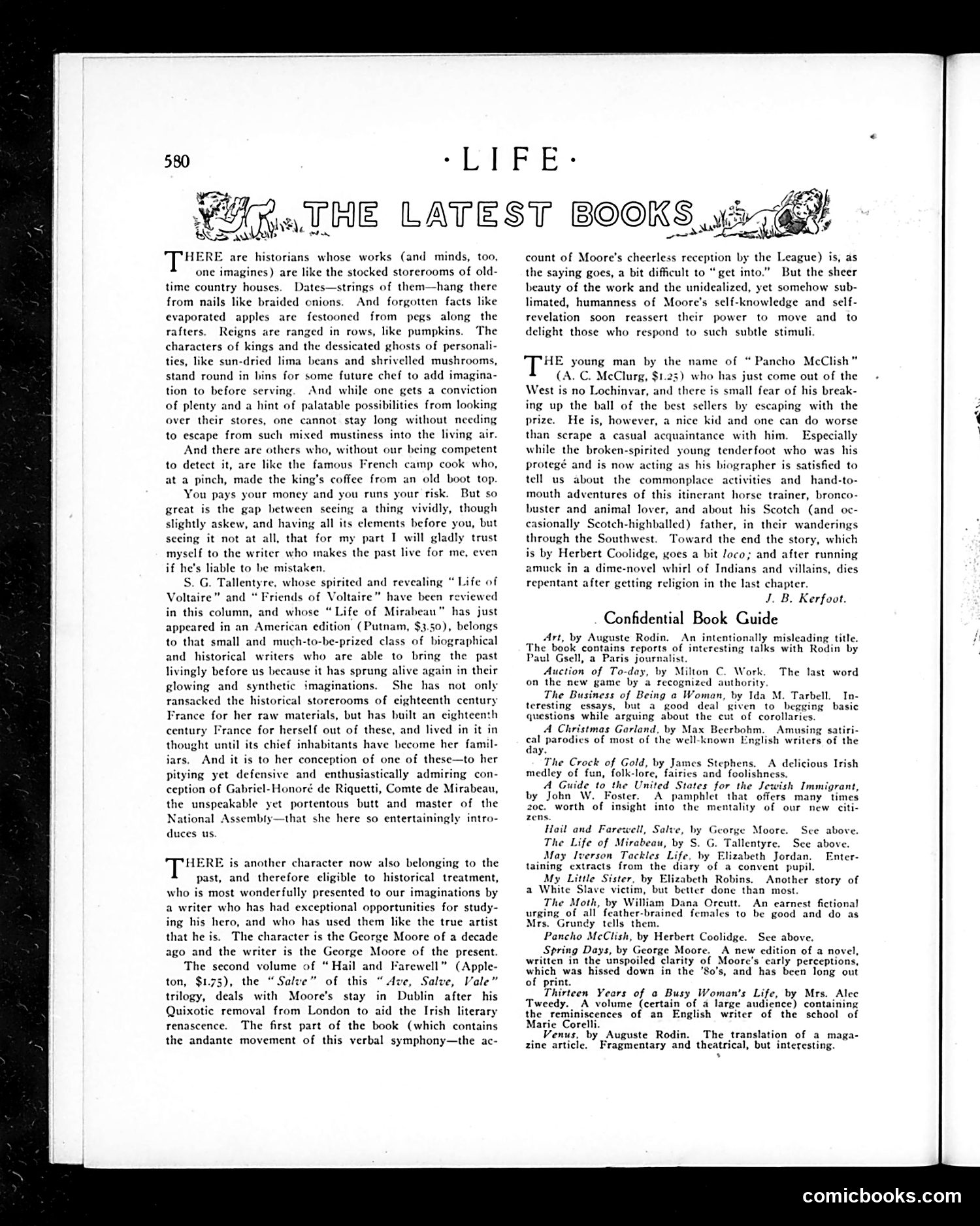
What you’re looking at
This page is primarily a **book review section** titled "The Latest Books," not a political cartoon page. It contains literary criticism rather than satirical illustrations. The page discusses three historical works: 1. **"Life of Voltaire" and "Life of Mirabeau"** by S. G. Tallentyre—praised for bringing eighteenth-century French history vividly to life through imaginative synthesis 2. **"Hail and Farewell" (volume 2, "Salve")** by George Moore—a semi-autobiographical trilogy about Moore's return to Dublin to support Irish literary revival, described as initially difficult but ultimately moving 3. **"Pancho McClish"** by A. C. McClurg—a Western novel about a young man from the West who, despite being "a nice kid," offers no threat to bestseller status The satirical tone targets pretentious historical writing versus accessible narrative, and gently mocks Moore's self-aggrandizing memoir. This is **literary satire**, not political commentary.
📄 Transcribed text from this page (OCR, searchable)
Machine-transcribed from the original scan — historical spelling and the odd misread are preserved.
LIFE «aLHE LATEST BOOKS. TH! are historians whose works (and minds, too, one imagines) are like the stocked storerooms of old- time country houses. Dates—strings of them—hang there from nails like braided cnions. And forgotten facts like evaporated apples are festooned from pegs along the rafters. Reigns are ranged in rows, like pumpkins. The characters of kings and the dessicated ghosts of personali- ties, like sun-dried lima beans and shrivelled mushrooms, stand round in bins for some future chef to add imagina- tion to before serving. And while one gets a conviction of plenty and a hint of palatable possibilities from looking over their stores, one cannot stay long without needing to escape from such mixed mustiness into the living air. And there are others who, without our being competent to detect it, are like the famous French camp cook who, ata pinch, made the king’s coffee from an old boot top. You pays your money and you runs your risk. But so great is the gap between seeing a thing vividly, though slightly askew, and having all its elements before you, but seeing it not at all, that for my part I will gladly trust myself to the writer who makes the past live for me, even iable to be mistaken. S. G. Tallentyre, whose spirited and revealing “ Life of Voltaire” and “Friends of Voltaire” have been reviewed in this column, and whose “Life of Mirabeau” has just appeared in an American edition (Putnam, $3.50), belongs to that small and much-to-be-prized class of biographical and historical writers who are able to bring the past livingly before us because it has sprung alive again in their glowing and synthetic imaginations. She has not only ransacked the historical storerooms of eighteenth century France for her raw materials, but has built an eighteenth century France for herself out of these, and lived in it in thought until its chief inhabitants have become her famil- jars. And it is to her conception of one of these—to her pitying yet defensive and enthusiastically admiring con- ception of Gabriel-Honoré de Riquetti, Comte de Mirabeau, the unspeakable yet portentous butt and master of the National Assembty—that she here so entertainingly intro- duces us. HERE is another character now also belonging to the past, and therefore eligible to historical treatment, who is most wonderfully presented to our imaginations by a writer who has had exceptional opportunities for study- ing his hero, and who has used them like the true artist that he is. The character is the George Moore of a decade ago and the writer is the George Moore of the present. The second volume of “Hail and Farewell” (Apple- ton, $1.75), the “Salve” of this “Ave, Salve, Vale” trilogy, deals with Moore's stay in Dublin after his Quixotic removal from London to aid the Irish literary renascence. The first part of the book (which contains the andante movement of this verbal symphony—the ac- count of Moore's cheerless reception by the League) is, as the saying goes, a bit difficult to “get into.” But the sheer beauty of the work and the unidealized, yet somehow sub- limated, humanness of Moore's self-knowledge and self- revelation soon reassert their power to move and to delight those who respond to such subtle stimuli HE young man by the name of “ Pancho McClish” (A. C. McClurg, $1.23) who has just come out of the West is no Lochinvar, and there is small fear of his break- ing up the ball of the best sellers by escaping with the prize. He is, however, a nice kid and one can do worse than scrape a casual acquaintance with him. Especially while the broken-spirited young tenderfoot who was his protegé and is now acting as his biog: pher is satisfied to tell us about the commonplace ac s and hand-to- mouth adventures of this itinerant horse trainer, bronco- buster and animal lover, and about his Scotch (and oc- casionally Scotch-highballed) father, in their wanderings through the Southwest. Toward the end the story, which is by Herbert Coolidge, goes a bit loco; and after running uck in a dime-novel whirl of Indians and villains, dies repentant after getting religion in the last chapter. J. B. Kerfoot. Confidential Book Guide Art, by Auguste Rodin. An intentionally misleading title. The book contains reports of interesting talks with Rodin by Paul Gsell, a Paris journalist. Auction of To-day, by Milton C. Work. The last word on the new game by a recognized authority The Business of Being @ Woman, by Ida M. Tarbell. In- teresting essays, but a good deal given to begging basic questions while ‘arguing about the eut of corollaries. A Christmas Garland, by Max Beerbohm. Amusing satiri- cal parodies of most of the well-known English writers of the day. The Crock of Gold, by James Stephens. A delicious Irish medley of fun, folk-lore, fairies and foolishness. A Guide to the United States for the Jewish Immigrant, by John W. Foster. A pamphlet that offers many times 20c. worth of insight into the mentality of our new citi- zens. Hail and Farewell, Salve, by George Moore. See above. The Life of Mirabeau, by S. G. Tallentyre. See above. May Iverson Tackles Life, by Elizabeth Jordan, Enter- taining extracts from the diary of a convent pupil. My Little Sister, by Elizabeth Robins. Another story of a White Slave victim, but better done than most. The Moth, by William Dana Orcutt. An earnest fictional urging of all’ feather-brained females to be good and do as Mrs. Grundy tells ther Pancho McClish, by Herbert Coolidge. See above. Spring Days, by George Moore, A new edition of a novel, written in the unspoiled clarity of Moore's carly perceptions, which was hissed down in the ‘So's, and has been long out of print. Thirteen Years of a Busy Woman's Life, by Mrs. Alec Tweedy. A volume (certain of a large audience) containing the reminiscences of an English writer of the school of Maric Corelli. . _ Venus, by Auguste Rodin. The translation of a maga- zine article. Fragmentary and theatrical, but interesting. comicbooks.com