
Life, 1913-03-20 · page 16 of 44
Life — March 20, 1913 — page 16: what you’re looking at
What you’re looking at
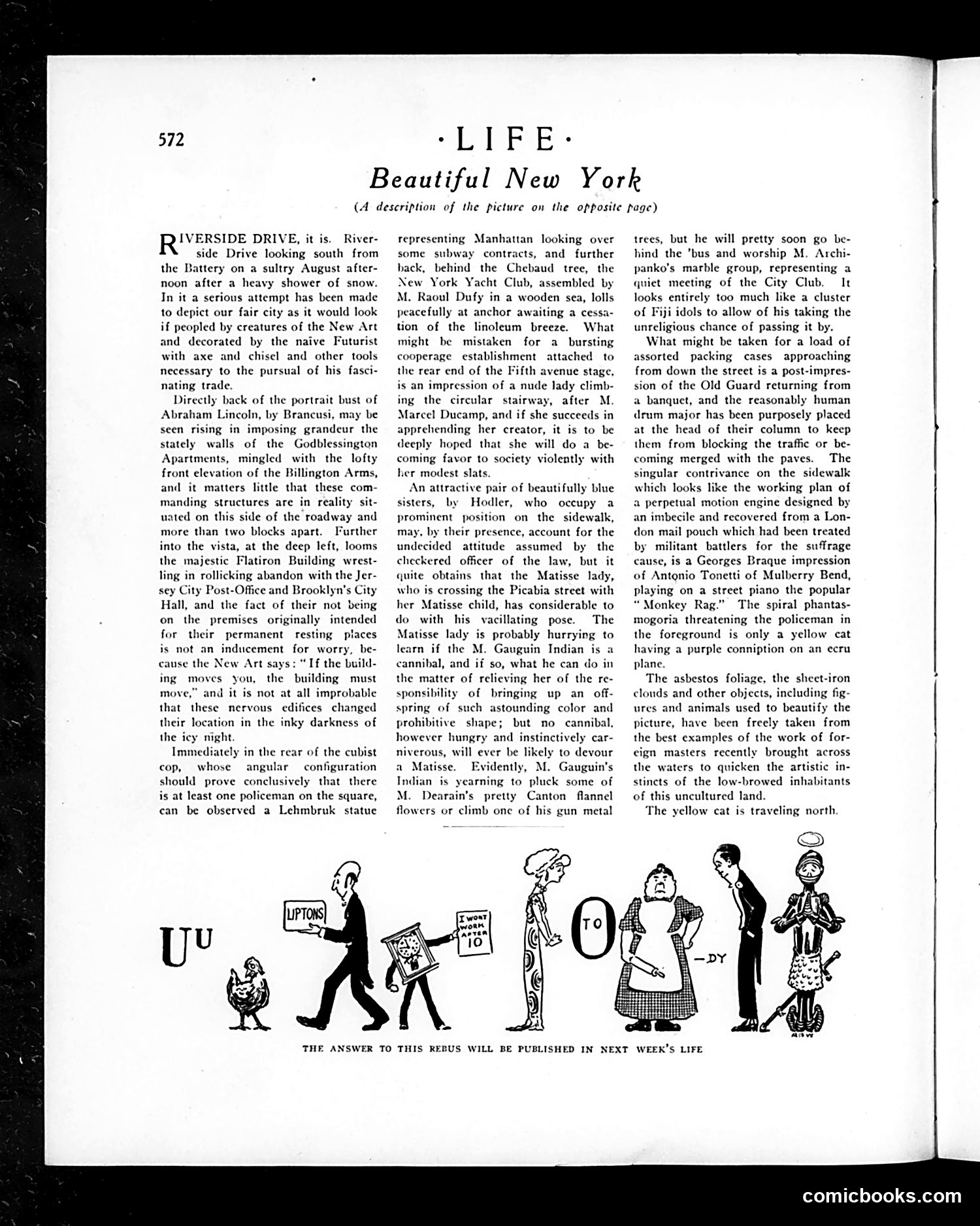
This is a scathing satirical description of a Futurist/Cubist reimagining of New York City. The text mocks early modernist art movements—Cubism, Futurism, and Post-Impressionism—by describing absurd distortions of Manhattan landmarks. The piece ridicules named artists including Brancusi, Marcel Duchamp, Raoul Dufy, Hodler, Matisse, Picabia, and Gauguin, presenting their artistic styles as nonsensical when applied to urban reality. It jabs at the Cubist "cop" with "angular configuration," Matisse's "prohibitive shape," and buildings that move because "if the building moves you, the building must move"—a parody of modernist logic. The rebus/puzzle at the bottom (with symbols and figures) appears to be a visual joke readers were invited to solve. **The satire's point**: Life magazine dismisses avant-garde European art as pretentious absurdity unfit for depicting recognizable American reality. The mockery reflects early 20th-century American resistance to modernism.
📄 Transcribed text from this page (OCR, searchable)
Machine-transcribed from the original scan — historical spelling and the odd misread are preserved.
ESE Beautiful New York (A description of the picture on the opposite page) IVERSIDE DRIVE, it is. River- side Drive looking south from the Battery on a sultry August after- noon after a heavy shower of snow. In it a serious attempt has been made to depict our fair city as it would look if peopled by creatures of the New Art and decorated by the naive Futurist with axe and chisel and other tools necessary to the pursual of his fasci- nating trade. Directly back of the portrait bust of Abraham Lincoln, by Brancusi, may be seen rising in imposing grandeur the stately walls of the Godblessington Apartments, mingled with the lofty front elevation of the Billington Arms, and it matters little that these com- manding structures are in reality sit- uated on this side of the roadway and more than two blocks apart. Further into the vista, at the deep left, looms the majestic Flatiron Building wrest- ling in rollicking abandon with the Jer- sey City Post-Office and Brooklyn's City Hall, and the fact of their not being on the premises originally intended for their permanent resting places is not an inducement for worry, be- cause the New Art says: “If the build- ing moves you, the building must move,” and it is not at all improbable that these nervous edifices changed their location in the inky darkness of the icy night. Immediately in the rear of the cubist cop, whose angular configuration should prove conclusively that there is at least one policeman on the square, can be observed a Lehmbruk statue representing Manhattan looking over some subway contracts, and further back, behind the Chebaud tree, the New York Yacht Club, assembled by M. Raoul Dufy in a wooden sea, lolls peacefully at anchor awaiting a cessa- tion of the linoleum breeze. What might be mistaken for a_ bursting cooperage establishment attached to the rear end of the Fifth avenue stage, is an impression of a nude lady climb- ing the circular stairway, after M Marcel Ducamp, and if she succeeds in apprehending her creator, it is to be deeply hoped that she will do a be- coming favor to society violently with her modest slats An attractive pair of beautifully blue sisters, by Hodler, who occupy a prominent position on the sidewalk, may, by their presence, account for the undecided attitude assumed by the checkered officer of the law, but it quite obtains that the Matisse lady, who is crossing the Picabia street with her Matisse child, has considerable to do with his vacillating pose. The Matisse lady is probably hurrying to learn if the M. Gauguin Indian is a cannibal, and if so, what he can do in the matter of relieving her of the re- sponsibility of bringing up an off- spring of such astounding color and prohibitive shape; but no cannibal, however hungry and instinctively car- niverous, will ever be likely to devour a Matisse. Evidently, M. Gauguin’s Indian is yearning to pluck some of M. Dearain’s pretty Canton flannel flowers or climb one of his gun metal trees, but he will pretty soon go be- hind the ‘bus and worship M. Archi- panko's marble group, representing a quiet meeting of the City Club. It looks entirely too much like a cluster of Fiji idols to allow of his taking the unreligious chance of passing it by. What might be taken for a load of assorted packing cases approaching from down the street is a post-impres- sion of the Old Guard returning from a banquet, and the reasonably human drum major has been purposely placed at the head of their column to keep them from blocking the traffic or be- coming merged with the paves. The singular contrivance on the sidewalk which looks like the working plan of a perpetual motion engine designed by an imbecile and recovered from a Lon- don mail pouch which had been treated by militant battlers for the suffrage cause, is a Georges Braque impression of Antonio Tonetti of Mulberry Bend, playing on a street piano the popular “Monkey Rag.” The spiral phantas- mogoria threatening the policeman in the foreground is only a yellow cat having a purple conniption on an ecru plane. The asbestos foliage, the sheet-iron clouds and other objects, including fig- ures and animals used to beautify the picture, have been freely taken from the best examples of the work of for- eign masters recently brought across the waters to quicken the artistic in- stincts of the low-browed inhabitants of this uncultured land. The yellow cat is traveling north. THE ANSWER TO THIS REBUS WILL BE PUBLISHED IN NEXT WEEK’S LIFE comicbooks.com