
Life, 1913-03-20 · page 9 of 44
Life — March 20, 1913 — page 9: what you’re looking at
What you’re looking at
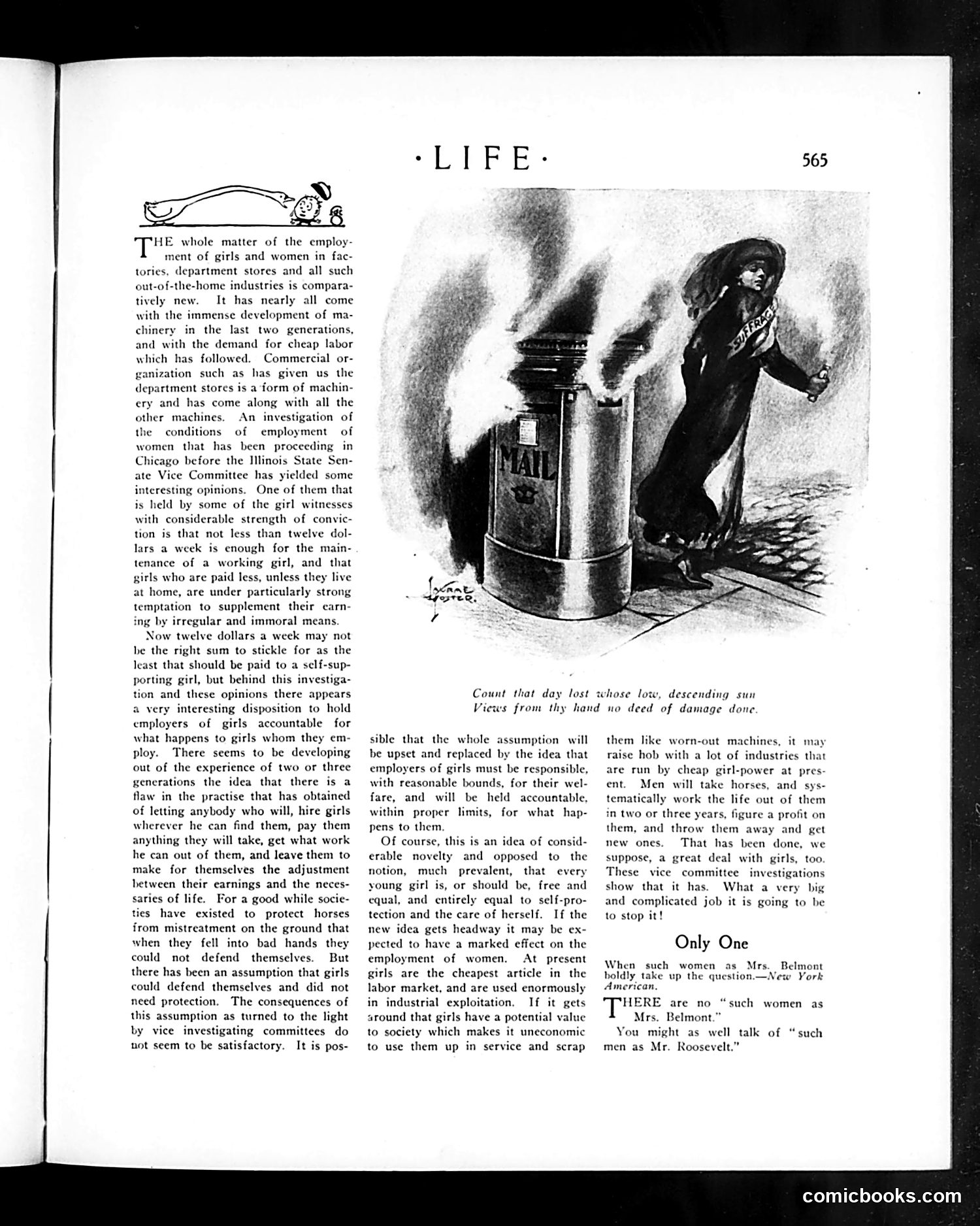
The main illustration depicts a woman in dark clothing standing beside a factory smokestack, looking distressed or contemplative. The caption references loss and damage, suggesting commentary on industrial working conditions. The accompanying text discusses employment of women and girls in factories and department stores, examining wages (twelve dollars weekly mentioned as minimum) and working conditions. The article addresses a concern that poorly-paid working girls might resort to "irregular and immoral means" to supplement income—a Victorian-era anxiety about female factory workers' vulnerability. The piece debates employer responsibility for workers' welfare and whether women should be economically independent. A section titled "Only One" references Mrs. Belmont's views on exceptional women, contrasting her with typical working women. The overall satire critiques both exploitative labor practices and paternalistic attitudes toward female workers.
📄 Transcribed text from this page (OCR, searchable)
Machine-transcribed from the original scan — historical spelling and the odd misread are preserved.
T! whole matter of the employ- ment of girls and women in fac- tories, department stores and all such out-of-the-home industries is compara- tively new. It has nearly all come with the immense development of ma- chinery in the last two generations, and with the demand for cheap labor which has followed. Commercial or- anization such as has given us the department stores is a:form of machin- ery and has come along with all the other machines. An investigation of the conditions of employment of women that has been proceeding in Chicago before the Illinois State Sen- ate Vice Committee has yielded some interesting opinions. One of them that is held by some of the girl witnesses with considerable strength of convic- tion is that not less than twelve dol- lars a week is enough for the main- tenance of a working girl, and that girls who are paid less, unless they live at home, are under particularly strong temptation to supplement their ecarn- ¢ by irregular and immoral means. w twelve dollars a week may not he the right sum to stickle for as the least that should be paid to a self-sup- porting girl, but behind this investiga- tion and these opinions there appears a very interesting disposition to hold employers of girls accountable for what happens to girls whom they em- ploy. There seems to be developing out of the experience of two or three generations the idea that there is a flaw in the practise that has obtained of letting anybody who will, hire girls wherever he can find them, pay them anything they will take, get what work he can out of them, and leave them to make for themselves the adjustment between their earnings and the neces- saries of life. For a good while socie- ties have existed to protect horses from mistreatment on the ground that when they fell into bad hands they could not defend themselves. But there has been an assumption that girls could defend themselves and did not need protection. The consequences of this assumption as turned to the light by vice investigating committees do not seem to be satisfactory. It is pos- Count that day lost whose low, descending sun Views from thy hand no deed of damage done. sible that the whole assumption will be upset and replaced by the idea that employers of girls must be responsible, with reasonable bounds, for their wel- fare, and will be held accountable, within proper limits, for what hap- pens to them. Of course, this is an idea of consid- erable novelty and opposed to the notion, much prevalent, that every young girl is, or should be, free and equal, and entirely equal to self-pro- tection and the care of herself. If the new idea gets headway it may be ex- pected to have a marked effect on the employment of women. At present girls are the cheapest article in the labor market, and are used enormously in industrial exploitation. If it gets around that girls have a potential value to society which makes it uneconomic to use them up in service and scrap them like worn-out machines, it ma raise hob with a lot of industries that are run by cheap girl-power at pres ent. Men will take horses, and sys- tematically work the life out of them in two or three years, figure a profit on them, and throw them away and get new ones. That has been done, we suppose, a great deal with girls, too. These vice committee investigations show that it has. What a very big and complicated job it is going to be to stop it! Only One When such women as Mrs. Belmont boldly take up the question—New York American. HERE are no “such women as Mrs. Belmont You might as well talk of “such men as Mr. Roosevelt.” comicbooks.com