
Life, 1913-03-20 · page 20 of 44
Life — March 20, 1913 — page 20: what you’re looking at
What you’re looking at
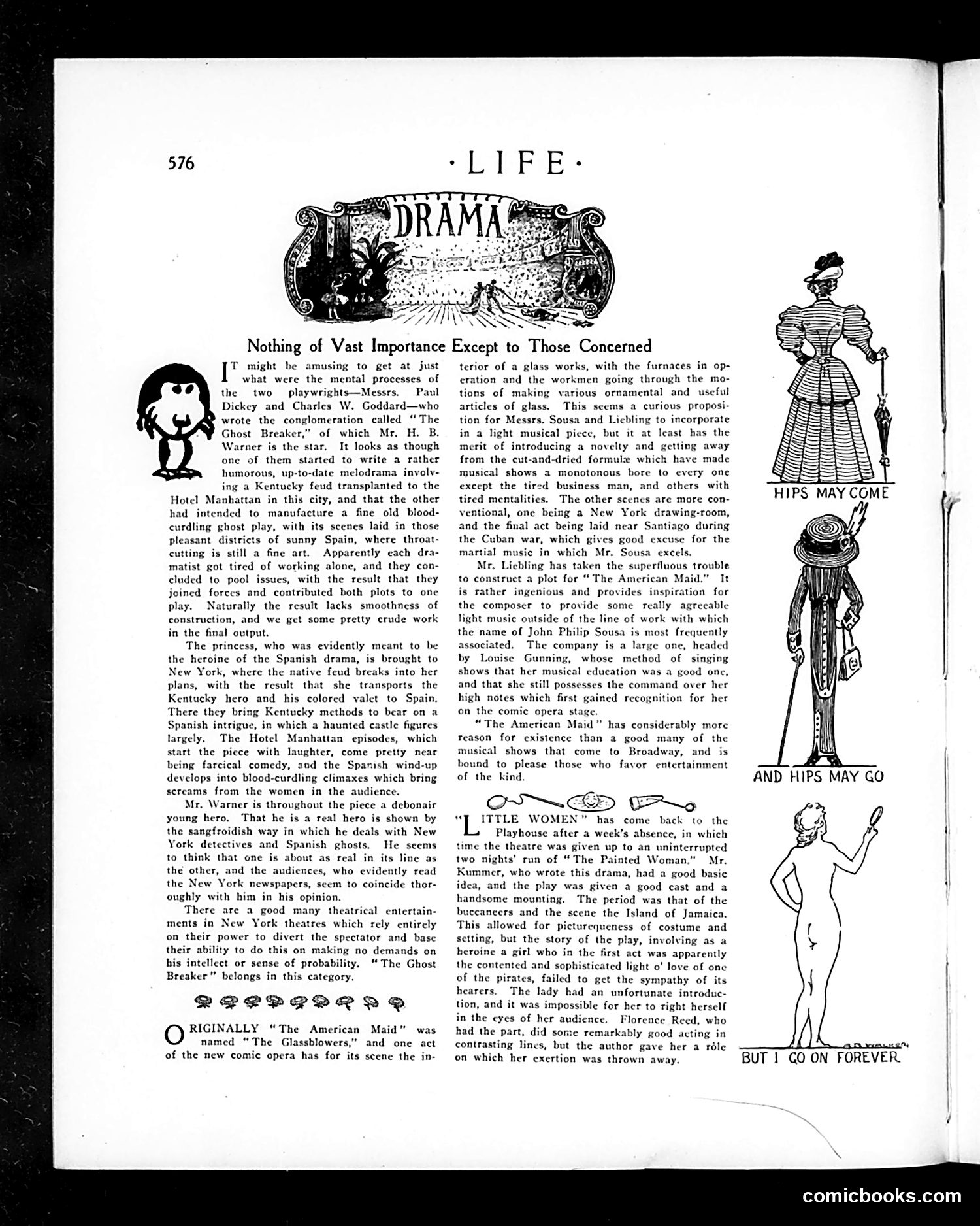
This page reviews theatrical productions with characteristic early-1900s satirical commentary. The main critique concerns "The Ghost Breaker," starring H.B. Warner, which the reviewer argues lazily combines two incompatible plots: a Kentucky feudal melodrama and a Spanish ghost story. The satire mocks the play's lack of coherence—two playwrights apparently gave up collaborating and simply merged both scripts, creating crude entertainment that demands nothing intellectually from audiences. The illustrations on the right appear to be fashion sketches ("Hips May Come and Hips May Go," "But I Go On Forever"), typical Life magazine content satirizing women's changing silhouettes and fashion trends of the era. A secondary review discusses "The American Maid," a comic opera by Sousa and Liebling, noting its unusual inclusion of a glass factory scene, praising its novelty while acknowledging most audiences prefer conventional musical theater formulas.
📄 Transcribed text from this page (OCR, searchable)
Machine-transcribed from the original scan — historical spelling and the odd misread are preserved.
Nothing of Vast Importance Except to Those Concerned I might be amusing to get at just what were the mental processes of the two playwrights—Messrs. Paul Dickey and Charles W. Goddard—who wrote the conglomeration called “ The Ghost Breaker,” of which Mr. H. B. Warner is the star. It looks as though one of them started to write a rather humorous, up-to-date melodrama involv- ing a Kentucky feud transplanted to the Hotel Manhattan in this city, and that the other had intended to manufacture a fine old blood- curdling ghost play, with its scenes laid in those nt districts of sunny Spain, where throat- ing is still a fine art. Apparently each dra- matist got tired of working alone, and they con- cluded to pool issues, with the result that they joined forces and contributed both plots to one play. Naturally the result lacks smoothness of construction, and we get some pretty crude work in the final output. The princess, who was evidently meant to be the heroine of the Spanish drama, is brought to New York, where the native feud breaks into her plans, with the result that she transports the Kentucky hero and his colored valet to Spain. There they bring Kentucky methods to bear on a Spanish intrigue, in which a haunted castle figures largely. The Hotel Manhattan episodes, which start the picce with laughter, come pretty near being farcical comedy, and the Spanish wind-up develops into blood-curdling climaxes which bring screams from the women in the audience. Mr. Warner is throughout the piece a debonair young hero, That he is a real hero is shown by the sangfroidish way in which he deals with New York detectives and Spanish ghosts. He seems to think that one is about as real in its line as the other, and the audiences, who evidently read the New York newspapers, seem to coincide thor- oughly with him in his opinion. There are a good many theatrical entertain- ments in New York theatres which rely entirely on their power to divert the spectator and base their ability to do this on making no demands on his intellect or sense of probability. “The Ghost Breaker” belongs in this category. RASDPA@QRQS RIGINALLY “The American Maid” was named “The Glassblowers,” and one act of the new comic opera has for its scene the in- terior of a glass works, with the furnaces in op- eration and the workmen going through the mo- tions of making various ornamental and useful articles of glass. This seems a curious proposi- tion for Messrs, Sousa and Licbling to incorporate in a light musical picce, but it at least has the merit of introducing a novelty and getting away from the cut-and-dried formule which have made musical shows a monotonous bore to every one except the ti business man, and others with tired mentalities. The other scenes are more con- ventional, one being a New York drawing-room, and the final act being laid near Santiago during the Cuban war, which gives good excuse for the martial music in which Mr, Sousa excels. Mr. Licbling has taken the superfluous trouble to construct a plot for “ The American Maid.” It is rather ingenious and provides inspiration for the composer to provide some really agreeable light music outside of the line of work with which the name of John Philip Sousa is most frequently associated. The company is a large one, headed by Louise Gunning, whose method of singing shows that her musical education was a good one, and that she still possesses the command over her high notes which first gained recognition for her on the comic opera stage. “The American Maid” has considerably more reason for existence than a good many of the musical shows that come to Broadway, and is bound to please those who favor entertainment of the kind. OS™ C~o ITTLE WOM " has come back to the Playhouse after a week's absence, in which time the theatre was given up to an uninterrupted two nights’ run of “The Painted Woman.” Mr. Kummer, who wrote this drama, had a good basic idea, and the play was given a good cast and a handsome mounting. The period was that of the buccaneers and the scene the Island of Jamaica. This allowed for picturequeness of costume and setting, but the story of the play, involving as a heroine a girl who in the first act was apparently the contented and sophisticated light 0’ love of one of the pirates, failed to get the sympathy of its hearers. The lady had an unfortunate introduc- tion, and it was impossible for her to right herself in the cyes of her audience. Florence Reed, who had the part, did some remarkably good acting in contrasting lines, but the author gave her a role on which her exertion was thrown away. comicbooks.com