
Life, 1913-03-20 · page 10 of 44
Life — March 20, 1913 — page 10: what you’re looking at
What you’re looking at
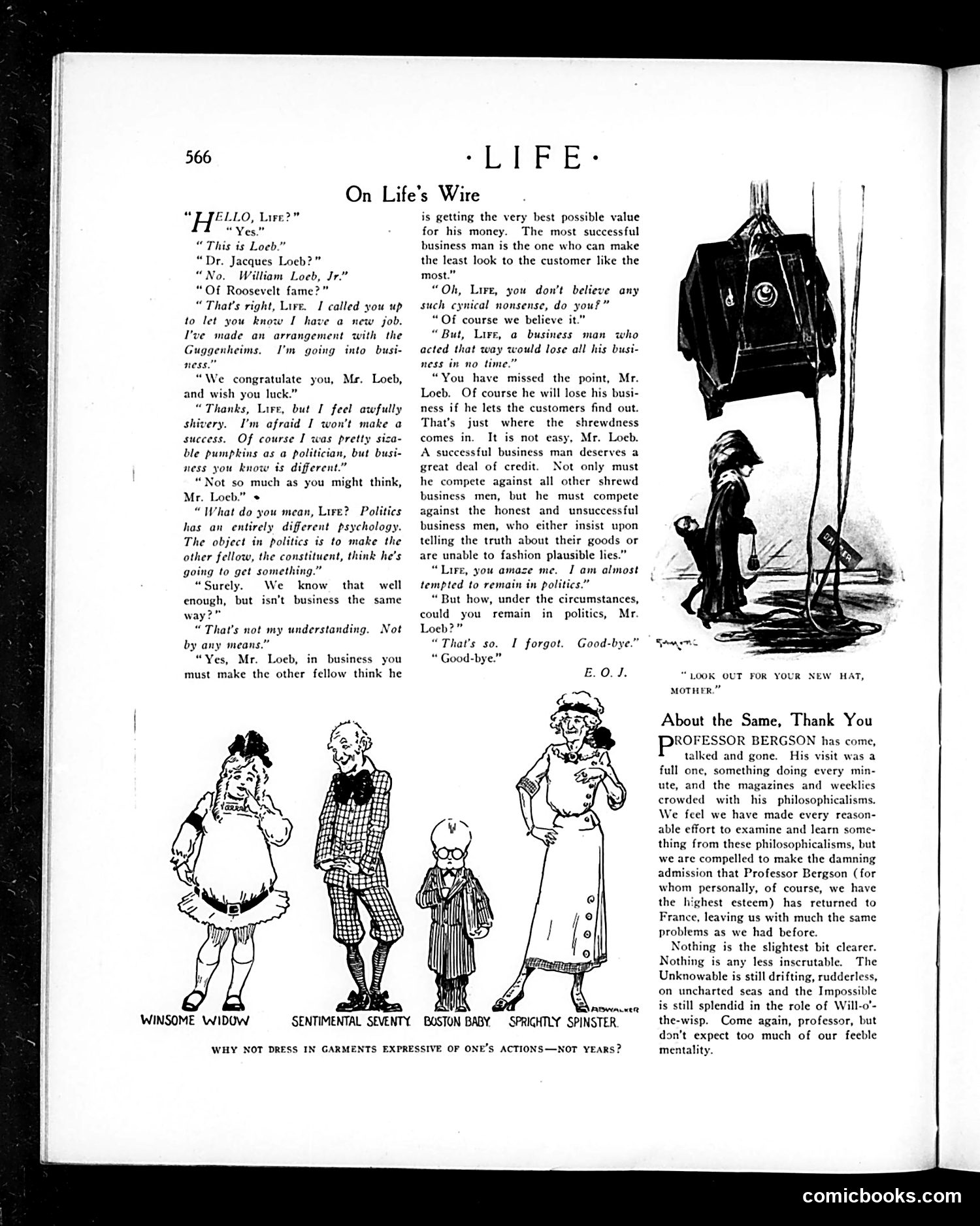
This page contains two satirical pieces: **"On Life's Wire"** is a dialogue between Life magazine and "Mr. Loeb" (likely referring to a notable businessman of the era). The conversation criticizes business ethics, suggesting successful businessmen must deceive customers while maintaining appearances. Life questions whether such dishonesty differs fundamentally from politics, noting both require "making the other fellow think" one thing while pursuing personal gain. **"Why Not Dress in Garments Expressive of One's Actions"** features four cartoon characters labeled by stereotyped female types: "Winsome Widow," "Sentimental Severity," "Boston Baby," and "Sprightly Spinster." This cartoon satirizes women's fashion as potentially misleading—suggesting clothing should honestly reflect character rather than projecting false impressions. Both pieces critique deception in American society.
📄 Transcribed text from this page (OCR, searchable)
Machine-transcribed from the original scan — historical spelling and the odd misread are preserved.
WINSOME WIDOW 566 "LIFE On Life's Wire a ELLO, Lire?” “Yes.” “This is Loeb.” “Dr. Jacques Loeb?” “No. William Loeb, Jr.” “Of Roosevelt fame?” “That's right, Lire. I called you up to let you know I have a new job. I've made an arrangement with the Guggenheims. I’m going into busi- ness. “We congratulate you, Mr. Loeb, and wish you luck.” “Thanks, Lire, but I feel awfully shivery. I'm afraid I won't make a success. Of course I was pretty ble pumpkins as a politician, but busi- ness you know is different.” “Not so much as you might think, Mr. Loeb.” + “What do you mean, Lire? Politics has an entirely different psychology. The object in politics is to make the other fellow, the constituent, think he’s going to get something.” “Surely. We know that well enough, but isn’t business the same way?” “That's not my understanding. by any means.” “Yes, Mr. Loeb, in business you must make the other fellow think he Not is getting the very best possible value for his money. The most successful business man is the one who can make the least look to the customer like the most.” “Oh, Lire, you don’t believe any such cynical nonsense, do youf” “Of course we believe it.” “But, Lire, a business man who acted that way would lose all his busi- ness in no time.” “You have missed the point, Mr. Loeb. Of course he will lose his busi- ness if he lets the customers find out. That’s just where the shrewdness comes in. It is not easy, Mr. Loeb. A successful business man deserves a great deal of credit. Not only must he compete against all other shrewd business men, but he must compete against the honest and unsuccessful business men, who either insist upon telling the truth about their goods or are unable to fashion plausible lies.” “Lire, you amaze me. I am almost tempted to remain in politics.” “But how, under the circumstances, could you remain in politics, Mr. Loeb?” “That's so. “ Good-bye.” I forgot. Good-bye.” i (A SENTIMENTAL SEVENTY. BOSTON BABY ADMAKER SPRIGHTLY SPINSTER WHY NOT DRESS IN GARMENTS EXPRESSIVE OF ONE’S ACTIONS—NOT YEARS? Saas “LOOK OUT FOR YOUR NEW MOTHER.” About the Same, Thank You IROFESSOR BERGSON has come, talked and gone. His visit was a full one, something doing every min- ute, and the magazines and wecklies crowded with his philosophicalisms. We feel we have made every reason- able effort to examine and learn some- thing from these philosophicalisms, but we are compelled to make the damning admission that Professor Bergson (for whom personally, of course, we have the highest esteem) has returned to France, leaving us with much the same problems as we had before. Nothing is the slightest bit clearer. Nothing is any less inscrutable. The Unknowable is still drifting, rudderless, on uncharted seas and the Impossible is still splendid in the role of Will-o’- the-wisp. Come again, professor, but don't expect too much of our feeble mentality. HAT, comicbooks.com