
A complete issue · 44 pages · 1913
Life — February 13, 1913
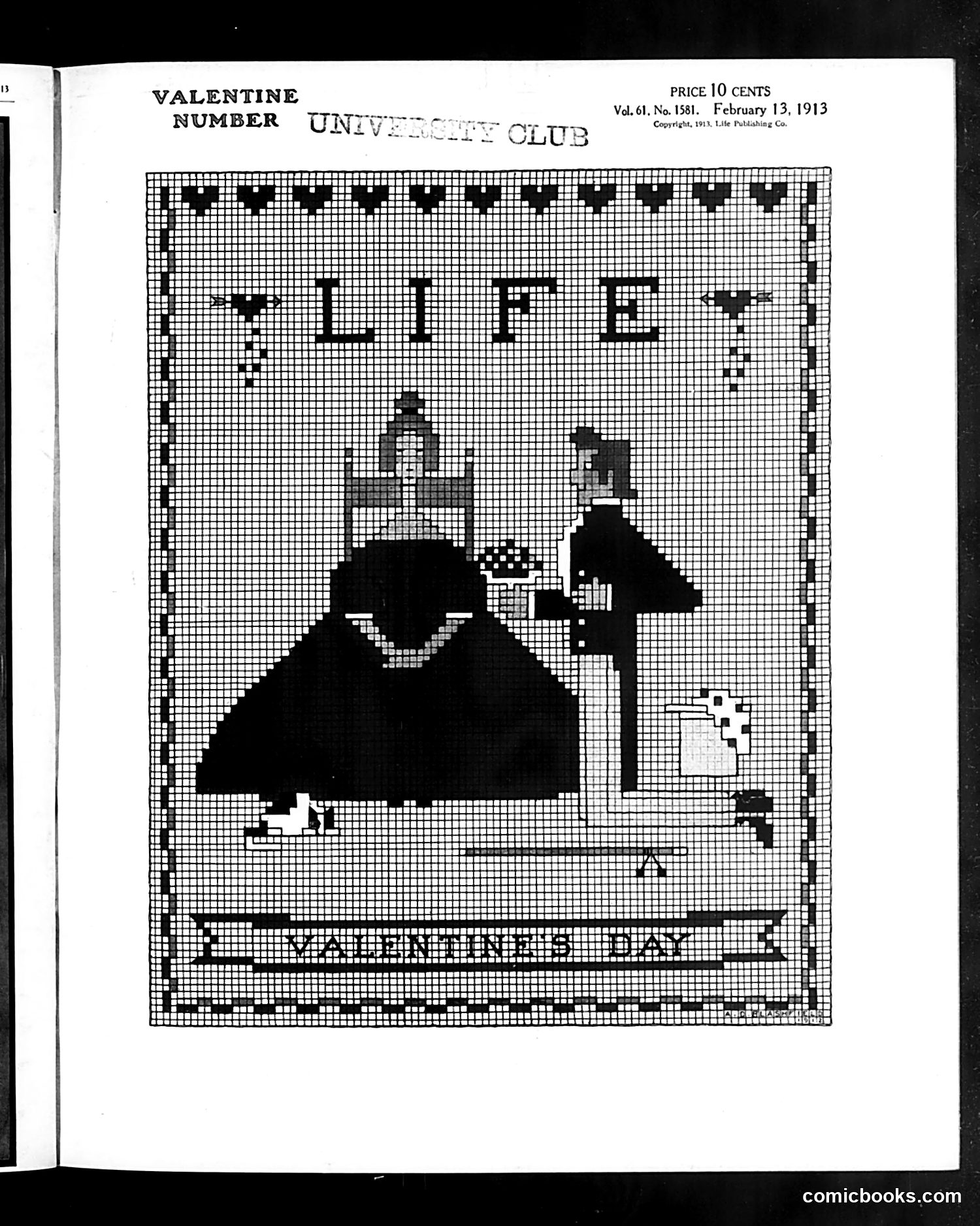
This Valentine-themed cover depicts two silhouetted figures in what appears to be a romantic scene. The man on the left presents a heart to a woman on the right, who stands near a window or doorway of a building. The word "LIFE" appears at the top in decorative lettering, with small heart symbols scattered throughout the border. The illustration uses a pixelated or dotted artistic style typical of early 20th-century printing. Without clearer identification of the specific figures, this appears to be a general romantic Valentine's Day illustration rather than political satire—likely representing an idealized courtship scene meant to appeal to Life magazine's educated, middle-class readership during the Valentine season.
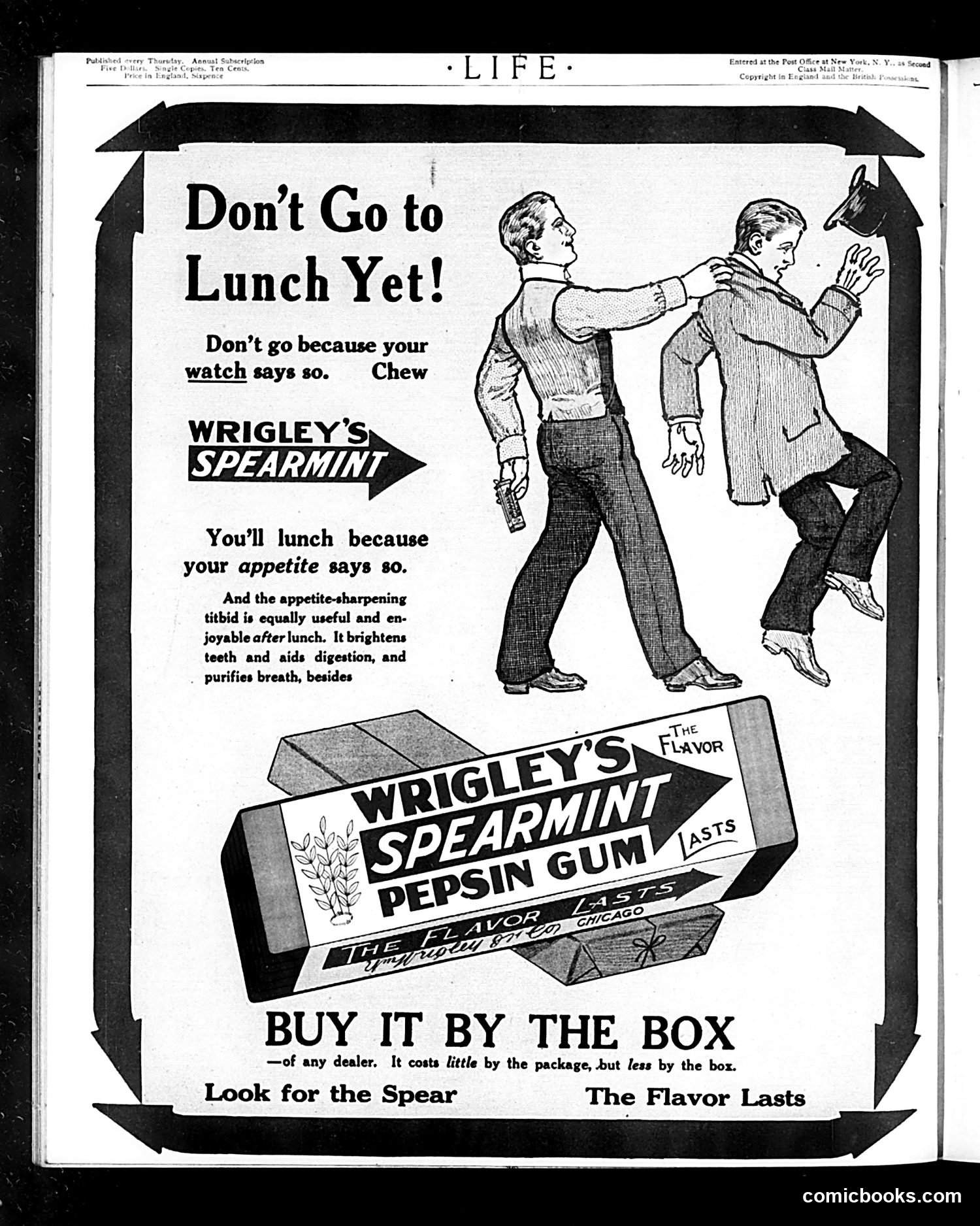
This is a **Wrigley's Spearmint gum advertisement**, not political satire. The ad uses humor to promote chewing gum by depicting two office workers—one trying to leave for lunch while his colleague physically restrains him. The joke plays on conflicting signals: the watch says it's too early for lunch, but appetite suggests otherwise. The ad claims gum serves a practical purpose: it suppresses hunger before lunch while also "brightens teeth and aids digestion, and purifies breath." This was typical early-20th-century advertising rhetoric, making health claims that would later be regulated. The bottom tagline, "The Flavor Lasts," emphasizes product durability—a selling point in an era when gum quality varied significantly.
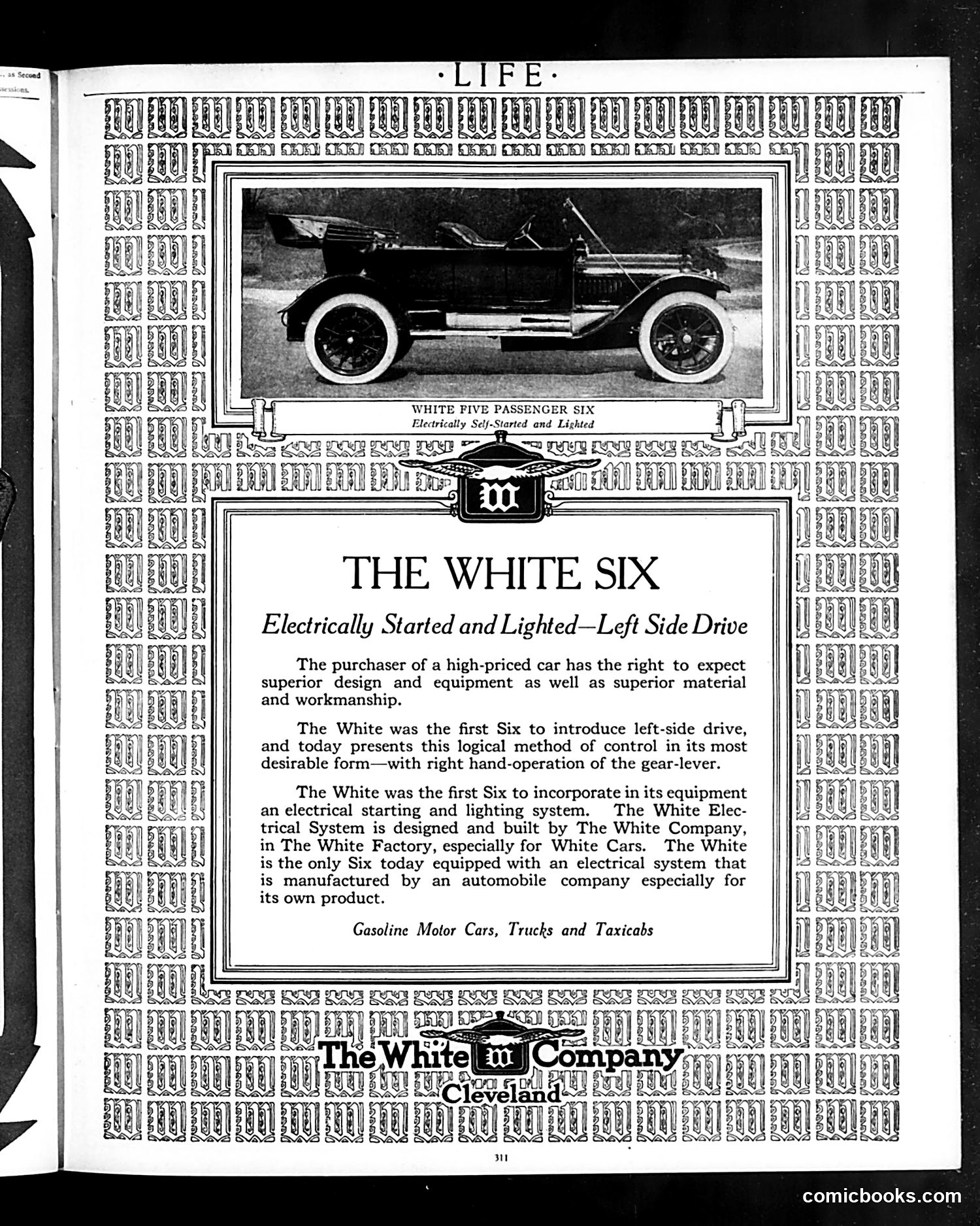
This page is **primarily an advertisement**, not a cartoon. It promotes the White Six automobile from The White Company of Cleveland. The ad emphasizes the car's innovative features: it was the first Six to introduce left-side drive (then considered modern and desirable) and the first to incorporate an electrical starting and lighting system. The text stresses superior design, materials, and workmanship as befitting "a high-priced car." The photograph shows the vehicle's side profile to display its elegant open-air design. The ornate border and prestigious placement in Life magazine reflect the product's luxury positioning. This represents early automotive advertising when electrical systems were novel selling points worthy of prominent magazine space—a far cry from today's vehicle advertisements.
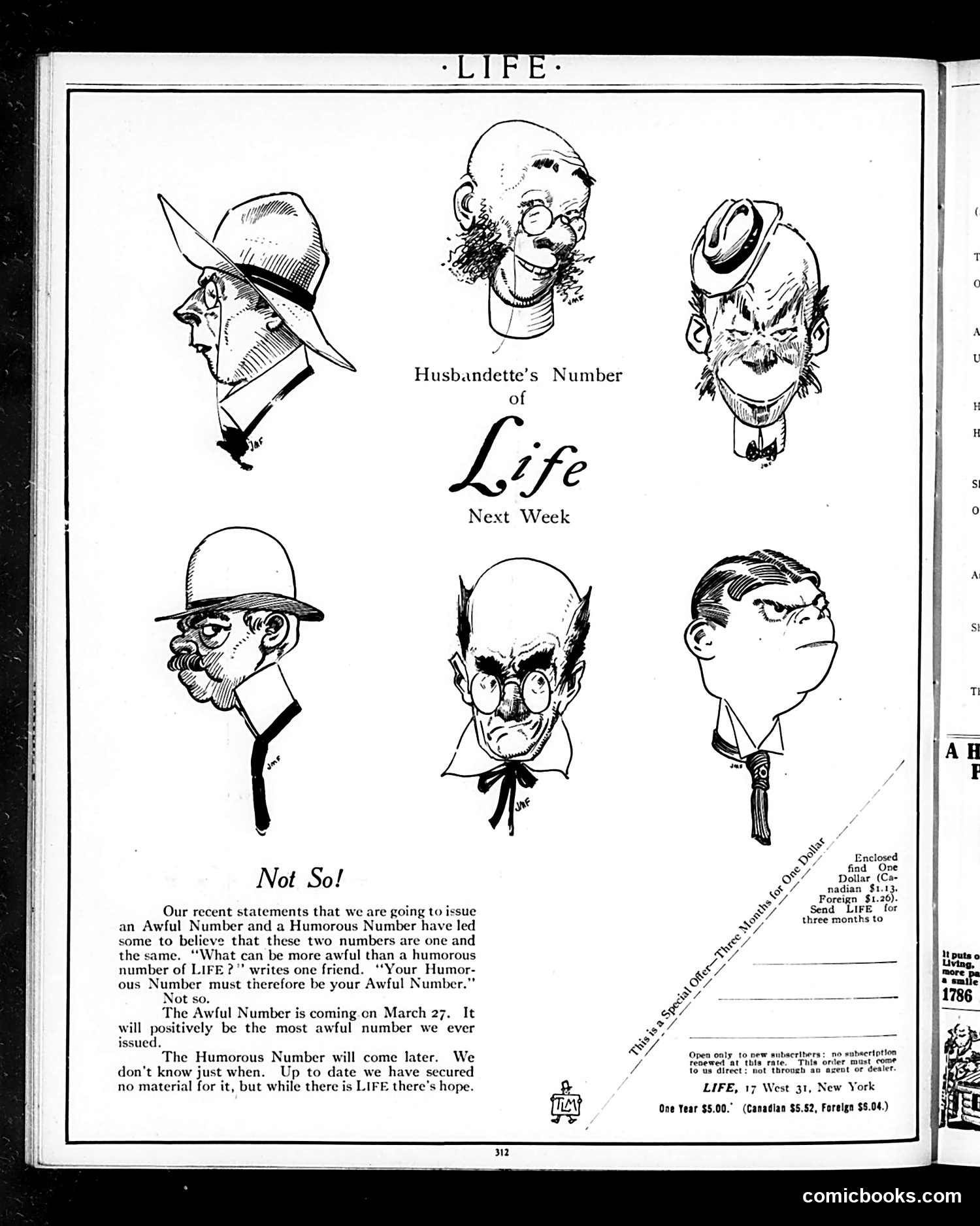
This page announces upcoming special issues of *Life* magazine. The text explicitly states that an "Awful Number" will arrive March 27, followed later by a "Humorous Number." The six caricatured male heads illustrate the distinction: the top row (labeled "Husbandette's Number of Life Next Week") shows three figures in fashionable dress; the bottom row (labeled "Not So!") depicts three grotesque, unflattering exaggerated caricatures. The accompanying text clarifies the magazine's position: these are *not* the same thing. A reader's suggestion that "Your Humorous Number must therefore be your Awful Number" is rejected. The satire suggests that while humor can be awful, awfulness isn't necessarily humorous—contrasting refined comedy with crude ugliness. The specific identities of these caricatured men remain unclear without additional historical context.
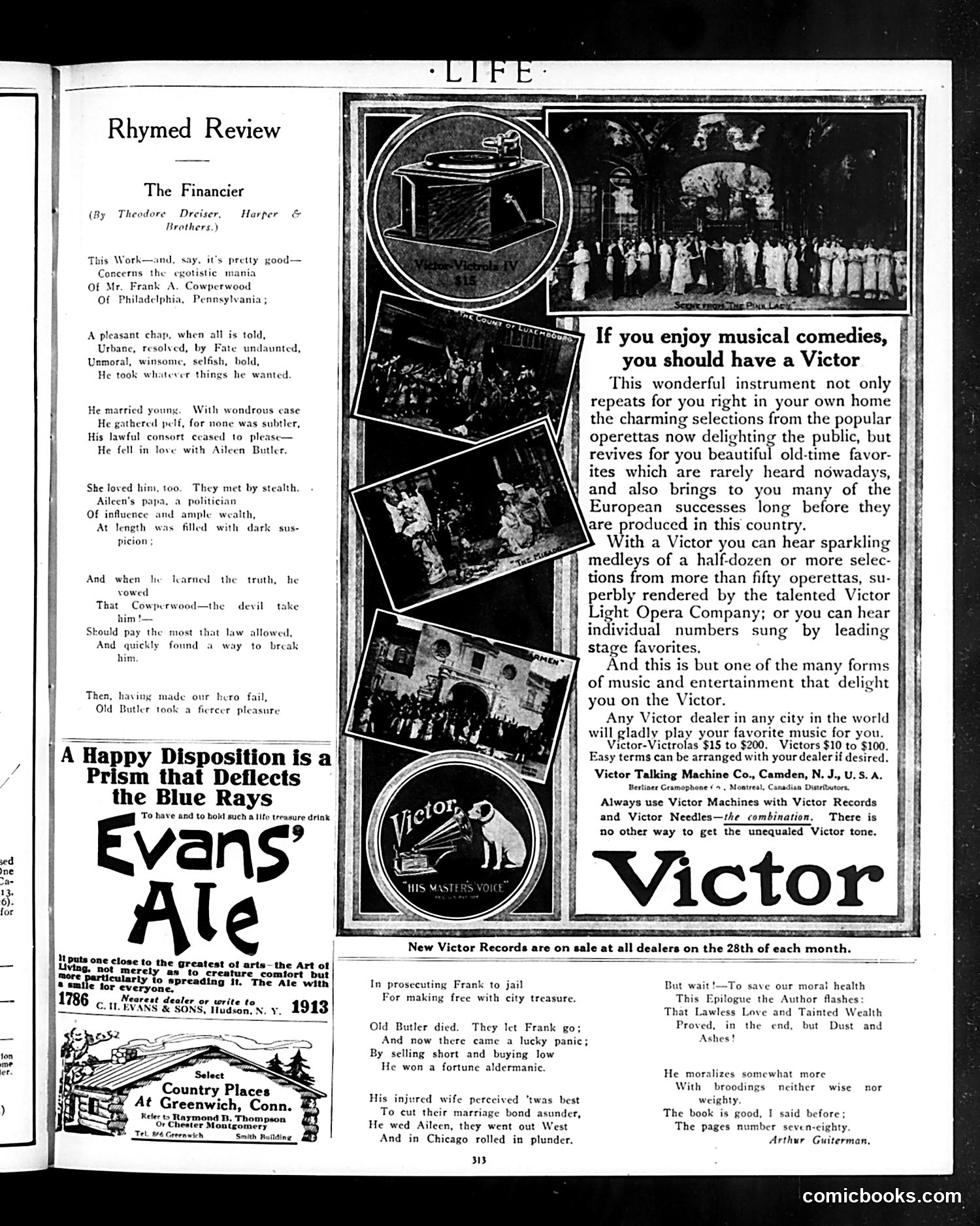
This page is primarily **advertising**, not political satire. The dominant right-hand section promotes Victor Talking Machines and phonograph records, emphasizing their ability to replay operettas and musical comedies at home. The left side contains a **rhymed review** of "The Financier" by Theodore Dreiser, summarizing the novel's plot about a man named Frank A. Cowperwood who rises through questionable financial dealings and romantic entanglements, ultimately facing legal trouble. Below this is an **Evans' Ale advertisement** using a pun ("A Happy Disposition is a Prism that Deflects the Blue Rays"). The bottom advertises country properties near Greenwich, Connecticut. There is **no political cartoon** on this page—it's a standard magazine layout mixing editorial content with contemporary commercial advertisements.
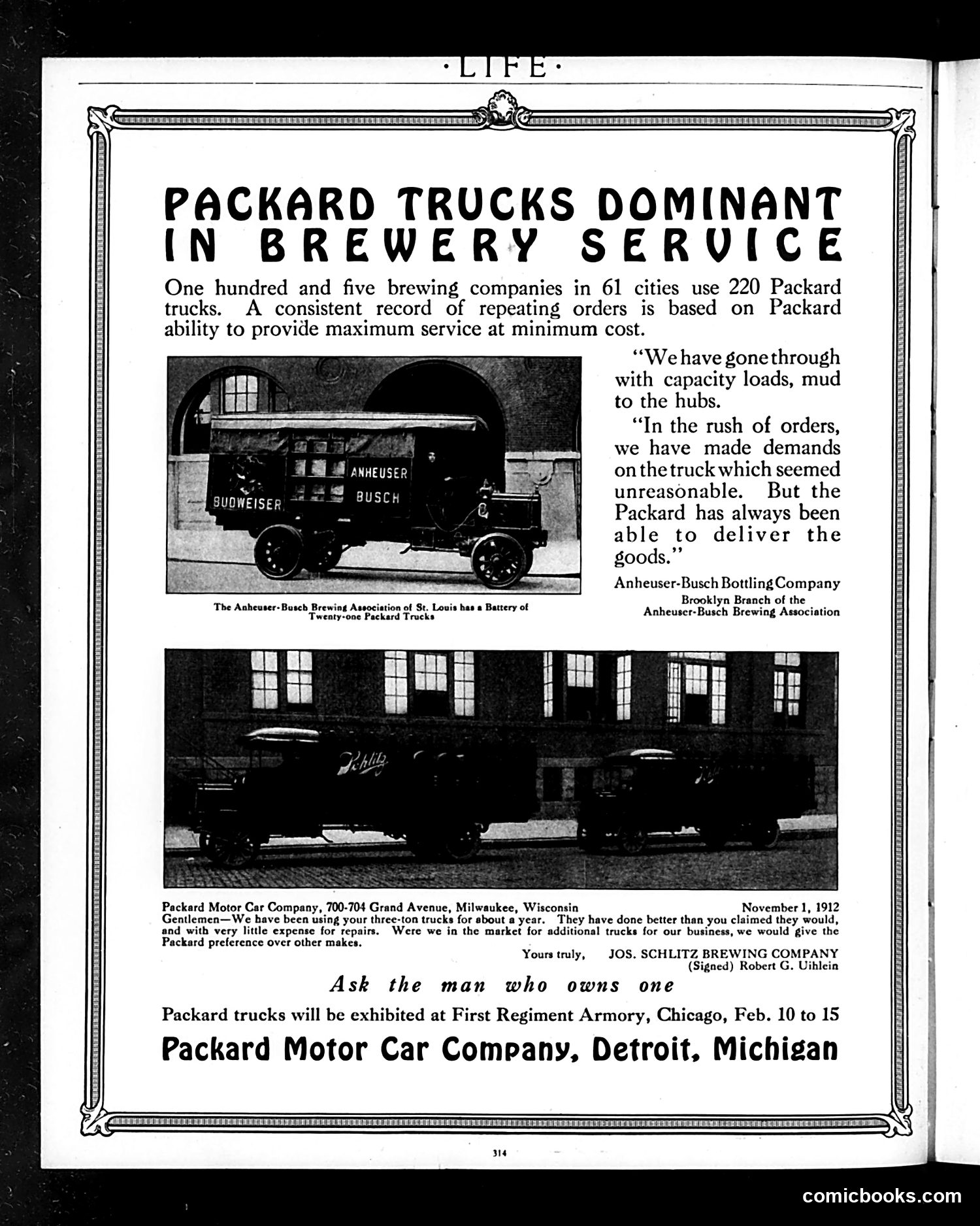
This page is **primarily advertising**, not satire or political commentary. It promotes Packard Motor Car Company's commercial trucks for brewery deliveries. The content includes: - **Two photographs** of Packard trucks (one Budweiser-branded, one unmarked) used by brewing companies - **A testimonial** from the Schlitz Brewing Company (dated November 1, 1912) praising Packard trucks' reliability and delivery capability - **Statistics**: 105 brewing companies across 61 cities use 220 Packard trucks The message is straightforward business advertising: Packard trucks are dependable for industrial brewery transport. The tagline "Ask the man who owns one" emphasizes customer satisfaction through direct recommendation. An exhibition notice mentions Packard trucks will be displayed in Chicago, February 10-15. This reflects early automotive history when trucks were marketed specifically to commercial enterprises.
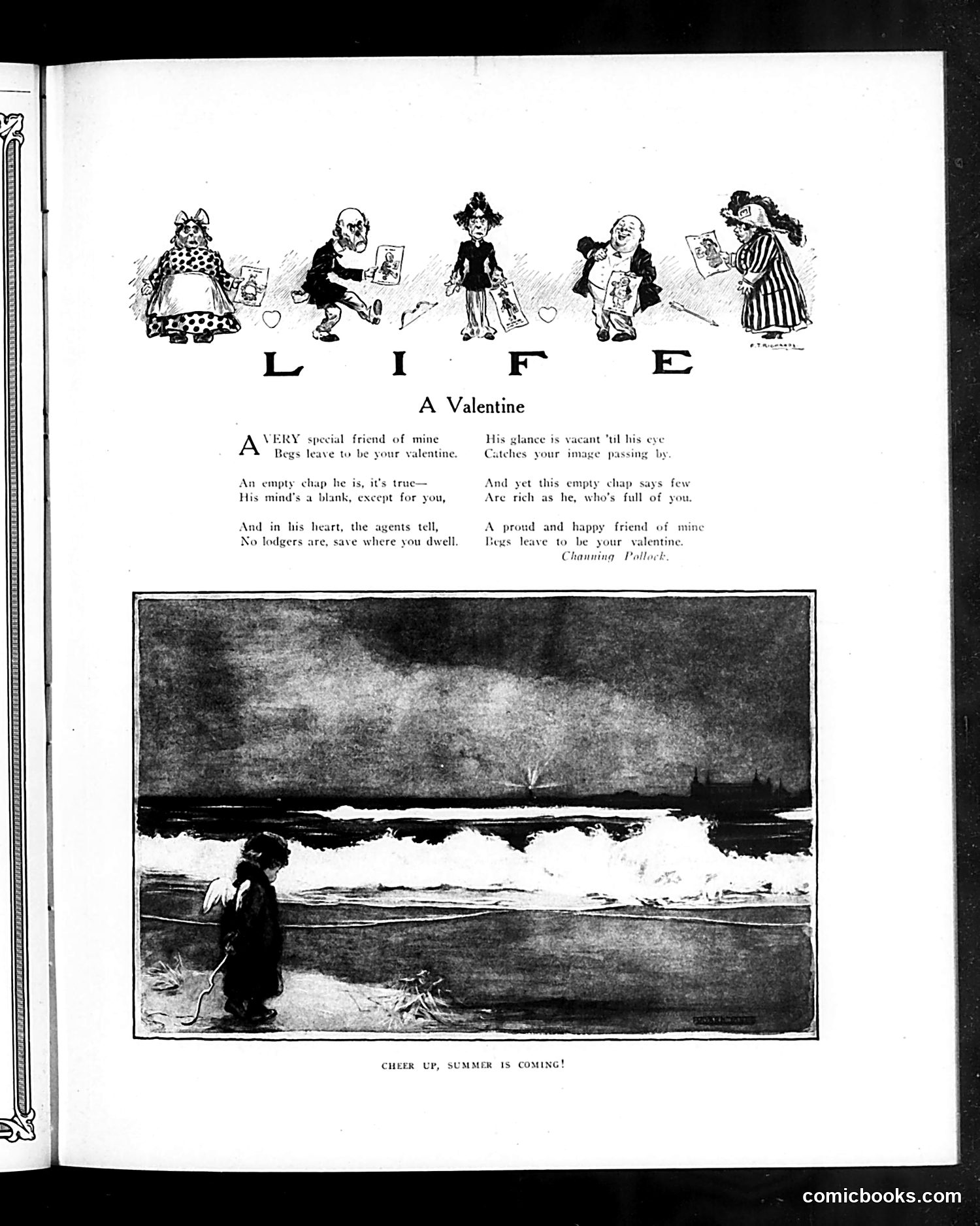
This is a Valentine's Day-themed page from *Life* magazine featuring two distinct elements: **Top Section ("LIFE - A Valentine"):** Five caricatured figures representing different character types or social stereotypes. The accompanying poem by Channing Pollock celebrates an "empty chap" as a valentine—someone vacant-minded yet unpretentious, contrasting favorably with someone "full of" themselves. The satire appears to mock pretentiousness and vanity. **Bottom Section:** A photograph or illustration captioned "CHEER UP, SUMMER IS COMING!" showing a solitary figure sitting pensively by a stormy sea with large waves. This appears to offer melancholic contrast to the Valentine's sentiment above, suggesting some readers might not find romantic cheer during difficult times. The page juxtaposes lighthearted character satire with more somber seasonal imagery.
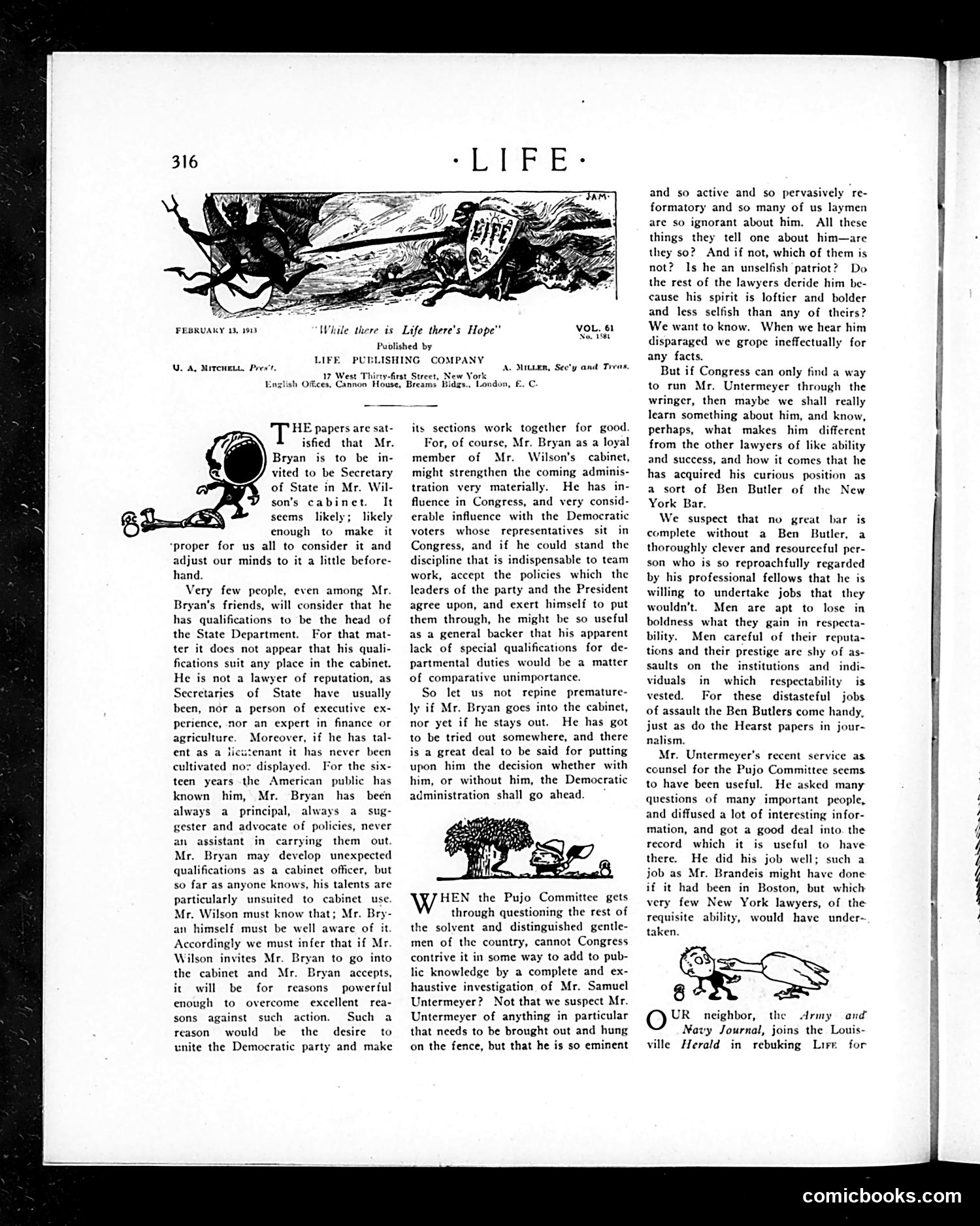
This February 13, 1913 issue discusses William Jennings Bryan's potential appointment as Secretary of State under President Wilson. The article debates whether Bryan—a three-time presidential candidate and prominent Democrat—has the qualifications for high office, despite his lack of diplomatic experience. The cartoon critiques Bryan's suitability, using visual caricature (the large head suggests pomposity or overconfidence). The text satirizes Bryan's political prominence versus actual expertise, questioning whether his popularity and influence within the Democratic Party compensate for his inexperience in departmental administration and foreign policy. The piece also references the Pujo Committee's ongoing investigation into Samuel Untermeyer, suggesting concerns about Bryan's qualifications compared to other potential cabinet members.
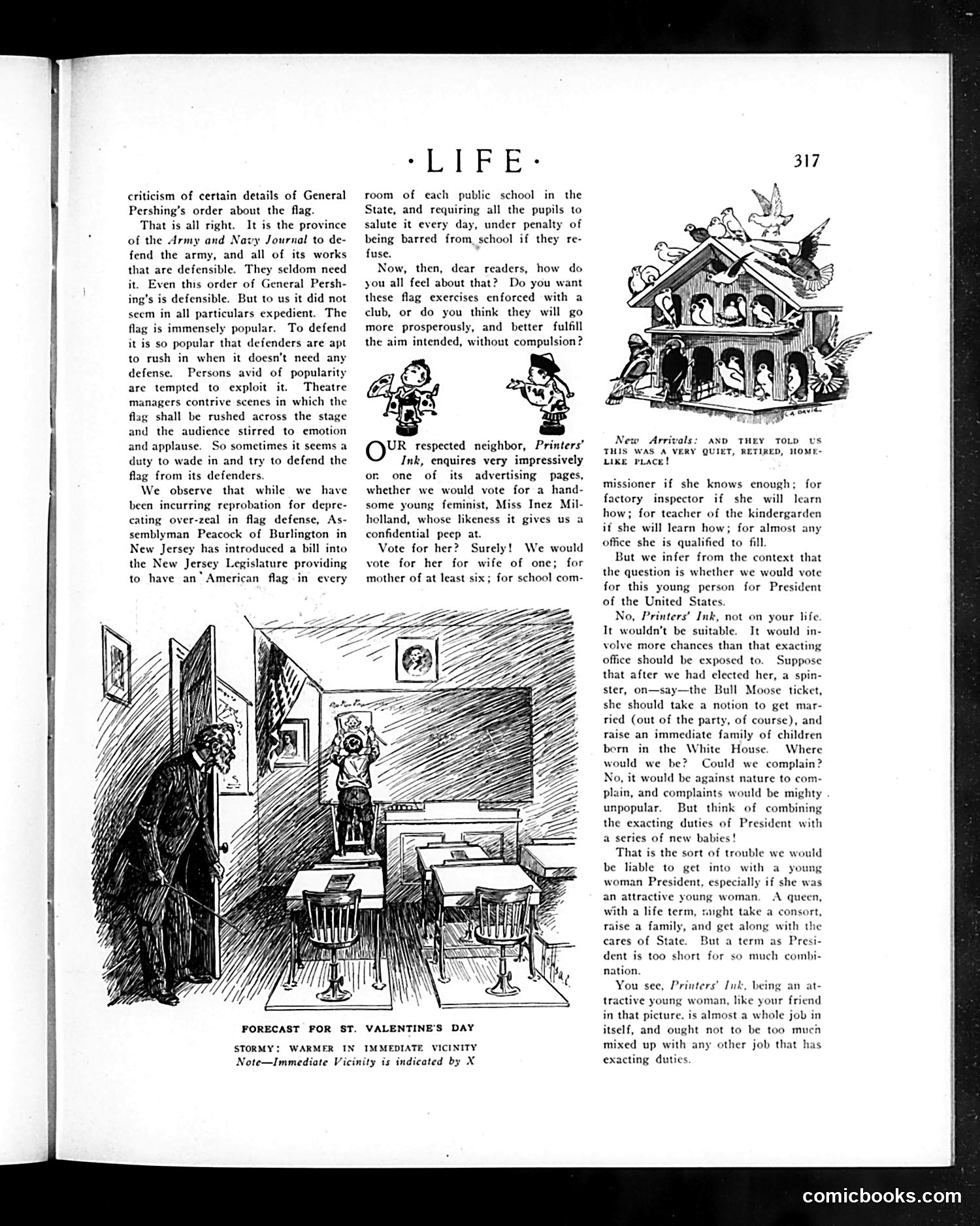
The page contains a satirical editorial addressing flag exercises in schools. The text criticizes mandatory daily flag salutes, arguing they've become unpopular despite defenders claiming they're necessary for patriotic defense. The main cartoon ("Forecast for St. Valentine's Day") depicts a romantic couple in a bedroom, with a caption about "stormy" weather. The satire appears to mock concerns about young women in public life—specifically referencing "Miss Inez Milholland," a feminist activist. The editorial sarcastically suggests voting for a young woman for President, then absurdly warns this could lead to presidential babies and domestic complications, undermining her ability to govern. This reflects 1910s-20s anxieties about women's suffrage and political participation.
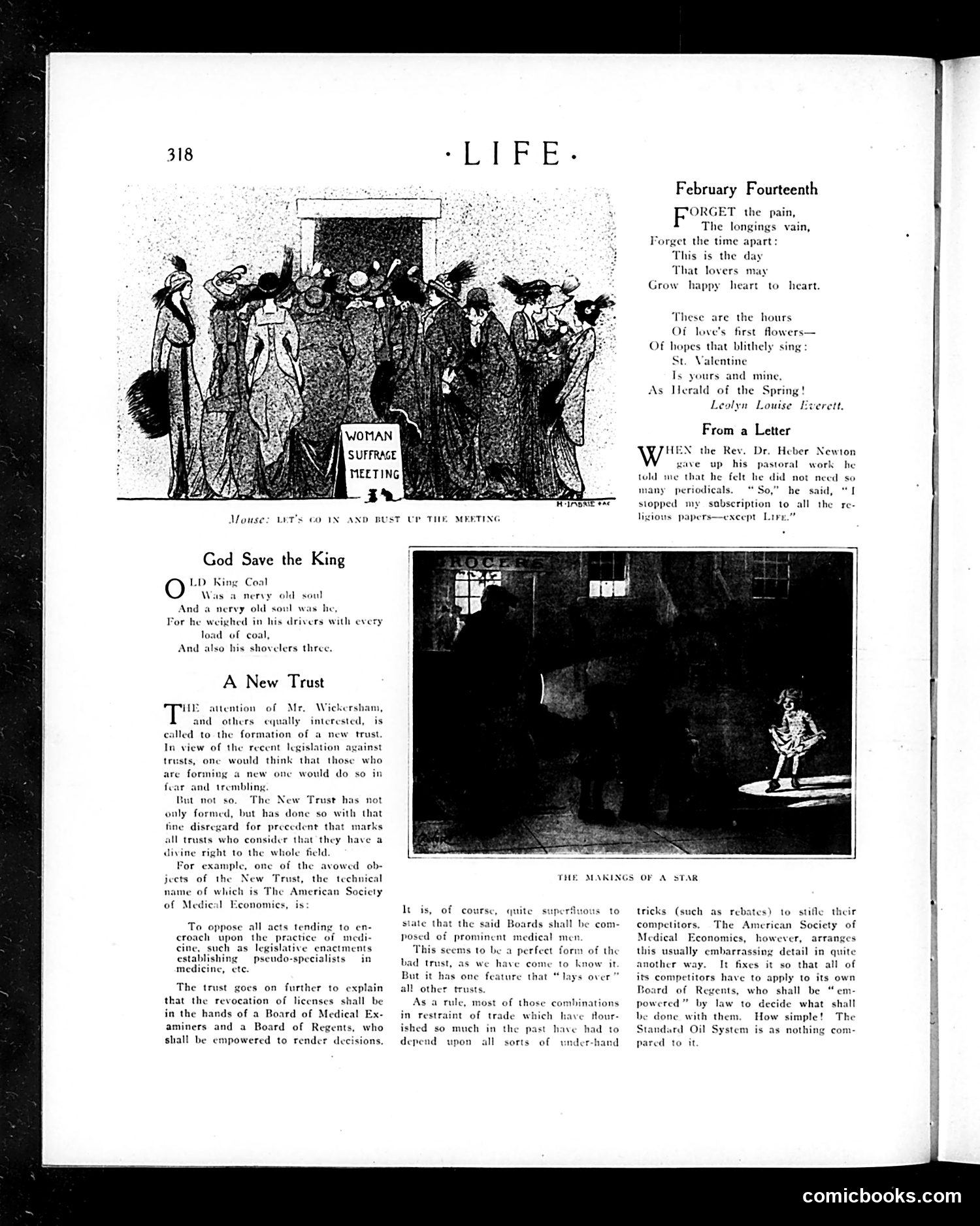
This cartoon depicts a woman suffrage meeting being disrupted by a rowdy mob. The caption "Woman Suffrage Meeting" and the sign visible in the crowd indicate this satirizes opposition to women's voting rights. The chaotic scene—with figures appearing aggressive and disorderly—reflects actual historical disruptions that anti-suffrage groups staged against suffragists' public gatherings in the early 20th century. The satire appears to mock these disruptors by portraying them as an unruly, uncivilized rabble, rather than depicting suffragists negatively. This supports women's suffrage activism, presenting opponents as hostile to democratic assembly and reasoned debate.
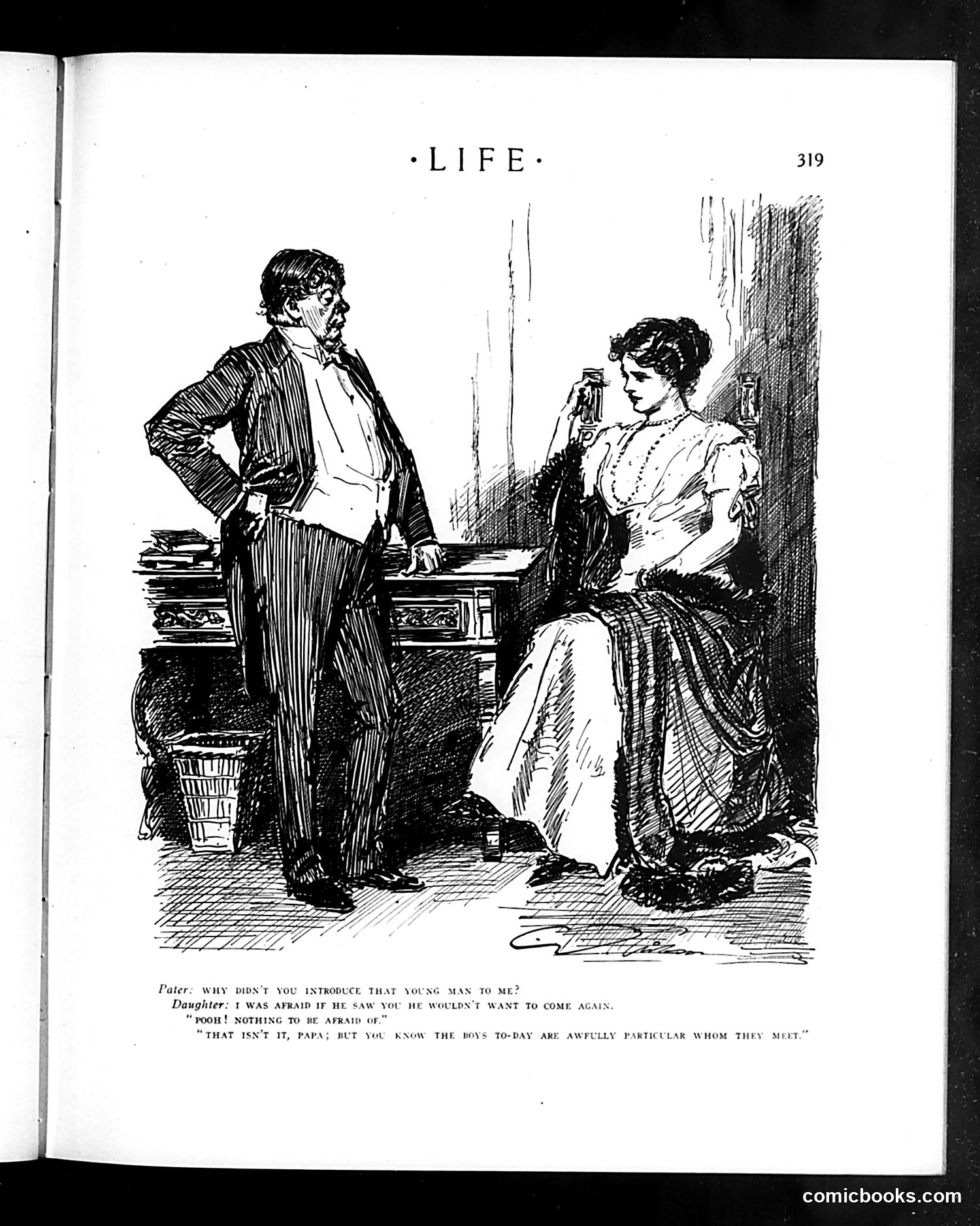
This single-panel cartoon depicts a social interaction between a father and daughter. The father stands with hand on hip, asking why the daughter hasn't introduced him to "that young man." The daughter, seated, responds that she was afraid he wouldn't want to come again—"nothing to be afraid of," the father assures her. He then adds the punchline: "That isn't it, Papa; but you know the boys to-day are awfully particular whom they meet." The satire targets early 20th-century generational anxiety about parental respectability. The joke implies the father himself may be socially embarrassing or of questionable reputation, making him unsuitable company for the daughter's suitor. It mockingly reflects both paternal vanity and period concerns about courtship etiquette and social standing.
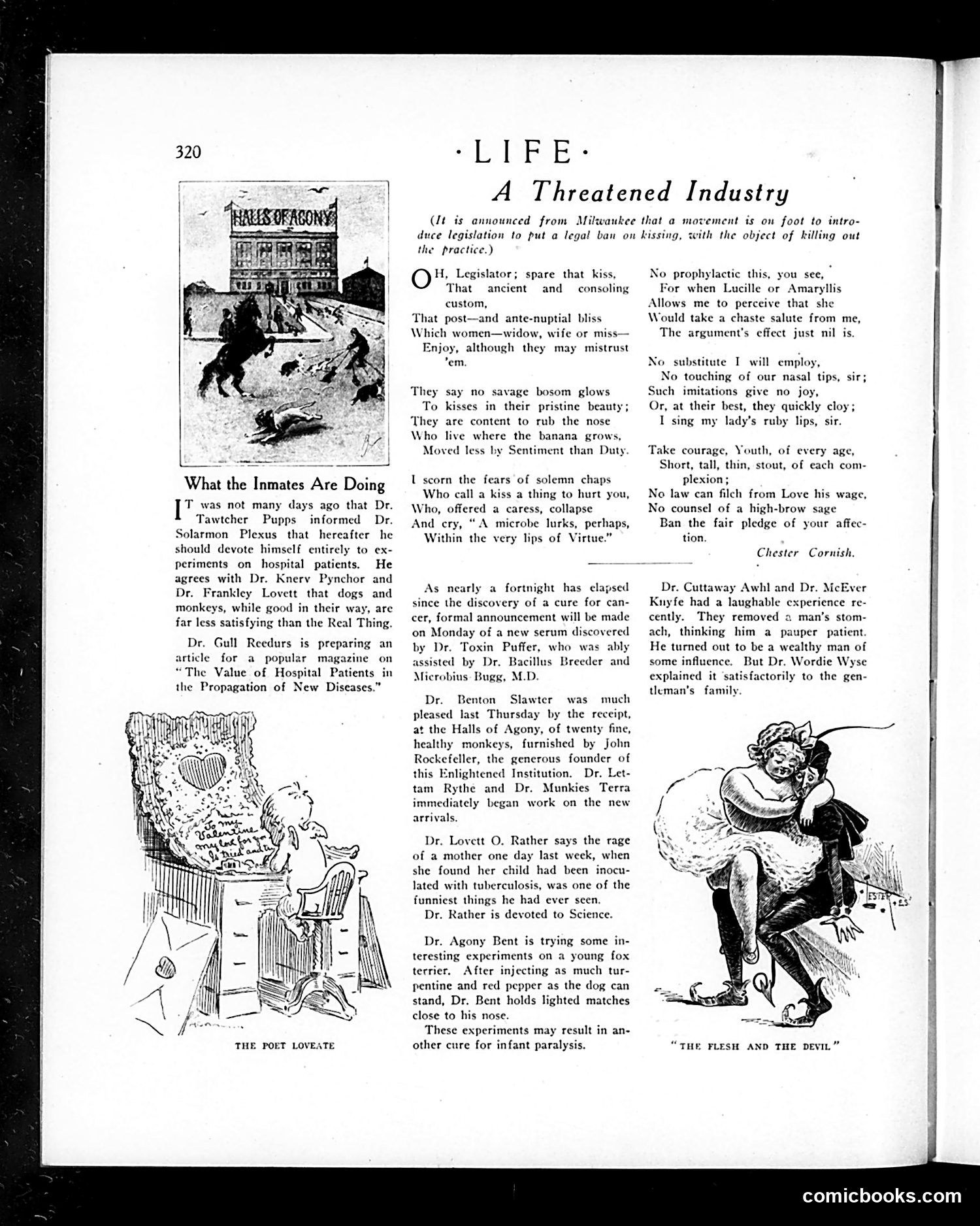
This satirical article attacks proposed legislation to ban kissing in Milwaukee, Wisconsin. The main cartoon shows a woman rejecting a man's advances with the caption "What the Inmates Are Doing" — suggesting hospital patients are conducting unauthorized romantic experiments. The accompanying poem mocks the kiss-ban proposal by defending kissing as an "ancient and consoling custom." It argues that kisses cannot be legislated away and celebrates them as natural human behavior. The smaller cartoons ("The Poet Loveate" and "The Flesh and the Devil") support the satire through humorous depictions of romantic entanglement. The piece ridicules what it views as government overreach into private intimate behavior, presenting the proposed ban as absurdly puritanical and unenforceable.
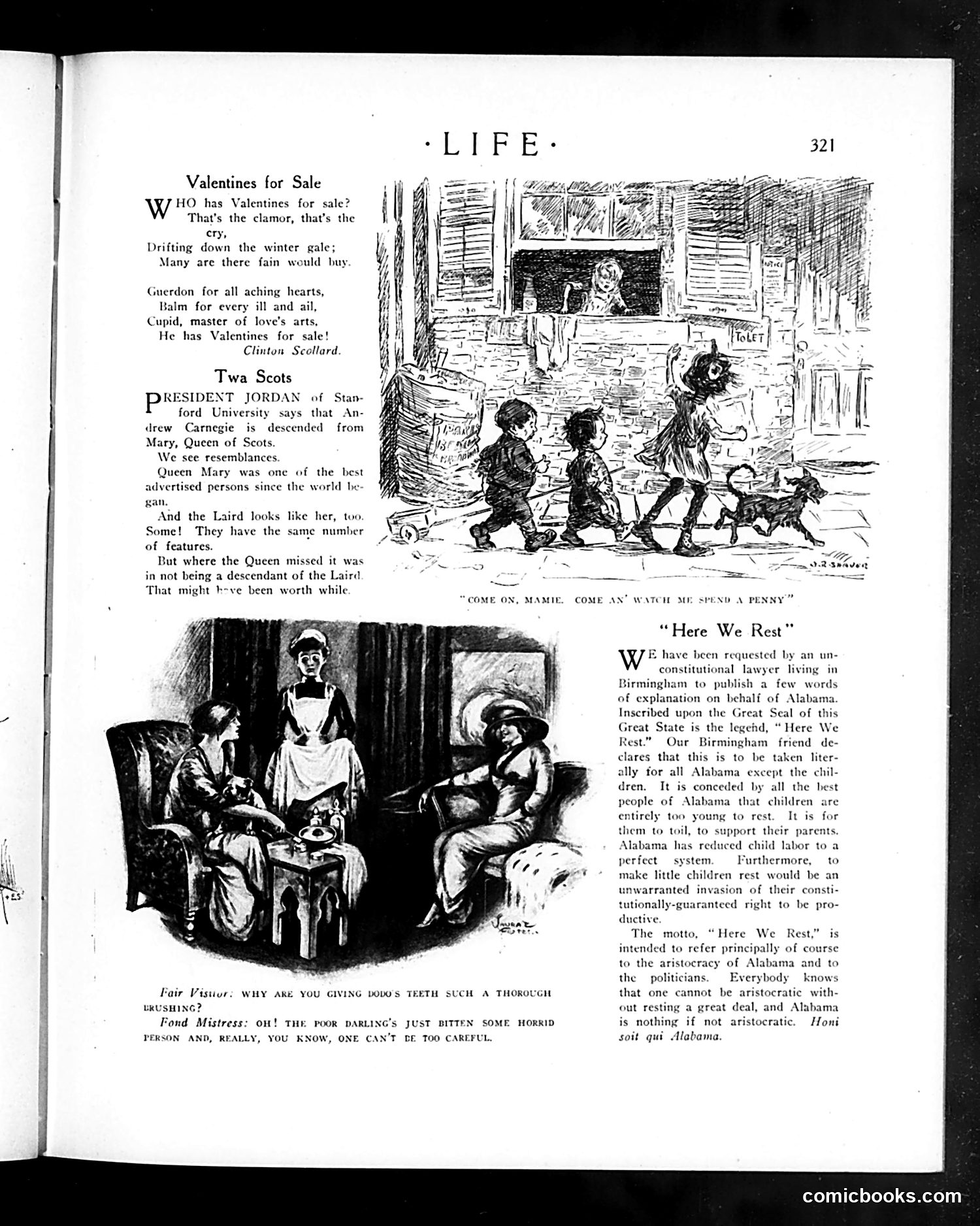
This page contains three distinct pieces of humor: 1. **"Valentines for Sale"** — A poem by Christian Schofield offering metaphorical "valentines" (solutions) for life's problems, playing on commercial Valentine's Day sentiment. 2. **"Twa Scots"** — A brief satirical item comparing President Jordan of Stanford University and Andrew Carnegie, joking about their Scottish descent and physical resemblance to Queen Mary. 3. **"Here We Rest"** — The main piece satirizes Alabama's state motto by mocking the state's claims of aristocracy while exploiting child labor. A Birmingham lawyer requests this explanation, noting Alabama's contradiction: it prevents children from resting while claiming aristocratic status that requires leisure. The satire targets Alabama's hypocrisy regarding child welfare and social hierarchy. The lower illustration depicts a domestic scene with servants, supporting the aristocracy theme.
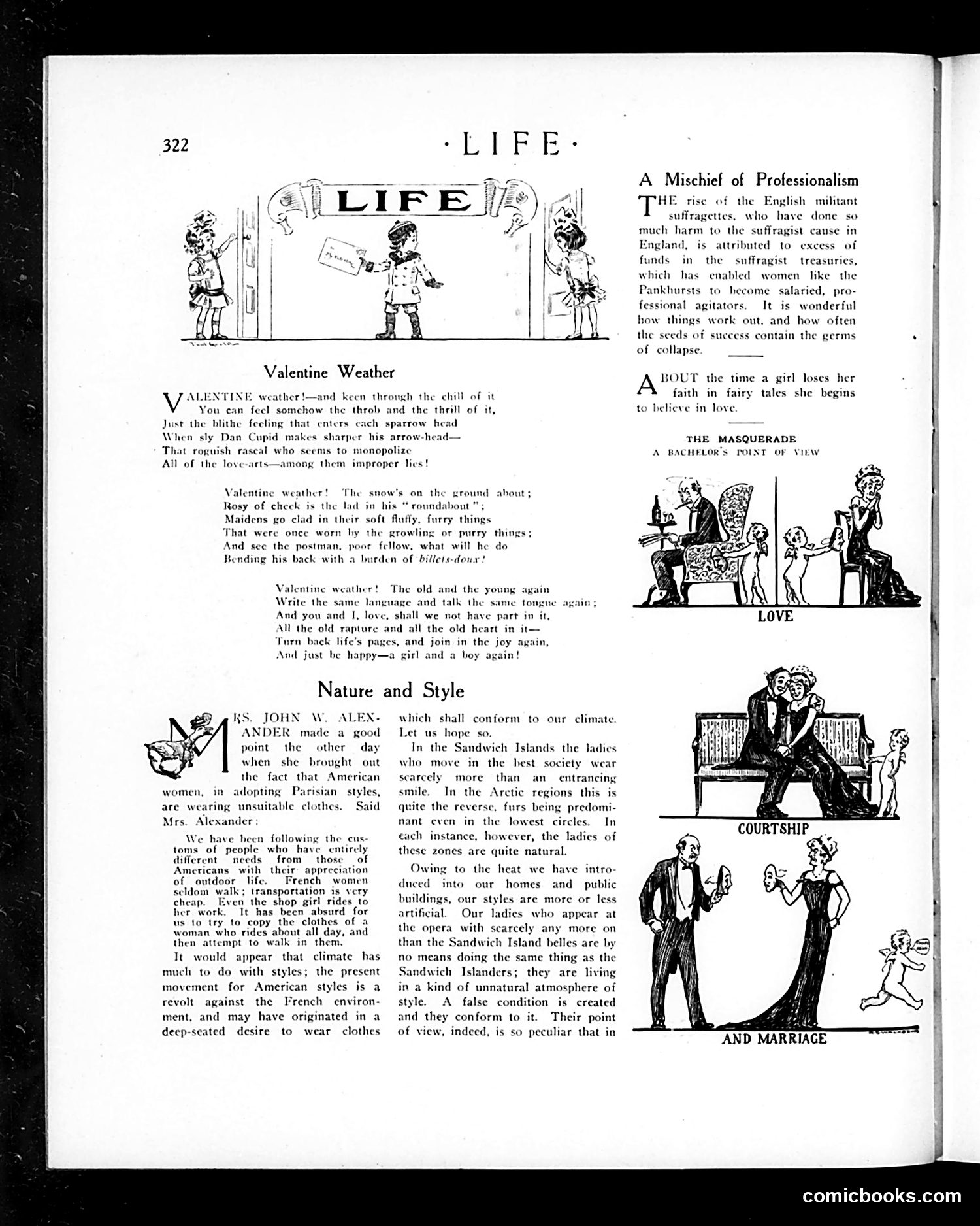
This page contains literary and illustrative content rather than political cartoons. The main features are: **"Valentine Weather"** — A poem by an unnamed author celebrating romantic winter scenery, using traditional love metaphors. **"Nature and Style"** — An article discussing American women's adoption of Parisian fashion, attributed to "Mrs. John W. Alexander." The piece critiques how climate influences clothing choices, noting that American women increasingly wear French styles despite their unsuitability for different climates. It suggests this represents a cultural shift away from French environmental influence. **Comic illustrations** on the right show domestic scenarios labeled "Love," "Courtship," and "Marriage" — apparently satirizing romantic progression through humor. The page reflects early 20th-century debates about American cultural independence from European (particularly French) fashion and social traditions.
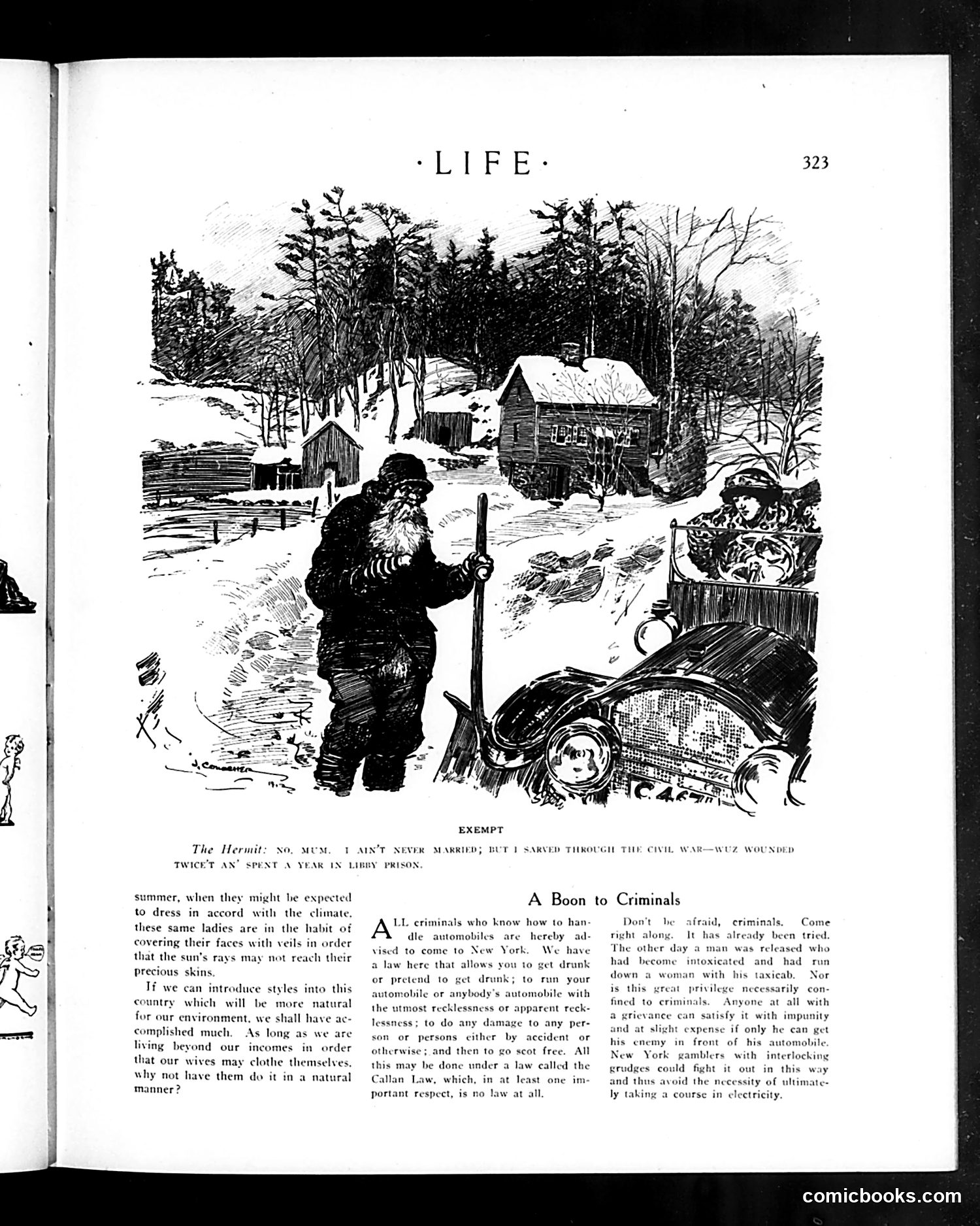
This page contains two distinct pieces of satire: **"The Hermit" (top):** A cartoon mocking upper-class women's fashion contradictions. The hermit character critiques wealthy women who wear heavy veils in summer to protect their skin from sun damage, while their families live "beyond our incomes" to afford fashionable clothing. The satire attacks both excessive concern with appearance and conspicuous consumption beyond one's means. **"A Boon to Criminals" (bottom):** This article sarcastically praises New York's "Callan Law" as beneficial to criminals. It describes how the law allows drunk drivers to cause damage with near-total impunity—the satirist cites a real case of an intoxicated man who hit a woman with his taxi and faced no serious consequences. The piece argues the law is essentially toothless ("no law at all") and mocks New York's lenient treatment of reckless automobile drivers, a growing concern in the early automotive era. Both pieces target perceived social absurdities and legal failures affecting public welfare.
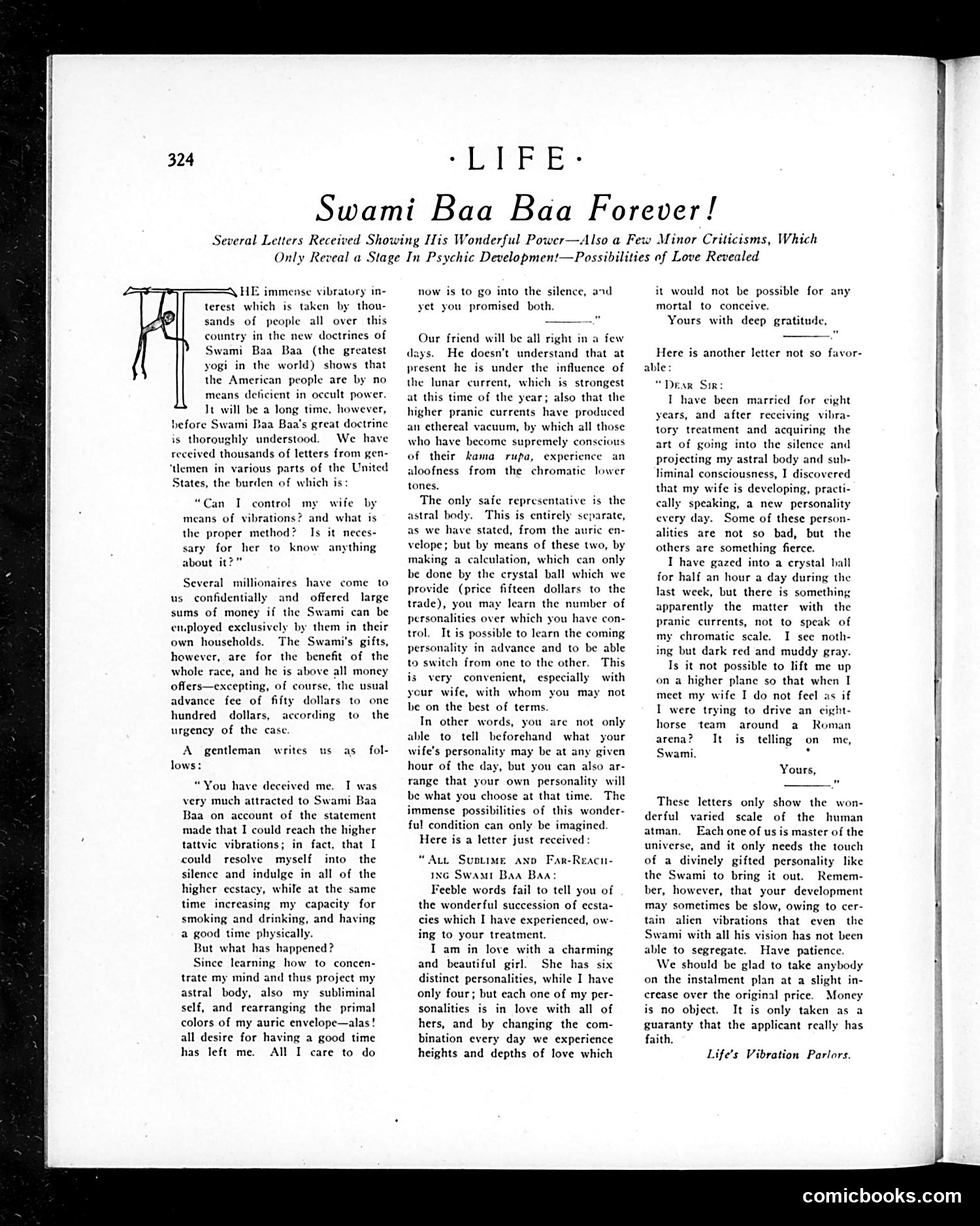
This page satirizes the early 20th-century American fascination with occultism and pseudo-spiritual gurus. "Swami Baa Baa" appears to be a fictional charlatan selling dubious "vibratory" and mystical services to credulous wealthy Americans. The cartoon's targets include: 1. **Gullible wealthy clients** seeking supernatural solutions to mundane problems (controlling wives, improving love lives) 2. **Fraudulent spiritual practitioners** exploiting occult terminology ("kama rupa," "astral body," "pranic currents") to justify expensive services 3. **The commercialization of mysticism** — the Swami charges "$15 to $100" for crystal balls and consultations despite claiming to serve "the whole race" The letters mock how followers rationalize contradictions (promised pleasure but now feel aloofness; promised control but need to "switch personalities"). The satire's humor relies on absurdist logic — the notion that one's wife has six distinct personalities one can manipulate through occult means — revealing the ridiculousness underlying such claims.
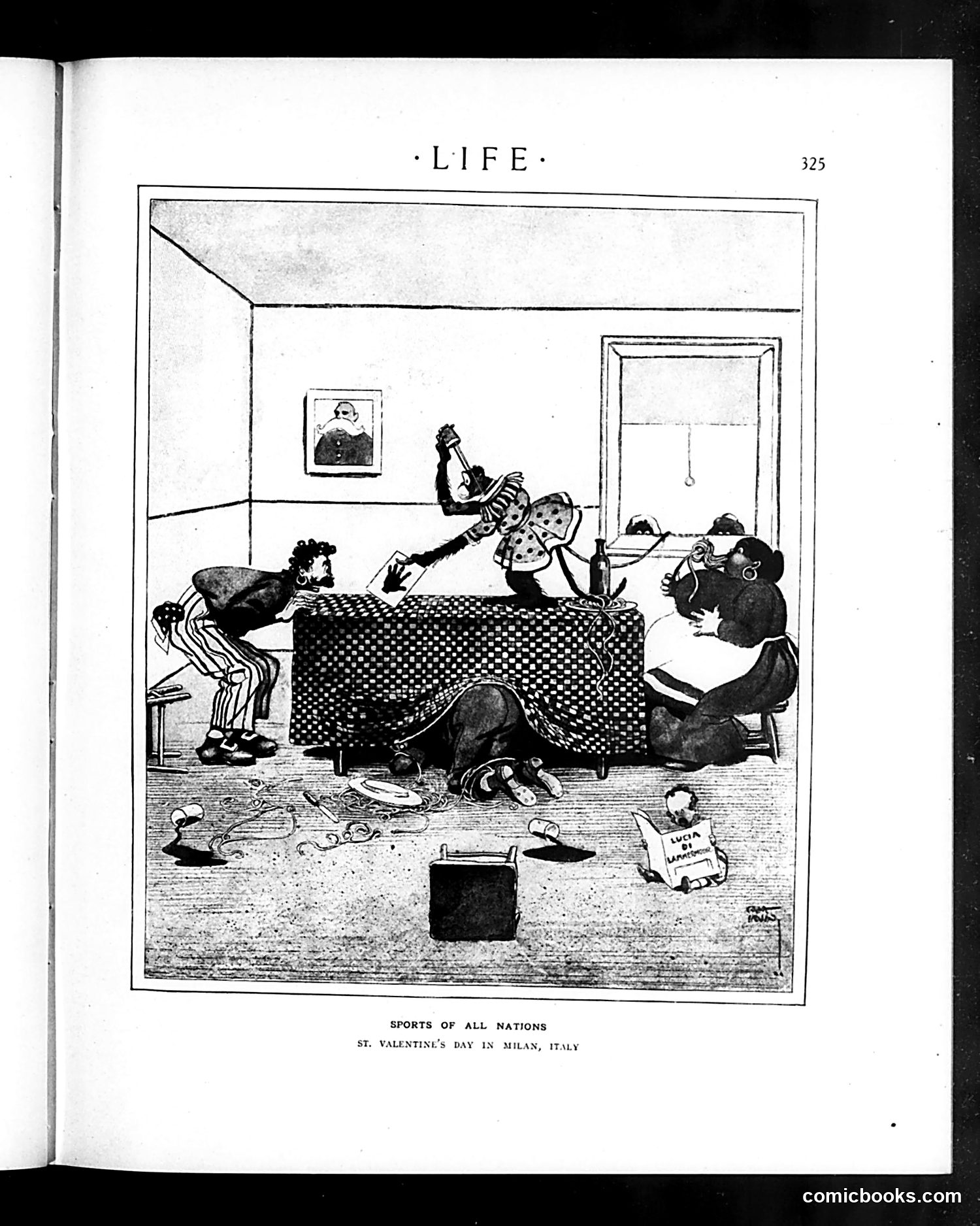
This satirical cartoon depicts Valentine's Day celebrations in Milan through exaggerated physical comedy. A group of people are engaged in what appears to be rowdy, chaotic behavior around a checkered tablecloth-covered table—wrestling, fighting, and generally brawling. The scattered items on the floor (including what appears to be a "Do Not Disturb" sign) emphasize the disorder. The joke plays on national stereotypes: the caption "Sports of All Nations" treats this violent mayhem as Italy's characteristic way of celebrating romance. Rather than gentle courtship, the cartoon presents Italian Valentine's Day as boisterous, physical combat—a humorous commentary on Italian temperament or culture, typical of Life magazine's early 20th-century satirical approach to international differences.
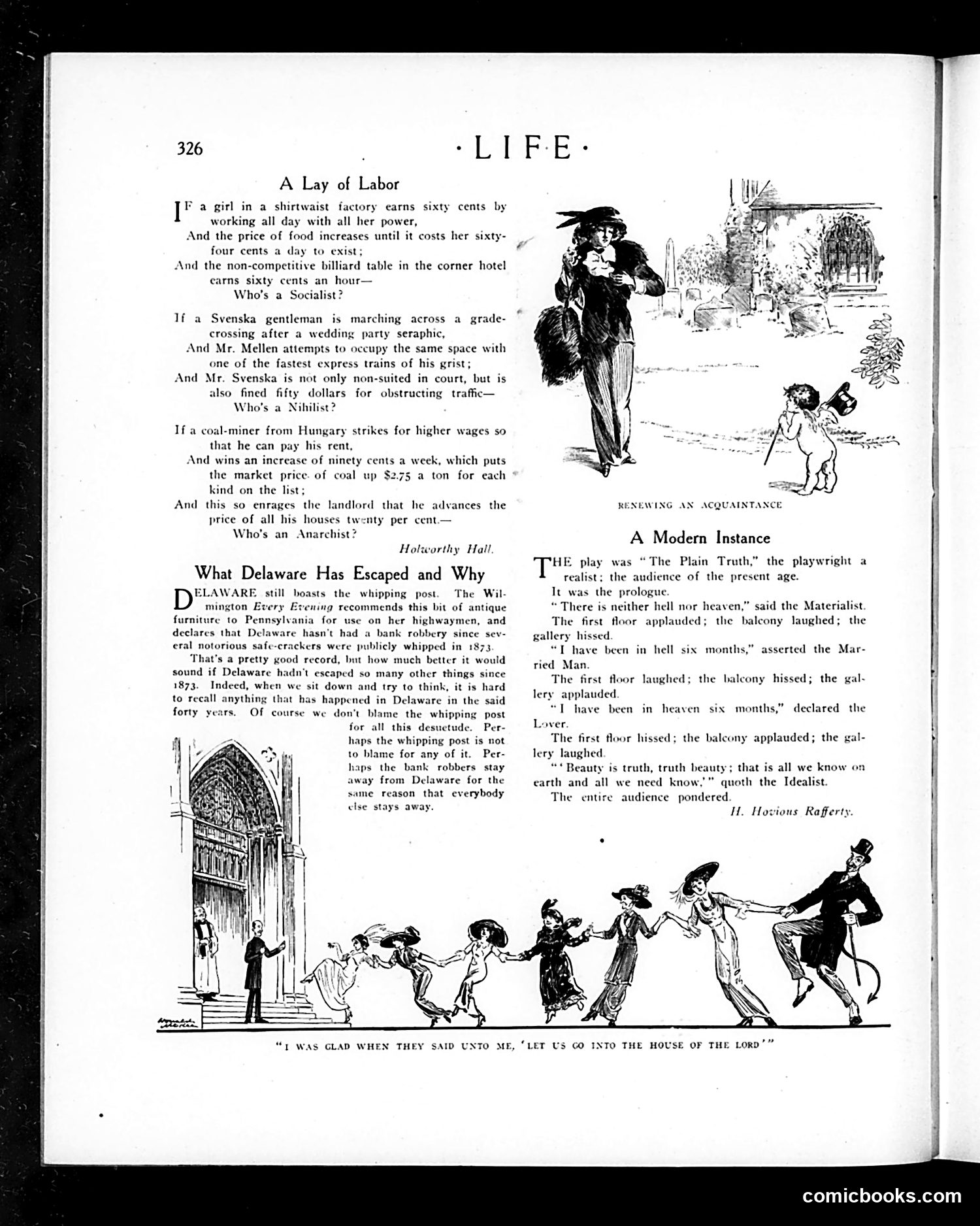
This page contains three satirical pieces critiquing early 20th-century American social and economic inequality: **"A Lay of Labor"** uses rhetorical questions to expose systemic exploitation: a factory girl earning 60¢ daily can't afford food at that wage; a billiard hall profits effortlessly; immigrant workers striking for wage increases only see landlords raise rents accordingly. The poem sarcastically labels victims of this system—socialists, nihilists, anarchists—implying the system itself, not activists, creates radicalism. **"What Delaware Has Escaped and Why"** mocks Delaware's reliance on the whipping post as evidence of law-and-order, suggesting the state is economically stagnant and isolated—people avoid Delaware entirely, not because of effective punishment, but because nothing happens there. **"A Modern Instance"** depicts a play where different audience sections (wealthy, middle-class, poor) react oppositely to identical philosophical statements about hell, heaven, and beauty, suggesting class determines ideology rather than objective truth. All three pieces satirize social hypocrisy and class division in Progressive Era America.
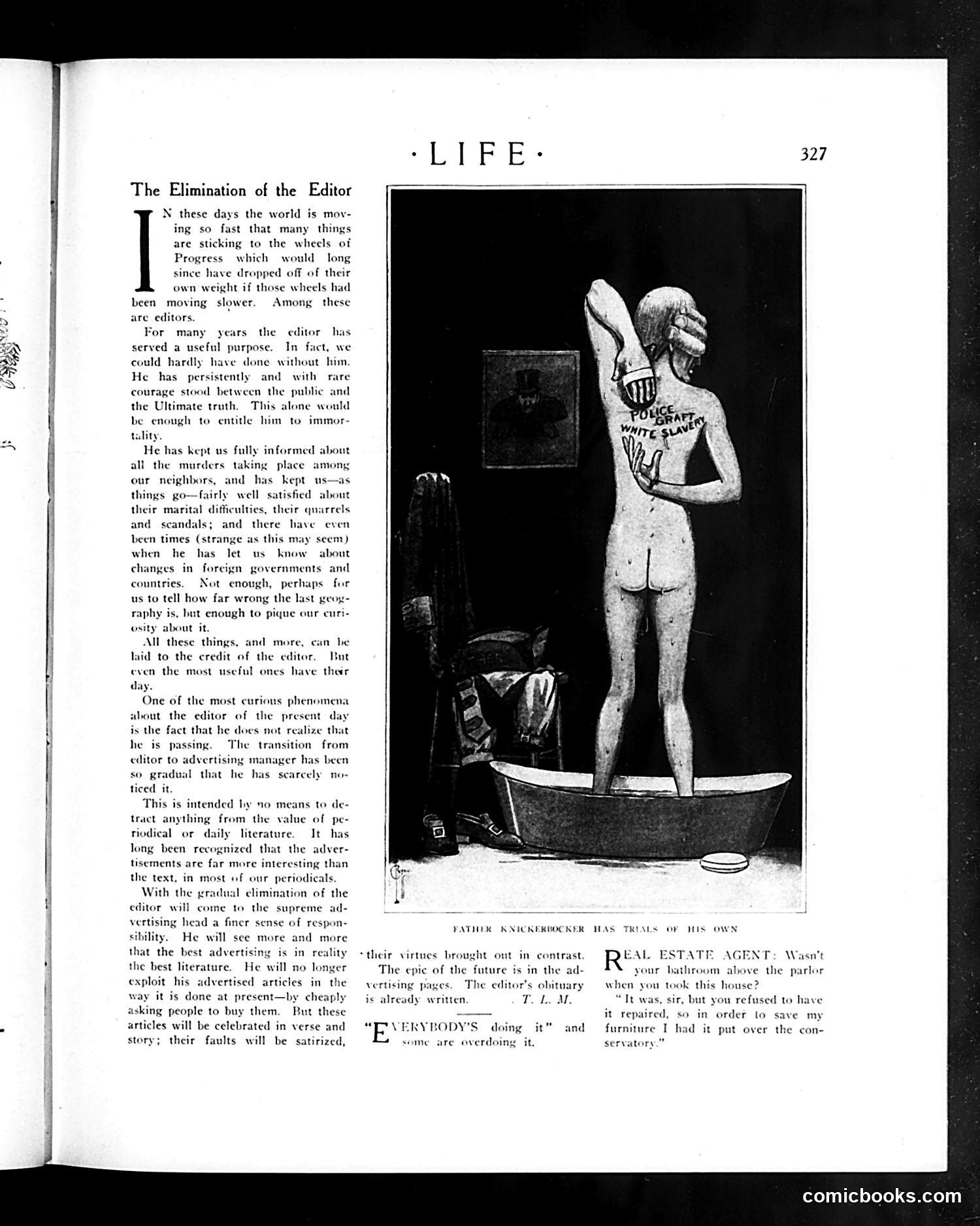
This satirical piece critiques the early 20th-century decline of newspaper editors' editorial authority. The text argues that editors—once guardians standing "between the public and Ultimate truth"—have gradually become advertising managers without realizing it. The author warns that editors are now exploiting advertised products through cheap promotional tactics rather than serving the public interest. The cartoon (bottom right) shows a "Real Estate Agent" explaining to a prospective buyer that he refused to repair a bathroom above the parlor, instead moving his furniture to the conservatory. This illustrates the satirical theme: advertising-driven publications now prioritize selling products (real estate, furnishings) over honest consumer advice or editorial integrity. The underlying critique suggests that commercial interests have corrupted journalism's fundamental purpose, reducing editors to mere advertising vehicles rather than trustworthy information sources.
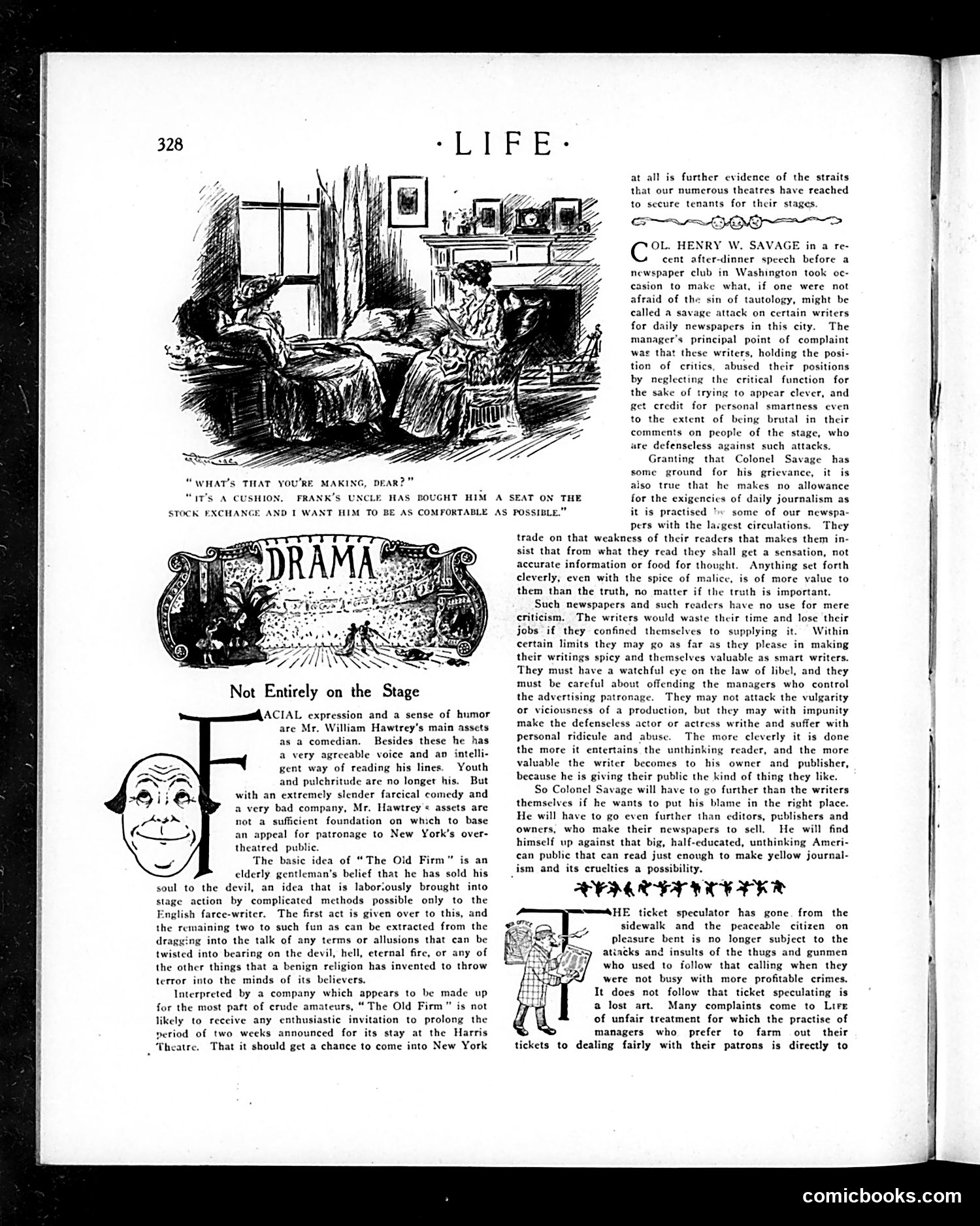
This page contains two distinct pieces of social commentary: **Top cartoon**: Shows a conversation about stock market investment, with a man explaining he's bought his uncle a Stock Exchange seat to keep him "comfortable." This satirizes the wealthy leisured class and their casual approach to expensive financial instruments as mere comfort provisions. **"Not Entirely on the Stage" article**: Critiques both theater producer Colonel Henry W. Savage and newspaper drama critics. Savage complained that critics abuse their position by prioritizing clever, brutal commentary over truthful analysis to entertain readers. The author agrees Savage has a point but explains newspapers—especially those with large circulations—deliberately encourage sensational writing over accuracy because readers demand sensation. Critics can ridicule defenseless actors without legal consequence, making such cruelty profitable for publishers. The piece exposes a systemic problem: profit-driven journalism rewards entertainment value over journalistic integrity, trapping writers within these corrupting constraints. The accompanying theater review dismisses "The Old Firm" as poorly executed farce.
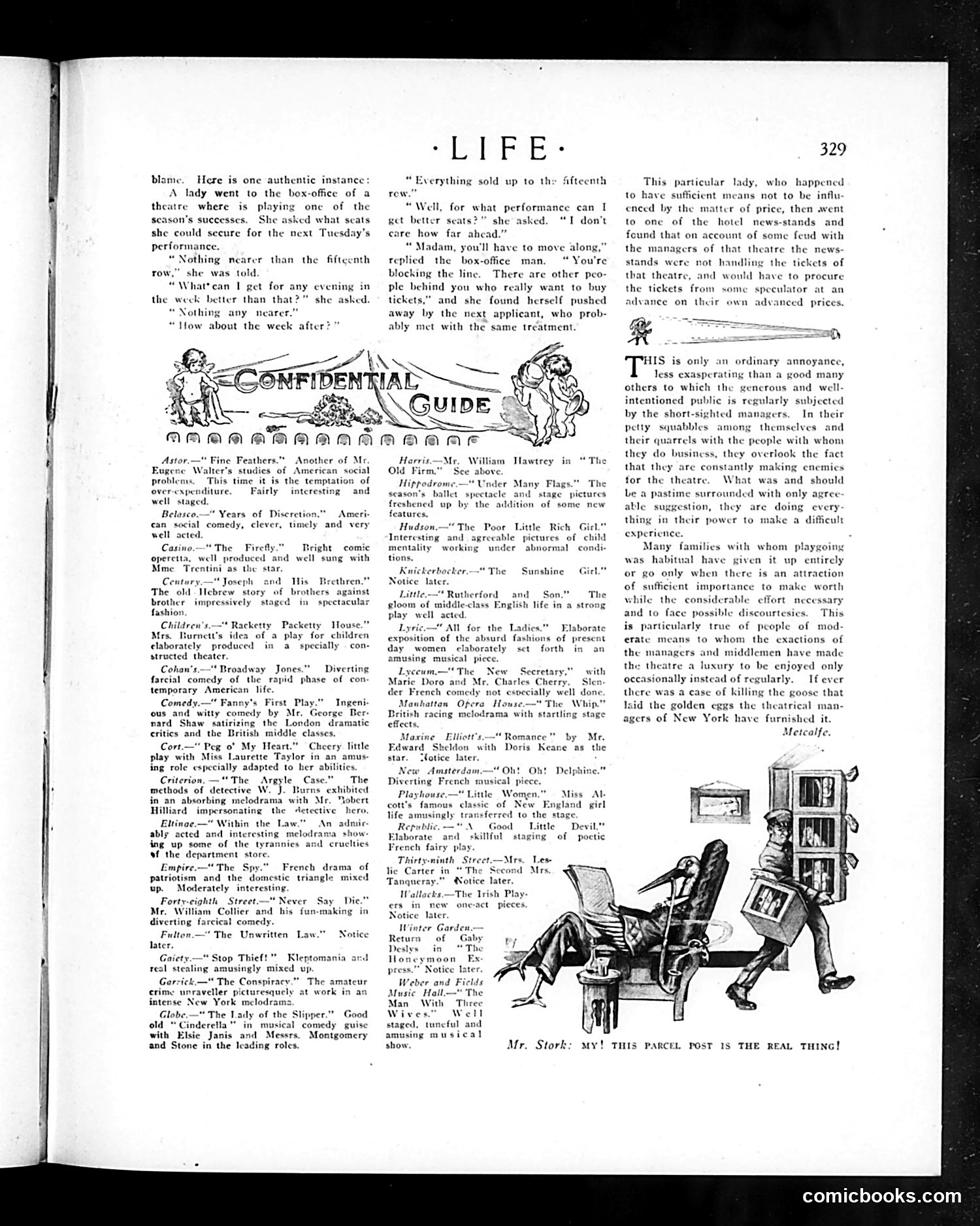
The main cartoon depicts a theater box-office scene illustrating a social complaint about ticket distribution. A well-dressed woman inquires about seats for an upcoming performance, only to be repeatedly told everything is sold out—even weeks in advance. When she persists in asking, the dismissive box-office clerk rudely tells her to "move along" because she's "blocking the line," pushing her aside for the next customer. The satire targets theatrical box-office practices of the era: the apparent monopolization of good seats (possibly by speculators or wealthy advance-buyers), the indifference of ticket sellers to ordinary patrons, and the artificial scarcity created by poor distribution systems. The woman's frustrated attempts to secure any reasonable seats—eventually willing to accept anything, however distant—underscore the frustration of theatergoers locked out by inefficient or corrupt ticketing systems. The page also lists current Broadway productions.
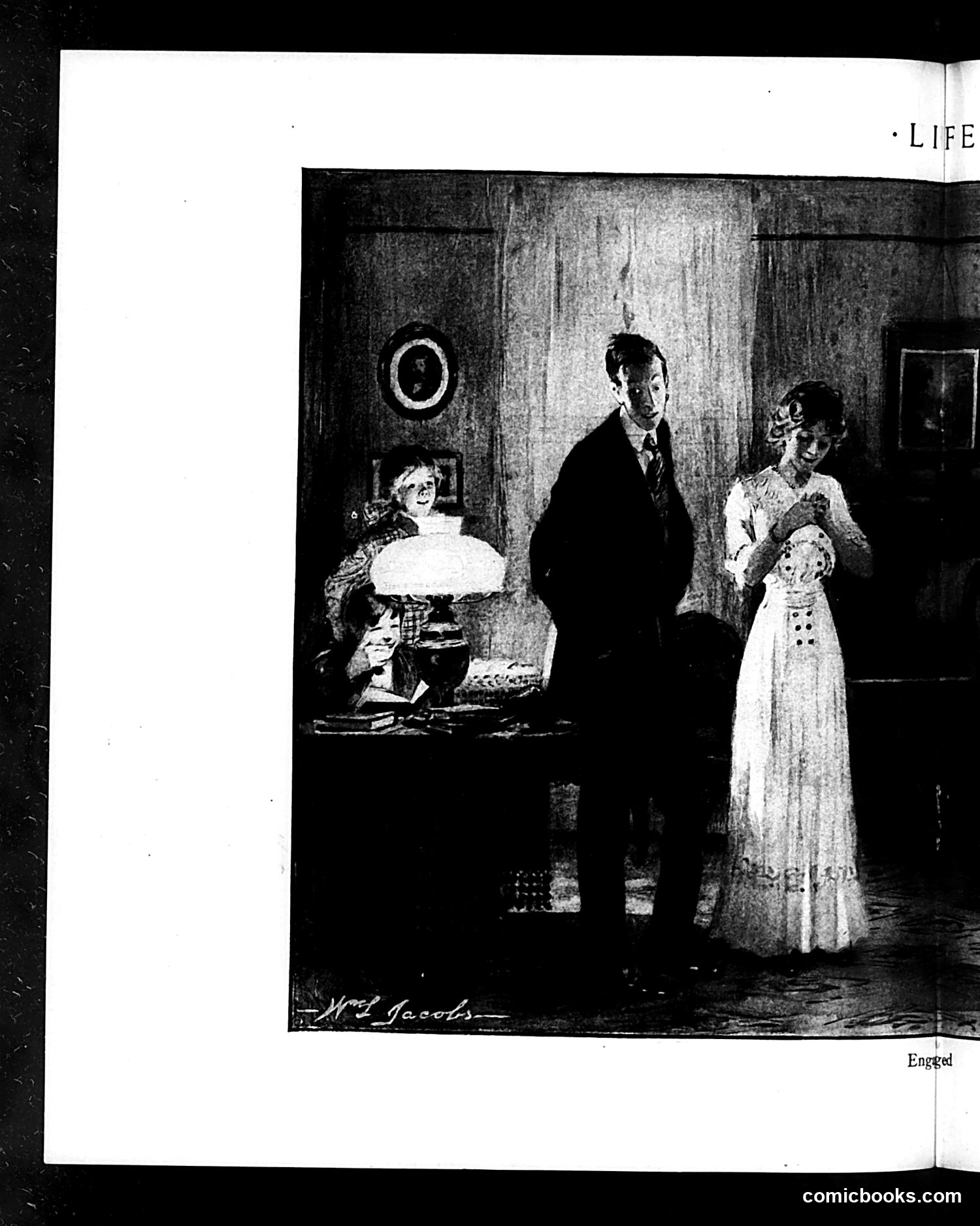
This illustration, signed by what appears to be "Abe Jacobs," depicts a domestic interior scene labeled "Engaged" at the bottom. The image shows three figures: a woman in a white dress (right), a man in dark formal attire (center), and a child at a table on the left. The satire likely comments on Victorian-era courtship rituals and social expectations around engagement. The formal, somewhat stiff postures and the presence of the child suggest commentary on the awkwardness of romantic situations in polite society, or perhaps on the contrast between formal engagements and domestic reality. The composition emphasizes the social performance aspect of the engagement announcement rather than genuine emotion.
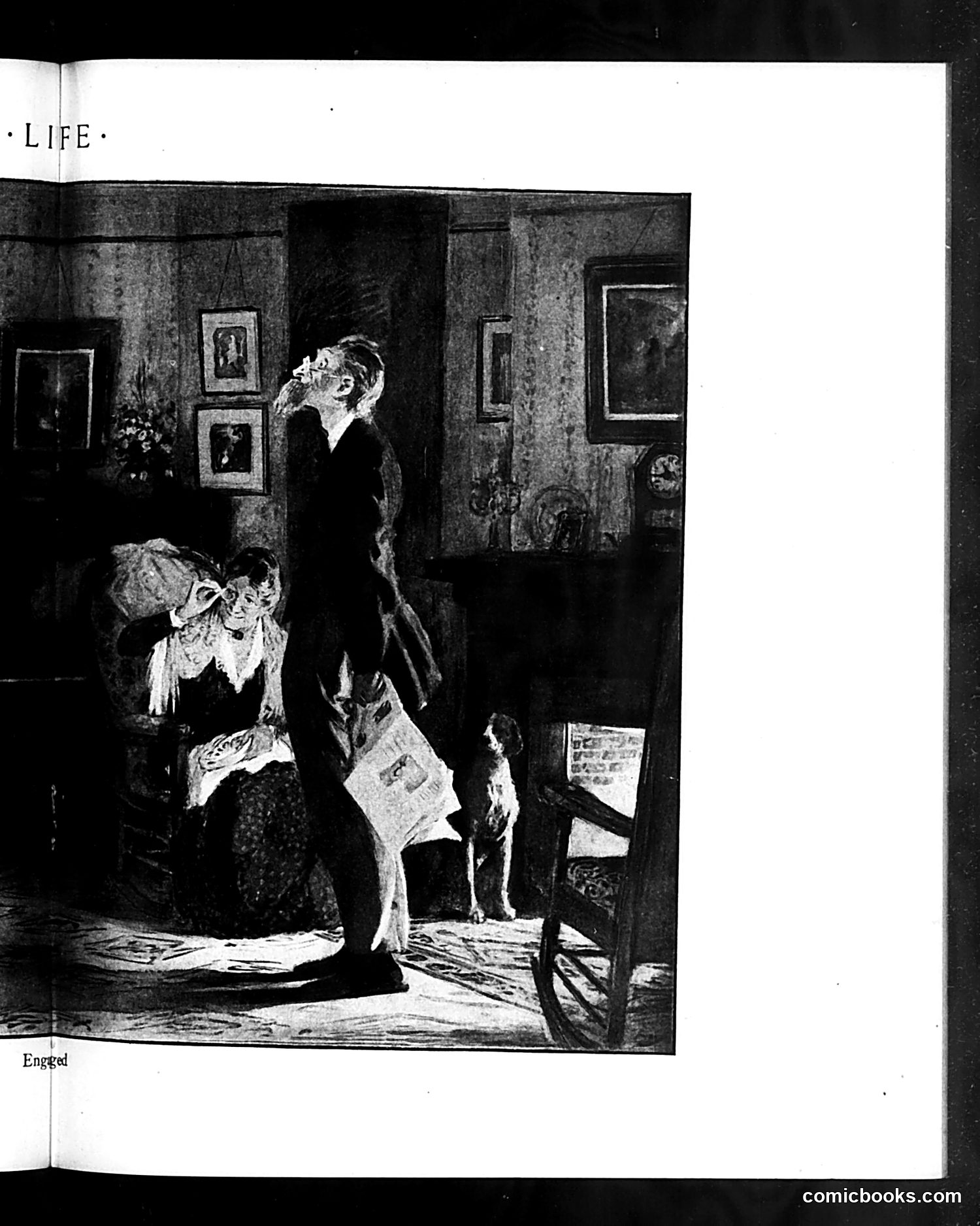
This page from *Life* magazine shows a black and white illustration titled "Engaged." The scene depicts an interior domestic setting where a well-dressed man stands holding a newspaper, while a woman sits nearby with a small dog. The composition and the man's somewhat disdainful expression suggest social commentary about engagement or marriage dynamics. The satire likely mocks the disparity between romantic expectations and marital reality—perhaps critiquing either the pretenses of courtship or the awkwardness of domestic life after engagement. The man's absorbed attention to his newspaper rather than his fiancée, combined with his aloof demeanor, suggests he's already emotionally detached from romantic attention, poking fun at how quickly the novelty of engagement fades into indifference. The specific historical context remains unclear without additional publication details.
This page is primarily a **book review column**, not a political cartoon. The main content critiques Gerhart Hauptmann's novel *Atlantis*, newly published in America. The satirical point is: Hauptmann recently won the Nobel Prize for the "spiritual content" of his work, yet his new novel *Atlantis* appears to lack exactly that quality. The reviewer mockingly notes the irony—that the Nobel Prize seems cursed, citing Kipling (idealist literature) and Theodore Roosevelt (peace) as previous recipients whose subsequent actions contradicted their awards. The "Evil Eye" joke suggests the Nobel Prize brings bad luck: recipients subsequently disappoint. Hauptmann's *Atlantis* is criticized as heavy-handed, earthly realism rather than the spiritually elevated work that supposedly earned him the prize. The page includes a decorative "Confidential Book Guide" header with cherubs and brief reviews of contemporary works by Cobb, Dreiser, and others—standard literary journalism for this era's *Life* magazine.
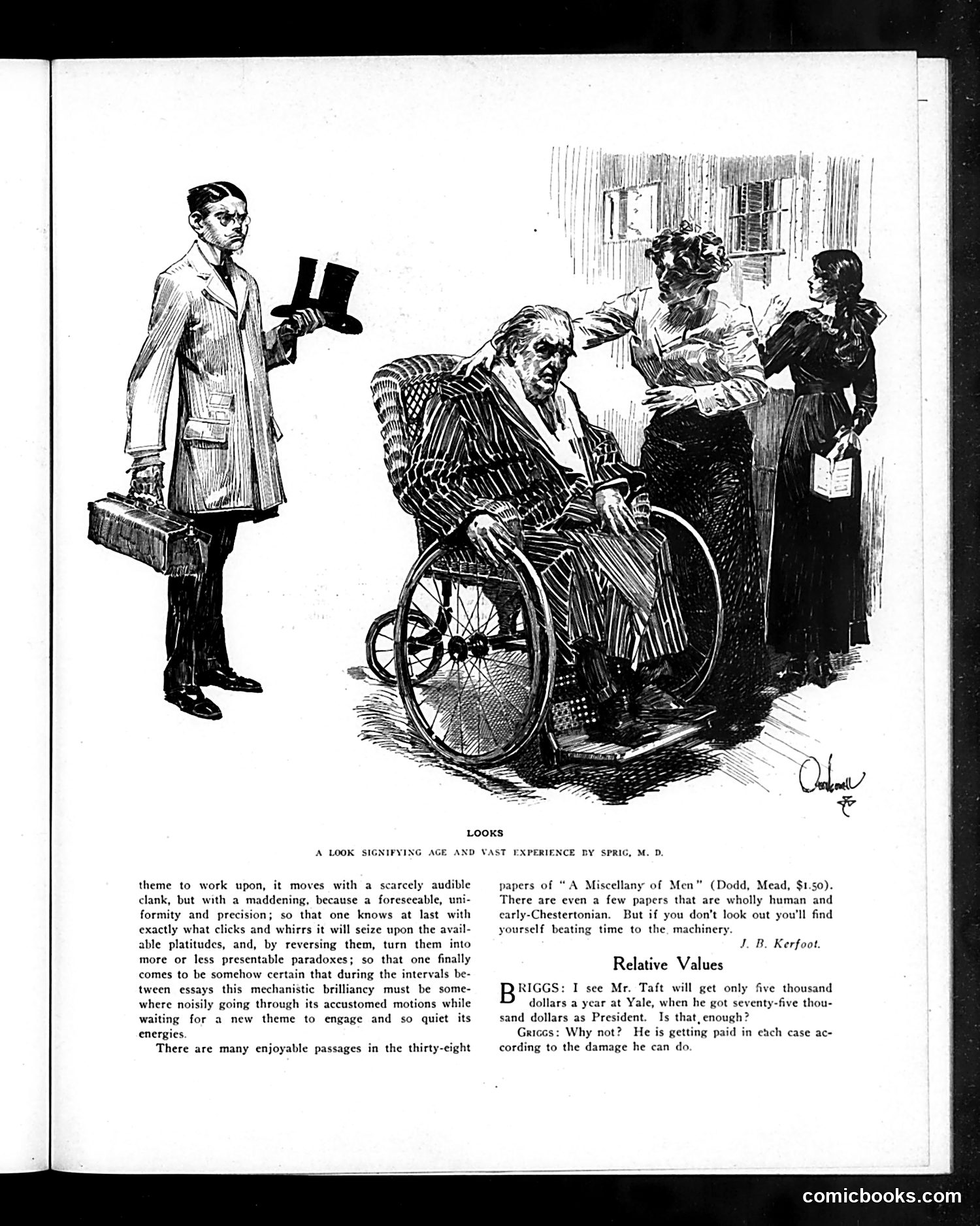
The cartoon "Looks" depicts a well-dressed man in a top hat (left) observing a disabled gentleman in a wheelchair surrounded by attentive women (right). The caption attributes it to "Sprig, M.D."—likely a satirical pseudonym. Below, the "Relative Values" joke mocks former President William Howard Taft's move to Yale University. Taft earned $75,000 as President but would receive only $5,000 at Yale. The humor hinges on the punchline: he's being paid based on "the damage he can do"—implying Taft caused significant harm as President, making his lower academic salary appropriate to his reduced capacity for damage. This reflects early 1900s criticism of Taft's presidency and satirizes the notion that executive power is inherently destructive.
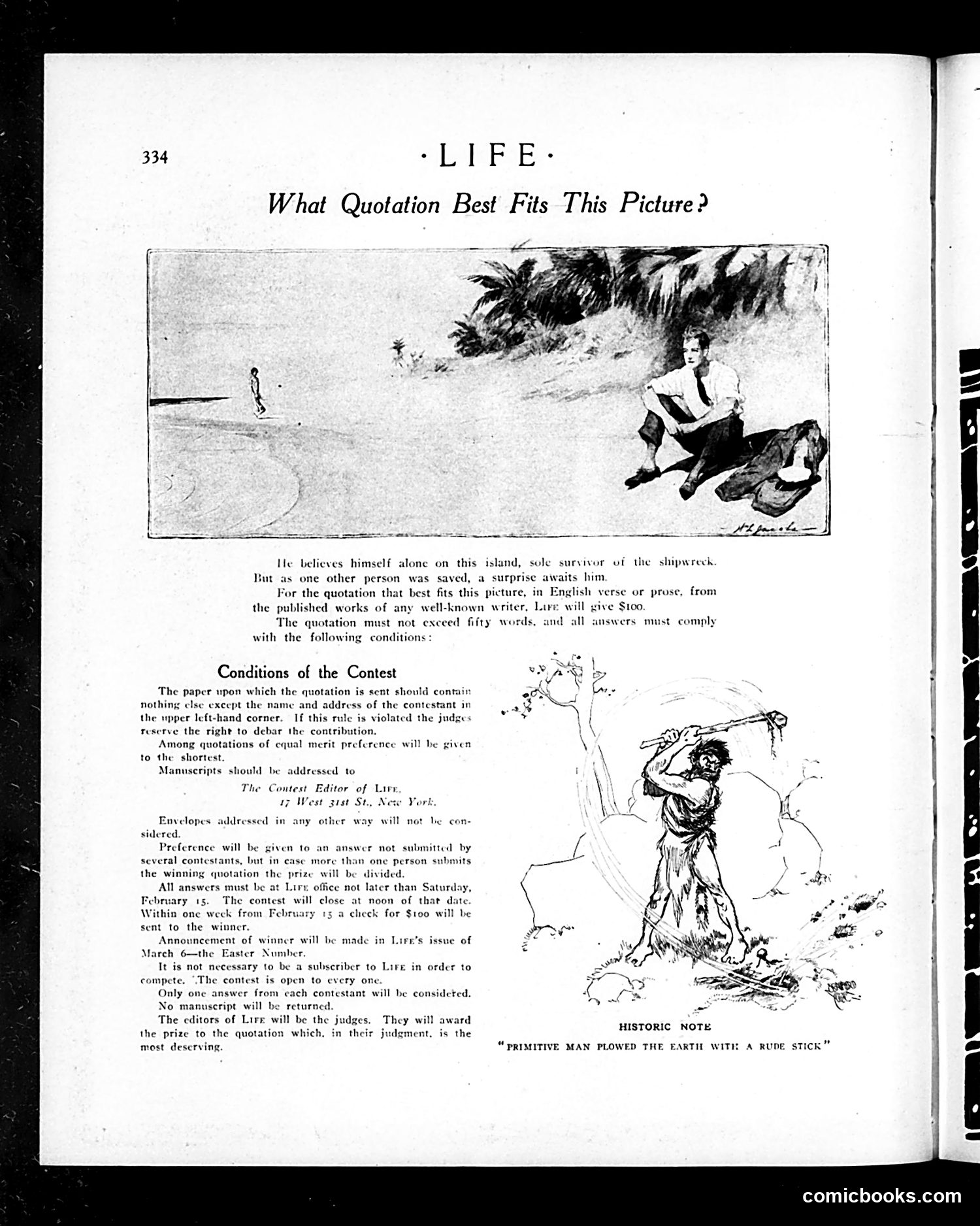
This page features a **quotation-matching contest** from Life magazine. The top illustration shows a man alone on an island after a shipwreck, unaware that another survivor exists nearby—setting up an ironic "surprise" scenario. Readers were invited to submit famous quotations (under 50 words) from published authors that best fit this picture, with a $100 prize for the winning entry. The contest had strict submission rules: entries had to include only the quotation, contestant's name and address on the upper left corner; envelopes addressed elsewhere would be disqualified. The bottom illustration—labeled "Historic Note"—depicts a primitive man plowing earth with a stick, captioned with that exact phrase. This appears to be a humorous reference showing humanity's progress from rudimentary tools to modern civilization, perhaps hinting at thematic contrast with the island survival scenario above. This was typical early-20th-century magazine content: interactive contests encouraging reader participation and literary engagement.
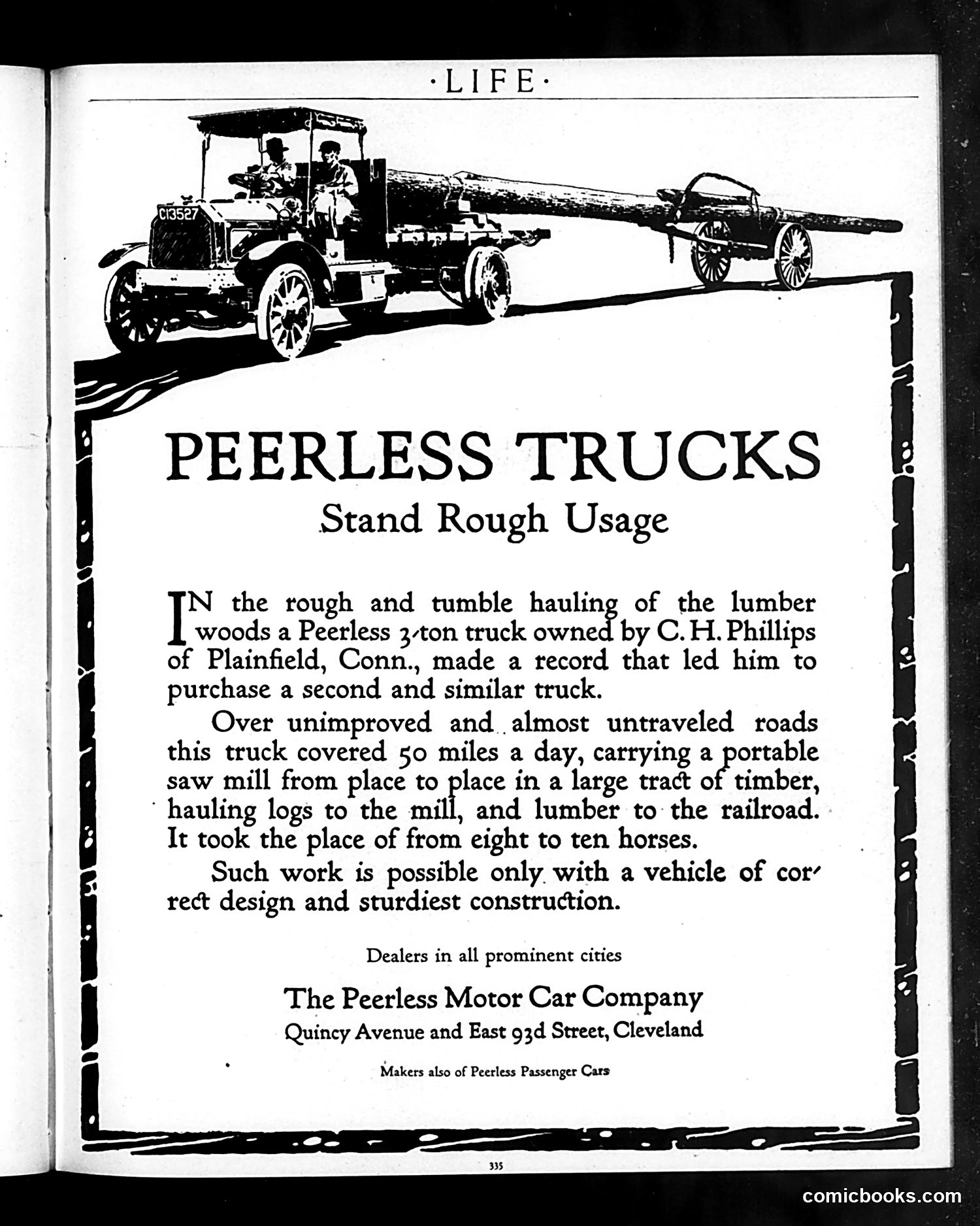
This is **not satirical content**—it's a straightforward advertisement for Peerless Trucks, placed in *Life* magazine (which mixed humor with advertising). The page depicts an early automotive truck (circa 1910s-1920s) hauling a large log, with two men in the cab. The ad promotes the Peerless 3-ton truck as a practical replacement for horse teams in lumber work. **Key selling point**: A single truck could do the work of 8-10 horses, covering 50 miles daily over rough roads while transporting a portable sawmill and logs. This demonstrates the **revolutionary efficiency of motorized transport** replacing animal power—a major industrial shift of the early 20th century. The ad targets business owners considering mechanization. There's no joke or satire here; it's earnest marketing of new technology to a magazine audience evaluating modern equipment. The *Life* placement suggests trucks were novel enough to warrant editorial-style advertising in a general-interest publication.
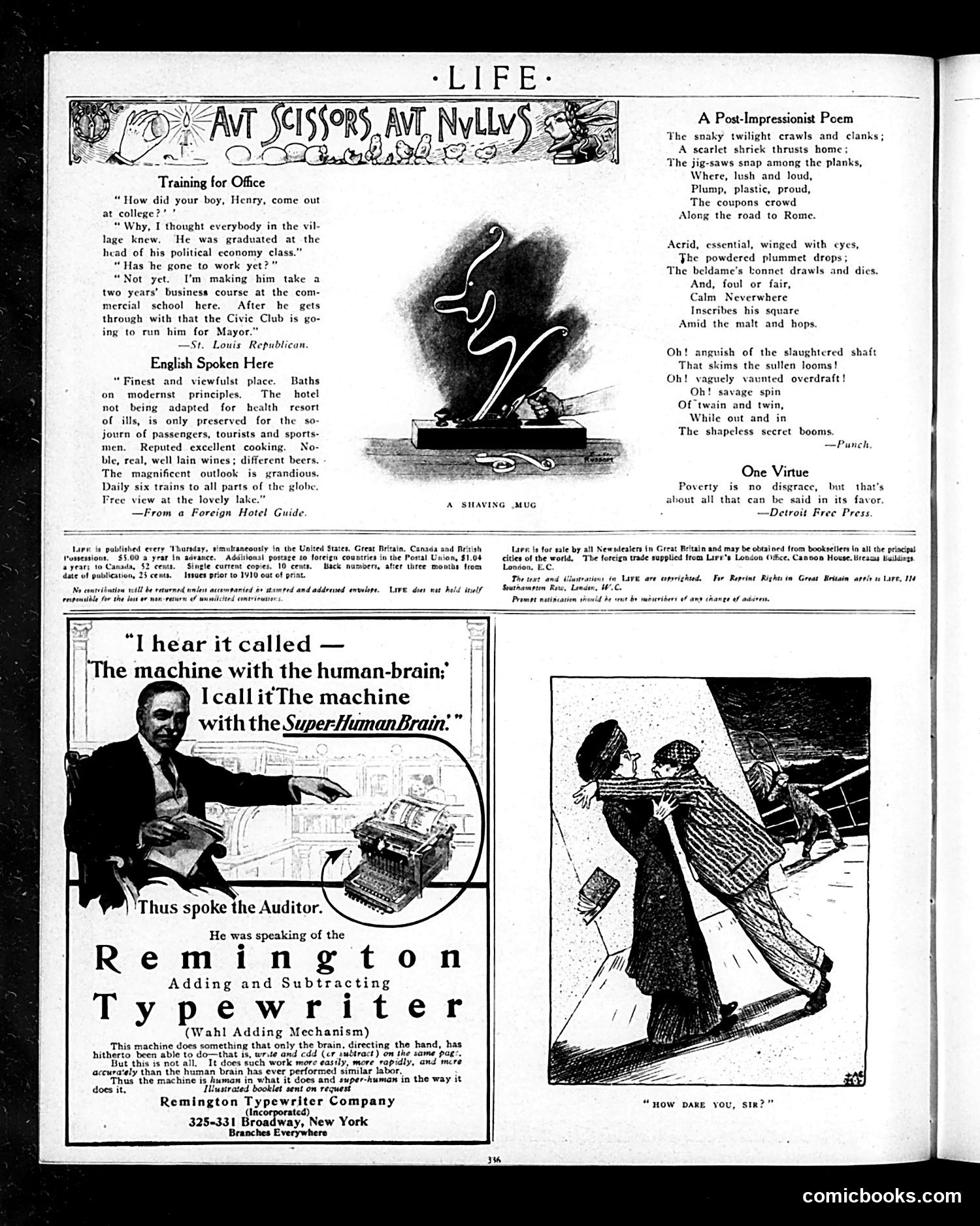
This page contains multiple satirical items typical of early-20th-century Life magazine: **Left column**: A brief joke mocking overeducation without practical employment. A college graduate with top grades in political economy hasn't found work, so his parents enroll him in business school and plan to have the Civic Club run him for Mayor—satirizing how credentials and connections substitute for actual competence. **Center**: A mock hotel guide excerpt ridiculing flowery, pretentious foreign hospitality writing that obscures rather than clarifies information. **Right column**: A "Post-Impressionist Poem" parodying modernist poetry's obscurity and pretension—deliberately nonsensical language ("snaky twilight crawls," "shapeless secret booms") mocking the movement's opacity. **Bottom**: A Remington typewriter advertisement claiming the machine has a "Super-Human Brain" for its adding/subtracting capabilities—hyperbolic advertising language of the era. **Small cartoon**: "How dare you, sir?"—unclear without full context, but appears to depict social scandal or impropriety. The page satirizes education, foreign affectation, modernist art, and advertising excess.
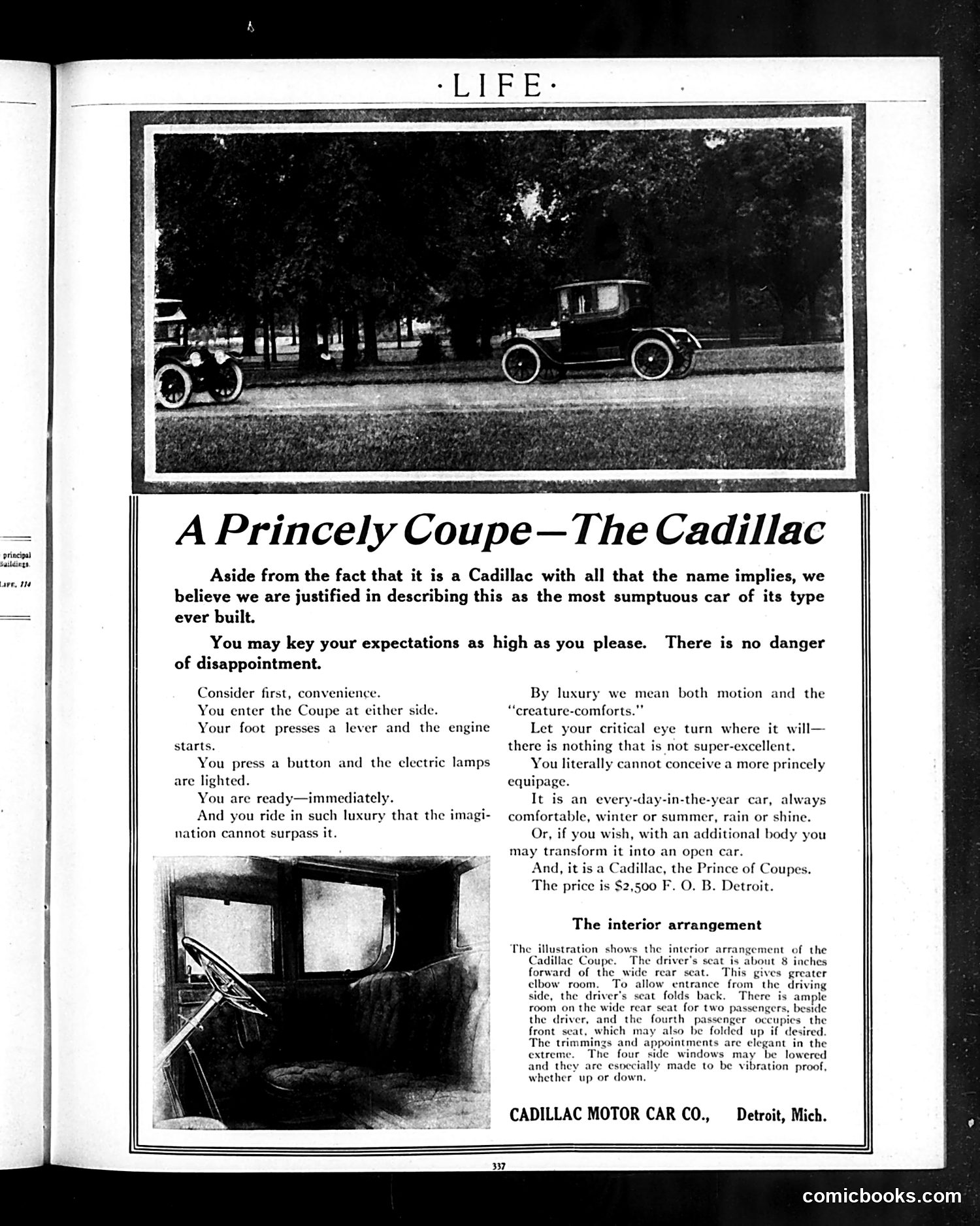
This is **not a cartoon or satire**—it's a straightforward automobile advertisement for the Cadillac Motor Company, appearing in *Life* magazine. The page showcases the Cadillac Coupe as a luxury vehicle, emphasizing its convenience features (foot-lever engine start, electric lamps operated by button), comfort appointments, and flexibility (convertible body option available). The price of $2,500 F.O.B. Detroit positions it as high-end. The two images show the car in use and its interior layout with folding seats designed to accommodate four passengers despite the compact coupe body style. The only potential irony *Life* might be layering here is calling it a "Princely Coupe"—suggesting extravagant luxury for the wealthy—but the advertisement itself plays this straight as marketing copy rather than satire. Without additional editorial framing on the page, this reads as paid advertising rather than satirical commentary.
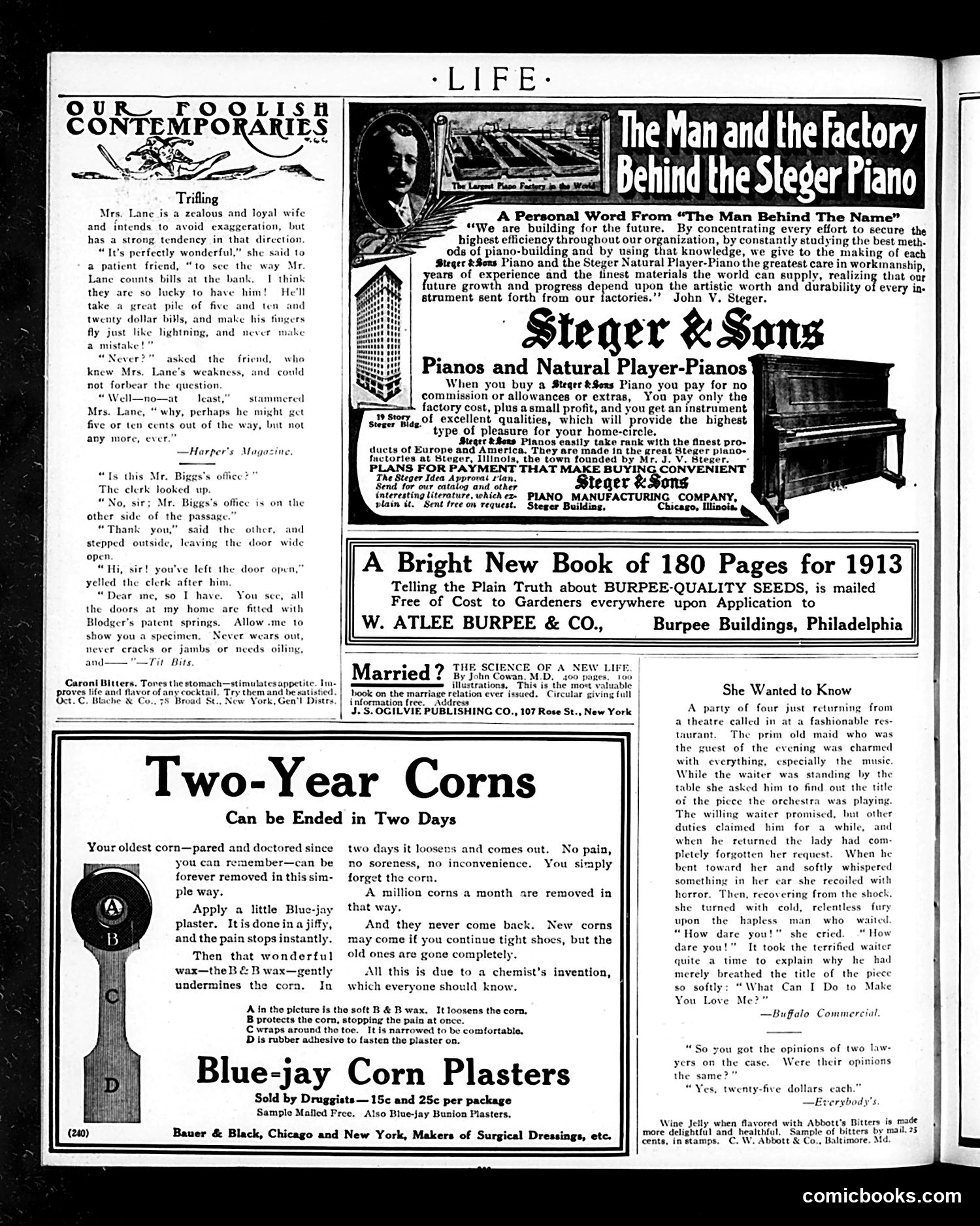
This page is primarily **advertising**, not political satire. It contains: 1. **"Trilling"** — a brief humorous anecdote about Mrs. Lane's banking skills, published in Harper's Magazine style 2. **"She Wanted to Know"** — a short joke about an old maid guest at a restaurant asking a waiter to identify an orchestra piece, then becoming angry when he returns with the title 3. **Multiple advertisements** for commercial products: Steger pianos, Burpee seeds, corn plasters, and medical books The page reflects early 1900s magazine format, mixing light entertainment with product marketing. The humor is gentle domestic comedy rather than political commentary. The advertising emphasizes manufacturing quality and mail-order convenience—typical concerns of the era before mass retail distribution.
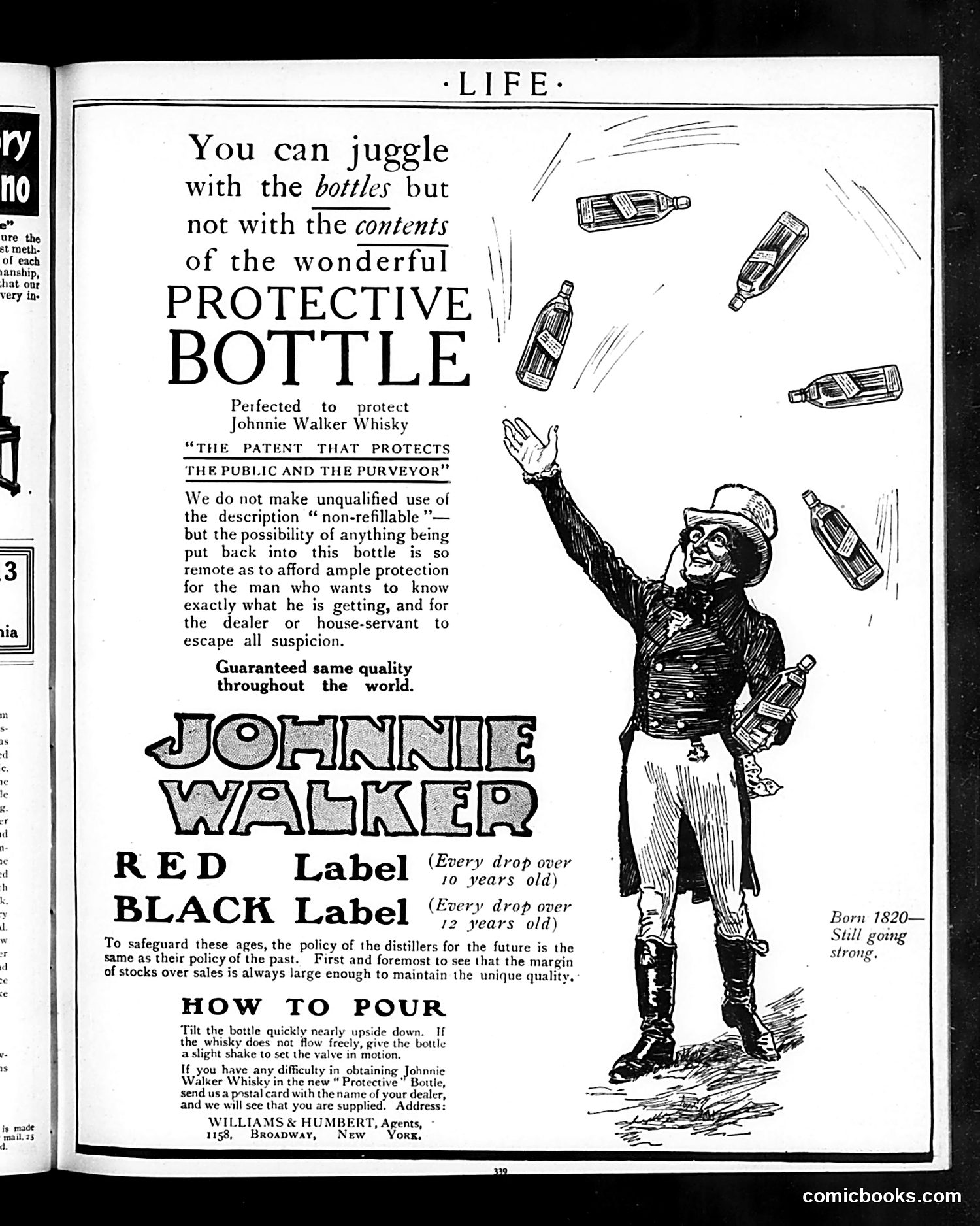
This is primarily a **whisky advertisement**, not political satire. It promotes Johnnie Walker's new "Protective Bottle" design, emphasizing the bottle's anti-tampering features to assure consumers of product authenticity and quality. The illustration shows a jovial Scottish figure (Johnnie Walker's mascot, "Born 1820—Still going strong") juggling bottles, visually reinforcing the advertising tagline: you can juggle with the *bottles* but not with the *contents*. The design aims to address Prohibition-era concerns about counterfeit or adulterated whisky, protecting both consumers and sellers from suspicion. The humor is gentle marketing rather than satirical commentary—the cartoon humanizes the brand through the cheerful Scottish character while the protective bottle becomes a selling point emphasizing quality assurance and consumer trust during a period of widespread product adulteration.
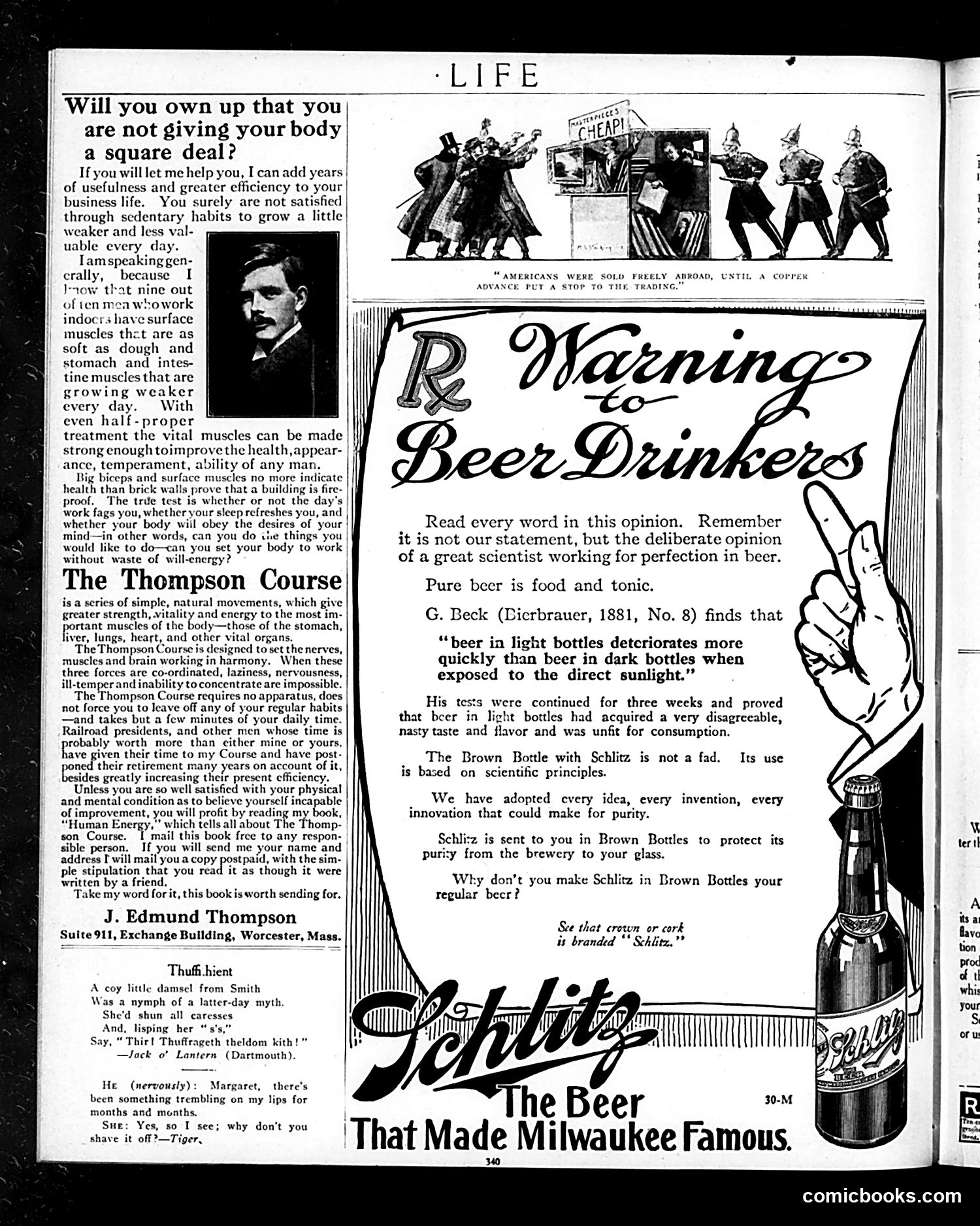
This page mixes advertising with satirical humor typical of early Life magazine. **The cartoons:** The top illustration satirizes American commercial expansion abroad—showing figures in military/business dress forcing their way into foreign markets, with a caption noting Americans "sold freely abroad until a coffee advance put a stop to the trading." This critiques aggressive American business imperialism. Below are two brief joke items: one mocking suffragettes (the "Smith" damsel), another a flirtation gag about facial hair. **The advertisements:** The left side promotes J. Edmund Thompson's exercise course, claiming it strengthens internal organs through simple movements—a common early-20th-century fitness pitch targeting sedentary office workers. The right side is a **Schlitz beer advertisement** claiming scientific authority (citing a German beer scientist) that brown bottles protect beer from sunlight damage better than clear bottles. This represents the era's use of pseudo-scientific endorsements to market consumer products. The page reflects Progressive-era anxieties about physical decline from office work, coupled with commercial marketing strategies that borrowed scientific language for credibility.
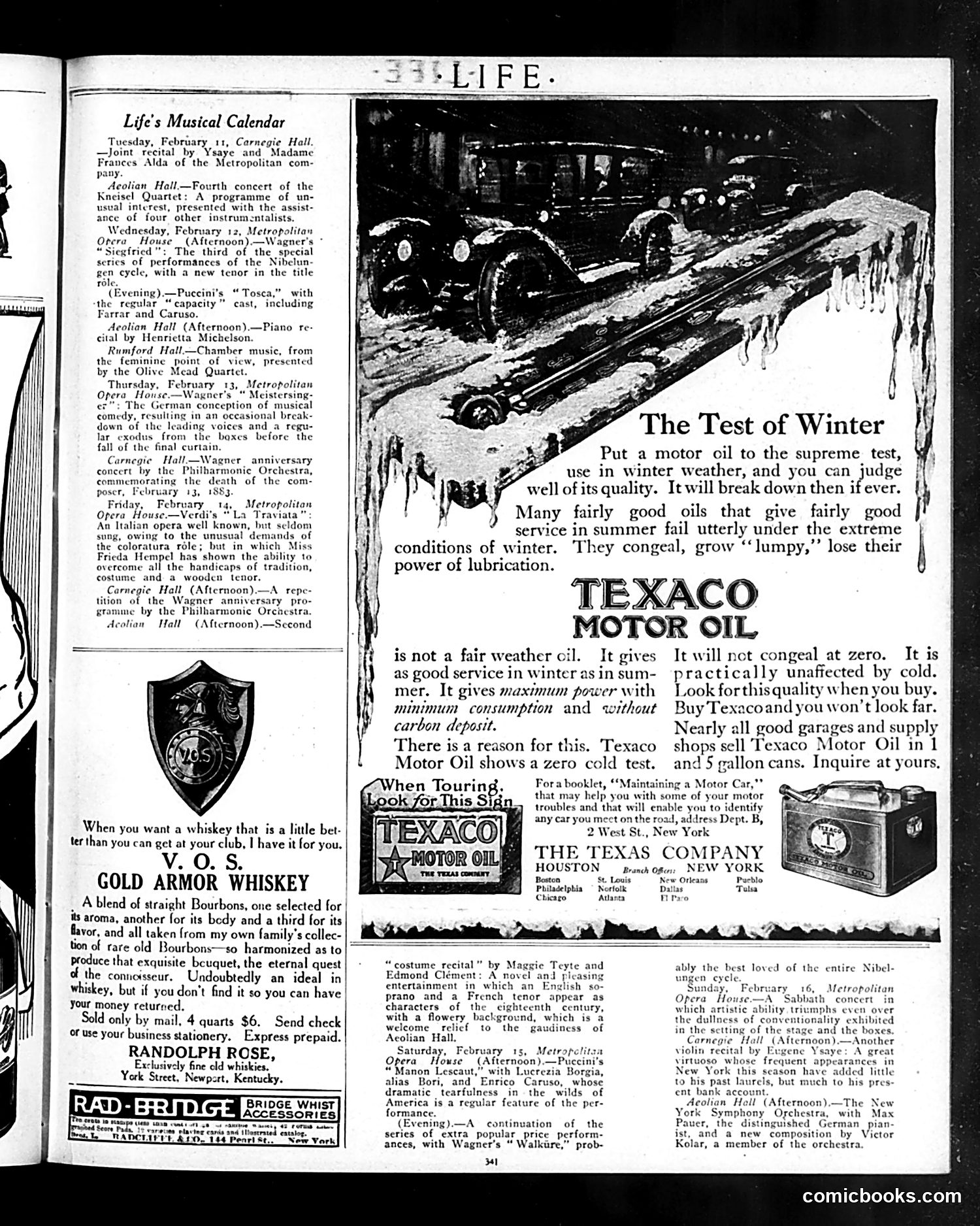
This page is primarily **advertising**, not satirical content. It features: **Left side:** Musical calendar listings for New York opera and concert performances (February 11-14), plus advertisements for Gold Armor Whiskey and Rad-Bridge whiskey accessories. **Right side:** Large advertisement for Texaco Motor Oil, emphasizing its superior cold-weather performance—it "will not congeal at zero" unlike competitors' oils that become "lumpy" in winter. **Context for modern readers:** The advertisements reflect early 20th-century concerns: classical music was elite entertainment; mail-order whiskey was legal (pre-Prohibition); and motor oil quality was a serious selling point when automobiles were still relatively new technology. The Texaco ad's emphasis on winter performance addressed a genuine practical problem for early car owners in northern climates. There is no political satire or cartoon on this page—it's a standard issue showcasing cultural events and commercial products.
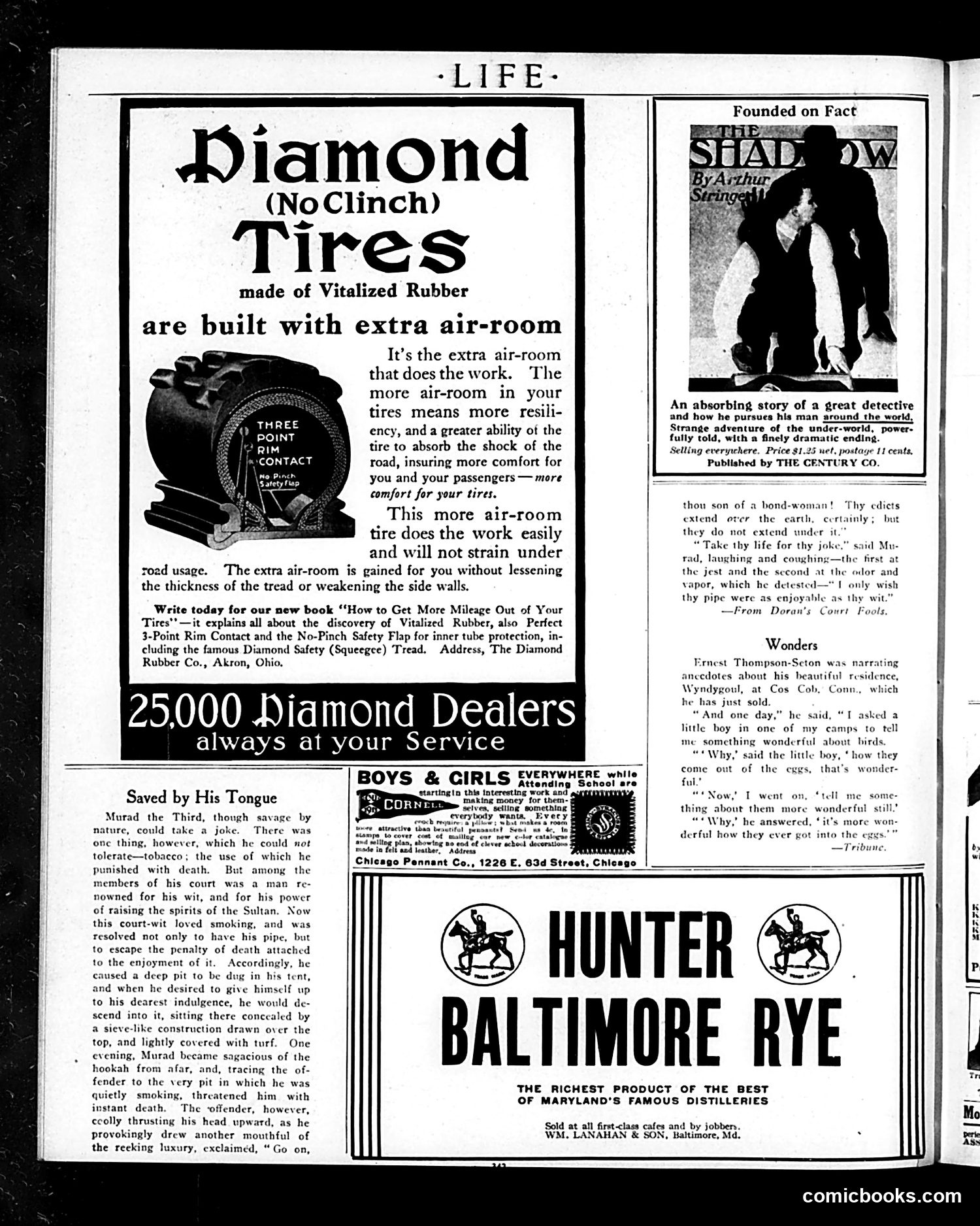
This is primarily an **advertising page** from Life magazine, not a political cartoon. The page contains: **Main Content:** - Diamond Tire advertisement (top left) promoting "Vitalized Rubber" tires with extra air-room for comfort and durability - Book advertisement for *The Shadow* by Arthur Stringer (top right)—a detective story - Two brief humorous anecdotes in the middle: one about Murad the Third (a Ottoman Sultan) whose court wit cleverly smokes tobacco despite a death penalty by hiding in a pit, and another about naturalist Ernest Thompson-Seton telling a boy about bird eggs - Hunter Baltimore Rye whiskey advertisement (bottom) **Historical Context:** The page reflects early 20th-century American consumer culture. The tire ad emphasizes technological innovation; the tobacco anecdote reflects pre-prohibition attitudes toward smoking; and the whiskey ad would soon become illegal (Prohibition era). The content is entertainment and product promotion rather than political satire.
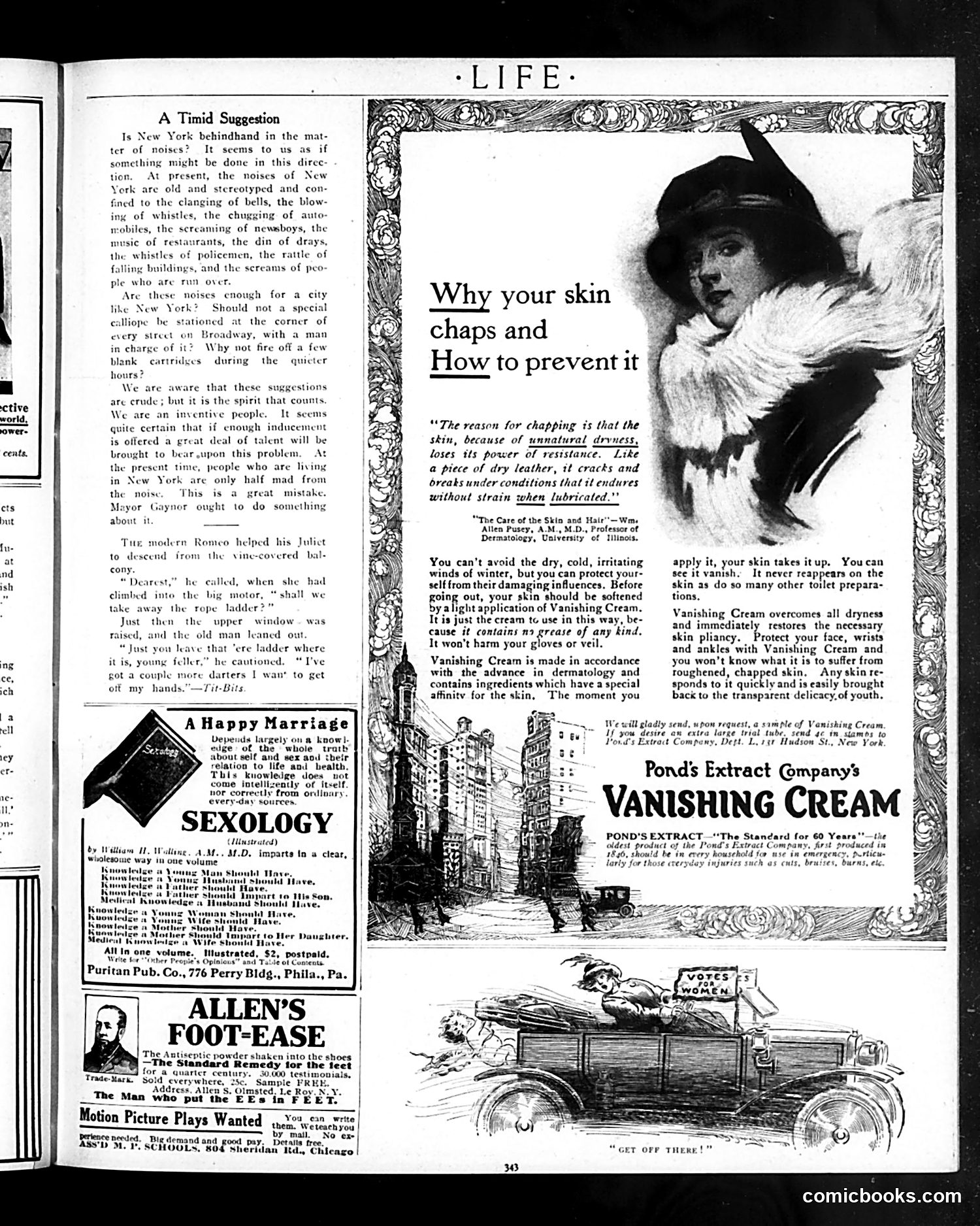
This page contains primarily **advertisements and light satirical content**, not political cartoons. The main item is "A Timid Suggestion"—a humorous editorial proposing that New York City install calliopes and fire blank cartridges to increase urban noise, since residents aren't yet "half mad" from existing racket. It's satirizing the city's cacophony by suggesting absurd solutions, likely reflecting contemporary complaints about New York's growing industrial clamor. A brief anecdote jokes about a modern Romeo and Juliet: a young man helps a girl elope via motor car while her father watches from a window, only to ask the couple to return the ladder—he needs it for his other daughters. The humor relies on implying the father has multiple daughters eloping. The page is otherwise dominated by **product advertisements**: Sexology books, Allen's Foot-Ease powder, and Pond's Vanishing Cream (the dominant ad). These ads are typical early-20th-century magazine fare with medical/scientific appeals to sell personal care products.
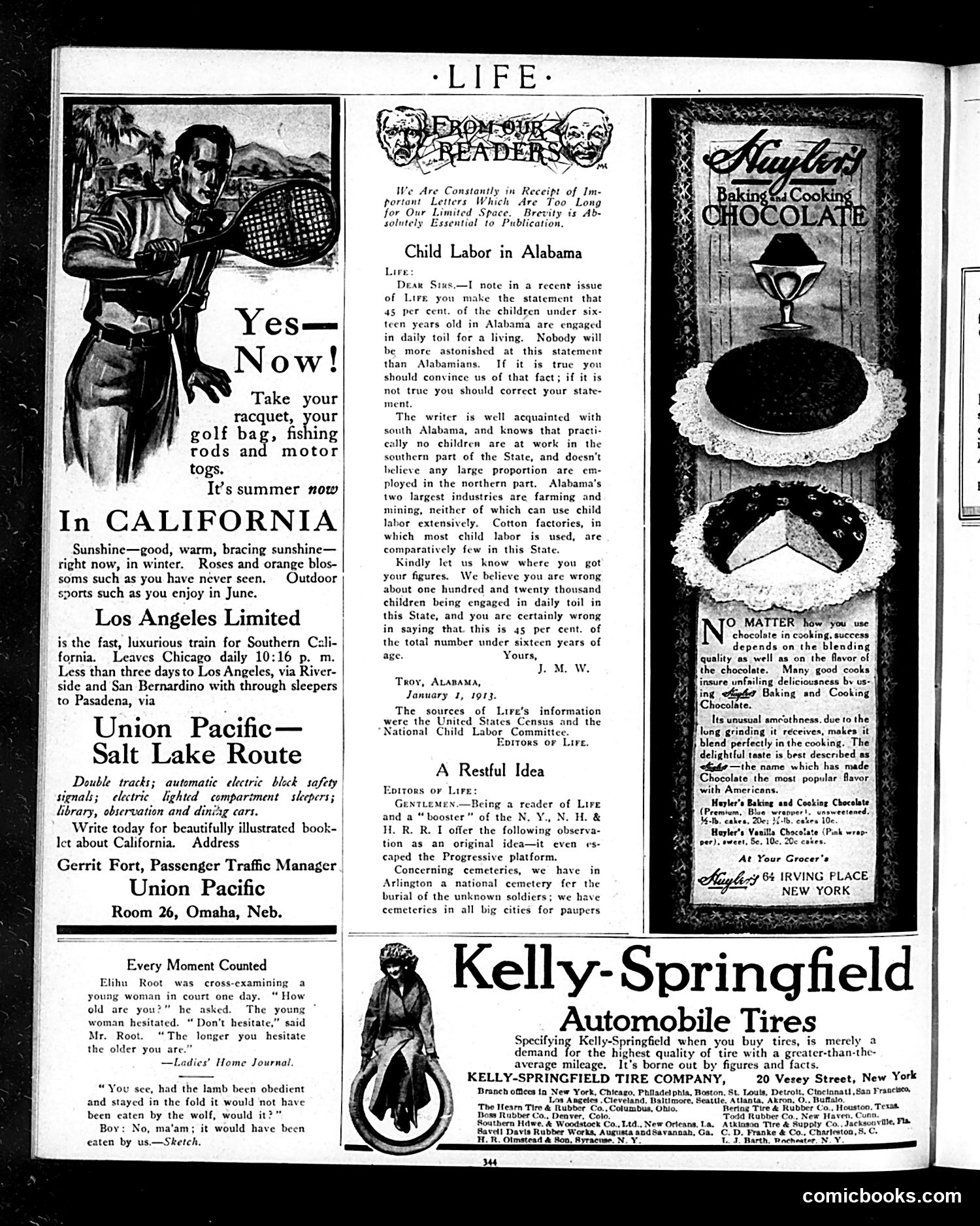
This page is primarily **advertising and editorial content** rather than political satire. The main elements are: **Left Side: California Travel Advertisement** A stylized male figure promotes Union Pacific's "Los Angeles Limited" train, urging readers to escape winter weather for California's perpetual sunshine and outdoor sports. This is straightforward commercial advertising. **Center: Readers' Letters Section** Two editorial letters debate child labor statistics in Alabama. A reader challenges Life's claim that 45% of children under 16 work in Alabama's mines and factories, arguing the figure is exaggerated. Life's editors cite U.S. Census and National Child Labor Committee data defending their reporting—a factual dispute about Progressive Era social conditions. **Right Side: Product Advertisements** Nestlé's chocolate baking product and Kelly-Springfield automobile tires. **Bottom: Humor Anecdote** A joke about attorney Elihu Root cross-examining a woman about her age, suggesting hesitation reveals age—light comedic filler typical of period magazines. The page reflects early 1900s concerns about child labor and Progressive Era reform debates, but contains no editorial cartoons or sustained satirical commentary.
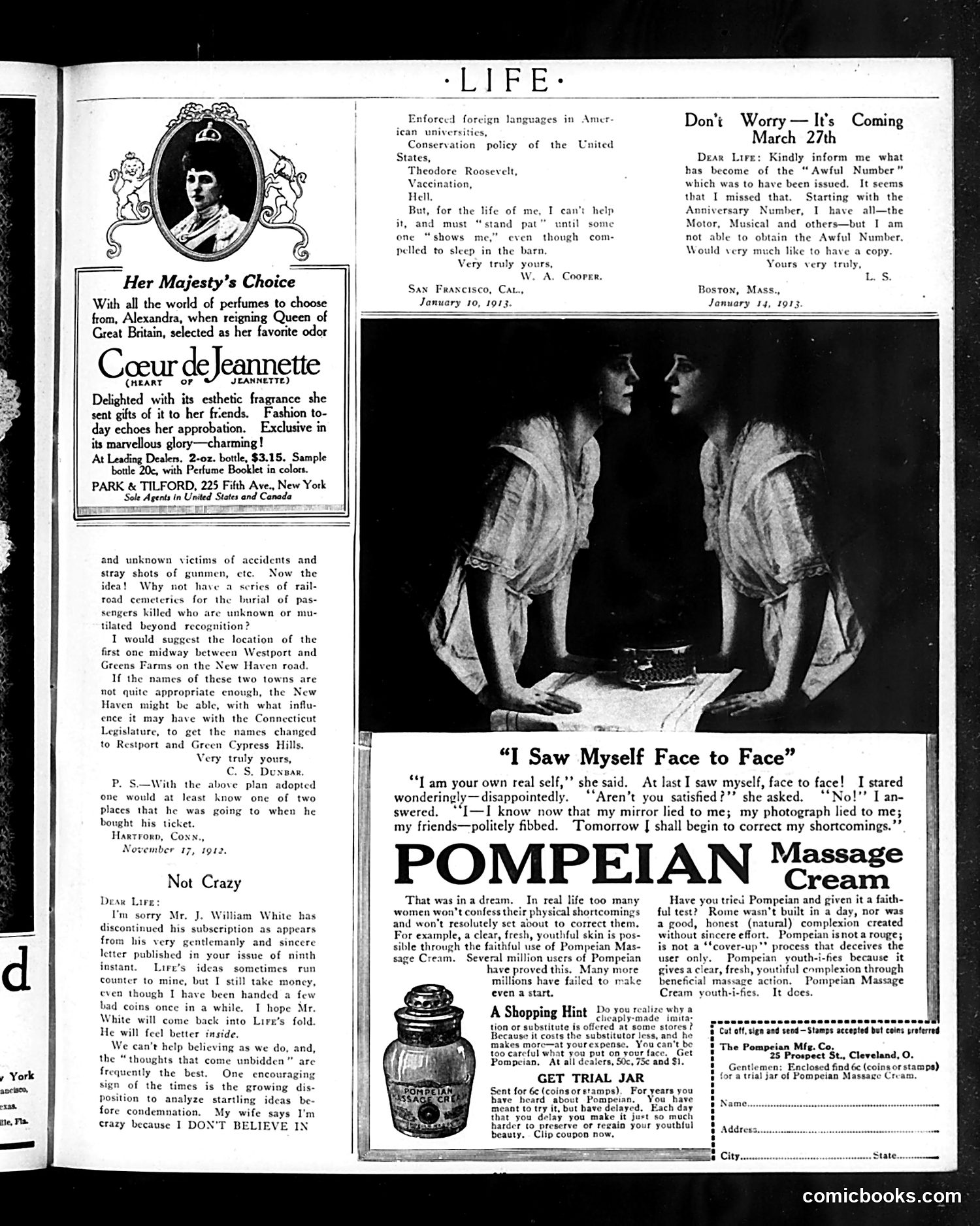
This page is primarily **advertising and reader correspondence**, not political satire. The main content includes: 1. **Perfume Advertisement**: "Coeur de Jeannette" cologne, marketed using Queen Alexandra of Great Britain's endorsement—a common advertising tactic leveraging royal approval. 2. **Reader Letters**: Mundane complaints about magazine issues, railroad safety concerns, and subscription matters. One letter sarcastically suggests "railroad cemeteries" for unidentified accident victims near New Haven, Connecticut—dark humor about rail safety. 3. **"Not Crazy" Letter**: A reader defending unconventional thinking against a subscriber (J. William White) who cancelled. 4. **Pompeian Massage Cream Ad**: A narrative advertisement featuring a woman confronting her "real self," designed to sell beauty products by appealing to women's insecurities about appearance. The page reflects early 1913 concerns: railroad safety, women's appearance standards, and subscription management. It's representative of Life's mix of satirical commentary and commercial content, but contains no significant political cartoons or social satire requiring historical context.
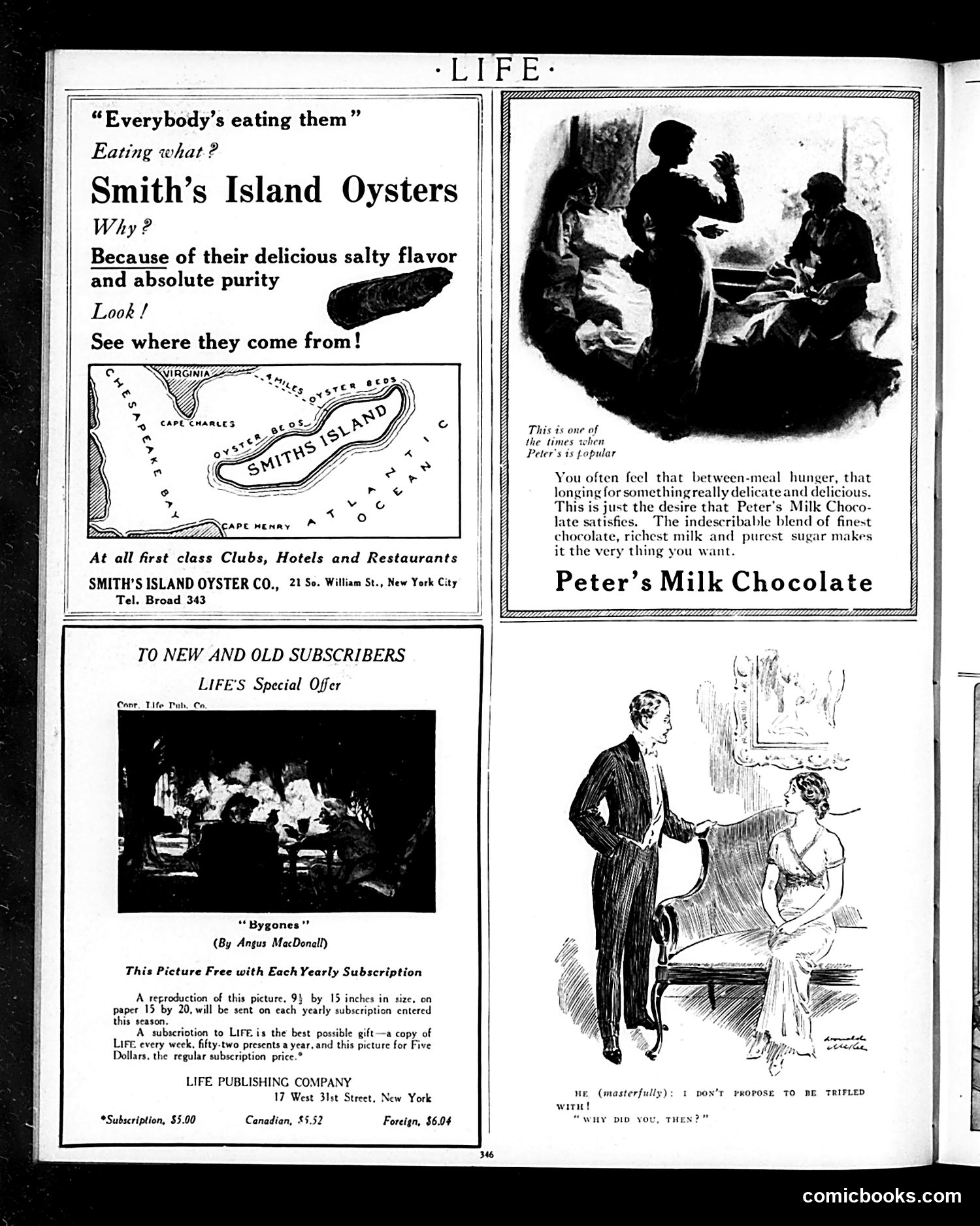
This page is primarily **advertising**, featuring three product promotions typical of early 20th-century magazines: 1. **Smith's Island Oysters** — a straightforward food advertisement emphasizing quality and availability at upscale venues 2. **Peter's Milk Chocolate** — marketed as satisfying "between-meal hunger" with appeals to purity and fine ingredients 3. **Life Magazine subscription offer** — promoting a yearly subscription ($5) that includes a free reproduction of a painting titled "Bygones" by Angus MacDonall The only cartoon content is a small illustration at bottom right (credited to artist signature), showing a woman and man in formal dress with the caption about not being "trifled with" followed by "Why did you, then?" — a brief joke about courtship or romantic entanglement, typical of Life's humor of the era. The page reflects Gilded Age consumer culture and magazine marketing practices rather than political satire.
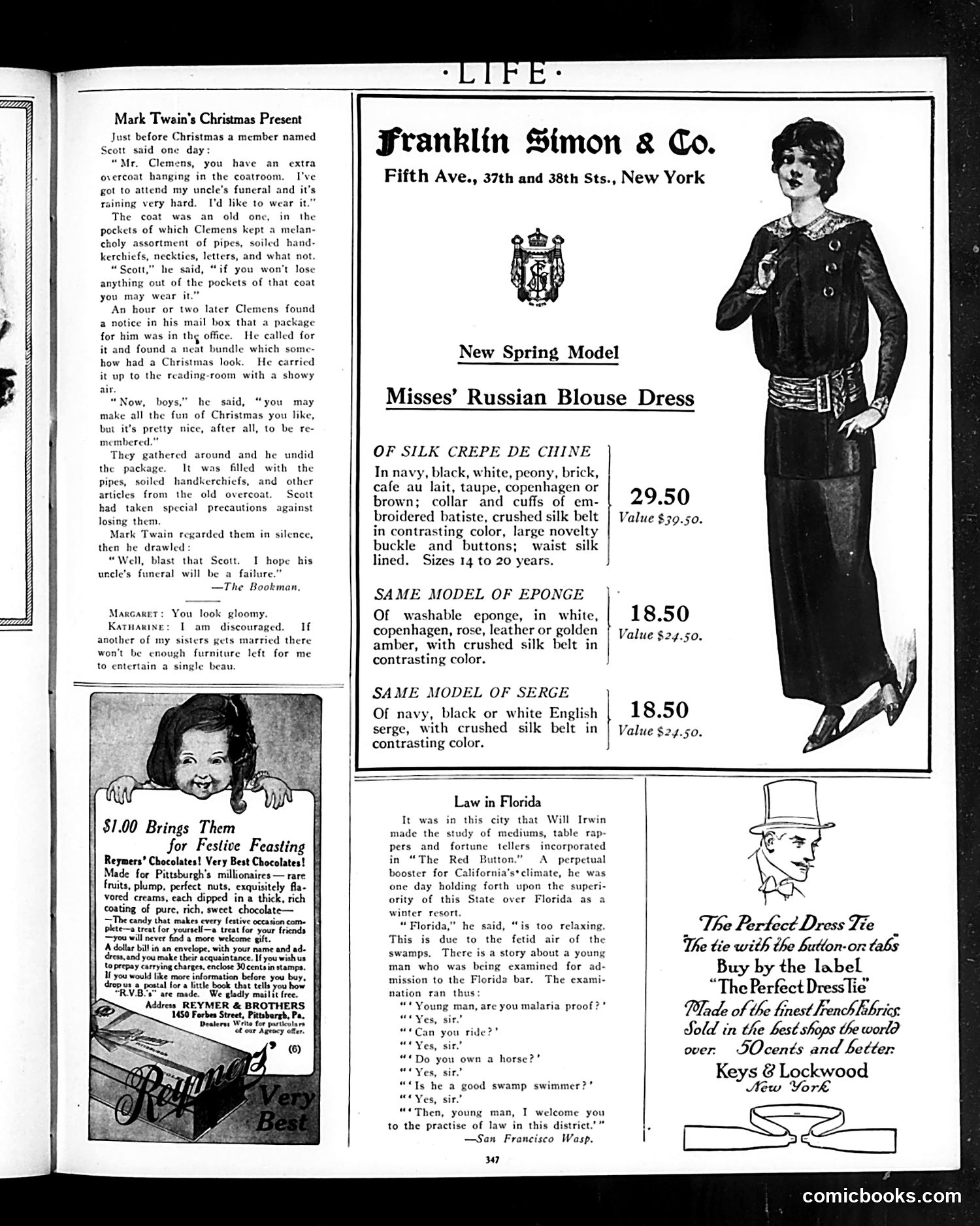
This Life magazine page (circa 1910s) contains three distinct sections: **Mark Twain Anecdote**: A humorous story about author Mark Twain lending his overcoat to colleague Scott for a funeral. Scott returns all the items that fell from Twain's pockets (pipes, handkerchiefs, letters), packaged as a "Christmas present." The joke is that Twain, despite appearing generous, finds the return of his own items darkly ironic—he wishes Scott's uncle's funeral "will be a failure" as mock revenge. **Marriage Joke**: A brief comic exchange where Katherine laments that her sisters' marriages deplete family furniture for entertaining suitors—social satire on dowries and marriage customs. **Florida Bar Exam**: A tall tale satirizing Florida's unhealthy climate. A young man applying for the Florida bar is questioned about malaria-proofing, horse-riding, and swamp-swimming rather than law—suggesting Florida is so disease-ridden and primitive that practical survival skills matter more than legal knowledge. This mocks Florida's reputation as an undeveloped, malarial frontier. The page also contains period fashion advertisements for women's dresses and chocolates.
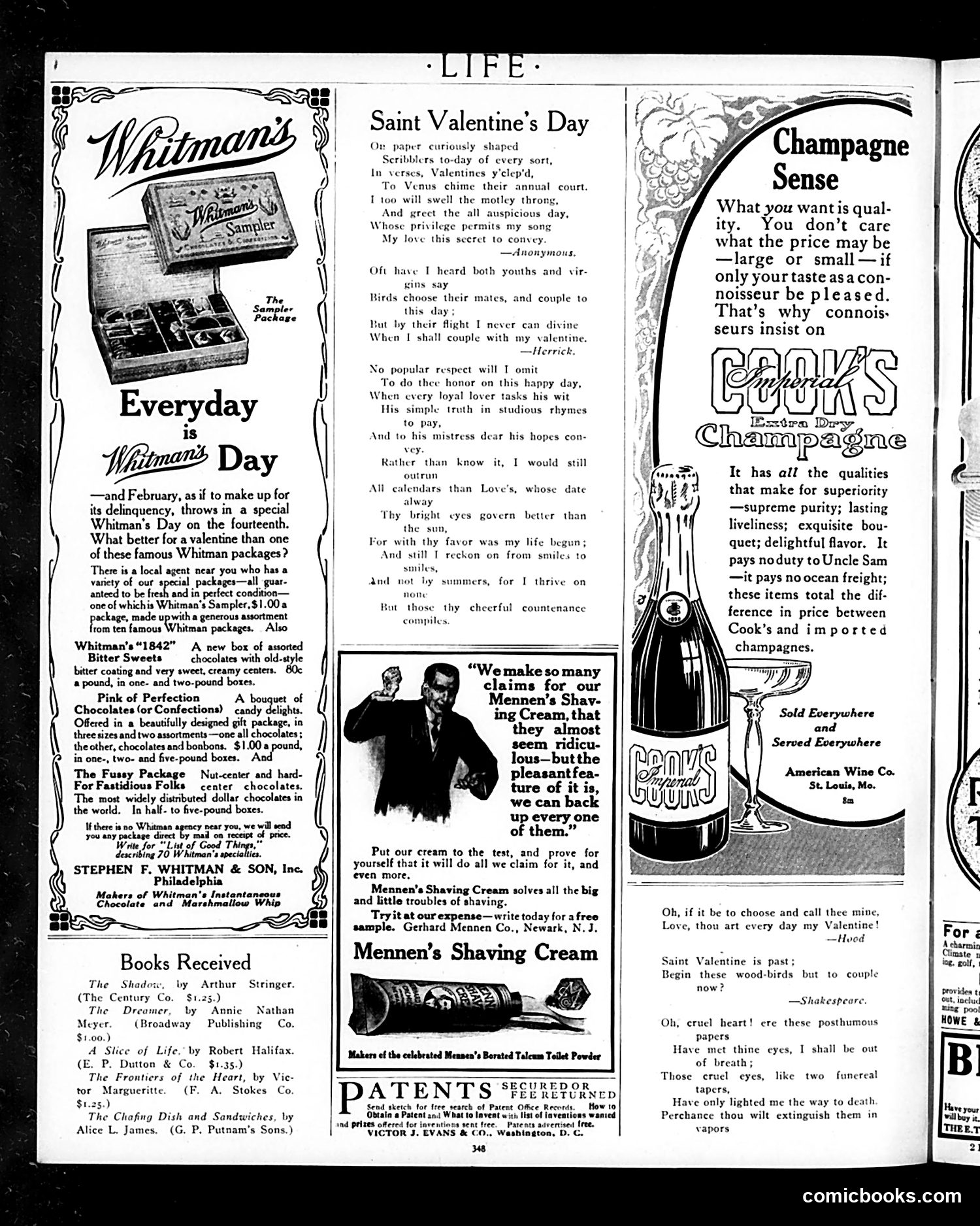
This page is primarily **advertising and Valentine's Day content** rather than political satire. The main elements are: **Advertisements:** Whitman's chocolates dominate the left side, promoting Valentine's Day gift packages. Mennen's Shaving Cream and Cook's champagne occupy the center and right. **Valentine's Day Poetry:** The center features period verses about romance and courtship, including classical references (Venus, Herrick). These are conventional sentimental poems typical of early 20th-century Valentine's Day publications. **The "Champagne Sense" ad** emphasizes quality over price—a connoisseur's argument for premium goods. **Books Received section** lists newly published volumes, a standard Life magazine feature. There is **no discernible political cartoon or satirical commentary** on this particular page. It reflects early 1900s consumer culture and romantic sentiment marketed through commercial products.
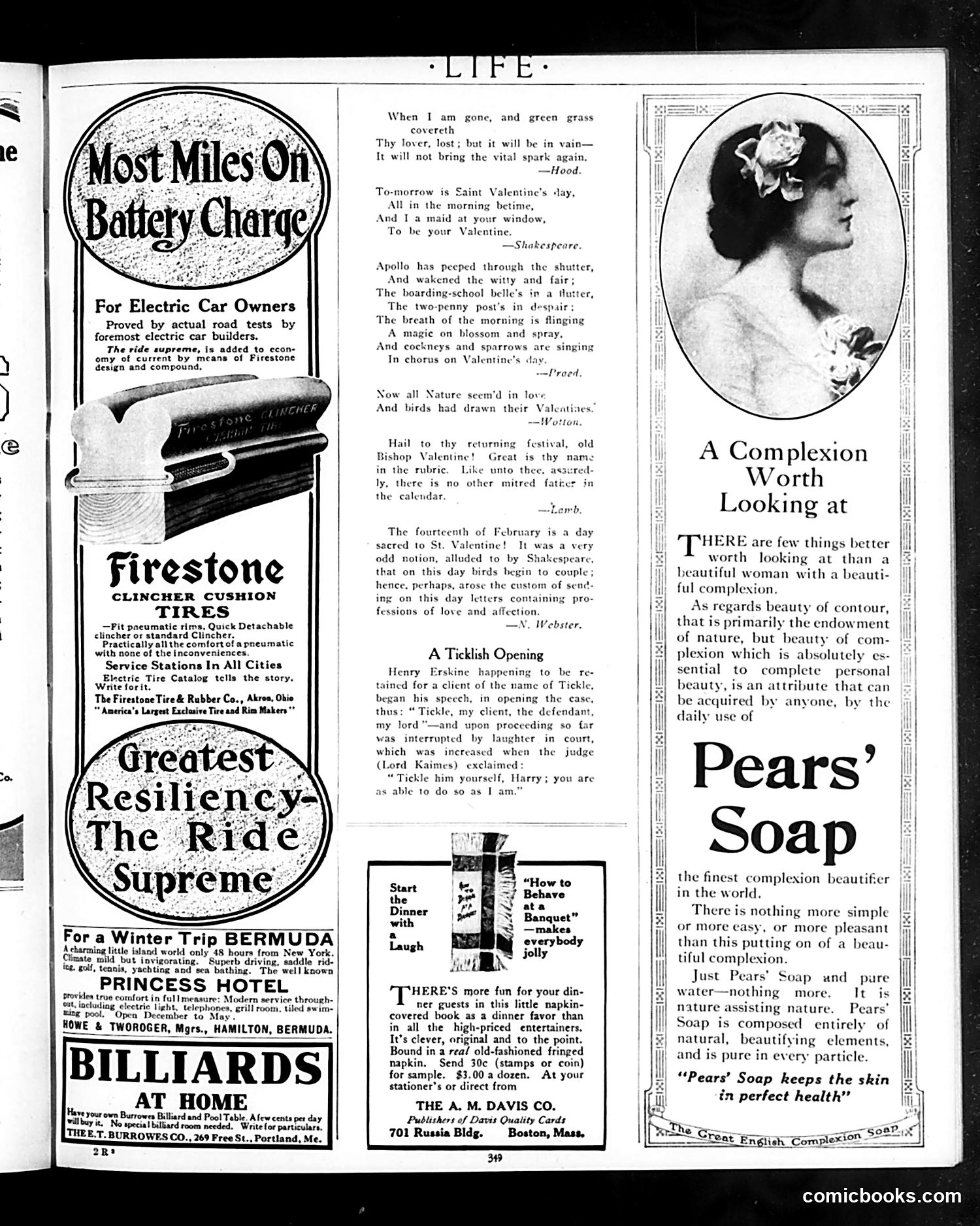
This page is primarily **advertising and light entertainment content**, not political satire. The main elements are: **Left side:** Product advertisements for Firestone tires (marketed to electric car owners), a Bermuda resort, and billiards equipment—typical early 20th-century ads. **Center:** Valentine's Day themed content—poetry excerpts and a humorous anecdote about lawyer Henry Erskine, whose client's unfortunate surname "Tickle" caused courtroom laughter when he began his legal argument. The judge (Lord Kaimes) quipped that Erskine could "tickle him himself," a crude pun. This is genteel humor for the era. **Right side:** Beauty advertisements for Pears' Soap, featuring a woman's profile portrait and claims about complexion improvement. The page reflects early 1900s advertising standards and social values—emphasis on personal grooming, leisure travel for the affluent, and automotive technology. There is no political cartoon or meaningful satire present.
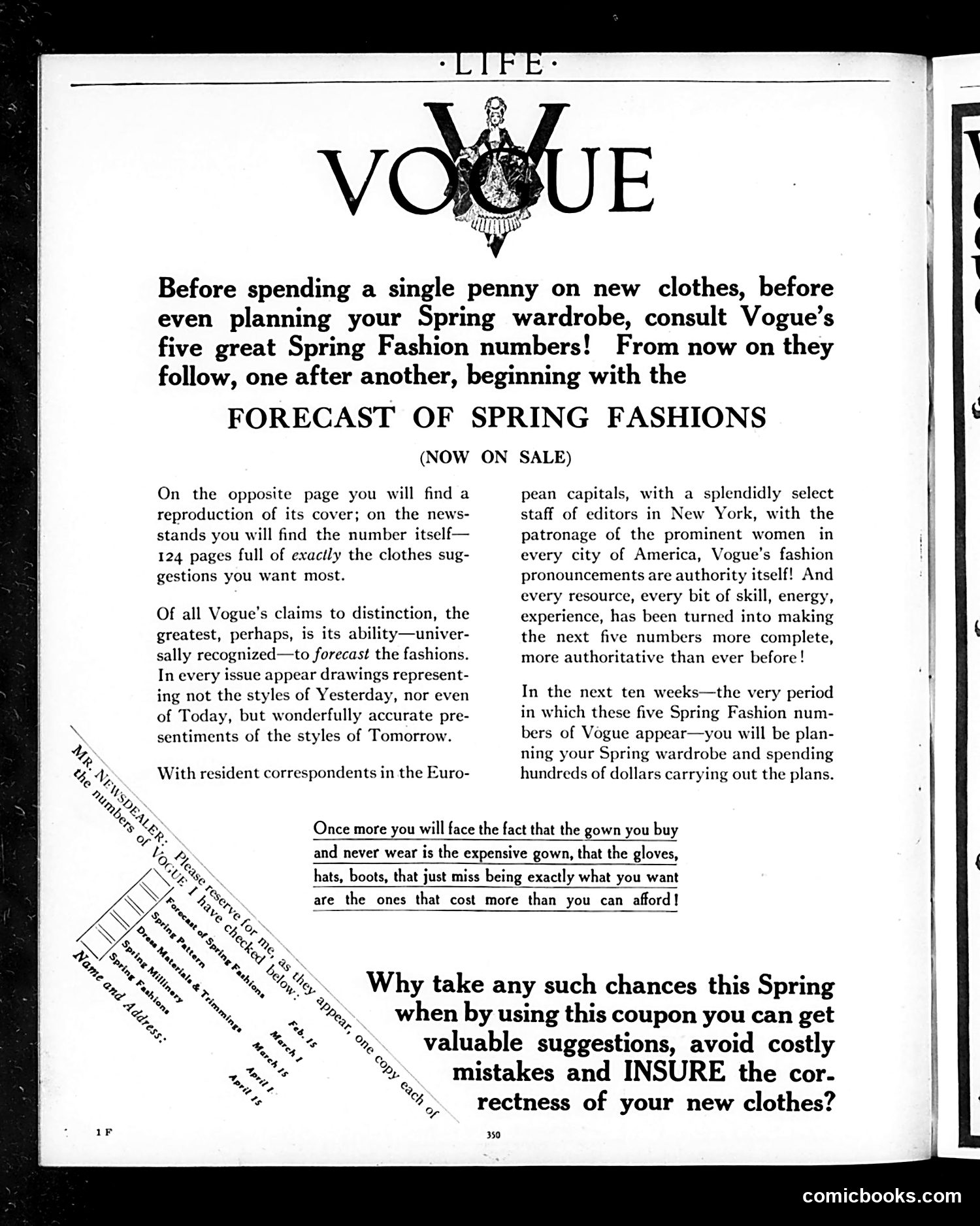
This is **not a cartoon or satire**—it's a **Vogue advertisement disguised as editorial content** in *Life* magazine. The page promotes Vogue's upcoming "five great Spring Fashion numbers" (special issues). The pitch exploits a genuine consumer anxiety: the fear of buying expensive clothes that don't work or miss the mark. The ad emphasizes Vogue's claimed authority in "forecasting" fashions through European correspondents and prominent women patrons. The satire here is *implicit*—*Life* magazine (which was genuinely satirical) is running what appears to be editorial praise for Vogue, but it's actually paid advertising. The irony: Vogue claims to prevent costly fashion mistakes, yet the very act of following fashion forecasts typically *requires* spending on trendy items. A coupon on the left side (partially visible) appears to solicit subscriptions. The underlying message: don't trust your own judgment; consult Vogue's experts to avoid wasting money—which means buying *their* magazine.
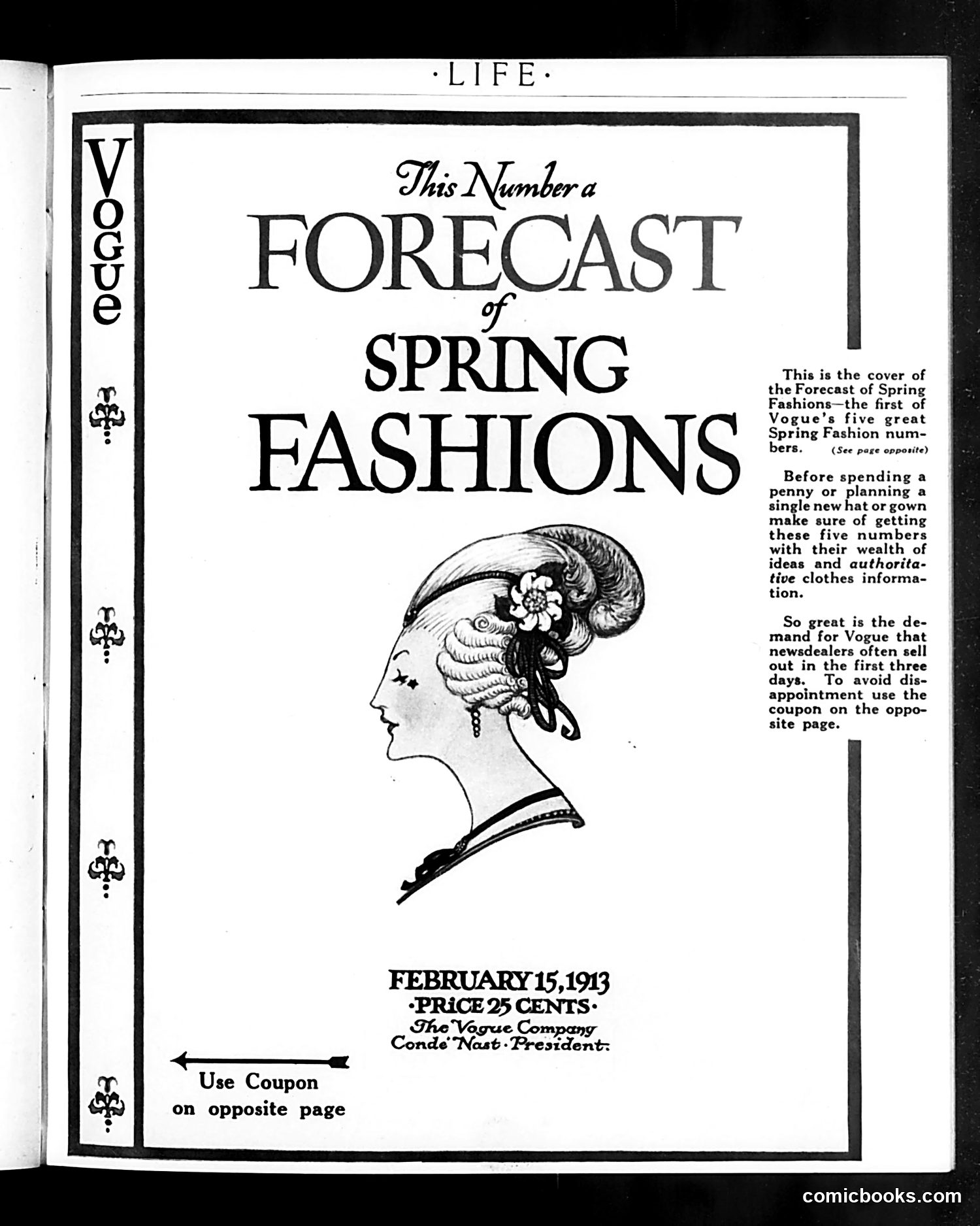
This is a title page rather than a satirical cartoon. It advertises Life magazine's "Forecast of Spring Fashions" issue from February 15, 1913, priced at 25 cents. The central image is a stylized profile illustration of a fashionable woman's head, featuring an elaborate upswept hairstyle typical of the 1910s era, adorned with flowers and ribbons. This represents the height of contemporary fashion. The page functions primarily as promotional material, urging readers to purchase this and four other upcoming Vogue fashion issues before newsdealers sell out within three days. The decorative fleur-de-lis border on the left margin adds elegance. No political satire or caricature is present. Rather, this reflects the magazine's dual role: combining satirical content with fashion advertising—a significant revenue source during this period.
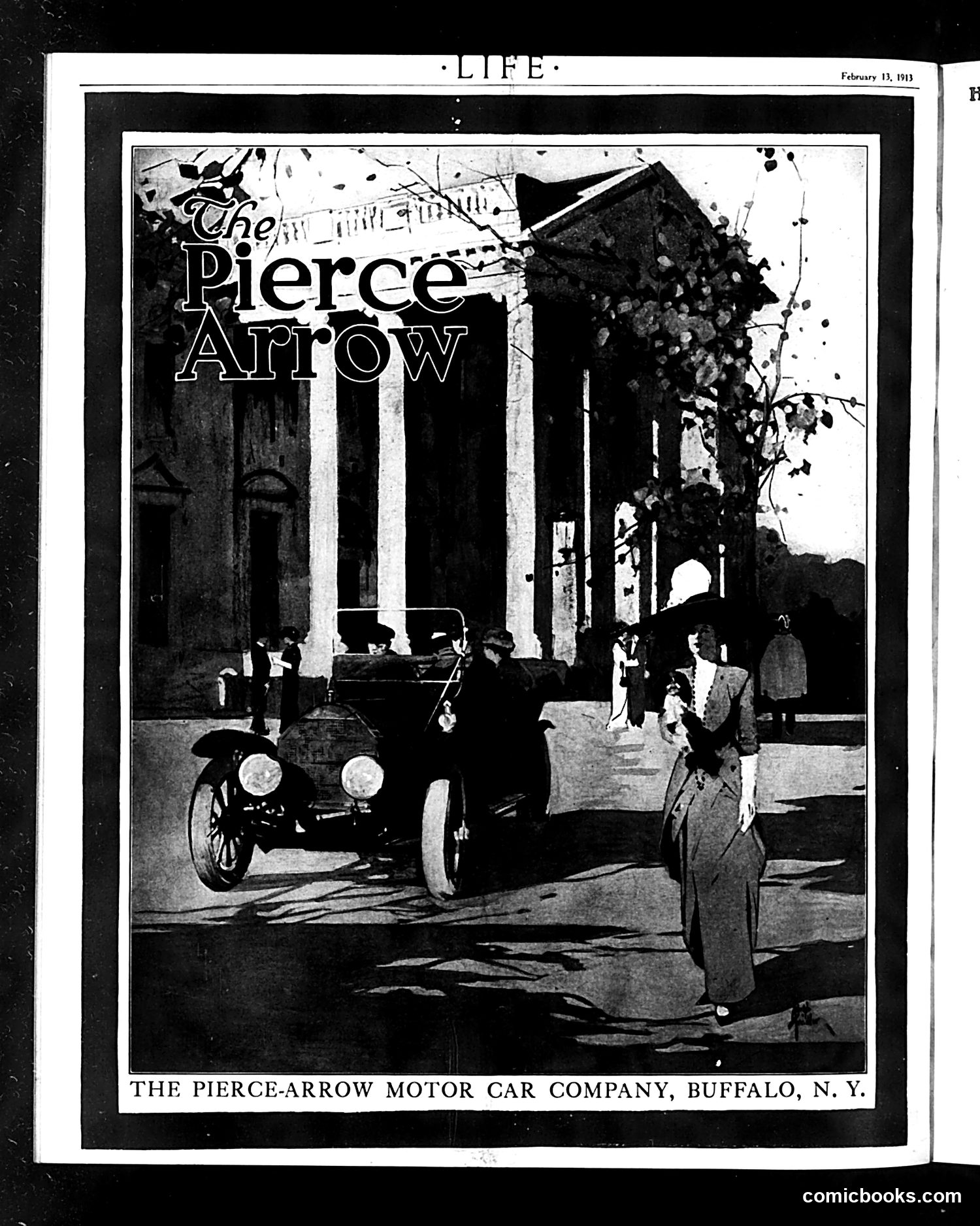
This is primarily an advertisement for the Pierce-Arrow Motor Car Company of Buffalo, New York, rather than political satire. The image depicts an early automobile (circa 1913) parked beneath classical columns in what appears to be a grand civic or institutional setting. Well-dressed figures stand nearby, suggesting affluence and sophistication. The ad uses classical architecture as visual metaphor—equating the Pierce-Arrow automobile with timeless elegance and permanence. This appeals to wealthy buyers by positioning the car as a luxury good comparable to refined civilization itself. The composition emphasizes the vehicle's prominence within an aspirational social scene, a common advertising strategy for high-end automobiles during the early automotive era when car ownership signified considerable wealth and status.