
Life, 1913-02-13 · page 18 of 44
Life — February 13, 1913 — page 18: what you’re looking at
What you’re looking at
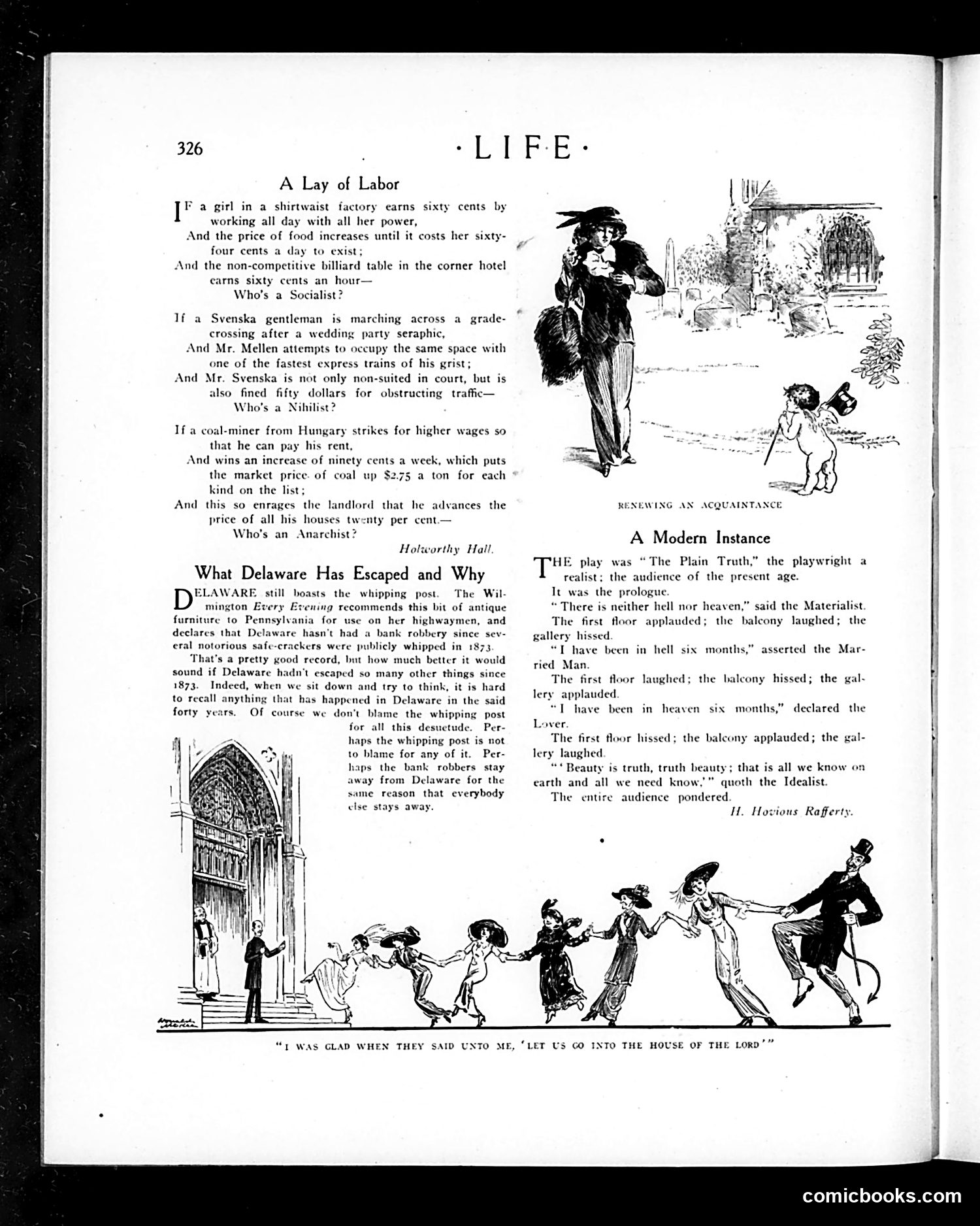
This page contains three satirical pieces critiquing early 20th-century American social and economic inequality: **"A Lay of Labor"** uses rhetorical questions to expose systemic exploitation: a factory girl earning 60¢ daily can't afford food at that wage; a billiard hall profits effortlessly; immigrant workers striking for wage increases only see landlords raise rents accordingly. The poem sarcastically labels victims of this system—socialists, nihilists, anarchists—implying the system itself, not activists, creates radicalism. **"What Delaware Has Escaped and Why"** mocks Delaware's reliance on the whipping post as evidence of law-and-order, suggesting the state is economically stagnant and isolated—people avoid Delaware entirely, not because of effective punishment, but because nothing happens there. **"A Modern Instance"** depicts a play where different audience sections (wealthy, middle-class, poor) react oppositely to identical philosophical statements about hell, heaven, and beauty, suggesting class determines ideology rather than objective truth. All three pieces satirize social hypocrisy and class division in Progressive Era America.
📄 Transcribed text from this page (OCR, searchable)
Machine-transcribed from the original scan — historical spelling and the odd misread are preserved.
326 A Lay of Labor I a girl in a shirtwaist factory earns sixty cents by working all day with all her power, And the price of food increases until it costs her sixty- four cents a day to exist; And the non-competitive billiard table in the corner hotel carns sixty cents an hour— Who's a Socialist? If a Svenska gentleman is marching across a grade- crossing after a wedding party seraphic, And Mr. Mellen attempts to occupy the same space with one of the fastest express trains of his grist; And Mr. Svenska is not only non-suited in court, but is also fined fifty dollars for obstructing traffic— Who's a Nihilist? If a coal-miner from Hungary strikes for higher wages so that he can pay his rent, And wins an increase of ninety cents a week, which puts the market price. of coal up $2.75 a ton for each kind on the list; And this so enrages the landlord that he advances the price of all his houses twenty per cent— Who's an Anarchist? Holworthy Hall. What Delaware Has Escaped and Why = still boasts the whipping post. The Wil- ery Evening recommends this bit of antique furniture to Pennsylvania for use on her highwaymen, and declares that Delaware hasn't had a bank robbery since sev- eral notorious safe-crackers were publicly whipped in 1873 That's a pretty good record, but how much better it would sound if Delaware hadn't escaped so many other things since 1873. Indeed, when we sit down and try to think, it is hard to recall anything that has happened in Delaware in the said Of course we don't blame the whipping post for all this desuetude. Per- haps the whipping post is not to blame for any of it. Per- haps the bank robbers stay away from Delaware for the same reason that everybody else stays away. “T WAS GLAD WHEN THEY SAID UNTO ME, ‘LET US GO INTO THE HOUSE OF THE LORD oe ei ela RENEWING AN ACQUAINTANCE A Modern Instance HE play was “The Plain Truth,” the play realist; the audience of the present age. It was the prologue. “ There is neither hell nor heaven,” said the Mate: The first floor applauded; the balcony laughed; the gallery hissed I have been in hell six months,” asserted the Mar- ried Man. The first floor laughed; the balcony hissed; the gal- lery applauded. I have been in heaven six months,” declared the Lover. The first floor hissed; the balcony applauded; the gal- lery laughed “*Beauty is truth, truth beauty; that is all we know on earth and all we need know,'” quoth the Idealist The entire audience pondered H. Hovious Rafferty. comicbooks.com