
Life, 1913-02-13 · page 15 of 44
Life — February 13, 1913 — page 15: what you’re looking at
What you’re looking at
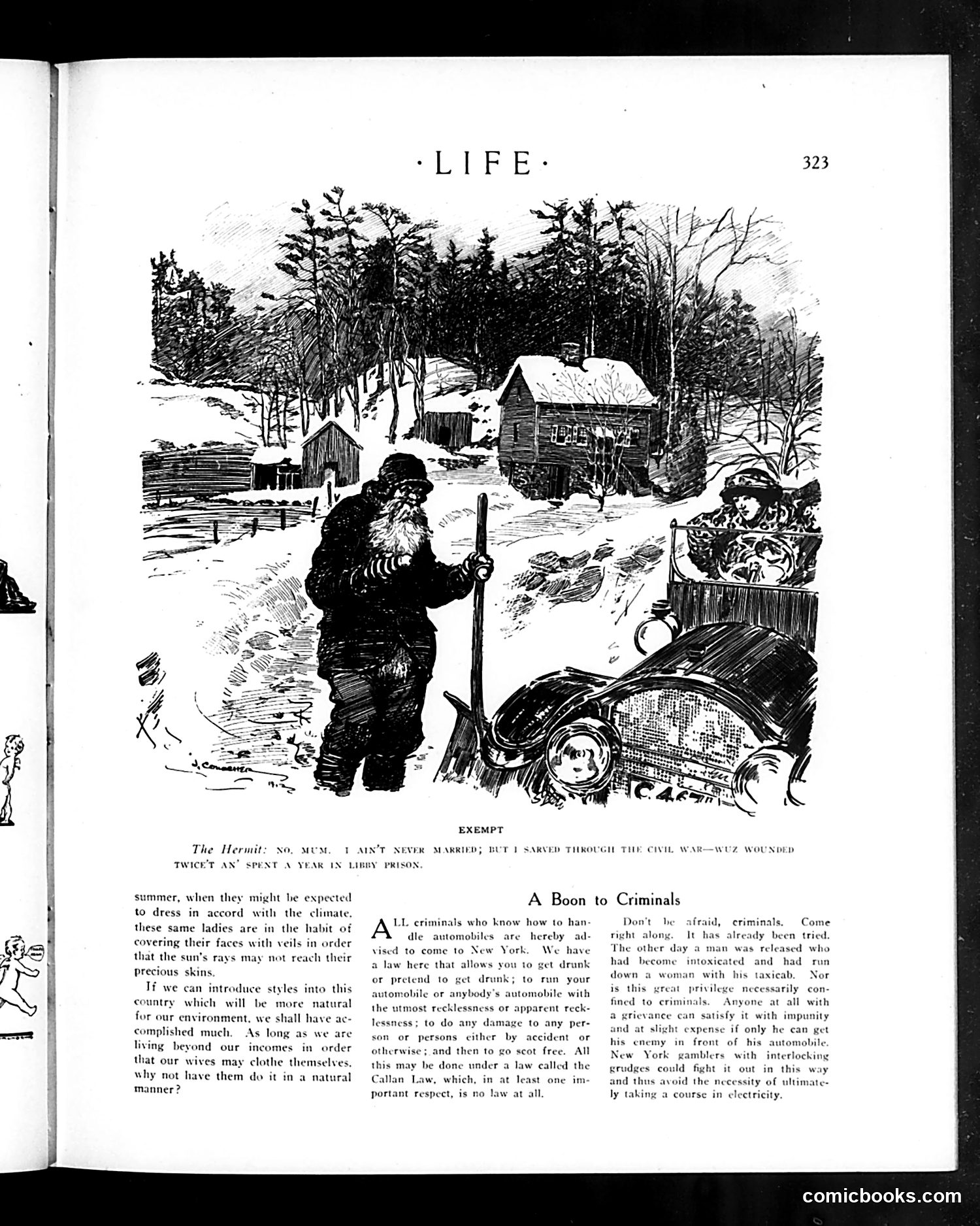
This page contains two distinct pieces of satire: **"The Hermit" (top):** A cartoon mocking upper-class women's fashion contradictions. The hermit character critiques wealthy women who wear heavy veils in summer to protect their skin from sun damage, while their families live "beyond our incomes" to afford fashionable clothing. The satire attacks both excessive concern with appearance and conspicuous consumption beyond one's means. **"A Boon to Criminals" (bottom):** This article sarcastically praises New York's "Callan Law" as beneficial to criminals. It describes how the law allows drunk drivers to cause damage with near-total impunity—the satirist cites a real case of an intoxicated man who hit a woman with his taxi and faced no serious consequences. The piece argues the law is essentially toothless ("no law at all") and mocks New York's lenient treatment of reckless automobile drivers, a growing concern in the early automotive era. Both pieces target perceived social absurdities and legal failures affecting public welfare.
📄 Transcribed text from this page (OCR, searchable)
Machine-transcribed from the original scan — historical spelling and the odd misread are preserved.
The Hermit: xo, mem. 1 TWICE'T AN’ SPENT A YEAR IN Linney summer, when they might he expected to dress in accord with the climate, these same ladies are in the habit of covering their faces with veils in order that the sun's rays may not reach their Precious skins. Tf we can introduce styles into this country which will be more natural for our environment, we shall have ac- complished much. As long as we are living beyond our incomes in order that our wives may clothe themselves, why not have them do it in a natural manner? EXEMPT MIN’T NEVER PRISON MARRIED; BUT 1 SARVED THROUGH THEE CIVIL WAR—WUZ WOUNDED A Boon to Criminals LL criminals who know how to han dle hereby ad- vised to come to New York. We have a law here that allows you to get drunk automobiles are or pretend to get drunk; to run your automobile or anybody's automobile with the utmost recklessness of apparent reck- lessness; to do any damage to any per- or persons. cither otherwise; and then to go scot free. All be done under a law called the Callan Law, which, in at least one im portant respect, is no law at all. son by accident or this may Don't he Come right along. It has already been tried. The other day had afraid, criminals, man was released who and had a woman with his taxicab. become intoxicated run Nor necessarily con- all with y it with impunity t expense if only he can get his enemy in front of his New York grudges could fight it out and thus ly takir down is this great priviles fined to criminals. one at © can satis automobile. amblers with interlocking in this way void the necessity of ultimate- a course in electricity, comicbooks.com