
Life, 1913-02-13 · page 8 of 44
Life — February 13, 1913 — page 8: what you’re looking at
What you’re looking at
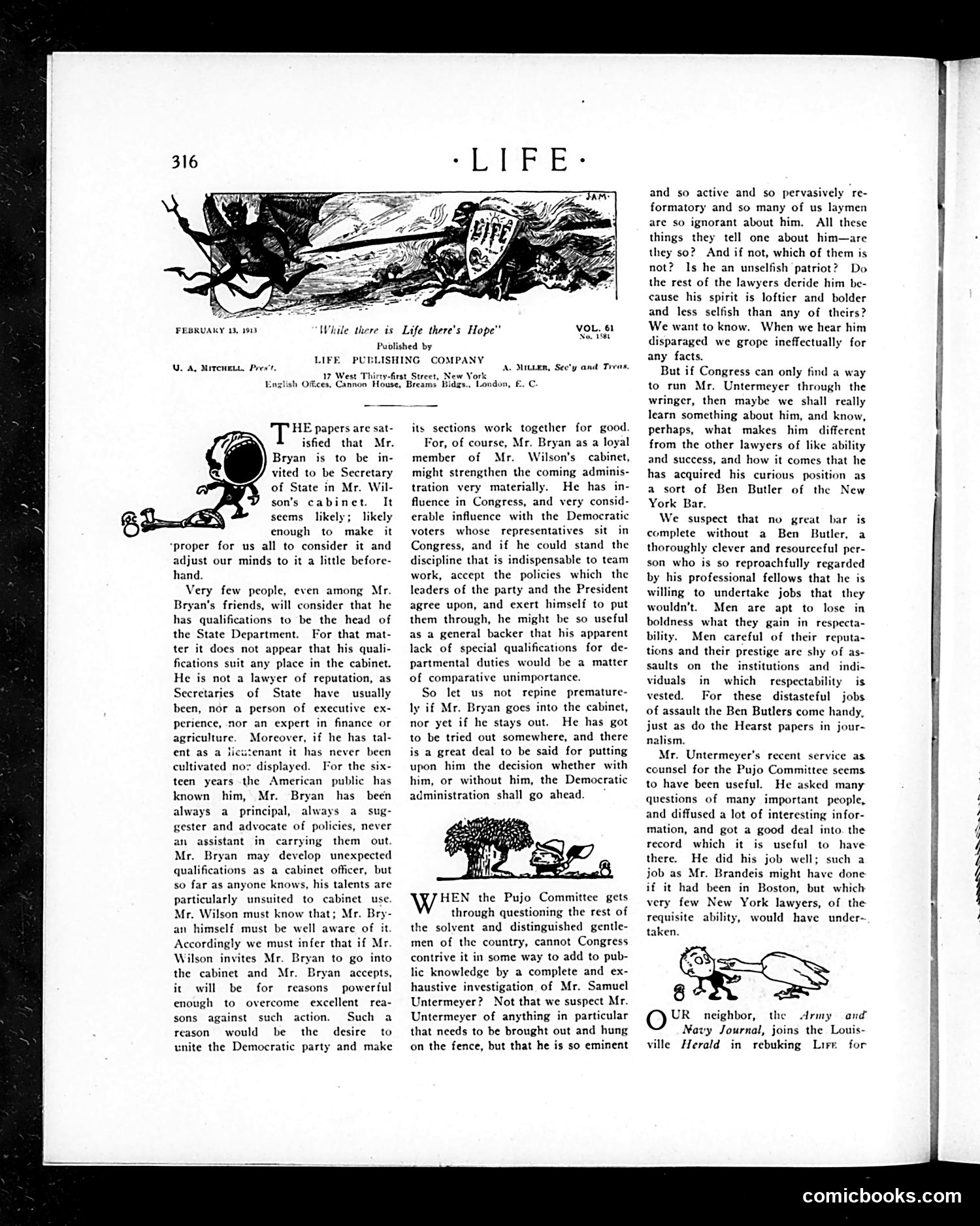
This February 13, 1913 issue discusses William Jennings Bryan's potential appointment as Secretary of State under President Wilson. The article debates whether Bryan—a three-time presidential candidate and prominent Democrat—has the qualifications for high office, despite his lack of diplomatic experience. The cartoon critiques Bryan's suitability, using visual caricature (the large head suggests pomposity or overconfidence). The text satirizes Bryan's political prominence versus actual expertise, questioning whether his popularity and influence within the Democratic Party compensate for his inexperience in departmental administration and foreign policy. The piece also references the Pujo Committee's ongoing investigation into Samuel Untermeyer, suggesting concerns about Bryan's qualifications compared to other potential cabinet members.
📄 Transcribed text from this page (OCR, searchable)
Machine-transcribed from the original scan — historical spelling and the odd misread are preserved.
FEBRUAKY 13, 1913 While there is Life there's Hope” Published by LIFE PUBLISHING COMPANY U. A, MitcHELt. Pres’t. 17 West T English Offices, Cannon House, HE papers are sat- isfied that Mr. Bryan is to be in- vited to be Secretary of State in Mr. Wil- son’s cabinet. It seems likely; likely enough to make it ‘proper for us all to consider it and adjust our minds to it a little before- hand. Very few people, even among Mr. Bryan's friends, will consider that he has qualifications to be the head of the State Department. For that mat- ter it does not appear that his quali- fications suit any place in the cabinet. He is not a lawyer of reputation, as Secretaries of State have usually been, nor a person of executive ex- perience, nor an expert in finance or agriculture. Moreover, if he has tal- ent as ai enant it has never been cultivated no: displayed. For the six teen years the American public has known him, Mr. Bryan has been always a principal, always a sug- gester and advocate of policies, never an assistant in carrying them out Mr. Bryan may develop unexpected qualifications as a cabinet officer, but so far as anyone knows, his talents are particularly unsuited to cabinet use. Mr. Wilson must know that; Mr. Bry- an himself must be well aware of it Accordingly we must infer that if Mr. Wilson invites Mr. Bryan to go into the cabinet and Mr. Bryan accepts, it will be for reasons powerful enough to overcome excellent rea- sons against such action. Such a reason would be the desire to unite the Democratic party and make A. MILLER, Sec'y anit Tr t Street, New York Breams’ Bidgs.. Londo its sections work together for good. For, of course, Mr. Bryan as a loyal member of Mr. Wilson's cabinet, might strengthen the coming adminis- tration very materially. He has in- fluence in Congress, and very consid- erable influence with the Democratic voters whose representatives sit in Congress, and if he could stand the discipline that is indispensable to team work, accept the policies which the leaders of the party and the President agree upon, and exert himself to put them through, he might be so useful as a general backer that his apparent lack of special qualifications for de- partmental duties would be a matter of comparative unimportance. So let us not repine premature- ly if Mr. Bryan goes into the cabinet, nor yet if he stays out. He has got to be tried out somewhere, and there is a great deal to be said for putting upon him the decision whether with him, or without him, the Democratic administration shall go ahead. HEN the Pujo Committee gets through questioning the rest of the solvent and distinguished gentle- men of the country, cannot Congress contrive it in some way to add to pub- lic knowledge by a complete and ex- haustive investigation of Mr. Samuel Untermeyer? Not that we suspect Mr. Untermeyer of anything in particular that needs to be brought out and hung on the fence, but that he is so eminent and so active and so pervasively re- formatory and so many of us laymen are so ignorant about him. All these things they tell one about him—are they so? And if not, which of them is. not? Is he an unselfish patriot? Do the rest of the lawyers deride him be- cause his spirit is loftier and bolder and less selfish than any of theirs? We want to know. When we hear him disparaged we grope ineffectually for any facts. But if Congress can only find a way to run Mr. Untermeyer through the wringer, then maybe we shall really learn something about him, and know, perhaps, what makes him different from the other lawyers of like ability and success, and how it comes that he has acquired his curious position as a sort of Ben Butler of the New York Bar. We suspect that no great bar is complete without a Ben Butler, a thoroughly clever and resourceful per- son who is so reproachfully regarded by his professional fellows that he is willing to undertake jobs that they wouldn't. Men are apt to lose in boldness what they gain in respecta- bilit; Men careful of their reputa- tions and their prestige are shy of as- saults on the institutions and indi- viduals in which respectability is vested. For these distasteful jobs of assault the Ben Butlers come handy, just as do the Hearst papers in jour- nalism. Mr. Untermeyer’s recent service as counsel for the Pujo Committee seems to have been useful. He asked many questions of many important people, and diffused a lot of interesting infor- mation, and got a good deal into. the record which it is useful to have there. He did his job well; such a job as Mr. Brandeis might have done if it had been in Boston, but which very few New York lawyers, of the requisite ability, would have under- UR neighbor, the Army and Navy Journal, joins the Louis- ville Herald in rebuking Lire for comicbooks.com ee