
Life, 1913-02-13 · page 21 of 44
Life — February 13, 1913 — page 21: what you’re looking at
What you’re looking at
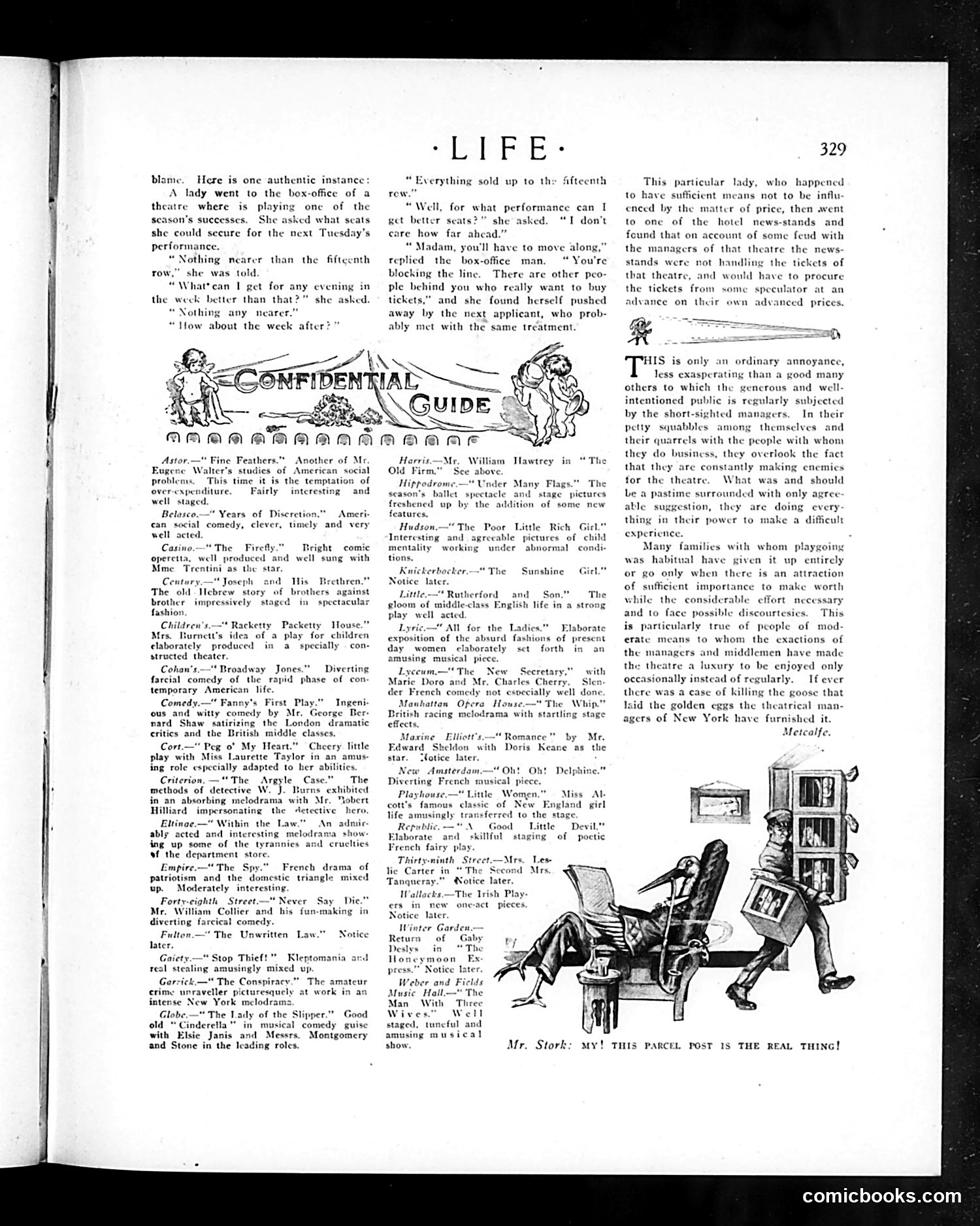
The main cartoon depicts a theater box-office scene illustrating a social complaint about ticket distribution. A well-dressed woman inquires about seats for an upcoming performance, only to be repeatedly told everything is sold out—even weeks in advance. When she persists in asking, the dismissive box-office clerk rudely tells her to "move along" because she's "blocking the line," pushing her aside for the next customer. The satire targets theatrical box-office practices of the era: the apparent monopolization of good seats (possibly by speculators or wealthy advance-buyers), the indifference of ticket sellers to ordinary patrons, and the artificial scarcity created by poor distribution systems. The woman's frustrated attempts to secure any reasonable seats—eventually willing to accept anything, however distant—underscore the frustration of theatergoers locked out by inefficient or corrupt ticketing systems. The page also lists current Broadway productions.
📄 Transcribed text from this page (OCR, searchable)
Machine-transcribed from the original scan — historical spelling and the odd misread are preserved.
Blame. Here is one authentic instance: A lady went to the box-office of a theatre where is playing onc of the season's successes. She asked what seats she could secure for the next Tuesday's performance. Nothing nearer than the fifteenth row,” “What*can I get for any evening in the week better than that?” she asked. “Nothing any nearer.” “Mow about the week after?” she was told. EF E verything sold up to the fifteenth row “Well, for what performance can I get betters " she asked. “IT don't care how far ahead. “ Madam, you'll have to move along,” replied the box-office man, “You're blocking the line. There are other peo- ple behind you who really want to buy tickets,” and she found herself pushed away by the next applicant, who prob- ably met with the same treatment. Astor.—" Fine Feathers." Another of Mr Eugene Walter's studies of American social proble This time it is the temptation of over-expenditure. irly interesting and well staged. Belasco.—" Years of Discretion.” Ame can social comedy, clever, timely and ver: well acted. Casino.—" The Firefly." Bright comic operctta, well produced and well sung with Mme Trentini as the star, nd His Brethren.” against Century.—“ Joseph The old Hebrew story of broth brother impressively staged in spectacular fashion Children’s.—"* Racketty Packetty House.”” Mrs. Burnett’s idea of a play for children elaborately produced a specially . con structed theater. Cohan’s.—* Broadway Jones.” —Diverting farcial comedy of the rapid phase of con: temporary American life. Comedy. fanny’s First Play.” Ingeni ous and witty comedy by Mr. George Ber- nard Shaw satirizing the London dramatic critics and the British middle classes. Cort.—" Peg of My Heart.” Cheery little play with Miss Laurette Taylor in an amus. ing role especially adapted to her abilities Criterion. ~The Argyle Case." The methods of detective W. J. burns exhibited in an absorbing melodrama with Mr. "lobert Hilliard impersonating the detective hero. Eltinae.—" Within the Law." An admire ably acted and interesting melodrama show- ing up some of the tyrannies and cruclties Sf the department store Empire.—" The Spy French drama of patriotism and the domestic triangle mixed up. Moderately interesting Forty-eighth Street.—“ Never Say Die. Mr. William Collier and his fun-making in diverting farcical comedy. Fulton.—" The Unwritten Law." Notice later. Gaicty.—" Stop Thief!” Kleptomania ard real stealing amusingly mixed up. Garrick.—" The Conspiracy.” The am: crime unraveller picturesquely at work intense New York melodran Globe.—"" The Lady of the Slipper.” Good old “Cinderella” in. musical comedy guise ith Elsie Janis and Messrs. Montgomery and Stone in the leading roles. Harris.—Mr. William Hawtrey in“ The Old Firm.” See above Hippodrome.—"U season's er Many Flags." The spectacle and stage pictures freshe the addition of some new features, Hudson.—“ The Poor Little Rich Girl.” Interesting and agreeable pictures of chi mentality working under abi tions, Knickerbocker." The — Sunshine Notice later. He. Rutherford and Son." The gloom of middle-class English life in a st play well acted. Lyric." MM for the Ladies." Elaborate exposition of the absurd fashions of present day women elaborately set forth in amusing musical piece. “The New Secretary,” with nd Mr. Charles Cherry. Sen cdy not especially well done mn Opera Hous The Whip.” Monhat British racing melodrama with startling stage effects. Elliott's. —“* Romance" by Mr. elon with Doris Keane as the Motice later. Amsterdam.—“ Oh! Oht De ing French musical piece, Playhouse.—“ Little Wor n.”” Miss Ale cott’s famous classic of New England girl life amusingly transferred to the stage. Republic \ Good Little Devil." Elaborate and skillful staging of poetic lie Carter in Tanqueray.” Notice later. A Wallacks.—The Irish Play 4 w one-act ter ers in Notice Winter Garden. Return of Deslys Honeymoon Ex press.”” Notice Weber and F Music Hall.— Man With Thre Wie We staged, tuneful and amusing musical show pieces. Mr. Stork: My! THIS PARCEL POST IS THE REAL THING! 329 This particular lady, who happened to have sufficient means not to be influ enced by the matter of price, then avent to one of the hotel news-stands and found that on account of some feud with the managers of that theatre th stands were not handling the tickets of that theatre, and would have to procure news- the tickets from some speculator at an advance on their own advanced prices. ws HIS is only an ordinary annoyance, less exasperating than a good many others to which the generous and well intentioned public is regularly subjected by the short-sighted managers, In their petty squabbles among themselves. and their quarrels with the people with whom they do business, they overlook the fact that they are constantly making enemies for the theatre. What was and should Le a pastime surrounded with only agree stion, they are doing every thing in their power to make a difficult experience. Many famil was habitual h or go only when there is an attraction of sufficient importance to make worth while the considerable ¢ and to is particularly true of people of mod able su es with whom playgoing ve given it up entirely t necessary ¢ possible discourtesics. This erate means to whom the exactions of the managers and middlemen have made the theatre a luxury to be enjoyed only occasionally instead of regularly. If e er there was a case of killing the goose that Isid the golden cggs the theatrical man- agers of New York have furnished it. Metcalfe. comicbooks.com