
Life, 1913-02-13 · page 19 of 44
Life — February 13, 1913 — page 19: what you’re looking at
What you’re looking at
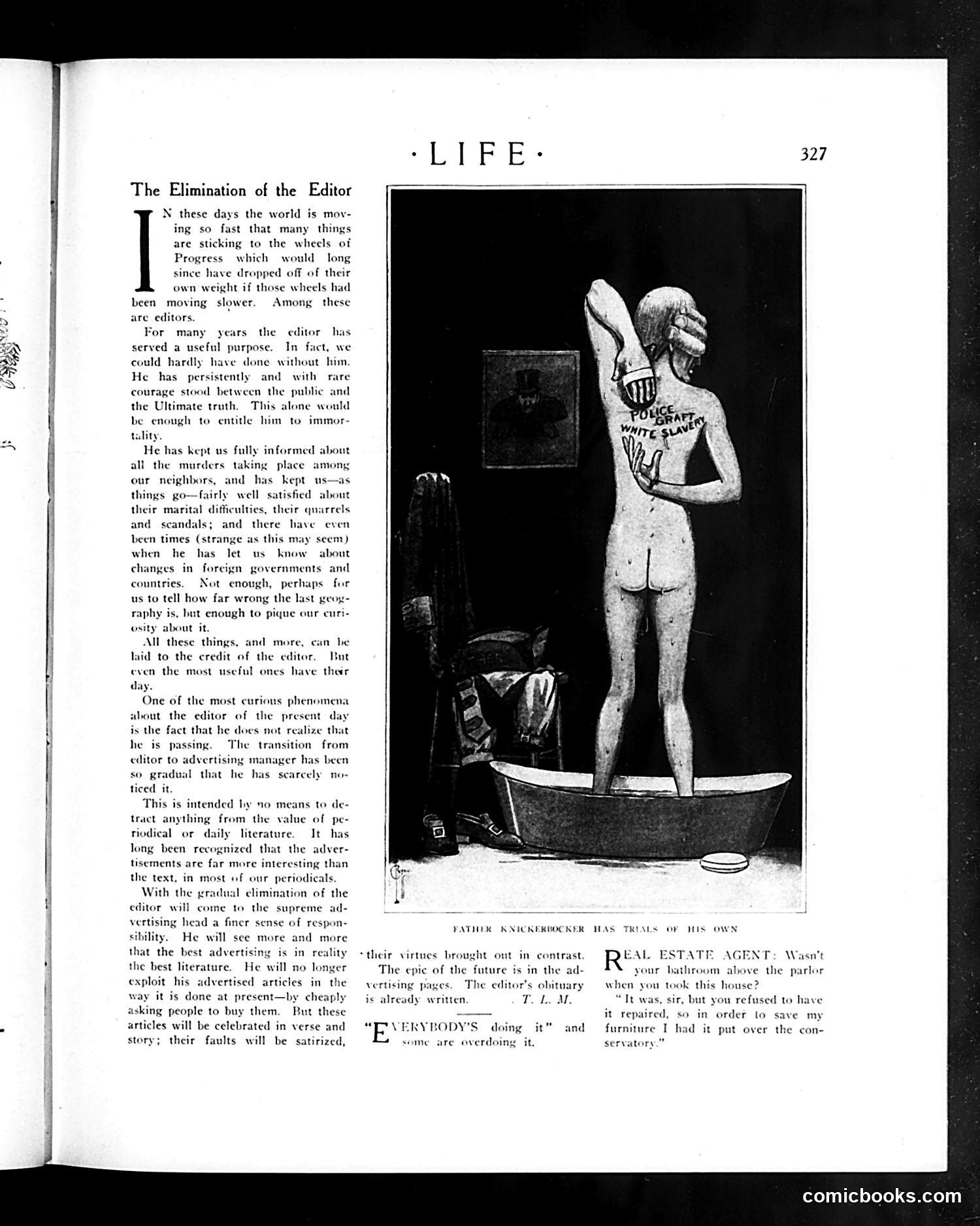
This satirical piece critiques the early 20th-century decline of newspaper editors' editorial authority. The text argues that editors—once guardians standing "between the public and Ultimate truth"—have gradually become advertising managers without realizing it. The author warns that editors are now exploiting advertised products through cheap promotional tactics rather than serving the public interest. The cartoon (bottom right) shows a "Real Estate Agent" explaining to a prospective buyer that he refused to repair a bathroom above the parlor, instead moving his furniture to the conservatory. This illustrates the satirical theme: advertising-driven publications now prioritize selling products (real estate, furnishings) over honest consumer advice or editorial integrity. The underlying critique suggests that commercial interests have corrupted journalism's fundamental purpose, reducing editors to mere advertising vehicles rather than trustworthy information sources.
📄 Transcribed text from this page (OCR, searchable)
Machine-transcribed from the original scan — historical spelling and the odd misread are preserved.
The Elimination of the Editor N these days the world is mov- ing so fast that many things are sticking to the wheels of Progress which would long since have dropped off of their own weight if those wheels had been moving slower. Among these are editors. For many years the editor has served a useful purpose. In fact, we ] could hardly have done without him. | He has persistently and with rare courage stood between the public and the Ultimate truth, This alone would | be enough to entitle him to. immor- “ i tality ] He has kept us fully informed about fi all the murders taking pla among i ‘ar: ineighbors, and has: kept! waaé y things go—fairly well satisfied about | their marital difficulties, their quarrels and scandals; and there have even been times (strange as this may seem) when he has let us know about changes in foreign governments and countries. Not enough, perhaps fe us to tell how far wrong the last x raphy is, but enough to pique our curi- osity about it. All these things, and more, can be laid to the credit of the editor. But f even the most useful ones have their day. One of the most curious phenomena about the editor of the present day is the fact that he doc he is passing. The transition from rs not realize t editor to advertising manager has been so gradual that he has scarcely no- ii ticed it. This is intended by no means to de- | tract anything from the value of pe- i riodical or daily literature. It has long been recognized that the adver- tisements are far more interesting than the text, in most of our periodicals With the gradual elimination of the t editor will come to the supreme ad- vertising head a finer sense of respon- sibility. He will see more and more that the best advertisi FATHEK KNICKERBOCKER HAS TRIALS OF HIS OWN AL ESTATE AC NT: Wasn't gis in reality their virtues brought ont in contrast y the best literature. He will no longer The epic of the future is in the ad- your bathroom above the parlor | exploit his advertised articles in the vertising pages. The editor's obituary — when you took this house? way it is done at present—by cheaply js already. written Te Lol “Tt was, sir, but you refused to have sking people to buy them. But these — it repaired, so in order to save my . articles will be celebrated in verse and E‘ ZKYBODY doing it” and furniture I had it put over the con- story; their faults will be satirized, some are overdoing it, servatory.” comicbooks.com