
Life, 1913-02-13 · page 24 of 44
Life — February 13, 1913 — page 24: what you’re looking at
What you’re looking at
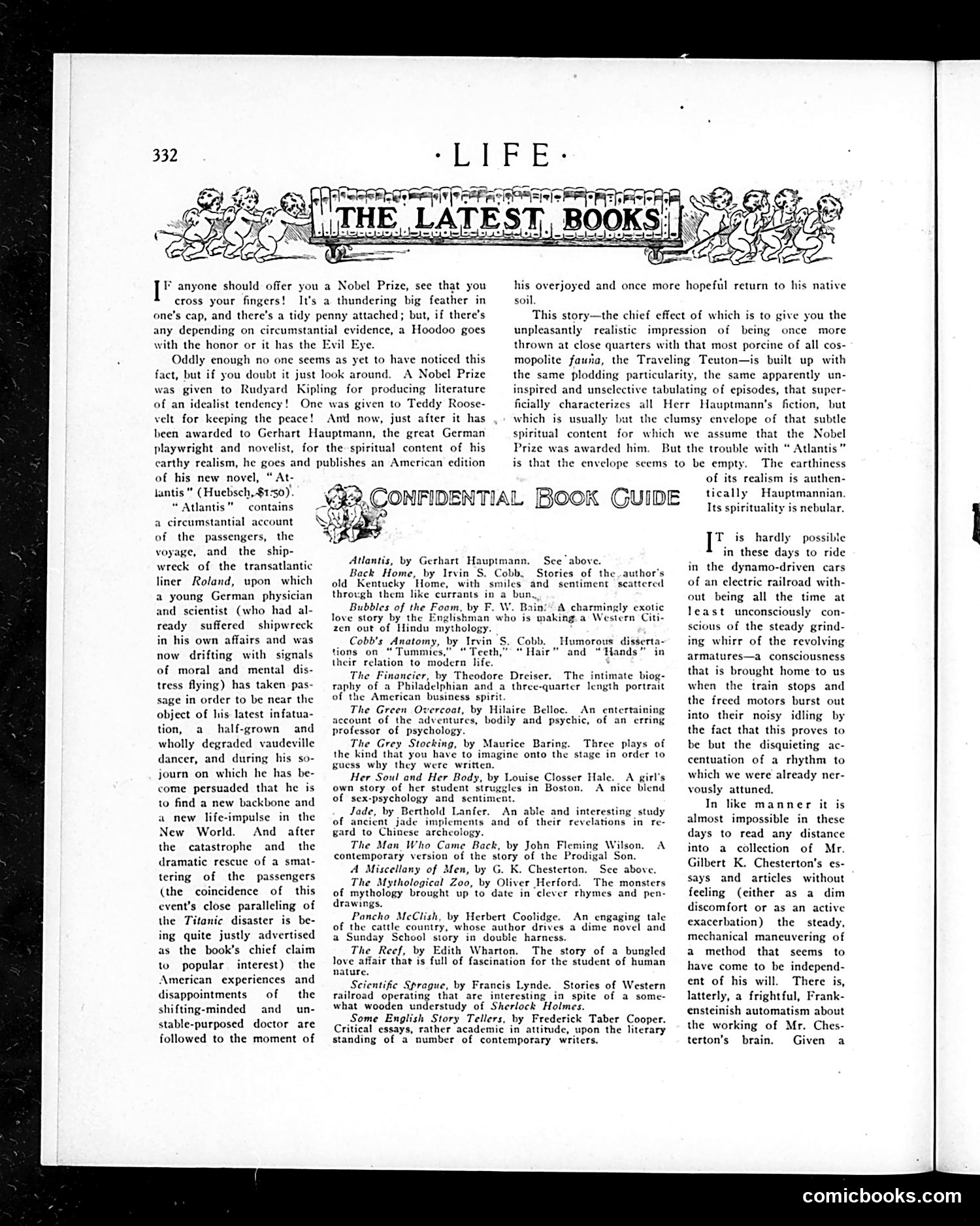
This page is primarily a **book review column**, not a political cartoon. The main content critiques Gerhart Hauptmann's novel *Atlantis*, newly published in America. The satirical point is: Hauptmann recently won the Nobel Prize for the "spiritual content" of his work, yet his new novel *Atlantis* appears to lack exactly that quality. The reviewer mockingly notes the irony—that the Nobel Prize seems cursed, citing Kipling (idealist literature) and Theodore Roosevelt (peace) as previous recipients whose subsequent actions contradicted their awards. The "Evil Eye" joke suggests the Nobel Prize brings bad luck: recipients subsequently disappoint. Hauptmann's *Atlantis* is criticized as heavy-handed, earthly realism rather than the spiritually elevated work that supposedly earned him the prize. The page includes a decorative "Confidential Book Guide" header with cherubs and brief reviews of contemporary works by Cobb, Dreiser, and others—standard literary journalism for this era's *Life* magazine.
📄 Transcribed text from this page (OCR, searchable)
Machine-transcribed from the original scan — historical spelling and the odd misread are preserved.
* anyone should offer you a Nobel Prize, see that you cross your fingers! It's a thundering big feather in one’s cap, and there's a tidy penny attached; but, if there’s any depending on circumstantial evidence, a Hoodoo goes with the honor or it has the Evil Eye. Oddly enough no one seems as yet to have noticed this fact, but if you doubt it just look around. A Nobel Prize en to Rudyard Kipling for producing literature of an idealist tendency! One was given to Teddy Roose- velt for keeping the peace! And now, just after it has been awarded to Gerhart Hauptmann, the great German playwright and novelist, for the spiritual content of his carthy realism, he goes and publishes an American edition of his new novel, “ At- lantis ” (Huebsch, $1:50). “Atlantis” contains 32, CONFIDENTIAL BOOK GUIDE his overjoyed and once more hopeful return to his native soil. This story—the chief effect of which is to give you the unpleasantly realistic impression of being once more thrown at close quarters with that most porcine of all cos- mopolite fawia, the Traveling Teuton—is built up with the same plodding particularity, the same apparently un- inspired and unselective tabulating of episodes, that super- ficially characterizes all Herr Hauptmann’s fiction, but which is usually but the clumsy envelope of that subtle spiritual content for which we assume that the Nobel Prize was awarded him. But the trouble with “ Atlantis” is that the envelope seems to be empty. The earthiness of its realism is authen- tically Hauptmannian. a circumstantial account of the passengers, the voyage, and the ship- wreck of the transatlantic liner Roland, upon which a young German physician and scientist (who had al- ready suffered shipwreck in his own affairs and was now drifting with signals of moral and mental dis- tress flying) has taken pas- sage in order to be near the object of his latest infatua- tion, a half-grown and wholly degraded vaudeville dancer, and during his so- journ on which he has be- come persuaded that he is to find a new backbone and a new life-impulse in the New World. And after the catastrophe and the dramatic rescue of a smat- tering of the passengers (the coincidence of this event’s close paralleling of the Titanic disaster is be- ing quite justly advertised as the book's chief claim to popular interest) the American experiences and disappointments of the shifting-minded and un- stable-purposed doctor are followed to the moment of A! Atlantis, by Gerhart Hauptmann, See’ above. Back Home, by Irvin S. Cobb, Stories of the. author's old Kentucky Home, with smiles and sentiment scattered throvgh them like currants a bun. Bubbles of the Foom, by F. W. Bain! A charmingly exotic love story by the an who is making a Western Citi- zen out of Hindu mythology. Cobb's Anatom: tions on “ Tummie: their relation to modern life. The Financier, by Theodore Dreiser. raphy of a Philadelphian and a thre of the American business spirit. The Green Overcoat, by Hilaire Belloc. An entertaining account of the adventures, bodily and psychic, of an erring professor of psychology. The Grey Stocking, by Maurice Barin; the kind that you have to imagine onto the guess why they were written. Her Soul and Her Body, by Louise Closser Hale. A girl's own story of her student struggles in Boston. A nice blend of sex-psychology and sentiment. Jade, by Berthold Lanfer. An able and interesting study of ancient jade implements and of their revelations in re- gard to Chinese archeology. The Man Who Came Back, by John Fleming Wilson. A contemporary version of the story of the Prodigal Son. A Miscellany of Men, by G. K. Chesterton, See above. The Mythological Zoo, by Oliver Herford. The monsters of mythology brought upto date in clever rhymes and pen- drawings. Pancho McClish, by Herbert Coolidge. An_ engaging tale of the cattle country, whose author drives a dime novel and a Sunday School siory in double harn The Reef, by Edith Wharton. The story of a bungled love affair that is full of fascination for the student of human nature. _ Scientific Sprague, by Francis Lynde. Stories of Western railroad operating that are interesting in spite of a some- what wooden understudy of Sherlock Holmes. Some English Story Tellers, by Frederick Taber Cooper. Critical essays, rather academic in attitude, upon the literary standing of a number of contemporary writers. Cobb, Hair” Humorous disserta~ and “Hands” in The intimate biog- -quarter length portrait Three plays of age in order to Its spirituality is nebular. I" is hardly possible in these days to ride in the dynamo-driven cars of an electric railroad with- out being all the time at least unconsciously con- scious of the steady grind- ing whirr of the revolving armatures—a consciousness that is brought home to us when the train stops and the freed motors burst out into their noisy idling by the fact that this proves to be but the disquieting ac- centuation of a rhythm to which we were already ner- vously attuned. In like manner it is almost impossible in these days to read any distance into a collection of Mr. Gilbert K. Chesterton's es- says and articles without feeling (either as a dim discomfort or as an active exacerbation) the steady, mechanical maneuvering of a method that seems to have come to be independ- ent of his will. There is, latterly, a frightful, Frank- ensteinish automatism about the working of Mr. Ches- terton’s brain. Given a comicbooks.com