
Life, 1913-02-13 · page 20 of 44
Life — February 13, 1913 — page 20: what you’re looking at
What you’re looking at
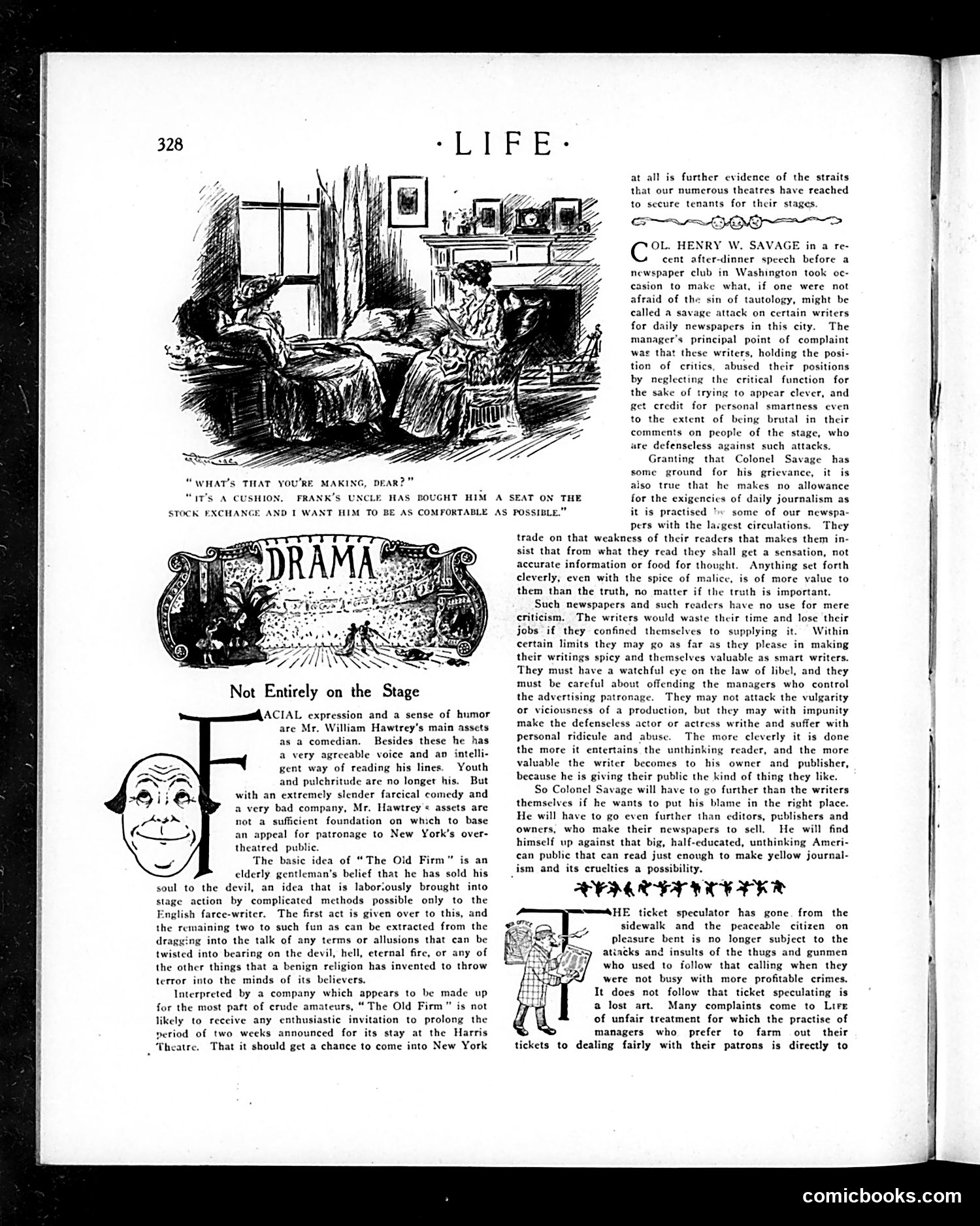
This page contains two distinct pieces of social commentary: **Top cartoon**: Shows a conversation about stock market investment, with a man explaining he's bought his uncle a Stock Exchange seat to keep him "comfortable." This satirizes the wealthy leisured class and their casual approach to expensive financial instruments as mere comfort provisions. **"Not Entirely on the Stage" article**: Critiques both theater producer Colonel Henry W. Savage and newspaper drama critics. Savage complained that critics abuse their position by prioritizing clever, brutal commentary over truthful analysis to entertain readers. The author agrees Savage has a point but explains newspapers—especially those with large circulations—deliberately encourage sensational writing over accuracy because readers demand sensation. Critics can ridicule defenseless actors without legal consequence, making such cruelty profitable for publishers. The piece exposes a systemic problem: profit-driven journalism rewards entertainment value over journalistic integrity, trapping writers within these corrupting constraints. The accompanying theater review dismisses "The Old Firm" as poorly executed farce.
📄 Transcribed text from this page (OCR, searchable)
Machine-transcribed from the original scan — historical spelling and the odd misread are preserved.
at all is further evidence of the straits that our numerous theatres have reached to secure tenants for their stages. Oe OO OL. HENRY W. SAVAGE in a re- cent after-dinner speech before a newspaper club in Washington took oc- casion to make what, if one were not “WHAT'S THAT YOU'RE EAR?" “11's A CUSHION, FRANK'S UNCLE HAS BOUGHT HIM STOCK EXCHANGE AND I WANT HIM TO BE AS COMFORTABLE Not a on the Pal ACIAL expression and a sense of humor are Mr. William Hawtrey’s main assets as a comedian. Besides these he has a very agreeable voice and an intelli- gent way of reading his lines. Youth and pulchritude are no longet his. But with an extremely slender farcical comedy and a very bad company, Mr. Hawtrey's assets are not a sufficient foundation on which to base peal for patronage to New York's over- tred_ public. The basic idea of “The Old Firm” is an elderly gentleman’s belief that he has sold his soul to the devil, an idea that is laboriously brought into stage action by complicated methods possible only to the English farce-writer. The first act is given over to this, and the remaining two to such fun as can be extracted from the dragging into the talk of any terms or allusions that can be twisted into bearing on the devil, hell, eternal fire, or any of the other things that a benign religion has invented to throw terror into the minds of its believers. Interpreted by a company which appears to be made up for the most paft of crude amateurs, “The Old Firm” is not likely to receive any enthusiastic invitation to prolong the eriod of two weeks announced for its stay at the Harris heatre. That it should get a chance to come into New York A SEAT ON THE AS POSSIBLE.” afraid of the sin of tautology, might be called a fe attack on certain writers for daily newspapers this city. The manager’s principal point of complaint was that these writers, holding the posi- tion of critics, abused their positions by neglecting the critical function for the sake of trying to appear clever, and get credit for personal smartness even to the extent of being brutal in their comments on people of the stage, who are defenseless against such attack: Granting that Colonel Savage has some ground for his grievance, it is also true that he makes no allowance for the exigencies of daily journalism as it is practised ‘~ some of our newspa- pers with the lasgest circulations. They trade on that weakness of their readers that makes them in- sist that from what they read they shall get a sensation, not accurate information or food for thought. Anything set forth cleverly, even with the spice of malice, is of more value to them than the truth, no matter if the truth is important. Such newspapers and such readers have no use for mere criticism, The writers would waste their time and lose their jobs if they confined themselves to supplying Within certain limits they may go as far as they please in making their writings spicy and themselves valuable smart writers. They must have a watchful eye on the law of libel, and they must be careful about offending the managers who control the advertising patronage. They may not attack the vulgarity or viciousness of a production, but they may with impunity make the defenseless actor or actress writhe and suffer with personal ridicule and abuse. The more cleverly it is done the more it entertains the unthinking reader, and the more valuable the writer becomes to his owner and publisher, because he is giving their public the kind of thing they like. So Colonel Savage will have to go further than the writers themselves if he wants to put his blame in the right place. He will have to go even further than editors, publishers and owners, who make their newspapers to sell. He will find himself up against that big, half-educated, unthinking Ameri- can public that can read just enough to make yellow journal- ism and its crucltics a possibility. REMIT PTH EKR HE ticket speculator has gone from the eo ] 4 sidewalk and the peaceable citizen on a ure bent is no longer subject to the atiacks and insults of the thugs and gunmen who used to follow that calling when they were not busy with more profitable crimes. It does not follow that ticket speculating is a lost art. Many complaints come to Lire of unfair treatment for which the practise of managers who prefer to farm out their tickets to dealing fairly with their patrons is directly to comicbooks.com