
A complete issue · 40 pages · 1913
Life — January 16, 1913
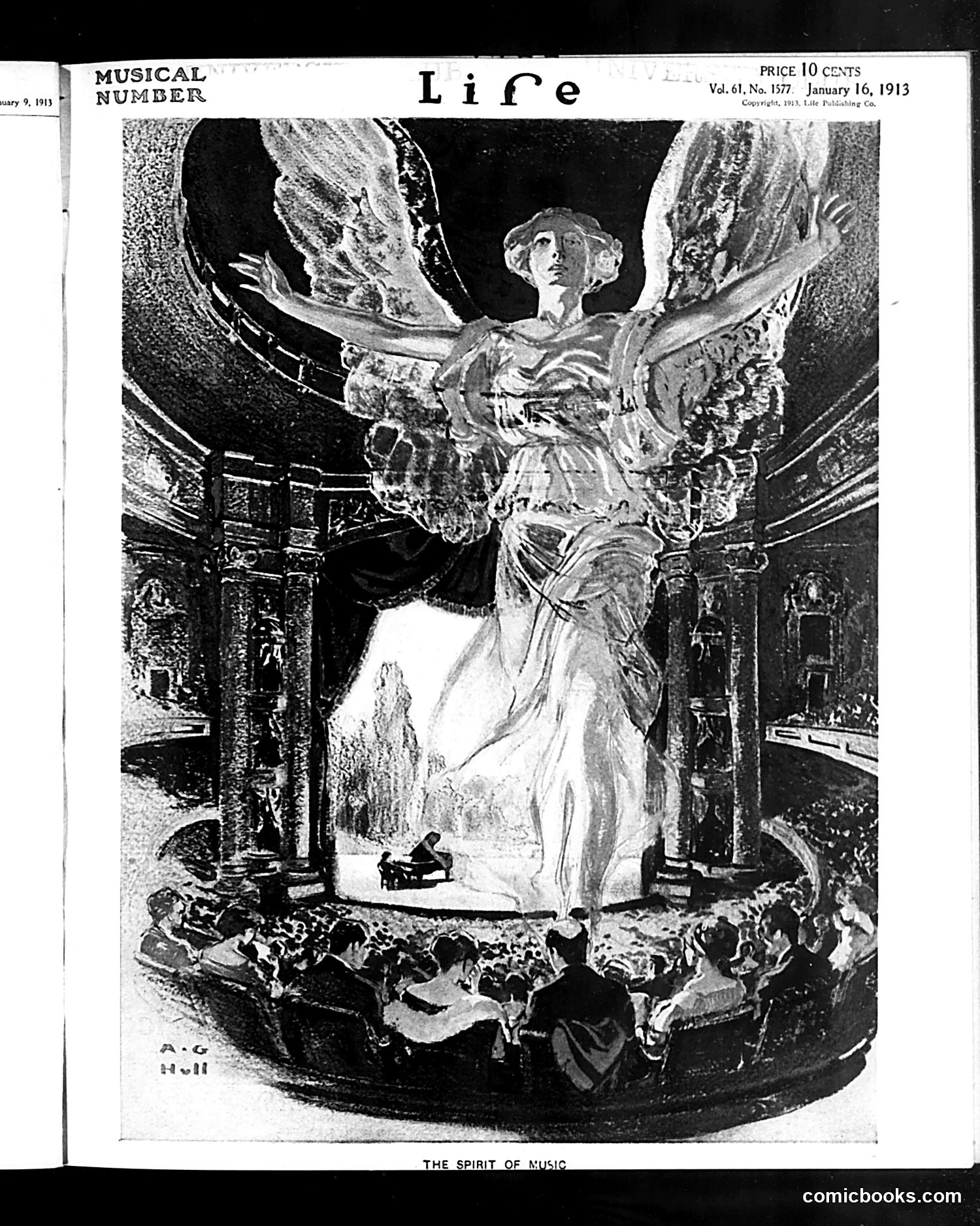
This cover illustration depicts an allegorical female figure representing Music, depicted with wings and classical drapery, presiding over a concert hall or opera house. She gazes heavenward while an orchestra performs below, surrounded by an appreciative audience. The image appears to be a straightforward celebration of musical culture and the performing arts rather than political satire. The "Musical Number" designation and elaborate classical staging suggest this is artwork commissioned to commemorate music's cultural significance. The illustration demonstrates Life magazine's regular use of allegorical female figures as symbols of abstract concepts—a common artistic convention of the early 20th century. Without additional context or satirical elements visible, this seems to be earnest cultural commentary celebrating the arts' transcendent power.
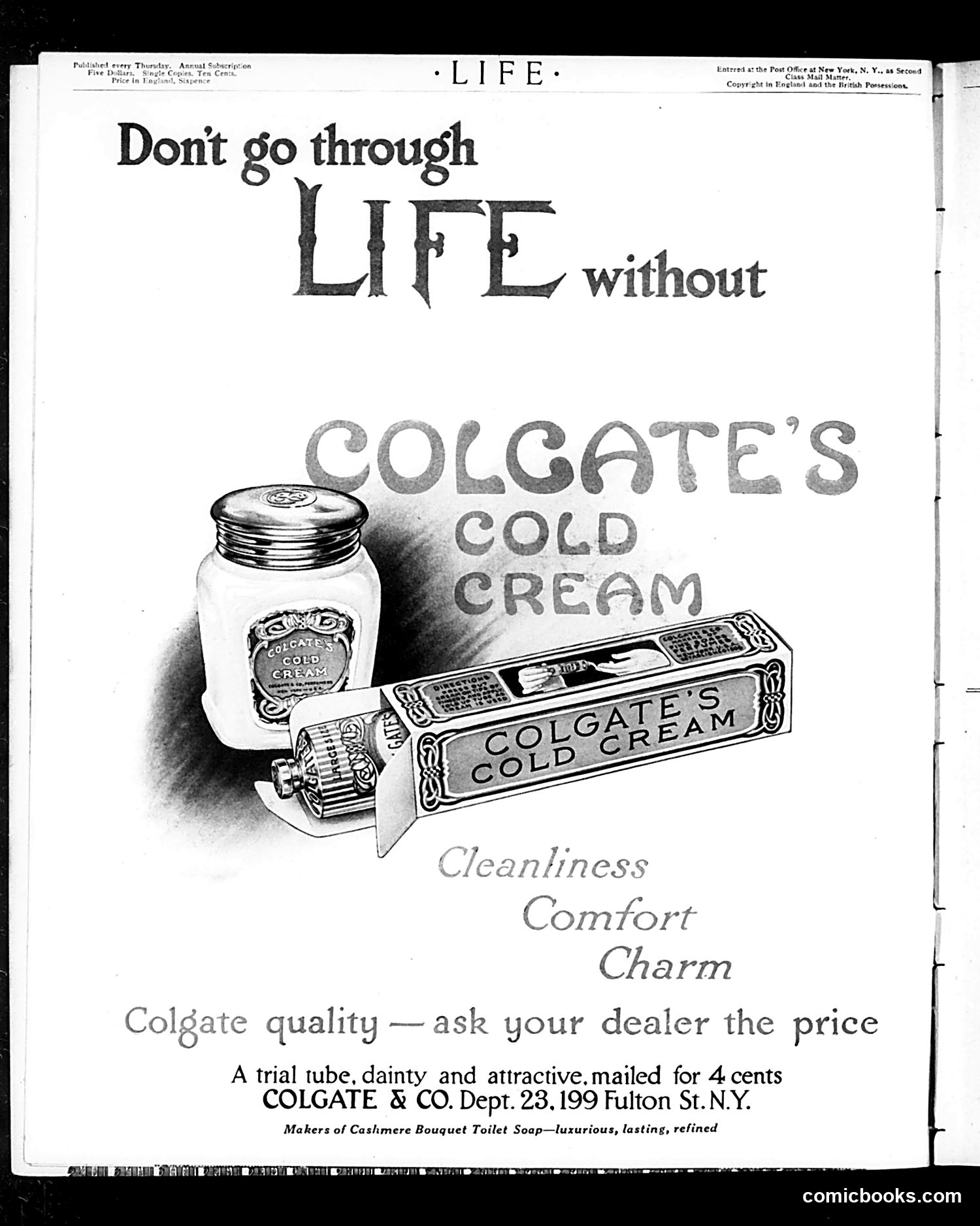
This page is **primarily an advertisement**, not satirical content. It's a Colgate cold cream ad from Life magazine. The ad uses hyperbolic language typical of early 20th-century marketing, claiming one shouldn't "go through life without" Colgate's product. It promotes cold cream in a jar and tube form, emphasizing three benefits: "Cleanliness, Comfort, Charm." The visual shows product packaging and a dispenser. The ad promises "Colgate quality" and offers a trial tube for 4 cents by mail. The only satirical element—if present—would be the exaggerated life-advice framing ("Don't go through life without..."), which gently mocks advertising's tendency to present cosmetics as essential to a fulfilling life. However, this appears to be earnest promotional copy rather than intentional satire from Life's editors.
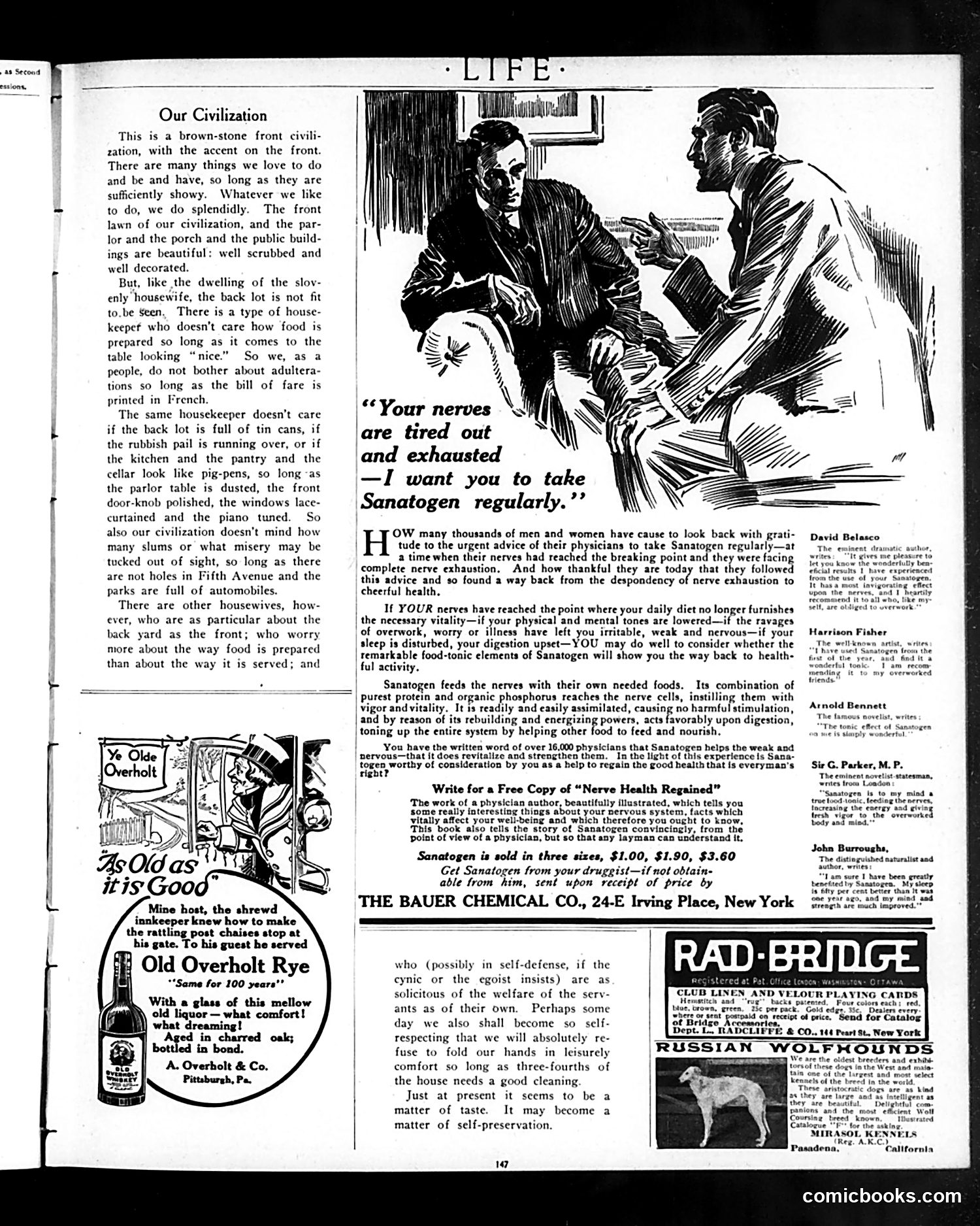
This page is primarily **advertising content** disguised as editorial material. The main feature is a full-page ad for Sanatogen, a patent medicine marketed as a nerve tonic. The illustrated scenario shows a doctor advising an exhausted patient to take Sanatogen regularly, claiming it restores vitality and strengthens nerves. The ad includes testimonials from named public figures (David Belasco, Harrison Fisher, Arnold Bennett, etc.) endorsing the product. The satire is implicit rather than explicit: Life presents this dubious medical claim straightforwardly, allowing readers to recognize the absurdity themselves. Patent medicine advertising of this era commonly made exaggerated health claims. The page also includes period advertisements for Old Overholt Rye whiskey and Russian Wolfhound dogs, typical of early 20th-century magazine content.
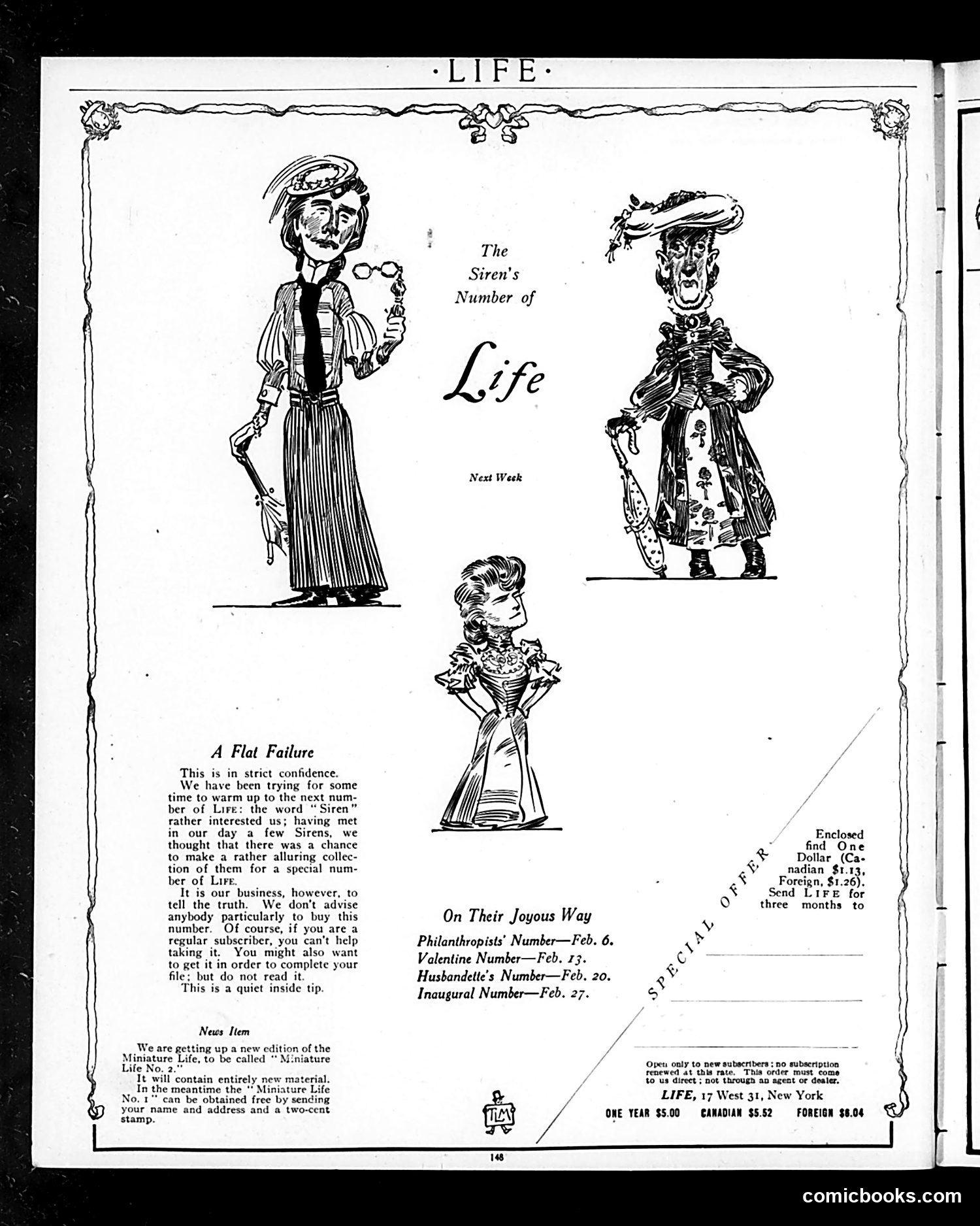
This page announces upcoming special issues of Life magazine, featuring caricatured figures representing different themes: "A Flat Failure" (left figure), an unnamed middle figure, and a character on the right. The text indicates these are themed issues—Philanthropists' Number (Feb. 6), Valentine Number (Feb. 13), Husbandette's Number (Feb. 20), and Inaugural Number (Feb. 27). The satire appears to mock these social categories through exaggerated character types. However, **without knowing the specific publication date or identifying the individual caricatures**, I cannot definitively explain what "flat failure" references or which public figures these represent. The page is primarily promotional, advertising special themed issues rather than presenting a single coherent political cartoon. The humor relies on visual caricature of social stereotypes.
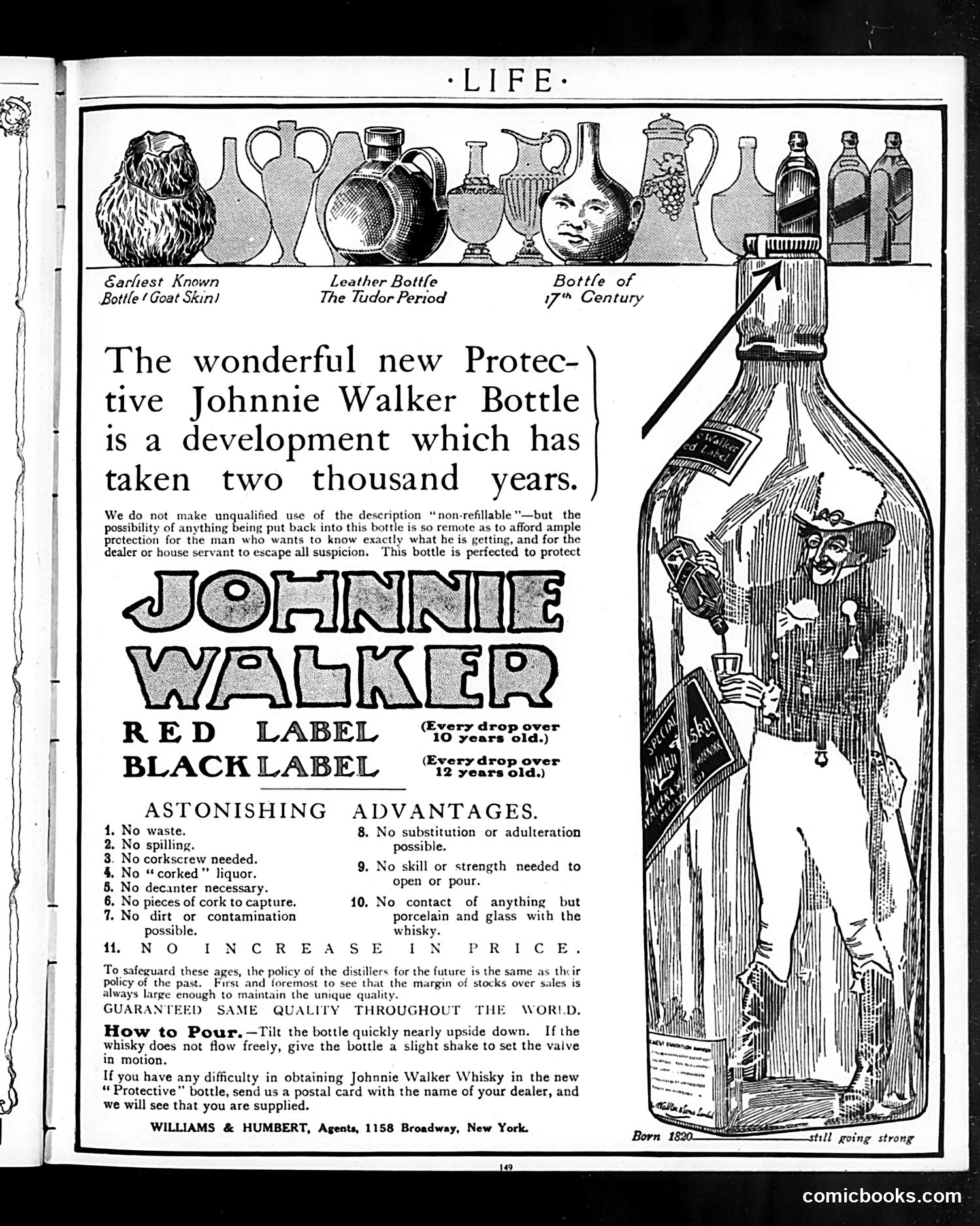
This is primarily a **commercial advertisement**, not political satire. It promotes Johnnie Walker Red and Black Label whisky in their new "Protective" bottle design. The page features a historical timeline of bottle evolution at top, positioning Johnnie Walker as the modern culmination of two thousand years of container development. The large illustration shows a bottle with a cork-capturing valve mechanism. The "astonishing advantages" listed (no waste, no spilling, no corkscrew needed, no skill required to pour) emphasize the bottle's practical innovations—marketed as solutions to real consumer problems. The small figures visible inside the bottle appear to be decorative illustrations rather than satirical commentary. This is straightforward product marketing using appeals to modernity, reliability, and convenience rather than social or political satire.
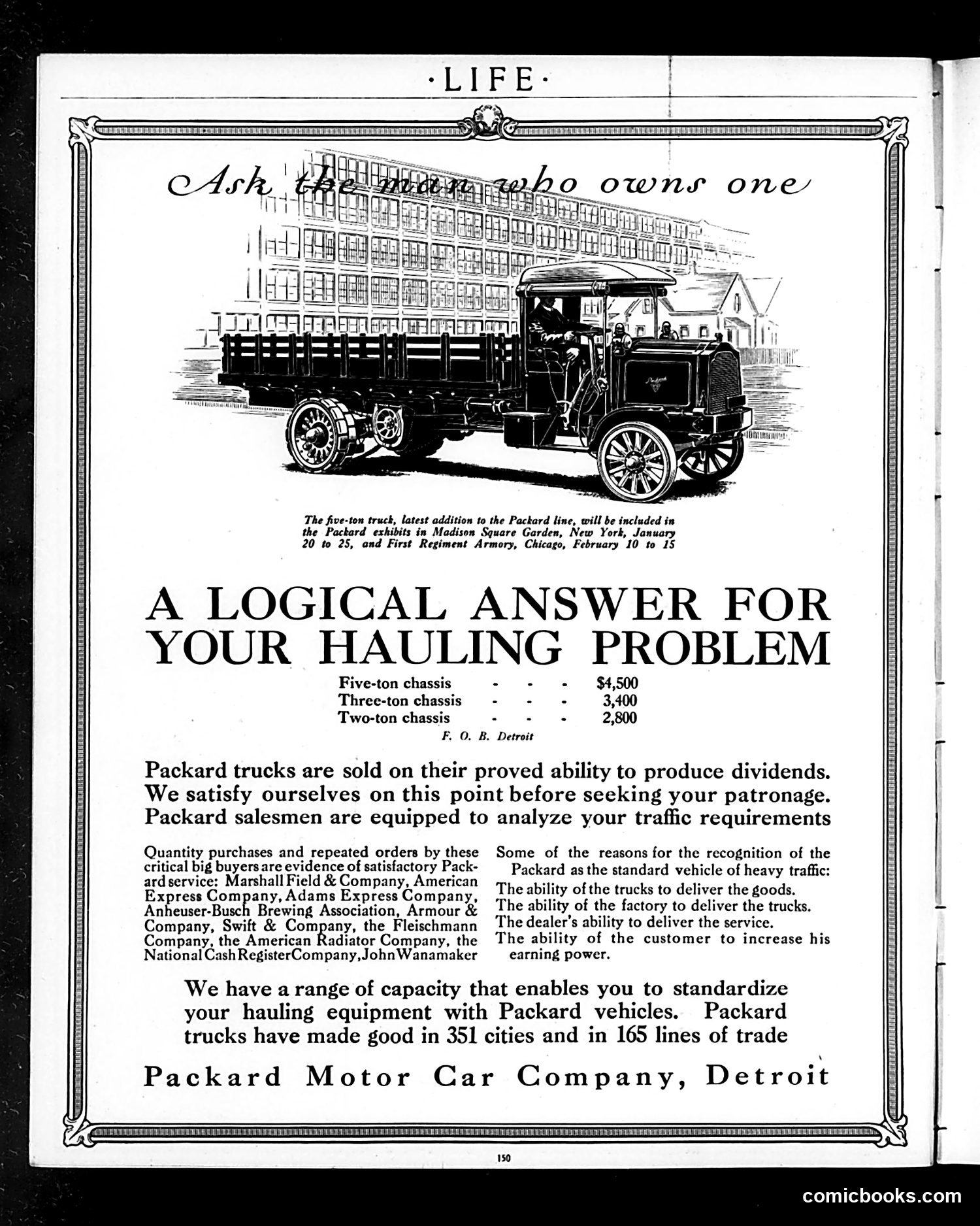
This is primarily a **commercial advertisement**, not political satire. The page promotes Packard Motor Car Company's new five-ton truck line for commercial hauling. The illustration shows a heavy-duty truck with cargo bed, positioned against a urban backdrop with tall buildings. The headline "A Logical Answer for Your Hauling Problem" frames the vehicle as a practical business solution. The ad emphasizes Packard trucks' reliability and widespread adoption by major companies (Armour, Swift, American Express, etc.), arguing they've "made good in 351 cities and in 165 lines of trade." **For modern readers**: This represents early-20th-century commercial vehicle marketing, when trucks were relatively new technology. The sales pitch focuses on proven track record and standardization—concepts still used in B2B advertising today.
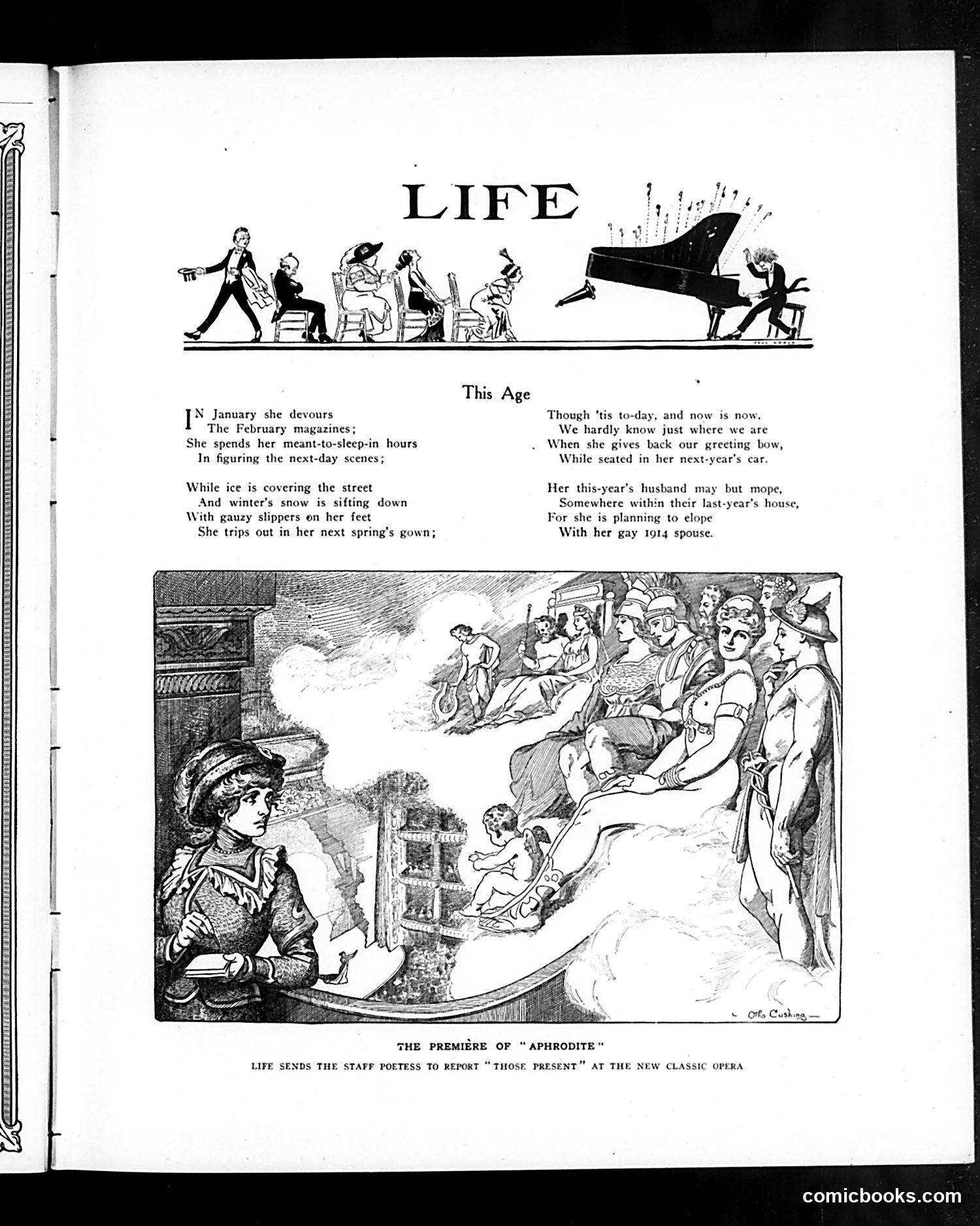
This page satirizes the modern woman of 1914. The header illustration shows a woman's chaotic life: she reads magazines, plans seasons ahead, buys spring gowns in winter, and schemes about husbands and elopements. The poem mocks her fickleness—planning to run away with a "1914 spouse" while her current husband is unaware. The main illustration depicts the premiere of the opera "Aphrodite," where Life magazine's "staff poetess" reports on "those present." The joke appears to be satirizing society women's obsession with high culture attendance and gossip—they attend opera not for artistic merit but for social visibility and to observe who else appears. It's a critique of superficial high-society culture.
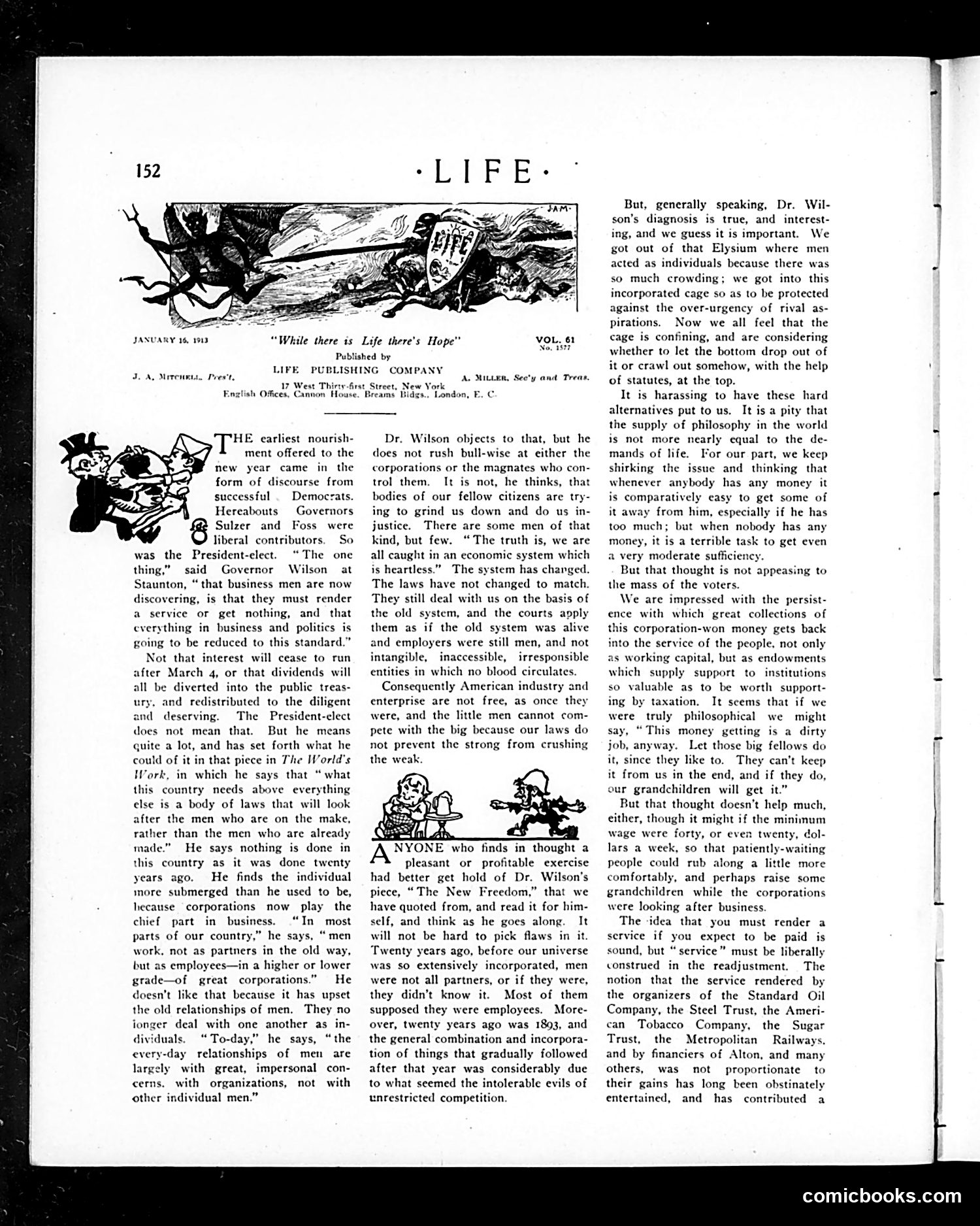
This page contains editorial commentary rather than political cartoons. The main illustration shows what appears to be a caricatured figure in distress or constraint, labeled "While there is Life there's Hope." The text discusses Dr. Wilson's (likely President Woodrow Wilson) economic philosophy, criticizing his objections to corporate consolidation. The article argues that large corporations have become necessary in modern business, contrasting Wilson's idealistic views with practical economic reality. The piece satirizes Wilson's resistance to "big business," suggesting his antitrust philosophy is naive. It defends corporate mergers and consolidation as inevitable progress, mocking the tension between the President's regulatory ideals and actual industrial practice in early 20th-century America.
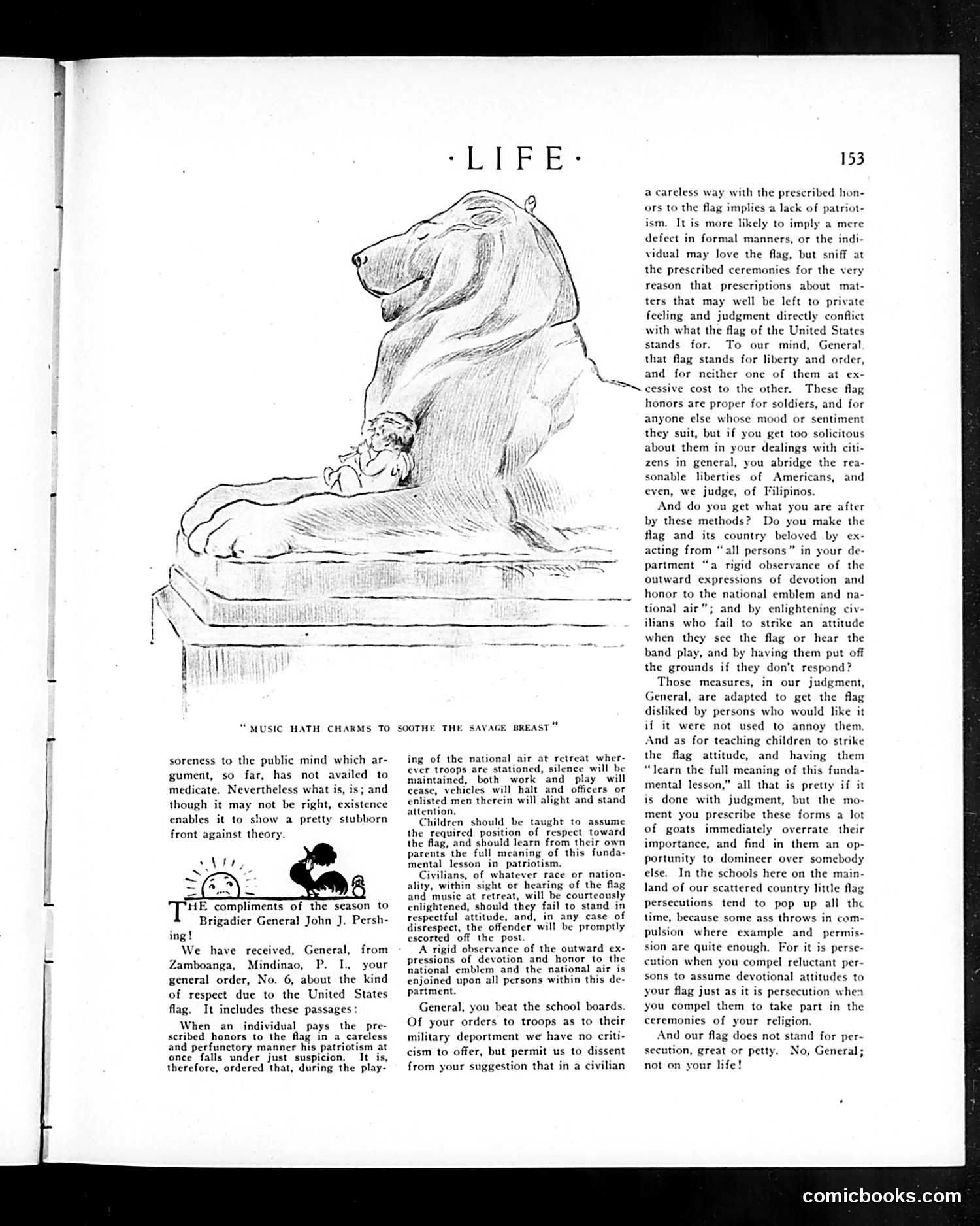
The cartoon shows a large bear sitting with a tiny human figure nestled against it, captioned "MUSIC HATH CHARMS TO SOOTHE THE SAVAGE BREAST." This illustrates the accompanying text's discussion of General John J. Pershing's order about flag etiquette. The "savage beast" appears to represent public outrage or nationalist sentiment that can be calmed through proper patriotic ceremony and music. The text debates whether prescribing rigid flag-salute rituals actually promotes patriotism or merely enforces conformity. The author argues that compulsory flag observances may backfire, irritating citizens rather than inspiring genuine devotion. The bear metaphor suggests that public passion, while powerful, can be managed through appropriate cultural performances—though the satire questions whether such artificial measures truly serve their purpose.
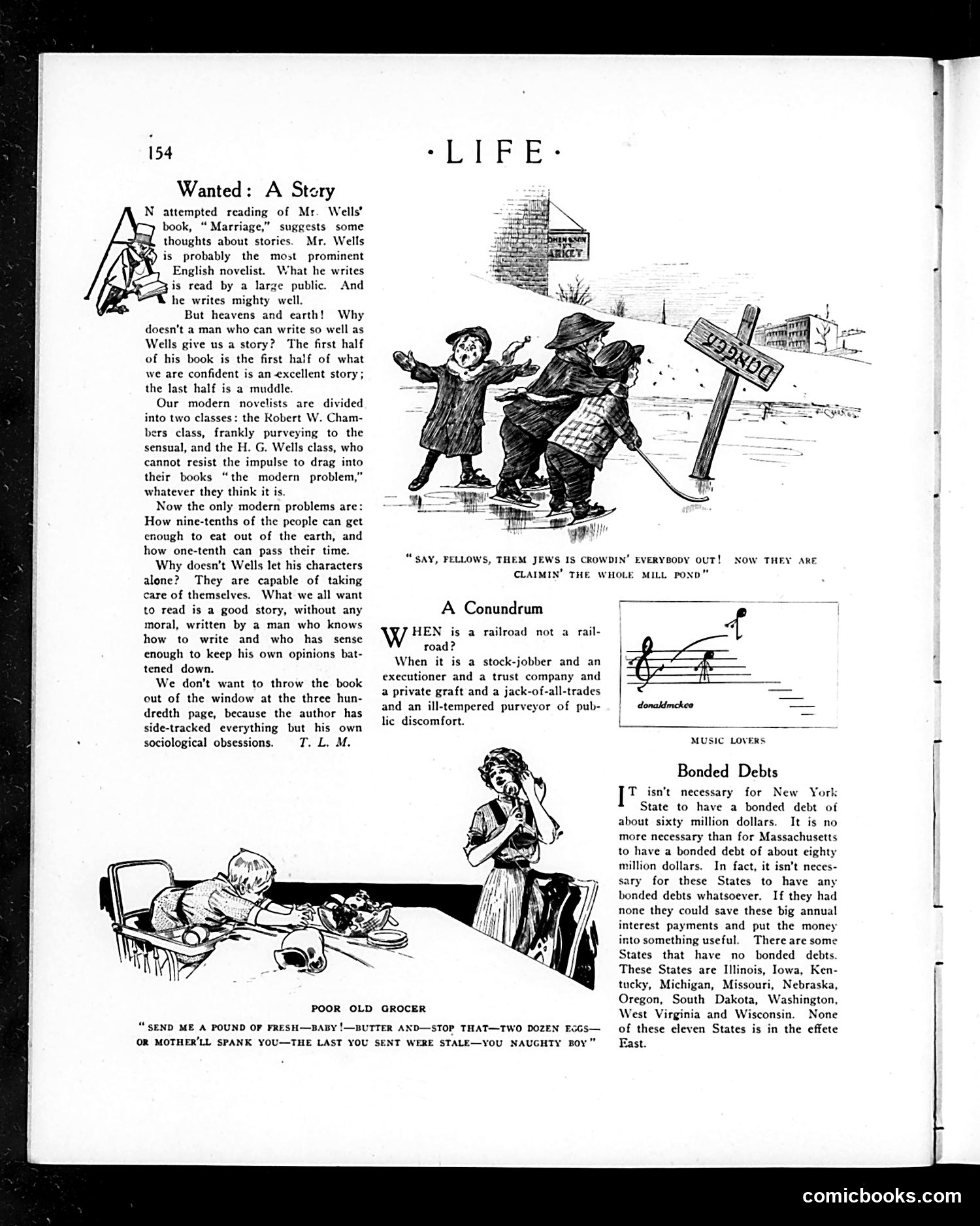
**"Wanted: A Story"** - A critique of H.G. Wells as a novelist. The author argues Wells divides modern writers into two classes: the "Robert W. Chambers class" (sensual) and the "H.G. Wells class" (focused on "modern problems"). The complaint is that Wells's characters don't act independently—they can't solve problems like eating or passing time without authorial intervention. The satire mocks Wells for inserting his sociological opinions into fiction rather than letting characters drive the narrative. **Secondary cartoons** illustrate everyday subjects: "A Conundrum" about railroads, "Music Lovers," and "Bonded Debts" discussing state finances. The "Poor Old Grocer" cartoon shows domestic life complaints. The page exemplifies *Life's* role as a literary and social commentary magazine, mixing book criticism with broader cultural observation.
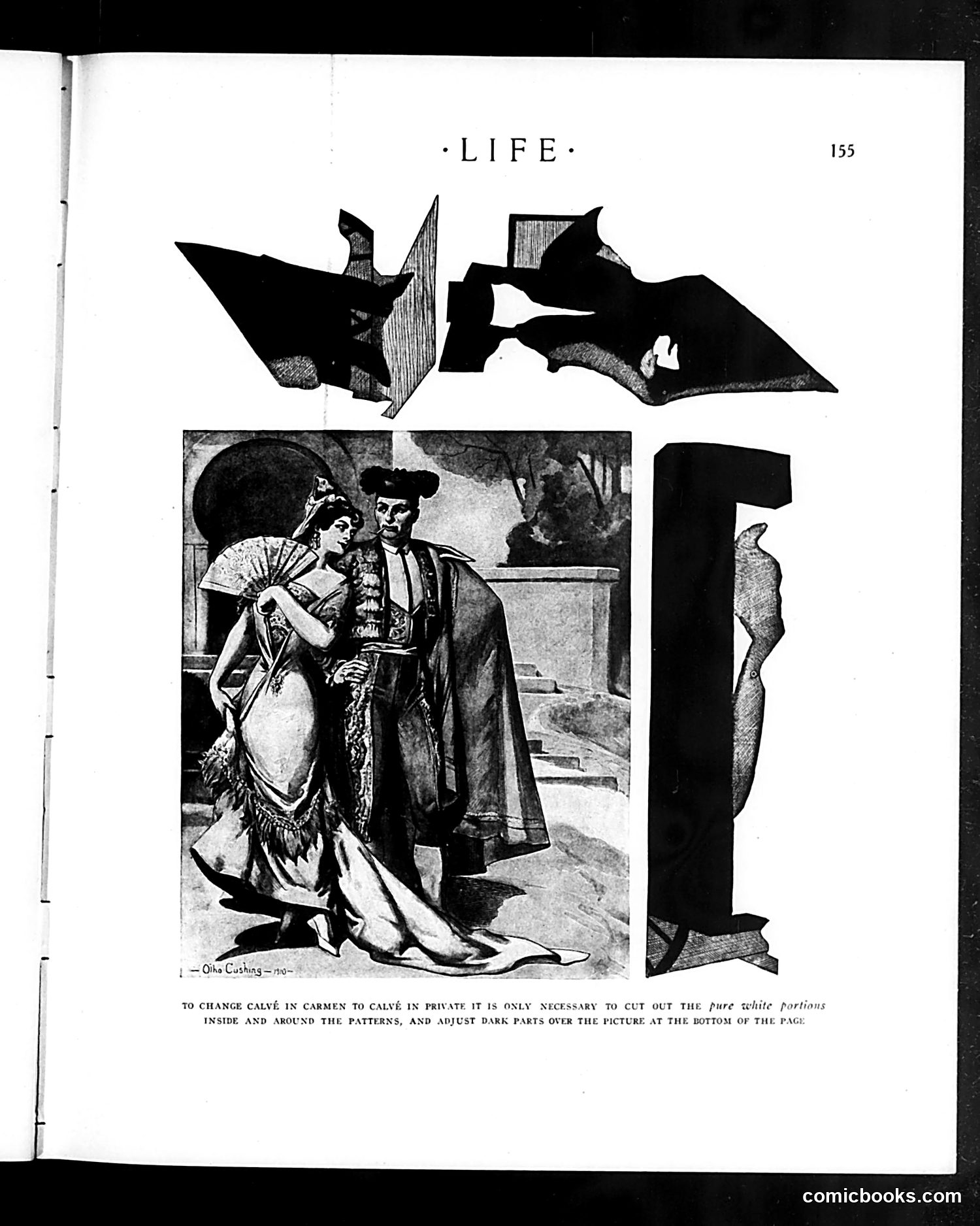
This page from *Life* magazine (page 155) demonstrates a printing technique rather than presenting satirical content. The main illustration shows a man and woman in elaborate period costume—the woman holds a fan and wears an ornate dress, while the man wears military regalia and a cape, suggesting a historical or operatic scene, credited to " Ora Cushing." The instructional text below explains how to create the effect of "calvé in Carmen" changing from public to private performance: by cutting out pure white areas and adjusting dark portions around patterns at the page's bottom, readers could manipulate the image's appearance. This appears to be a technical demonstration of photographic or printing manipulation for *Life*'s audience rather than political satire.
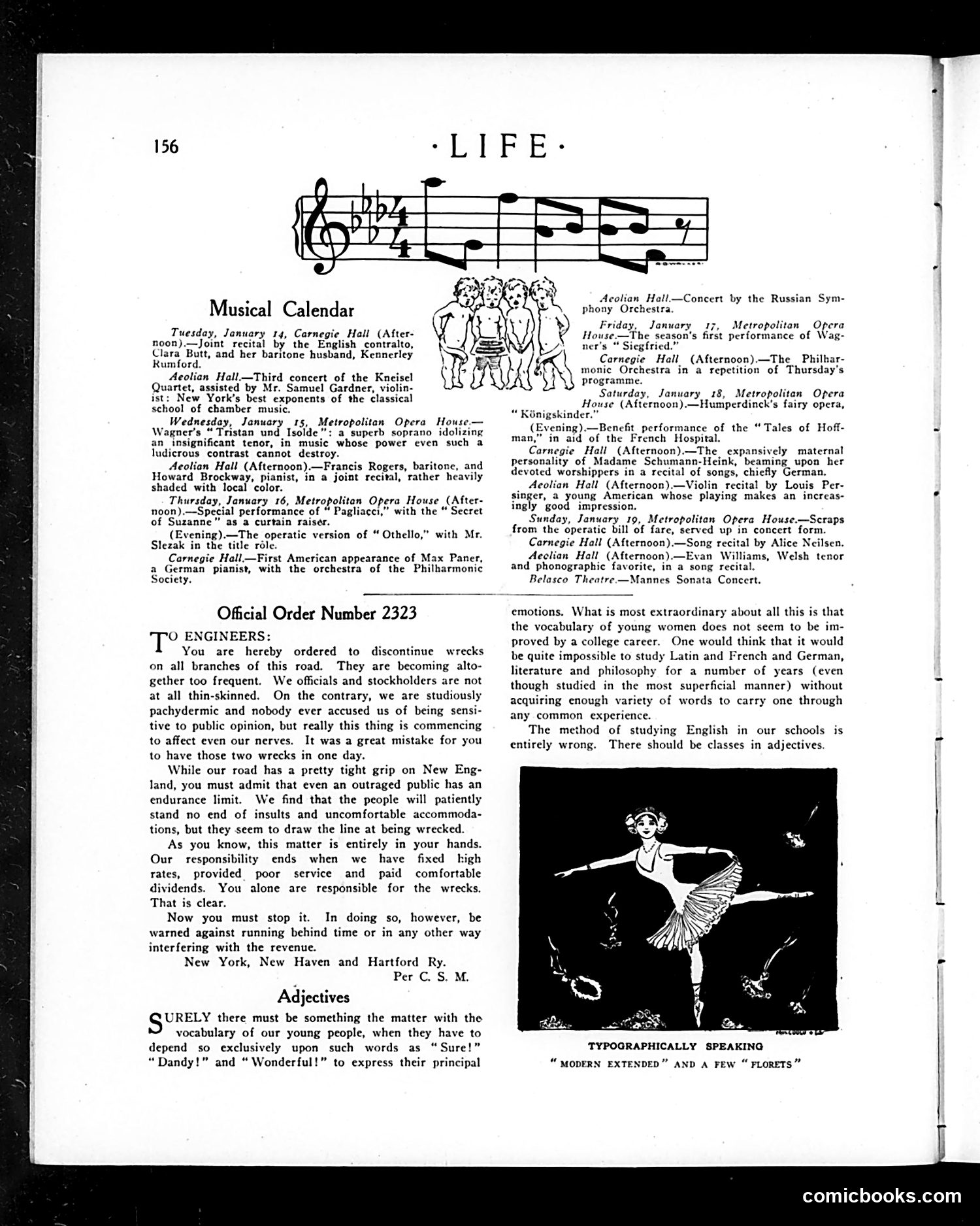
This page contains a musical calendar of concert events, an official order about railway service, and a discussion of English language education. The cartoon at bottom right shows a female ballet dancer in an extended arabesque pose. The caption reads "TYPOGRAPHICALLY SPEAKING" with a subtitle noting "'MODERN EXTENDED' AND A FEW 'FLORETS.'" The satire appears to be a visual pun: the dancer's extended leg position resembles typographical elements or characters. The joke plays on the term "extended" (both a ballet position and a typographical concept) to create a witty comparison between bodily movement and printed text. This reflects early 20th-century amusement with linguistic and visual wordplay.
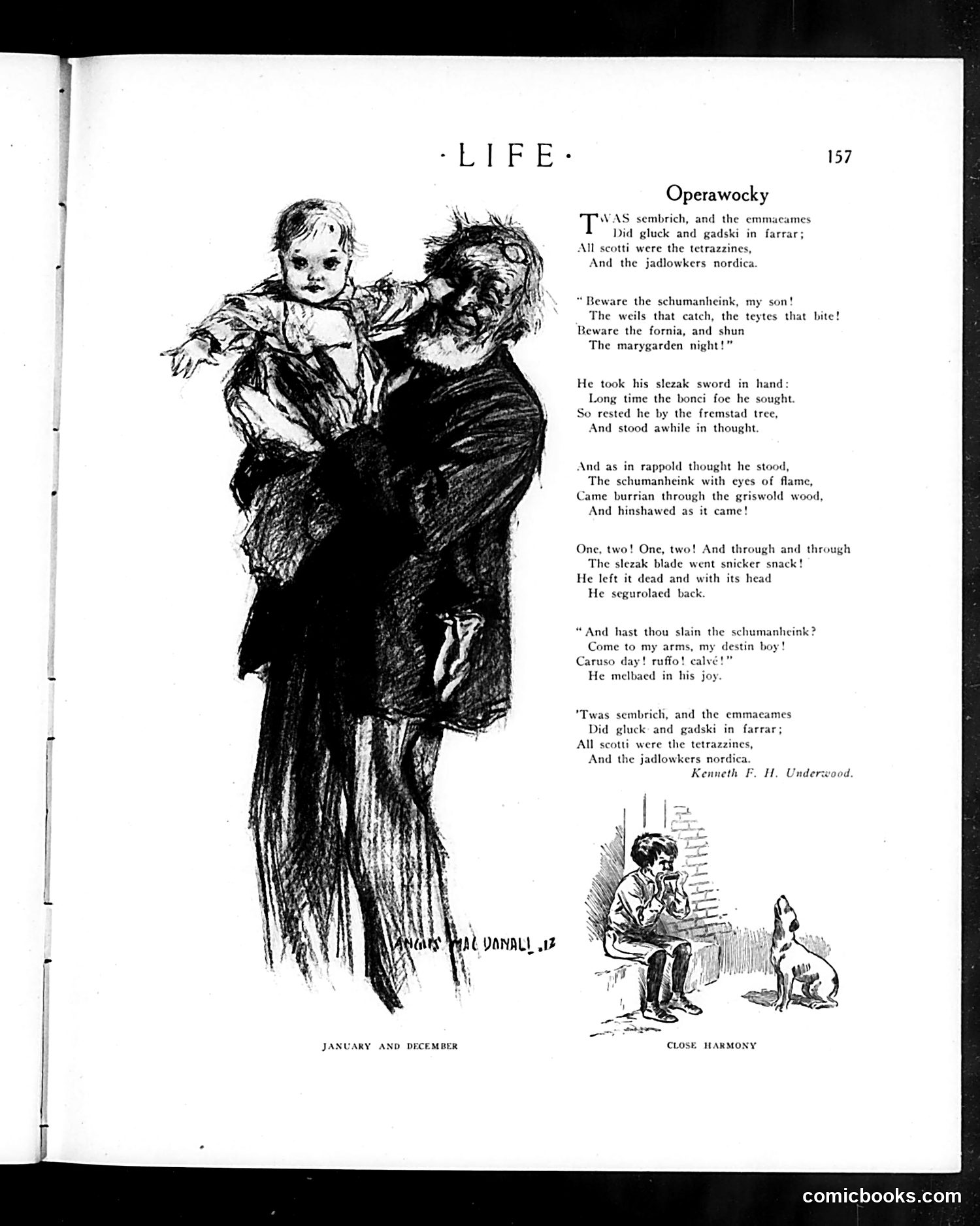
This page presents a nonsense poem titled "Operawocky"—a parody of Lewis Carroll's "Jabberwocky" applied to opera. The left illustration labeled "January and December" depicts a man holding an infant, drawn by Paul Dandal (signed lower left). The right illustration, "Close Harmony," shows a boy with a dog. The poem mocks operatic conventions: cryptic Germanic character names ("schumanheink," "marygarden"), exaggerated vocal techniques ("gluck and gadski"), and the genre's typical absurdity. By applying Carroll's nonsense structure to opera, the satire suggests that opera itself—with its incomprehensible plots and artificial dramatics—is already nonsensical. This was likely an appeal to American readers skeptical of highbrow European art forms.
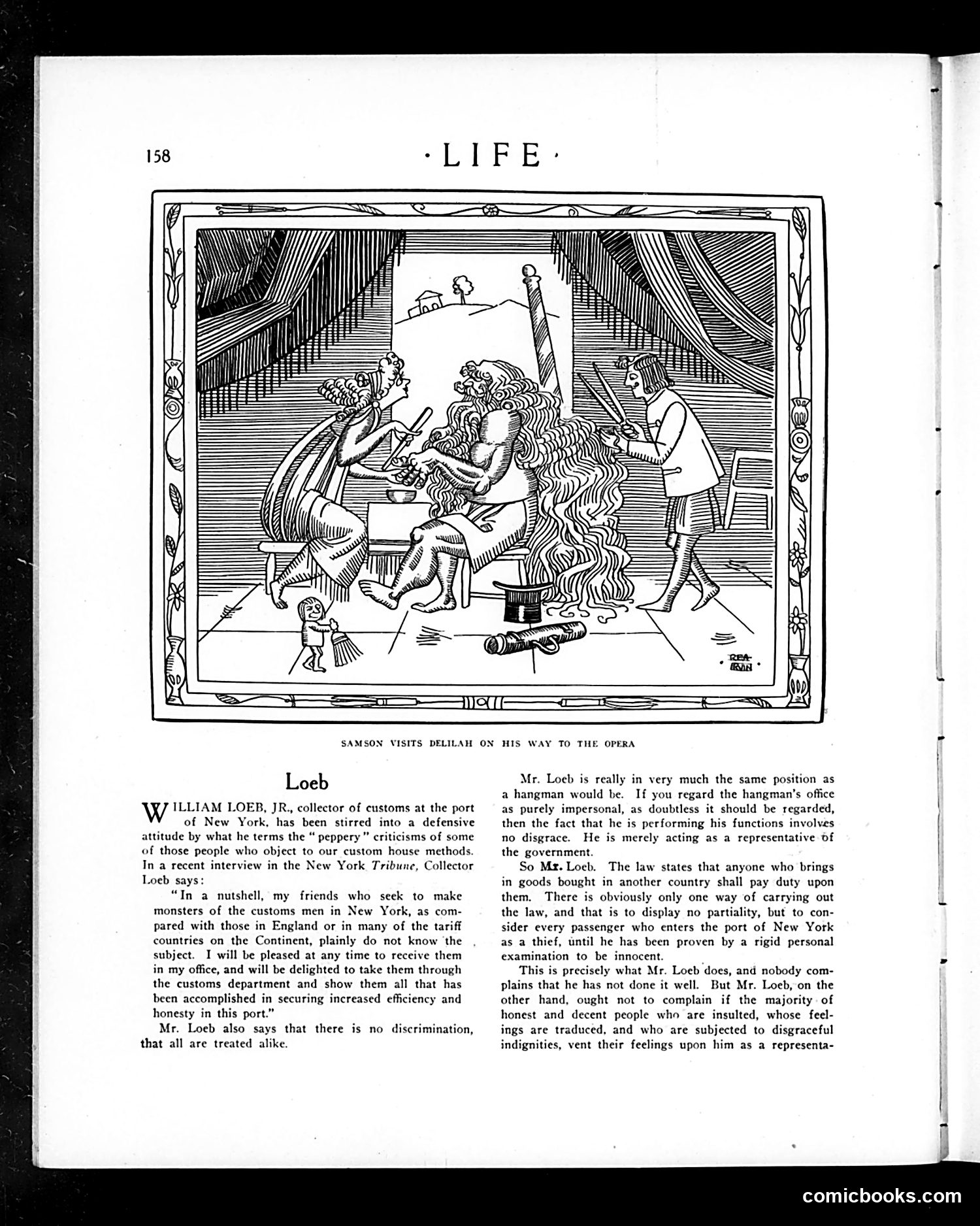
The cartoon illustrates "Samson Visits Delilah on His Way to the Opera," depicting the biblical story of Samson and Delilah in a modern setting. The accompanying article about William Loeb, collector of customs at the Port of New York, uses this biblical reference satirically. The cartoon shows Samson (with long hair) being attended to by Delilah and servants in an interior space, with opera-goers visible in the background. The satire appears to be comparing Loeb's position to Samson's—both potentially compromised by those around them. The text suggests Loeb faces criticism for his customs enforcement methods, with detractors viewing him as either complicit with smugglers or overzealous with honest travelers. The biblical parallel implies vulnerability to betrayal or moral compromise in his role.
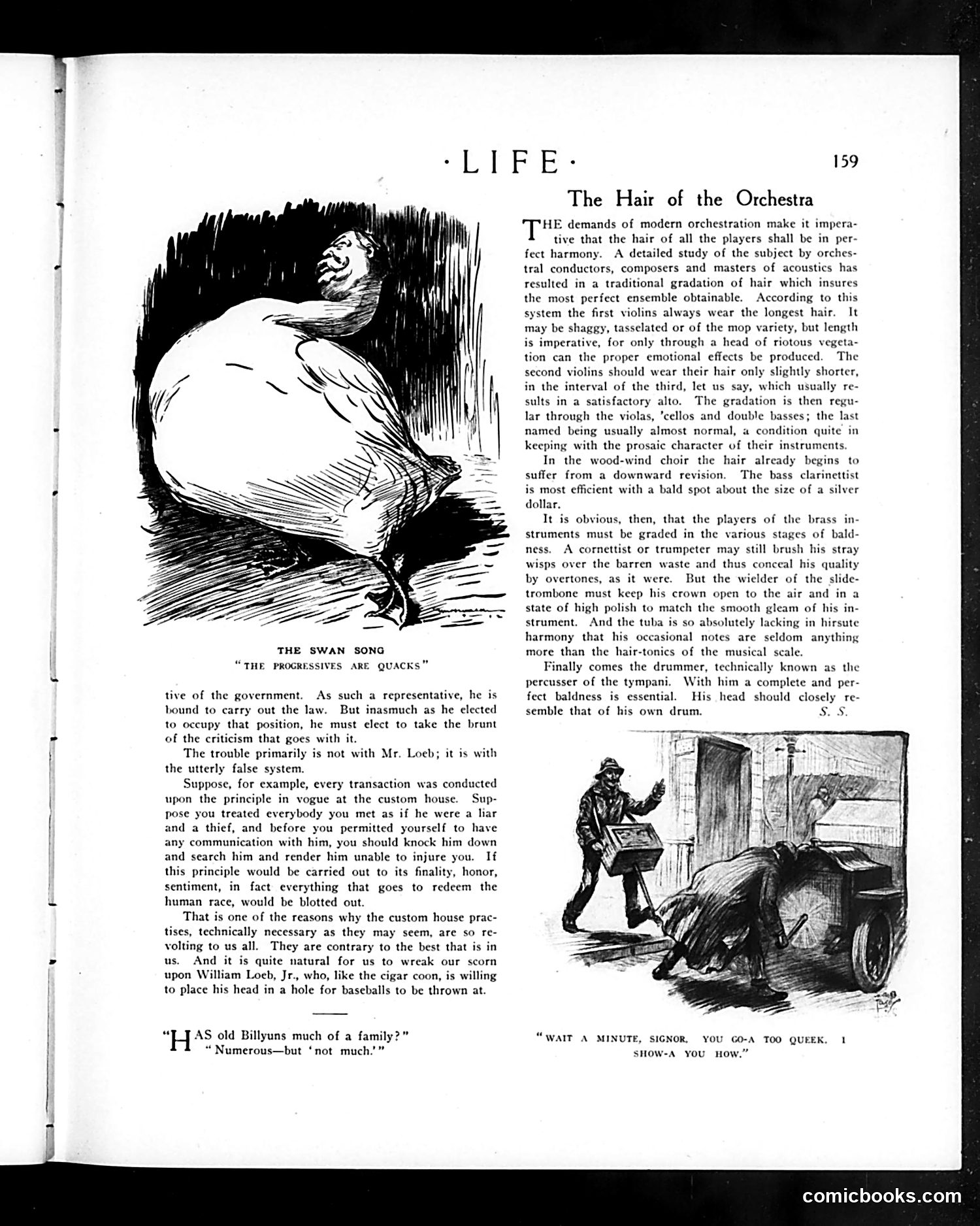
This page contains two distinct pieces. The upper section discusses William Loeb Jr. and Progressive Party criticism (likely referencing early 1900s politics), but the main satirical content is "The Hair of the Orchestra." The humor mocks pseudo-scientific pretension in music criticism. The article absurdly argues that orchestral harmony depends on players' hair length—first violins needing longest hair, second violins slightly shorter, progressing to completely bald tuba and timpani players whose "baldness is essential." The accompanying illustration shows a conductor instructing an Italian musician (suggested by "Signor" and dialect), presumably about these ridiculous hair requirements. The satire targets overblown musical theory and the absurd pseudo-logic used to justify arbitrary rules. It's a jab at conductors and critics who invented elaborate justifications for their preferences, treating subjective aesthetic choices as scientific necessities.
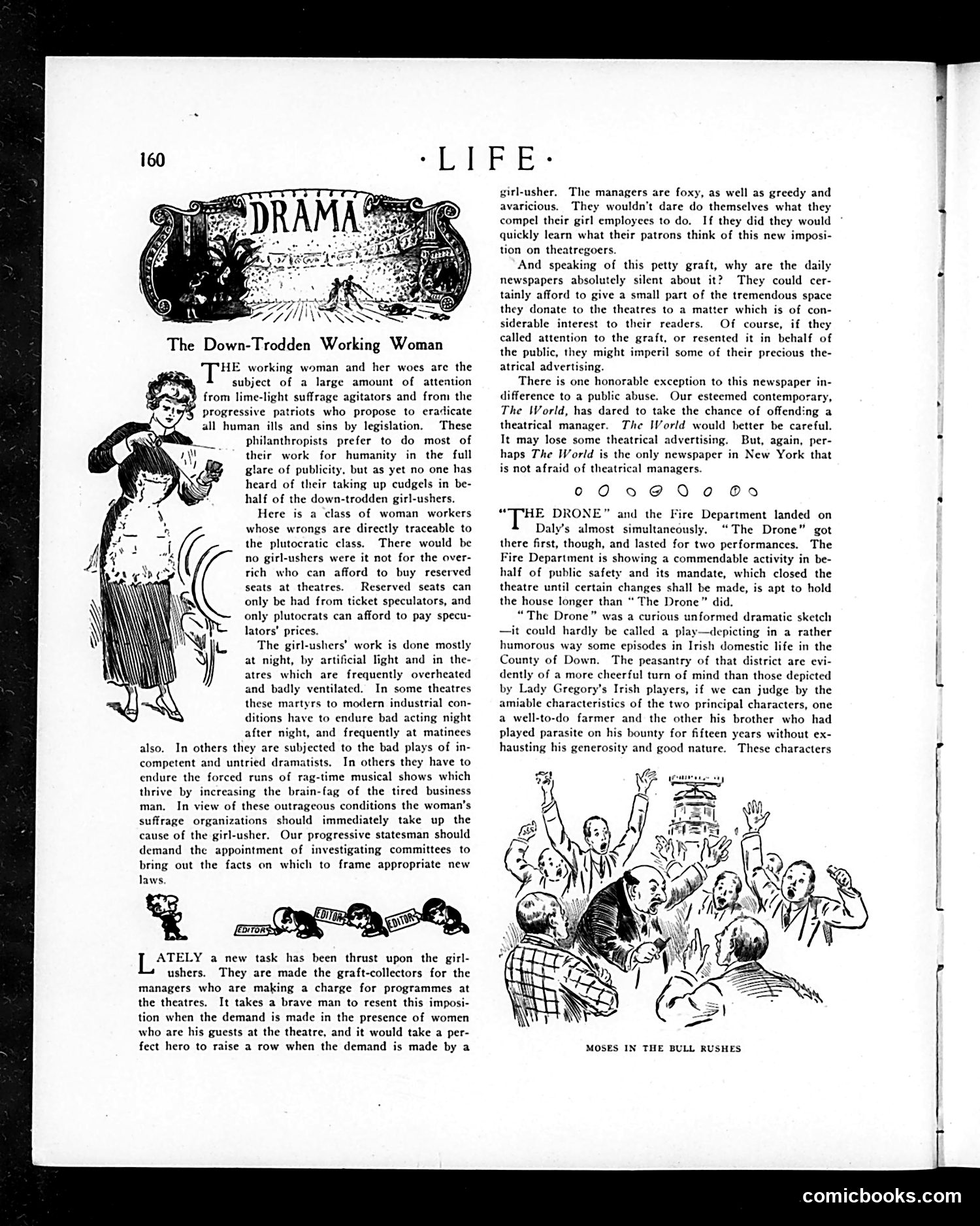
This satirical piece mocks progressive reformers and suffragists for ignoring theatre girl-ushers' genuine hardships while grandstanding about broader social issues. The author catalogs real problems: night work under artificial lights in overheated theatres, exposure to bad plays and acting, and newly imposed "graft"—forced programme sales that exploit the women's vulnerable position in front of male theatre patrons. The satire targets newspapers' complicity: they advertise theatres extensively yet refuse to expose this petty corruption, fearing loss of advertising revenue. *The World* alone receives praise for coverage. The accompanying illustration of Moses and the bull rushes likely reinforces the irony—comparing the ushers' plight to Biblical suffering, emphasizing how overlooked their actual oppression remains compared to theatrical self-promotion and moral posturing.
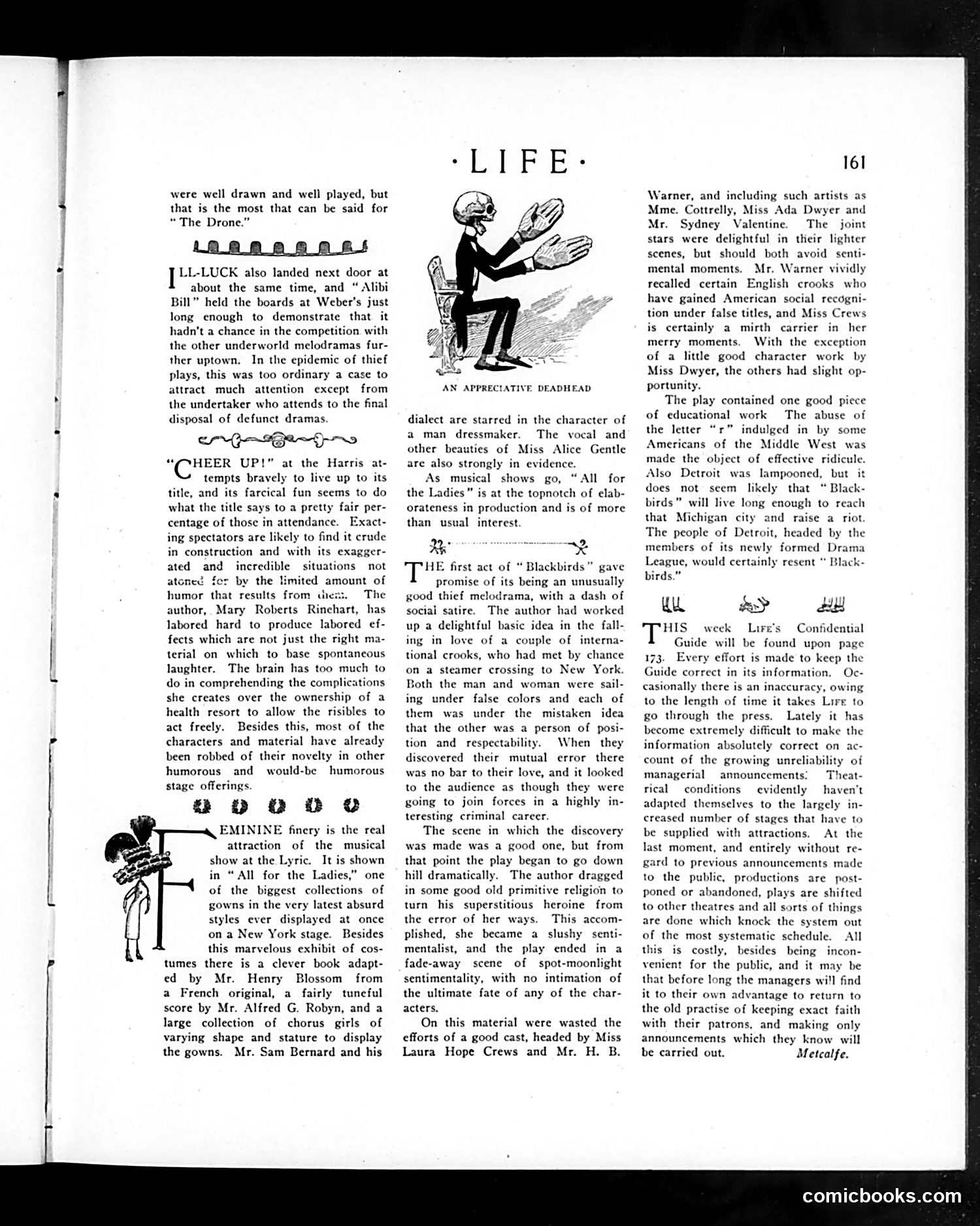
This page reviews several theatrical productions on Broadway. The main cartoon, titled "An Appreciative Deadhead," depicts a figure catching baseballs—a visual pun suggesting someone who attends theater without paying (a "deadhead" was slang for a freeloader getting complimentary admission). The text reviews plays including "The Drone," "Alibi Bill," "Cheer Up!," and "All for the Ladies." The critic dismisses most as derivative or poorly constructed, though praising elaborate costumes and performances. "Blackbirds" receives mixed assessment—praised for its opening premise about international crooks meeting under false pretenses, but criticized for deteriorating into sentimental religion and melodrama rather than exploring the criminal plot. The reviews exemplify early 20th-century theatrical criticism's focus on plot mechanics, star power, and production values, while the "deadhead" cartoon humorously comments on theater culture and free admission practices of that era.
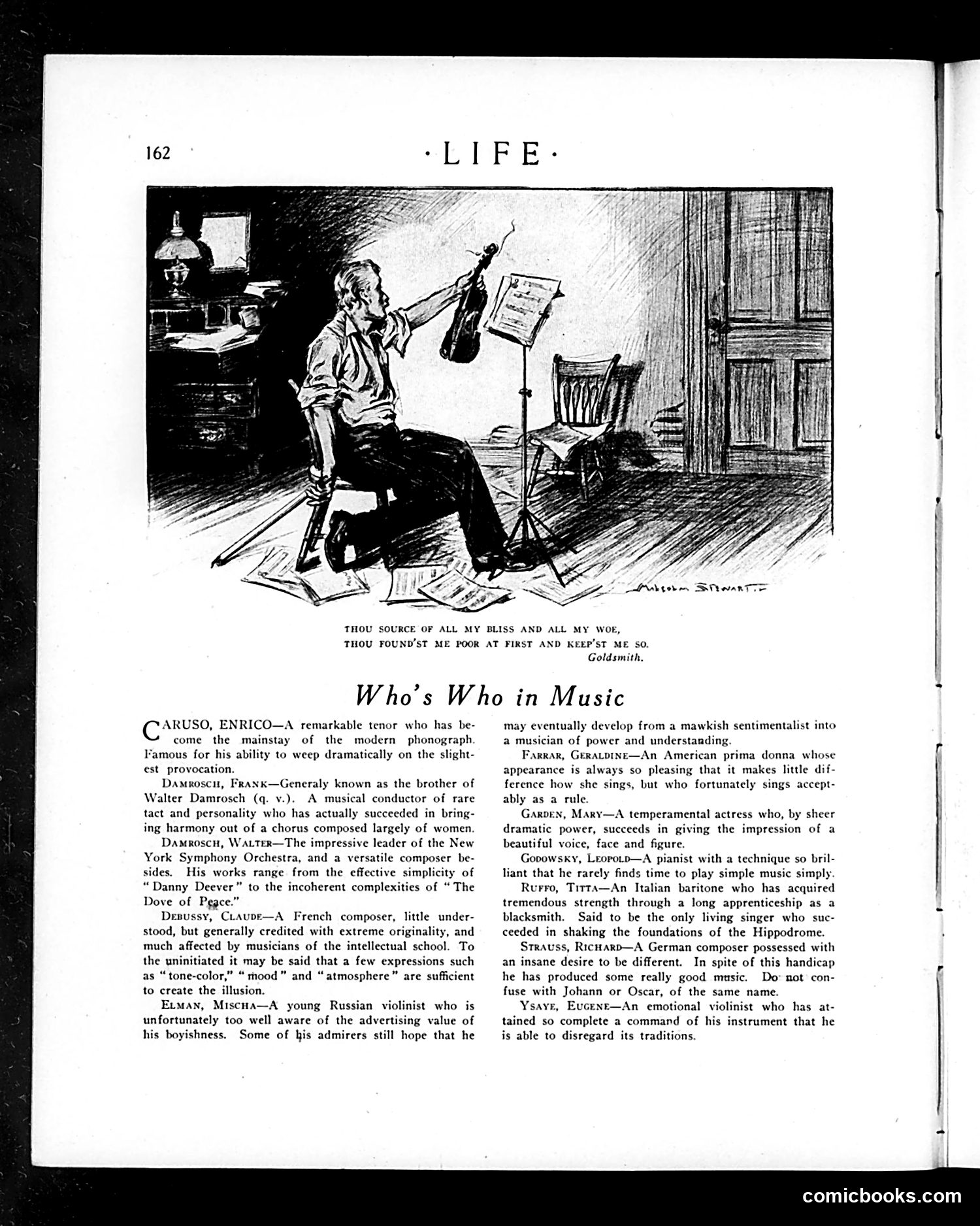
This page presents satirical biographical sketches of famous early 20th-century musicians. The cartoon above shows a struggling composer at work—likely illustrating the Goldsmith epigraph about poverty in artistic pursuit. The text mocks prominent musicians through exaggerated, backhanded compliments. Caruso is famous mainly for phonograph recordings and crying on cue. The Damrosch brothers receive praise tinged with condescension. Debussy is portrayed as incomprehensible, understood only through pretentious jargon like "tone-color." Elman, a young violinist, is criticized for exploiting his boyish appeal rather than developing serious musicianship. Farrar's appearance matters more than her singing ability. Richard Strauss is ridiculed for obsessing over originality at music's expense. The satire targets both the musicians themselves and the culture surrounding them—emphasizing vanity, commercialism, affectation, and the gap between reputation and actual merit in the musical establishment of the era.
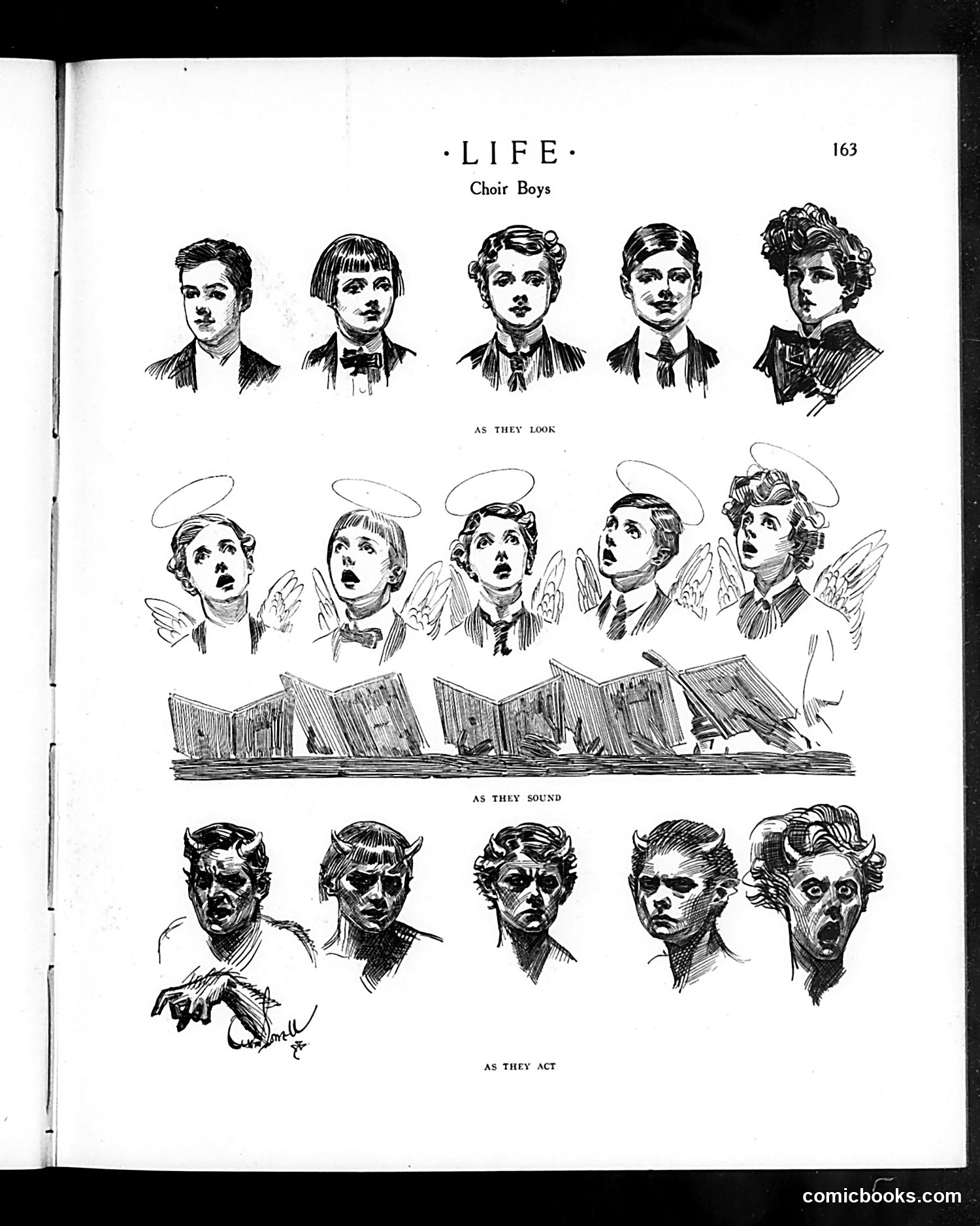
This is a humorous illustration comparing choir boys across three scenarios. The top section shows them "as they look"—innocent, well-groomed young men in formal attire. The middle depicts them "as they sound"—angelic figures with halos and wings, reading from hymnals, suggesting their pure vocal performance. The bottom section, "as they act," reveals exaggerated demonic or mischievous faces with grotesque expressions. The satire mocks the contrast between choir boys' outwardly virtuous, angelic public image and their actual troublemaking behavior—the gap between appearance and reality. This gentle ribbing suggests the young performers were known for misbehavior despite their pious musical role, a common observation about youthful performers in institutional settings.
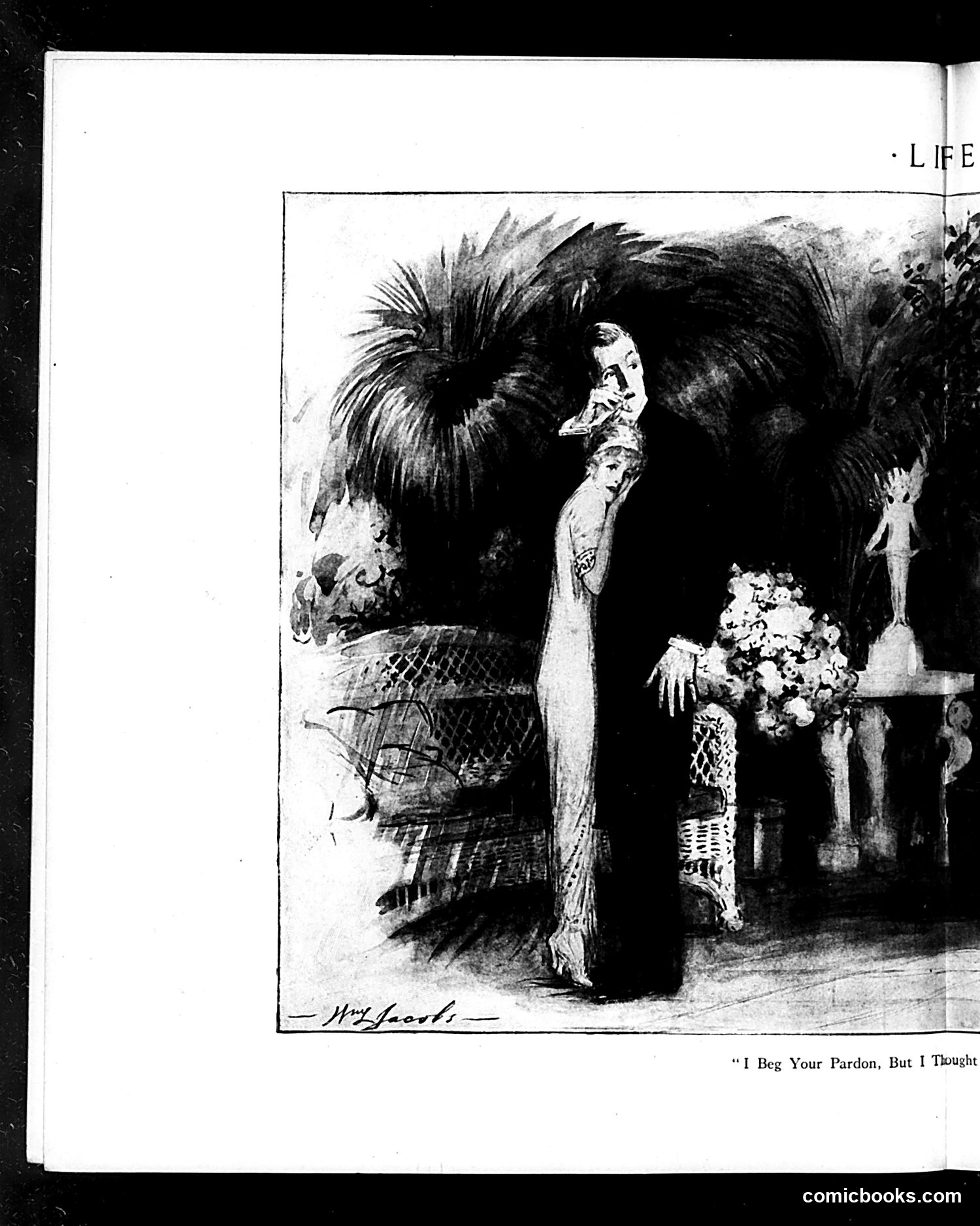
This is a satirical illustration by an artist signed "Max Beerbohm" (visible at bottom left). The cartoon depicts a woman in an elegant, form-fitting gown speaking to a man in formal attire with distinctive feathered headwear, likely indicating wealth or high social status. The woman holds flowers, suggesting a formal social occasion. The caption—"I Beg Your Pardon, But I Thought"—appears incomplete in this OCR'd text, but the image suggests social awkwardness or mistaken identity at an upper-class gathering. The contrast between the woman's refined elegance and the man's unusual headpiece suggests Beerbohm is satirizing pretension, vanity, or misplaced assumptions among the wealthy elite—typical subjects of *Life* magazine's social commentary.
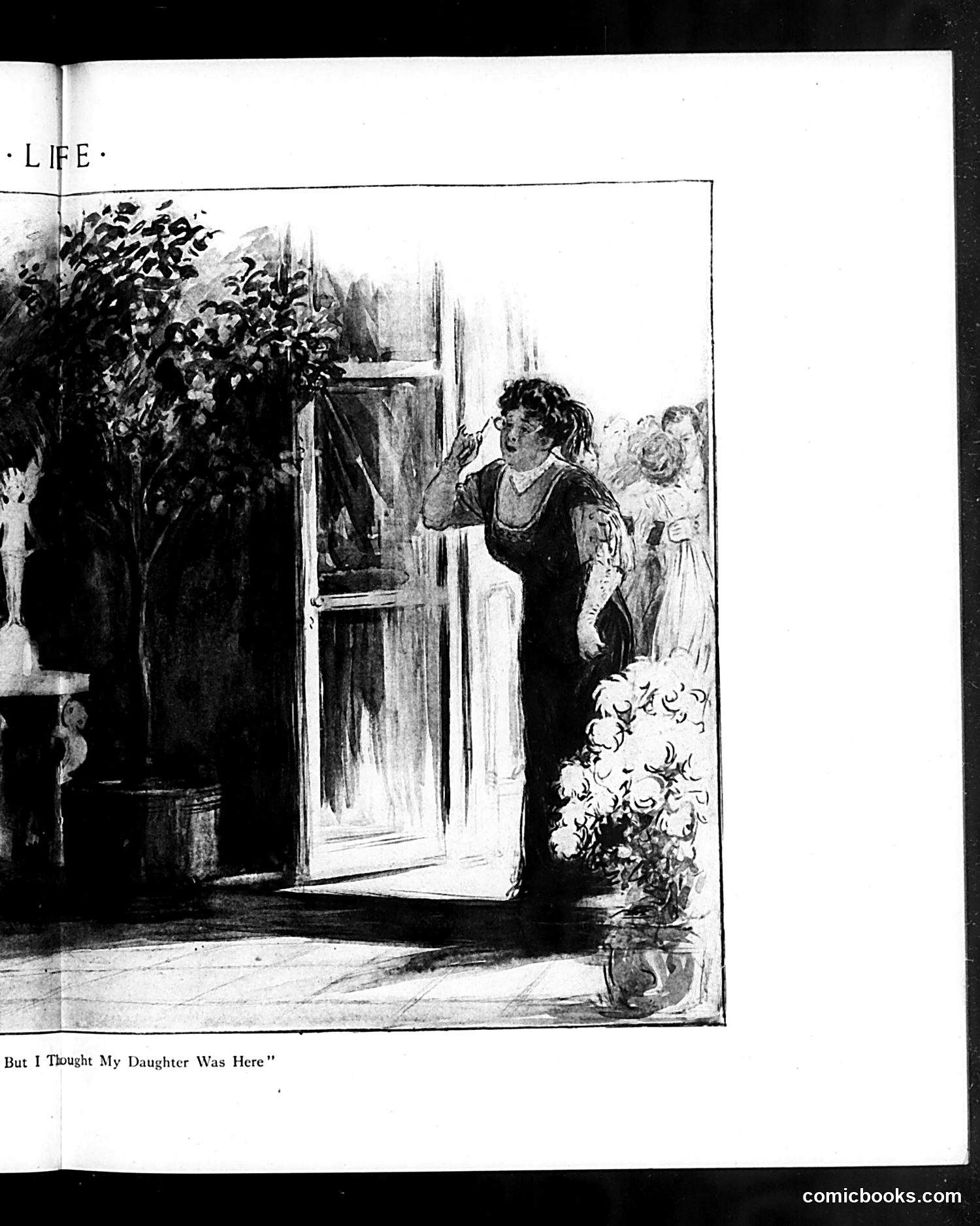
This cartoon depicts a domestic scene where a woman appears at a doorway, seemingly surprised or confused. A well-dressed woman stands in the entryway while others (possibly family members) are visible in the background near flowering plants. The caption suggests the humor relies on mistaken identity or expectation—the woman expected to find her daughter present but instead encountered someone or something else. Without additional context about the specific issue of *Life* magazine or the date of publication, the exact social commentary remains unclear. The cartoon likely satirizes domestic life, family expectations, or social visits common to early-to-mid 20th century American culture, playing on the gap between what one anticipates and what one actually finds.
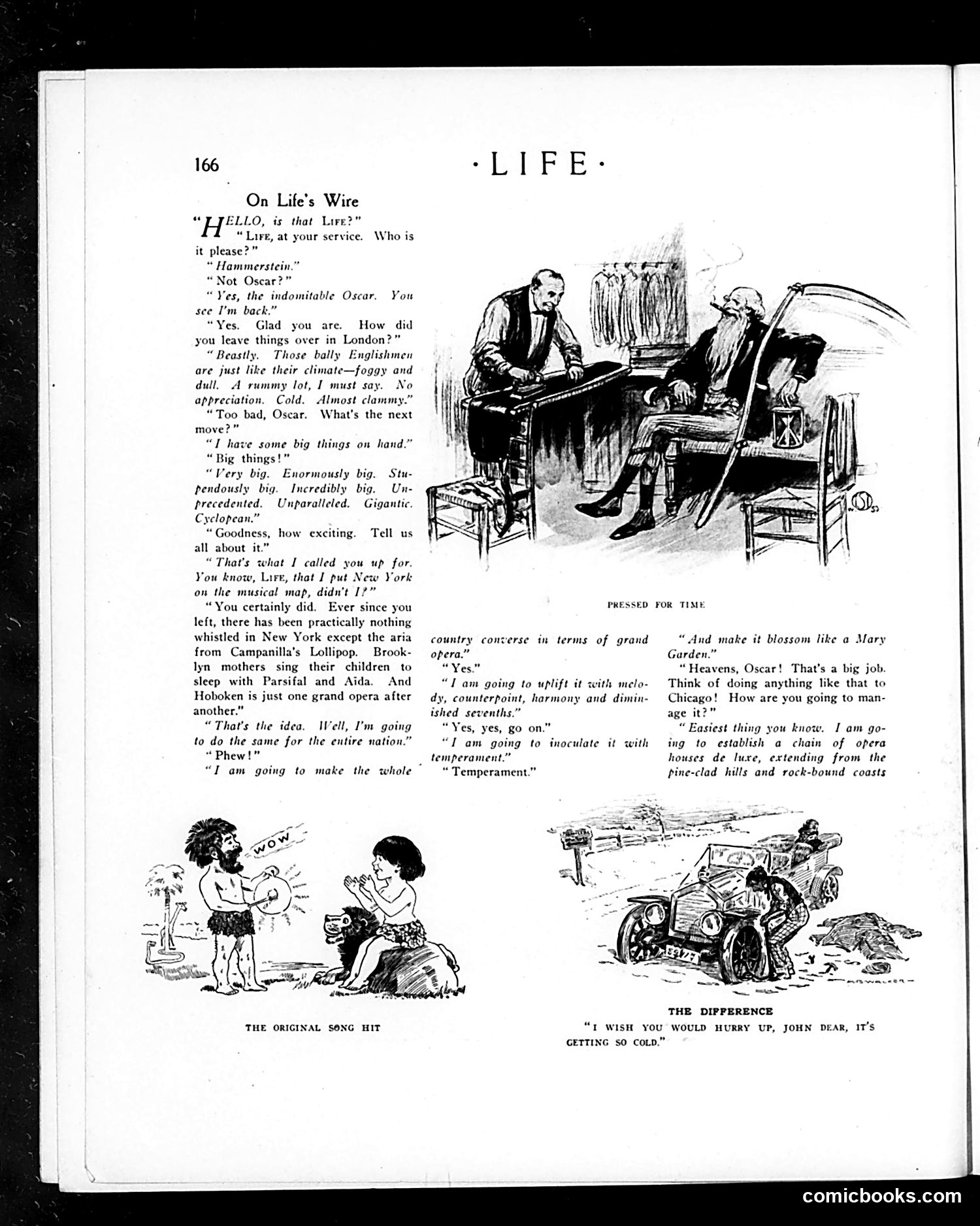
This page satirizes **Oscar Hammerstein**, the famous Broadway impresario and lyricist. The dialogue mocks his grandiose ambitions and inflated self-regard. After returning from a disappointing London visit (where he complains the English are "foggy and dull"), Hammerstein boasts of plans to make America "converse in terms of grand opera" through a chain of luxury opera houses—transforming even Chicago's cultural landscape. The satire targets his pretentiousness: his description of his plans uses absurdly stacked superlatives ("Enormously big. Stupendously big. Incredibly big"). The accompanying cartoons provide visual jokes contrasting this grandiosity with ordinary life—one depicts "The Original Song Hit" (primitive), another shows "The Difference," capturing the gap between Hammerstein's operatic vision and everyday reality. The humor lies in deflating the artistic pretensions of a self-important cultural figure through his own boastful words.
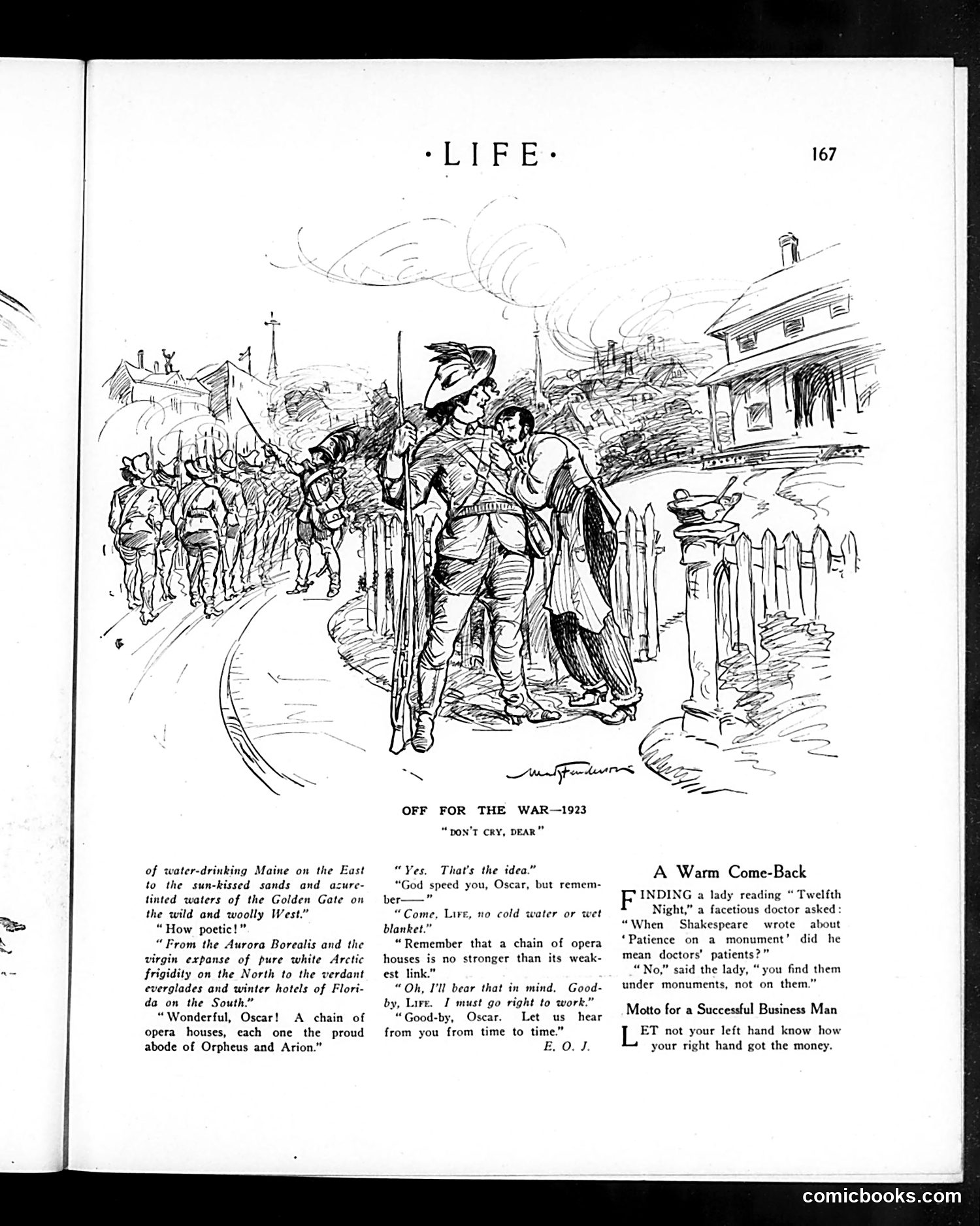
This cartoon depicts a farewell scene between two figures identified as "Oscar" and "Lire" (likely personifications of optimism and finance/caution). Oscar enthusiastically describes plans for a chain of opera houses spanning America—from Maine to California to Florida—as a romantic, poetic enterprise. Lire warns him that "a chain of opera houses is no stronger than its weakest link," cautioning against the venture. The cartoon satirizes post-WWI American optimism and overconfidence. Published in 1923, it reflects skepticism about ambitious business schemes during the economically unstable early 1920s. Oscar represents blind enthusiasm; Lire represents financial prudence. The humor lies in their contrasting perspectives—Oscar dismisses Lire's reasonable warning as "cold water," proceeding recklessly forward while Lire frets about inevitable failure. The title's reference to "war" suggests parallels between military recklessness and business folly.
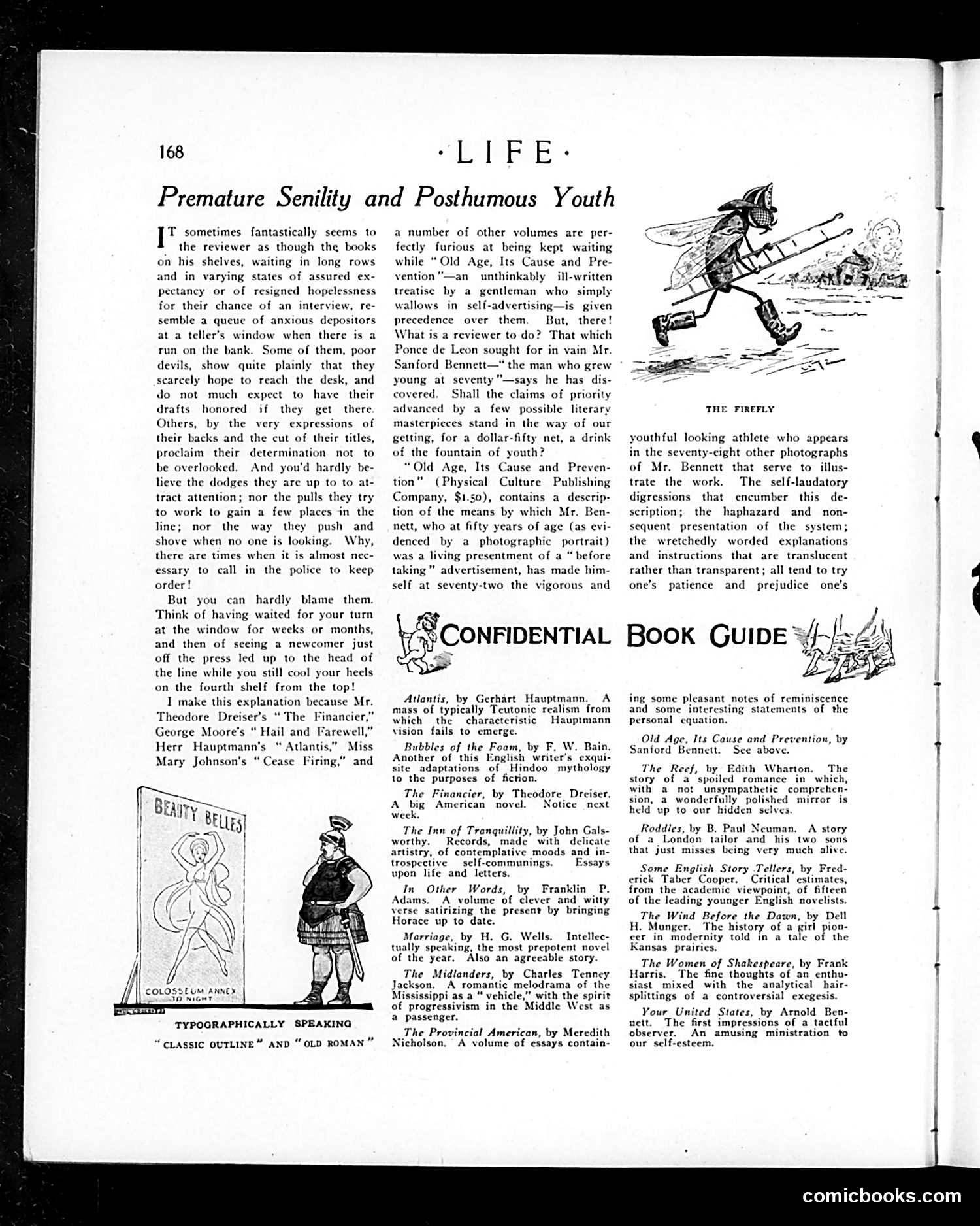
This book review column satirizes a self-help fad. The main target is Sanford Bennett's "Old Age, Its Cause and Prevention"—a vanity-published tract promising rejuvenation. Bennett claims he "grew young at seventy," supporting this with before-and-after photographs showing him as a vigorous athlete. The reviewer ridicules Bennett's shameless self-advertising and the book's prominence in publishing, despite its poor quality. The complaint: serious literary works by respected authors (Dreiser, Hauptmann, H.G. Wells) languish unread while Bennett's dubious "$1.50" fountain-of-youth manual gets priority attention. The satire mocks both Bennett's pseudoscientific claims and readers' gullibility for such promises. The small illustration shows "The Firefly"—likely a reference to rejuvenation's illusory appeal. This reflects early 20th-century anxieties about aging and the flourishing market for dubious anti-aging remedies.
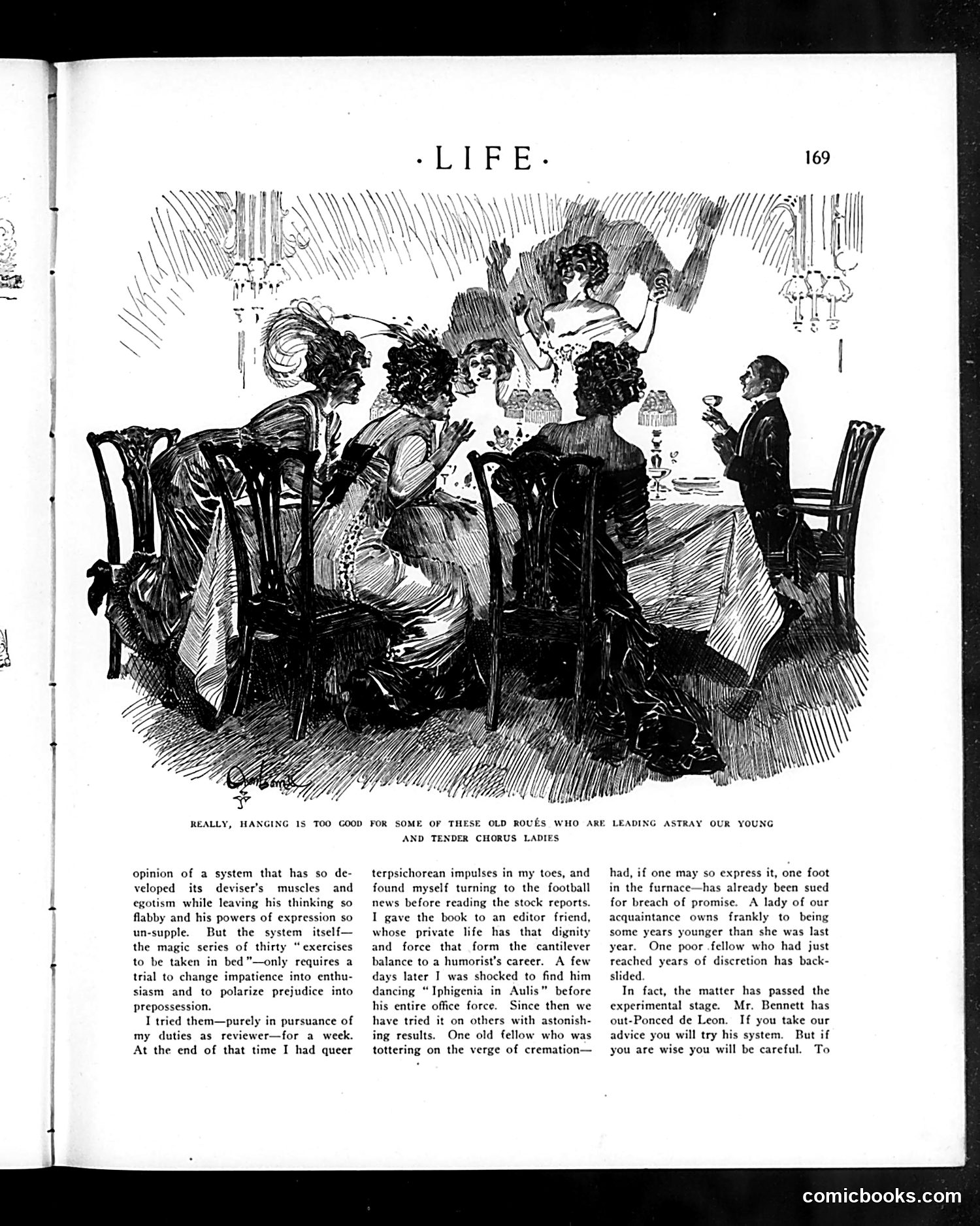
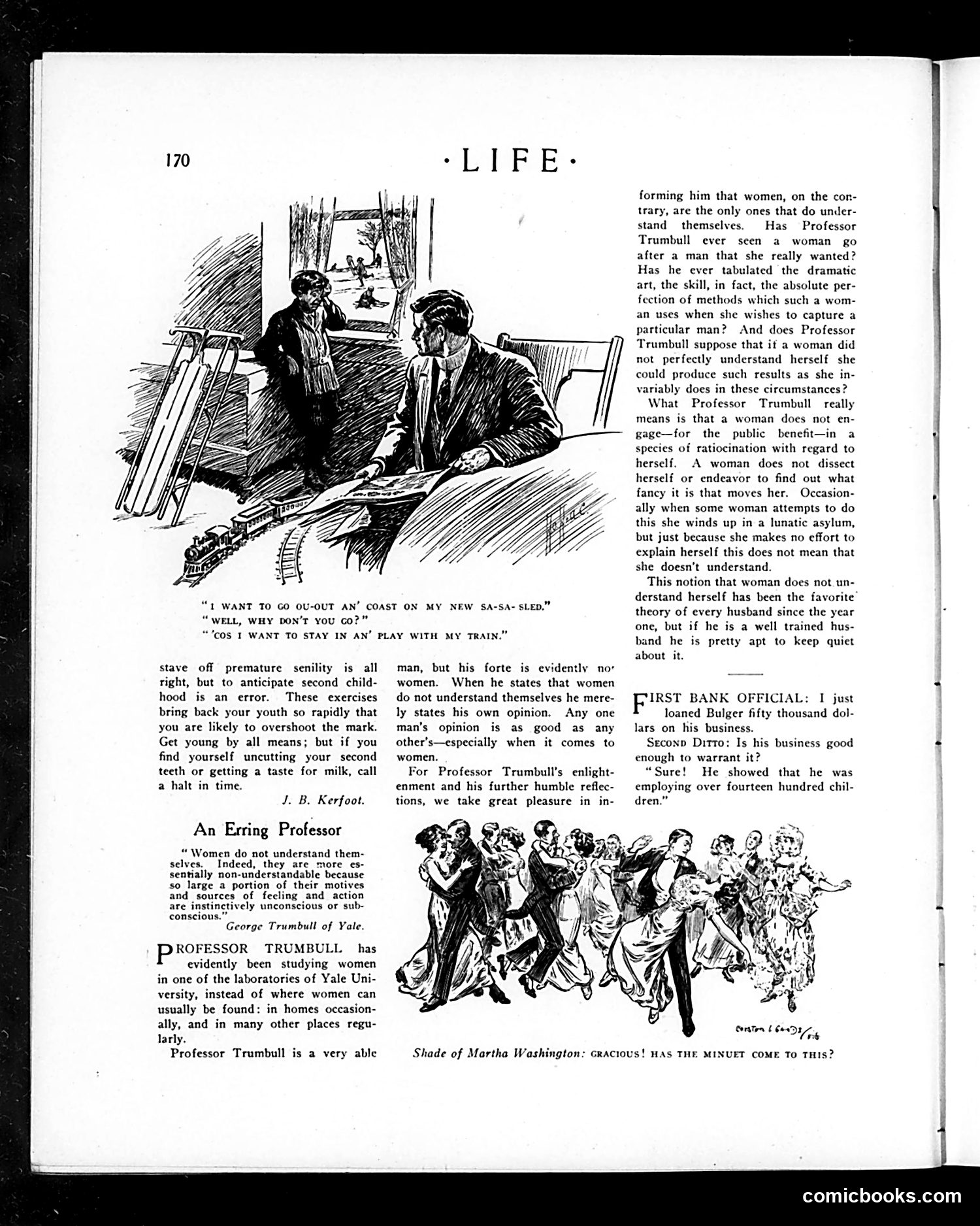
This *Life* magazine page contains three distinct satirical pieces: **1. Top cartoon:** A father and son discuss their competing desires—the boy wants to sled outside, but prefers playing with his train indoors. The humor mocks adults who regress to childishness through excessive "rejuvenation" exercises (a contemporary wellness trend). The caption warns against overdoing youth-restoration practices. **2. "An Erring Professor":** The article attacks Yale Professor George Trumbull's claim that women don't understand themselves. The satire argues the opposite: women demonstrate complete self-knowledge through their strategic ability to attract men. It dismisses his pseudo-scientific observations as mere male opinion, noting husbands have made similar claims since antiquity. **3. Bottom cartoon:** Two bank officials discuss a large loan. One justifies it because the borrower employs "over fourteen hundred children"—implying child labor was considered a legitimate business asset or credit indicator. The caption references Martha Washington, suggesting shock at modern degradation. All three pieces satirize flawed masculine reasoning about women, childhood, and economics.
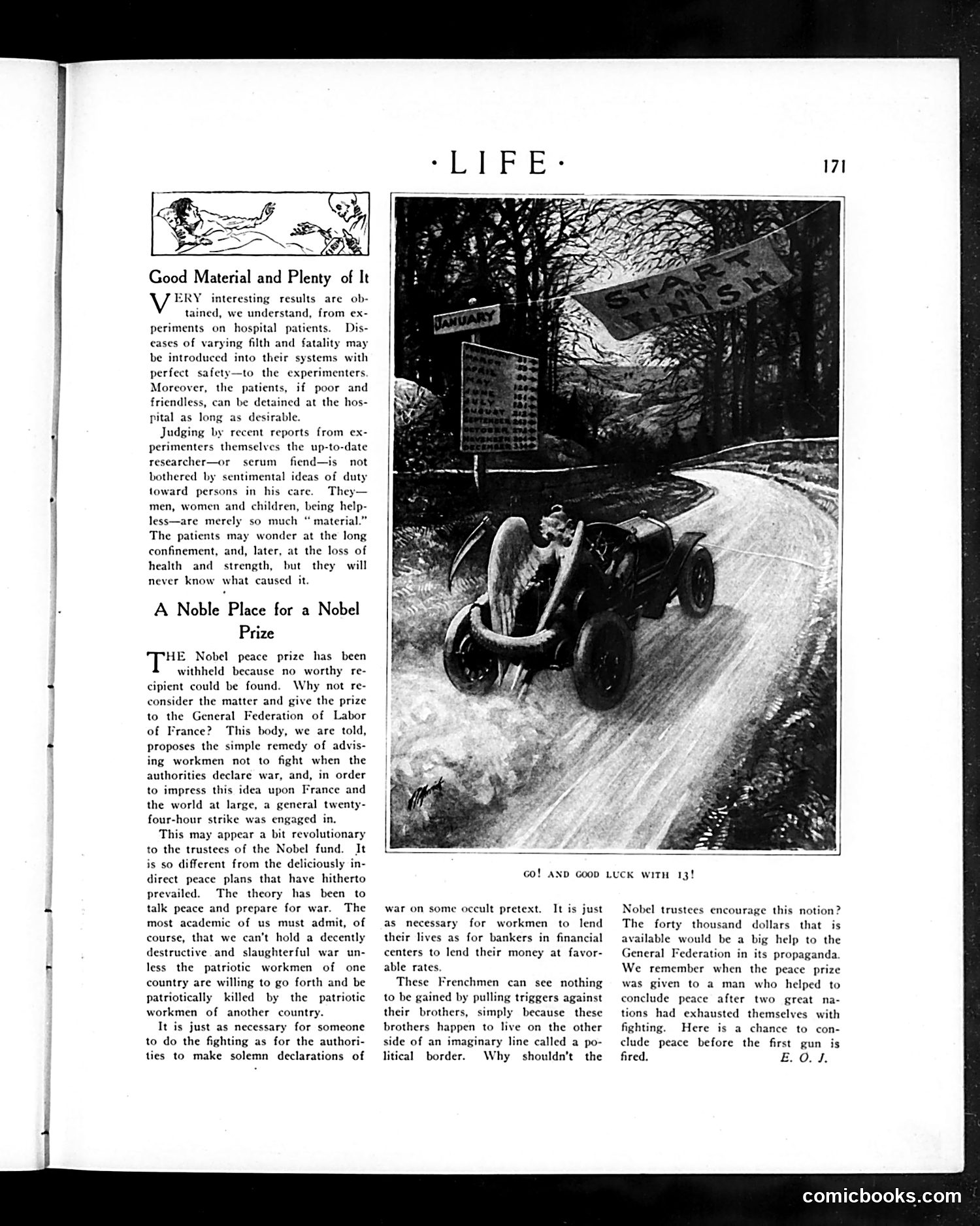
This page contains two separate satirical pieces criticizing institutional exploitation and war: **"Good Material and Plenty of It"** attacks unethical medical experimentation. It sarcastically praises researchers who test diseases on poor, institutionalized hospital patients—people with no legal protection or advocates. The dark humor emphasizes that vulnerable populations ("helpless") are treated as expendable "material" for science, with victims never knowing what harmed them. **"A Noble Place for a Nobel Prize"** mocks both war and peace-prize hypocrisy. It ironically proposes awarding the Nobel Peace Prize to France's Labor Federation for advocating worker non-cooperation with war declarations. The author argues this is actually more logical than previous prizes—preventing war is superior to negotiating peace *after* nations exhaust themselves killing workers. The satire critiques how governments declare wars while workmen do the dying, while bankers safely profit. Both pieces expose how institutions exploit the powerless (patients, laborers) for others' benefit.
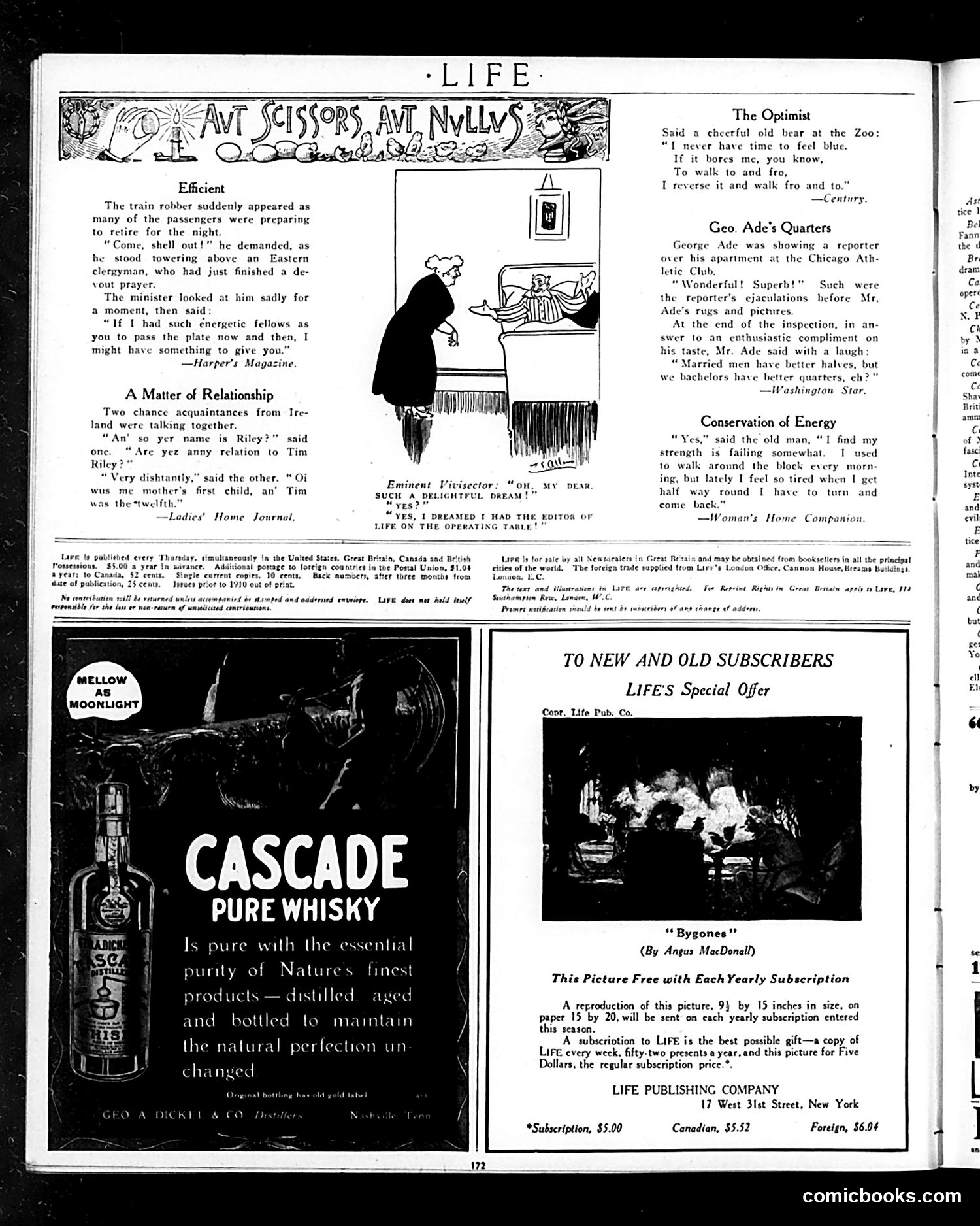
This page from *Life* magazine contains several short humorous anecdotes typical of early 20th-century satirical humor: **"Efficient"**: A train robber confronts an Eastern clergyman. The joke plays on the minister's complaint that if energetic people like the robber would help collect church donations, he'd have more to give. The satire mocks both clergy ineffectiveness at fundraising and the robber's misplaced "efficiency." **"A Matter of Relationship"**: Two Irish immigrants discuss family connections, with wordplay on being "relation to Tim Riley"—a likely reference to a contemporary figure or stereotype, though unclear to modern readers. **"Eminent Vivisector"**: A scientist dreams of having a *Life* magazine editor on an operating table. This satirizes the tense relationship between medical researchers and press critics of animal experimentation (vivisection), a contemporary controversy. The page also includes advertisements for Cascade whisky and subscription offers featuring a picture titled "Bygones" by Angus MacDonall. The editorial and advertising content reflects early 1900s American consumer culture and social commentary.
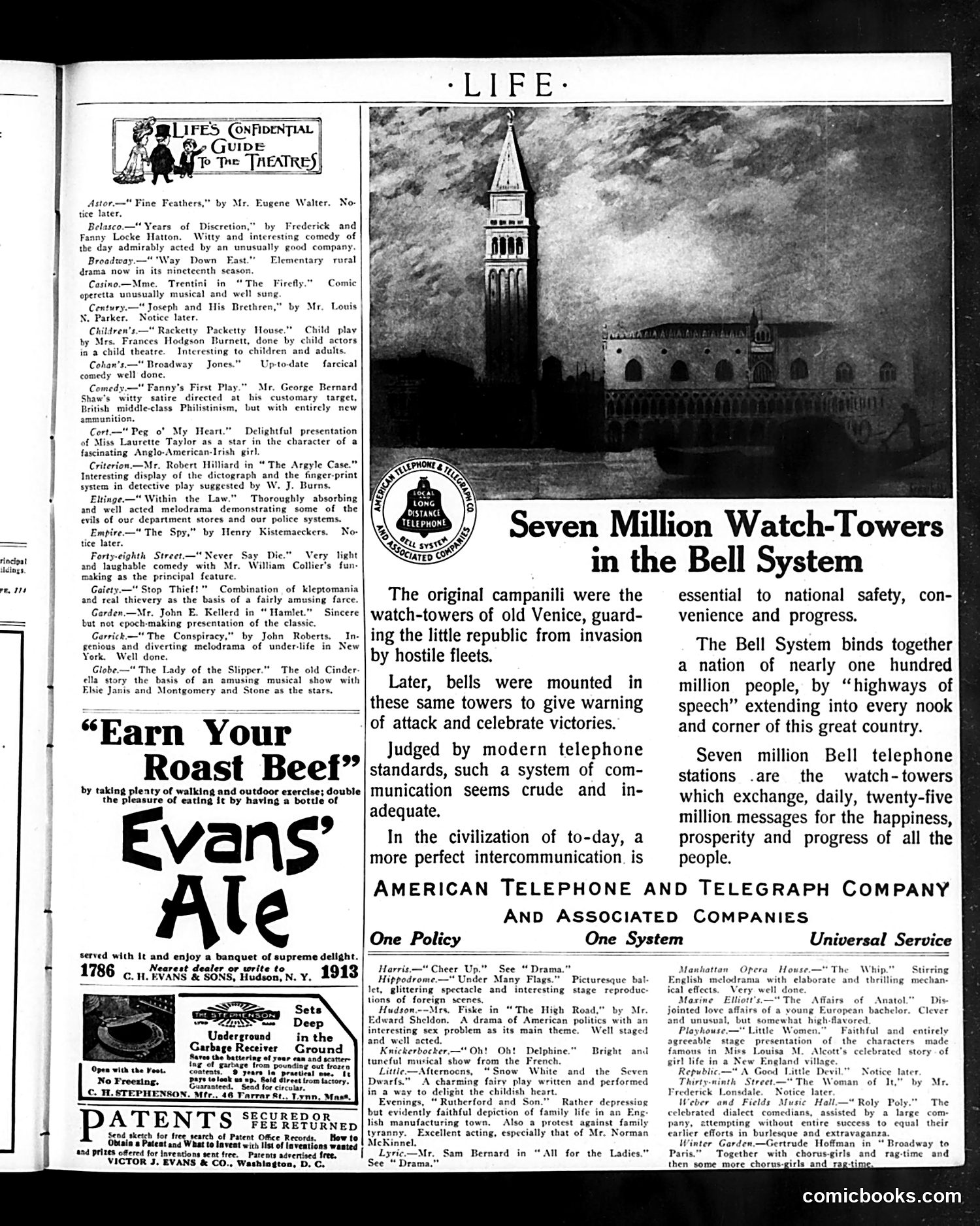
This page is primarily **advertising and theater listings**, not political satire. The main content includes: 1. **Theater reviews** - a "Life's Confidential Guide to the Theatres" listing Broadway shows with brief critiques (Shaw's "Fanny's First Play," Laurette Taylor in "Peg of My Heart," etc.) 2. **Evans' Ale advertisement** - promoting beer as a health tonic ("Earn Your Roast Beef" through exercise) 3. **Patent advertisement** - Victor J. Evans & Co. soliciting inventions 4. **Bell System advertisement** - the largest piece, drawing a historical parallel between Venice's medieval watch-towers and modern telephone infrastructure. It positions Bell's "seven million" telephone stations as contemporary "watch-towers" binding the nation together through "highways of speech" for "national safety, convenience and progress." The Bell ad reflects early-20th-century corporate messaging celebrating technological progress and national connectivity—not satire, but earnest corporate promotion dressed in grandiose language.
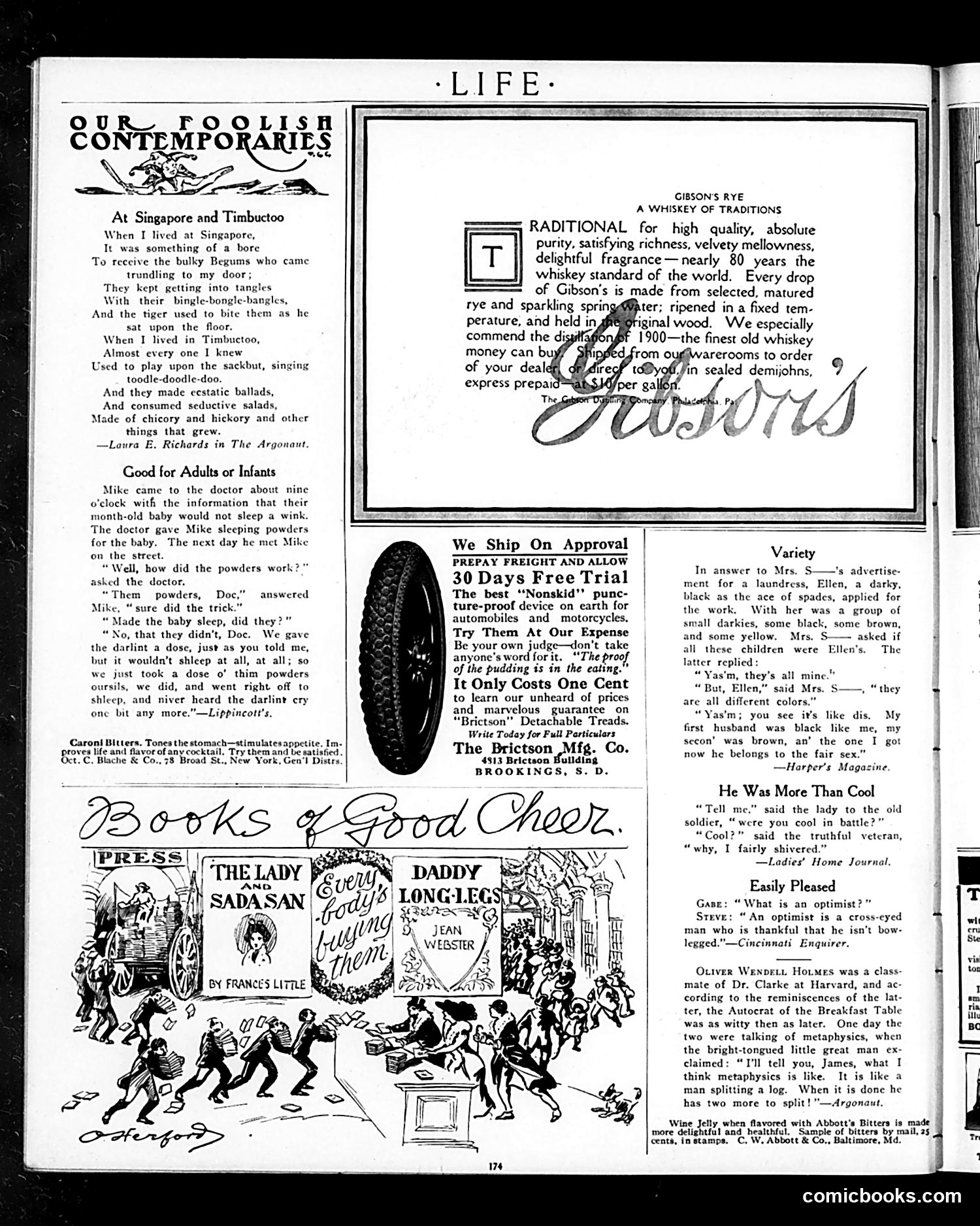
This is primarily a **humor and advertising page** from Life magazine (early 20th century). The content consists of: **Text Humor Pieces:** - "Our Foolish Contemporaries" mocks exotic travel writing through exaggerated descriptions of Singapore and Timbuctoo - "Good for Adults or Infants" is an Irish dialect joke about a father who takes sleeping powder meant for his baby - Brief jokes about optimism, military bravery, and racial stereotypes typical of the era **Advertisements:** - Gibson's Rye whiskey (emphasizing 80-year tradition) - Brictson tire treads for automobiles - Various book titles **Notable Element:** The "Variety" section uses a **racist caricature** about a Black woman's children having different skin tones, reflecting deeply offensive period attitudes toward race. **Historical Context:** This reflects Life's role as a satirical magazine mixing humor, ads, and social commentary. The jokes reveal period attitudes—ethnic stereotypes, class humor, and casual racism were considered acceptable entertainment for contemporary readers.
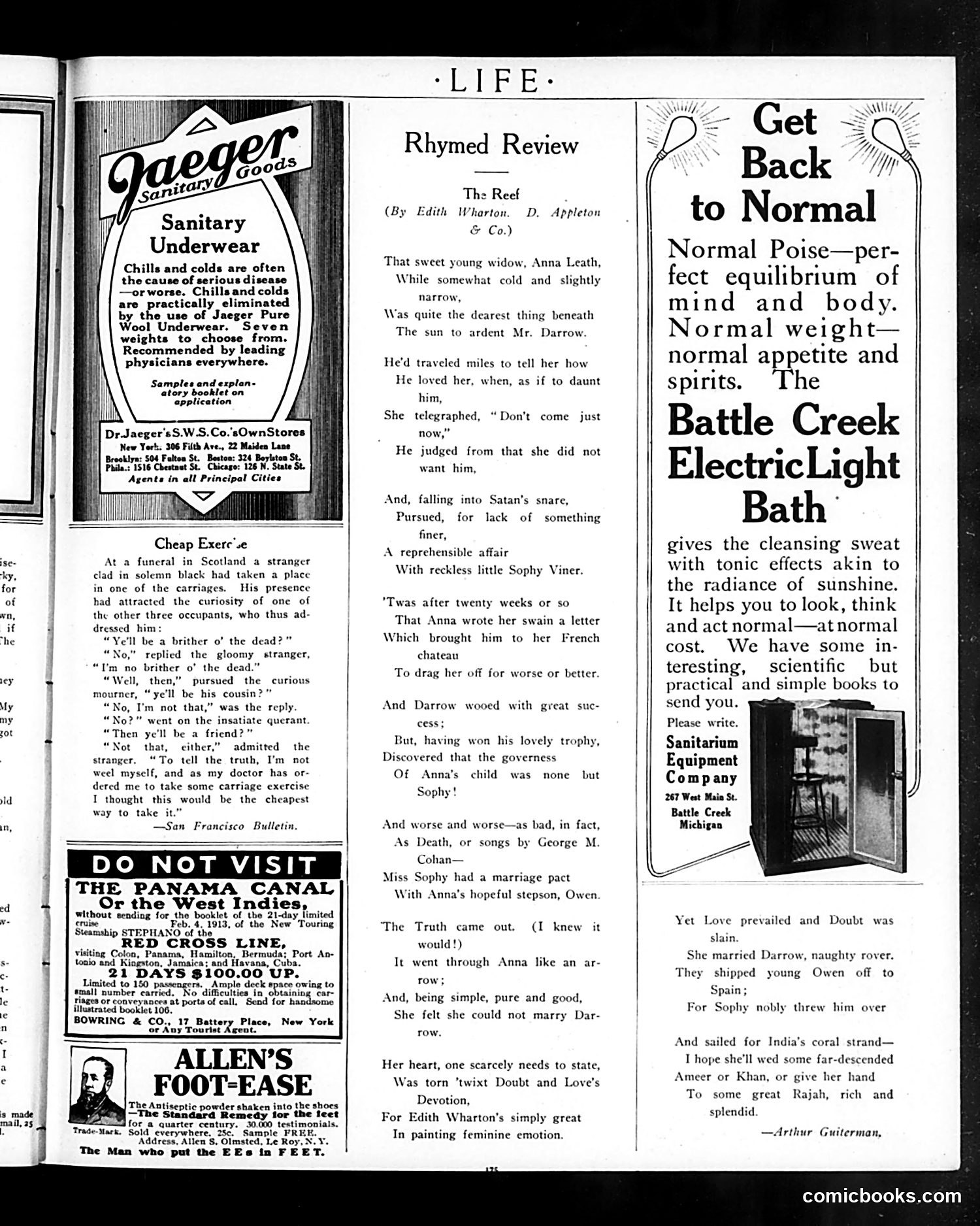
This page is primarily **advertising and literary content** rather than political satire. The main elements are: **"Cheap Exercise" anecdote**: A brief humorous Scottish story about a stranger attending a funeral solely for the free carriage ride his doctor recommended—satirizing penny-pinching practicality disguised as medical advice. **"Rhymed Review"**: A lighthearted verse summary of Edith Wharton's novel *The Reef*, mocking romantic melodrama through exaggerated plot complications (love triangles, governesses, moral dilemmas). The reviewer pokes fun at Wharton's earnest portrayal of "feminine emotion." **Advertisements**: The page features vintage product ads—Jaeger wool underwear, Panama Canal cruises, Allen's Foot-Ease powder, and a Battle Creek electric light bath—typical early 20th-century marketing emphasizing health and leisure. **No political cartoons appear** on this page. The humor is social/literary rather than political, targeting Victorian sentimentality and commercial consumer culture.
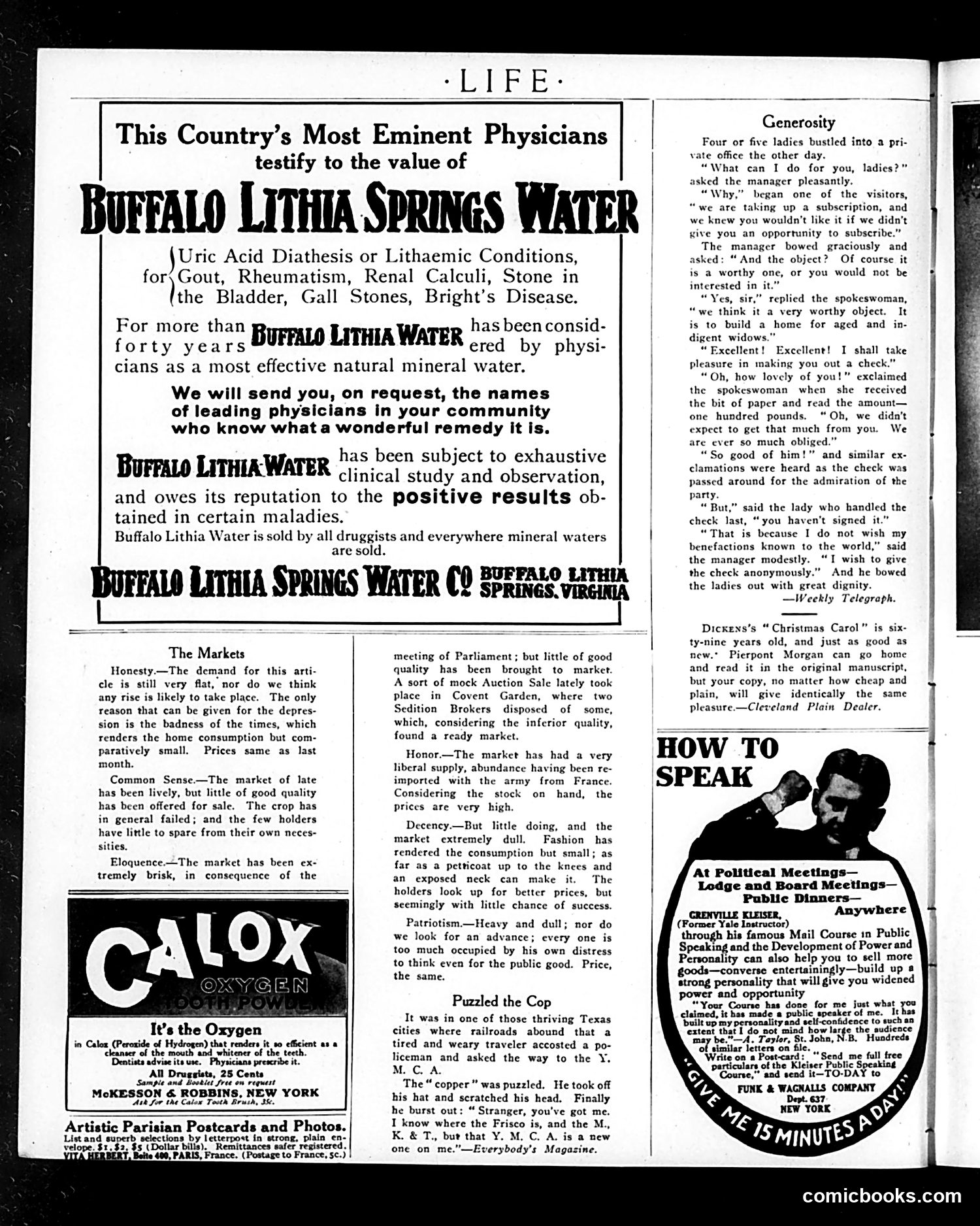
This page is primarily **advertising and light humor** rather than political satire. The dominant content is a full-page advertisement for Buffalo Lithia Springs Water, a patent medicine claiming to cure gout, rheumatism, and kidney stones—a common commercial practice in early 20th-century magazines. The page includes several minor humorous pieces: 1. **"The Markets"** — A satirical commodity-price listing treating abstract concepts (Honesty, Common Sense, Patriotism, Decency) as tradeable goods with market values, ironically commenting that most are in short supply or "dull" demand. 2. **"Puzzled the Cop"** — A brief anecdote about a confused Texas policeman unable to locate the YMCA, playing on rural unfamiliarity with urban institutions. 3. **"Generosity"** — A joke about ladies soliciting donations, with the punchline playing on the manager's assumption they seek worthy causes. The page reflects the era's patent-medicine advertising saturation and gentle, non-political humor typical of *Life* magazine.
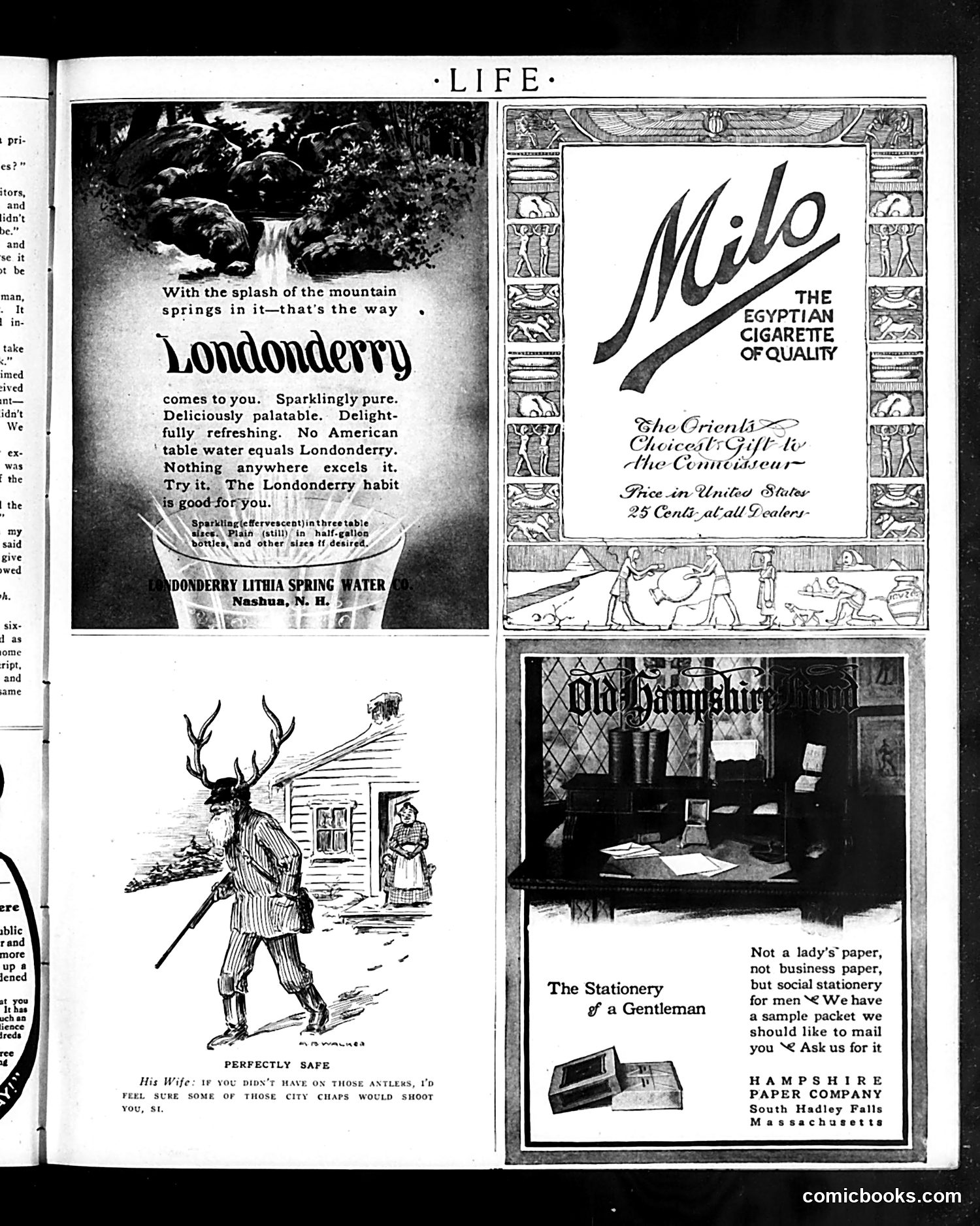
This page consists primarily of period advertisements rather than satirical cartoons. The main content includes: **Londonderry Lithia Spring Water** (top left): A straightforward product ad emphasizing purity and refreshment, claiming superiority to American table water. **Milo Cigarettes** (top right): An Egyptian cigarette brand advertisement positioned as "the Orient's Choicest Gift to the Connoisseur," reflecting early 20th-century marketing that exoticized non-Western products. **The one cartoon** (bottom left) shows a hunter with exaggerated antlers confronted by his wife, who fears city hunters might shoot him by mistake. This is gentle domestic humor rather than political satire—playing on the contrast between rural hunters and urban sportsmen, with the implication that city dwellers are either incompetent or trigger-happy. **Hampshire Paper Company** (bottom right): Advertisements for gentlemen's stationery. The page reflects early 1900s consumer culture and gender assumptions (stationery explicitly "not a lady's paper").
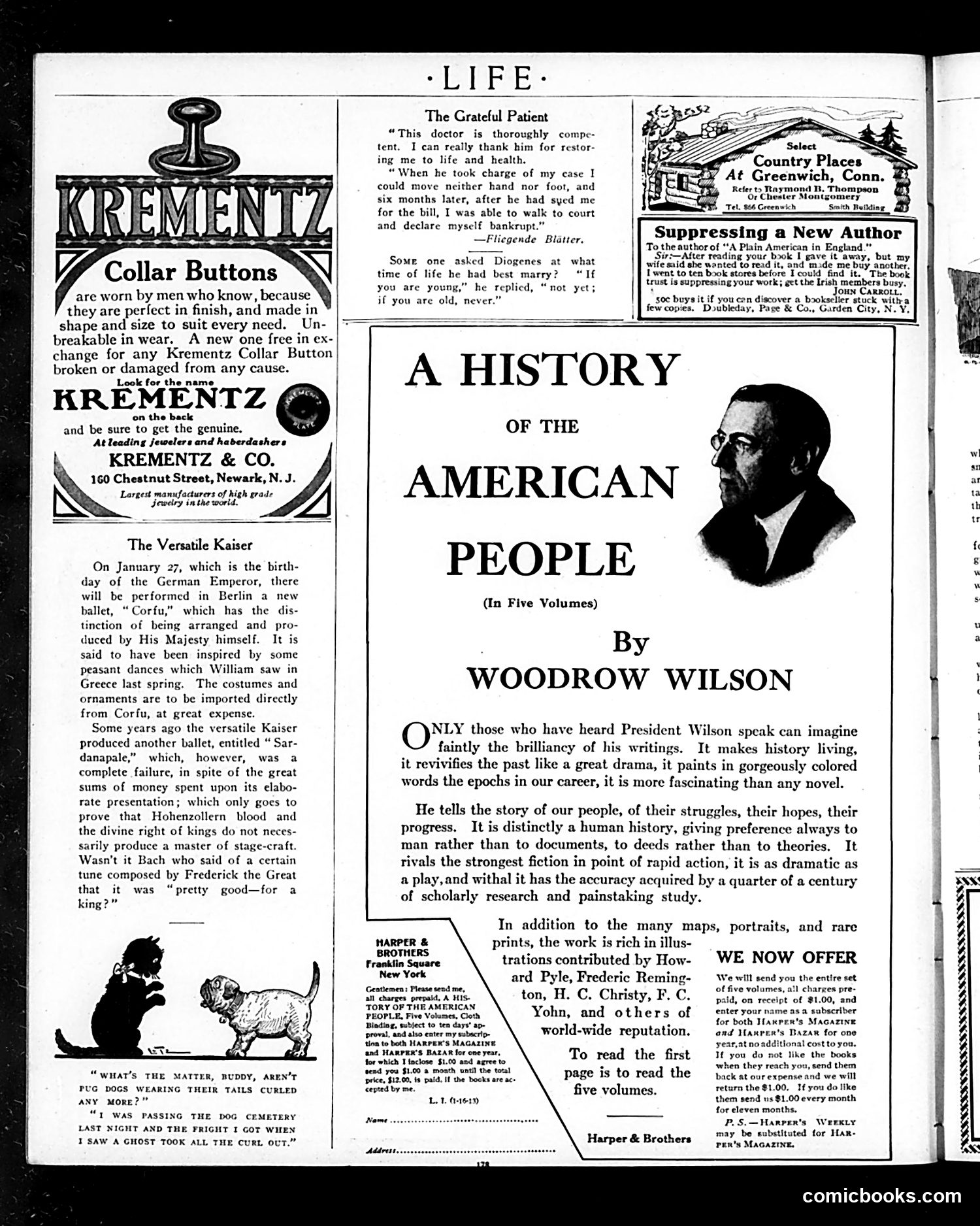
This page mixes advertisements and humor typical of Life magazine's satirical format. The main content is a large book advertisement for Woodrow Wilson's "History of the American People" (five volumes), promoting it as living history that surpasses fiction. The smaller items are satirical pieces: "The Grateful Patient" jokes that a doctor's cure only enabled the patient to walk to bankruptcy court—mocking both medical bills and financial ruin. "The Versatile Kaiser" sarcastically praises German Emperor Wilhelm II for choreographing ballets, comparing him unfavorably to Bach and noting his previous ballet "Sardanapale" failed despite expense—satirizing imperial pretension and wasted resources. A dog cemetery joke plays on wordplay about "curled tails." The page also includes Krementz collar button advertisements and brief advice columns. The satire reflects early 20th-century American attitudes: skepticism toward both medical costs and imperial European excess.
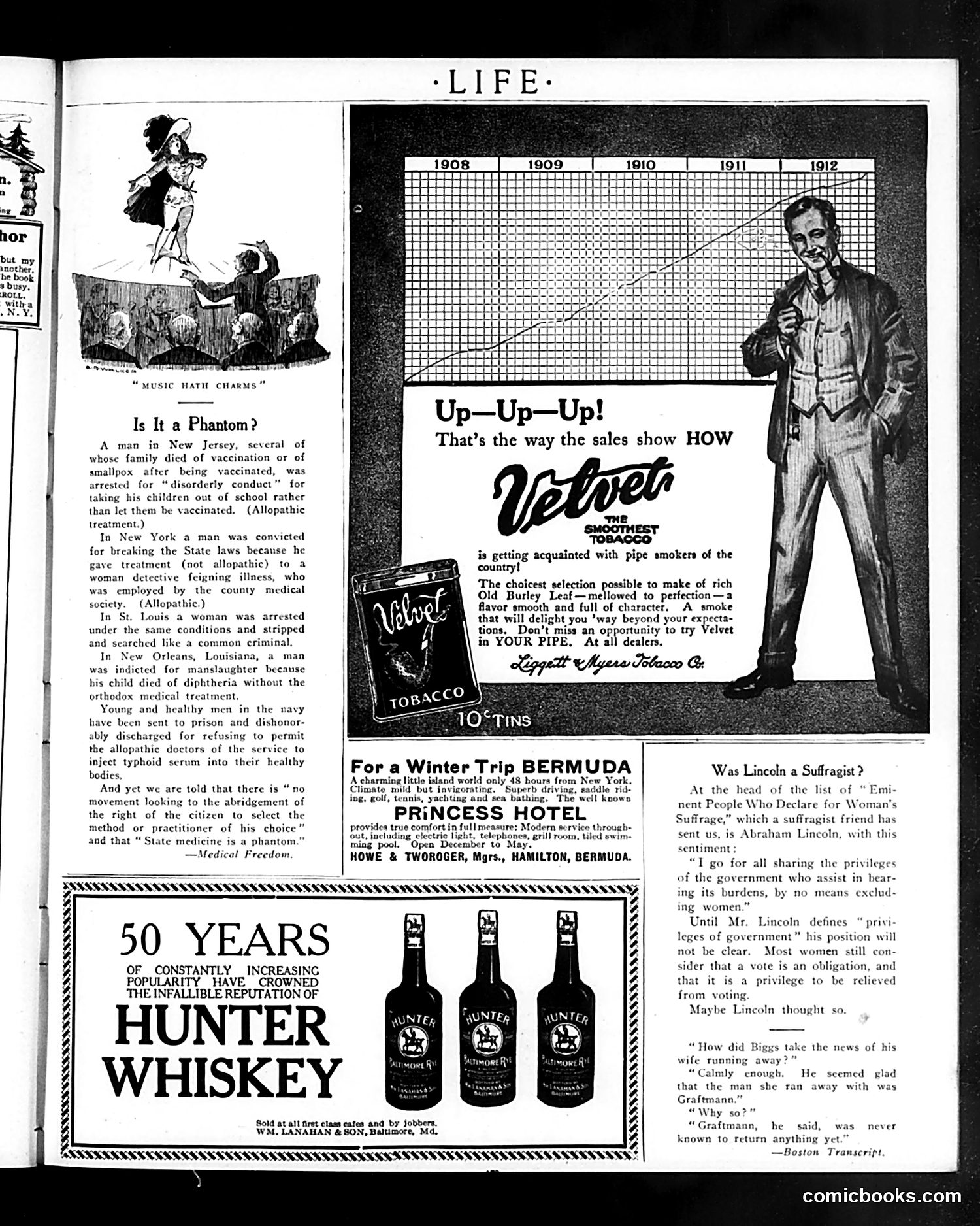
This page from *Life* satirizes medical freedom and government coercion circa 1912. The left column catalogs real cases of citizens arrested or imprisoned for refusing mandatory vaccinations or allopathic (conventional) medical treatment—in New Jersey, New York, St. Louis, New Orleans, and the Navy. The satire's point: the government claims citizens have free choice in medical practitioners, yet prosecutes those who exercise that choice by refusing state-mandated treatments. The headline "State medicine is a phantom" suggests medical freedom is illusory. The page includes unrelated advertisements (Velvet tobacco, Hunter Whiskey, Bermuda travel) and a brief piece questioning whether Lincoln was a suffragist, quoting his support for voting rights while noting ambiguity in his language. The cartoon at top-left ("Music Hath Charms") depicts orchestral musicians, though its connection to the medical freedom theme is unclear.
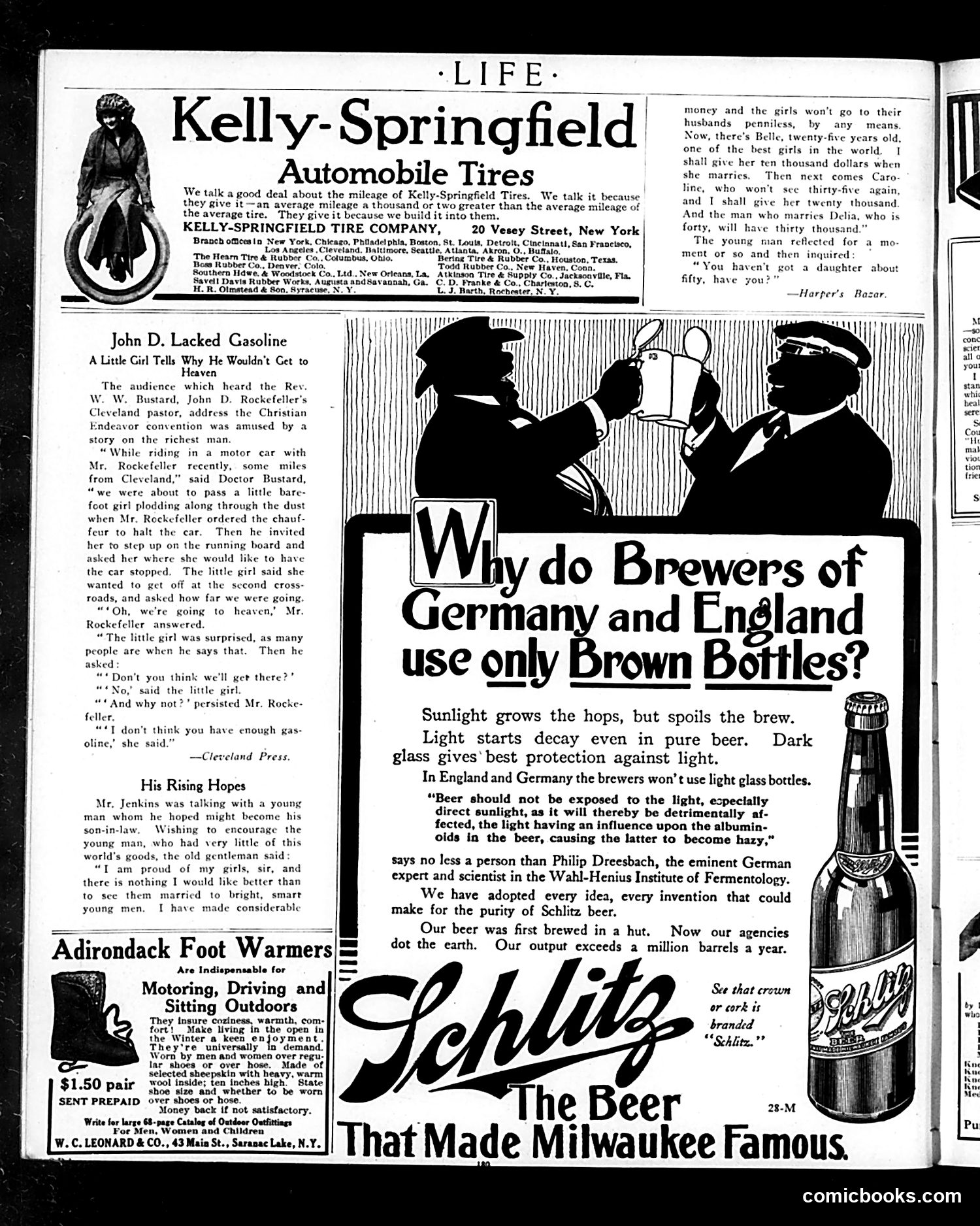
This page primarily contains **advertisements and humorous anecdotes** rather than political cartoons. The main content includes: 1. **"John D. Lacked Gasoline"** — A brief joke about John D. Rockefeller (the richest American of the era). A barefoot girl tells him his car won't reach heaven because "you don't have enough gasoline"—a sarcastic jab at his wealth and the common perception that the ultra-rich couldn't enter heaven. 2. **"His Rising Hopes"** — An anecdote where an elderly man boasts about dowries for his daughters, the punchline implying he's marrying them off for money rather than love. 3. **Large Schlitz beer advertisement** explaining why German and English brewers use only brown bottles: dark glass protects beer from sunlight damage. This was legitimate product information, not satire. 4. **Product ads** for Kelly-Springfield tires, Adirondack foot warmers, and other goods. The page reflects early-20th-century consumer culture and contains gentle satire about wealth and social climbing, typical of Life magazine's era.
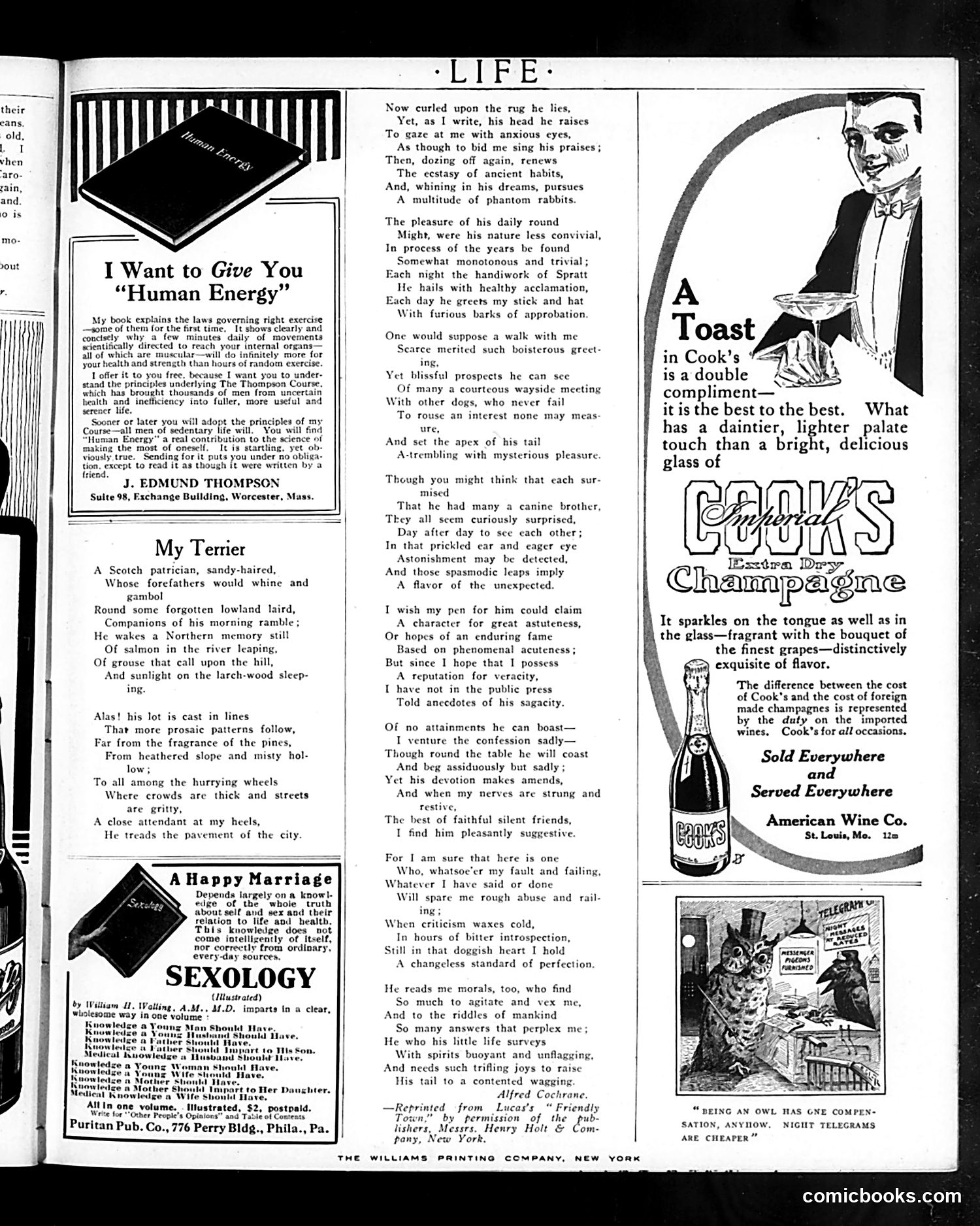
This page is primarily **literary and advertising content**, not political satire. The main material consists of: 1. **"My Terrier"** — a sentimental poem by Alfred Cochrane celebrating a Scottish terrier's simple pleasures (walks, food, companionship). The poem contrasts the dog's humble, contented life with human complexity, suggesting virtue in uncomplicated devotion and loyalty. 2. **Health/Self-improvement ads** — typical early 20th-century "self-made man" marketing (Edmund Thompson's exercise course; books on sexology and marriage). 3. **Cook's Champagne ad** — a luxury product advertisement positioned opposite the humble dog poem—an ironic juxtaposition of refined pleasures versus the terrier's simple joys. The implicit social commentary is gentle: the dog's faithful, uncritical companionship becomes a foil for human pretension and complexity. No specific political figures or events are referenced; rather, this reflects period attitudes about masculine virtue, class aspiration, and domesticity.
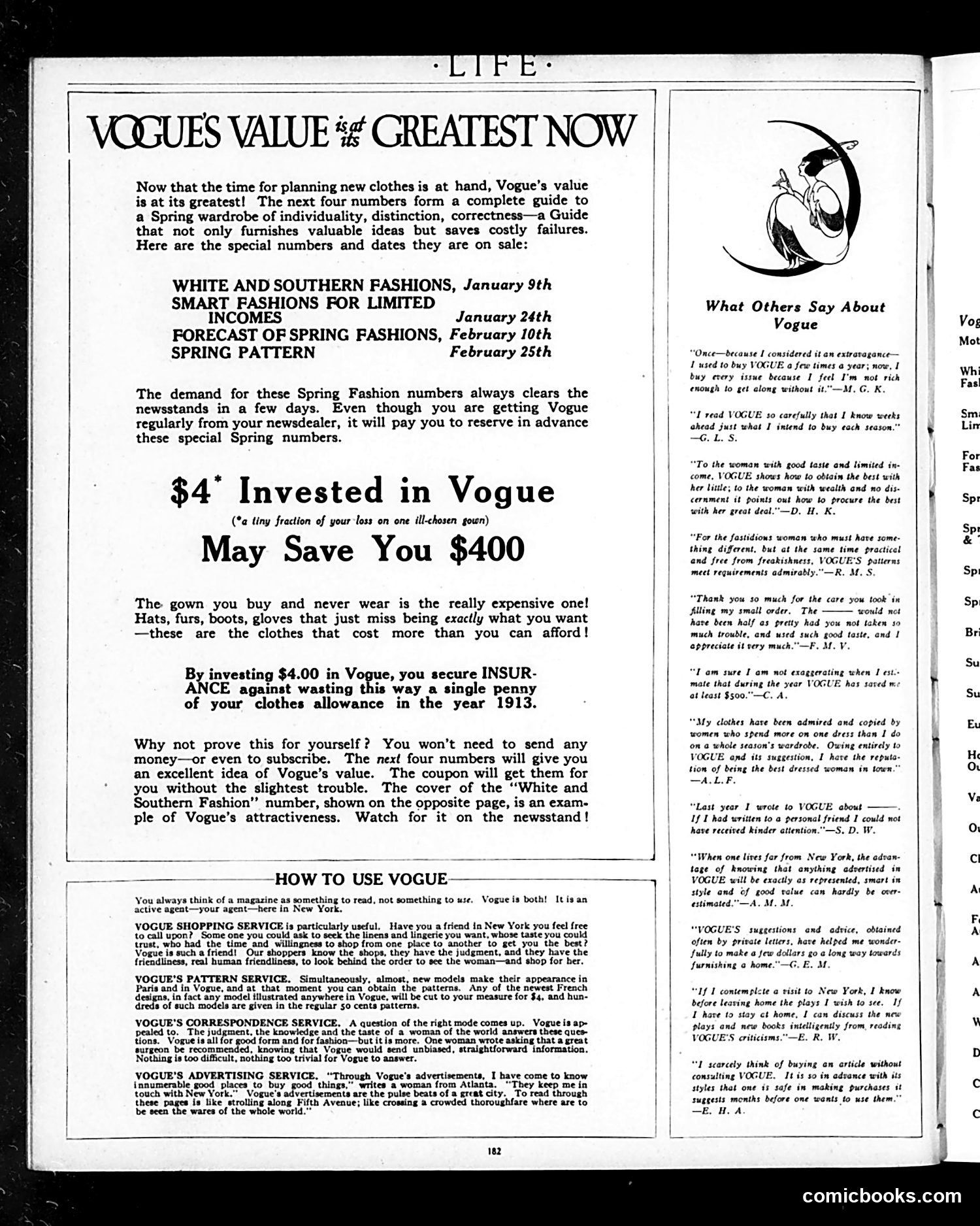
This page is primarily **advertising for Vogue magazine**, not political satire. It's a 1913 promotional spread designed to convince readers that a $4 annual investment in Vogue will save them $400 by preventing wasteful clothing purchases. The small illustration (top right) showing a woman on a crescent moon is decorative branding, not a political cartoon—it's the magazine's aesthetic touch. The core argument: women waste money buying garments that don't fit their needs or taste. Vogue's fashion guidance, shopping service, pattern service, and correspondence advice allegedly provide expert judgment, preventing costly mistakes. The testimonials at right (attributed quotes from satisfied readers) support this claim. This reflects early 20th-century consumer culture: positioning magazines as practical lifestyle advisors rather than mere entertainment, targeting middle and upper-class women managing household budgets and aspiring to fashionable dress.
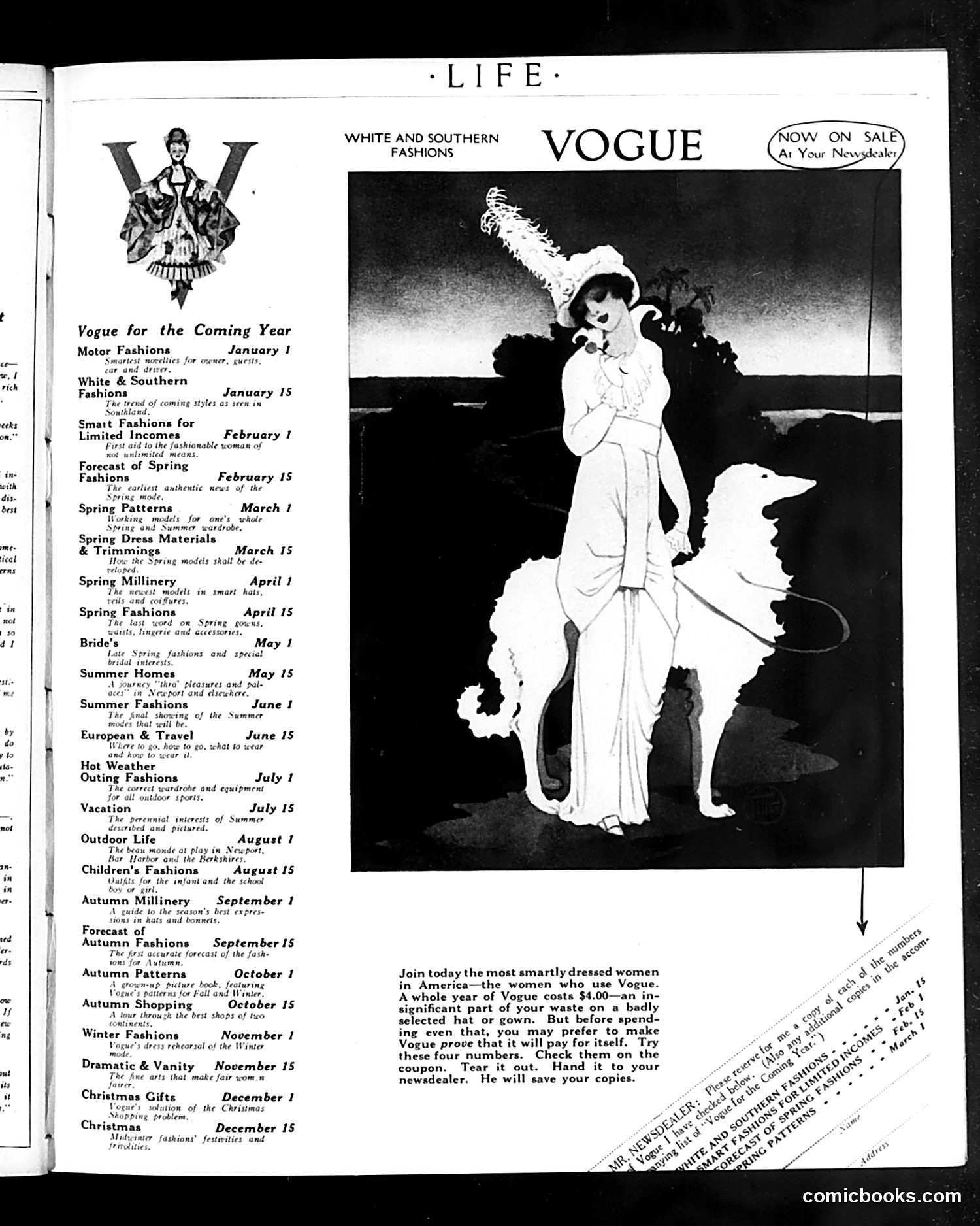
This page is primarily a **Vogue magazine advertisement** rather than satire or political commentary. The left column lists Vogue's upcoming fashion editorial topics organized by season (Motor Fashions in January, Spring Fashions in February, etc.). The right side features a **glamorous illustration of a woman in elegant white clothing** posed with a large greyhound dog, promoting Vogue's prestige and style authority. The accompanying text appeals to status-conscious readers: "Join today the most smartly dressed women in America." The satire here is **subtle and implicit**: the expensive lifestyle presented—European travel, Newport summers, formal wear—targets wealthy readers during an era of class consciousness. By positioning Vogue as essential to being "smartly dressed," the ad equates the magazine with social standing and taste. There's no caricature or identifiable public figure. This is straightforward fashion marketing using aspirational imagery rather than explicit political commentary.
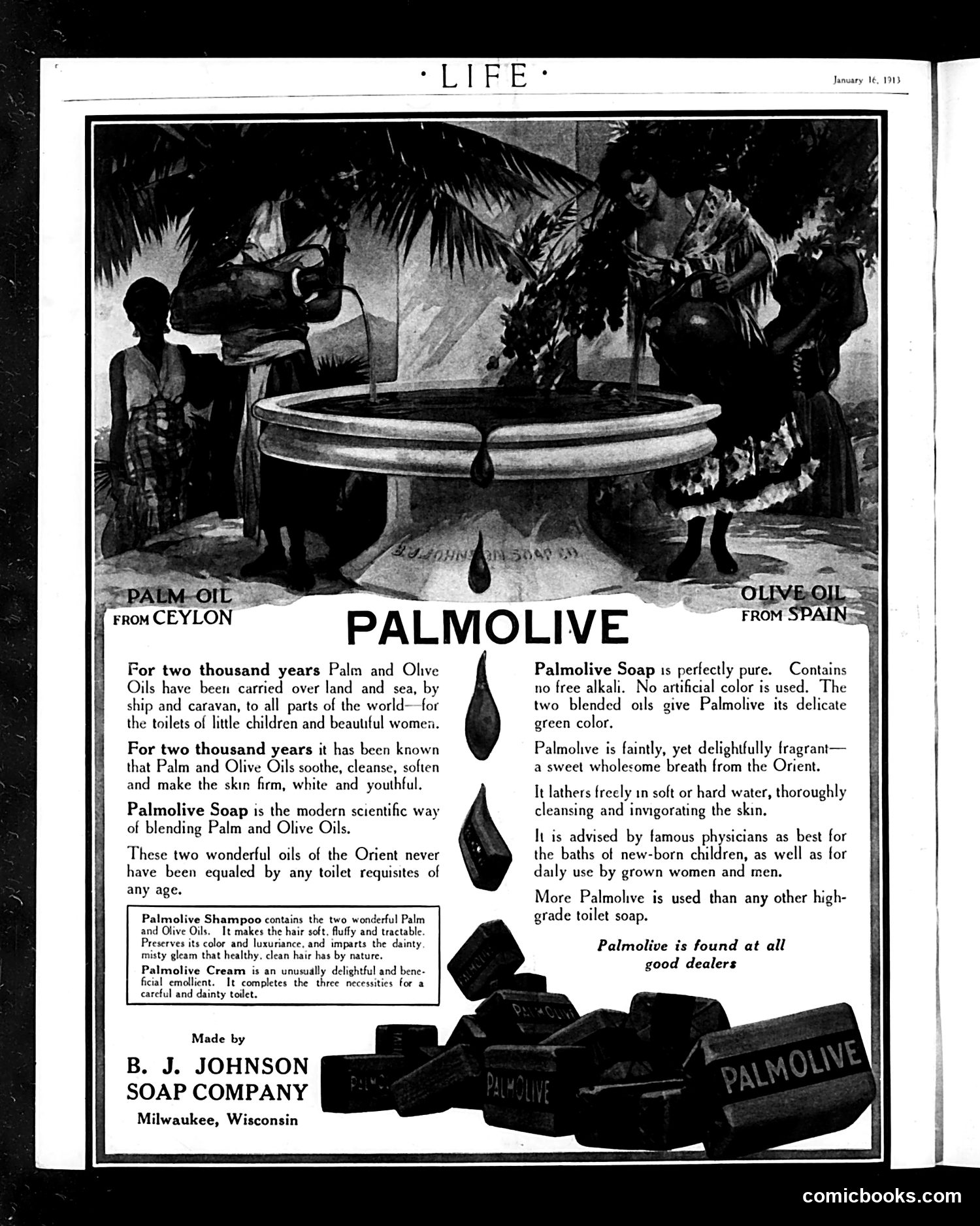
This is **advertising, not satire or commentary**. It's a 1913 Palmolive soap advertisement from Life magazine's pages. The image shows an orientalist fantasy scene: figures in exotic dress (appearing to represent Ceylon/Spain, the oil sources) pouring oils into a large basin. The theatrical staging and "exotic" costuming reflect early 20th-century marketing that traded on romanticized imagery of the Orient and colonial sources. The ad's claims are notable by modern standards: it promises the soap makes skin "white and youthful" and emphasizes "purity" and "no artificial color"—reflecting period beauty standards and ingredient transparency concerns of the era. The B.J. Johnson Soap Company (Milwaukee) marketed Palmolive as a premium product using historical claims ("two thousand years") and physician endorsements typical of early 1900s advertising. There is no political cartoon or satire here—this is straightforward product promotion using orientalist imagery common to the period.