
Life, 1913-01-16 · page 17 of 40
Life — January 16, 1913 — page 17: what you’re looking at
What you’re looking at
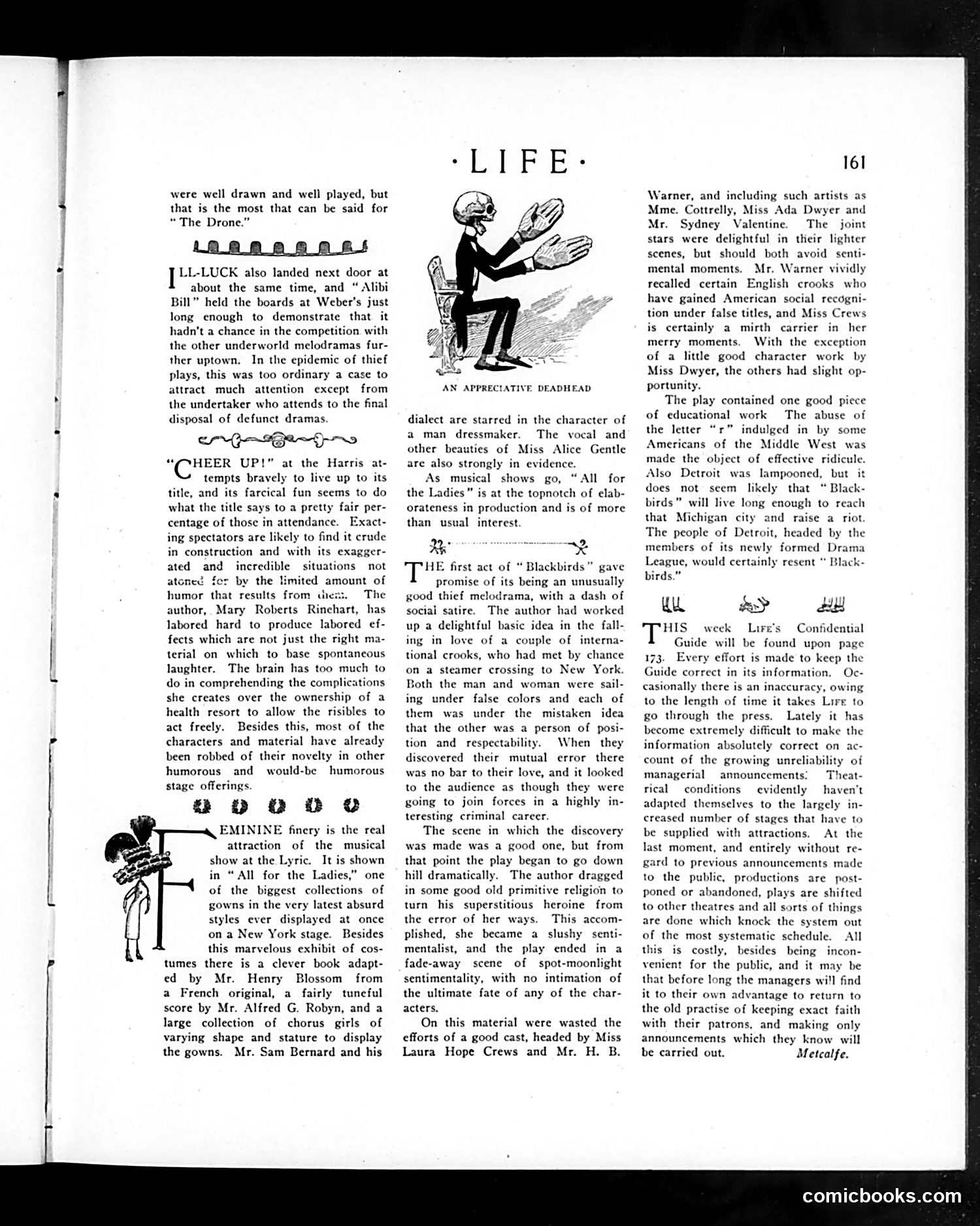
This page reviews several theatrical productions on Broadway. The main cartoon, titled "An Appreciative Deadhead," depicts a figure catching baseballs—a visual pun suggesting someone who attends theater without paying (a "deadhead" was slang for a freeloader getting complimentary admission). The text reviews plays including "The Drone," "Alibi Bill," "Cheer Up!," and "All for the Ladies." The critic dismisses most as derivative or poorly constructed, though praising elaborate costumes and performances. "Blackbirds" receives mixed assessment—praised for its opening premise about international crooks meeting under false pretenses, but criticized for deteriorating into sentimental religion and melodrama rather than exploring the criminal plot. The reviews exemplify early 20th-century theatrical criticism's focus on plot mechanics, star power, and production values, while the "deadhead" cartoon humorously comments on theater culture and free admission practices of that era.
📄 Transcribed text from this page (OCR, searchable)
Machine-transcribed from the original scan — historical spelling and the odd misread are preserved.
ro - — were well drawn and well played, but that is the most that can be said for “The Drone.” (AAO @ 9 A GS LL-LUCK also landed next door at about the same time, and “ Alibi Bill” held the boards at Weber's just long enough to demonstrate that it hadn't a chance in the competition with the other underworld melodramas fur- ther uptown. In the epidemic of thief plays, this was too ordinary a case to attract much attention except from the undertaker who attends to the final disposal of defunct dramas. * HEER UP!” at the Harris at- tempts bravely to live up to its title, and its farcical fun seems to do what the title says to a pretty fair per- centage of those in attendance. Exact- ing spectators are likely to find it crude in construction and with its exagger- ated and incredible situations not atoned fer by the limited amount of humor that results from c The author, Mary Roberts Rinchart, has labored hard to produce labored ef- fects which are not just the right ma- terial on which to base spontaneous laughter. The brain has too much to do in comprehending the complications she creates over the ownership of a health resort to allow the risibles to act freely. Besides this, most of the characters and material have already been robbed of their novelty in other humorous and would-be humorous stage offerings. ooo DBD eo MININE finery is the real attraction of the musical show at the Lyric. It is shown in “All for the Ladies,” one of the biggest collections of gowns in the very latest absurd styles ever displayed at once on a New York stage. Besides this marvelous exhibit of cos- tumes there is a clever book adapt- ed by Mr. Henry Blossom from a French original, a fairly tuneful score by Mr. Alfred G. Robyn, and a large collection of chorus girls of varying shape and stature to display the gowns. Mr. Sam Bernard and his AN APPRECIATIVE DEADHEAD dialect are starred in the character of a man dressmaker. The vocal and other beauties of Miss Alice Gentle are also strongly in evidence. As musical shows go, “All for the Ladies” is at the topnotch of elab- orateness in production and is of more than usual interest HE first act of “ Blackbirds” gave promise of its being an unusually good thief melodrama, with a dash of social satire. The author had worked up a delightful basic idea in the fall- ing in love of a couple of interna- tional crooks, who had met by chance on a steamer crossing to New York. 3oth the man and woman were sail- ing under false colors and each of them was under the mistaken idea that the other was a person of posi- tion and respectability. When they discovered their mutual error there was no bar to their love, and it looked to the audience as though they were going to join forces in a highly in- teresting criminal career. The scene in which the discovery was made was a good one, but from that point the play began to go down hill dramatically. The author dragged in some good old primitive religion to turn his superstitious heroine from the error of her ways. This accom- plished, she became a slushy sen mentalist, and the play ended in a fade-away scene of spot-moonlight sentimentality, with no intimation of the ultimate fate of any of the char- acters. On this material were wasted the efforts of a good cast, headed by Miss Laura Hope Crews and Mr. H. B. 161 Warner, and including such artists as Mme. Cottrelly, Miss Ada Dwyer and Mr. Sydney Valentine. The joint stars were delightful in their lighter scenes, but should both avoid senti- mental moments. Mr. Warner vividly recalled certain English crooks who have gained American social recogni- tion under false titles, and Miss Crews is certainly a mirth carrier in her merry moments. With the exception of a little good character work by Miss Dwyer, the others had slight op- portunity. The play contained one good piece of educational work The abuse of the letter “r” indulged in by some Americans of the Middle West was made the object of effective ridicule. Also Detroit was lampooned, but it does not seem likely that “ Black- birds” will live long enough to reach that Michigan city and raise a riot The people of Detroit, headed by the members of its newly formed Drama League, would certainly resent “ Black- birds.” rUs a HIS week Confidential Guide will be found upon page 173. Every effort is made to keep the Guide correct in its information. Oc- casionally there is an inaccuracy, owing to the length of time it takes Lire to go through the press. Lately it has become extremely difficult to make the information absolutely correct on 2 count of the growing unreliability of managerial announcements: Theat- rical_ conditions evidently haven't adapted themselves to the largely in- creased number of stages that have to be supplied with attractions. At the last moment, and entirely without re- gard to previous announcements made to the public, productions are post- poned or abandoned, plays are shifted to other theatres and all sorts of things are done which knock the system out of the most systematic schedule. All this is costly, besides being incon- venient for the public, and it may be that before long the managers wil!l find it to their own advantage to return to the old practise of keeping exact faith with their patrons, and making only announcements which they know will be carried out. Metcalfe. comicbooks.com