
Life, 1913-01-16 · page 24 of 40
Life — January 16, 1913 — page 24: what you’re looking at
What you’re looking at
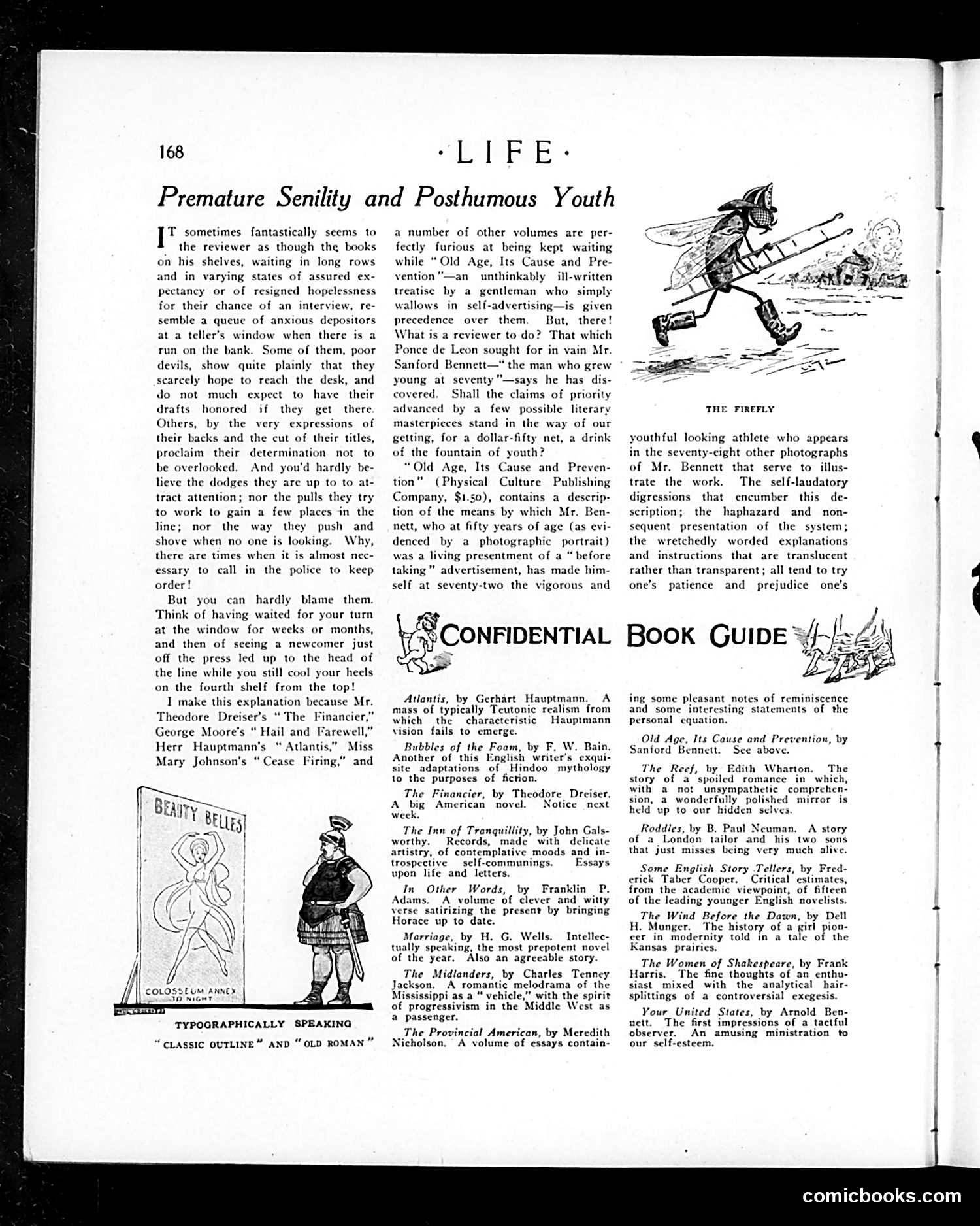
This book review column satirizes a self-help fad. The main target is Sanford Bennett's "Old Age, Its Cause and Prevention"—a vanity-published tract promising rejuvenation. Bennett claims he "grew young at seventy," supporting this with before-and-after photographs showing him as a vigorous athlete. The reviewer ridicules Bennett's shameless self-advertising and the book's prominence in publishing, despite its poor quality. The complaint: serious literary works by respected authors (Dreiser, Hauptmann, H.G. Wells) languish unread while Bennett's dubious "$1.50" fountain-of-youth manual gets priority attention. The satire mocks both Bennett's pseudoscientific claims and readers' gullibility for such promises. The small illustration shows "The Firefly"—likely a reference to rejuvenation's illusory appeal. This reflects early 20th-century anxieties about aging and the flourishing market for dubious anti-aging remedies.
📄 Transcribed text from this page (OCR, searchable)
Machine-transcribed from the original scan — historical spelling and the odd misread are preserved.
168 DRE Premature Senility and Posthumous Youth T sometimes fantastically seems to the reviewer as though the books on his shelves, waiting in long rows and in varying states of assured ex- pectancy or of resigned hopelessness for their chance of an interview, re- semble a queue of anxious depositors ata teller’s window when there is a run on the bank. Some of them, poor devils, show quite plainly that they scarcely hope to reach the desk, and do not much expect to have their drafts honored if they get there. Others, by the very expressions of their backs and the cut of their titles, proclaim their determination not to be overlooked. And you'd hardly be- lieve the dodges they are up to to at- tract attention; nor the pulls they try to work to gain a few places in the line; nor the way they push and shove when no one is looking. Why, there are times when it is almost nec- essary to call in the police to keep order! But you can hardly blame them. Think of having waited for your turn at the window for weeks or months, and then of seeing a newcomer just off the press led up to the head of the line while you still cool your heels on the fourth shelf from the top! I make this explanation because Mr. Theodore Dreiser's “ The Financier, George Moore's “ Hail and Farewell, Herr Hauptmann’s “ Atlantis,” Miss Mary Johnson's “Cease Firing,” and COLOSsE UM ANNE 30 MiGnT TYPOGRAPHICALLY SPEAKING “CLASSIC OUTLINE” AND “OLD ROMAN a number of other volumes are per- fectly furious at being kept waiting while “Old Age, Its Cause and Pre- vention ””—an unthinkably _ ill-written treatise by a gentleman who simply wallows in self-advertising—is given precedence over them. But, there! What is a reviewer to do? That which Ponce de Leon sought for in vain Mr. Sanford Bennett—* the man who grew young at seventy "—says he has dis- covered. Shall the claims of priority advanced by a few possible literary masterpieces stand in the way of our getting, for a dollar-fifty net, a drink of the fountain of youth? “Old Age, Its Cause and Preven- tion” (Physical Culture Publishing Company, $1.30), contains a descrip- tion of the means by which Mr. Ben- nett, who at fifty years of age (as evi- denced by a photographic portrait) was a living presentment of a “ before taking” advertisement, has made him- self at seventy-two the vigorous and > CONFIDENTIAL Atlantis, by Gerhart Hauptmann. A mass of typically Teutonic realism from which the characteristic Hauptmann vision fails to emerge. Bubbles of the Foam, by F. V Another of this English write site adaptations of Hindoo mythology to the purposes of fiction. The Financier, by Theodore Dreiser. A big American novel. “Notice next 'y, by John Gals- worthy. with delicate artistry, of contemplative moods and in- trospective self-communings. Essays upon life and letters. In Other Words, by Franklin P. Adams. A volume of clever and witty verse satirizing the present by bringing Horace up to date. Marriage, by H. G. Wells. Intellec- tually speaking, the most prepotent novel of the year. Also an agreeable story. The Midlanders, by Charles Tenney Jackson. A romantic melodrama of the Mississippi as a “ vehicle,” with the spirit of progressivism in the Middle West as a passenger. The Provincial American, by Meredith icholson. A volume of essays contain- THE FIREFLY youthful looking athlete who appears in the seventy-eight other photographs of Mr. Bennett that serve to illus- trate the work. The self-laudatory digressions that encumber this de- scription; the haphazard and non- sequent presentation of the system; the wretchedly worded explanations and instructions that are translucent rather than transparent; all tend to try one’s patience and prejudice one’s ing some pleasant notes of reminiscence and some interesting statements of the personal equation. Old Age, Its Cause and Prevention, by Sanford Bennett. See above. The Reef, by Edith Wharton. The story of a ‘spoiled romance in which, with a not unsympathetic comprehen- sion, a wonderfully. polished mirror is held’ up to our hidden selves. Roddles, by B. Paul Neuman. A story of a London tailor and his two sons that just misses being very much alive. Some English Story Tellers, by Fred- erick Taber Cooper. | Critical’ estimat from the academic viewpoint, of fifteen of the leading younger English nove The Wind Before the Dawn, by Dell H. Munger. The history of a girl pion- <r in modernity told in a tale of the Kansas prairies. The Women of Shakespeare, by Frank Harris. The fine thoughts of an enthu- siast_ mixed with the analytical hair- splittings of a controversial exegesis. Your United States, by Arnold Ben- nett. The first impressions of a tactful observer. An amusing ministration to our self-esteem. comicbooks.com