
Life, 1913-01-16 · page 18 of 40
Life — January 16, 1913 — page 18: what you’re looking at
What you’re looking at
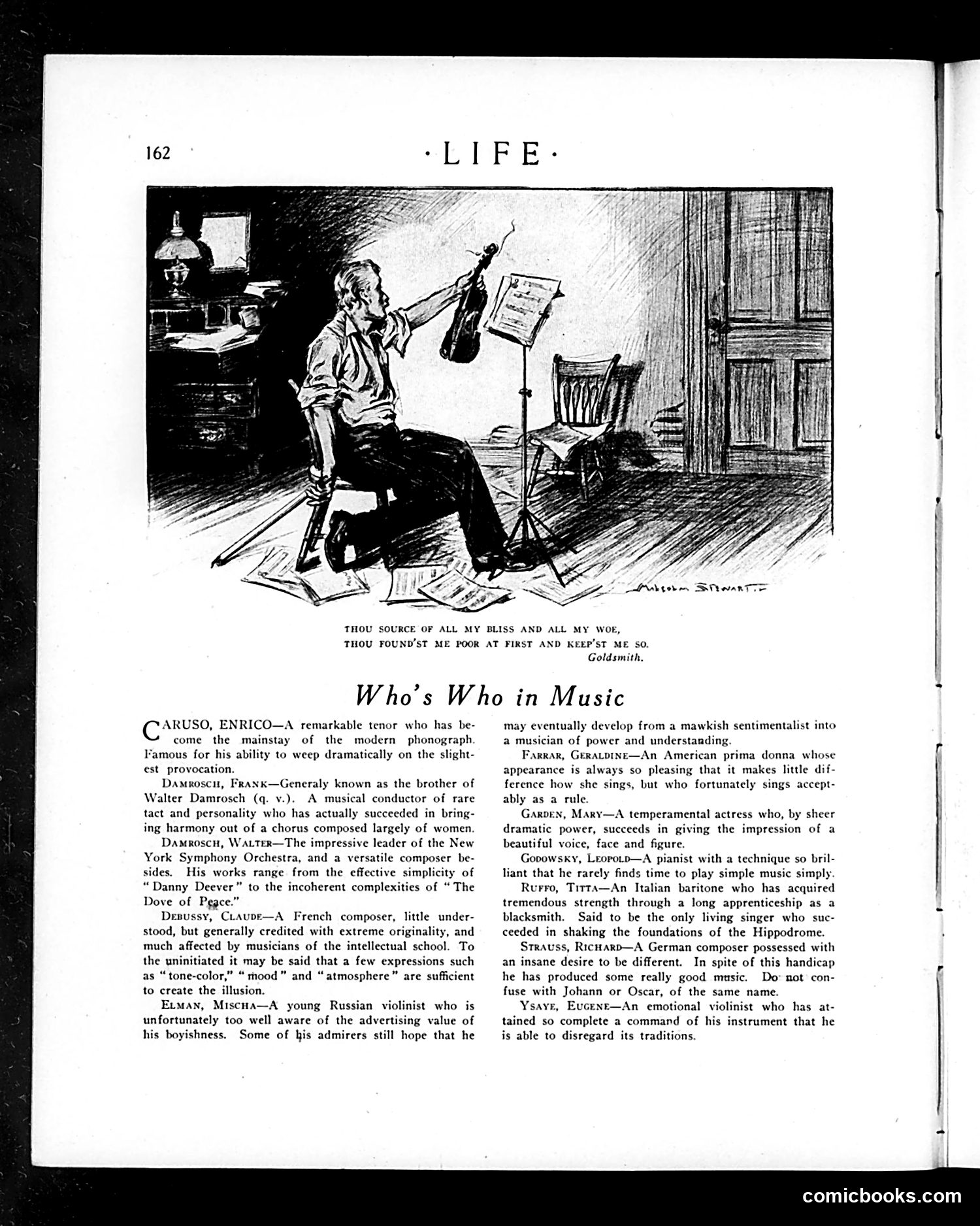
This page presents satirical biographical sketches of famous early 20th-century musicians. The cartoon above shows a struggling composer at work—likely illustrating the Goldsmith epigraph about poverty in artistic pursuit. The text mocks prominent musicians through exaggerated, backhanded compliments. Caruso is famous mainly for phonograph recordings and crying on cue. The Damrosch brothers receive praise tinged with condescension. Debussy is portrayed as incomprehensible, understood only through pretentious jargon like "tone-color." Elman, a young violinist, is criticized for exploiting his boyish appeal rather than developing serious musicianship. Farrar's appearance matters more than her singing ability. Richard Strauss is ridiculed for obsessing over originality at music's expense. The satire targets both the musicians themselves and the culture surrounding them—emphasizing vanity, commercialism, affectation, and the gap between reputation and actual merit in the musical establishment of the era.
📄 Transcribed text from this page (OCR, searchable)
Machine-transcribed from the original scan — historical spelling and the odd misread are preserved.
THOU SOURCE OF ALL MY BLISS AND ALL MY WOE, THOU FOUND’ST ME POOR AT FIRST AND KEEP’ST ME SO. Goldsmith, Who’s Who in Music ARUSO, ENRICO—A remarkable tenor who has be- come the mainstay of the modern phonograph. Famous for his ability to weep dramatically on the slight- est provocation. Damroscu, Frank—Generaly known as the brother of Walter Damrosch (q. v.). A musical conductor of rare tact and personality who has actually succeeded in bring- ing harmony out of a chorus composed largely of women. Damroscu, Watter—The impressive leader of the New York Symphony Orchestra, and a versatile composer be- sides. His works range from the effective simplicity of “Danny Deever” to the incoherent complexities of “ The Dove of Peace.” Desussy, CLaupe—A French composer, little under- stood, but generally credited with extreme originality, and much affected by musicians of the intellectual school. To the uninitiated it may be said that a few expressions such as “tone-color,” “mood” and “atmosphere” are sufficient to create the illusion. Etman, Miscua—A young Russian violinist who is unfortunately too well aware of the advertising value of his boyishness. Some of his admirers still hope that he may eventually develop from a mawkish sentimentalist into a musician of power and understanding. Farrar, Geracptne—An American prima donna whose appearance is always so pleasing that it makes little dif- ference how she sings, but who fortunately sings accept- ably as a rule. Garven, Mary—A temperamental actress who, by sheer dramatic power, succeeds in giving the impression of a beautiful voice, face and figure. Govowsky, Leorotp—A pianist with a technique so bril- liant that he rarely finds time to play simple music simply. Rurro, Titta—An Italian baritone who has acquired tremendous strength through a long apprenticeship as a blacksmith. Said to be the only living singer who suc- ceeded in shaking the foundations of the Hippodrome. Strauss, Ricuarp—A German composer possessed with an insane desire to be different. In spite of this handicap he has produced some really good music. Do not con- fuse with Johann or Oscar, of the same name. Ysaye, Eucene—An emotional violinist who has at- tained so complete a command of his instrument that he is able to disregard its traditions. comicbooks.com