
Life, 1913-01-16 · page 14 of 40
Life — January 16, 1913 — page 14: what you’re looking at
What you’re looking at
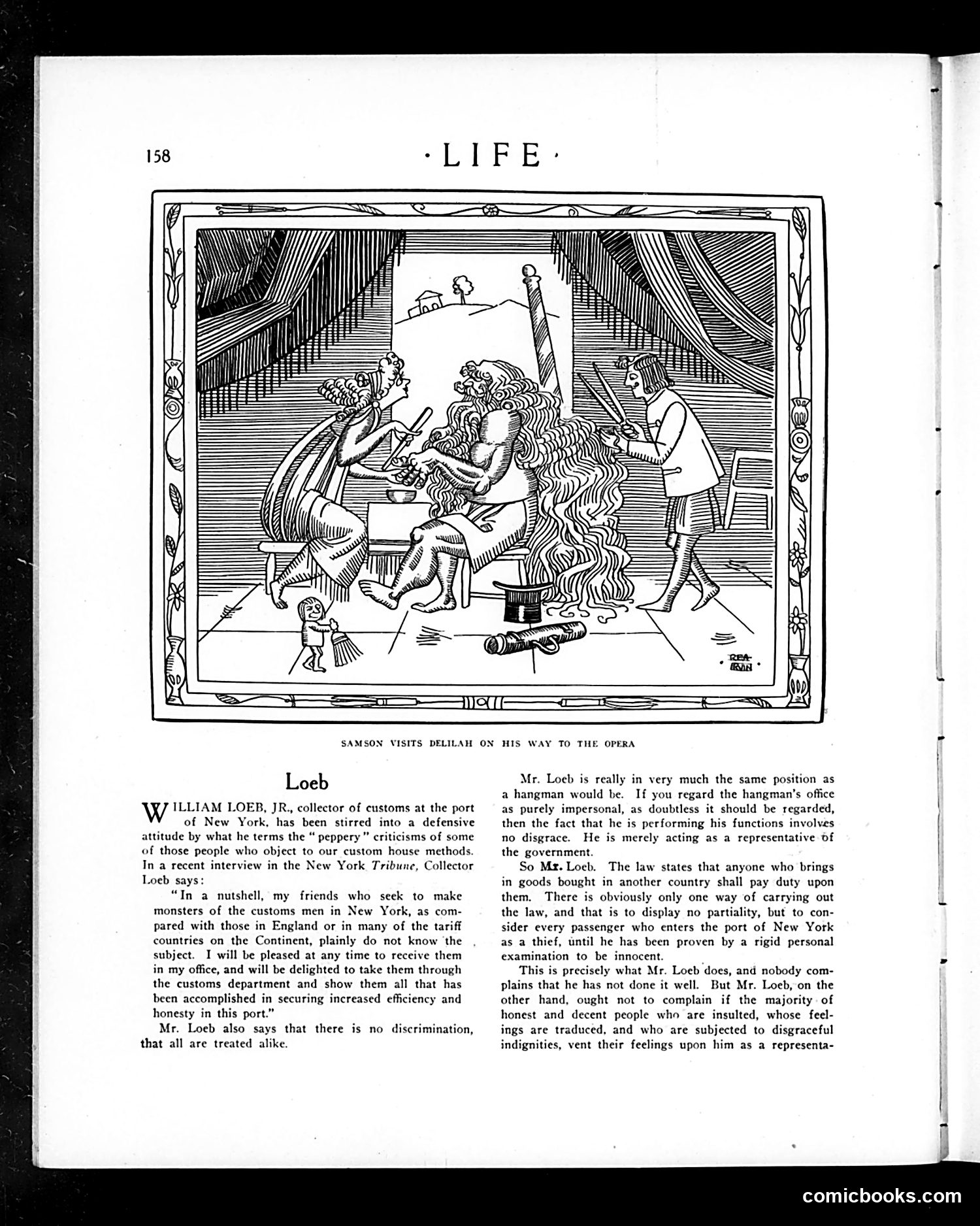
The cartoon illustrates "Samson Visits Delilah on His Way to the Opera," depicting the biblical story of Samson and Delilah in a modern setting. The accompanying article about William Loeb, collector of customs at the Port of New York, uses this biblical reference satirically. The cartoon shows Samson (with long hair) being attended to by Delilah and servants in an interior space, with opera-goers visible in the background. The satire appears to be comparing Loeb's position to Samson's—both potentially compromised by those around them. The text suggests Loeb faces criticism for his customs enforcement methods, with detractors viewing him as either complicit with smugglers or overzealous with honest travelers. The biblical parallel implies vulnerability to betrayal or moral compromise in his role.
📄 Transcribed text from this page (OCR, searchable)
Machine-transcribed from the original scan — historical spelling and the odd misread are preserved.
a SS Wi 1 SAMSON VISITS DELILAH ON HIS WAY TO THE OPERA Loeb ILLIAM LOEB, JR., collector of customs at the port of New York, has been stirred into a defensive attitude by what he terms the “ peppery” criticisms of some of those people who object to our custom house methods. In a recent interview in the New York Tribune, Collector Loeb says: “In a nutshell, my friends who seek to make monsters of the customs men in New York, as com- pared with those in England or in many of the tariff countries on the Continent, plainly do not know ‘the subject. I will be pleased at any time to receive them in my office, and will be delighted to take them through the customs department and show them all that has been accomplished in securing increased efficiency and honesty in this port.” Mr. Loeb also says that there is no discrimination, that all are treated alike. Mr. Loeb is really in very much the same position as a hangman would be. If you regard the hangman's office as purely impersonal, as doubtless it should be regarded, then the fact that he is performing his functions involves no disgrace. He is merely acting as a representative of the government. So Mx. Loeb. The law states that anyone who brings in goods bought in another country shall pay duty upon them. There is obviously only one way of carrying out the law, and that is to display no partiality, but to con- sider every passenger who enters the port of New York as a thief, until he has been proven by a rigid personal examination to be innocent. This is precisely what Mr. Loeb does, and nobody com- plains that he has not done it well. But Mr. Loeb, on the other hand, ought not to complain if the majority. of honest and decent people who are insulted, whose feel- ings are traduced, and who are subjected to disgraceful indignities, vent their feelings upon him as a representa- comicbooks.com