
Life, 1913-01-16 · page 15 of 40
Life — January 16, 1913 — page 15: what you’re looking at
What you’re looking at
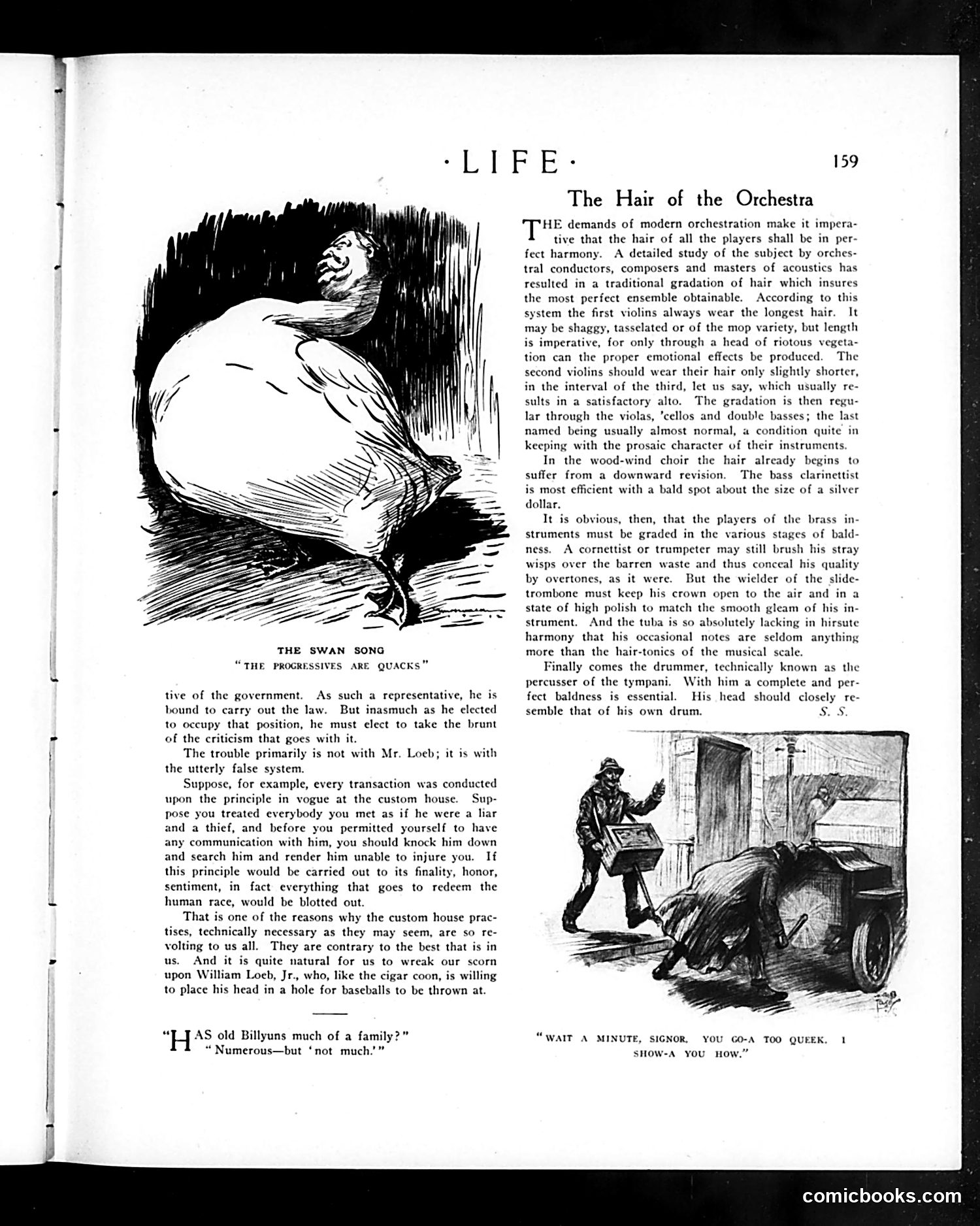
This page contains two distinct pieces. The upper section discusses William Loeb Jr. and Progressive Party criticism (likely referencing early 1900s politics), but the main satirical content is "The Hair of the Orchestra." The humor mocks pseudo-scientific pretension in music criticism. The article absurdly argues that orchestral harmony depends on players' hair length—first violins needing longest hair, second violins slightly shorter, progressing to completely bald tuba and timpani players whose "baldness is essential." The accompanying illustration shows a conductor instructing an Italian musician (suggested by "Signor" and dialect), presumably about these ridiculous hair requirements. The satire targets overblown musical theory and the absurd pseudo-logic used to justify arbitrary rules. It's a jab at conductors and critics who invented elaborate justifications for their preferences, treating subjective aesthetic choices as scientific necessities.
📄 Transcribed text from this page (OCR, searchable)
Machine-transcribed from the original scan — historical spelling and the odd misread are preserved.
‘LIFE: 159 THE SWAN SONG “THE PROGRESSIVES ARE QUACKS” tive of the government. As such a representative, he is Lound to carry out the law. But inasmuch as he elected to occupy that position, he must elect to take the brunt of the criticism that goes with it. The trouble primarily is not with Mr. Loeb; it is with the utterly false system. Suppose, for example, every transaction was conducted upon the principle in vogue at the custom house. Sup- pose you treated everybody you met as if he were a liar and a thief, and before you permitted yourself to have any communication with him, you should knock him down and search him and render him unable to injure you. If this principle would be carried out to its finality, honor, sentiment, in fact everything that goes to redeem the human race, would be blotted out. That is one of the reasons why the custom house prac- tises, technically necessary as they may seem, are so re- volting to us all. They are contrary to the best that is in us. And it is quite natural for us to wreak our scorn upon William Loeb, Jr., who, like the cigar coon, is willing to place his head in a hole for baseballs to be thrown at. “ AS old Billyuns much of a family?” “Numerous—but ‘not much.” The Hair of the Orchestra HE demands of modern orchestration make it impera- tive that the hair of all the players shall be in per- fect harmony. A detailed study of the subject by orches- tral conductors, composers and masters of acoustics has resulted in a traditional gradation of hair which insures the most perfect ensemble obtainable. According to this tem the first violins always wear the longest hair. It may be shaggy, tasselated or of the mop variety, but length is imperative, for only through a head of riotous vegeta- tion can the proper emotional effects be produced. The second violins should w their hair only slightly shorter, in the interval of the third, let us say, which usually re- sults in a satisfactory alto. The gradation is then regu- lar through the violas, ’cellos and double basses; the last named being usually almost normal, condition quite in keeping with the prosaic character of their instruments. In the wood-wind choir the hair already begins to suffer from a downward revision. The bass clarinettist is most efficient with a bald spot about the size of a silver dollar, It is obvious, then, that the players of the brass in- struments must be graded in the various stages of bald- ness. A cornettist or trumpeter may still brush his stray wisps over the barren waste and thus conceal his quality by overtones, as it were. But the wielder of the slide- trombone must keep his crown open to the air and in a state of high polish to match the smooth gleam of his in- strument. And the tuba is so absolutely lacking in hirsute harmony that his occasional notes are seldom anything more than the hair-tonics of the musical scale. Finally comes the drummer, technically known as the percusser of the tympani. With him a complete and per- fect baldness is essential. His head should closely re- semble that of his own drum. Ss. S “WAIT A MINUTE, SIGNOR, YOU GO-A TOO QUEE SHOW-A you How. comicbooks.com