
Life, 1913-01-16 · page 12 of 40
Life — January 16, 1913 — page 12: what you’re looking at
What you’re looking at
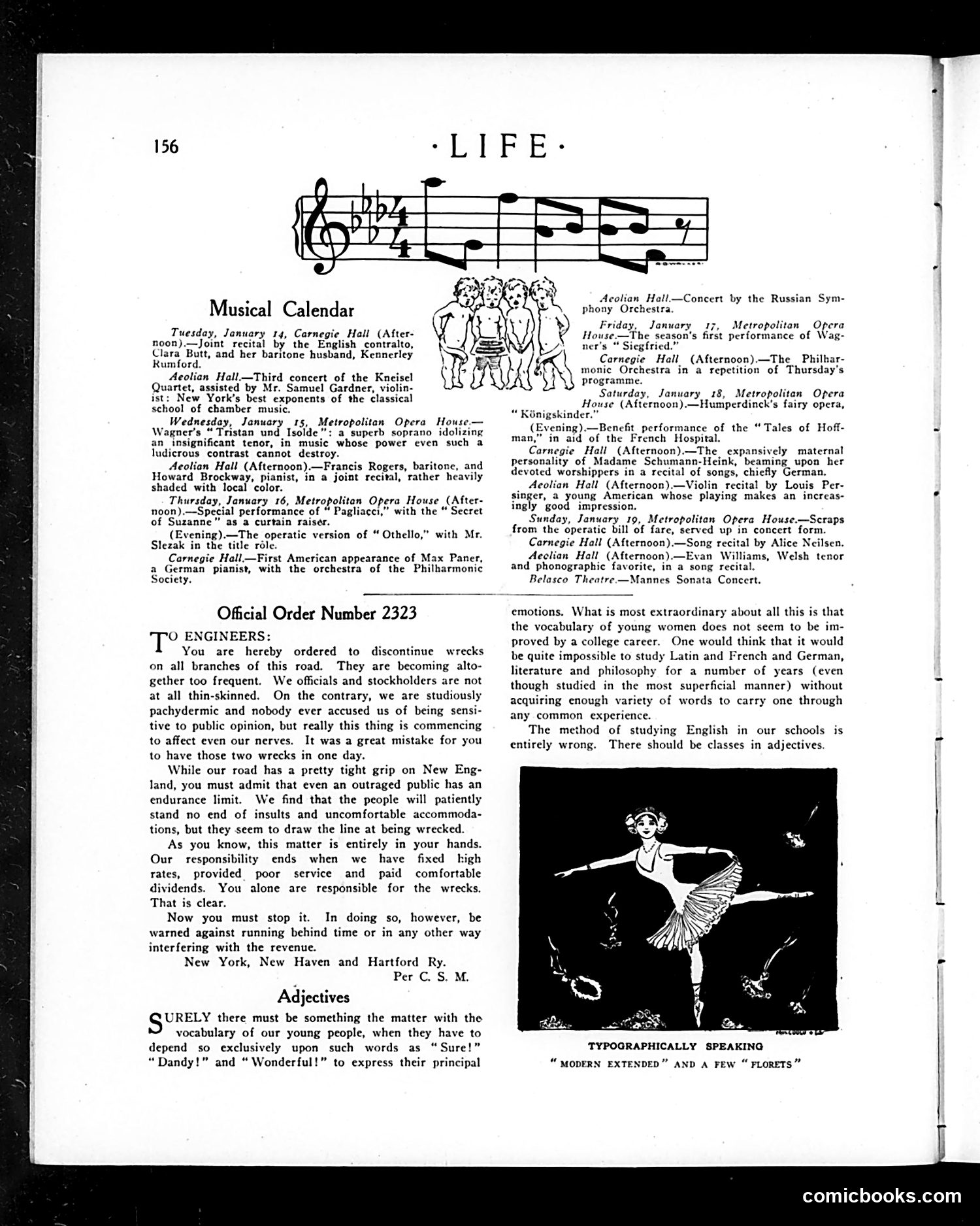
This page contains a musical calendar of concert events, an official order about railway service, and a discussion of English language education. The cartoon at bottom right shows a female ballet dancer in an extended arabesque pose. The caption reads "TYPOGRAPHICALLY SPEAKING" with a subtitle noting "'MODERN EXTENDED' AND A FEW 'FLORETS.'" The satire appears to be a visual pun: the dancer's extended leg position resembles typographical elements or characters. The joke plays on the term "extended" (both a ballet position and a typographical concept) to create a witty comparison between bodily movement and printed text. This reflects early 20th-century amusement with linguistic and visual wordplay.
📄 Transcribed text from this page (OCR, searchable)
Machine-transcribed from the original scan — historical spelling and the odd misread are preserved.
a Ly iDhy% [ Pen IVE TT CQ ypy | DO el Musical Calendar Tuesday, January 14, Carnegie Hall (After- noon).—Joint recital by the English contralto, Clara Butt, and her baritone husband, Kennerley Rumford. Aeolian Hall—Third concert of the Kneisel Quartet, assisted by Mr. Samuel Gardner, violin- ist: New York’s best exponents of the classical school of chamber music. Wednesday, January 15, Metropolitan Opera House— Wagner's “Tristan und Isolde”: a superb soprano idolizing an insignificant tenor, in music whose power even such a ludicrous contrast cannot destroy. Aeolian Hall (Afternoon).—Francis Rogers, baritone, and Howard Brockway, pianist, in a joint recital, rather heavily shaded with local color. Thursday, January 16, Metropolitan Opera House (After- noon).—Special performance of “ Pagliacci,” with the “ Secret of Suzanne” as a curtain raiser. (Evening).—The operatic version of “ Othello,” with Mr. Slezak in the title rdle. Carnegie Hall_—First American appearance of Max Paner, a German pianist, with the orchestra of the Philharmonic Society. Aeolian Hall—Concert by the Russian Sym- phony Orchestra. Friday, January 17, Metropolitan Opera House.—The season's first performance of Wag- net's “ Siegfried.” Carnegie Hall (Afternoon).—The _ Philhar- monic Orchestra in a repetition of Thursday's Programme. Saturday, January 18, Metropolitan Opera House (Afternoon).—Humperdinck’s fairy opera, “ Konigskinder.” (Evening).—Benefit_ performance of the “Tales of Hoff- man,” in aid of the French Hospital. Carnegie Hall (Afternoon).—The_ expansively maternal personality of Madame Schumann-Heink, beaming upon her devoted worshippers in a recital of songs, chiefly German. _ Aeolian Hall (Afternoon).—Violin recital by Louis Per- singer, a young American whose playing makes an increas- ingly ‘good impression. Sunday, January 19, Metropolitan Opera House.—Scraps from the operatic bill of fare, served up in concert form. Carnegie Hall (Afternoon).—Song recital by Alice Neilsen. Aeolian Hall (Afternoon).—Evan Williams, Welsh tenor and phonographie favorite, in a song recital. Belasco Theatre.—Mannes Sonata Concert. Official Order Number 2323 ‘0 ENGINEERS: You are hereby ordered to discontinue wrecks on all branches of this road. They are becoming alto- gether too frequent. We officials and stockholders are not at all thin-skinned. On the contrary, we are studiously pachydermic and nobody ever accused us of being sensi- tive to public opinion, but really this thing is commencing to affect even our nerves. It was a great mistake for you to have those two wrecks in one day. While our road has a pretty tight grip on New Eng- land, you must admit that even an outraged public has an endurance limit. We find that the people will patiently stand no end of insults and uncomfortable accommoda- tions, but they seem to draw the line at being wrecked. As you know, this matter is entirely in your hands. Our responsibility ends when we have fixed high rates, provided poor service and paid comfortable dividends. You alone are responsible for the wrecks. That is clear. Now you must stop it. In doing so, however, be warned against running behind time or in any other way interfering with the revenue. New York, New Haven and Hartford Ry. Per C. S. M. Adjectives URELY there must be something the matter with the vocabulary of our young people, when they have to depend so exclusively upon such words as “Sure!” “Dandy!” and “ Wonderful!” to express their principal emotions. What is most extraordinary about all this is that the vocabulary of young women does not seem to be im- proved by a college career. One would think that it would be quite impossible to study Latin and French and German, literature and philosophy for a number of years (even though studied in the most superficial manner) without acquiring enough variety of words to carry one through any common experience. The method of studying English in our schools is entirely wrong. There should be classes in adjectives. TYPOGRAPHICALLY SPEAKING “ MODERN EXTENDED” AND A FEW “ FLORETS” comicbooks.com