
Life, 1913-01-16 · page 8 of 40
Life — January 16, 1913 — page 8: what you’re looking at
What you’re looking at
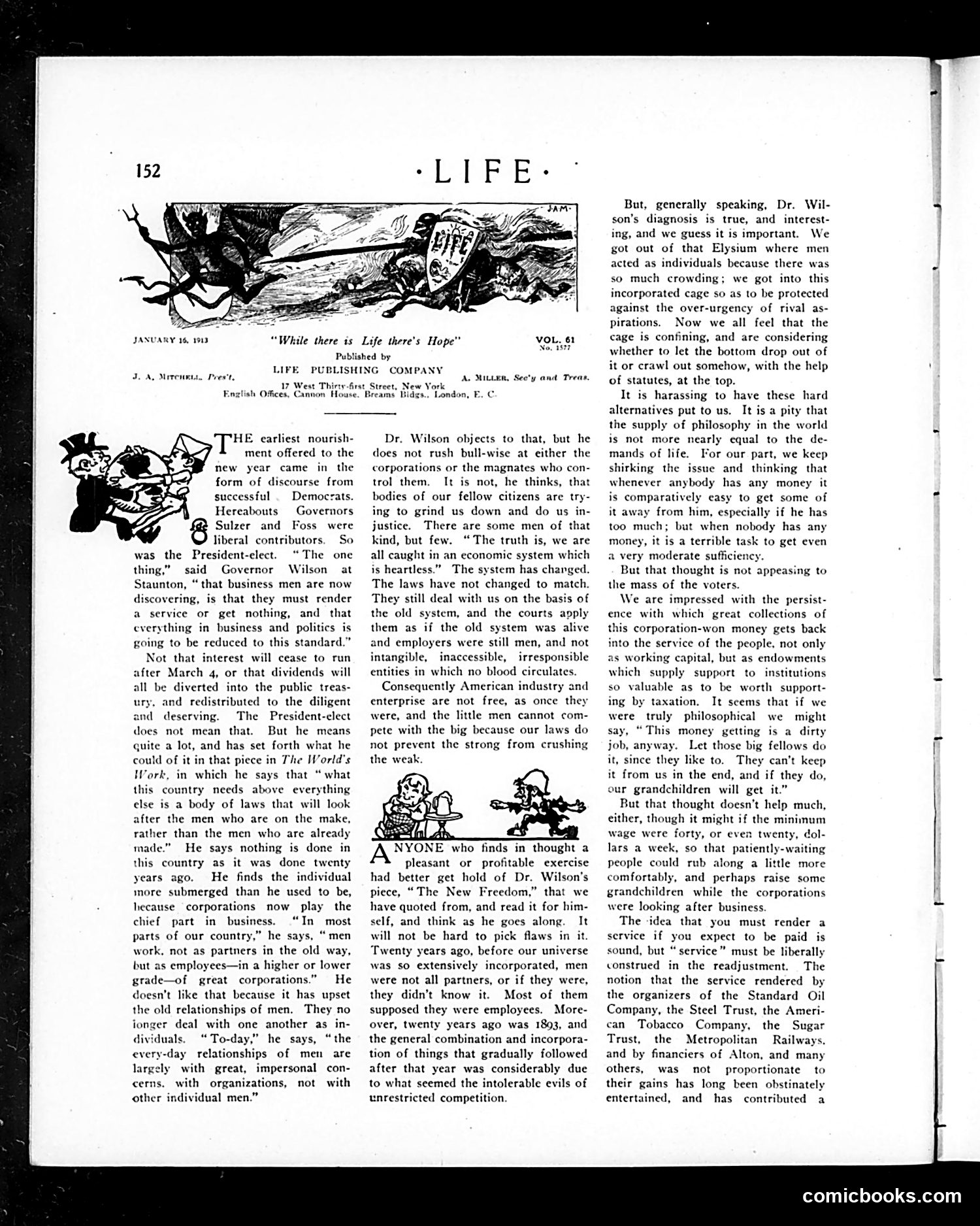
This page contains editorial commentary rather than political cartoons. The main illustration shows what appears to be a caricatured figure in distress or constraint, labeled "While there is Life there's Hope." The text discusses Dr. Wilson's (likely President Woodrow Wilson) economic philosophy, criticizing his objections to corporate consolidation. The article argues that large corporations have become necessary in modern business, contrasting Wilson's idealistic views with practical economic reality. The piece satirizes Wilson's resistance to "big business," suggesting his antitrust philosophy is naive. It defends corporate mergers and consolidation as inevitable progress, mocking the tension between the President's regulatory ideals and actual industrial practice in early 20th-century America.
📄 Transcribed text from this page (OCR, searchable)
Machine-transcribed from the original scan — historical spelling and the odd misread are preserved.
JANUARY 16, 1913 “While there is Life there's Hope" Published by LIFE 17 West Thi English Offices, Cannon House J. A, Mirren PUBLISHID first Street, NG COMPAN A. MILLER, See'y and Treas, New York Breams Didgs., London, FE. C HE earliest nourish- ment offered to the new year came in the form of discourse from successful . Democrats. Hereabouts Governors 8 Sulzer and Foss were liberal contributors. So was the President-elect. “The one thing,” said Governor Wilson at Staunton, “that business men are now discovering, is that they must render a service or get nothing, and that everything in business and politics is going to be reduced to this standard.” Not that interest will cease to run after March 4, or that dividends will all be diverted into the public treas- ury, and redistributed to the diligent and deserving. The President-elect does not mean that. But he means quite a lot, and has set forth what he could of it in that piece in The World's Work, in which he says that “what this country needs above everything else is a body of laws that will look after the men who are on the make, rather than the men who are already made.” He says nothing is done in is country as it was done twenty years ago. He finds the individual more submerged than he used to be, lhecause corporations now play the chief part in business. “In most parts of our country,” he says, “men work, not as partners in the old way, but as employees—in a higher or lower grade—of great corporations.” He doesn’t like that because it has upset the old relationships of men. They no ionger deal with one another as in- dividuals. “To-day,” he says, “the every-day relationships of men are largely with great, impersonal con- with organizations, not with cerns, other individual men.” Dr. Wilson objects to that, but he does not rush bull-wise at either the corporations or the magnates who con- trol them. It is not, he thinks, that bodies of our fellow citizens are try- ing to grind us down and do us in- justice. There are some men of that kind, but few. “The truth is, we are all caught in an economic system which is heartless.” The system has changed. The laws have not changed to match. They still deal with us on the basis of the old system, and the courts apply them as if the old system was alive and employers were still men, and not intangible, inaccessible, irresponsible entities in which no blood circulates. Consequently American industry and enterprise are not free, as once they were, and the little men cannot com- pete with the big because our laws do not prevent the strong from crushing the weak. pleasant or profitable exercise had better get hold of Dr. Wilson's piece, “The New Freedom,” that we have quoted from, and read it for him- If, and think as he goes along. It will not be hard to pick flaws in it. Twenty years ago, before our universe was so extensively incorporated, men were not all partners, or if they were, they didn’t know it. Most of them supposed they were employees. More- over, twenty years ago was 1893, and the general combination and incorpora- tion of things that gradually followed after that year was considerably due to what seemed the intolerable evils of unrestricted competition. But, generally speaking, Dr. Wil- son's diagnosis is true, and interest- ing, and we guess it is important. We got out of that Elysium where men acted as individuals because there was so much crowding; we got into this incorporated cage so as to be protected against the over-urgency of rival as- pirations. Now we all feel that the cage is confining, and are considering whether to let the bottom drop out of it or crawl out somehow, with the help of statutes, at the top. It is harassing to have these hard alternatives put to us. It is a pity that the supply of philosophy in the world is not more nearly equal to the de- mands of life. For our part, we keep shirking the issue and thinking that whenever anybody has any money it is comparatively easy to get some of it away from him, especially if he has too much; but when nobody has any money, it is a terrible task to get even a very moderate sufficiency. But that thought is not appeasing to the mass of the voters. We are impressed with the persist- ence with which great collections of this corporation-won money gets back into the service of the people, not only as working capital, but as endowments. which supply support to institutions uable as to be worth support- ing by taxation. It scems that if we were truly philosophical we might say, “This money getting is a dirty job, anyway. Let those big fellows do it, since they like to. They can’t keep it from us in the end, and if they do, our grandchildren will get it.” But that thought doesn’t help much, either, though it might if the minimum wage were forty, or even twenty, dol- lars a week, so that patiently-waiting people could rub along a little more comfortably, and perhaps raise some grandchildren while the corporations were looking after business. The ‘idea that you must render a service if you expect to be paid is sound, but “service” must be liberally construed in the readjustment. The notion that the service rendered by the organizers of the Standard Oil Company, the Steel Trust, the Ameri- can Tobacco Company, the Sugar Trust, the Metropolitan Railways. and by financiers of Alton, and many others, was not proportionate to their gains has long been obstinately entertained, and has contributed a so comicbooks.com