
Life, 1913-01-16 · page 27 of 40
Life — January 16, 1913 — page 27: what you’re looking at
What you’re looking at
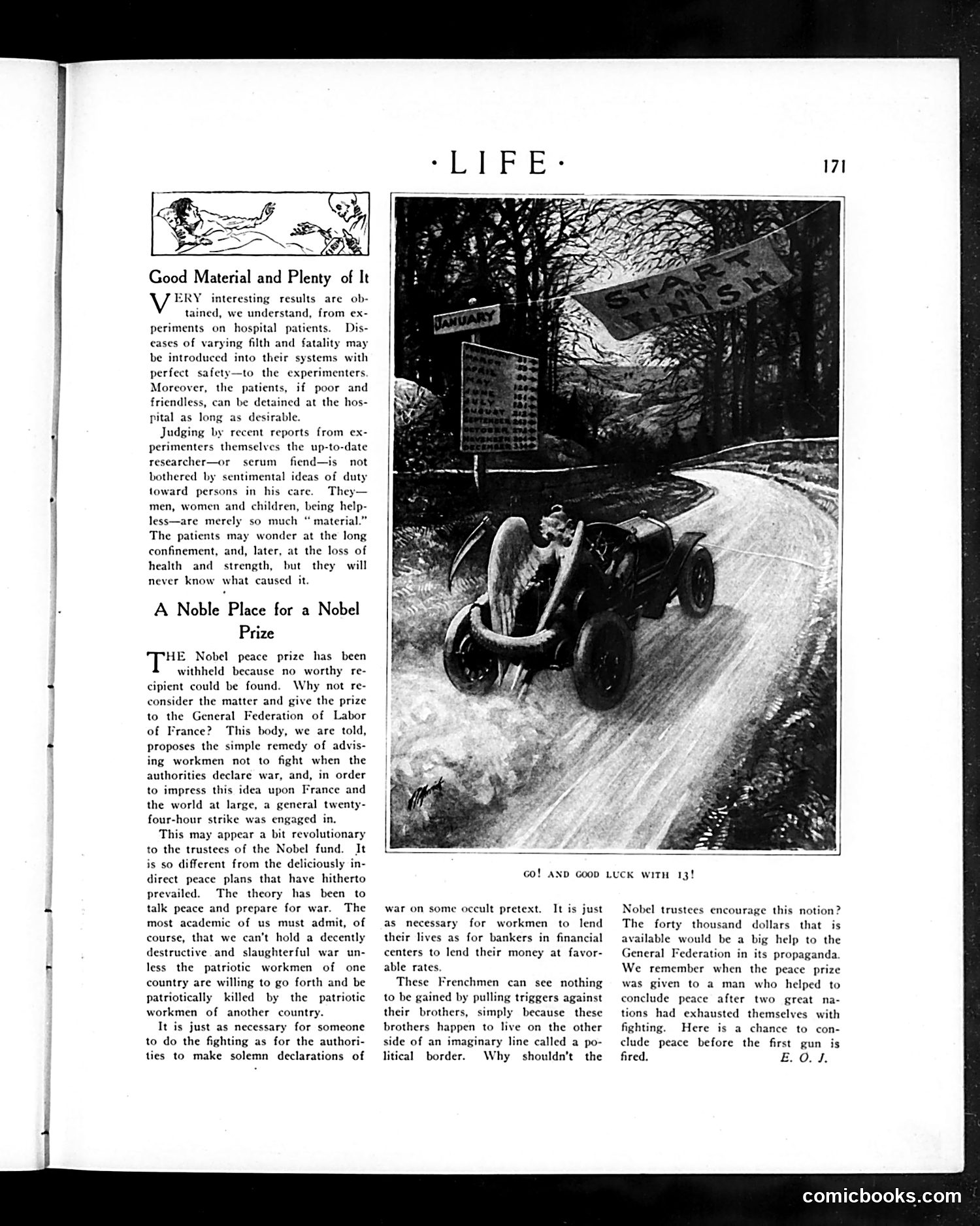
This page contains two separate satirical pieces criticizing institutional exploitation and war: **"Good Material and Plenty of It"** attacks unethical medical experimentation. It sarcastically praises researchers who test diseases on poor, institutionalized hospital patients—people with no legal protection or advocates. The dark humor emphasizes that vulnerable populations ("helpless") are treated as expendable "material" for science, with victims never knowing what harmed them. **"A Noble Place for a Nobel Prize"** mocks both war and peace-prize hypocrisy. It ironically proposes awarding the Nobel Peace Prize to France's Labor Federation for advocating worker non-cooperation with war declarations. The author argues this is actually more logical than previous prizes—preventing war is superior to negotiating peace *after* nations exhaust themselves killing workers. The satire critiques how governments declare wars while workmen do the dying, while bankers safely profit. Both pieces expose how institutions exploit the powerless (patients, laborers) for others' benefit.
📄 Transcribed text from this page (OCR, searchable)
Machine-transcribed from the original scan — historical spelling and the odd misread are preserved.
Good Material and Plenty of It ERY interesting results are ob- tained, we understand, from ex- periments on hospital patients. Dis- eases of varying filth and fatality may be introduced into their systems with perfect safety—to the experimenters Moreover, the patients, if poor and friendless, can be detained at the hos- pital as long as desirable. Judging by recent reports from ex- perimenters themselves the up-to-date researcher—or serum fiend—is not bothered by sentimental ideas of duty toward persons in his care. They— men, women and children, being help- less—are merely so much “ material.” The patients may wonder at the long confinement, and, later, at the loss of health and strength, but they will never know what caused it. A Noble Place for a Nobel Prize HE Nobel peace prize has been withheld because no worthy re- cipient could be found. Why not re- consider the matter and give the prize to the General Federation of Labor of France? This body, we are told, proposes the simple remedy of advis- ing workmen not to fight when the authorities declare war, and, in order to impress this idea upon France and the world at large, a general twenty- four-hour strike engaged in. This may appear a bit revolutionary to the trustees of the Nobel fund. It is so different from the deliciously in- direct peace plans that have hitherto prevailed. The theory has been to talk peace and prepare for war. The most academic of us must admit, of course, that we can’t hold a decently destructive and slaughterful war un- less the patriotic workmen of one country are willing to go forth and be patriotically killed by the patriotic workmen of another country. It is just as necessary for someone to do the fighting as for the authori- ties to make solemn declarations of co! AND Goop LUCK witH 13! war on some occult pretext. It is just as necessary for workmen to lend their lives as for bankers in financial centers to lend their money at favor- able rates. These Frenchmen can see nothing to be gained by pulling triggers against their brothers, simply because these brothers happen to live on the other side of an imaginary line called a po- litical border. Why shouldn't the Nobel trustees encourage this notion? The forty thousand dollars that is available would be a big help to the General Federation in its propaganda We remember when the peace prize was given to a man who helped to conclude peace after two great na- tions had exhausted themselves with fighting. Here is a chance to con- clude peace before the first gun is fired. E. 0. J. comicbooks.com