
Life, 1913-01-16 · page 16 of 40
Life — January 16, 1913 — page 16: what you’re looking at
What you’re looking at
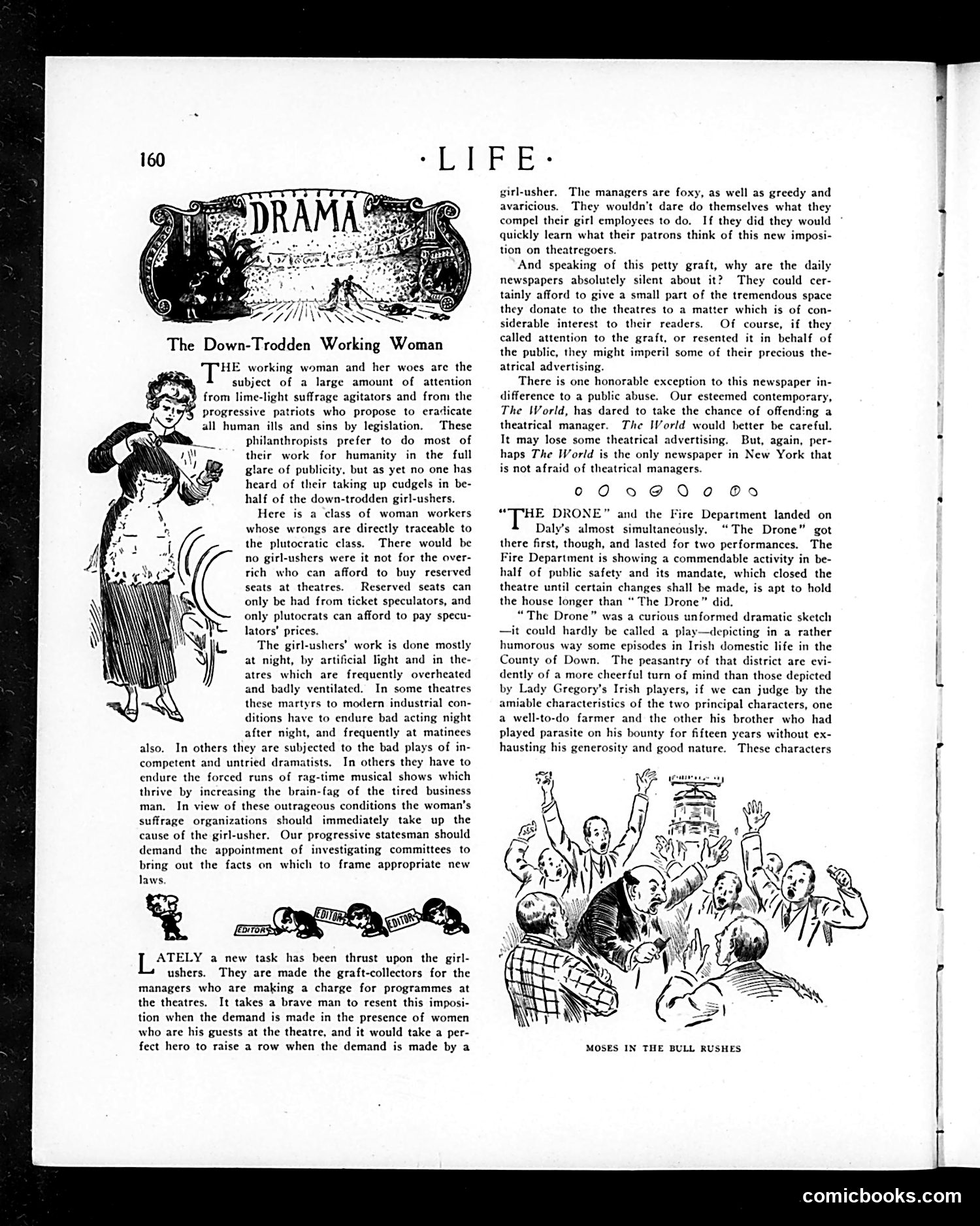
This satirical piece mocks progressive reformers and suffragists for ignoring theatre girl-ushers' genuine hardships while grandstanding about broader social issues. The author catalogs real problems: night work under artificial lights in overheated theatres, exposure to bad plays and acting, and newly imposed "graft"—forced programme sales that exploit the women's vulnerable position in front of male theatre patrons. The satire targets newspapers' complicity: they advertise theatres extensively yet refuse to expose this petty corruption, fearing loss of advertising revenue. *The World* alone receives praise for coverage. The accompanying illustration of Moses and the bull rushes likely reinforces the irony—comparing the ushers' plight to Biblical suffering, emphasizing how overlooked their actual oppression remains compared to theatrical self-promotion and moral posturing.
📄 Transcribed text from this page (OCR, searchable)
Machine-transcribed from the original scan — historical spelling and the odd misread are preserved.
HE working woman and her woes are the subject of a large amount of attention from lime-light suffrage agitators and from the progressive patriots who propose to eradicate all human ills and sins by legislation. These philanthropists prefer to do most of their work for humanity in the full glare of publicity, but as yet no one has heard of their taking up cudgels in be- half of the down-trodden girl-ushers. Here is a class of woman workers whose wrongs are directly traceable to the plutocratic class. There would be no girl-ushers were it not for the over- rich who can afford to buy reserved seats at theatres. Reserved seats can only be had from ticket speculators, and only plutocrats can afford to pay specu- lators’ prices. te The girl-ushers’ work is done mostly at night, by artificial light and in the- s atres which are frequently overheated and badly ventilated. In some theatres these martyrs to modern industrial con- ditions have to endure bad acting night after night, and frequently at matinees also. In others they are subjected to the bad plays of in- competent and untried dramatists. In others they have to endure the forced runs of rag-time musical shows which thrive by increasing the brain-fag of the tired business man. In view of these outrageous conditions the woman’s suffrage organizations should immediately take up the cause of the girl-usher. Our progressive statesman should demand the appointment of investigating committees to bring out the facts on which to frame appropriate new laws. ATELY a new task has been thrust upon the girl- ushers. They are made the graft-collectors for the managers who are making a charge for programmes at the theatres, It takes a brave man to resent this imposi- tion when the demand is made in the presence of women who are his guests at the theatre, and it would take a per- fect hero to raise a row when the demand is made by a od EL) cle oie girl-usher, The managers are foxy, as well as greedy and avaricious. They wouldn't dare do themselves what they compel their girl employees to do. If they did they would quickly learn what their patrons think of this new imposi- tion on theatregoers. And speaking of this petty graft, why are the daily newspapers absolutely silent about it? They could cer- tainly afford to give a small part of the tremendous space they donate to the theatres to a matter which is of con- siderable interest to their readers. Of course, if they called attention to the graft, or resented it in behalf of the public, they might imperil some of their precious the- atrical advertising. There is one honorable exception to this newspaper in- difference to a public abuse. Our esteemed contemporary, The World, has dared to take the chance of offending a theatrical manager. The World would better be careful. It may lose some theatrical advertising. But, again, per- haps The World is the only newspaper in New York that is not afraid of theatrical managers. ©0090 9000 05 ‘HE DRONE” and the Fire Department landed on Daly’s almost simultaneously. “The Drone” got there first, though, and lasted for two performances. The Fire Department is showing a commendable activity in be- half of public safety and its mandate, which closed the theatre until certain changes shall be made, is apt to hold the house longer than “ The Drone” did. “The Drone” was a curious unformed dramatic sketch —it could hardly be called a play—depicting in a rather humorous way some episodes in Irish domestic life in the County of Down. The peasantry of that district are evi- dently of a more cheerful turn of mind than those depicted by Lady Gregory’s Irish players, if we can judge by the amiable characteristics of the two principal characters, one a well-to-do farmer and the other his brother who had played parasite on his bounty for fifteen years without ex- hausting his generosity and good nature. These characters MOSES IN THE BULL RUSHES comicbooks.com «