
A complete issue · 42 pages · 1911
Life — September 28, 1911
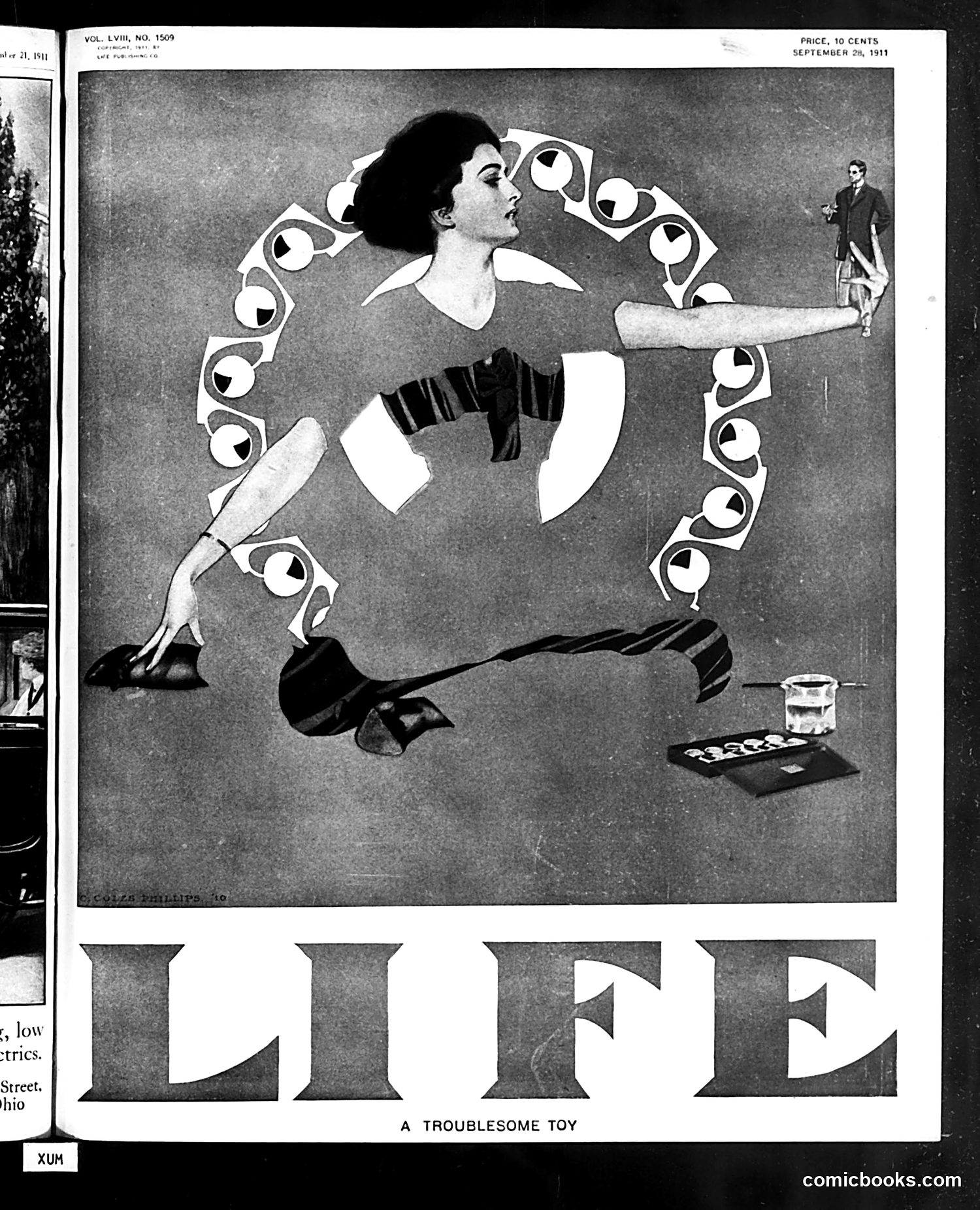
This satirical illustration depicts a woman as a spinning top or toy, surrounded by a circular arrangement of pie charts or clock faces. The woman is shown in an energetic, dynamic pose—legs and arms extended outward—suggesting chaotic motion. The title "A Troublesome Toy" suggests commentary on women's newfound social freedom or political power, likely referencing the recent women's suffrage movement (the 19th Amendment was ratified in August 1919, just weeks before this publication). The circular design with measurement charts implies the figure is being "analyzed" or controlled, while her energetic pose suggests she represents unpredictable, disruptive change to existing social order. The satire appears to mock anxieties about women's expanding role in American society during the post-WWI period.
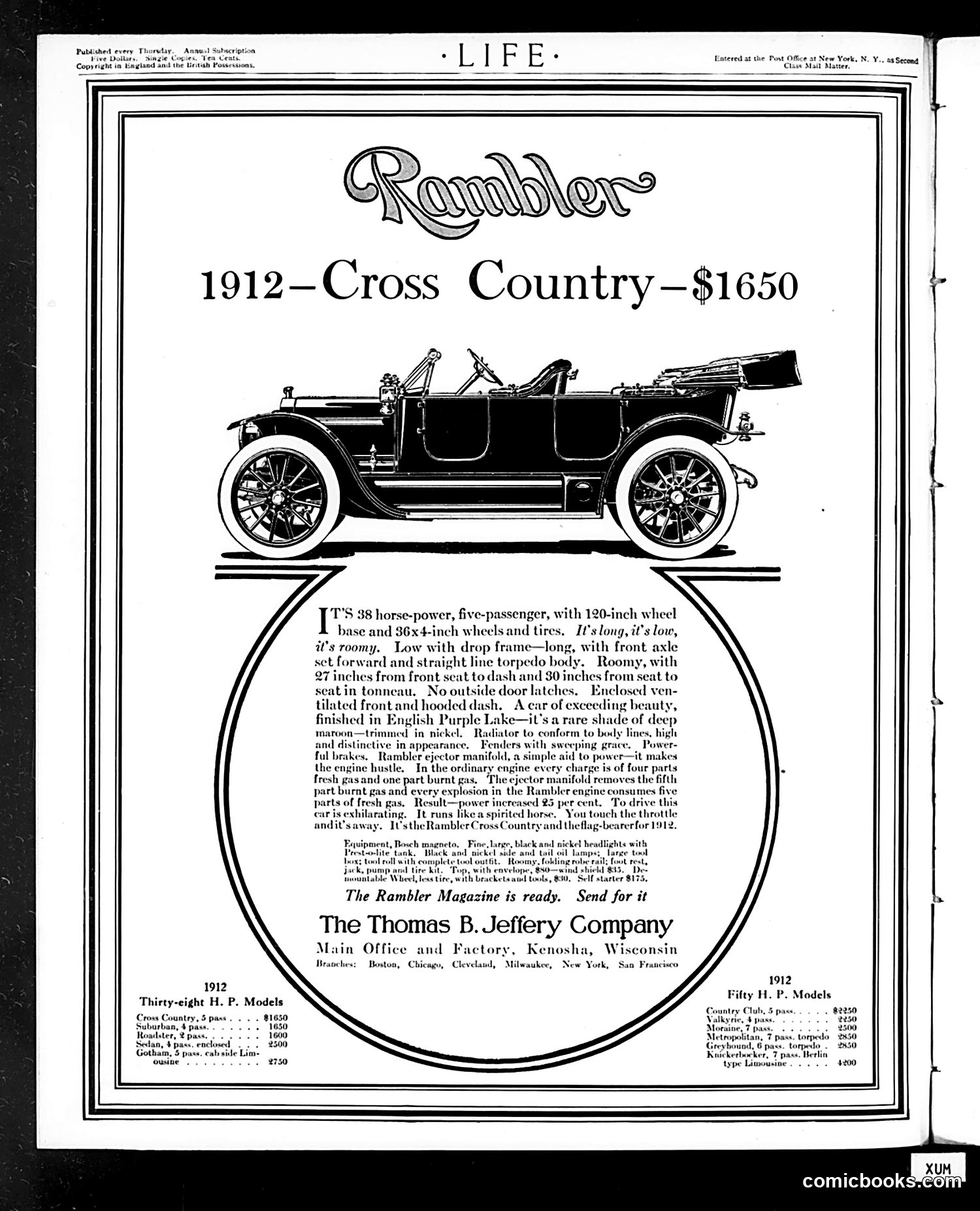
This page is **not a political cartoon or satirical content**—it's a straightforward automobile advertisement. The Rambler "Cross Country" model from The Thomas B. Jeffery Company is being marketed as a 1912 vehicle priced at $1650. The ad emphasizes features appealing to early automotive buyers: 98 horsepower, five-passenger capacity, spacious interior (27-30 inches of legroom), English Purple Lake finish, and advanced engineering details like the "Rambler ejector manifold." The descriptive language—"It runs like a spirited horse"—reflects period marketing rhetoric comparing cars to horses, the technology they replaced. The ad also promotes *The Rambler Magazine*, a company publication for owners. This represents standard early-1900s automotive advertising rather than political or social satire.
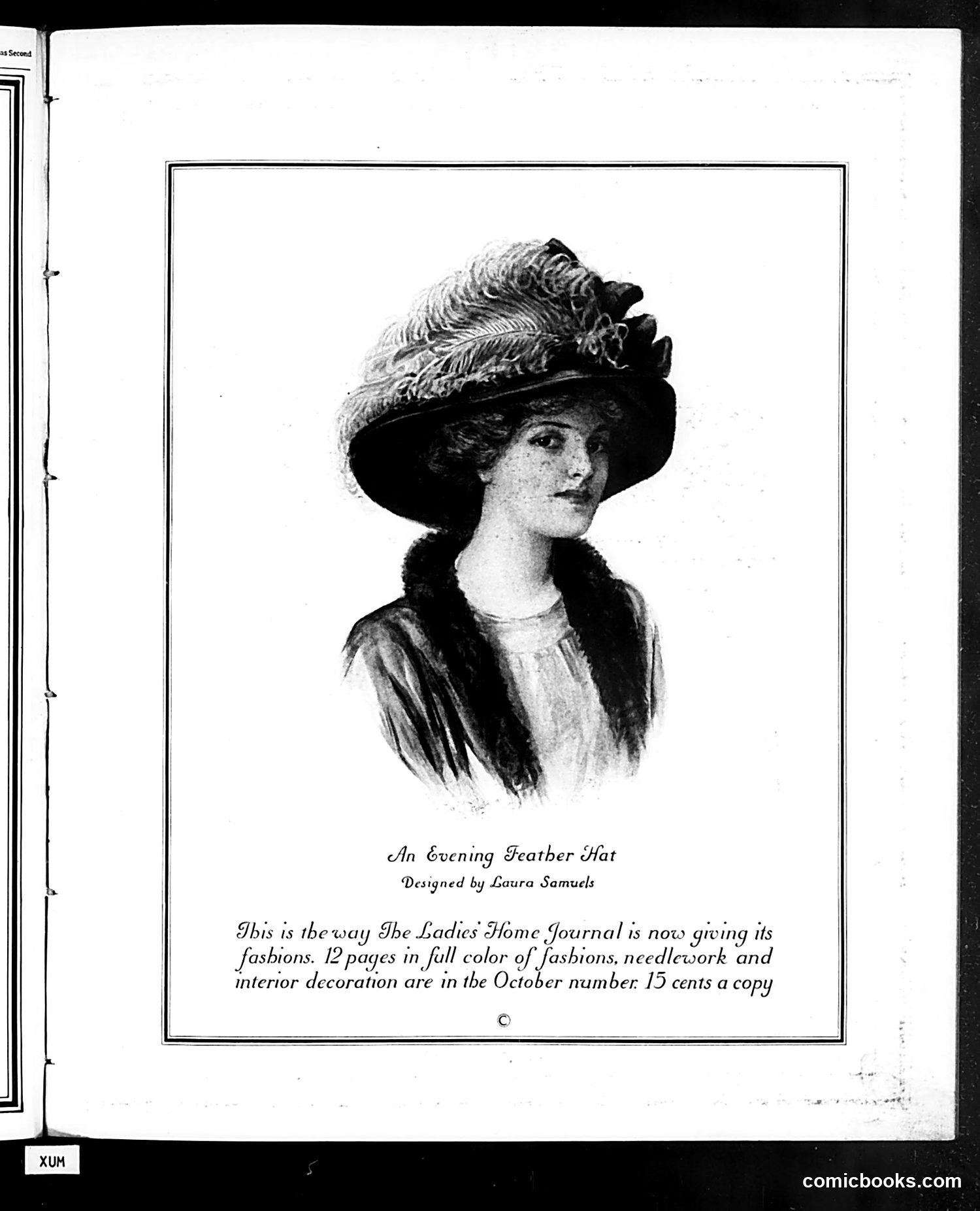
This page is primarily **advertising, not satire or political commentary**. It features an illustration of a woman wearing "An Evening Feather Hat" designed by Laura Samuels. The drawing is a fashion illustration typical of early 20th-century magazines. The accompanying text promotes *The Ladies' Home Journal*, advertising that its October issue contains 12 pages of color fashion content, needlework, and interior decoration advice, selling for 15 cents per copy. There is **no cartoon, satire, or political message** on this page—it's a straightforward fashion advertisement aimed at female readers interested in contemporary millinery and home design trends.
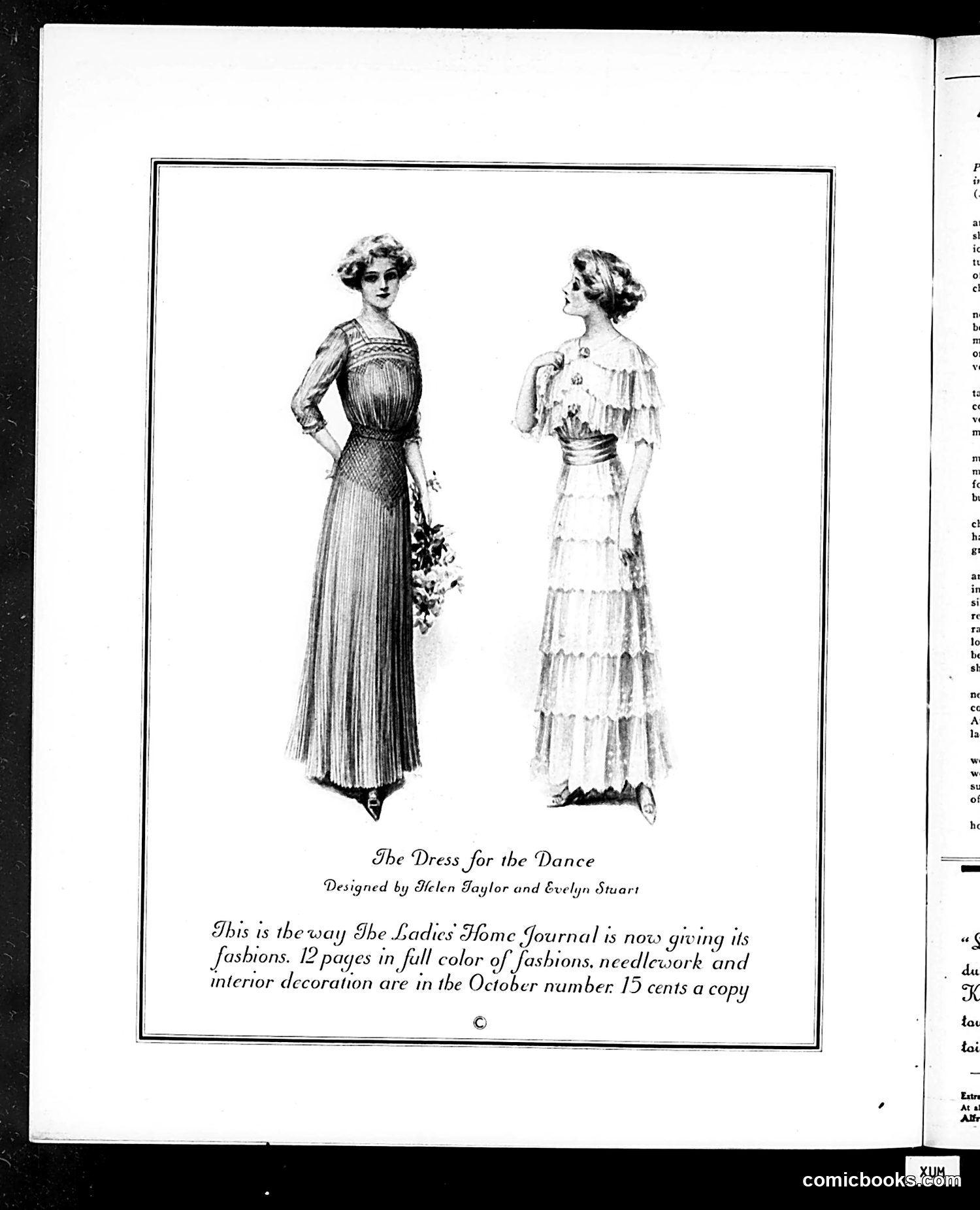
This page is **not a political cartoon or satire**—it's a fashion advertisement disguised as editorial content. The image shows two women's evening gowns "Designed by Helen Taylor and Evelyn Stuart," labeled "The Dress for the Dance." The text below is promotional copy for *The Ladies Home Journal*, announcing that their October issue features 12 pages of color fashion illustrations, needlework, and interior decoration advice, available for 15 cents. This represents early 20th-century magazine marketing: presenting commercial fashion content as aspirational lifestyle journalism. The elegant pen-and-ink drawings of formal wear would have appealed to middle and upper-class female readers interested in current dress trends for social occasions.
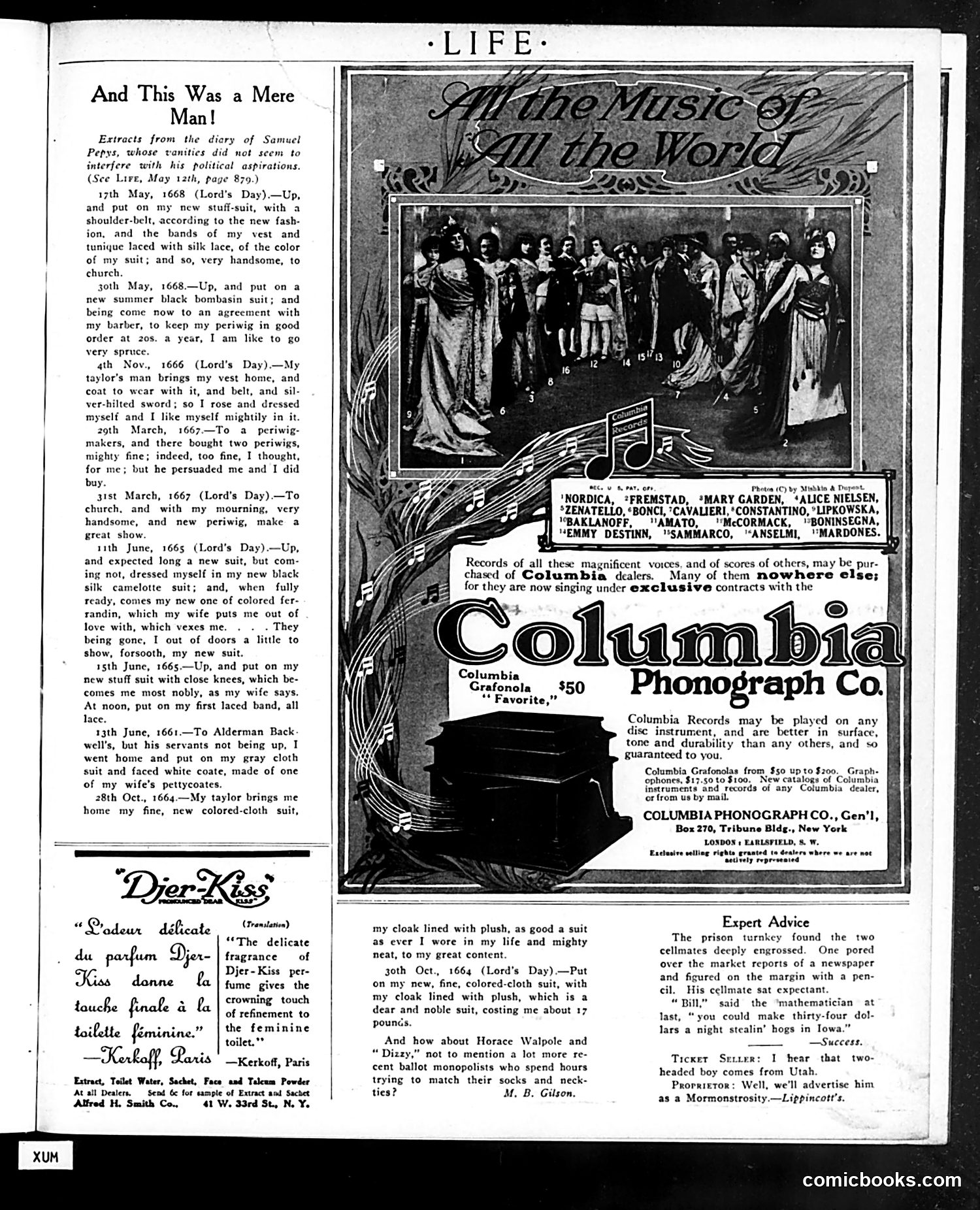
This page is primarily **advertising and diary excerpts**, not political satire. The left column features extracts from Samuel Pepys's 17th-century diary, describing his purchases of clothing and attendance at church—historical content unrelated to contemporary politics. The dominant right-side advertisement is for **Columbia Phonograph Co.**, featuring an illustration titled "All the Music of All the World." It showcases opera singers and promotes Columbia Records as superior products, listing famous performers like Nordica and Caruso. Below is a **Djer-Kiss perfume advertisement** with French text emphasizing feminine refinement. A small "Expert Advice" column addresses market investing and personal finance questions. There is **no political cartoon or satire** on this page. It reflects early 20th-century consumer culture and classical music promotion.
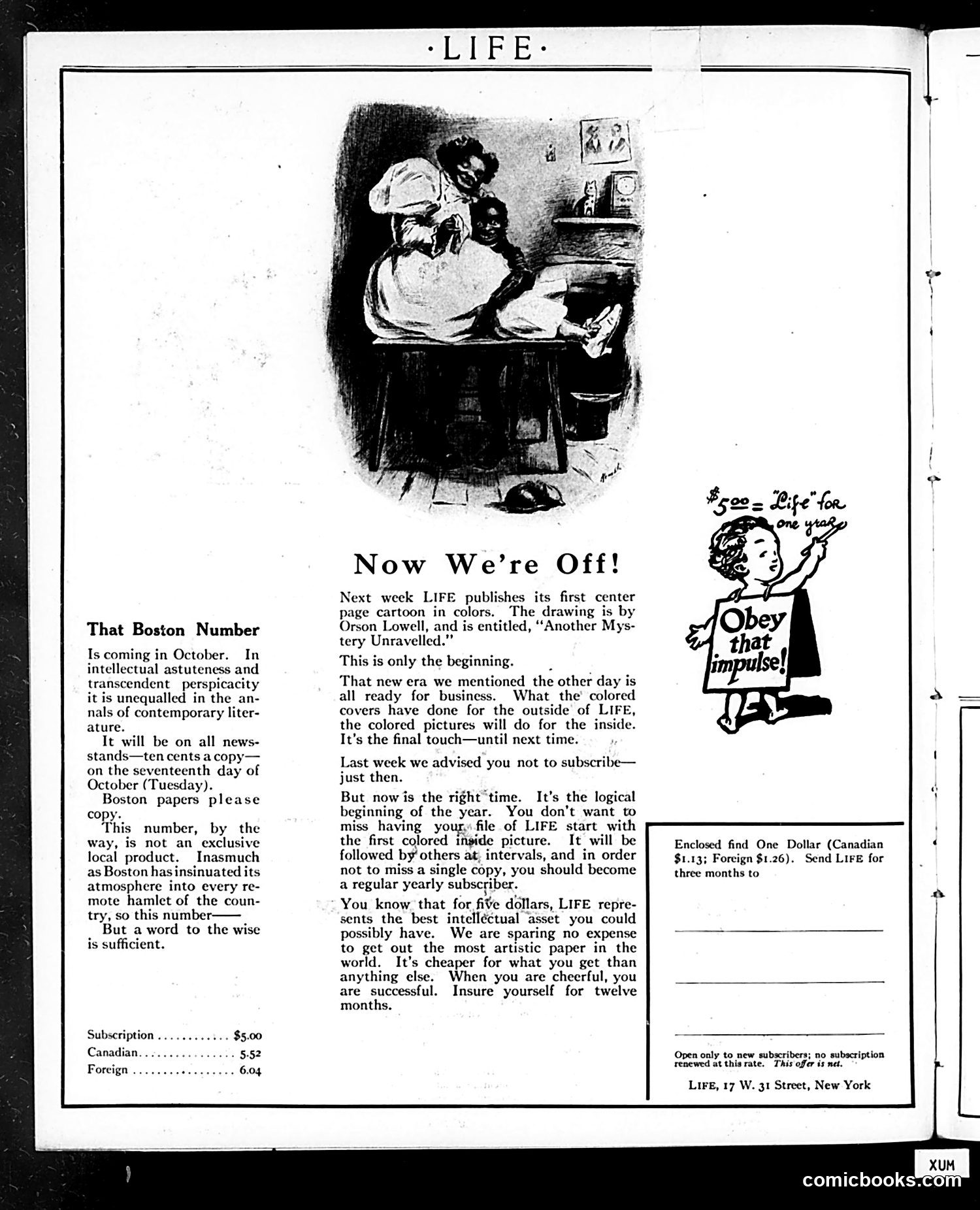
This page is primarily **promotional and advertising content** for Life magazine itself, not political satire. The main illustration shows a figure at a desk, likely representing a Life editor or publisher, announcing the magazine's expansion into **color printing**. The text announces Life's "first center page cartoon in color" by Orson Lowell titled "Another Mystery Unravelled," positioning this as a major milestone. The small cartoon on the right ("Obey that impulse") appears to be a subscription pitch—encouraging readers to subscribe. The left column promotes an upcoming **Boston-themed issue** (October) as a special intellectual endeavor, emphasizing the magazine's cultural importance. This is essentially a **house advertisement**, celebrating Life's technological and editorial advances while encouraging subscriptions at $5 annually.
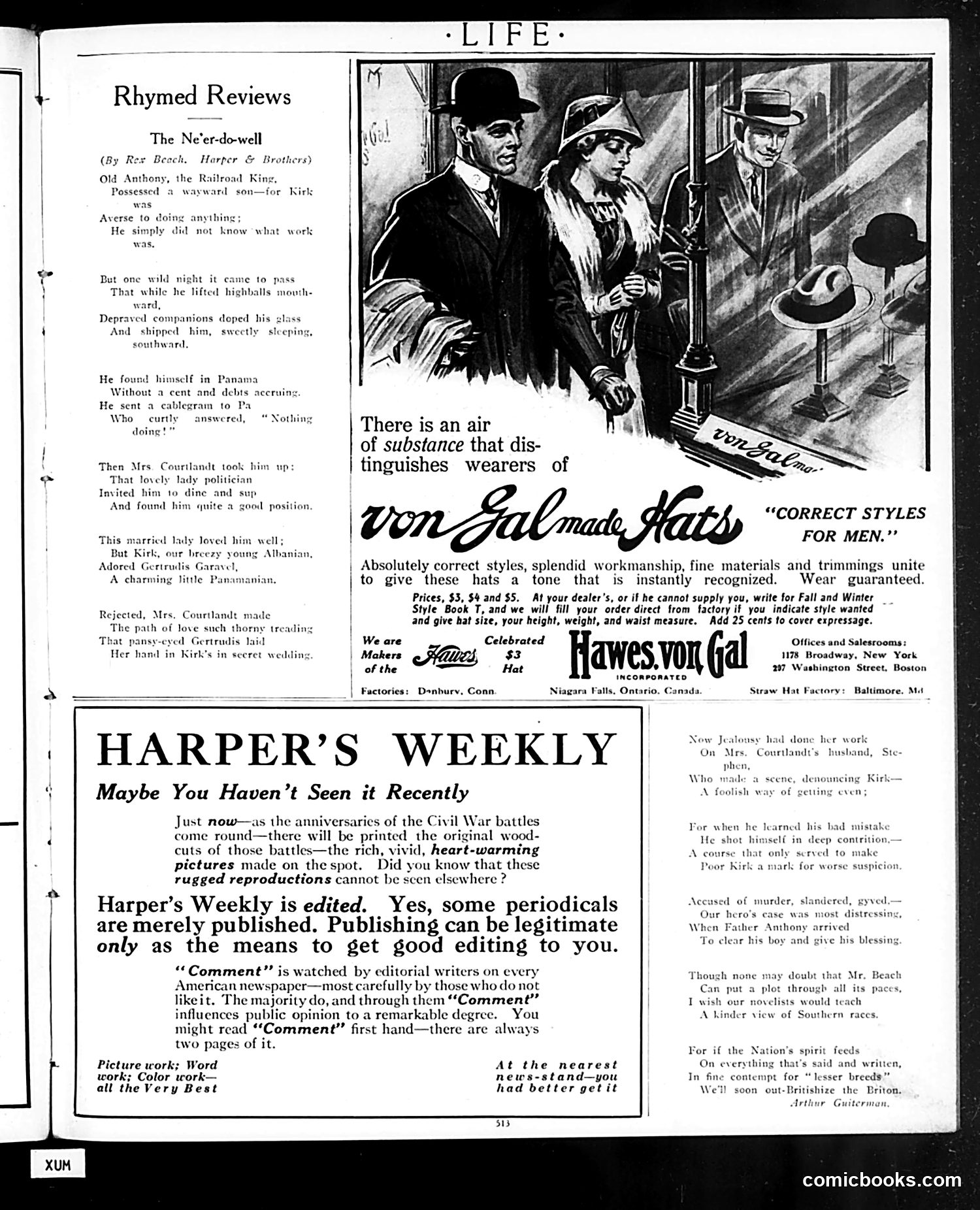
This page contains a **satirical poem titled "The Ne'er-do-well"** about Old Anthony, a railroad king who possessed wealth but no work ethic. The narrative describes his decline into poverty and eventual rescue by a female politician (Mrs. Courtlandt) who gives him a government position. The satire likely mocks: 1. **Idle wealthy men** dependent on family connections 2. **Women in politics** (then controversial), depicted as manipulative fixers 3. **Political patronage systems** rewarding incompetence The accompanying **Von Galmade Hats advertisement** features three well-dressed men, illustrating contemporary masculine fashion standards the poem's protagonist presumably lacked. The page primarily serves satirical commentary on class, work ethic, and gender roles in early 20th-century American society.
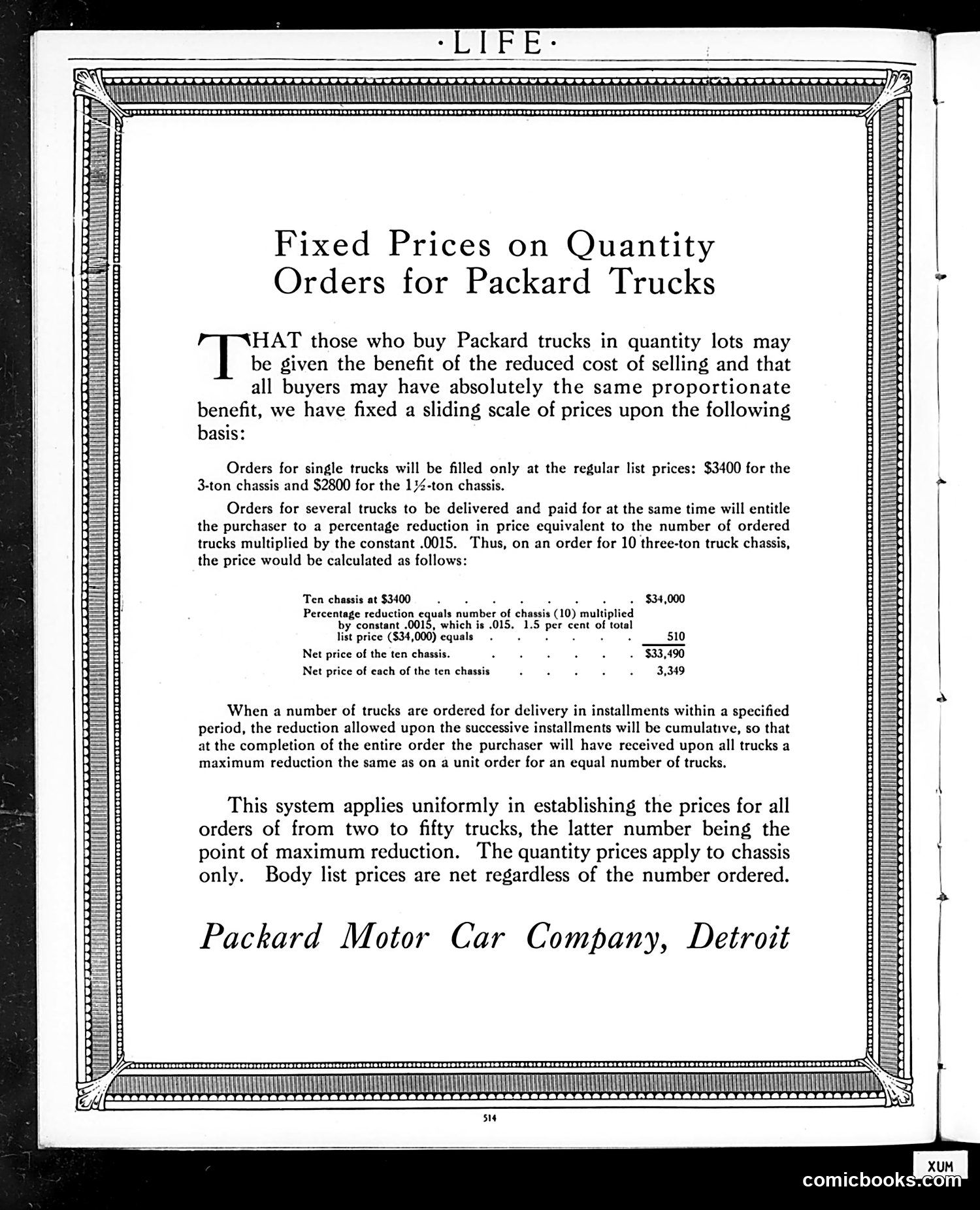
This is an advertisement for Packard Motor Car Company of Detroit, not satirical content. It explains the company's pricing structure for bulk truck orders. The ad announces a "sliding scale" discount system: single truck orders maintain list prices ($3,400 for 3-ton chassis, $2,800 for 1½-ton), but quantity purchases receive progressive price reductions calculated by multiplying the number of trucks ordered by .015. The example shows ten 3-ton chassis at $34,000 total, with a $10 reduction per truck, yielding $3,349 each. The system applies uniformly to orders of 2-50 trucks (the maximum discount threshold). Notably, the reductions apply to chassis only, not body prices, which remain fixed regardless of order size.
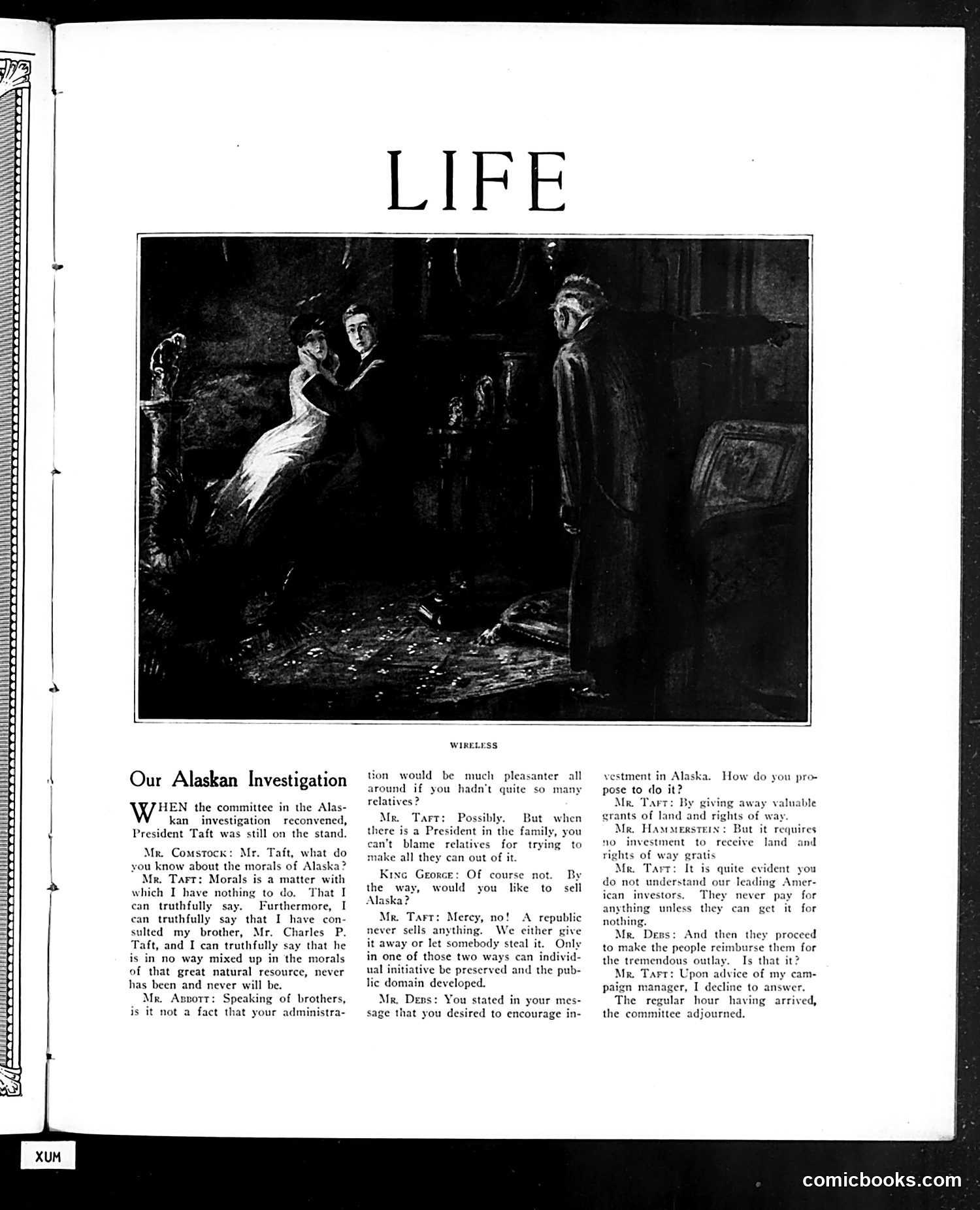
This is a satirical dialogue about Alaska's development and resource exploitation. The scene depicts what appears to be a formal committee investigation, with figures examining Alaska's potential. The satire centers on corrupt practices: Mr. Taft (likely President William Howard Taft) and colleagues discuss whether to develop Alaska's resources or allow private interests to exploit them. The exchange reveals cynical attitudes—one character states "A republic never sells anything. We either give it away or let somebody steal it." The cartoon mocks how government officials rationalize giving away public lands and resources to private investors under the guise of development, while avoiding direct accountability for the consequences. The dark, shadowy artistic style emphasizes the moral murkiness of these dealings.
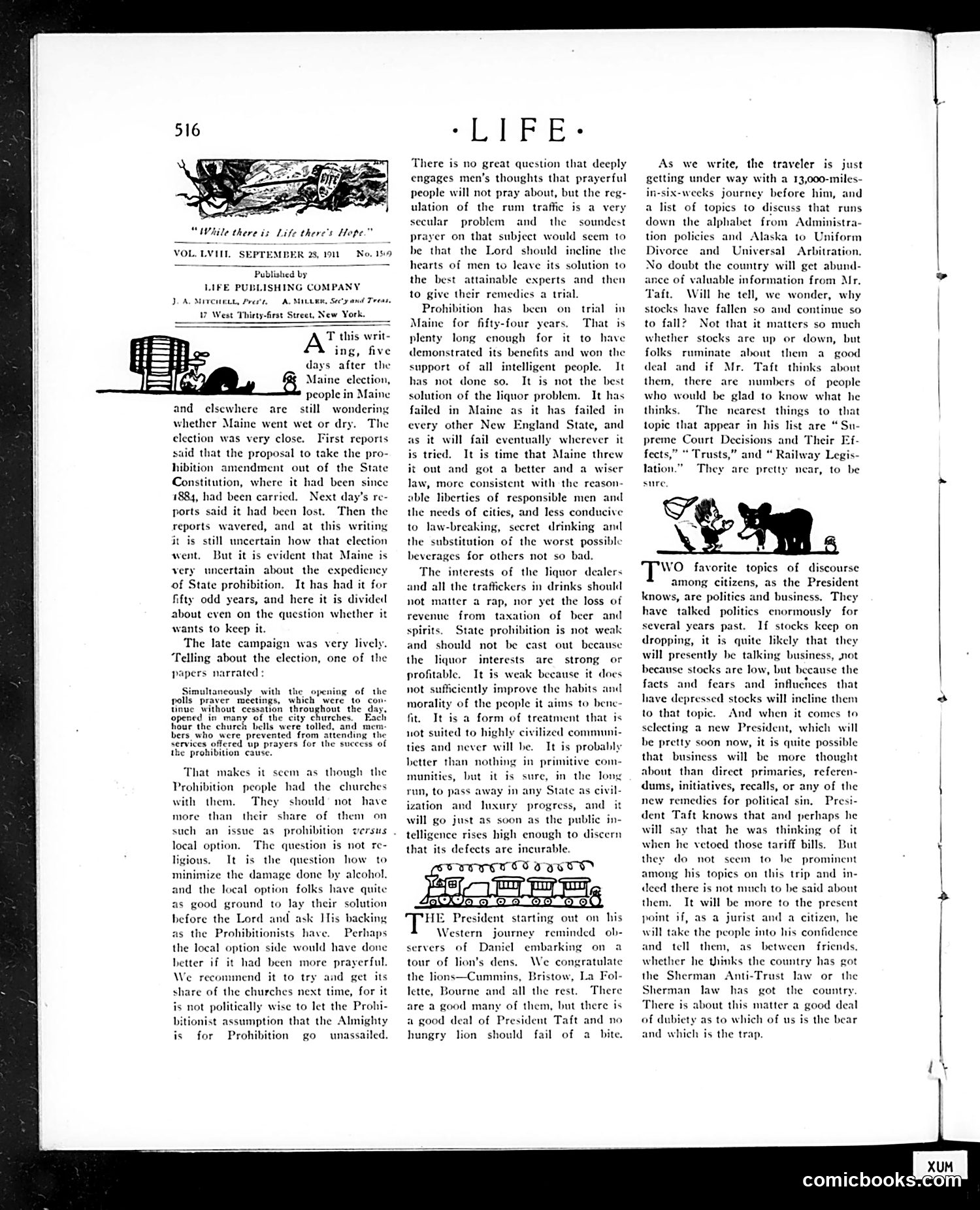
This page contains editorial commentary on Prohibition in Maine and President Taft's Western journey. The text criticizes Maine's fifty-four-year prohibition experiment as a failed policy that hasn't reduced drinking or improved public morality. The editorial argues Prohibition is weak law-making that should be replaced with approaches respecting "reasonable liberties of responsible men." Regarding Taft's travels, the commentary suggests he should focus on substantive issues—business, politics, tariffs, and the Sherman Anti-Trust law—rather than treating the trip as entertainment. The author expresses concern that Taft isn't addressing serious policy matters the country faces. The cartoons (visible but small) appear to illustrate these critiques, though specific details are difficult to discern clearly.
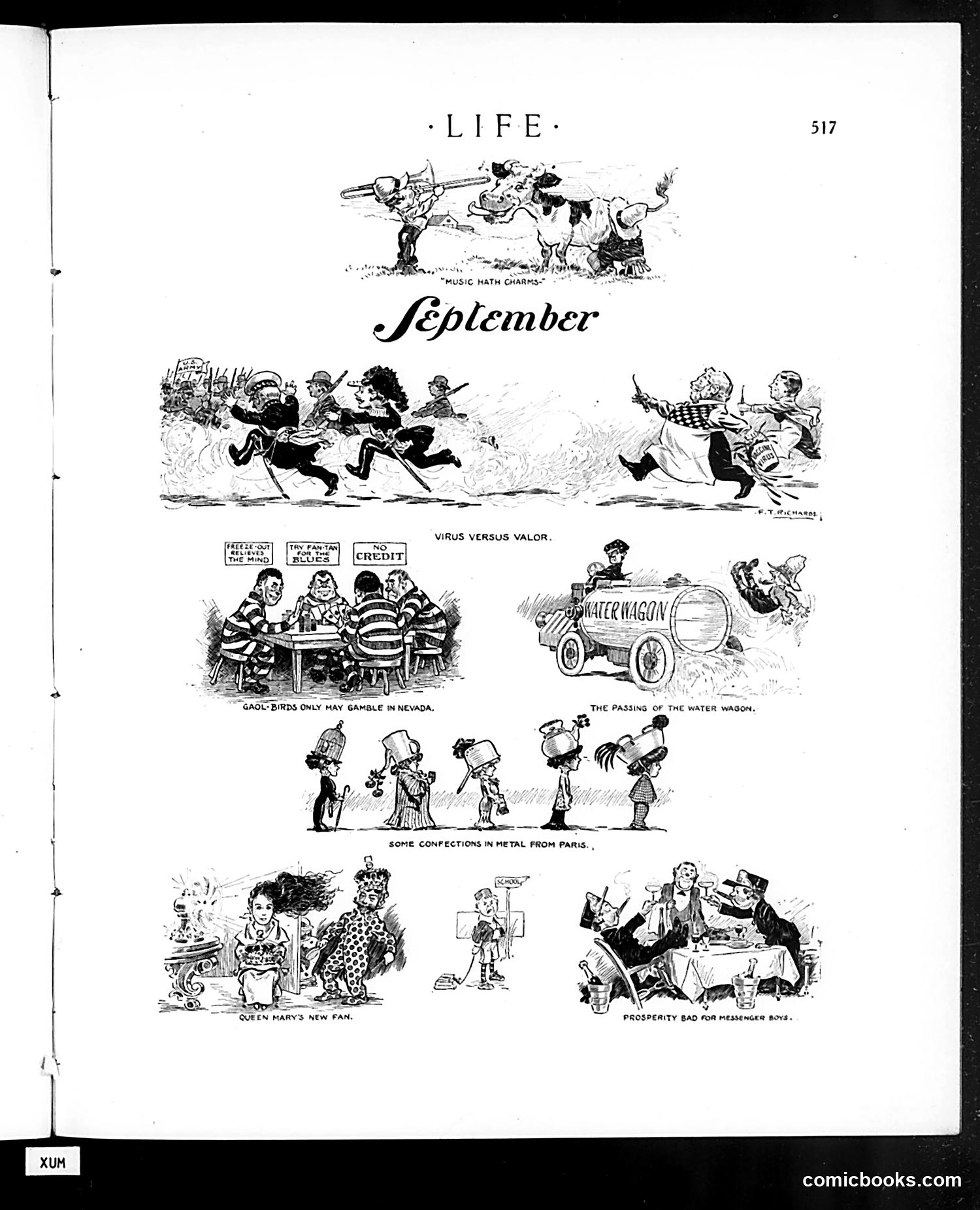
This page from *Life* magazine's September issue contains several satirical cartoon panels mocking contemporary social and political topics: **"Virus Versus Valor"** depicts a conflict between disease and courage, likely commentary on public health versus military/patriotic bravado. **"Gaol-Birds Only Hay Gamble in Nevada"** satirizes Nevada's gambling laws, suggesting only prisoners have freedom to gamble there. **"The Passing of the Water Wagon"** appears to reference Prohibition-era concerns about alcohol regulation. **"Some Confections in Metal from Paris"** and other panels mock fashion, royalty ("Queen Mary's New Fan"), and societal absurdities. **"Prosperity Bad for Passenger Rhyno"** suggests economic abundance creates unexpected problems. The cartoons employ caricature and visual wordplay typical of early 20th-century American satirical humor, targeting contemporary news, cultural trends, and social foibles.
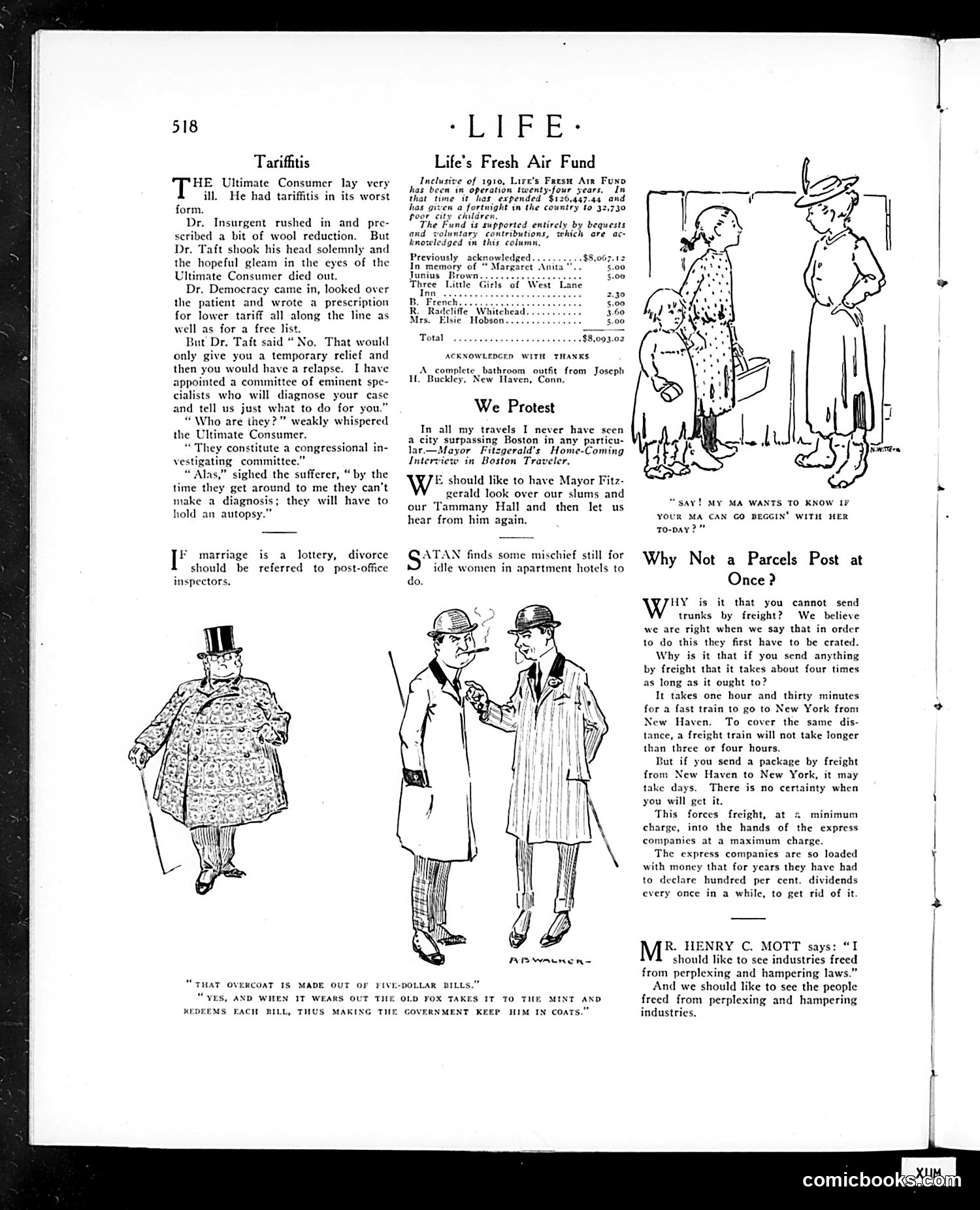
This Life magazine page contains several satirical pieces targeting contemporary problems: **"Tariffitis"** mocks protective tariffs harming consumers. The joke depicts the "Ultimate Consumer" suffering from inflated prices caused by tariff policies—a major political debate of the era. **"We Protest"** criticizes Mayor Fitzgerald of Boston for neglecting slum conditions while promoting tourism, satirizing politicians who ignore poor neighborhoods. **"Why Not a Parcels Post at Once?"** argues for establishing affordable parcel delivery service. The cartoon contrasts expensive, slow freight shipping with fast passenger trains, advocating government intervention to reduce shipping costs and corporate monopoly profits. **The overcoat cartoon** satirizes inflation: a five-dollar bill worn into an overcoat suggests currency's declining purchasing power—a concern during this inflationary period.
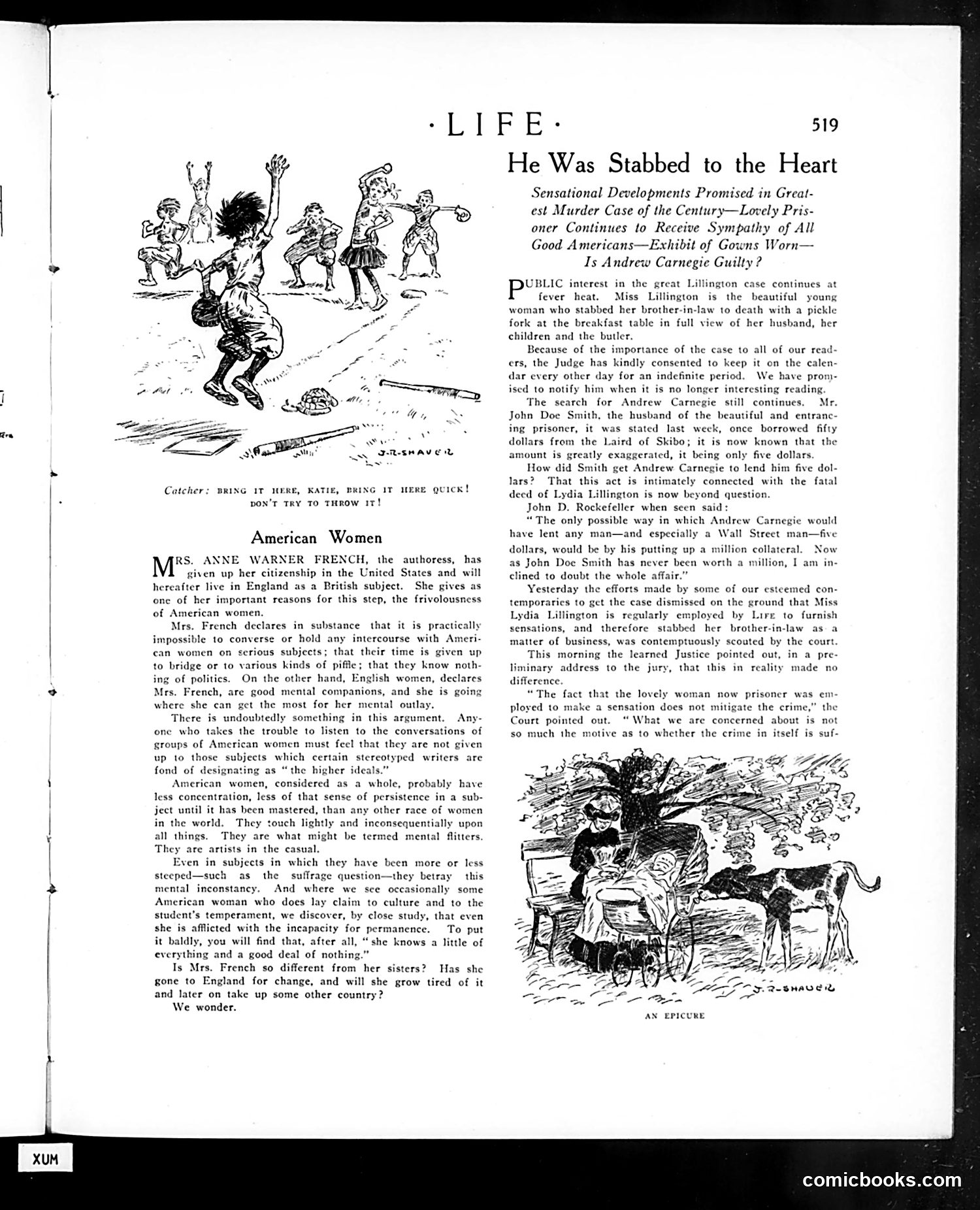
This page discusses the "Lillington case," a sensational murder trial where a young woman stabbed her brother-in-law with a pickle fork at breakfast. The article notes public fascination with the case and mentions Andrew Carnegie's reported involvement—apparently lending money to the defendant's husband. The top cartoon depicts children playing, seemingly oblivious or mocking the serious crime, suggesting public trivializing of the murder. The bottom illustration shows a woman with a dog, labeled "An Epicure"—likely satirizing how the defendant has become a media sensation, her notoriety making her fashionable despite committing murder. The satire critiques American society's appetite for sensational crime stories.
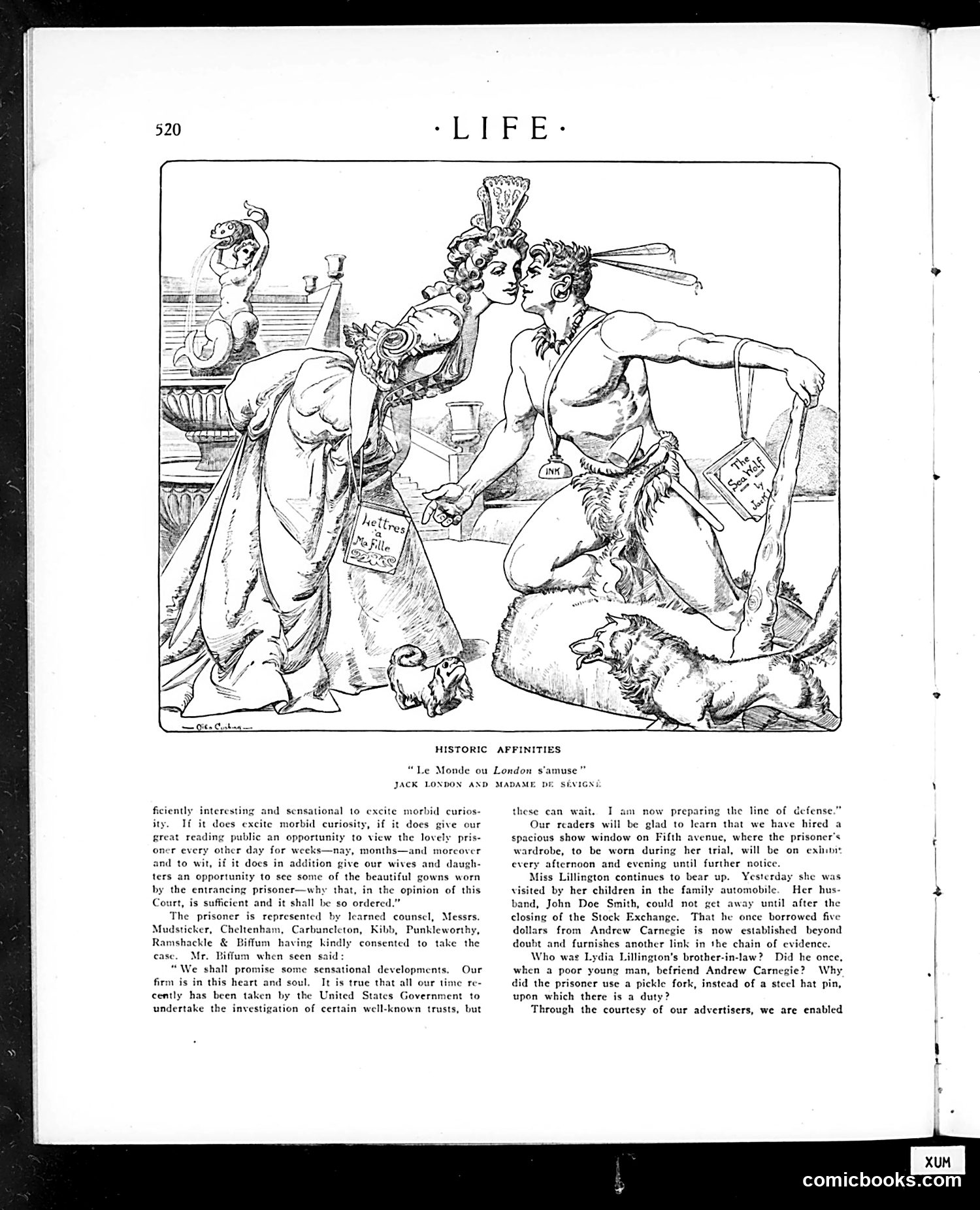
This satirical cartoon titled "Historic Affinities" compares contemporary figures to historical counterparts. The caption references "Le Monde ou London s'amuse" and names "Jack London and Madame de Sevigné." The illustration depicts elegantly dressed women in classical/aristocratic poses with cherubs, styled after classical art. The accompanying text discusses a prisoner (Miss Lillington) and mentions "Andrew Carnegie," "John Doe Smith," and stock exchange dealings, suggesting commentary on wealth, class, and social pretension. The satire appears to mock the affectations of wealthy society figures by comparing them to historical aristocracy—implying modern American wealth-holders are mimicking European refinement while their actual behavior (the referenced financial dealings and prisoner situation) reveals underlying moral or social contradictions. The specific historical and personal references are now obscure.
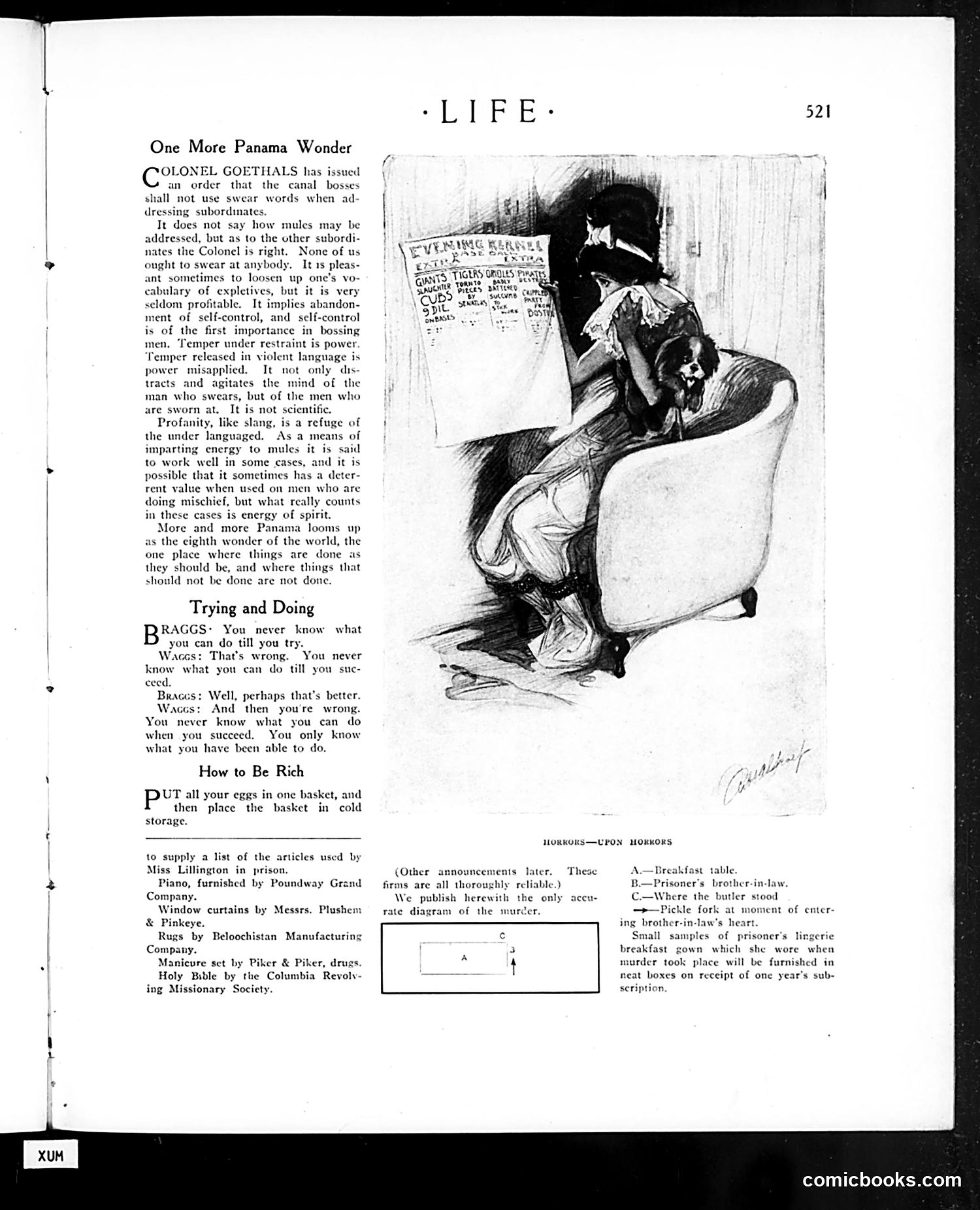
This page contains several satirical pieces targeting early 1900s social issues: **"One More Panama Wonder"** praises Colonel Goethals's order forbidding canal bosses from swearing at subordinates. The piece argues swearing reflects lack of self-control and damages leadership—though it admits profanity might work on mules. It presents the Panama Canal as an exemplary achievement where things are "done as they should be." **"Trying and Doing"** is a dialogue between Braggs and Wages debating whether you can know your abilities before succeeding. It's philosophical wordplay mocking overconfidence—you only truly know what you've *already* accomplished, not what you *might* do. **"How to Be Rich"** offers absurdist financial advice: concentrate all assets in one place, then freeze them. Dark humor about wealth preservation or critique of hoarding. The illustration appears to show a donkey or mule (referencing the swearing article's mention of addressing animals). The "Horrors Upon Horrors" section satirizes crime reporting by diagramming a murder scene with absurd detail—mocking sensational journalism of the era.
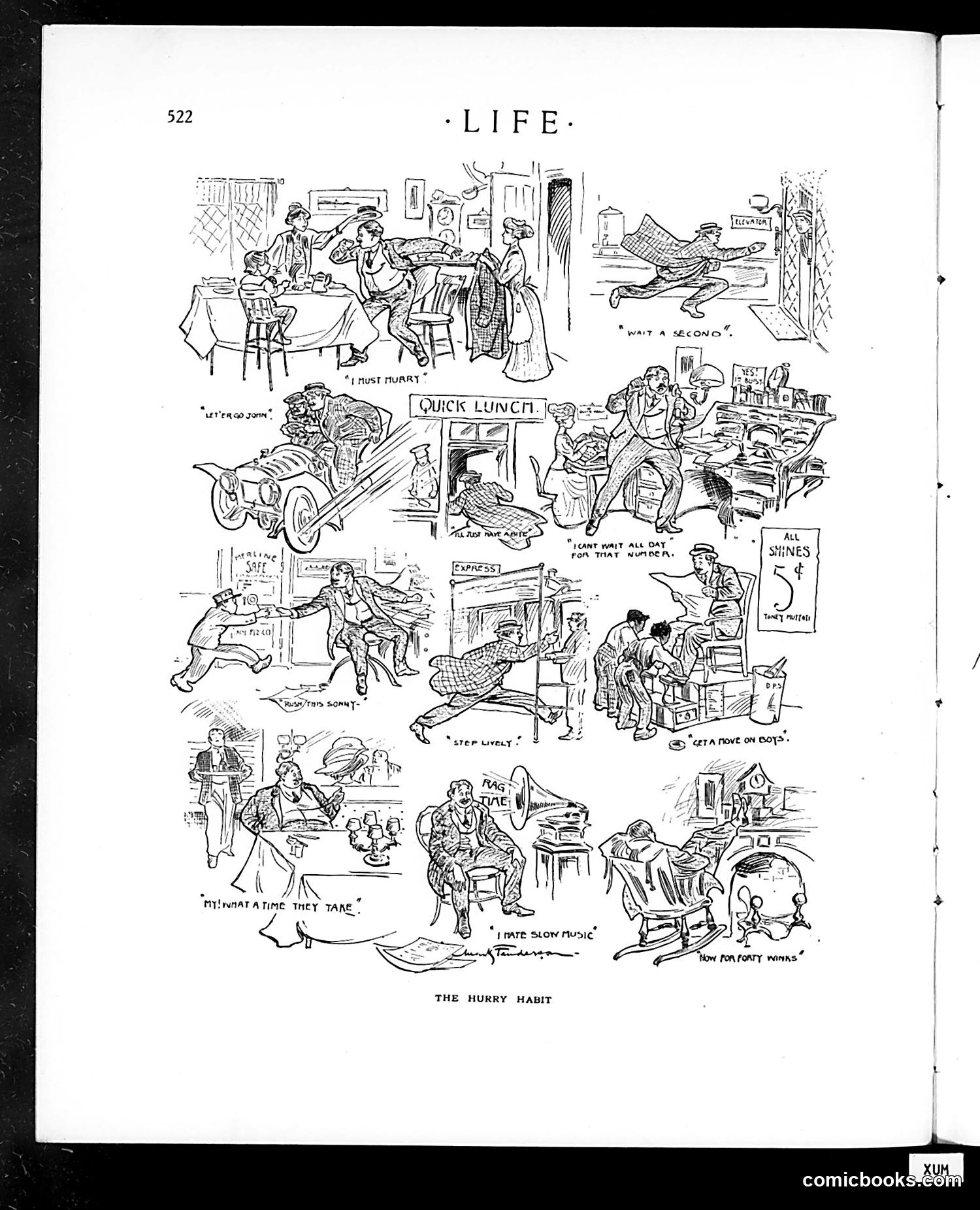
This Life magazine page satirizes the American obsession with speed and rushing through daily activities. The cartoon collection depicts various scenes of people constantly hurrying: dining hastily ("I must hurry"), operating a "Quick Lunch" counter, someone saying "wait a second," individuals running and gesturing frantically, someone working late ("I can't wait all day for that number"), and references to fast music and quick transactions ("all shines 5¢"). The recurring caption "The Hurry Habit" suggests social criticism of modern American culture's frenetic pace—people rushing through meals, work, entertainment, and leisure. The figure labeled "Midnight" and references to "slow music" contrast rushed versus leisurely living, implying the era valued constant activity and speed as markers of modern life, often at the expense of rest or contemplation.
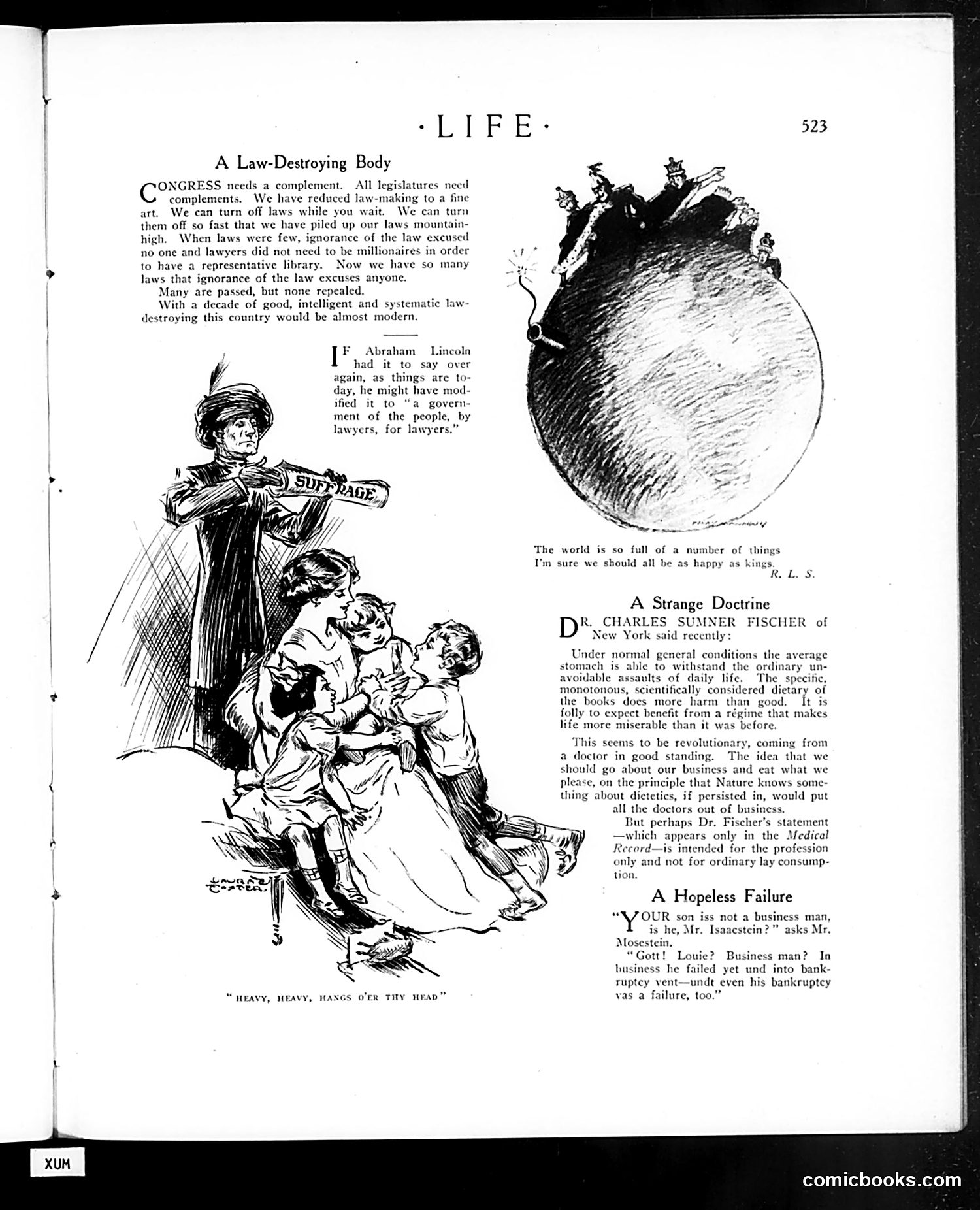
This page contains three satirical pieces critiquing American institutions and society: **"A Law-Destroying Body"** attacks Congress for legislative overproduction. The cartoon shows Lady Justice (holding "Suffrage") weighed down by three figures, illustrating how excessive laws burden society. The satire argues that too many laws create such complexity that ignorance becomes universal and lawyers become unnecessarily wealthy. A modified Lincoln quote suggests government now serves lawyers rather than the people. **"A Strange Doctrine"** questions a doctor's advice that people ignore restrictive diets and eat naturally instead. The satire implies this revolutionary medical opinion—if taken seriously by the public rather than just professionals—would economically devastate the medical profession. **"A Hopeless Failure"** is a brief Jewish-dialect joke about a son so incompetent he even fails at bankruptcy, playing on stereotypical humor common to the era. The overall theme critiques institutional excess, professional self-interest, and social complexity.
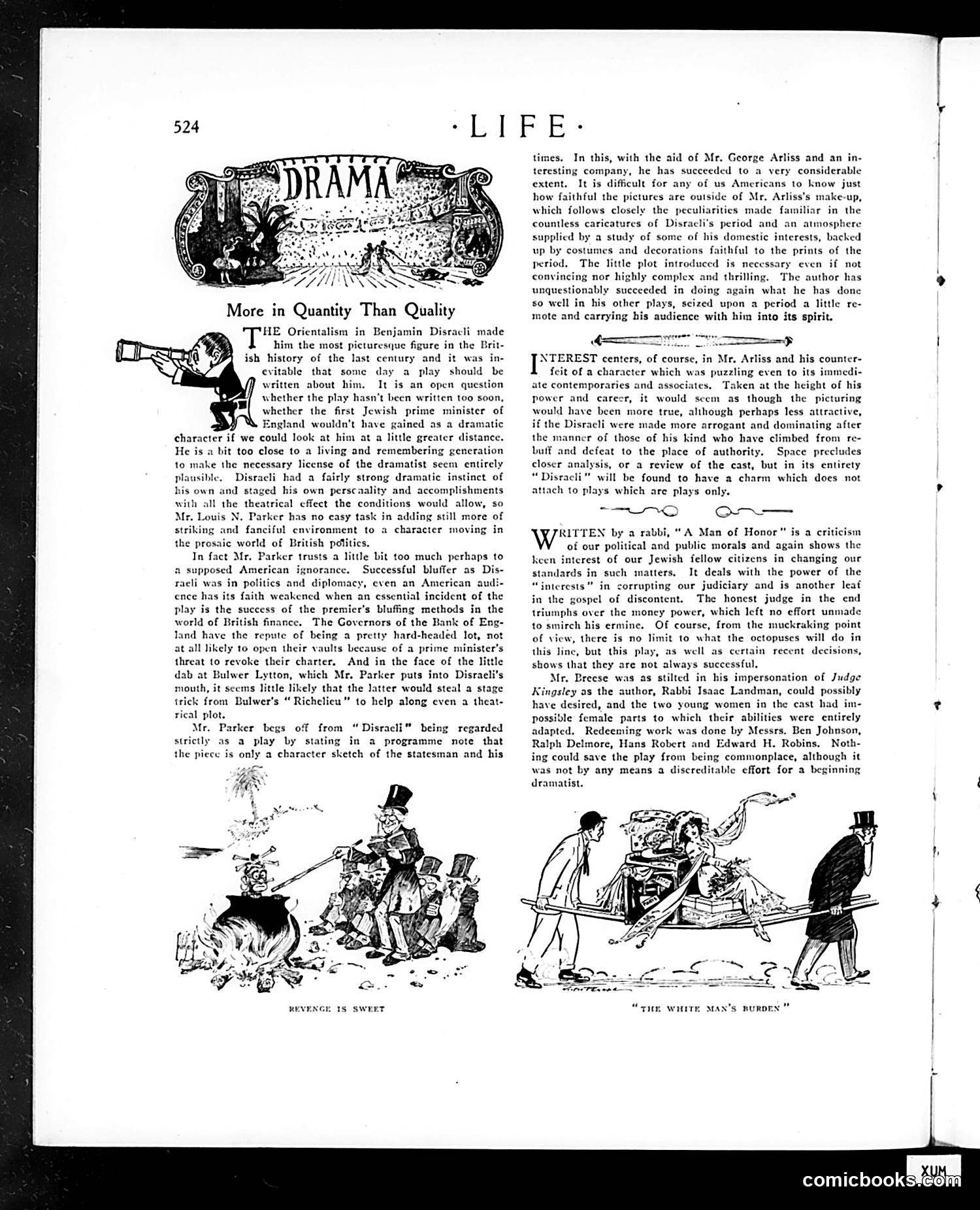
This page reviews two theatrical productions. The main article discusses a play about **Benjamin Disraeli**, the 19th-century British Prime Minister, starring actor George Arliss. The critic argues the play prioritizes spectacle and theatrical effect over historical accuracy—particularly a plot device where Disraeli supposedly bluffs the Bank of England into opening its vaults, which the reviewer finds implausible. The critic acknowledges Arliss's performance is effective but notes the play is more "character sketch" than rigorous drama. Two satirical cartoons illustrate political themes: "Revenge is Sweet" and "The White Man's Burden" (likely referencing Kipling's imperialist poem). The page also briefly mentions a play called "A Man of Honor" written by a rabbi, addressing Jewish citizens' concerns about political and public morality. The overall thrust critiques theatrical oversimplification of complex historical figures and contemporary social issues.
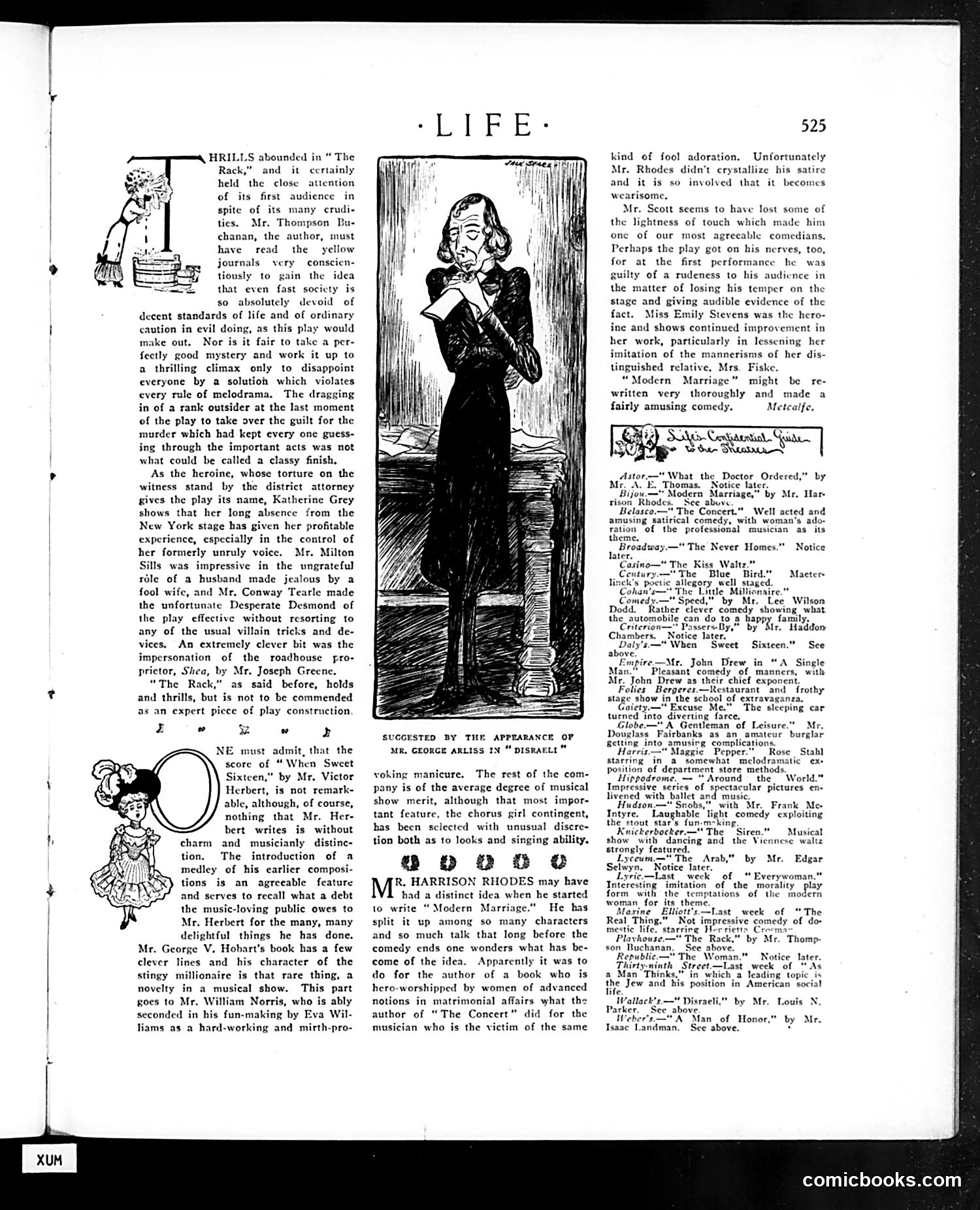
This page contains theater reviews from Life magazine's drama section. The central illustration shows a figure in formal dress, captioned as "suggested by the appearance of Mr. George Arliss in 'Disraeli'"—referencing the actor's famous role playing the British Prime Minister. The reviews critique three theatrical productions: 1. **"The Rack"** — criticized for weak plotting and relying on yellow journalism sensationalism 2. **"When Sweet Sixteen"** — a Victor Herbert musical with an undistinguished score but charming elements 3. **"Modern Marriage"** — satire about women's "advanced notions" on matrimony that lacks focus The tone is typical of early 20th-century theater criticism: intelligent but sometimes dismissive of commercial entertainment. The "Disraeli" reference suggests Arliss was a notable contemporary performer. The reviews reflect Life's satirical stance toward both theatrical excess and social pretension.
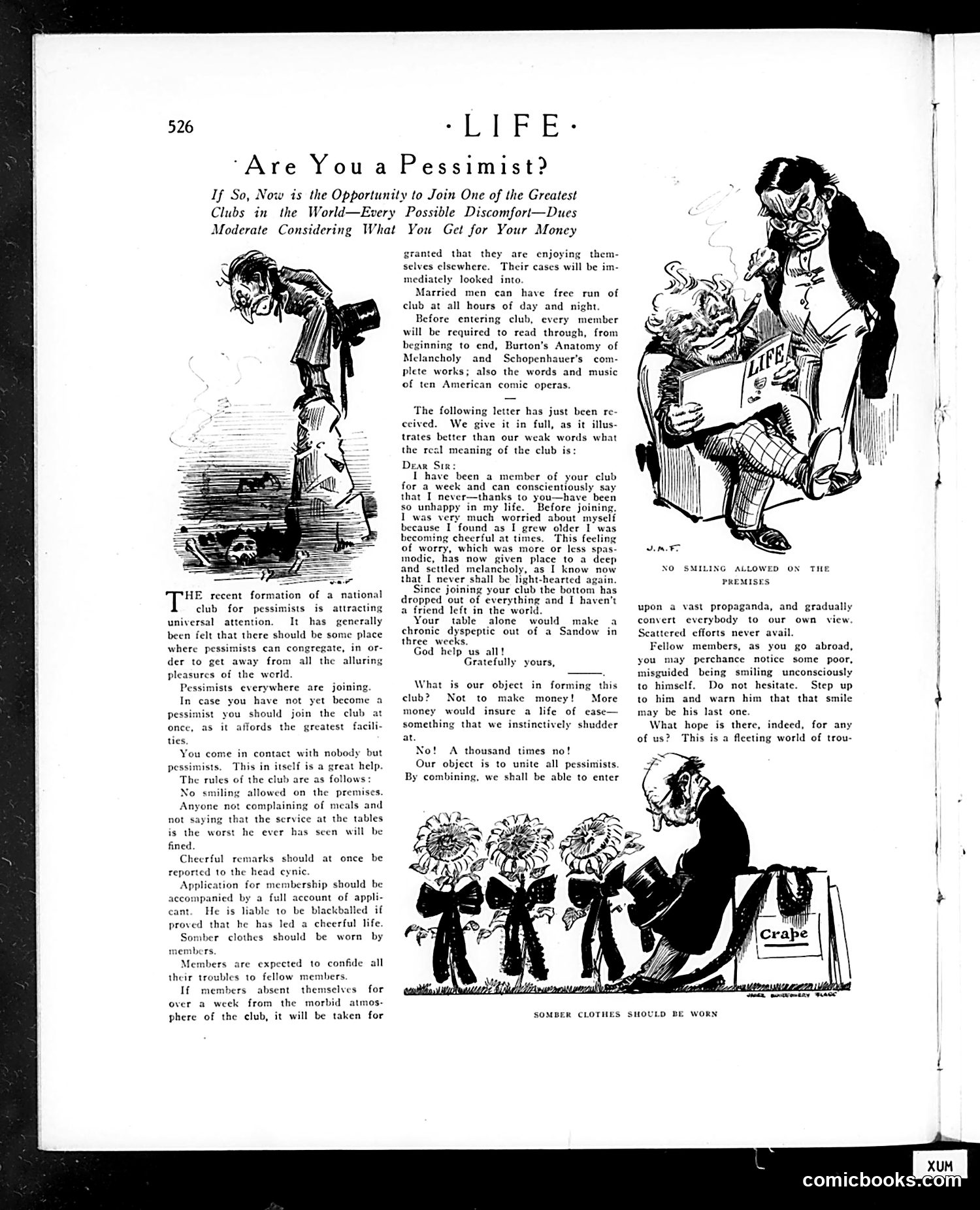
This satirical piece mocks both excessive pessimism and the era's proliferation of exclusive social clubs. Life presents a fictional "Pessimists Club" with deliberately absurd rules: members cannot smile, must complain about meals, wear somber clothes, and confess troubles to each other. The humor lies in the exaggeration—the club's stated goal is spreading misery through "vast propaganda" and converting the world to pessimism. A member's testimonial letter praises how the club has made him thoroughly unhappy, destroying his friendships and peace of mind. The accompanying cartoons reinforce the joke: one shows a pessimist hunched over in despair; another depicts members in dark clothing tending "Crape" flowers (crape being funeral fabric), emphasizing their morbid orientation. The satire targets both the period's enthusiasm for joining clubs and the philosophical pessimism that was fashionable in certain intellectual circles, suggesting that taking such ideologies to their logical extreme reveals their absurdity.
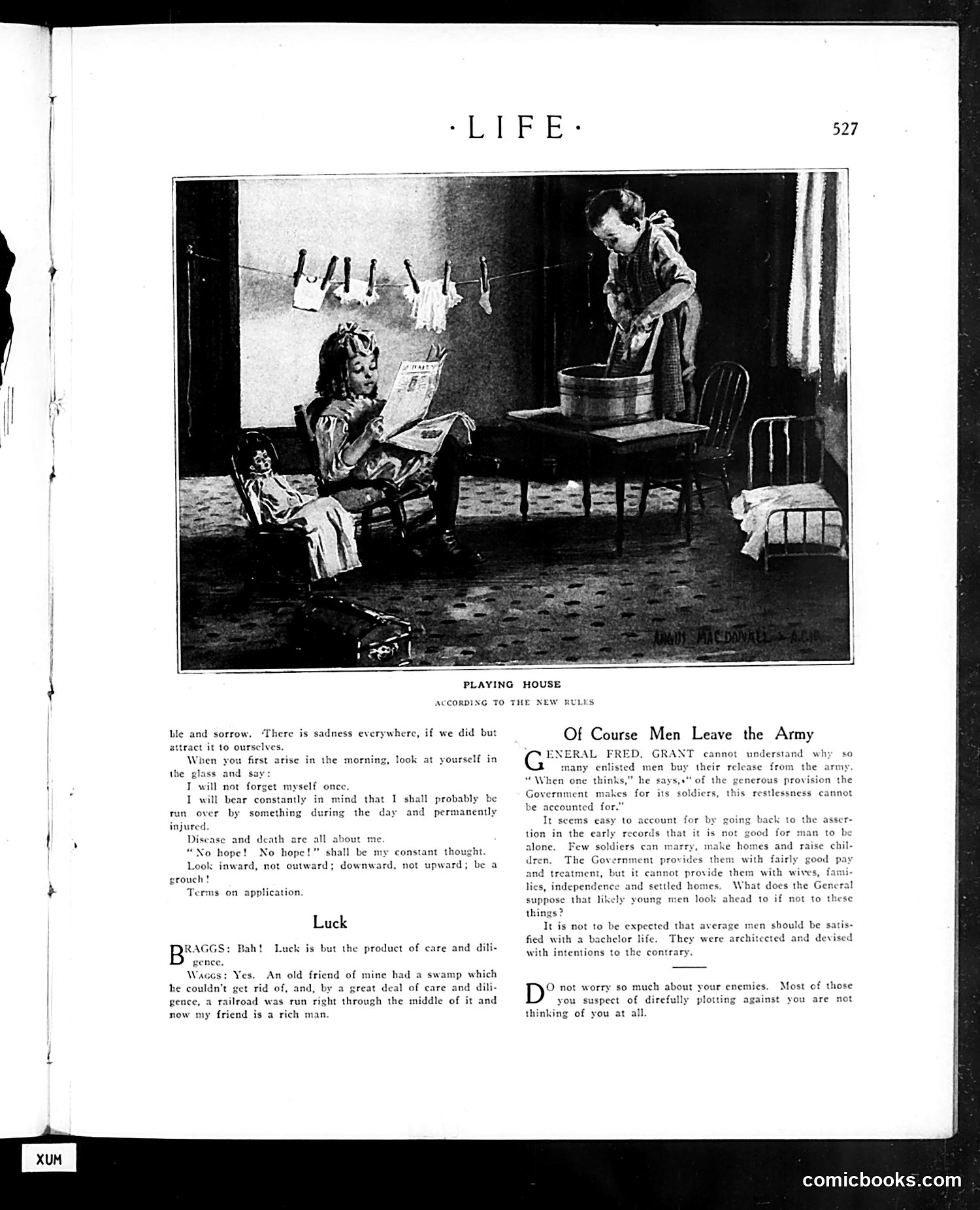
This page satirizes post-World War I social attitudes. The photograph shows children playing house—a domestic scene—captioned to mock contemporary pessimism and cynicism. The left column contains darkly comic "life advice" advocating constant gloom: expect to be run over, focus on disease and death, "be a grouch." This appears to ridicule the pervasive disillusionment and negativity many felt after the war. The right section addresses soldiers leaving the army. General Fred Grant is quoted explaining that men leave military service despite government provisions because they want families, homes, and independence—things the army cannot provide. The text acknowledges this is natural but "cannot be accounted for" by the government, gently poking fun at bureaucratic confusion over human desires for civilian life. The satire contrasts innocent childhood domesticity with the bitter, world-weary attitudes of post-war adults.
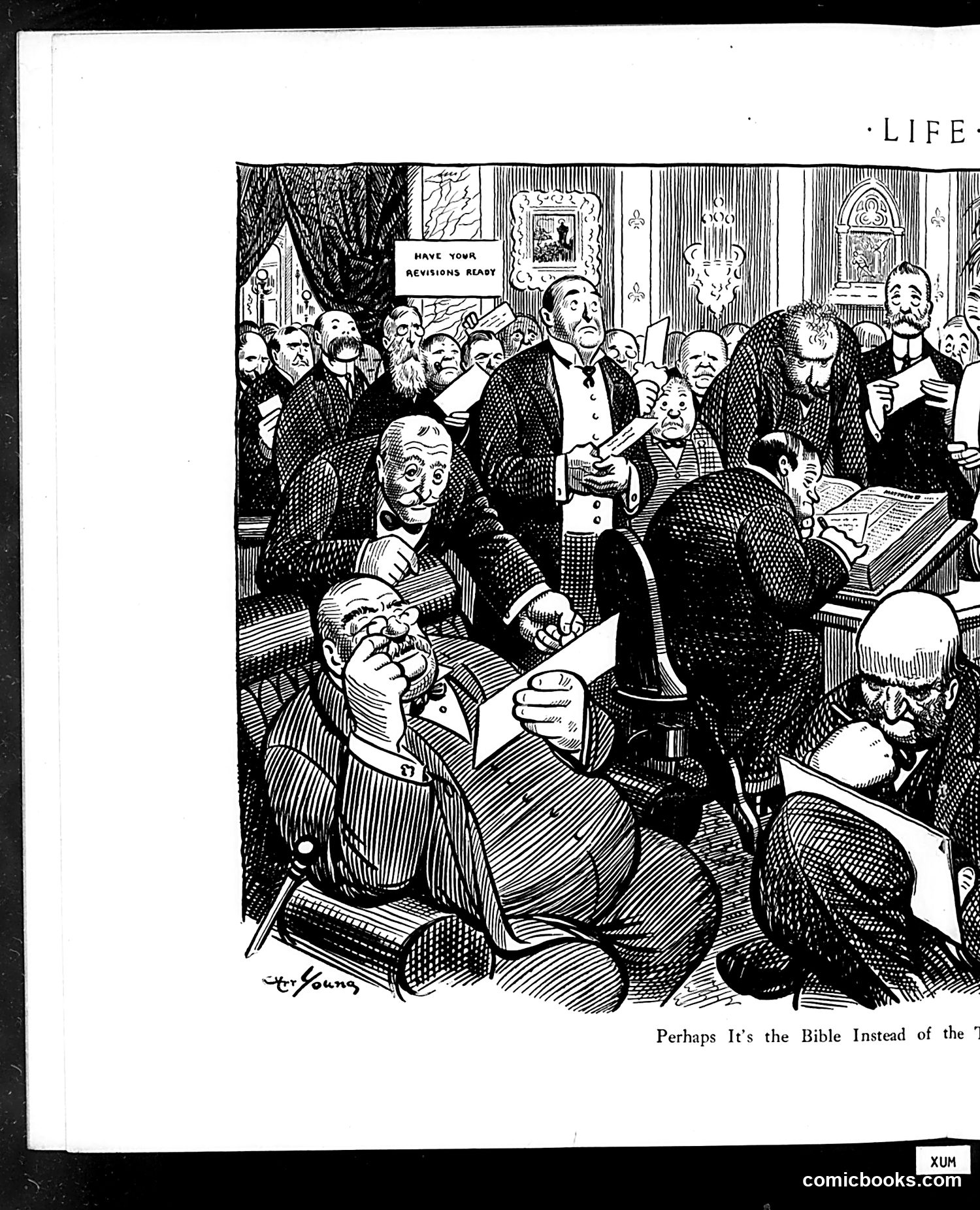
This cartoon depicts a crowded formal gathering (likely a legislative or governmental body) where a seated official holds documents while surrounded by standing men in formal attire. A banner reads "HAVE YOUR REVISIONS READY." The caption, "Perhaps It's the Bible Instead of the [text cut off]," suggests satire about proposed revisions to an important document—likely a constitution, law, or religious text. The cartoon mocks the proliferation of suggested changes, implying that endless revision requests have become absurd. The exaggerated facial expressions and crowded composition emphasize chaos and the futility of managing so many conflicting demands for modification. The humor lies in suggesting that even sacred texts face constant proposed amendments, reflecting early 20th-century debates about legal or constitutional reform.
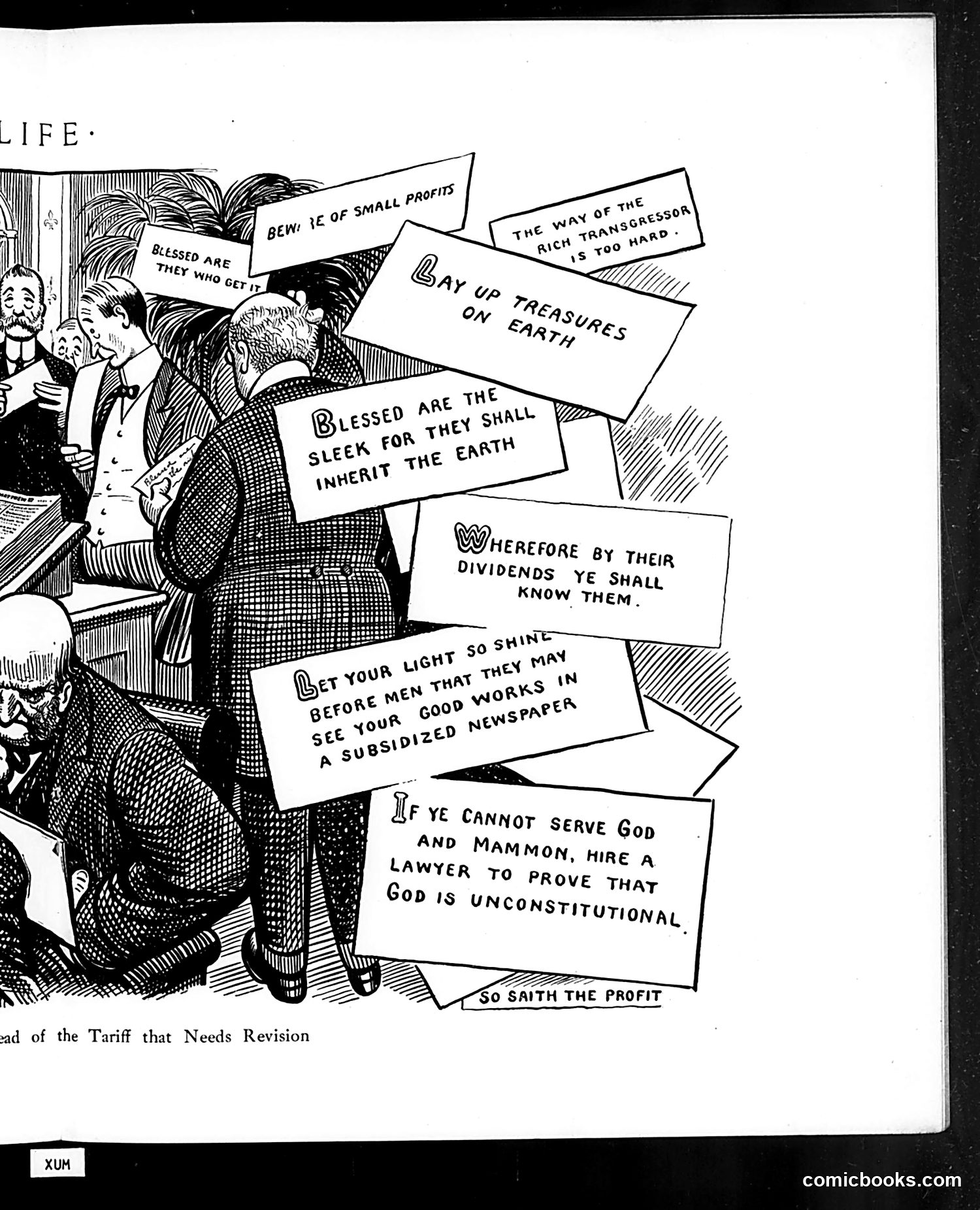
This satirical cartoon depicts wealthy businessmen/industrialists using distorted religious language to justify profit-seeking. The figure appears to be a bloated capitalist spouting perverted Biblical passages as justifications for greed: - "Blessed are the sleek" (mocking the Beatitudes) - References to "mammon" (biblical term for wealth/greed) - Mocking "small profits" and advocating "treasures on earth" - The final jab: hiring lawyers to prove "God is unconstitutional" The satire targets wealthy industrialists who cynically misuse religious rhetoric to legitimize capitalist excess while abandoning genuine Christian ethics. The phrase "So saith the Profit" (pun on "prophet") emphasizes these are false prophets of materialism. The caption references tariff revision, suggesting this critiques business interests manipulating policy. The cartoon appears to be from an era of progressive critique of robber-baron capitalism and religious hypocrisy.
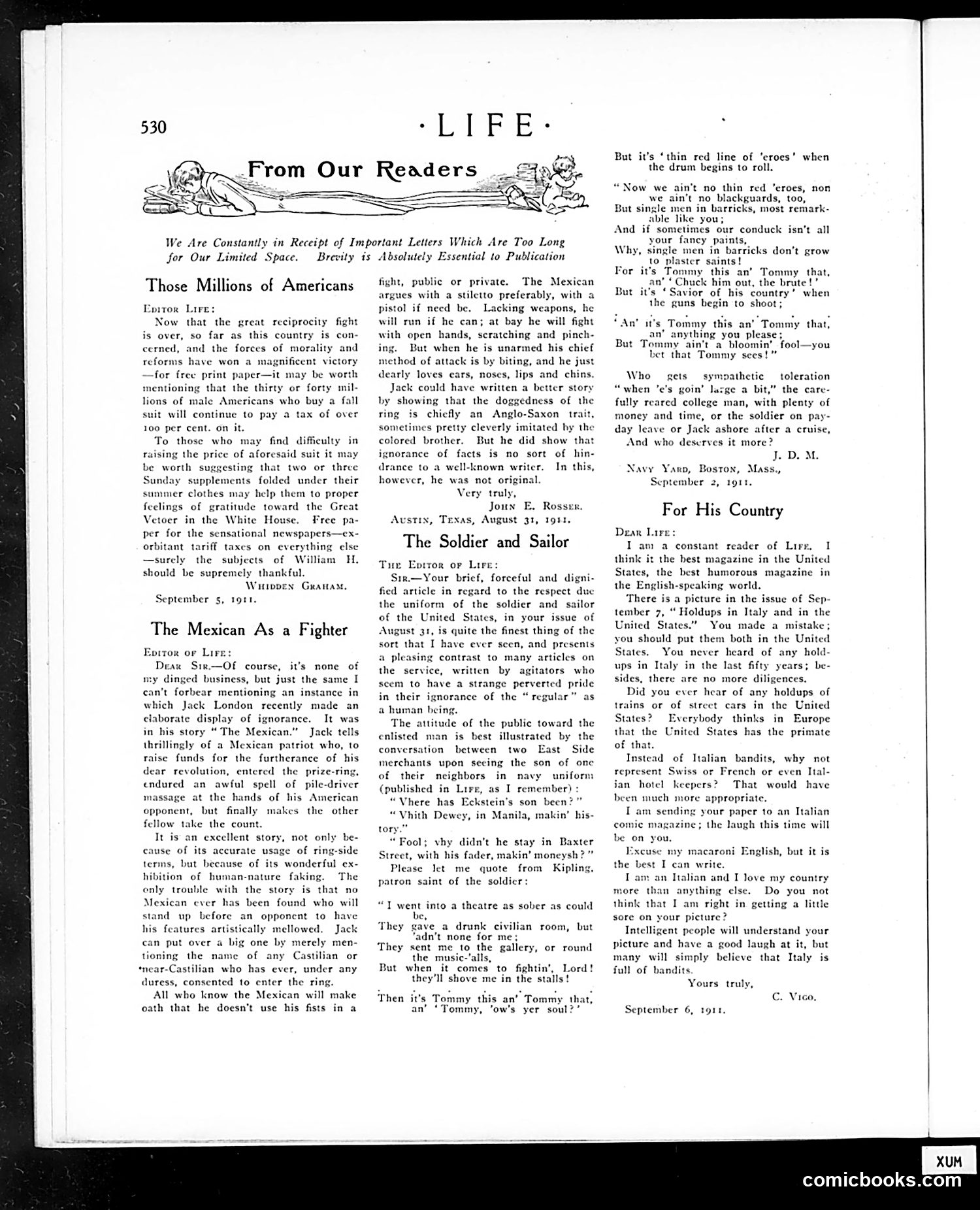
This is a **readers' letters section** from Life magazine, not primarily a cartoon page. Three letters discuss contemporary issues: 1. **"Those Millions of Americans"**: Critiques President Taft's tariff policy—celebrates free trade on newspaper paper while complaining that ordinary Americans pay 100% tariffs on clothing. The satire: reformers celebrate one victory while ignoring workers' struggles. 2. **"The Mexican As a Fighter"**: Attacks Jack London's short story "The Mexican" for romanticizing a Mexican revolutionary boxer. The letter argues London fabricated the story's premise—Mexicans actually prefer knives/pistols to boxing and bite opponents. The point: criticizes London for ignoring factual reality for dramatic effect. 3. **"The Soldier and Sailor"**: Praises an earlier Life article defending military respect, then quotes a Yiddish-accented dialogue where an immigrant father thinks his son should earn money rather than serve in the Navy—mocking working-class immigrants' priorities. All three letters exemplify early 20th-century American debates about labor, immigration, foreign policy, and national identity.
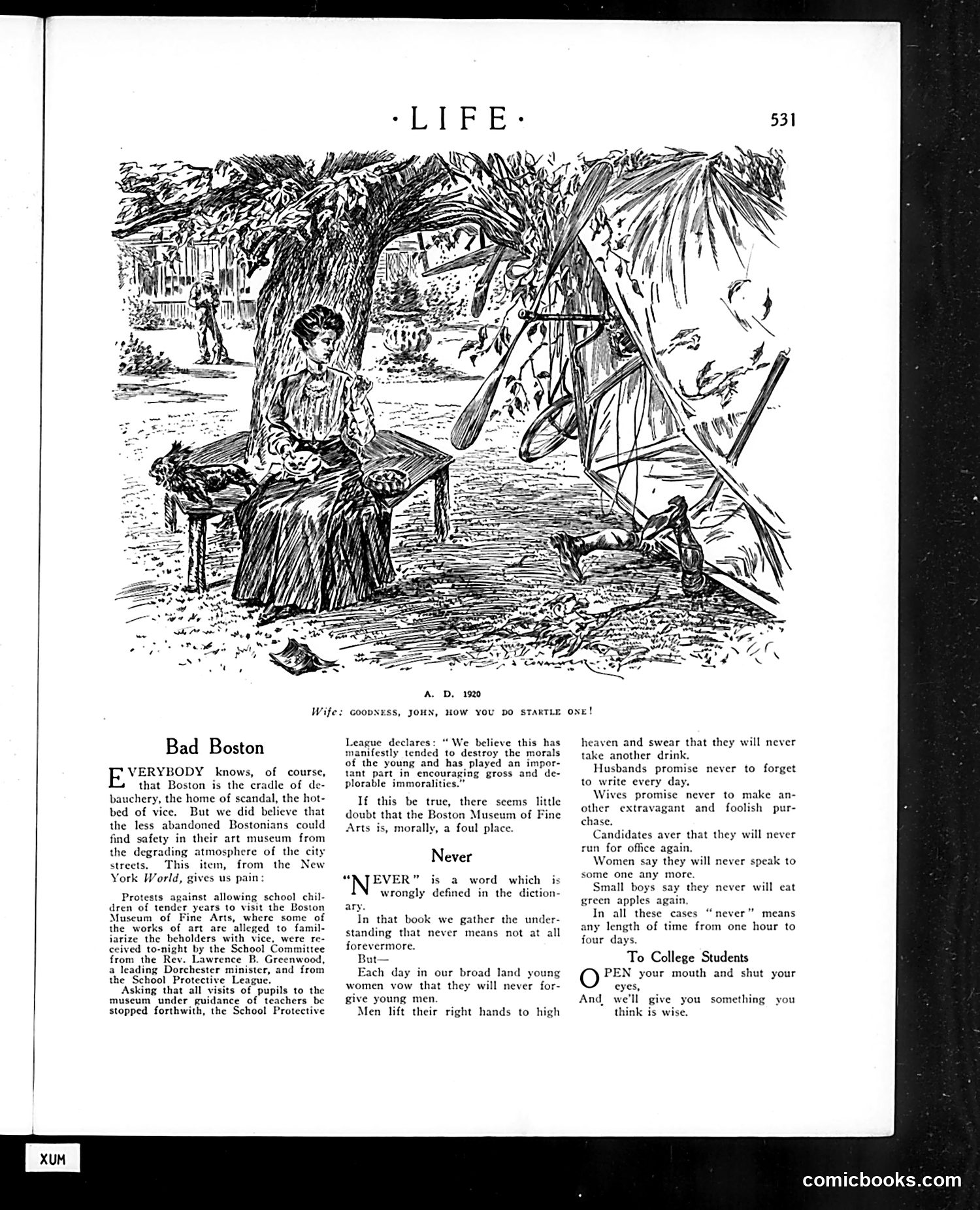
This page contains two satirical pieces from *Life* magazine (circa 1909, based on the illustration date): **"Bad Boston"** mocks Boston's reputation for moral scandal by sarcastically noting that even the city's art museum isn't safe from vice. The piece references a real controversy: religious leaders and the "School Protective League" demanded school children stop visiting the Museum of Fine Arts because certain artworks allegedly corrupted youth morality. Life ridicules this prudishness by suggesting Boston's moral decay is so complete that even "high art" can't escape the city's corrupting influence. **"Never"** satirizes the human tendency to make grand promises we immediately break. It catalogs everyday vows—from women swearing they'll never forgive men, to husbands promising to write daily, to politicians claiming they'll never seek office again—and notes these "nevers" typically last only hours or days. The tone is gently mocking of human weakness and hypocrisy. The cartoon above shows a woman startled by something (unclear what), accompanying the "Never" piece's theme about broken promises.
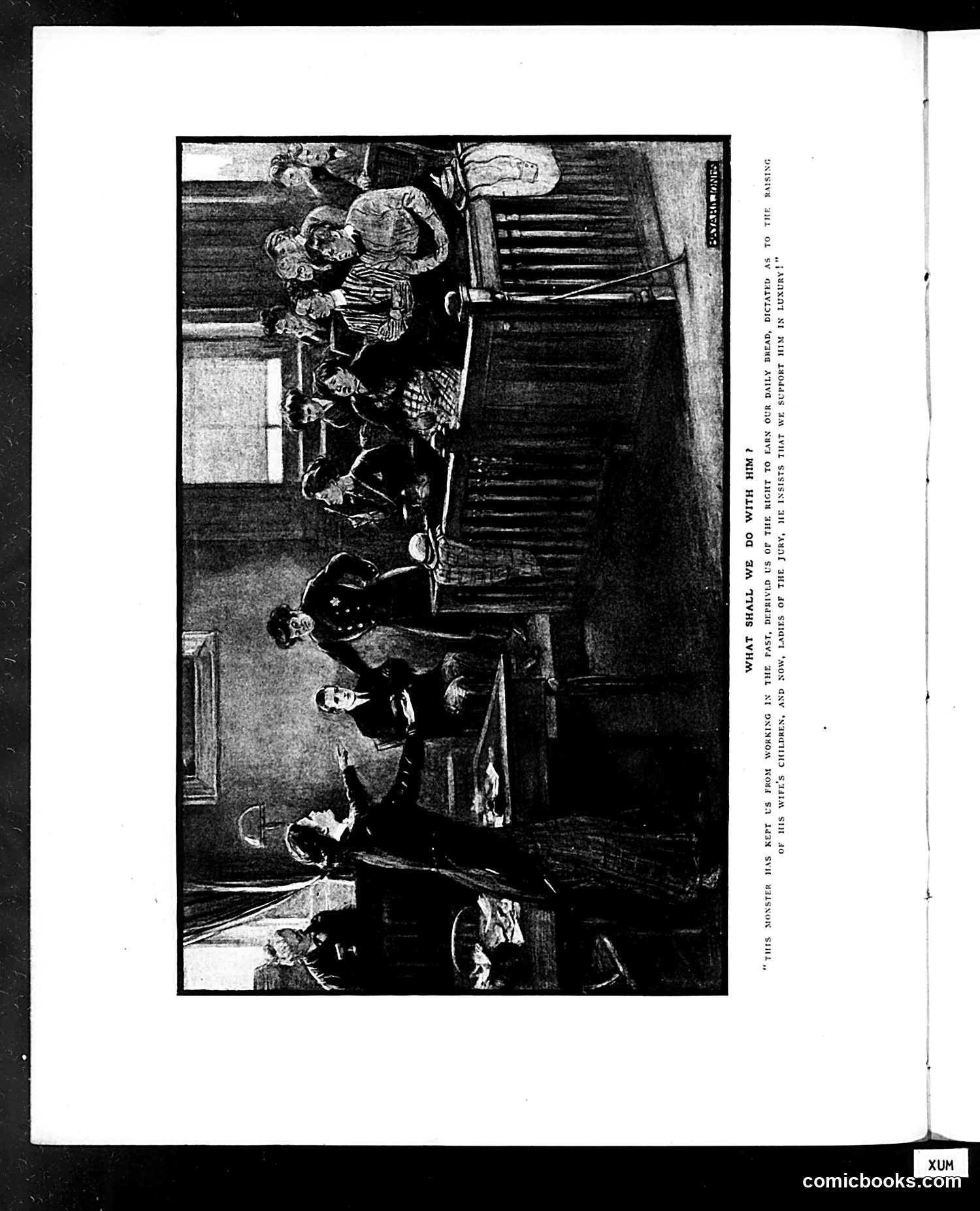
The OCR text is severely corrupted and unreadable, making it impossible to determine the specific caption or context with confidence. However, the image itself shows what appears to be a **domestic interior scene** with multiple figures positioned on and around stairs. The photograph is oriented sideways, suggesting it may be illustrating a humorous or satirical point about spatial relationships or social hierarchy. The formal dress of the figures and the architectural setting suggest this is likely **social satire** typical of *Life* magazine's humor. Without legible text, I cannot identify specific individuals, date the cartoon, or explain the intended joke. The image quality and OCR corruption prevent accurate analysis of what satirical point was being made.
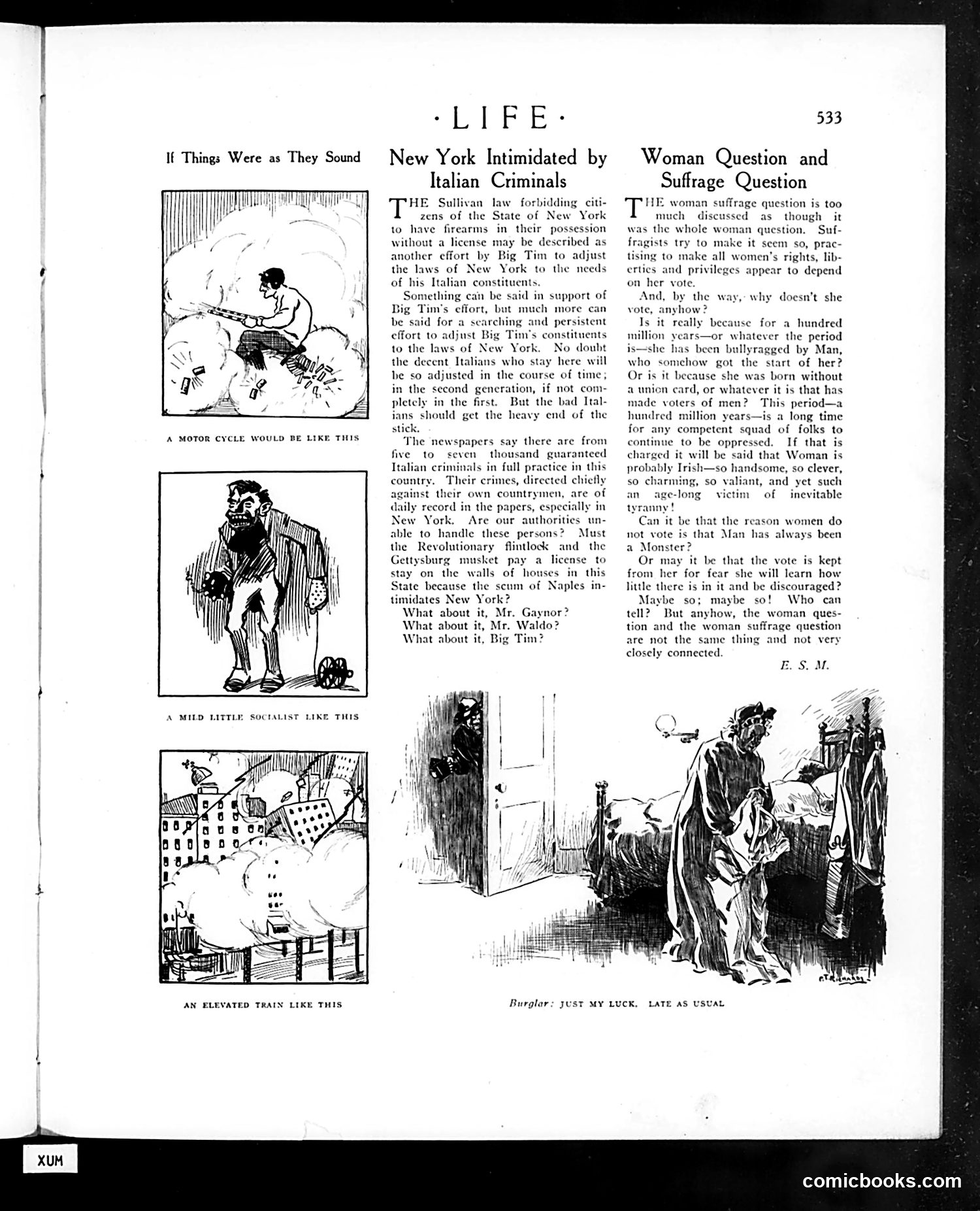
This page contains two separate satirical pieces: **"New York Intimidated by Italian Criminals"** (left column): A political attack on "Big Tim" (likely Big Tim Sullivan, a Tammany Hall politician), criticizing the Sullivan Law—which restricted firearm possession without a license. The satire argues that this law was adjusted to protect Italian criminals from prosecution rather than to protect law-abiding citizens. The piece claims 5,000-7,000 Italian criminals operate freely in America, intimidating authorities. It sarcastically questions whether law-abiding New Yorkers must surrender constitutional rights because Italian immigrants ("the scum of Naples") threaten the city. The cartoons illustrate absurd scenarios (a motorcycle like a rocking chair, a mild socialist, an elevated train) captioned "as they sound." **"Woman Question and Suffrage Question"** (right column): This dismisses women's suffrage activism as overblown, arguing the vote isn't women's primary issue. The author skeptically questions why women don't vote, suggesting excuses about male oppression are exaggerated. The closing cartoon shows a burglar caught—a punchline about bad luck unrelated to the text. Both pieces reflect early 20th-century satirical magazine style: anti-immigrant sentiment and dismissiveness toward women's rights advocacy.
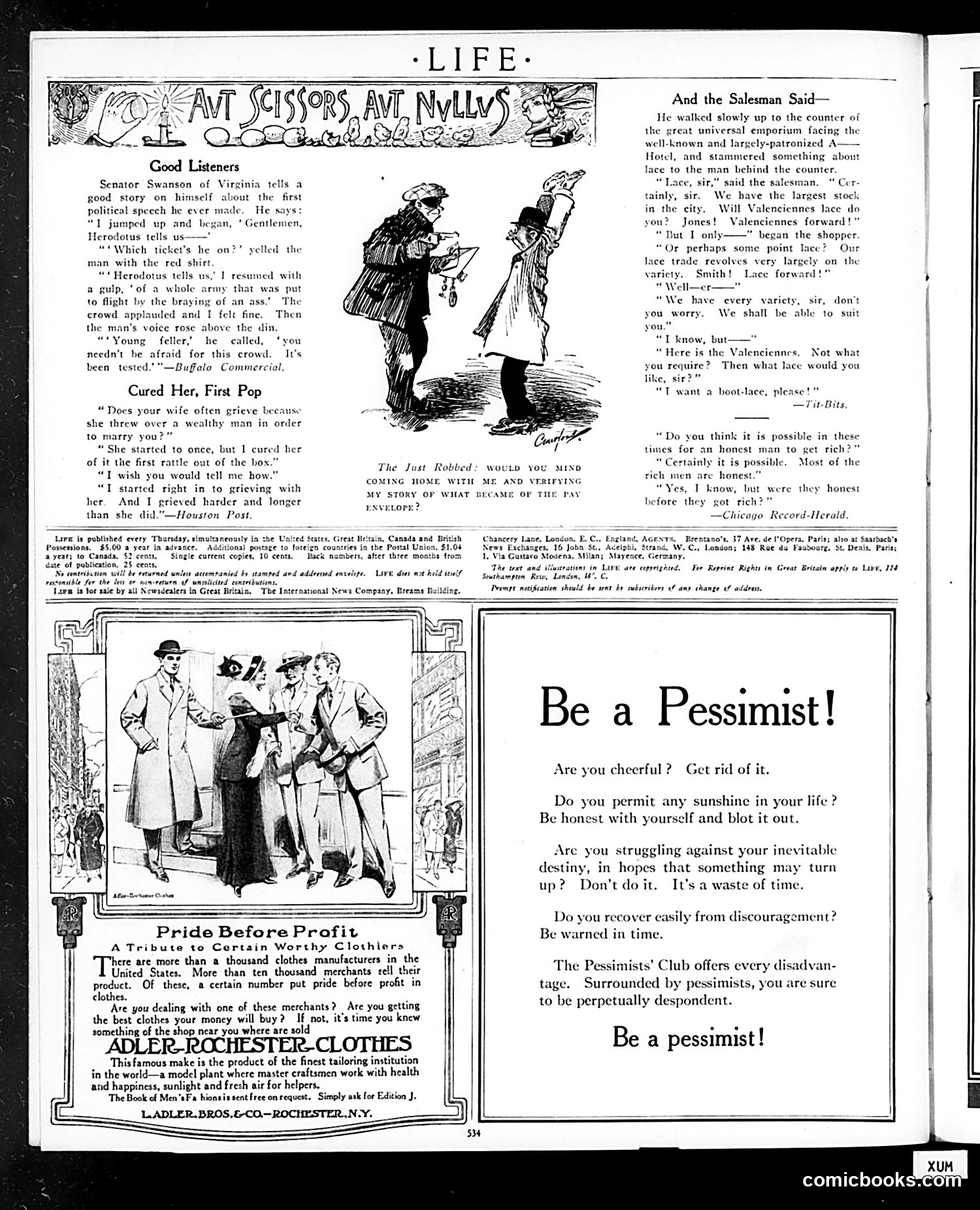
This page contains three satirical anecdotes and advertisements typical of early 20th-century Life magazine humor. **"Good Listeners"** mocks political speechmaking: Senator Swanson recounts his first speech, which opened with classical references (Herodotus) before a heckler interrupted—the joke being that even erudite oratory cannot impress working-class audiences ("man with the red shirt"). **"Cured Her, First Pop"** uses domestic humor: a husband prevents his wife's regret over marrying him by grieving *with* her until she stops—suggesting that shared misery bonds couples. **"The Just Robbed"** depicts a confused customer asking for "boot-lace" (shoelace) at an upscale lace counter, expecting fine textiles like Valenciennes lace. The satire targets both the salesman's obsequious verbosity and the customer's bewilderment in a department store. The page also includes a satirical advertisement encouraging pessimism—ironic praise of joining a "Pessimists' Club"—and an ad for Adler-Rochester clothes emphasizing craftmanship over profit.
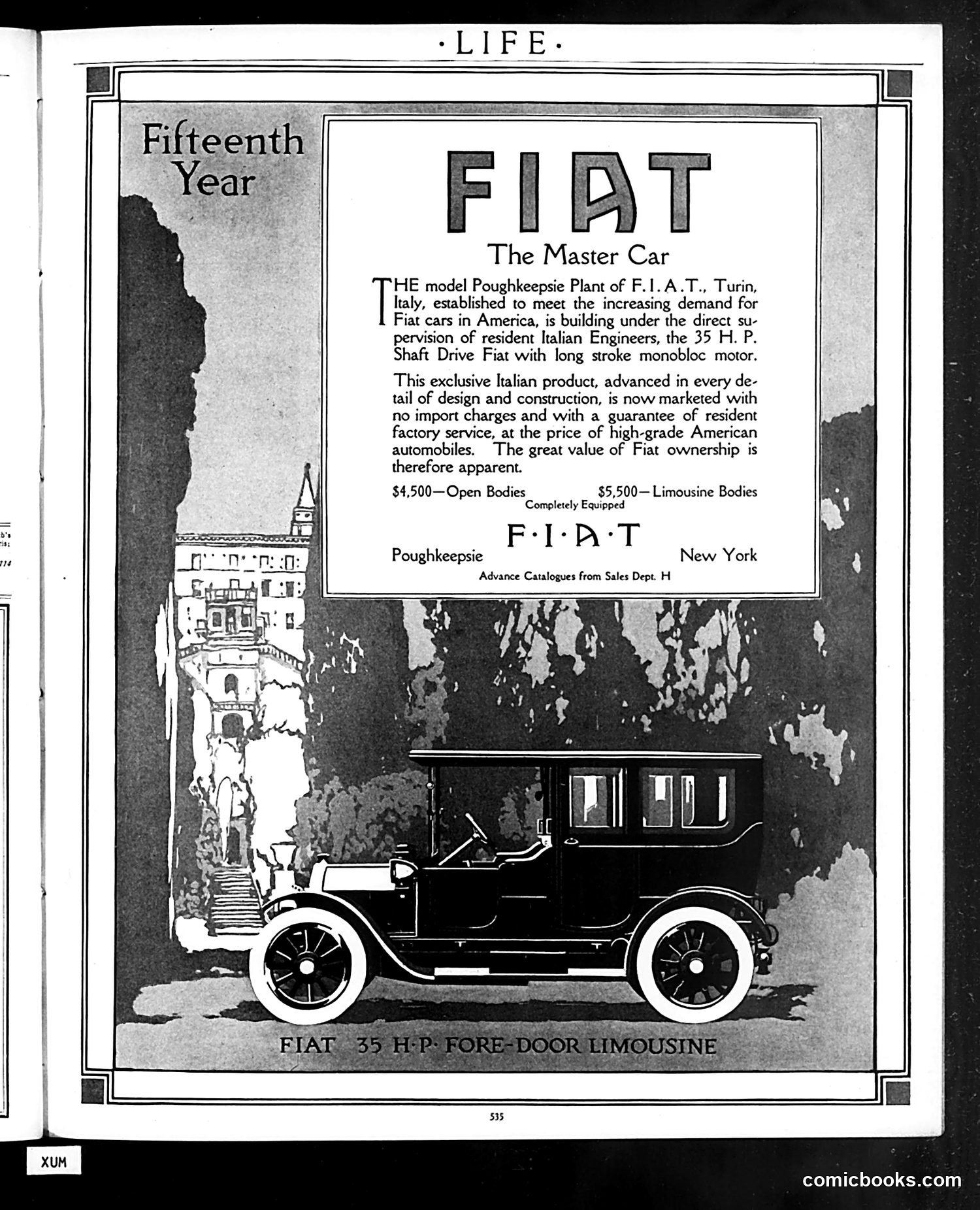
This is primarily a **car advertisement**, not political satire. It promotes the Fiat automobile to American readers during what appears to be the 1920s (based on the "Fifteenth Year" notation and vehicle style). **Key selling points:** - Fiat established a factory in Poughkeepsie, New York to avoid import tariffs - Italian engineering combined with American manufacturing proximity - Priced competitively with American luxury cars ($4,500-$5,500) - Features a 35 H.P. shaft-drive engine **The appeal to modern readers:** This reflects post-WWI economic nationalism—Fiat emphasized Italian prestige and engineering while leveraging domestic American production to undercut import costs and tariffs. The Italian architectural illustration (appears to be a European tower/landmark) positioned the brand as sophisticated and Old World-crafted. The advertisement contains **no satirical commentary**—it's straightforward marketing using period design conventions: elegant typography, artistic imagery, and emphasis on quality and value.
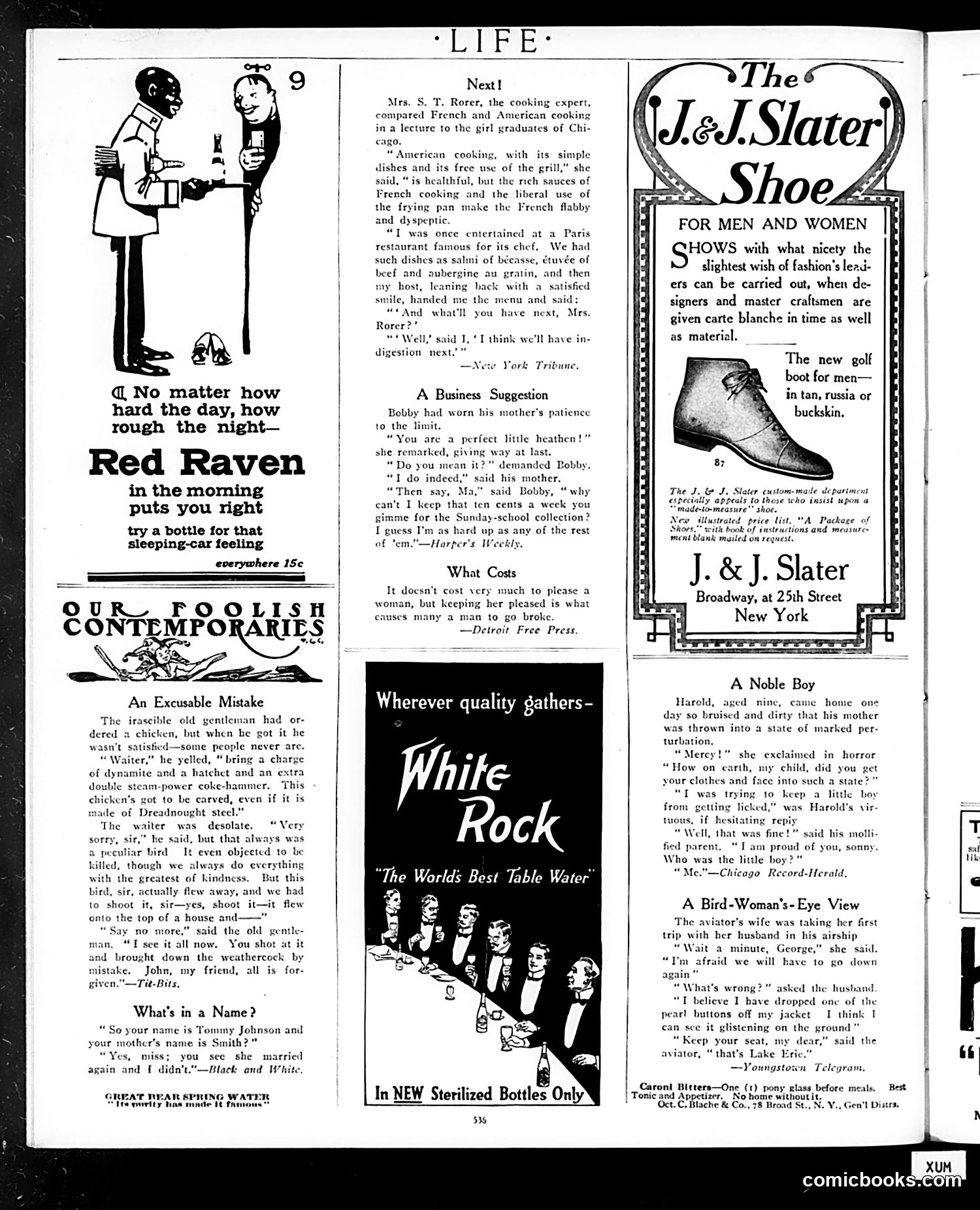
This page from *Life* magazine contains mostly humorous short anecdotes and advertisements, with no prominent political cartoons requiring historical context. The main satirical pieces are brief social jokes: - **"A Business Suggestion"**: A child's logic joke—Bobby argues that since he's "hard up" like adults, he shouldn't have to give his ten-cent allowance to Sunday school collection. - **"An Excusable Mistake"**: A man orders chicken but is unsatisfied; a waiter mistakenly shoots the weathercock (roof ornament) instead, then apologizes—playing on miscommunication and the man's unreasonable demands. - **"What's in a Name?"**: A simple pun about Tommy Johnson whose mother married, creating confusion. - **"A Noble Boy"**: Harold claims he got dirty fighting to protect "a little boy"—revealing it was himself. These reflect early 20th-century humor: domestic situations, class commentary, and children's logic. The remainder is advertising for Red Raven beverages, J&J Slater shoes, and White Rock water—period product placements common to *Life* magazine's format.
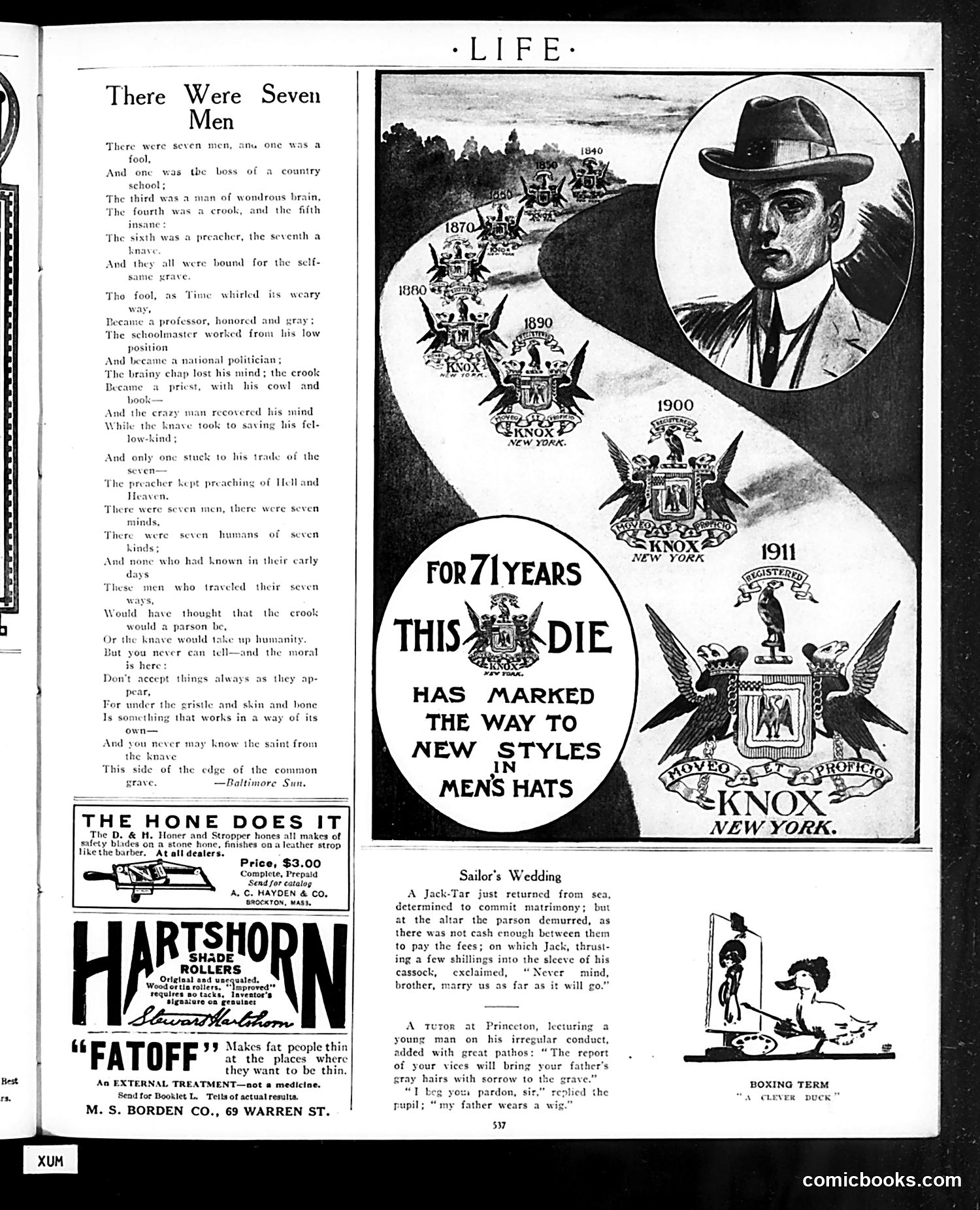
This page combines satirical poetry with period advertisements and humorous anecdotes, typical of early 20th-century *Life* magazine. **Main Content:** "There Were Seven Men" is a morality poem contrasting seven archetypes (fool, school official, scholar, madman, preacher, politician, crook) who all meet the same fate. The satire suggests that despite their different stations and supposed virtues, death equalizes everyone—and that appearances deceive. The final moral warns against judging by externals. **Advertisements:** Product ads for shaving hones, hat styles (Knox brand), and a weight-loss treatment reflect contemporary consumer culture. **Humorous Anecdotes:** Brief jokes about a sailor attempting to pay a clergyman to marry him ("as far as it will go") and a Princeton student's impudent reply to a moral lecture. These exemplify the magazine's satirical tone mocking authority figures and social pretension. The overall effect is characteristic *Life* satire: deflating social hierarchies and hypocrisy through verse, humor, and visual juxtaposition with commercial culture.
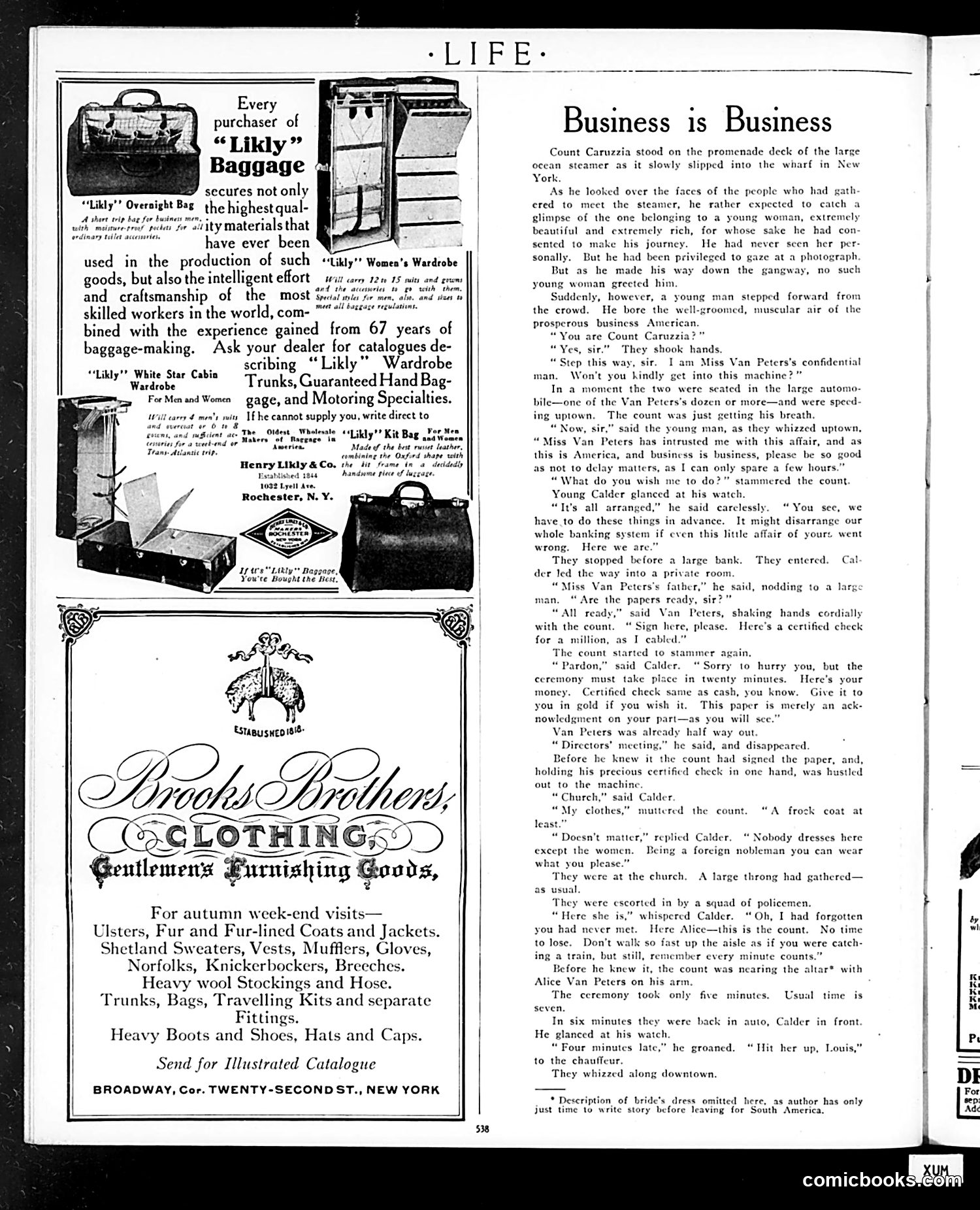
This page contains a short story satirizing American business pragmatism. Count Caruzzia arrives in New York expecting a romantic courtship with a wealthy young woman, Miss Van Peters. Instead, he's met by her confidential man, Calder, who treats the marriage as a pure business transaction to be expedited with ruthless efficiency. The satire targets American capitalism's infiltration into personal life: the Van Peters family has systematized courtship itself, scheduling the wedding ceremony in "twenty minutes" like a banking transaction. They present a certified check for a million dollars, reduce the count to signing documents, and then disappear to a "directors' meeting"—treating matrimony as indistinguishable from commercial dealings. The joke is that in America, even romance is "business," conducted with contracts, efficiency, and emotional detachment rather than sentiment or passion. The count's romantic expectations clash absurdly with American commercial values.
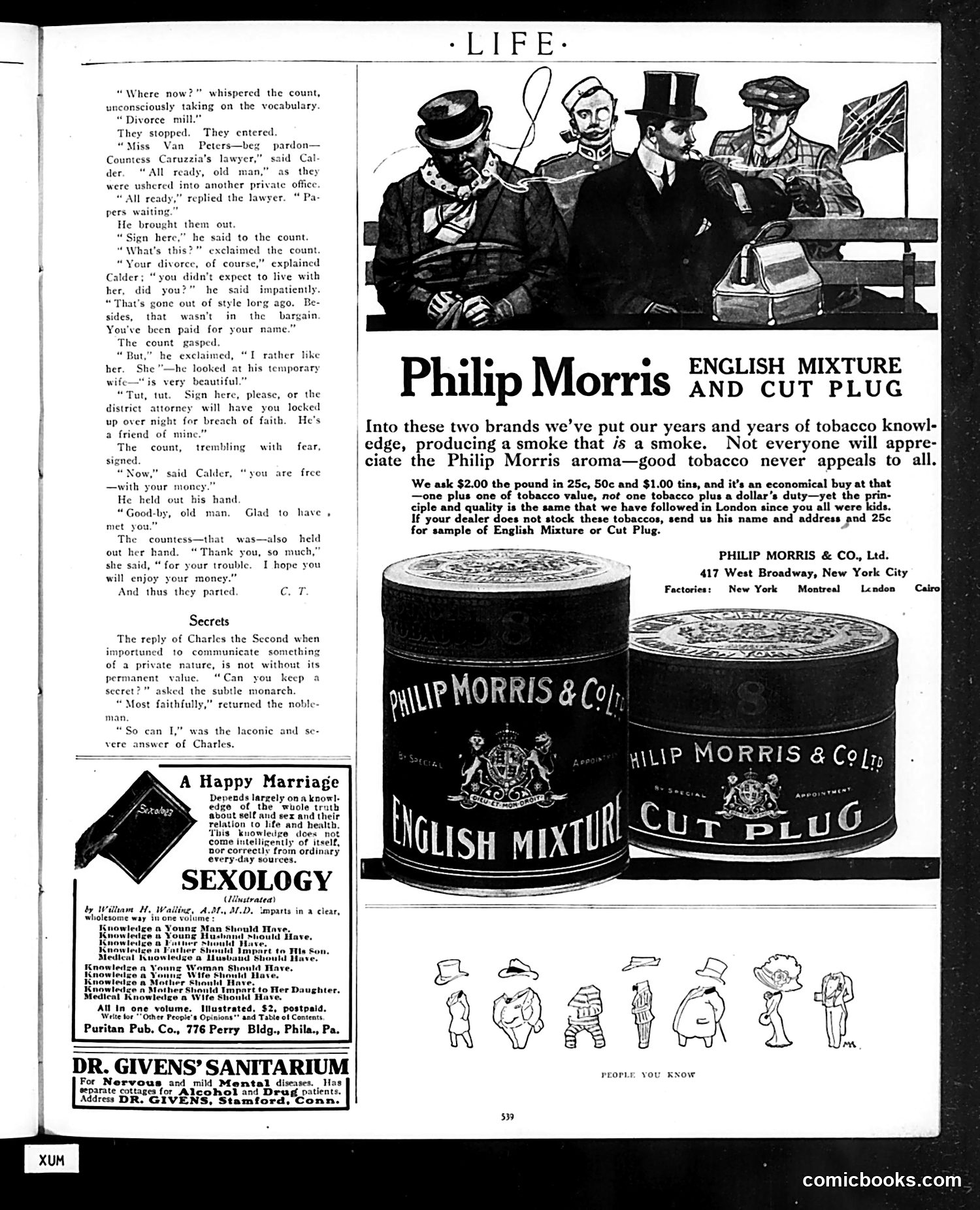
This page contains a satirical short story about aristocratic divorce. A European count seeks a quick divorce from his wife, engaging a lawyer named Calder. The joke centers on a cynical transactional marriage: the count marries a woman named Miss Van Peters (now "Countess Caruzzia") solely to gain a title, then immediately divorces her. When the count sentimentally claims to actually like his new wife, the lawyer dismissively orders him to sign the papers, noting the arrangement was never intended as a real marriage—"that's gone out of style long ago." The satire mocks both European aristocratic pretension and the commodification of marriage among the wealthy, where marriages are business transactions involving names and money rather than genuine relationships. The page also contains advertisements (Philip Morris tobacco, a "Sexology" book) and a brief anecdote about Charles II keeping secrets—unrelated filler content typical of Life's format.
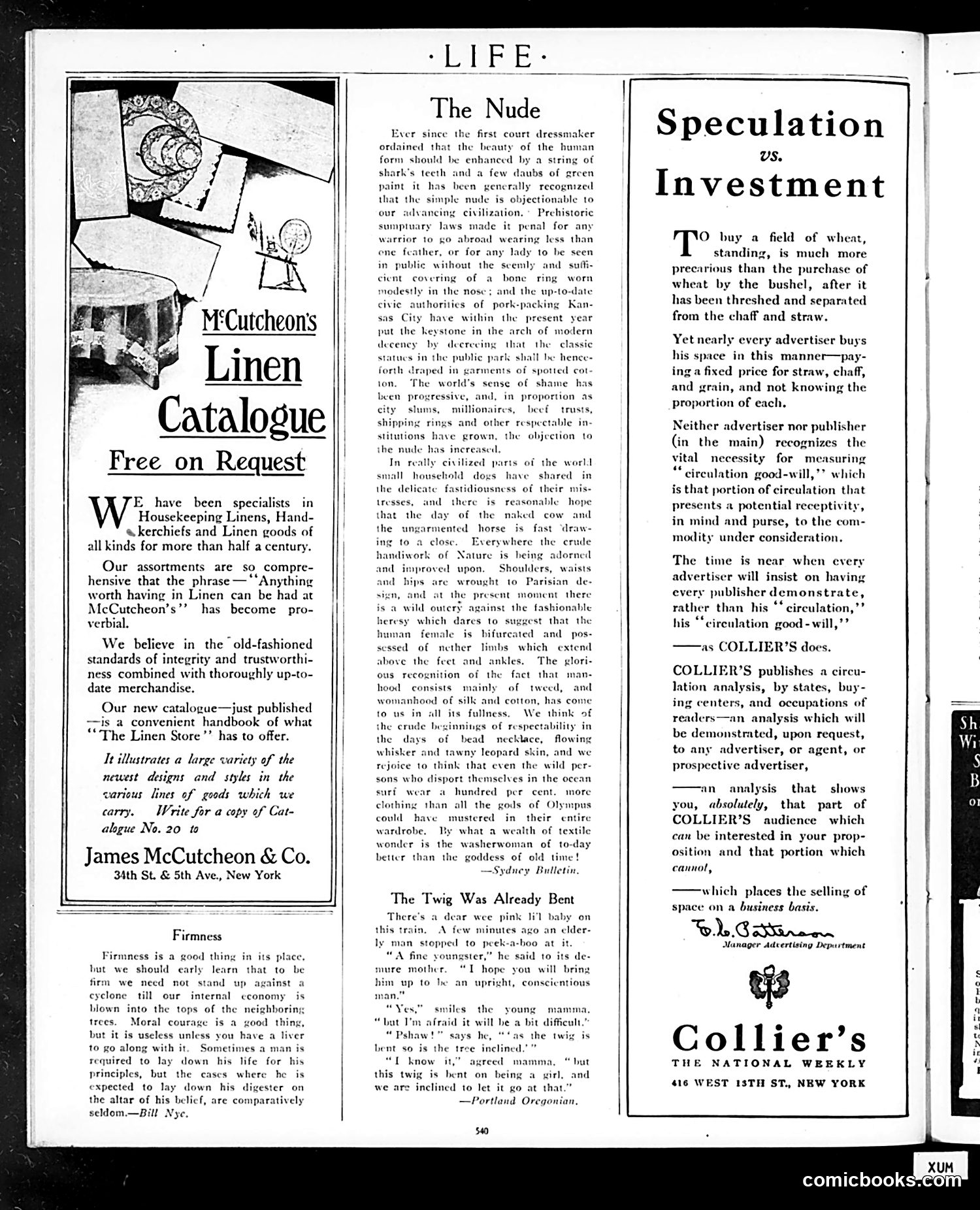
This page is primarily **advertising and editorial content** rather than political cartoons. The main illustrated advertisement is for **McCutcheon's Linen Catalogue**, featuring a decorative art nouveau-style drawing of linen goods and domestic items. The text articles are humorous essays typical of Life magazine's satirical style: 1. **"The Nude"** — A lengthy satire mocking society's prudishness about the human body. It traces how "civilization" has progressively required more clothing, even dressing public park statues. The joke: modern society obsesses over covering natural form while claiming moral progress. 2. **"Firmness"** — A short quip by Bill Nye about moral courage, humorously arguing that standing firm on principles shouldn't require sacrificing one's digestive health. 3. **"The Twig Was Already Bent"** (incomplete) — Appears to be another humorous anecdote. The **Collier's advertisement** on the right promotes their magazine's circulation data to advertisers—showing how they measure readership for potential clients. This reflects Life's core function: satirical social commentary mixed with advertising.
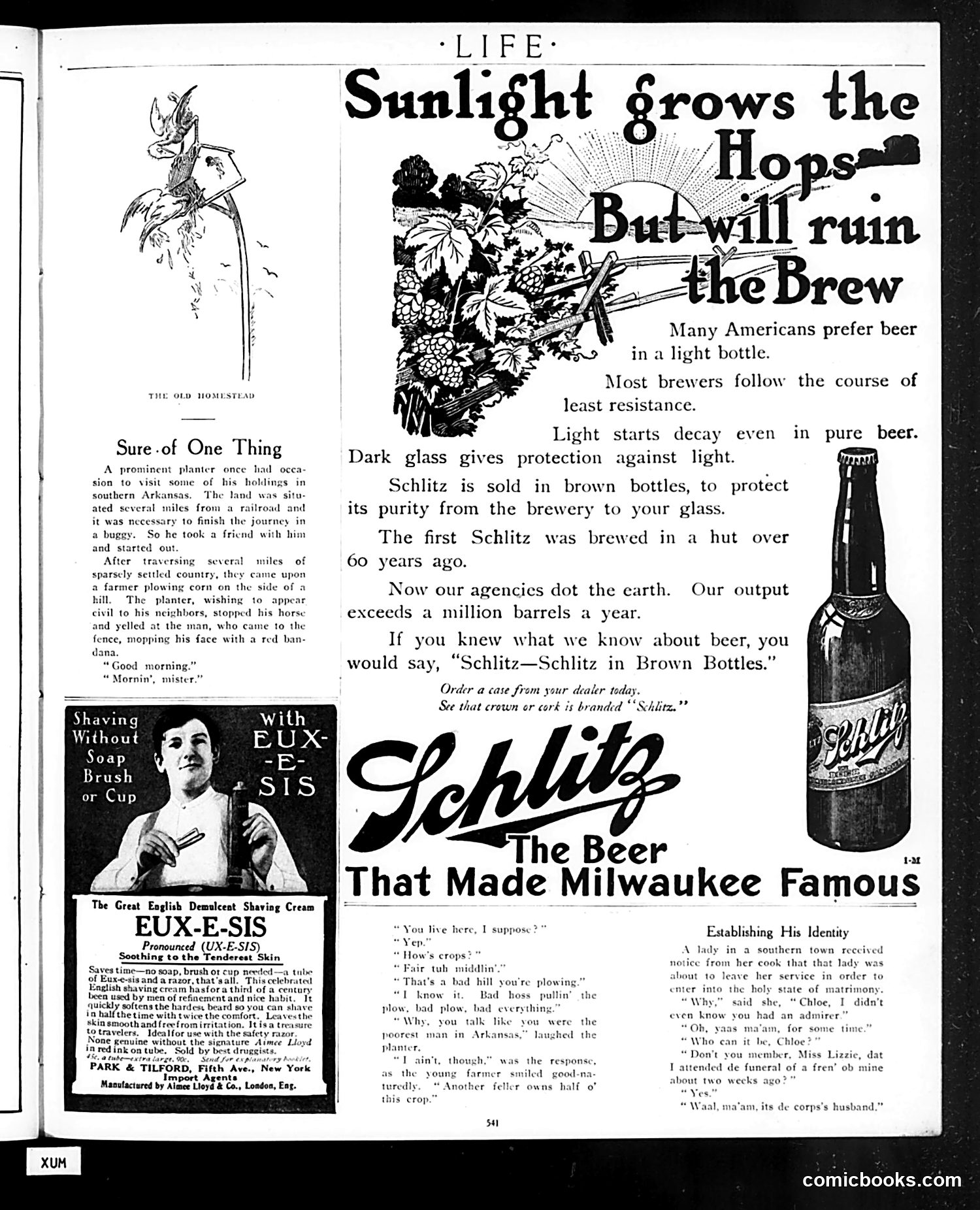
This page contains three distinct pieces of content: **Main Advertisement: Schlitz Beer** dominates the right side. The ad argues that sunlight ruins beer quality, positioning Schlitz's brown bottles as superior protection. It emphasizes the brand's German heritage ("brewed in a hut over 60 years ago") and Milwaukee manufacturing, using this as a quality marker. This reflects early 20th-century American beer marketing during pre-Prohibition era. **Left Side Story: "Sure of One Thing"** is a brief rural anecdote about a Southern planter greeting a farmer with false civility ("Good morning"/"Mornin', mister"), illustrating class tensions and social performance in the American South. **Bottom Left: EUX-E-SIS Shaving Cream Advertisement** promotes a British product claiming convenience without soap or brush. **Bottom Right: "Establishing His Identity"** is a humorous dialogue where a Southern Black cook's announcement of marriage surprises her white employer, who didn't realize she had a suitor. The humor derives from stereotypical dialect and the employer's condescension. The page reflects period attitudes toward race, class, and regional identity typical of early 20th-century American publishing.
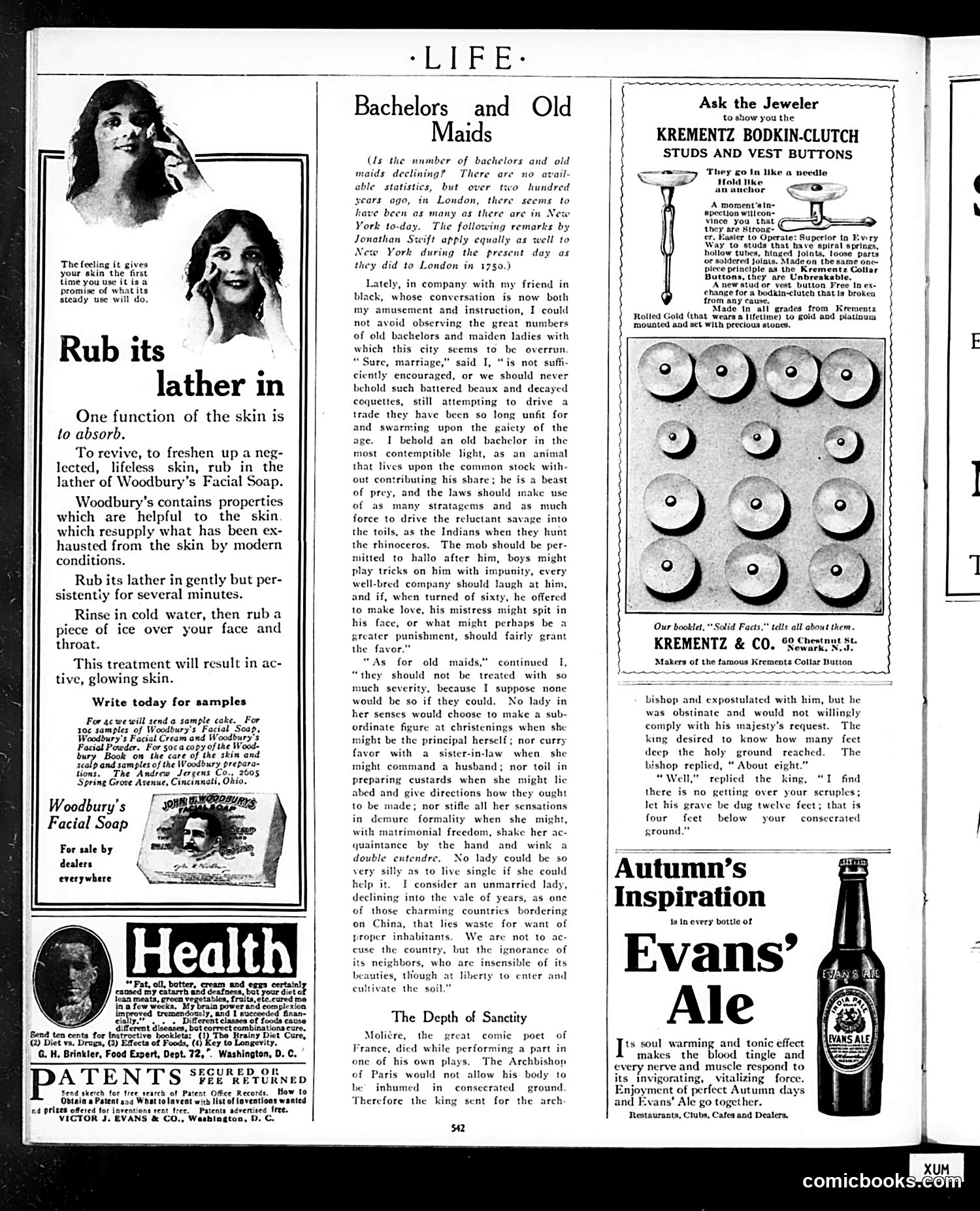
This page is primarily **advertising and social commentary**, not political satire. The main content is Jonathan Swift's 18th-century essay (republished here) criticizing unmarried people—particularly bachelors, whom Swift calls "beasts of prey" deserving public mockery, and old maids, whom he condescendingly pities as "waste" for lack of husbands. The accompanying **advertisements** (Woodbury's Facial Soap, Evans' Ale, patent medicines) use images of attractive young women, reflecting the era's emphasis on feminine beauty for matrimonial prospects—ironically reinforcing Swift's themes about women's limited social value outside marriage. For modern readers: This represents early 20th-century attitudes treating marriage as women's primary purpose and legitimizing social scorn toward the unmarried. The juxtaposition of Swift's harsh judgments with beauty product ads underscores how women's worth was culturally tied to marriageability and appearance.
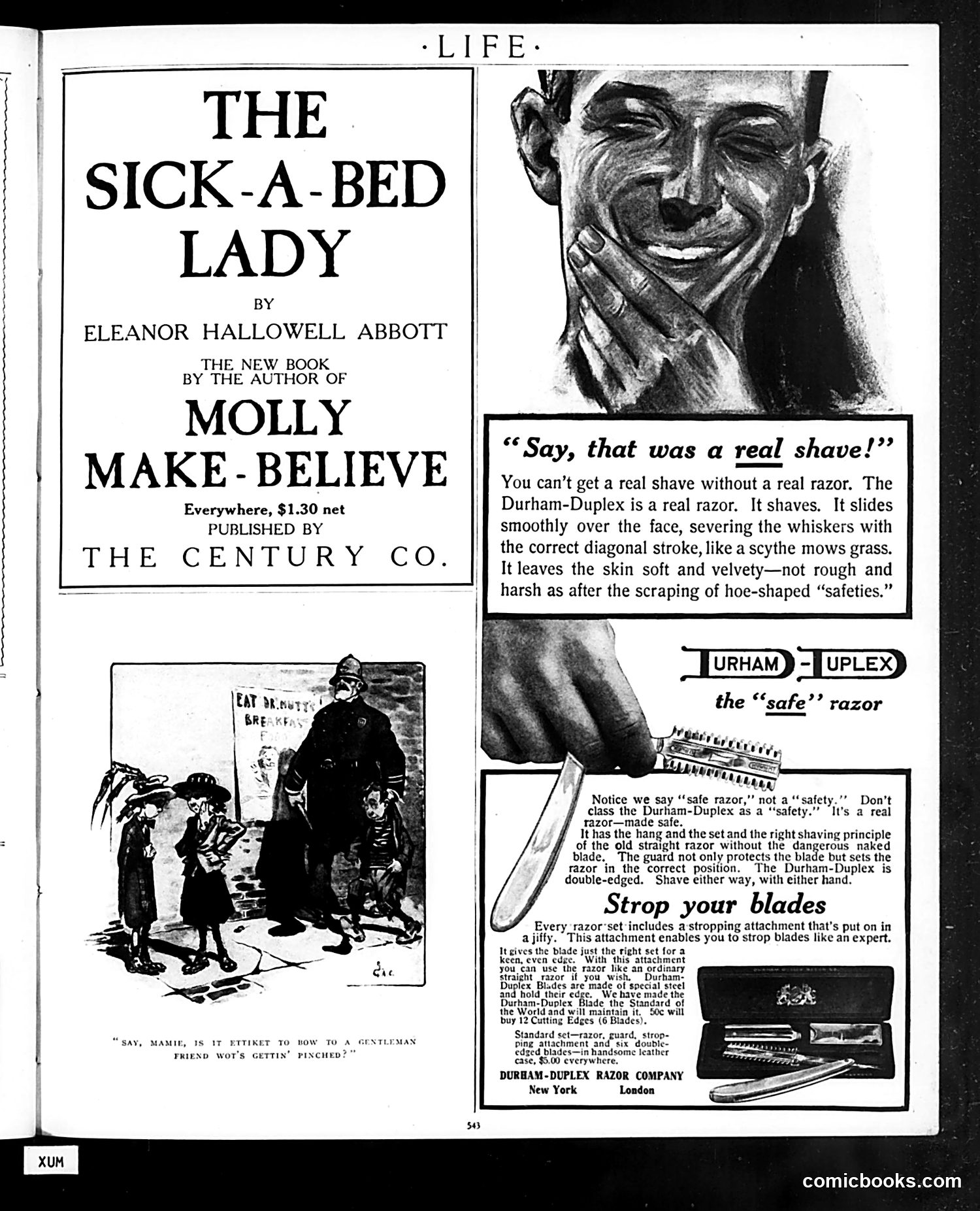
This is primarily a **book advertisement** (left) and **razor advertisement** (right) from Life magazine, with minimal satirical content. **Left side:** Promotes Eleanor Hallowell Abbott's novel *The Sick-a-Bed Lady*, published by Century Co. The small cartoon below shows two working-class figures in period dress discussing etiquette—a genteel topic treated humorously by common people ("Say, Mamie, is it etiquette to bow to a gentleman friend wot's gettin' pinched?"). The joke appears to satirize class pretensions: lower-class characters awkwardly applying upper-class social rules. **Right side:** A **Durham-Duplex razor advertisement** featuring a man's satisfied face after shaving. The ad emphasizes the razor's superiority over "safety" razors, claiming it provides a genuinely smooth shave without skin irritation. The marketing distinguishes their product as a "real razor—made safe" rather than merely a safety device. Both elements reflect early 20th-century consumer culture and class-conscious humor typical of Life magazine's approach.
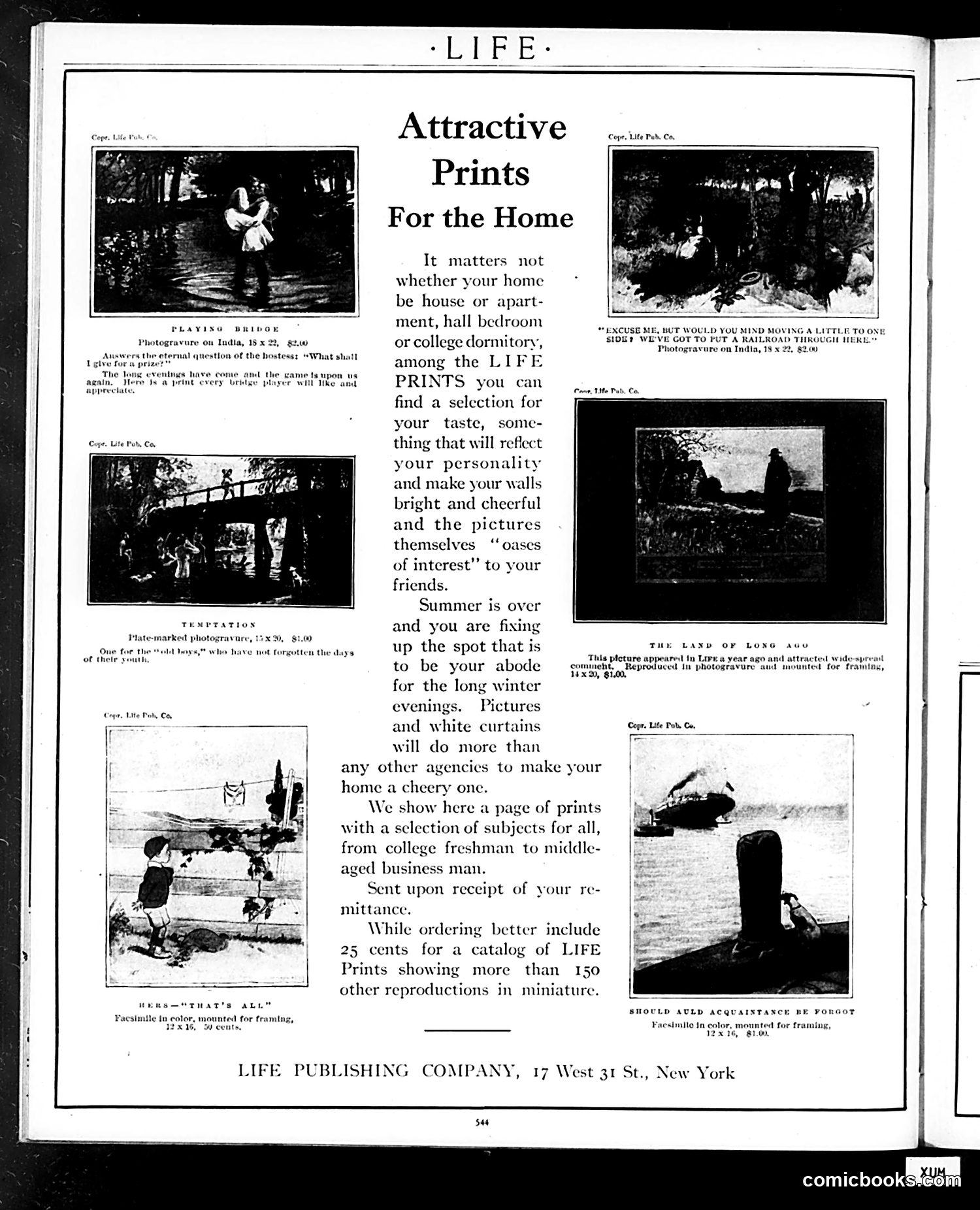
This is primarily **advertising content**, not satire or political commentary. The page promotes Life Publishing Company's line of decorative home prints for sale. The five photographs shown are landscape and genre scenes—a couple playing bridge, people on a wooden bridge, a rural figure, and water scenes—presented as affordable wall decoration options. The accompanying text targets middle-class homeowners seeking to make their interiors "bright and cheerful" during the transition from summer to winter. The only element approaching humor appears in the photograph captions: one print's title, "Excuse me, but would you mind moving a little to one side?" suggests a mild domestic comedy scenario, though the image itself is unclear. This represents early 20th-century consumer marketing: Life magazine (then a general-interest publication) used its pages to sell merchandise directly to readers, positioning artistic prints as accessible luxury items for various demographics from "college freshman to middle-aged business man."
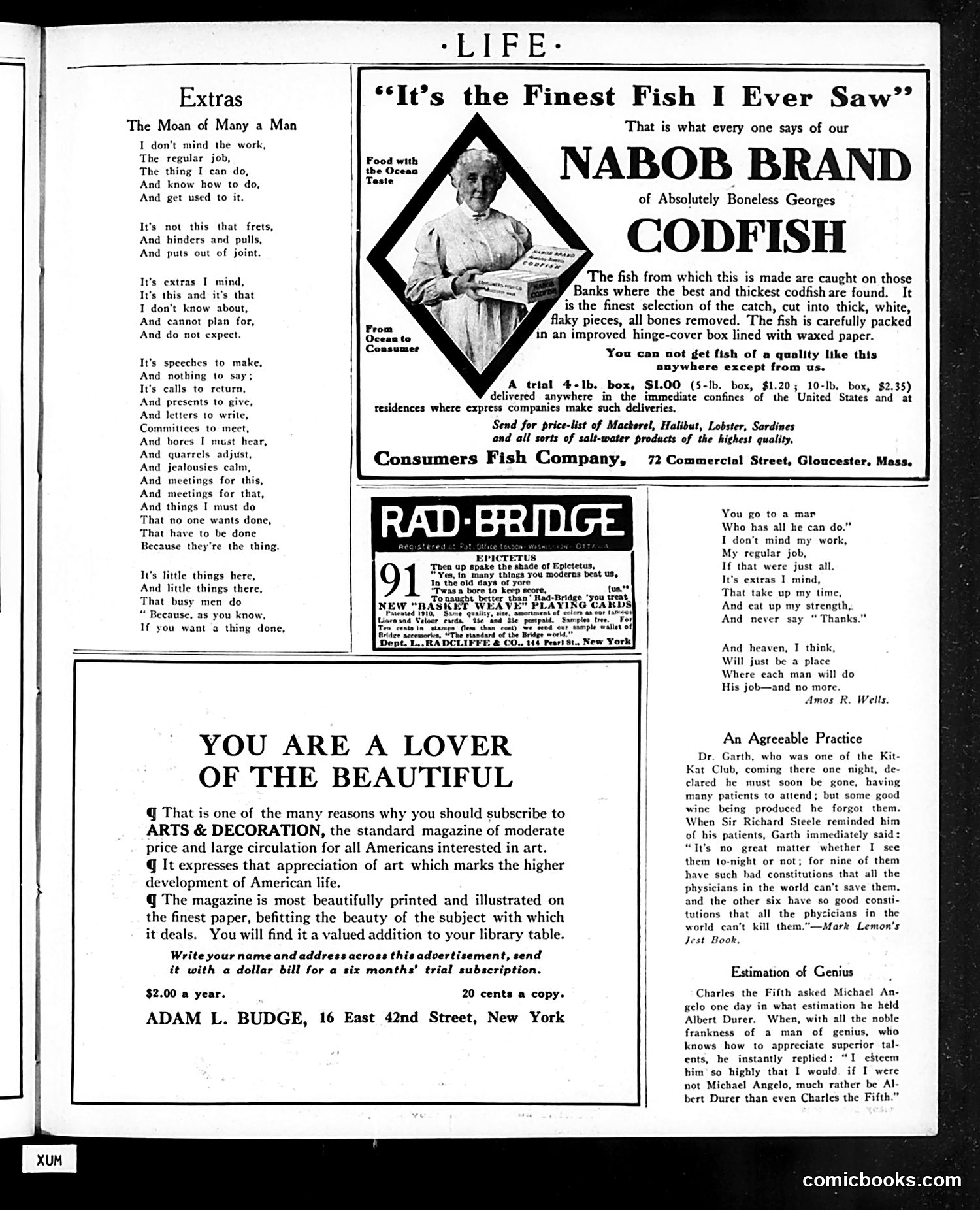
This page is primarily **advertising and lighter content**, not political satire. The main elements are: **"The Moan of Many a Man"** (left): A poem by Amos R. Wells lamenting how salaried workers resent unpaid "extras"—speeches, committees, social obligations—that drain time and energy without gratitude. It's relatable workplace frustration about invisible labor beyond one's job description. **Nabob Brand Codfish ad** (top right): A straightforward food advertisement featuring a woman holding packaged boneless codfish, sold mail-order from Gloucester, Massachusetts. **Rad-Bridge game ad** (middle left): An advertisement for what appears to be a card game. **"Arts & Decoration" subscription ad** (center): A magazine promotion targeting art-appreciating middle-class readers. **"An Agreeable Practice"** (right): A brief anecdote about Dr. Garth from the Kit-Kat Club, humorously dismissing his patients' health concerns—not particularly satirical. **"Estimation of Genius"** (bottom right): A historical anecdote about Michelangelo's opinion of Dürer. Overall, this is a **standard Life magazine page mixing light verse, advertisements, and brief humorous stories**—not political commentary.
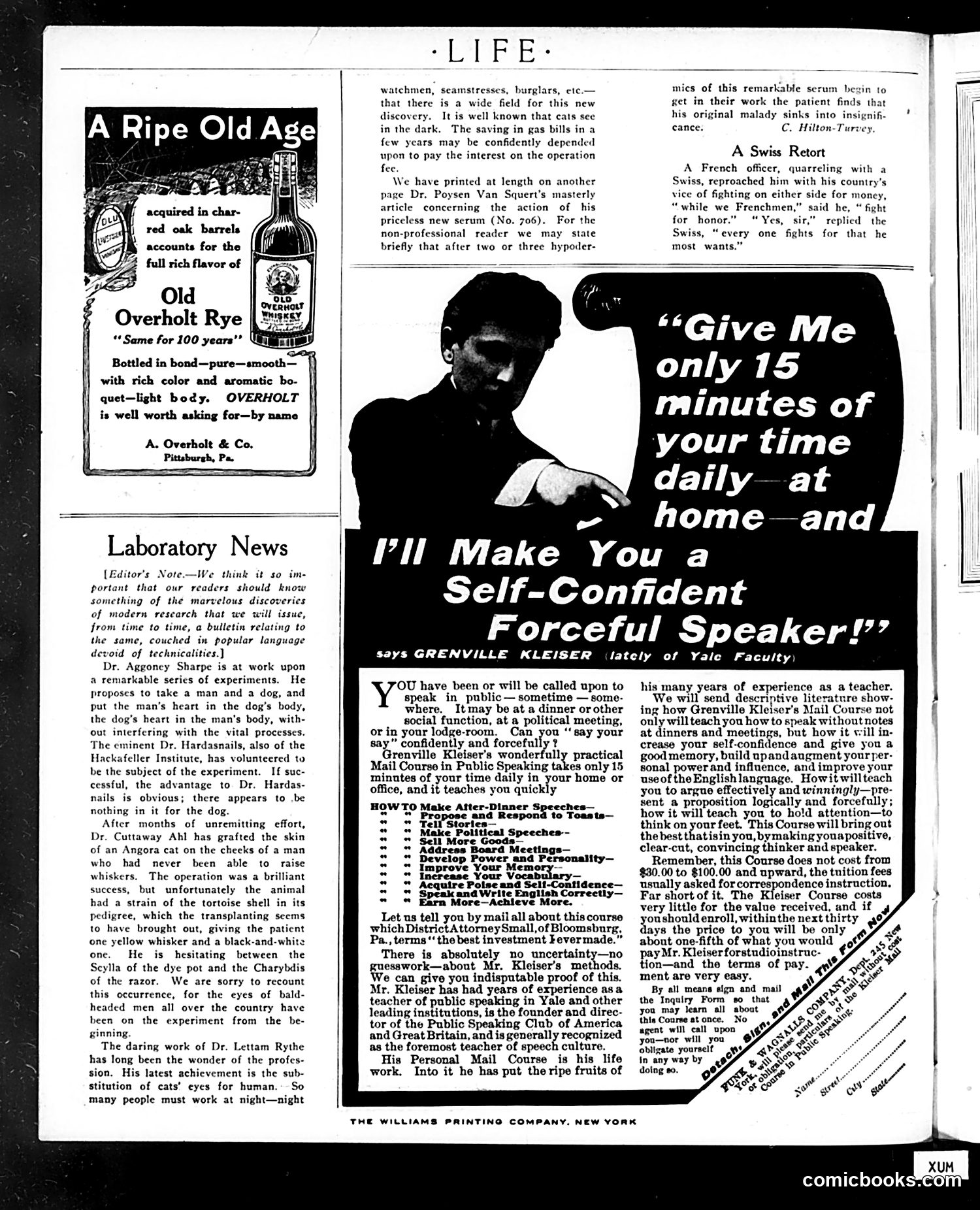
This page contains **satirical scientific articles** alongside advertisements. The "Laboratory News" section mocks pseudoscientific medical experimentation through absurdist humor. Dr. Aggoncy Sharpe proposes heart transplants between humans and dogs; Dr. Cuttaway Ahl grafts Angora cat skin onto a man's face (resulting in tortoiseshell-patterned whiskers); and Dr. Lettam Rythe replaces human eyes with cats' eyes for night vision—supposedly to save on gas bills. The satire targets contemporary obsession with modern "scientific progress" and its wild, unethical applications without considering practical consequences. A brief political anecdote (A Swiss Retort) contrasts French honor with Swiss pragmatism about mercenary motivation—likely reflecting WWI-era tensions. The remainder is **advertising**: Old Overholt Rye whiskey and Grenville Kleiser's mail-order public speaking course, positioned as solutions to modern social anxieties.
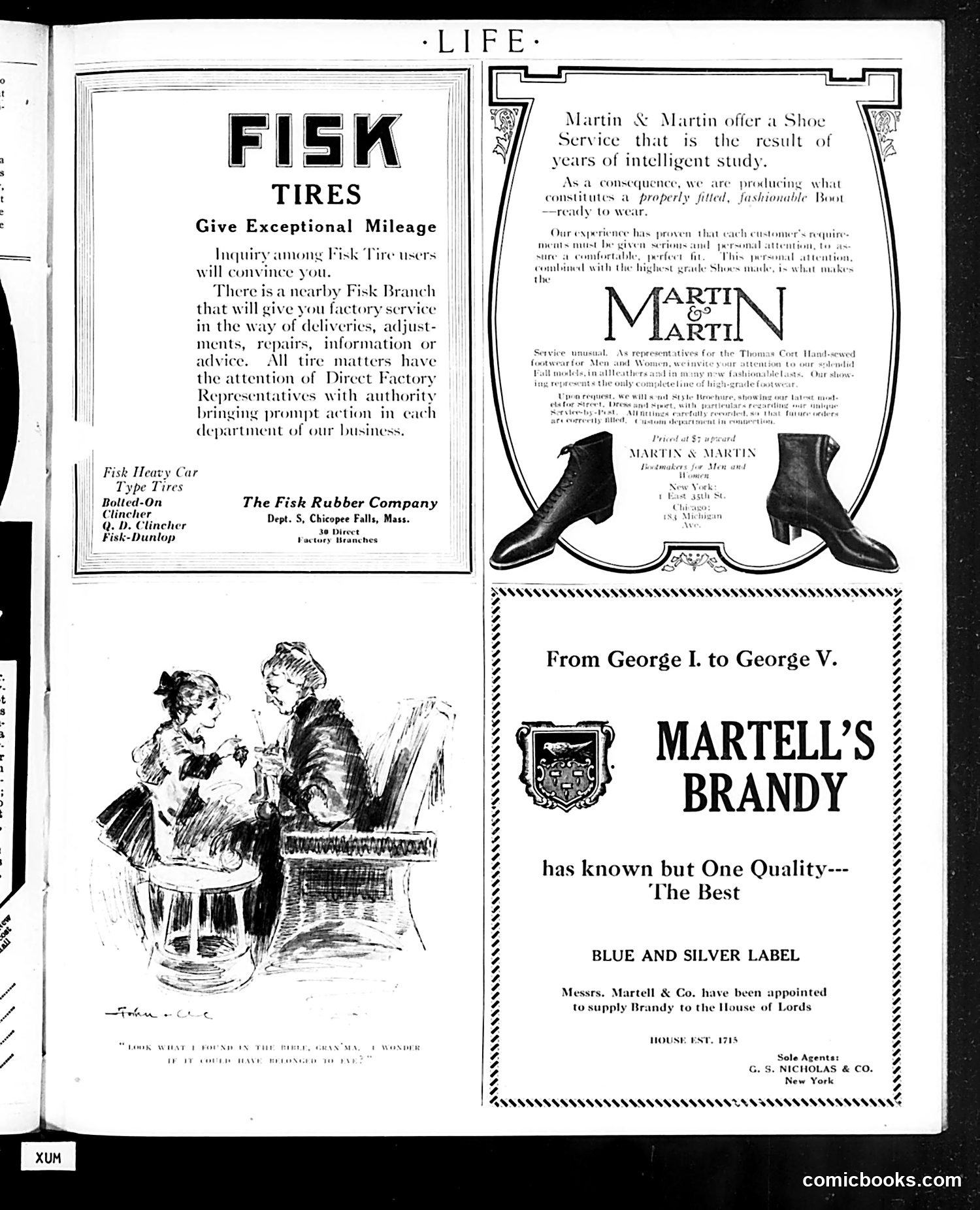
This page is primarily **advertising**, not political satire. It contains four advertisements: 1. **Fisk Tires** (top left): Emphasizes reliability and widespread service availability through factory branches. 2. **Martin & Martin Shoes** (top right): Promotes custom-fitted, fashionable boots as a premium service. 3. **A sketch cartoon** (bottom left): Shows two figures in conversation, with a caption referencing "the shell" and wondering if something "could have belonged to you"—likely a WWI-era joke about artillery shells, though the exact reference is unclear. 4. **Martell's Brandy** (bottom right): A luxury goods advertisement highlighting the brand's long history (established 1718) and royal patronage, using the phrase "From George I to George V" to emphasize centuries of quality across British monarchs. The page reflects early 20th-century advertising conventions and consumer products aimed at affluent readers.
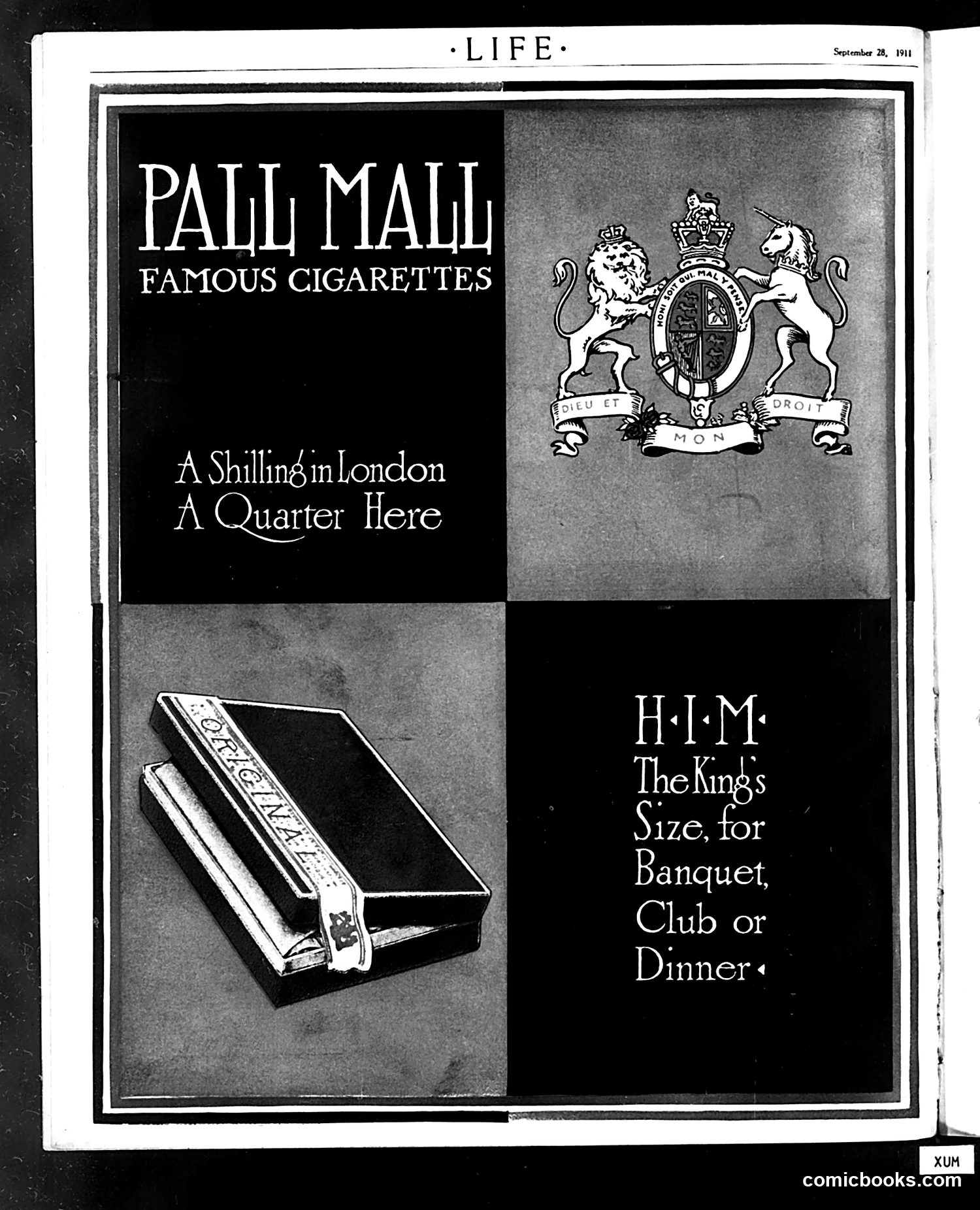
This is a **cigarette advertisement**, not political satire. The page promotes Pall Mall Famous Cigarettes, positioning them as a premium British product. The top features a royal coat of arms (lion and unicorn with crown), associating the cigarettes with British monarchy and prestige. The text emphasizes their status: "A Shilling in London / A Quarter Here" highlights their expensive positioning in both markets, while "H.I.M. The King's Size, for Banquet, Club or Dinner" suggests the product is appropriate for elite social occasions and implicitly endorsed by royalty ("H.I.M." = His Imperial Majesty). The lower left displays a Pall Mall cigarette package. This advertisement targets affluent American readers by leveraging British royal imagery and exclusivity as marketing tools.