
Life, 1911-09-28 · page 13 of 42
Life — September 28, 1911 — page 13: what you’re looking at
What you’re looking at
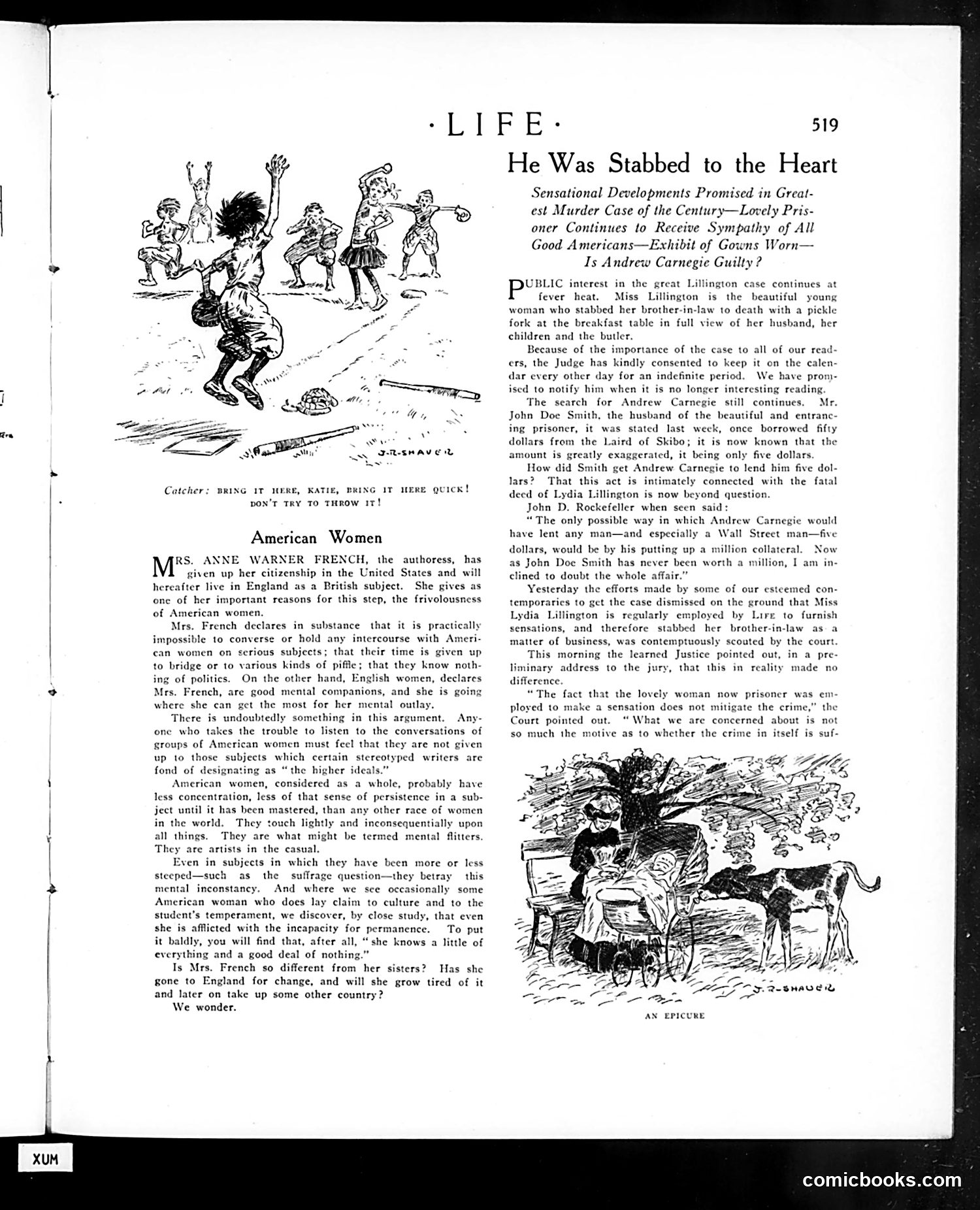
This page discusses the "Lillington case," a sensational murder trial where a young woman stabbed her brother-in-law with a pickle fork at breakfast. The article notes public fascination with the case and mentions Andrew Carnegie's reported involvement—apparently lending money to the defendant's husband. The top cartoon depicts children playing, seemingly oblivious or mocking the serious crime, suggesting public trivializing of the murder. The bottom illustration shows a woman with a dog, labeled "An Epicure"—likely satirizing how the defendant has become a media sensation, her notoriety making her fashionable despite committing murder. The satire critiques American society's appetite for sensational crime stories.
📄 Transcribed text from this page (OCR, searchable)
Machine-transcribed from the original scan — historical spelling and the odd misread are preserved.
ire ——— -LIFE- 519 a Sy LP WE wannavent Catcher: BRING 1T MERE, KATIE, BRING IT ItERE Quick! DON'T TRY TO THROW IT! American Women RNER FRENCH, the authoress, has given up her citizenship in the United States and will hereafter live in England as a British subject. She gives as one of her important reasons for this step, the frivolousness of American women. Mrs. French declares in substance that it is practi impossible 10 converse or hold any intercourse with Am can women on serious subjects; that their time is given up to bridge or to various kinds of pifle; that they know noth- ing of politics. On the other hand, E ish women, declares Mrs. French, are good mental companions, and she is going where she can get the most for her mental outlay, There is undoubtedly something in this argument. Any- one who takes the trouble to listen to the conversations of groups of American women must feel that they are not given up to those subjects which certain stereotyped writers are fond of designating as “the higher ideals.” American women, considered as a whole, probably have less concentration, less of that sense of persistence in a sub- ject until it has been mastered, than any other race of women in the world. They touch lightly and inconsequentially upon all things. They are what might be termed mental flitters. They are artists in the casual. Even in subjects in which they have been more or less steeped—such as the suffrage question—they betray this mental inconstancy. And where we sce occasionally some American woman who does lay claim to culture and to the student's temperament, we discover, by close study, that even she is afflicted with the incapacity for permanence. To put it baldly, you will find that, after all, “she knows a little of everything and a good deal of nothing.” Is Mrs. French so different from her sisters? Has she gone to England for change, and will she grow tired of it and later on take up some other country? We wonder. He Was Stabbed to the Heart Sensational Developments Promised in Great- est Murder Case of the Century—Lovely Pris- oner Continues to Receive Sympathy of All Good Americans—Exhibit of G Is Andrew Carnegie Guilty ? ns Worn— UBLIC interest in the great Lillington case continues at fever heat. Miss Lillington is the beautiful young woman who stabbed her brother-in-law to death with a pickle fork at the breakfast table in full view of her husband, her children and the butler. Because of the importance of the case to all of our read- ers, the Judge has kindly consented to keep it on the calen- dar every other day for an indefinite period. We have prom- ised to notify him when it is no longer interesting reading. The search for Andrew Carnegie still continues. Mr. John Doe Smith, the husband of the beautiful and entranc- ing prisoner, it was stated last weck, once borrowed fifty dollars from the Laird of Skibo; it is now known that the amount is greatly exaggerated, it being only five dollars. How did Smith get Andrew Carnegie to lend him five dol- lars? That this act is intimately connected with the fatal deed of Lydia Lillington is now beyond question. John D. Rockefeller when scen said: “The only possible way in which Andrew Carnegie would have lent any man—and especially a Wall Street_ man—five dollars, would be by his putting up a million collateral. Now as John Doe Smith has never been worth a million, I am in- clined to doubt the whole affair.” Yesterday the efforts made by some of our esteemed con- temporarics to get the case dismissed on the ground that Miss Lydia Lillington is regularly employed by Lire to furnish sen: tions, and therefore stabbed her brother-in-law as matter of business, was contemptuously scouted by the court This morning the learned Justice pointed out, in a pre liminary address to the jury, that this in reality made no difference. The fact that the lovely woman now prisoner was em- ployed to make a sensation does not mitigate the crime,” the Court pointed out. “What we are concerned about is not so much the motive as to whether the crime in itself is suf- AN EPICURE comicbooks.com