
Life, 1911-09-28 · page 10 of 42
Life — September 28, 1911 — page 10: what you’re looking at
What you’re looking at
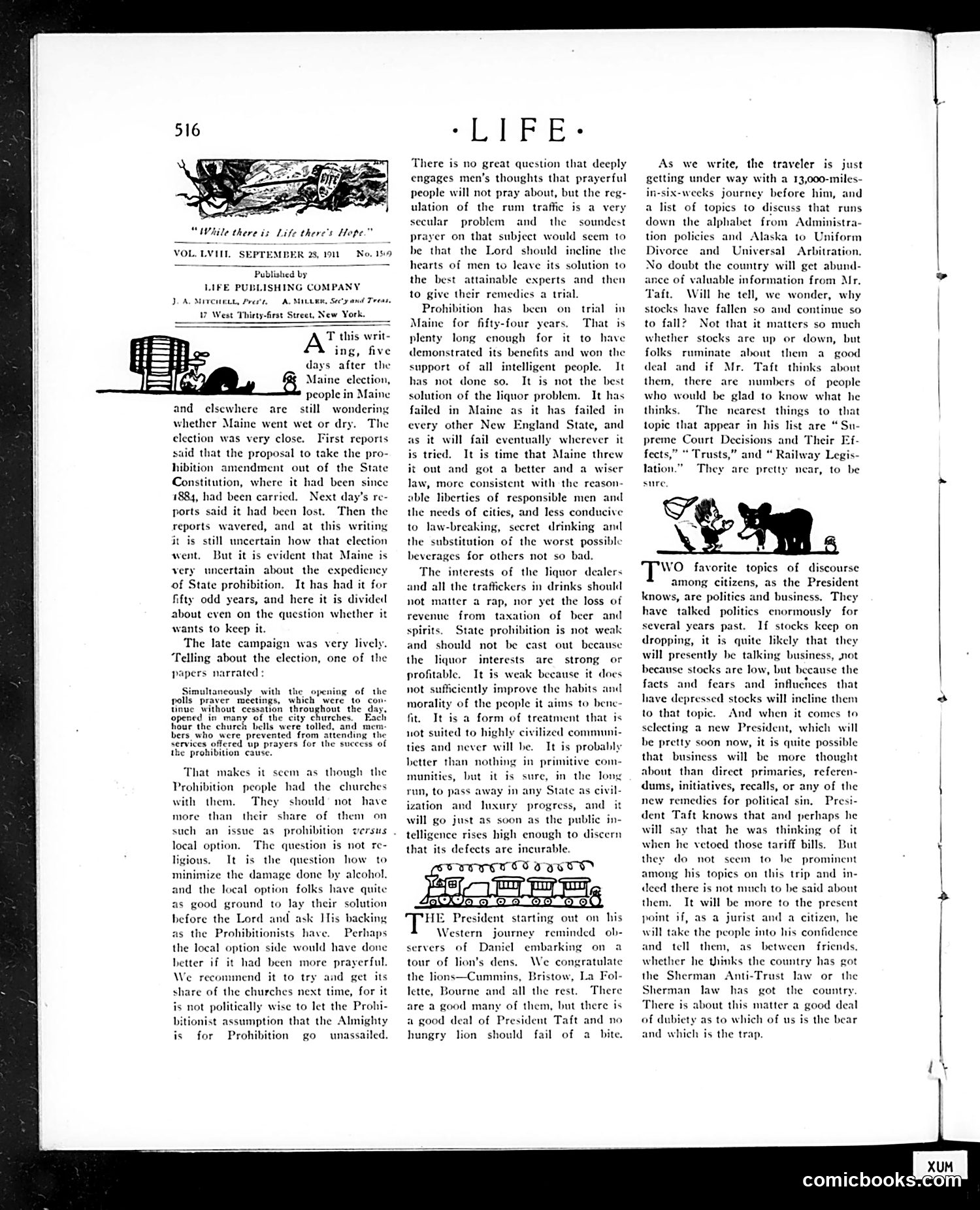
This page contains editorial commentary on Prohibition in Maine and President Taft's Western journey. The text criticizes Maine's fifty-four-year prohibition experiment as a failed policy that hasn't reduced drinking or improved public morality. The editorial argues Prohibition is weak law-making that should be replaced with approaches respecting "reasonable liberties of responsible men." Regarding Taft's travels, the commentary suggests he should focus on substantive issues—business, politics, tariffs, and the Sherman Anti-Trust law—rather than treating the trip as entertainment. The author expresses concern that Taft isn't addressing serious policy matters the country faces. The cartoons (visible but small) appear to illustrate these critiques, though specific details are difficult to discern clearly.
📄 Transcribed text from this page (OCR, searchable)
Machine-transcribed from the original scan — historical spelling and the odd misread are preserved.
“While there is Life there's Hope.” VOL. LVI. SEPT BER 28, 191 No. 189 Published by LIFE PUBLISHING COMPANY JOA. MITCHELL, Prestt, A MILLER, Sey and Treas, 1 West Thirty-first Street, New York. T this writ- ing, five days after the Maine election, people in Maine and elsewhere are still wondering whether Maine went wet or dry. The election was very close. First reports id that the proposal to take the pro- hibition amendment out of the State Constitution, where it had been since 1884, had been carricd. Next day’s re- ports said it had been lost. Then the reports wavered, and at this writing it is still uncertain how that election went. But it is evident that Maine is very uncertain about the expediency of State prohibition. It has had it for fifty odd years, and here it is divided about cven on the question whether it wants to keep it. The late campaign was very lively. Telling about the election, one of the papers narrated : Simultaneously with the opening of the polls praver meetings, which were to con Unue without cessation throughout the day, opened in many of the city churches. Each hour the church bells were tolled, and men bers who were prevented from attending th services offered up prayers for the success of Prohibition cause. That makes it seem as though the Prohibition people had the churches with them. They should not have more than their share of them on such an issue as prohibition versus . local option. The question is not re- ligious. It is the question how to minimize the damage done by alcohol. and the local option folks have quite as good ground to lay their solution before the Lord and ask JTis backing as the Prohibitionists have. Perhaps the local option side would have done better if it had been more prayerful. We recommend it to try and get its share of the churches next time, for it not politically wise to let the Prohi- Imighty unassailed. Ditionist assumption that the is for Prohibition go “Ld PE « ‘There is no great question that deeply engages men’s thoughts that prayerful people will not pray about, but the reg- ulation of the rum traffic is a very secular problem and the soundest prayer on that subject would seem to be that the Lord should incline the hearts of men to leave its solution to the best attainable experts and then to give their remedies a trial. Prohibition has been on trial in Maine for fifty-four years. That is plenty long enough for it to have demonstrated its benefits and won the support of all intelligent people. It has not done so, It is not the best solution of the liquor problem. It has failed in Maine as it has failed in every other New England State, and as it will fail eventually wherever it is tried. It is time that Maine threw it out and got a better and a wiser law, more consistent with the reason- able liberties of responsible men and the needs of cities, and less conducive to law-breaking, secret drinking anid the substitution of the worst possible beverages for others not so bad. The interests of the liquor dealers and all the traffickers in drinks should not matter a rap, nor yet the loss of revenue from taxation of beer and spirits. State pro! jon is not weak and should not be cast out because the liquor interests are strong or profitable, It is weak because it does not sufficiently improve the habits and morality of the people it aims to bene- fit. It is a form of treatment that is not suited to highly civilized communi- ties and never will be. It is probably better than nothing in primitive com- munities, but it is sure, in the lor run, to pass ay in any eas civ ization and luxury progress, and will go just as soon as the public in- telligence rises high enough to discern that its defects are incurable. STV T EW TT BYTOM Poc | Z[AD.O [oo MONO MMOKOMMONCL®} HE President starting out on his Western journey reminded servers of Daniel embarking on a tour of lion's dens. We congratulate the lions—Cummins, Bristow, La Fol- lette, Bourne and all the rest. There are a good many of them, but there is a good deal of President Taft and no hungry lion should fail of a_ bite. ob- As we write, the traveler is just getting under way with a 13,000-miles- in-six-weeks journey before him, and a list of topics to discuss that runs down the alphabet from Admin tion policies and Alaska to Uniform Divorce and Universal Arbitration. doubt the country will get abund- nce of valuable information from Mr, Taft. Will he tell, we wonder, why stocks have fallen so and continue so to fall? Not that it matters so much whether stocks are up or down, but tra- folks ruminate about them a good deal and if Mr. Taft thinks about them, there are numbers of people who would be glad to know what he thinks. The nearest things to that topic that appear in his list are “ Su- preme Court Decisi ind Their fects,” “ Trusts,” and “ Railway Legis- lation.” They are pretty near, to be sure. Sg WO favorite topics of discourse among citizens, as the President knows, are politics and business. They have talked politics enormously for several years past. If stocks keep on dropping, it is quite likely that they will presently he talking business, not because stocks are low, but because the facts and fears and influences that lave depressed stocks will incline them to that topic. And when it comes to selecting a new President, which will he pretty soon now, it is quite possible that business will be thought about than direct primaries, referen- dums, initiatives, recalls, or any of the ies for political sin, Presi- dent Taft knows that and perhaps he will say that he was thinking of it when he vetoed those tariff bills. But they do not scem to be prominent among his topics on this trip and in- deed there is not much to be said about them. It will be more to the present point if, as a jurist and a citizen, he will take the people into his confidence and tell between friends, whether he thinks the country has got the Sherman Anti-Trust 1 the Sherman law has got the country, There is about this matter a good deal of dubiety as to which of us is the bear and which is the trap. more them, as law or comicbooks-com