
Life, 1911-09-28 · page 19 of 42
Life — September 28, 1911 — page 19: what you’re looking at
What you’re looking at
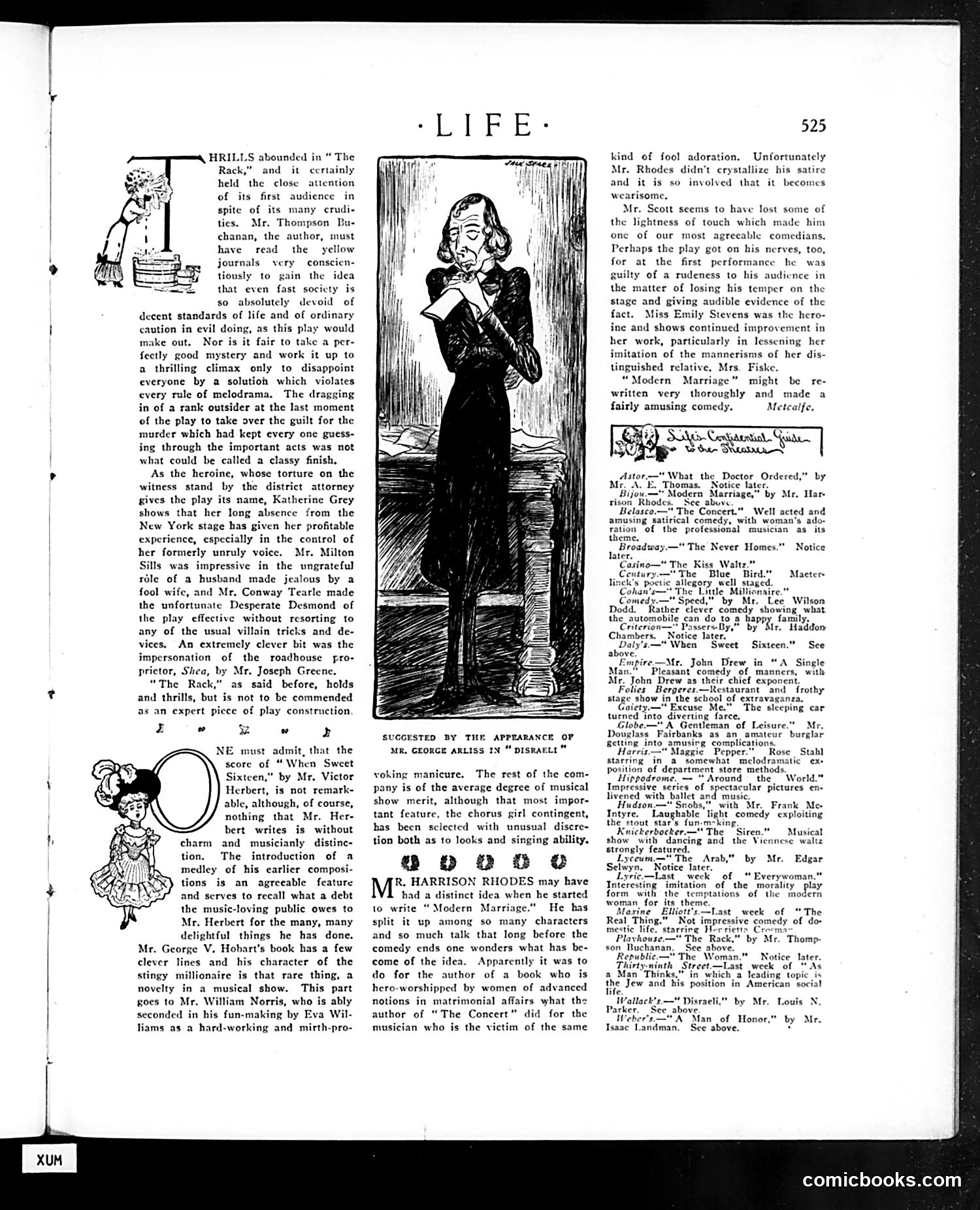
This page contains theater reviews from Life magazine's drama section. The central illustration shows a figure in formal dress, captioned as "suggested by the appearance of Mr. George Arliss in 'Disraeli'"—referencing the actor's famous role playing the British Prime Minister. The reviews critique three theatrical productions: 1. **"The Rack"** — criticized for weak plotting and relying on yellow journalism sensationalism 2. **"When Sweet Sixteen"** — a Victor Herbert musical with an undistinguished score but charming elements 3. **"Modern Marriage"** — satire about women's "advanced notions" on matrimony that lacks focus The tone is typical of early 20th-century theater criticism: intelligent but sometimes dismissive of commercial entertainment. The "Disraeli" reference suggests Arliss was a notable contemporary performer. The reviews reflect Life's satirical stance toward both theatrical excess and social pretension.
📄 Transcribed text from this page (OCR, searchable)
Machine-transcribed from the original scan — historical spelling and the odd misread are preserved.
HRILLS abounded in “ The Rack,” and it certainly held the close attention of its first audience in spite of its many erudi- ties. Mr. Thompson Bu- chanan, the author, must have read the yellow journals very conscien- tiously to gain the idea that even fast society is so absolutely devoid of decent standards of life and of ordinary caution in evil doing, as this play would make out. Nor is it fair to take a per- fectly good mystery and work it up to a thrilling climax only to disappoint everyone by a solutioh which violates every rule of melodrama, The dragging in of a rank outsider at the last moment of the play to take over the guilt for the murder which had kept every one guess- ing through the important acts was not what could be called a classy finish, As the heroine, whose torture on the witness stand by the district attorney gives the play its name, Katherine Grey shows that her long absence from the New York stage has given her profitable experience, especially in the control of her formerly unruly voice. Mr. Milton Sills was impressive in the ungrateful role of a husband made jealous by a fool wife, and Mr, Conway Tearle made the unfortunate Desperate Desmond of the play effective without resorting to any of the usual villain tricks and de- vices. An extremely clever bit was the impersonation of the roadhouse fro- prietor, Shea, by Mr. Joseph Greene. “The Rack,” as said before, holds and thrills, but is not to be commended as an expert piece of play construction. z ° B ” 2 NE must admit, that the score of “ When Sweet Sixteen,” by Mr. Victor Herbert, is not remark- able, although, of course, nothing that Mr. Her- bert writes is without charm and musicianly distinc- tion, The introduction of a medley of his earlier compo: tions is an agreeable feature and serves to recall what a debt the music-loving public owes to Mr. Herbert for the many, many delightful things he has done. Mr. George V. Hobart’s book has a few clever lines and his character of the stingy millionaire is that rare thing, a novelty in a musical show. This part goes to Mr. William Norris, who is ably seconded in his fun-making by Eva Wil- liams as a hard-working and mirth-pro- SUGGESTED BY THE APPEARANCE OF MR, GEORGE ARLISS IN “ DISRAELE” voking manicure, The rest of the com- pany is of the average degree of musical show merit, although that most impor- tant feature, the chorus girl contingent, has been sclected with unusual discre- tion both as to looks and singing ability. goo 6 Oo R. HARRISON RHODES may have had a distinct idea when he started to write “Modern Marriage.” He has split it up among so many characters and so much talk that long before the comedy ends one wonders what has be- come of the idea. Apparently it was to do for the author of a book who is hero-worshipped by women of advanced notions in matrimonial affairs what the author of “The Concert” did for the musician who is the victim of the same 525 kind of fool adoration. Unfortunately Mr. Rhodes didn’t crystallize his satire and it is so involved that it becomes wearisome, Mr. Scott seems to have lost some of the lightness of touch which made him one of our most agreeable comedians. Perhaps the play got on his nerves, too, for at the first performance he was guilty of a rudeness to his audience in the matter of losing his temper on the stage and giving audible evidence of the fact. Miss Emily Stevens was the hero- ine and shows continued improvement in her work, particularly in lessening her imitation of the mannerisms of her dis- tinguished relative, Mrs. Fiske. Modern Marriage" might be re- written very thoroughly and made a fairly amusing comedy. Metcalfe. Bij Modern Marriage, rison Rhodes. | See abuve Belasco.—" The Concert.” Well acted and amusing satirical comedy, with woman's ado- ration of the professional musician as its theme, aBtoadway.—" The Never Homes." Notice later. sino—" The Kiss Waltz. lenin" The | Blue, Bird Maeters 's po allegory well staged. Cohan he Title Millionaire.” Comedy.—" Speed," by Mr. Lee Wilson Dodd. Rather clever comedy showing what the automobile can do to a happy family, Criterion ssersBy,” by Sr. Haddon Chambers. Notice later. Daly's.—" When Sweet Sixteen.” See above. ire—Mr. John Drew in “A Single Man.” Pleasant’ comedy of manners, with Mr. John Drew as their chief exponent. Folies Bergeres.—Restaurant and frothy stage show in the school of extravaganza, Gaicty.—" Excuse Me.” The sleeping car turned into diverting farce. Globe.—"" A Gentleman of Leisure.” Mr, Douglass Fairbanks as an amateur burglar getting into amusirg complications. Harris." Maggie Pepper.” Rose Stahl starring in a somewhat melodramatic. ex+ position of department store methods. Hippodrome. — "Around — the World." Impressive series of spectacular pictures en- livened with ballet and music Hudson nobs,” with Mr, Frank Mc Intyre. Laughable ‘light comedy exploiting the stout star's fun.m-king. Knickerbocker—" The Siren." Musical show with dancing and the Viennese waltz strongly featured. Lyceum." The Arab," by Mr, Edgar Selwyn. Notice later. Lyric—Last week of |“ Everywoman." Interesting imitation of the morality play form with the te ations of the modern woman for its theme, Maxine Elliott's —Last_week of “The Real Thing.” Not impressive comedy of do- mestic life, st 15 Crema Playhouse. by Mr. Thomp- son Buchana: See above. Republic.—" The Woman.” Notice later. Thirty-ninth Street—Last week of “As a Man Thinks,” in which a leading topic. ix the Jew and his position in American social life. Wallack’s—" Disraeli,” by Mr. Louis N. Parker. See above. Wel A Man of Honor," by Mr. Isaac Landman. See above. ‘ comicbooks.com