
Life, 1911-09-28 · page 24 of 42
Life — September 28, 1911 — page 24: what you’re looking at
What you’re looking at
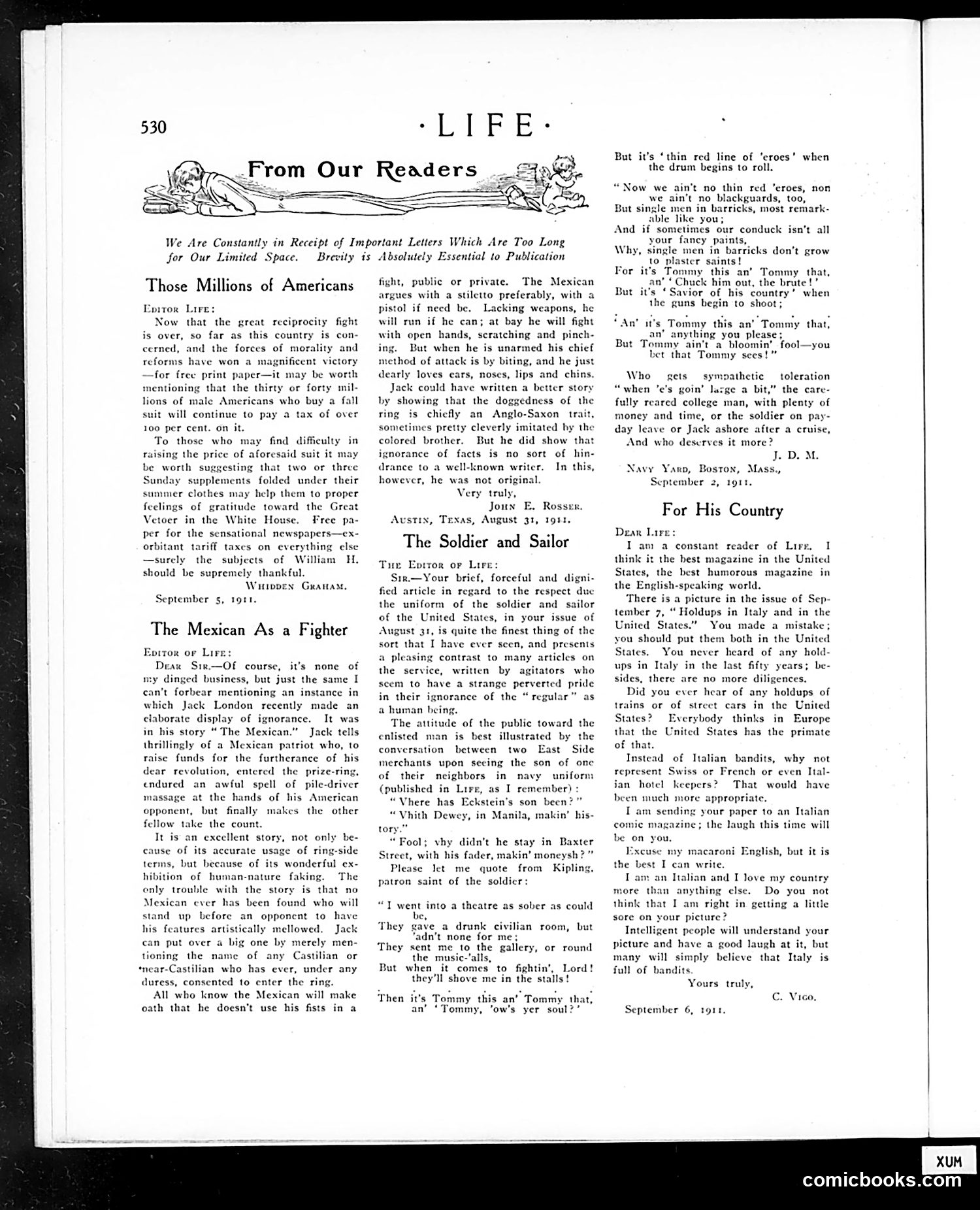
This is a **readers' letters section** from Life magazine, not primarily a cartoon page. Three letters discuss contemporary issues: 1. **"Those Millions of Americans"**: Critiques President Taft's tariff policy—celebrates free trade on newspaper paper while complaining that ordinary Americans pay 100% tariffs on clothing. The satire: reformers celebrate one victory while ignoring workers' struggles. 2. **"The Mexican As a Fighter"**: Attacks Jack London's short story "The Mexican" for romanticizing a Mexican revolutionary boxer. The letter argues London fabricated the story's premise—Mexicans actually prefer knives/pistols to boxing and bite opponents. The point: criticizes London for ignoring factual reality for dramatic effect. 3. **"The Soldier and Sailor"**: Praises an earlier Life article defending military respect, then quotes a Yiddish-accented dialogue where an immigrant father thinks his son should earn money rather than serve in the Navy—mocking working-class immigrants' priorities. All three letters exemplify early 20th-century American debates about labor, immigration, foreign policy, and national identity.
📄 Transcribed text from this page (OCR, searchable)
Machine-transcribed from the original scan — historical spelling and the odd misread are preserved.
“LTP E* We Are Constantly in Receipt of Important Letters Which Are Too Long for Our Limited Space. Those Millions of Americans Epitor Lire: Now that the great reciprocity fight is over, so far as this country is con- and the forees of morality and reforms have won a magnificent victory for free print paper—it may be worth mentioning that the thirty or forty mil- lions of male Americans who buy a fall suit will continue to pay a tax of over 100 per cent. on it. To those who may find difficulty in raising the price of aforesaid suit it m be worth suggesting that two or three Sunday supplements folded under their mmer clothes may help them to proper feelings of gratitude toward the Great Vetoer in the White House. Free pa- per for the sensational newspapers—ex- orbitant tariff taxes on everything else surely the subjects of William H. should be supremely thankful. Winopes Geantast. September §, 1911. The Mexican As a Fighter Eprror or Lire: Deax Six—Of course, it’s none of y dinged business, but just the same I can't forbear mentioning an instance in which Jack London recently made an claborate display of ignorance. It was in his story “The Mexican.” Jack tells thrillingly of a Mexican patriot who, to raise funds for the furtherance of his dear revolution, entered the prize-ring, endured an awful spell of pile-driver the hands of his American opponent, but finally makes the other fellow take the count. It is an cause of its accurate usage of rin terms, but because of its wonderful ex- hibition of human-nature faking. T| only trouble with the story is that no Mexican ever has been found who will an opponent to have artistically mellowed. Jack can put over a big one by merely men- tioning the name of any Castilian or snear-Castilian who has ever, under any duress, consented to enter the ring. All who know the M oath that he cerned, massage at stand up before his feature ican will make doesn't use his fists in a Brevity is Absolutely Essential to Publication fight, public or private. The Mexican argues with a stiletto preferably, with a pistol if need be. Lacking weapons, he will run if he can; at bay he will fight with open hands, scratching and pinch ing. But when he is unarmed his chief method of attack is by biting, and he just dearly loves ears, noses, lips and chins. Jack could have written a better story by showing that the doggedness of the ring is chiefly an Anglo-Saxon trait, etimes pretty cleverly imitated by the colored brother. But he did show that ance of facts is no sort of hin- drance to a well-known writer. In this, however, he was not original Very truly, Joux E. Rosser. Avstix, Texas, August 31, 1911, The Soldier and Sailor Eptror or Lire: Sin.—Your brief, forceful and digni- fied article in regard to the respect duc the uniform of the soldier and sailor of the United States, in your issue of August 31, is quite the finest thing of the sort that I have ever scen, and presents a pleasing contrast to many articl the service, written by agitators who scem to have a strange perverted pride in their ignorance of the “ a human being. The attitude of the public toward the enlisted man is best illustrated by the conversation two East Side merchants upon seeing the son of onc of their neighbors in navy uniform (published in Lire, as I remember) : “Vhere has Eckstein’s son been “Vhith Dewey, in Manila, makin’ his- tor “Fool; vhy didn’t he stay in Baxter Street, with his fader, makin’ moneysh?” Please let me quote from Kipling, patron saint of the soldier: igno Tr on * regul between “I went into a theatre as sober as could be, They gave a drunk civilian room, but ‘adn’t none for me; sent me to the gallery, or round the music-'alls, But when it comes to fightin’, Lord! they'll shove me in the stalls! They an’ Tommy that, "ow's yer soul?’ ‘Then it’s Tommy this an’ ‘Tommy, But it's ‘thin red line of ‘eroes’ when the drum begins to roll. “Now we ain't no thin red ‘eroes, non we ain't no blackguards, too, But single men in barricks, most remark- ble like you; And if sometimes our conduck isn’t all your fancy paints, Why, single men in barricks don’t grow . 10 plaster saints! For it's Tommy this an’ Tommy that, an’ ‘Chuck him out, the brute!” 's ‘Savior of his country’ when the guns begin to shoot ; But it “An' it's Tommy this an’ Tommy that, an’ anything you please But Tommy ain't a bloomin’ fool—you bet that Tommy sees! Who gets sympathetic toleration “when 'e’s goin’ lazge a bit,” the care- fully reared college man, with plenty of money and time, or the soldier on p: day leave or Jack ashore after a cruise, And who deserves it more? J.D. M. Navy Yarv, Bostox, Mass., September 2, 1911. For His Country Dear Lire: I am a constant reader of Li think it the best magazine in the United States, the best humorous ma the English-speaking world. ‘There is a picture in the issue of Ser tember 7, “Holdups in Italy and in the United States.” You made a mista you should put them both in the United States. You never heard of any hold- ups in Italy in the last fifty years; be- sides, there are no more diligences. Did you ever hear of any holdups of trains or of street cars in the United States? Everybody thinks in Europe that the United States has the primate of that. Instead of Halian bandits, why not represent Swiss or French or even Ital- jan hotel That would have been much more appropriate. I am sendi aper to an Italian comic magazine; the laugh this time will zine in keepers? 2 your be on you. Excuse my macaroni English, but it is the best I can write Tam an Italian and I love my coun more than anything else. Do you not think that I am right in getting a little sore on your picture? Intelligent people will understand your picture and have a good laugh at it, but many will simply believe that Italy is full of bandits Yours truly, C. Vico, September 6, tg1t. comicbooks.com