
Life, 1911-09-28 · page 18 of 42
Life — September 28, 1911 — page 18: what you’re looking at
What you’re looking at
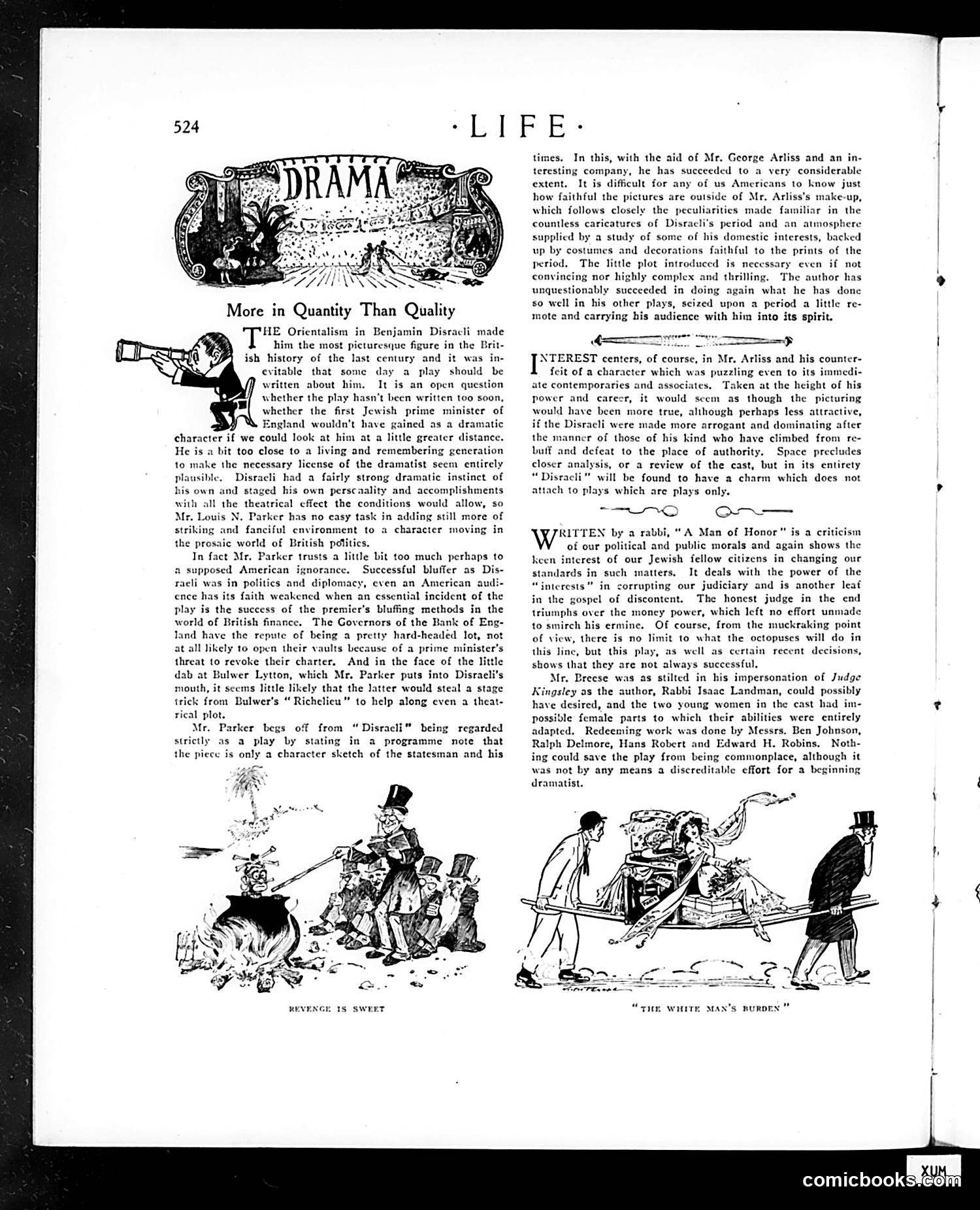
This page reviews two theatrical productions. The main article discusses a play about **Benjamin Disraeli**, the 19th-century British Prime Minister, starring actor George Arliss. The critic argues the play prioritizes spectacle and theatrical effect over historical accuracy—particularly a plot device where Disraeli supposedly bluffs the Bank of England into opening its vaults, which the reviewer finds implausible. The critic acknowledges Arliss's performance is effective but notes the play is more "character sketch" than rigorous drama. Two satirical cartoons illustrate political themes: "Revenge is Sweet" and "The White Man's Burden" (likely referencing Kipling's imperialist poem). The page also briefly mentions a play called "A Man of Honor" written by a rabbi, addressing Jewish citizens' concerns about political and public morality. The overall thrust critiques theatrical oversimplification of complex historical figures and contemporary social issues.
📄 Transcribed text from this page (OCR, searchable)
Machine-transcribed from the original scan — historical spelling and the odd misread are preserved.
More in Quantity Than Quality HE Orientalism in Benjamin Disracli made him the most picturesque figure in the Bri ish history of the last century and it was in- evitable that some day a play should be written about him. It is an open question whether the play hasn't been written too soon, whether the first Jewish prime minister of England wouldn’t have gained as a dramatic character if we could Jook at him at a little greater distance. He is a bit too close to a living and remembering generation to make the necessary license of the dramatist seem entirely plausible, Disracli had a fairly strong dramatic instinct of his own and staged his own perscaality and accomplishments with all the theatrical effect the conditions would allow, so Mr. Louis N. Parker has no easy task in adding still more of striking and fanciful environment to a character moving in the prosaic world of British politics. In fact Mr. Parker trusts a little bit too much perhaps to a supposed American ignorance. Successful bluffer as Di: raeli was in politics and diplomacy, even an American aud: ence has its faith weakened when an essential incident of the play is the success of the premier’s bluffing methods in the world of British finance, The Governors of the Bank of Eng- land have the repute of being a pretty hard-headed lot, not at all likely to open their vaults because of a prime minister's threat to revoke their charter, And in the face of the littl dab at Bulwer Lytton, which Mr. Parker puts into Disraeli’s mouth, it seems little likely that the latter would steal a stage trick from Bulwer's “Richelieu to help along even a theat- rical plot. Mr. Parker begs off from “ Disracli® being regarded strictly as a play by stating in a programme note that the piece is only a character sketch of the statesman and his REVENGE 18 SWEET “LP EB times. In this, with the aid of Mr. George Arliss and an in- teresting company, he has succeeded to a very considerable extent. It is difficult for any of us Americans to know just how faithful the pictures are outside of Mr. Arliss’s make-up, which follows closely the peculiarities m uniliar in the countless caricatures of Disracli’s period and an atmosphere supplied by a study of some of his domestic interests, backed up by costumes and decorations faithful to the prints of the period, The little plot introduced is necessary even if not convincing nor highly complex and thrilling. The author has unquestionably succeeded in doing again what he has done so well in his other plays, seized upon a period a little re- mote and carrying his audience with him into its spirit. an =F [TEREST centers, of course, in Mr. Arliss and his counte feit of a character which was puzzling even to its immedi- ate contemporaries and associates, Taken at the height of his power and career, it would scem as though the picturing would have been more true, although perhaps less attractive, if the Disracli were made more arrogant and dominating after the manner of those of his kind who have climbed from re- buff and defeat to the place of authority, Space precludes closer analysis, or a review of the cast, but in its entirety “Disracli” will be found to have a charm which does not attach to plays which are plays only, on— RITTEN by a rabbi, “A Man of Honor” is a criticism of our political and public morals and again shows the keen interest of our Jewish fellow citizens in changing our standards in such matters, It deals with the power of the “jmterests” in corrupting our judiciary and is another leat in the gospel of discontent. The honest judge in the end triumphs over the money power, which left no effort unmade to smirch his ermine. Of course, from the muckraking point of view, there is no limit to what the octopuses will do in this line, but this play, as well as certain recent de shows that they are not always successful. Mr. Breese was as stilted in his impersonation of Judge Kingsley as the author, Rabbi Isaac Landman, could possibly have desired, and the two young women in the cast had im- possible female parts to which their abilities were entirely adapted, Redeeming work was done by Messrs. Ben Johnson, Ralph Delmore, Hans Robert and Edward H. Robins. Not! ing could save the play from being commonplace, although it was not by any means a discreditable effort for a beginning dramatist. de TOD sions, ee oh “Tuk WHITE MAN'S RURDEN ” comicbookMeom