
A complete issue · 44 pages · 1911
Life — June 15, 1911
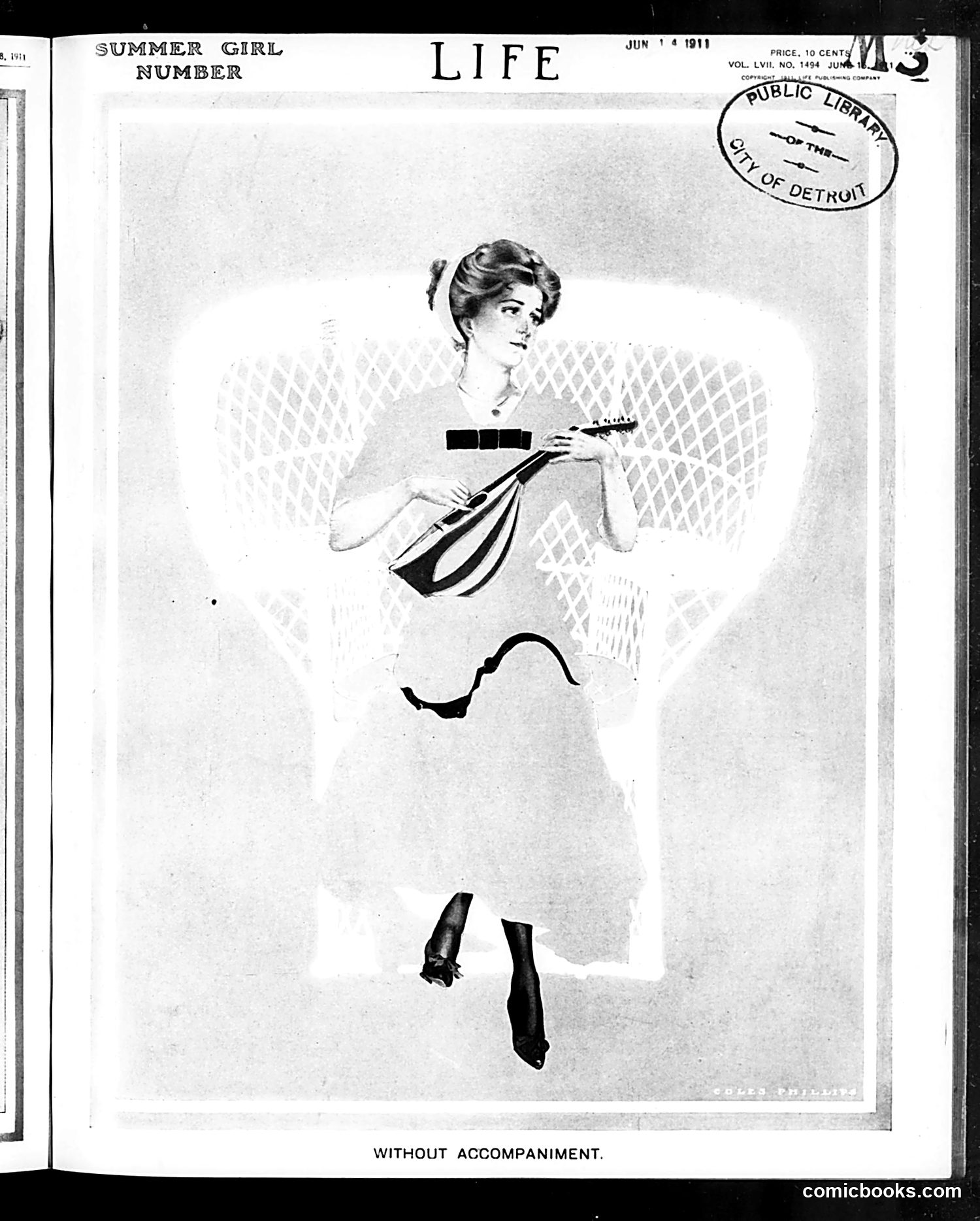
This "Summer Girl Number" cover illustrates a play on words about female musicians. The illustration shows a young woman playing a stringed instrument (appears to be a mandolin or similar) while floating or posing dramatically against a decorative lattice background. The caption "WITHOUT ACCOMPANIMENT" is the joke: it refers both to musical performance (playing solo, without instrumental backup) and to the woman's apparent lack of a male companion or chaperone—a significant social concern in 1911. The satirical point mocks the growing independence of young women of the era, who were increasingly engaging in public activities and entertainments without male supervision, which was considered improper by conservative standards of the time.
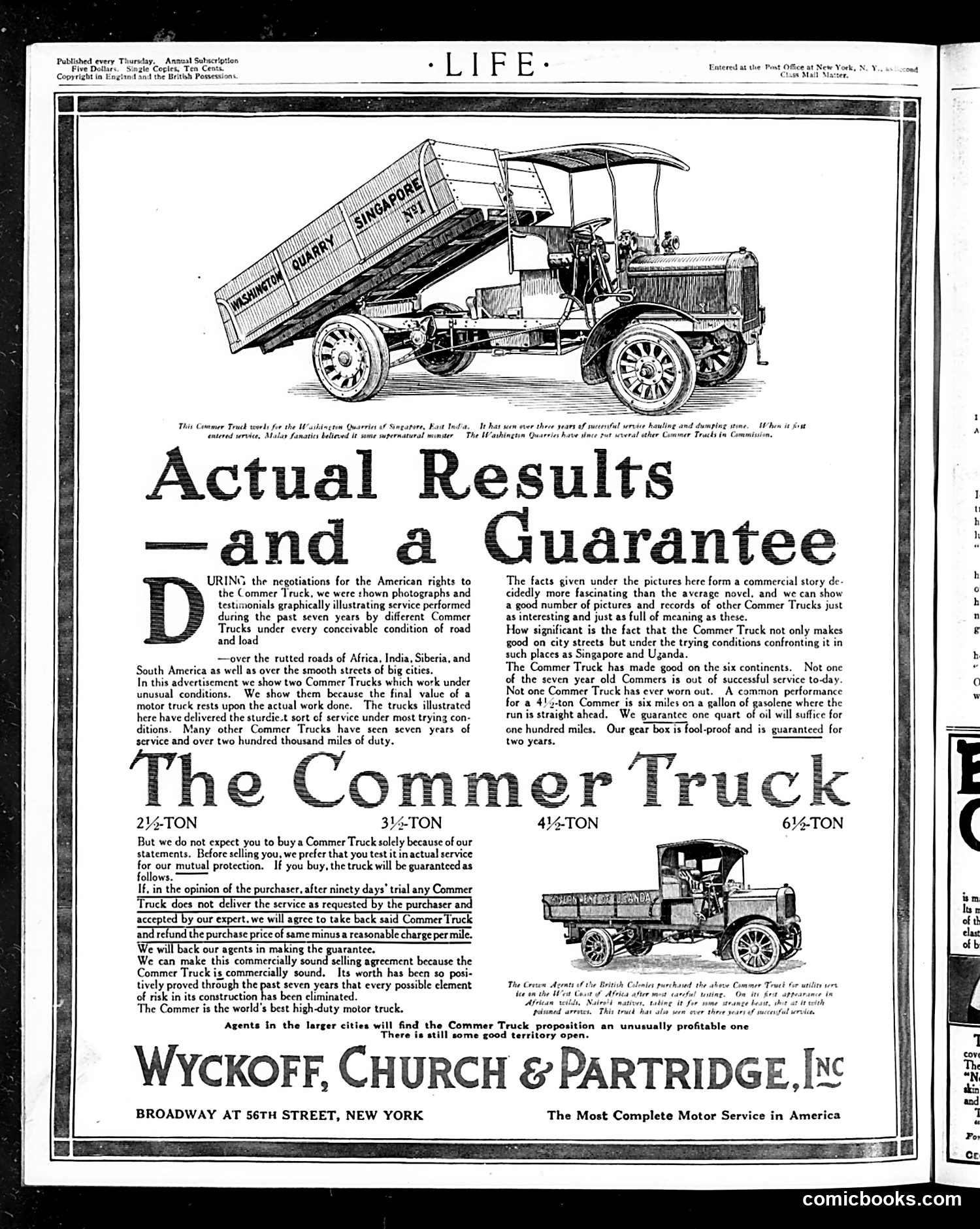
This page is **primarily an advertisement**, not political satire. It's a full-page commercial for the Commer Truck, published in *Life* magazine. The ad showcases dump trucks in various tonnage sizes (2½ to 6½ ton) and references their proven performance in challenging locations like Africa, India, Siberia, and Singapore. The marketing emphasizes durability under "unusual conditions" and offers a guarantee. The key selling point is the bold guarantee: if the truck fails to perform as promised during a trial period, the company will refund the purchase price minus a reasonable service charge—an unusually strong commercial promise for the era. The ad targets commercial fleet buyers, positioning the Commer as "the world's best high-duty motor truck" distributed by Wyckoff, Church & Partridge in New York.
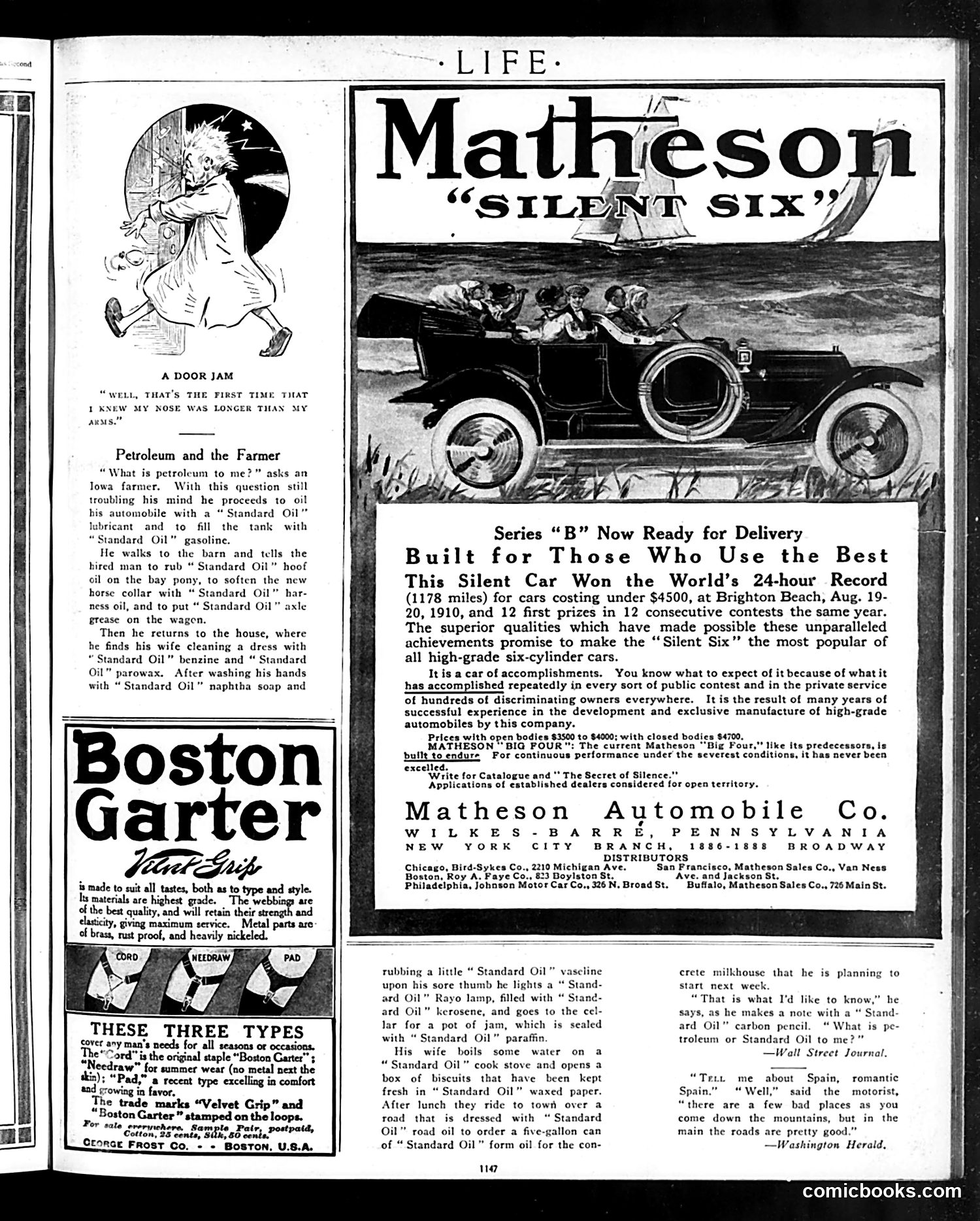
This page is primarily **advertising**, not political satire. The dominant content features a Matheson "Silent Six" automobile advertisement showcasing the car's reliability and performance records. The left side contains a brief humorous comic titled "A Door Jam" depicting someone's nose caught in a door, with the caption "Well, that's the first time that I knew my nose was longer than my arms"—a simple physical comedy joke unrelated to politics or social commentary. Below that is a Boston Garter advertisement for men's hosiery, featuring three sock types for different seasons. The "Petroleum and the Farmer" text block discusses how farmers use Standard Oil products, functioning as product placement rather than satire. This page reflects early 20th-century *Life* magazine's mixed editorial and commercial content model.
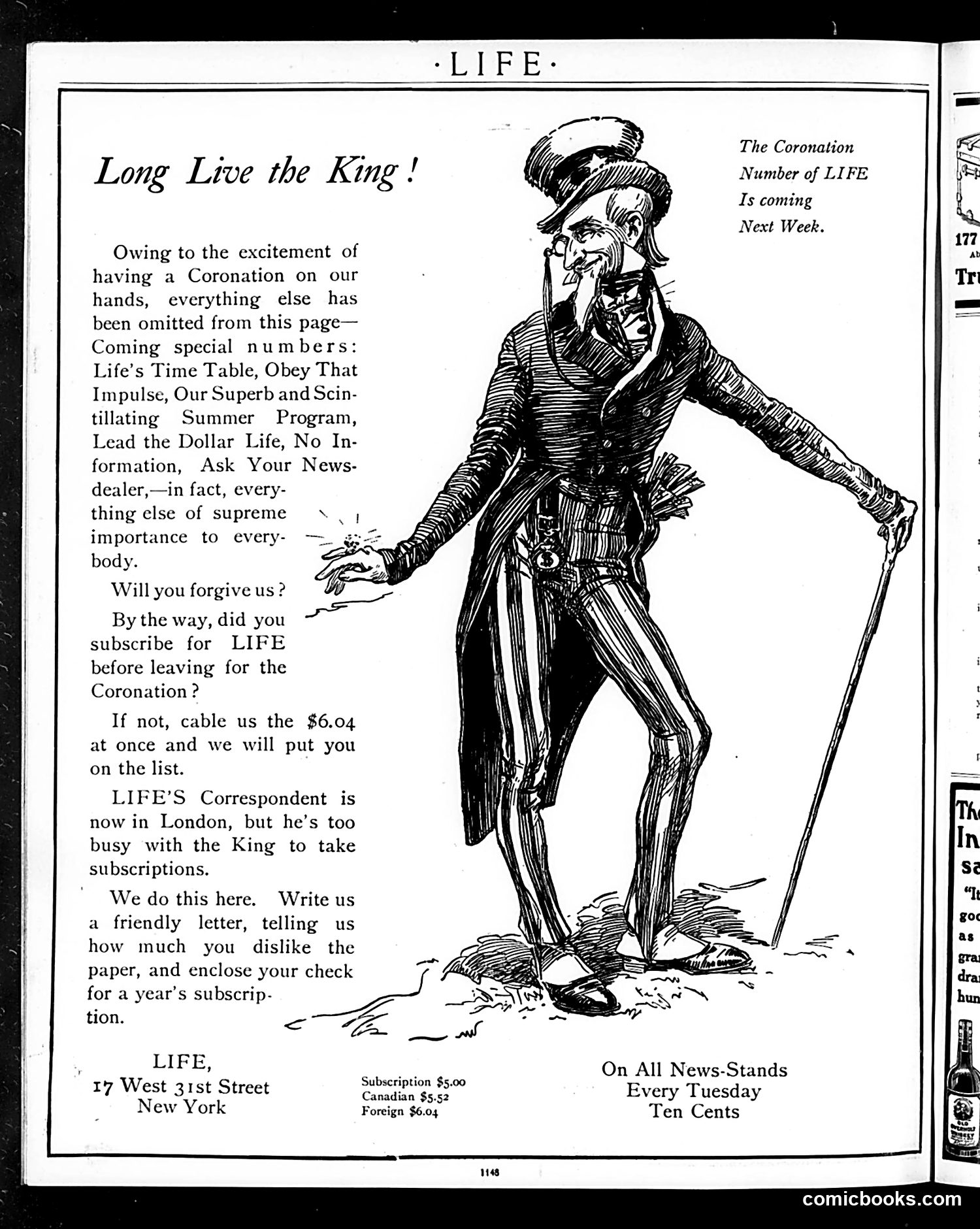
This is primarily a **subscription advertisement** for Life magazine, humorously apologizing for omitting regular content due to covering a coronation event. The caricatured figure appears to be **Uncle Sam** or a similar American personification, depicted as an exaggerated, thin character in formal attire and top hat, gesturing with a cane. The crude, satirical drawing style emphasizes his skeletal appearance. The joke: Life magazine reduced its normal content to focus on royal coronation coverage, so editors humorously "apologize" by personifying the magazine itself as desperately promoting a subscription ($5.00 domestic, $5.52 Canadian) to compensate readers for missed regular features. The satire gently mocks the magazine's editorial decision while simultaneously pushing subscriptions—using self-deprecating humor as a sales tactic.
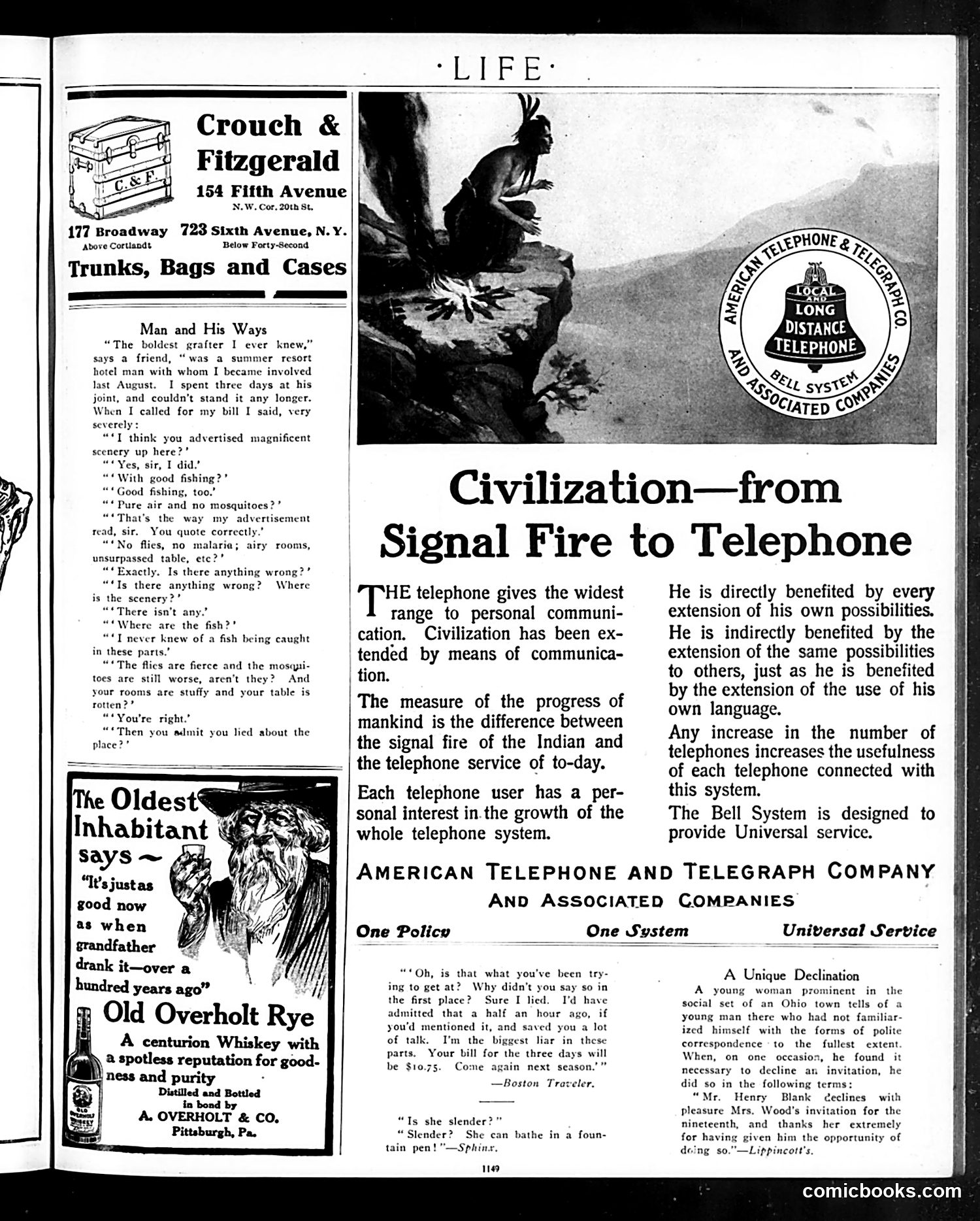
This page is primarily **advertising and promotional content** rather than political satire. The main elements are: 1. **Crouch & Fitzgerald ad** (left): A luggage company advertisement 2. **"Civilization—from Signal Fire to Telephone"** (center/right): A Bell System advertisement celebrating the telephone as progress, contrasting Indigenous signal fires with modern telecommunications 3. **"Old Overholt Rye"** (bottom left): A whiskey advertisement featuring "The Oldest Inhabitant" character—a bearded figure claiming the whiskey is "just as good now as when grandpa drank it over a hundred years ago" The "oldest inhabitant" is a generic stock character used in advertising to suggest tradition and reliability rather than a specific political reference. The page reflects early 20th-century advertising celebrating technological progress and product longevity, with no evident satirical intent.
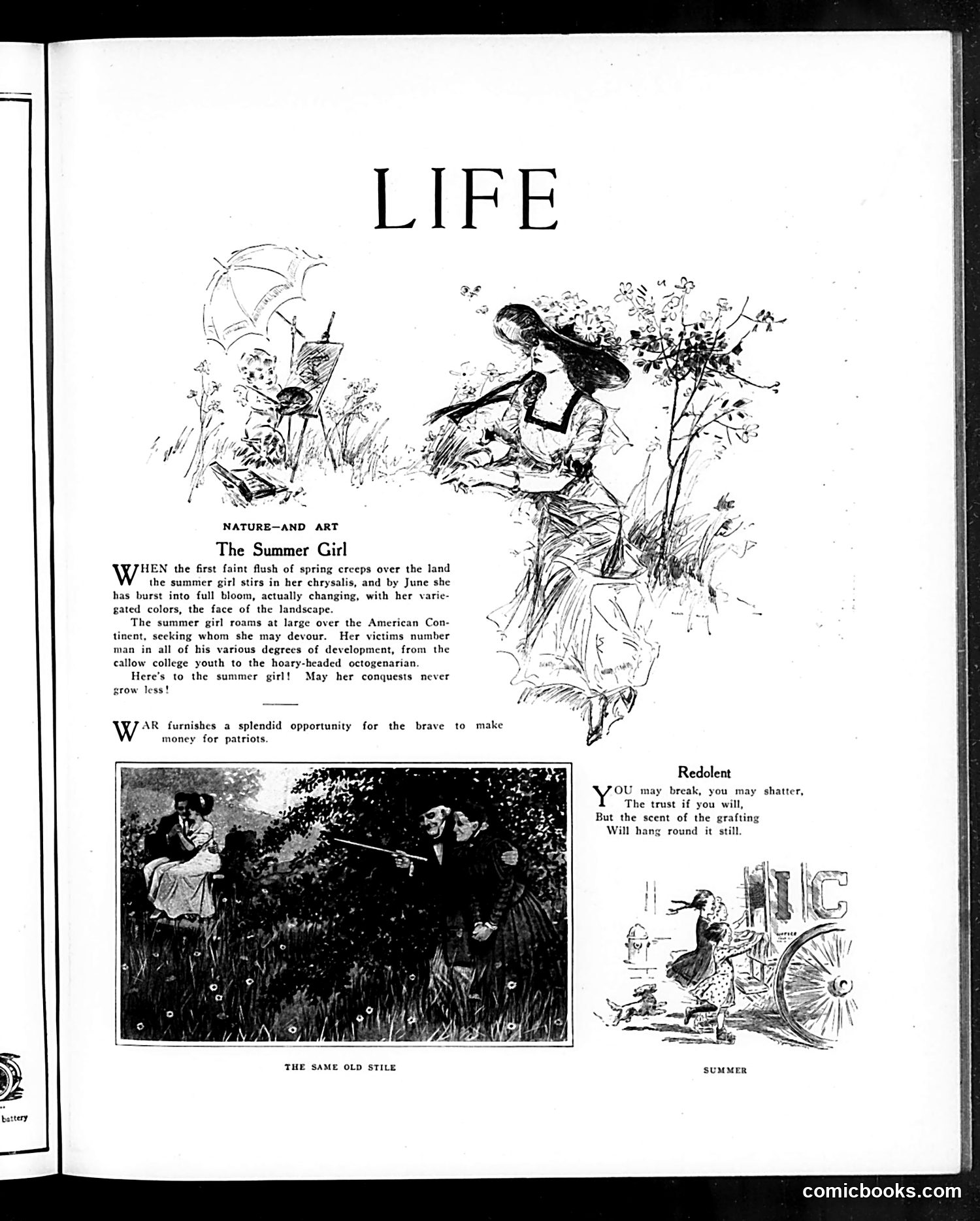
This page celebrates the "Summer Girl"—a seasonal social type in early 20th-century America. The text describes her transformation from spring's first flowers through June bloom, contrasting her refined chrysalis stage with her expansive summer roaming across the continent, where she encounters "man in all of his various degrees of development." The top illustration shows a fashionable young woman in nature with parasol and flowers. The lower photograph titled "The Same Old Stile" depicts a couple in a pastoral setting—likely representing the timeless romance of courtship. The "Redolent" poem on the right plays on themes of romantic constancy. The content gently satirizes the summer leisure pursuits and romantic escapades of young, well-to-do American women, a recurring subject in Life's social commentary.
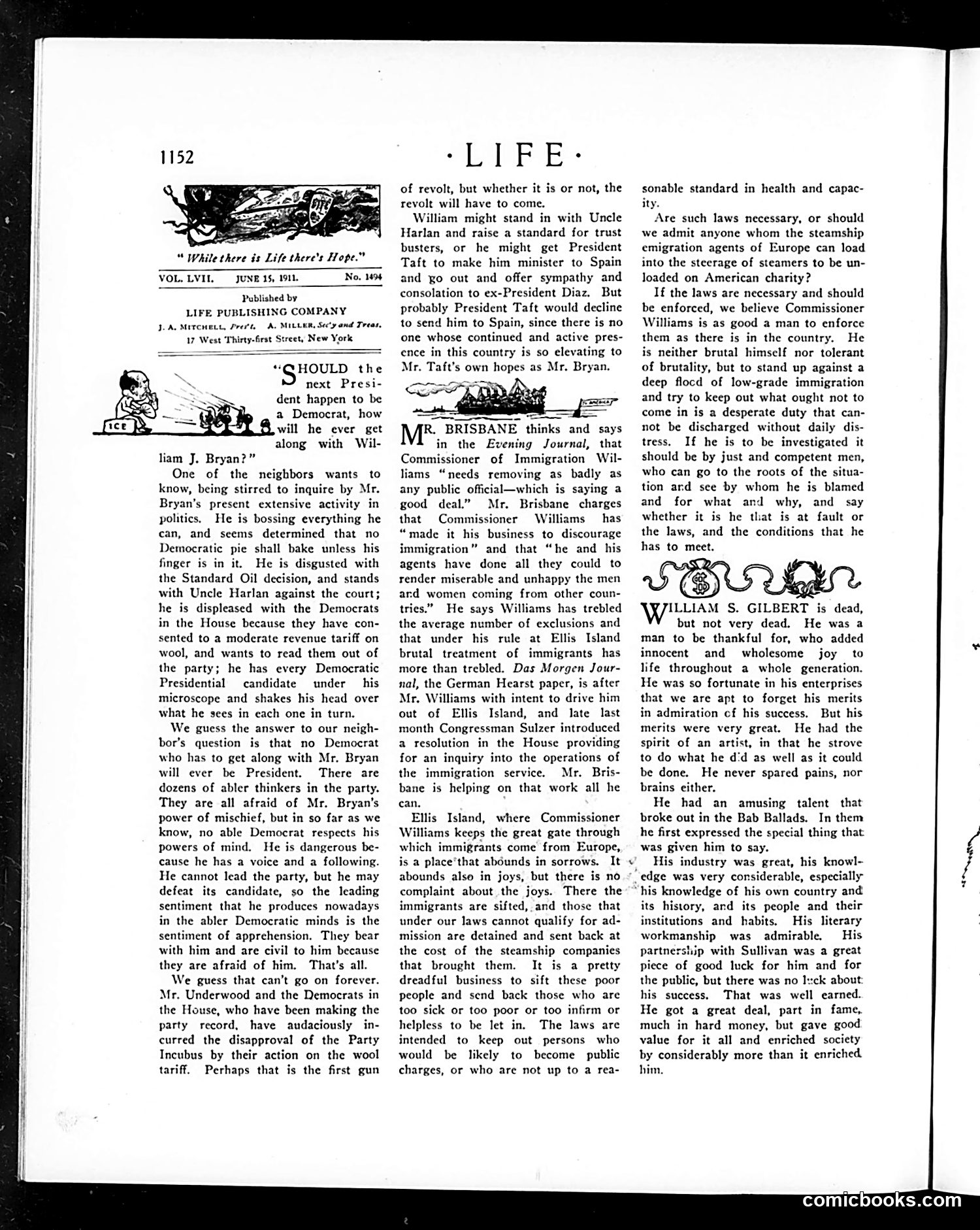
This page contains political commentary and editorial discussion rather than cartoons. The main content addresses the 1912 presidential election and immigration policy debates. The text discusses William Jennings Bryan's Democratic Party activities and criticizes Commissioner of Immigration Williams for his strict enforcement policies at Ellis Island. The authors argue Williams has been too harsh in excluding immigrants, characterizing his methods as creating "miserable and unhappy" conditions. There's also a tribute to William S. Gilbert (of Gilbert and Sullivan), noting his death and contributions to artistic culture. The page satirically questions whether Bryan and Democratic leadership can effectively challenge the Republican establishment, while debating the proper balance between immigration restriction and humanitarian treatment of arrivals.
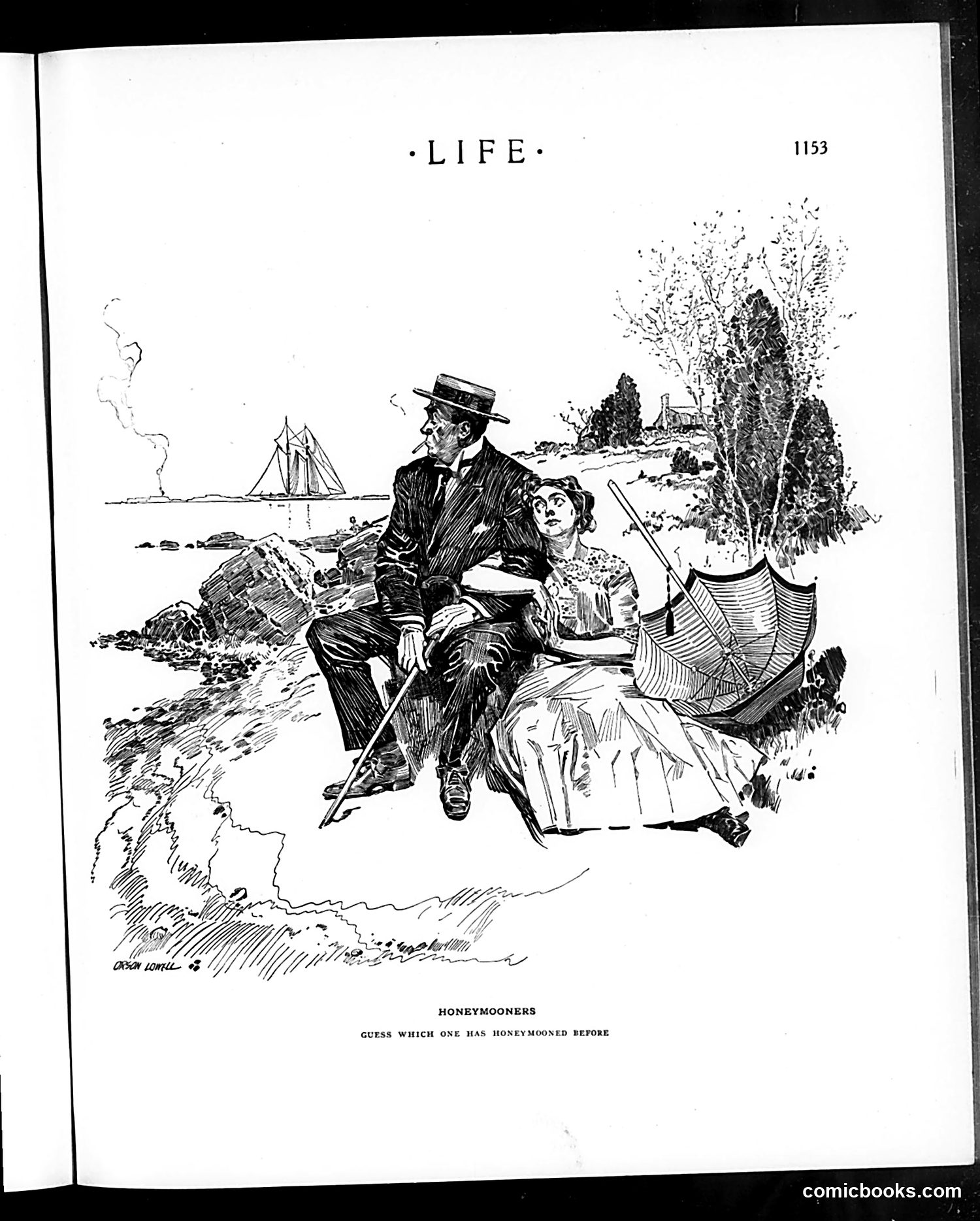
This is a humorous social commentary on honeymoon experiences. The illustration shows a couple on a seaside honeymoon—a man in formal attire and a woman with a parasol, sitting on a beach with a sailing ship visible in the background. The caption's joke relies on visual cues suggesting which partner has previously honeymooned. The satire appears to mock social assumptions about courtship and marriage in the early 20th century, particularly the expectation that honeymoons were novel experiences. The "guess which" framing invites readers to identify telltale signs of experience versus innocence—a form of social humor common to Life magazine's commentary on romantic relationships and marriage customs of the era.
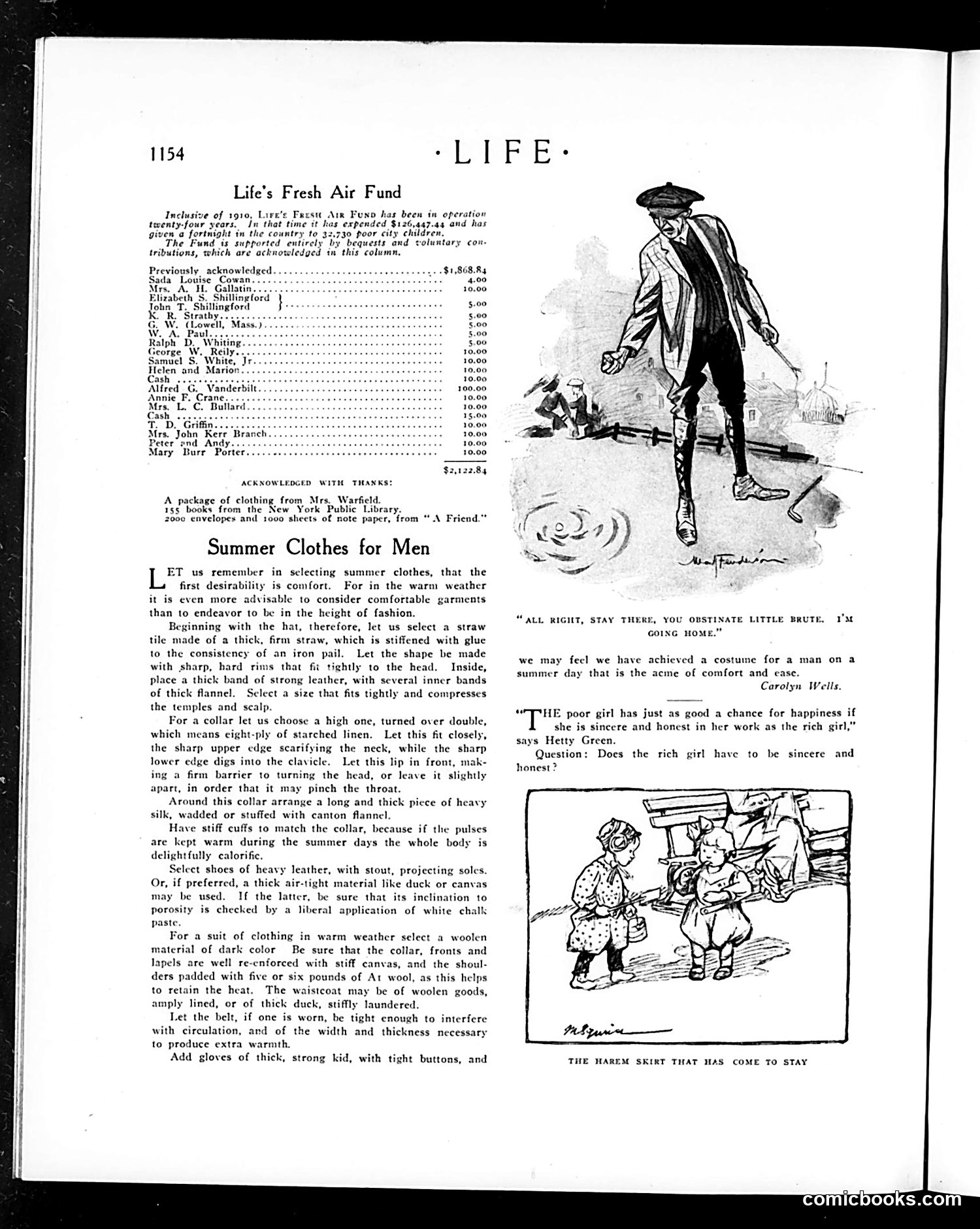
This page combines a charitable fund announcement with practical fashion advice and illustrations. **Top Section:** Life's Fresh Air Fund donation list acknowledges contributions for sending poor children to the countryside—a Progressive Era charitable initiative addressing urban poverty. **Main Content:** "Summer Clothes for Men" provides detailed grooming and wardrobe guidance, reflecting early 20th-century concerns about propriety and class distinction through dress. The advice emphasizes comfort while maintaining formality (stiff collars, heavy fabrics, leather shoes). **Cartoons:** Two untitled illustrations appear to be generic domestic/social humor rather than political satire—one showing a man with children outdoors, another depicting what appears to be a social interaction. Neither contains identifiable caricatures or specific political commentary visible in the image. The page represents Life magazine's dual function: supporting charitable causes while offering lifestyle guidance to its middle-class readership.
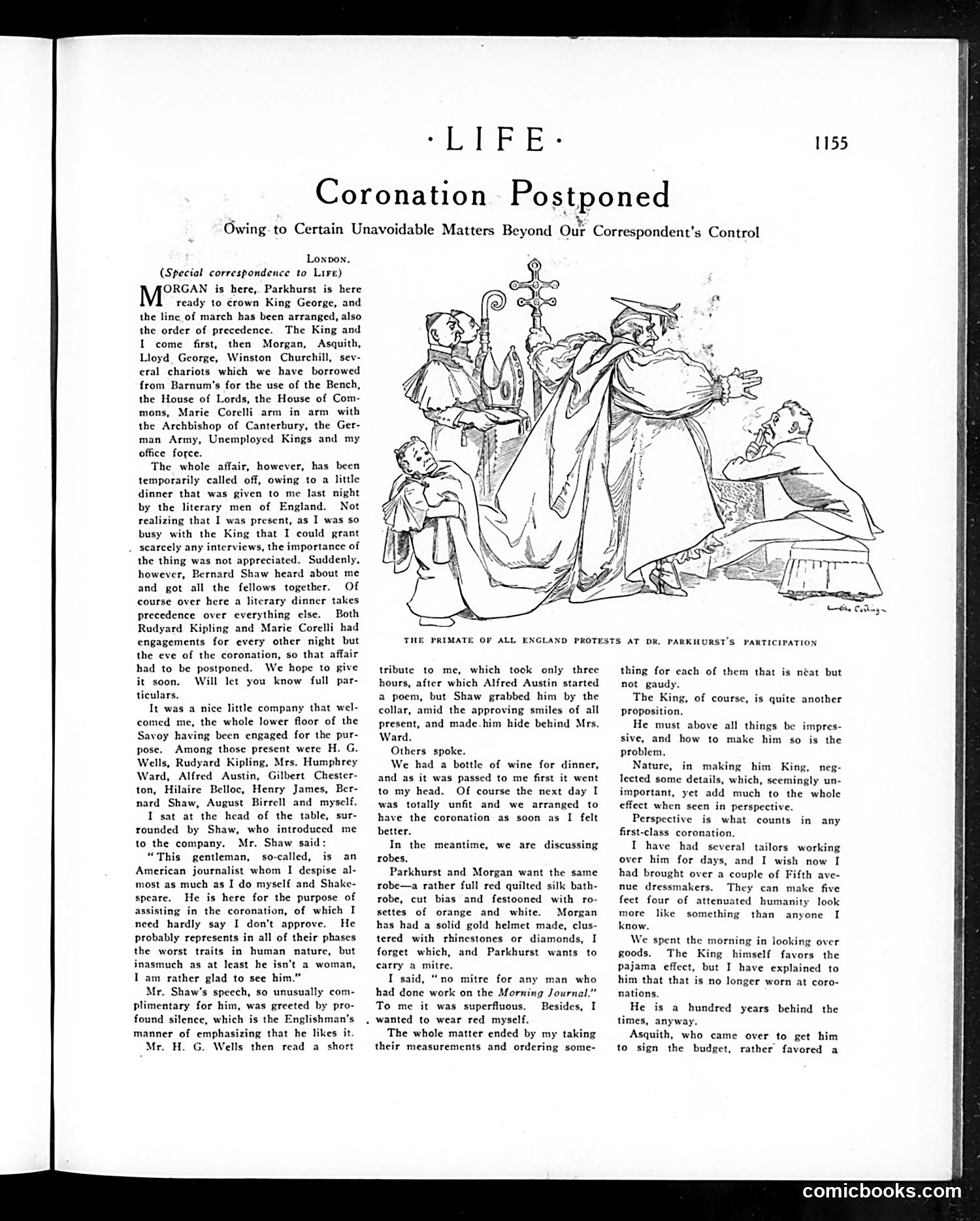
This page satirizes the postponement of King George V's coronation. The illustration depicts "the Primate of All England protests at Dr. Parkhurst's participation"—showing the Archbishop of Canterbury objecting to an American clergyman's involvement in the ceremony. The text describes how the coronation was called off due to a dinner incident where literary men of England gave the correspondent a difficult time. The satire mocks both British pomposity about coronation protocol and American presumption in wanting to participate in such a quintessentially British state occasion. The cartoon ridicules class hierarchies and institutional rigidity: the Archbishop fusses over proper procedure while the Americans represent a more casual, egalitarian attitude—a recurring theme in Anglo-American relations of the era.
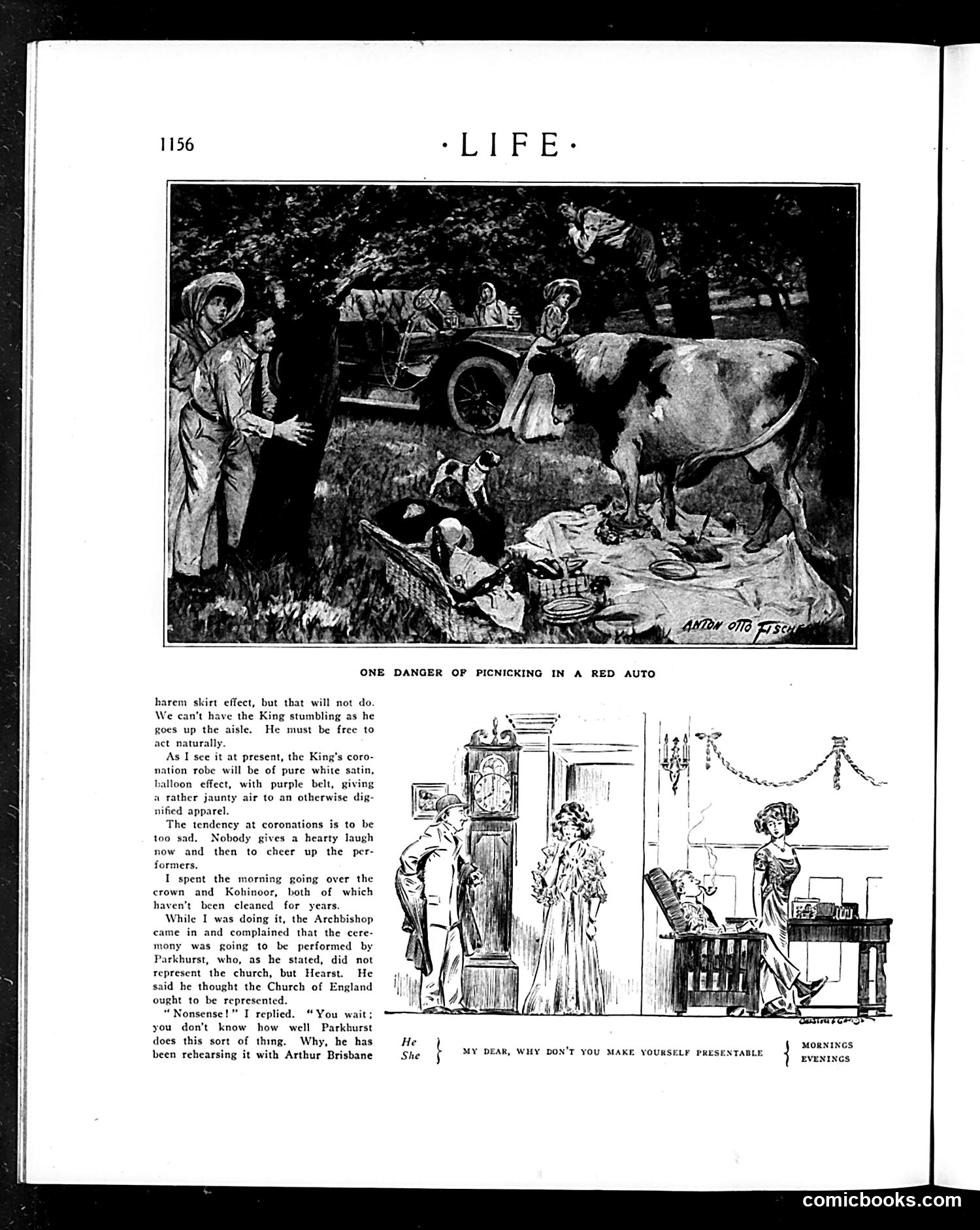
**Main Cartoon (top):** "One Danger of Picnicking in a Red Auto" This satirical illustration depicts a rural picnic scene where a cow has apparently wandered into or near the group's picnic setup beside a parked red automobile. The humor lies in the juxtaposition of modern motorcar leisure culture with unpredictable rural hazards—the cow representing the unpredictability of countryside adventures for city dwellers unfamiliar with farm animals. **Secondary Illustrations (bottom right):** Titled "Mornings & Evenings," these appear to show domestic scenes of someone (likely a woman) preparing or grooming herself, with the caption "My Dear, Why Don't You Make Yourself Presentable"—satirizing social expectations around appearance and domestic behavior in the early 20th century. The page satirizes both automotive-era leisure activities and gender/domestic expectations of the period.
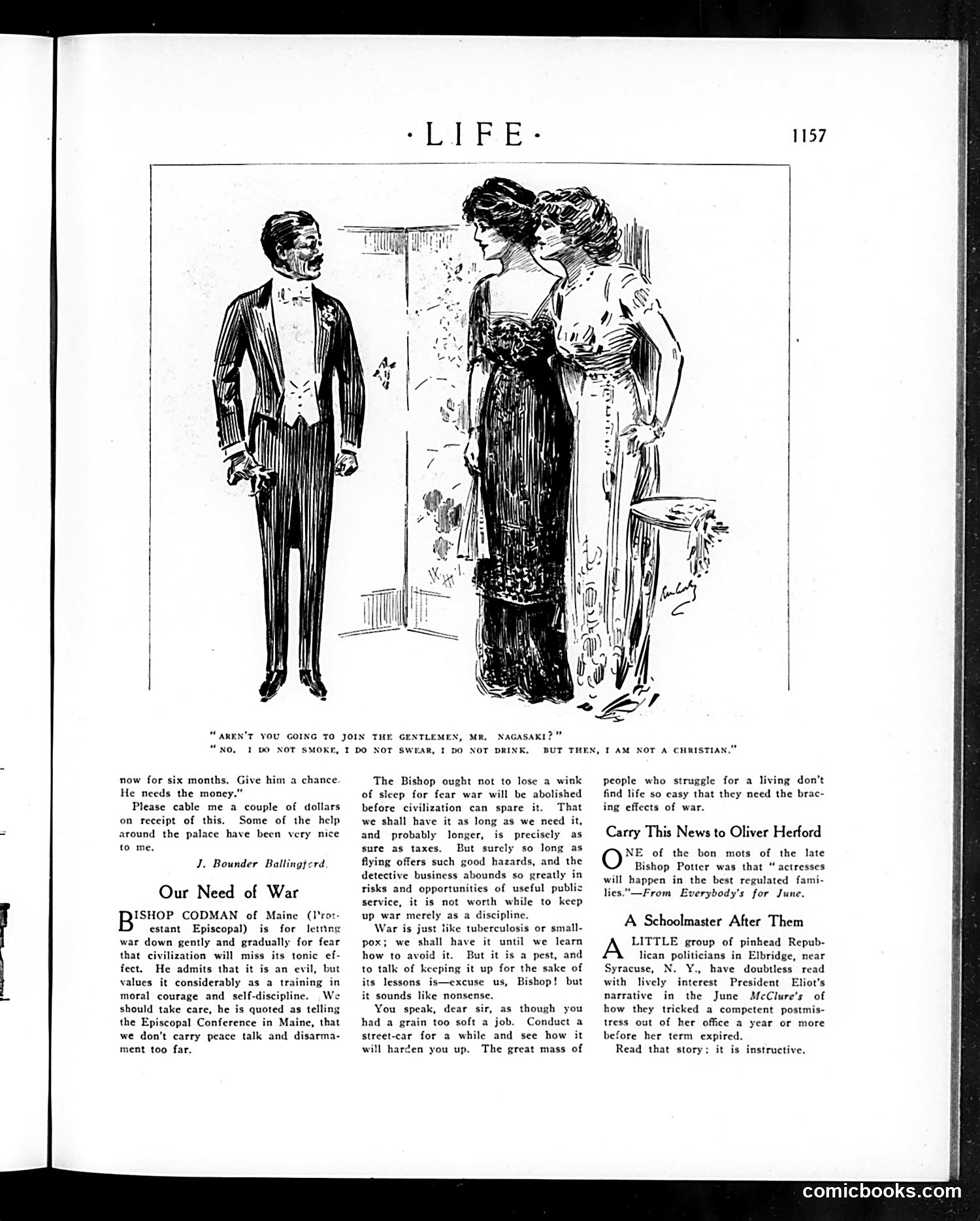
The cartoon depicts a man in formal evening wear confronting two women in elegant gowns. The caption reads: "AREN'T YOU GOING TO JOIN THE GENTLEMEN, MR. NAGASAKI?" / "NO, I DO NOT SMOKE, I DO NOT SWEAR, I DO NOT DRINK. BUT THEN, I AM NOT A CHRISTIAN." **The Satire:** This is anti-Christian social commentary. The joke targets Christian hypocrisy by suggesting that Christian gentlemen habitually engage in vices (smoking, swearing, drinking) that they publicly condemn. The Japanese man's name and refusal to join them implies that non-Christian moral standards may actually be superior or more consistent than Christian practice. The humor relies on early 20th-century American assumptions about both Japanese culture and Christian social behavior.
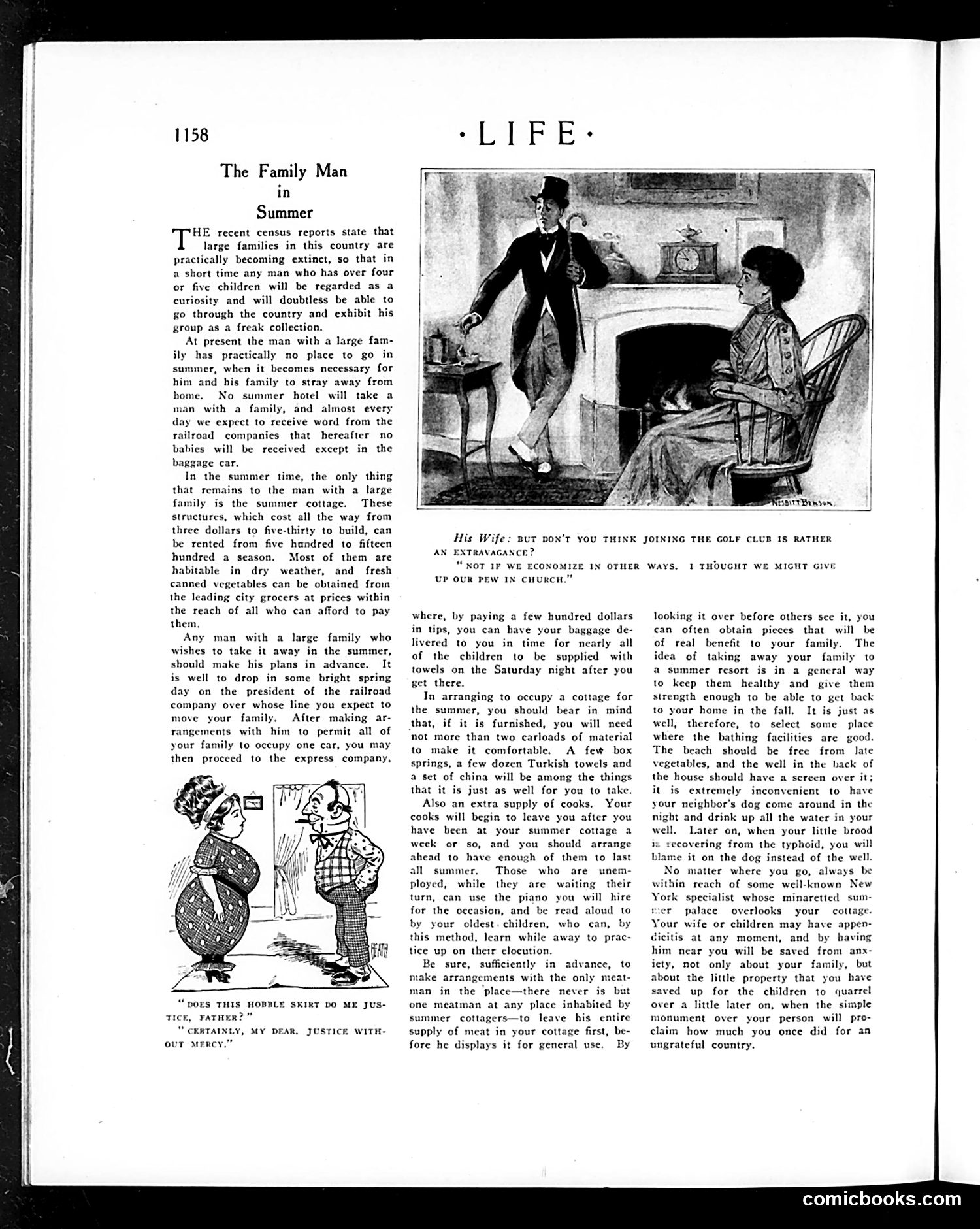
This article satirizes the impracticality of middle-class family vacations in early 20th-century America. The piece mocks the absurd obstacles facing fathers with large families: **The Setup**: Census reports note large families are becoming rare, making them "curiosities." Hotels reject families with children; railroads threaten to relegate babies to baggage cars. **The "Solution"**: Summer cottages—expensive rentals costing $300-$1,500—requiring elaborate advance planning: negotiating with railroad presidents for car space, paying substantial tips, hauling two carloads of personal items, hiring multiple cooks (who quit weekly), arranging meat delivery. **The Satire**: The author deadpans increasingly absurd advice—hiring a piano for unemployed cooks to practice elocution, inspecting meat before public display, ensuring wells have screens against neighbors' dogs. **The Cartoon**: A wife asks her husband if joining a golf club is extravagant; he replies they'll "economize in other ways" by reducing church donations—satirizing misplaced priorities. The joke targets upper-middle-class pretension: families spend fortunes on summer retreats while claiming financial constraint, and fathers pursue leisure activities before charitable obligations.
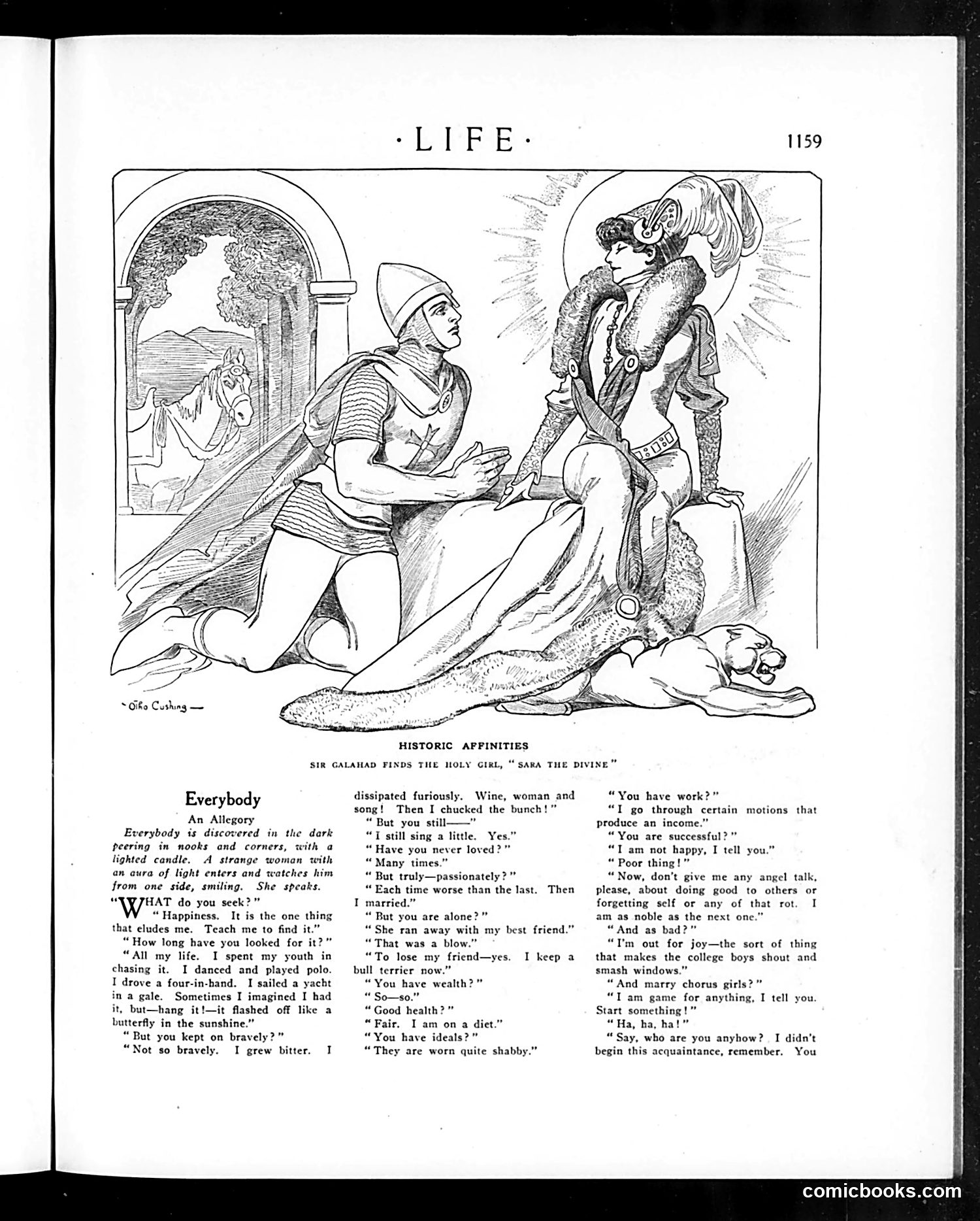
This is a satirical allegorical dialogue between "Everybody"—an everyman figure representing modern American society—and "Sara the Divine," a mysterious woman with a halo (likely representing either spirituality, idealism, or salvation). The cartoon critiques the spiritual emptiness of early 20th-century American life. Everybody confesses to pursuing happiness through conventional means: wealth, romance, sensory pleasures (wine, women, song), and hedonism—yet remains perpetually unfulfilled. His confessions reveal disillusionment: failed love, infidelity, bitterness, and cynicism masquerading as worldly sophistication. "Sara" questions him systematically about work, health, ideals, and morality, exposing how he's abandoned genuine meaning for shallow pursuits and materialistic comfort. The satire suggests that modern Americans mistake pleasure-seeking and conspicuous consumption for authentic happiness, while dismissing spirituality or genuine virtue as naive "angel talk." The title reference to Sir Galahad (a pure knight) underscores the ironic gap between noble ideals and modern moral degradation.
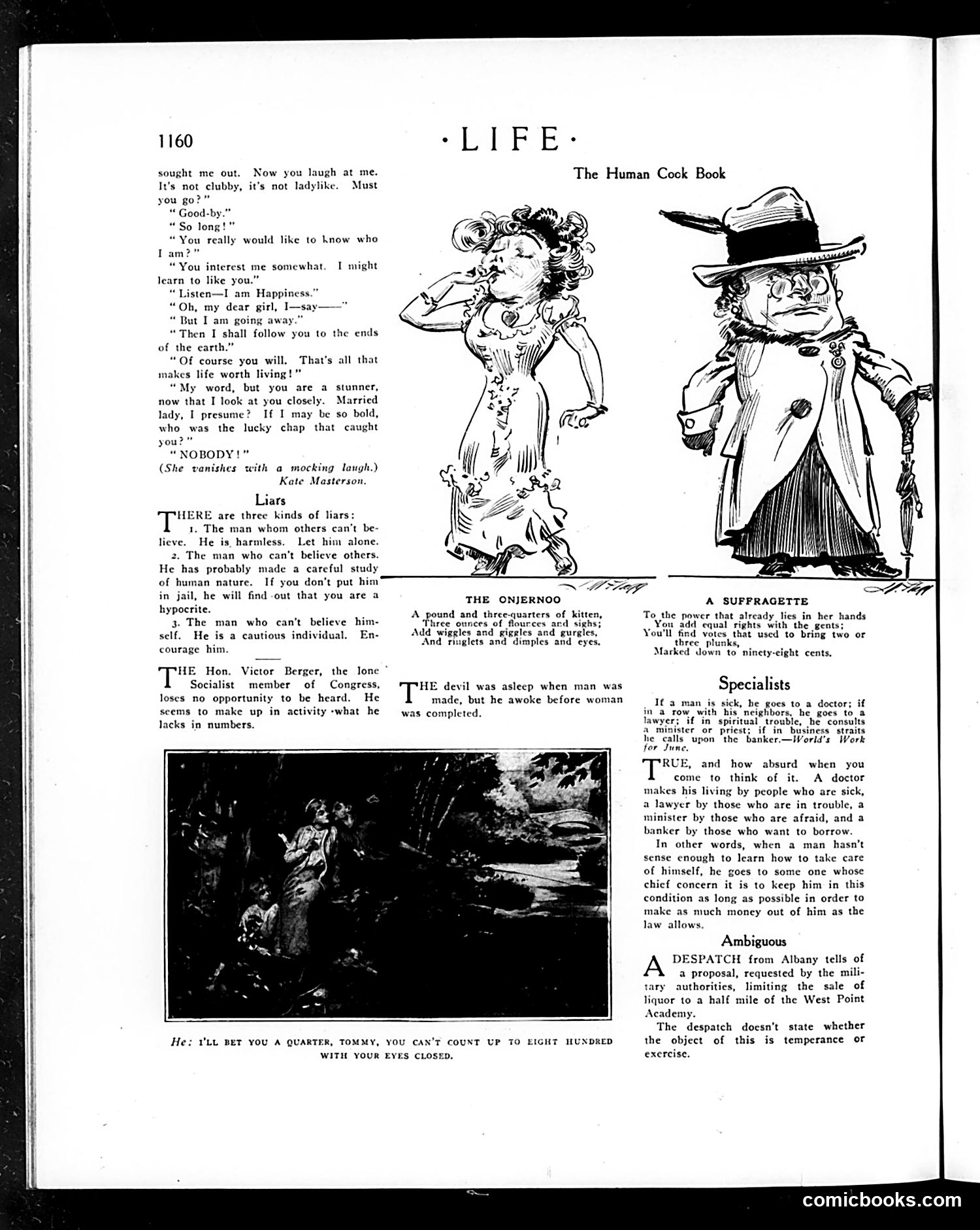
This page contains multiple satirical pieces targeting early 20th-century social attitudes: **"The Onjernoo" and "A Suffragette"**: The cartoons mock women, particularly suffragettes (women's voting rights activists). The left figure represents an idealized woman as mere physical attributes; the right depicts a suffragette as masculine and undesirable. The suffragette caption sarcastically suggests that granting women voting rights will devalue their political power ("marked down to ninety-eight cents"), implying women voters are worthless. **"The Human Cock Book"**: A dehumanizing recipe reducing women to physical components—"kitten," "wiggles," "dimples." **"Specialists" and "True"**: Social commentary criticizing professions (doctors, lawyers, clergy, bankers) for profiting from human misery rather than solving problems. **Victor Berger reference**: Notes the lone Socialist congressman's verbal activism despite minimal political power—mild political satire. **"Three Kinds of Liars"**: Philosophical observation about human nature and self-deception. The page reflects early 1900s anti-feminist sentiment and class-based social criticism typical of Life magazine's satirical approach.
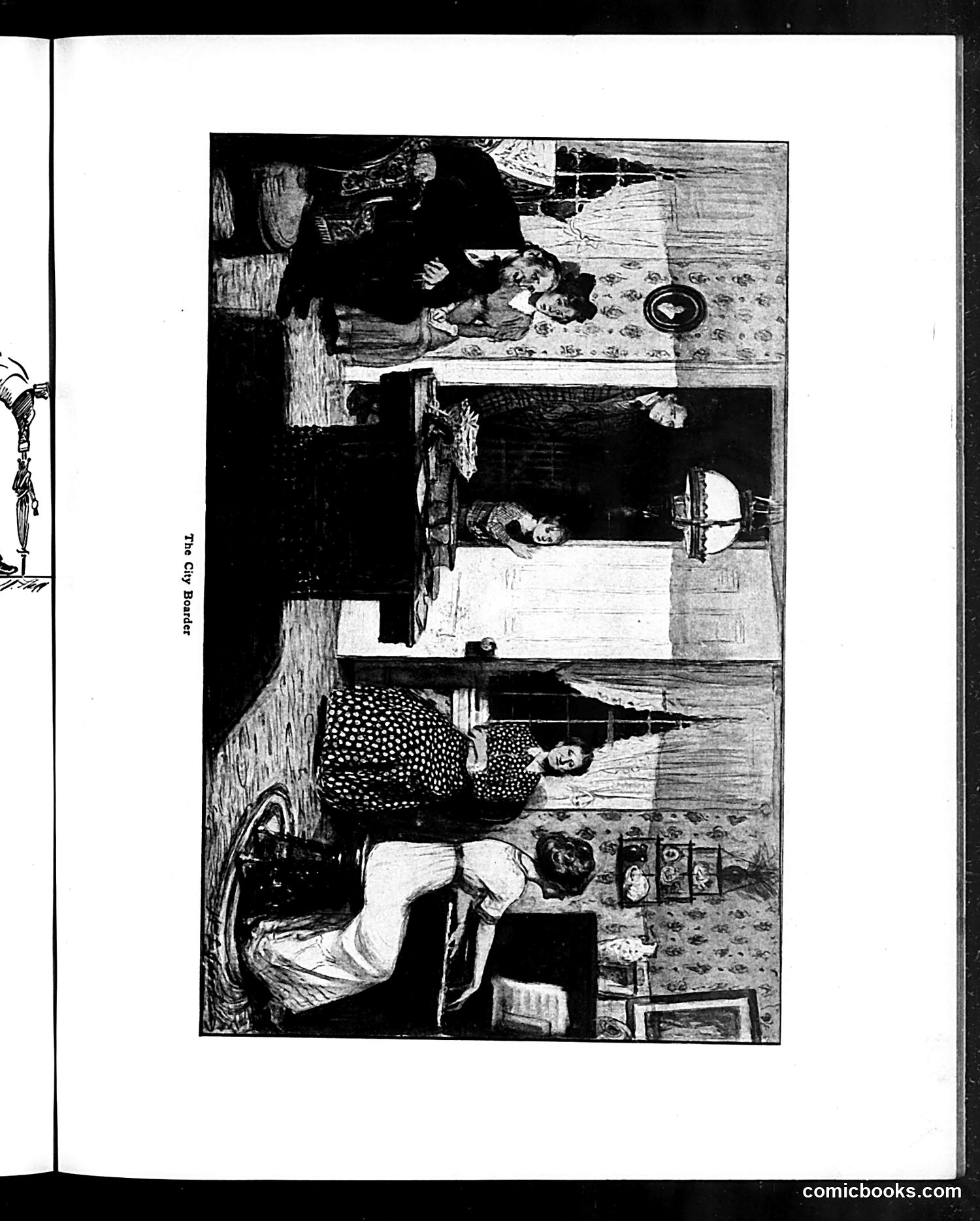
This appears to be a satirical illustration titled "The Cry Bucket" depicting domestic life in what looks like a tenement or working-class apartment. The image shows multiple figures across different rooms or levels of a cramped dwelling, with people engaged in various activities suggesting emotional distress or complaint. The satire likely mocks working-class domestic complaints and grievances—the "crying" or complaining about everyday hardships. The cramped, multi-level living space emphasizes poverty and overcrowding. Without clearer text identifying specific figures or a precise publication date, the exact political target remains unclear, but the overall mockery appears directed at complaints about living conditions or domestic life among the working poor.
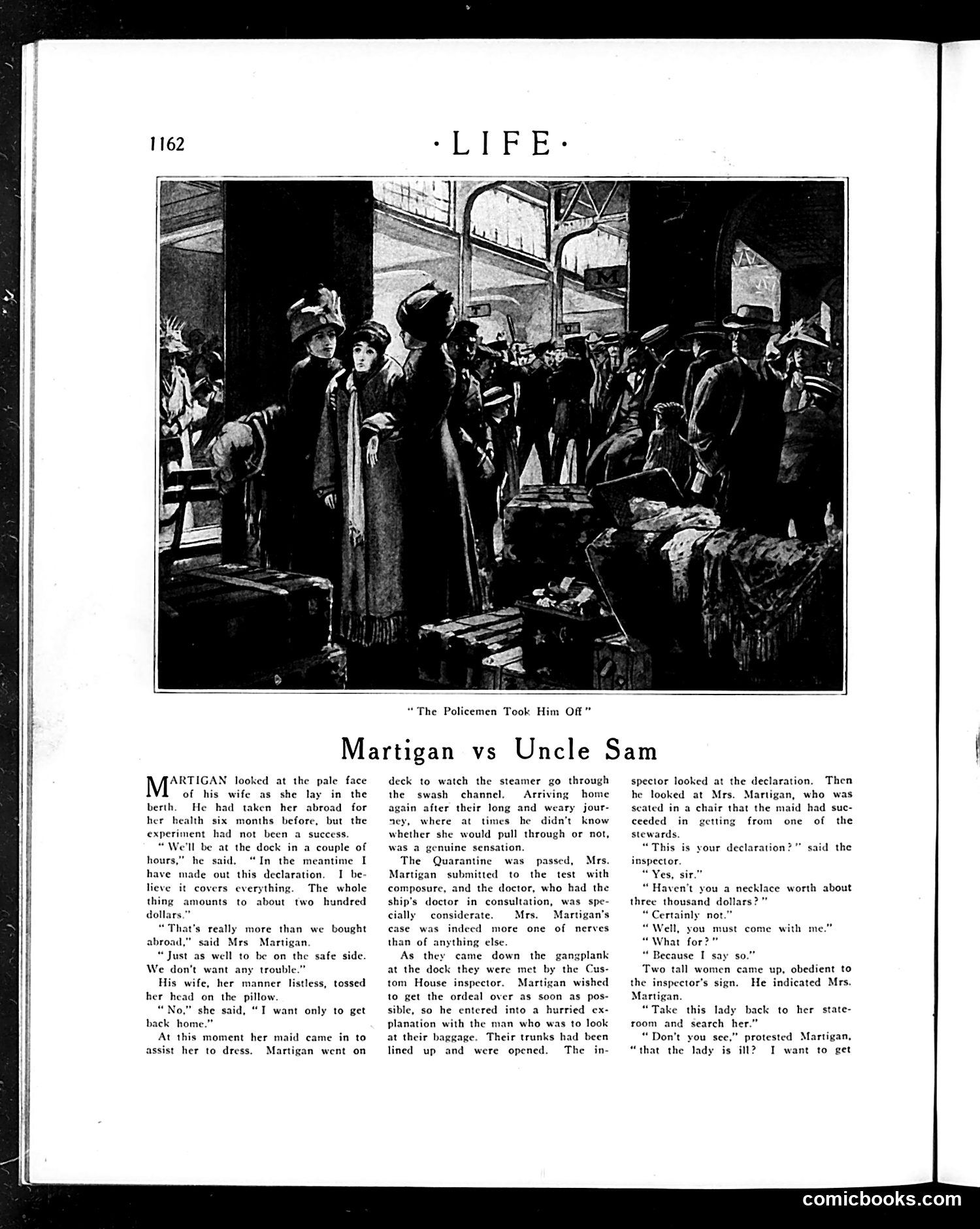
This satirical story depicts a customs dispute at an American port. Mr. Martigan returns from abroad with his ailing wife, declaring about $200 worth of purchases. A customs inspector suspects Mrs. Martigan is concealing an undeclared necklace worth approximately $3,000. When Martigan protests—noting his wife's poor health—the inspector orders female officers to search her anyway, invoking his authority. The satire mocks **overzealous government bureaucracy**. "Uncle Sam" (the U.S. government, represented by the customs inspector) rigidly enforces regulations without compassion or common sense, prioritizing revenue collection over a sick woman's dignity and condition. The inspector's dismissive "Because I say so" epitomizes arbitrary official power. The story satirizes how American customs enforcement prioritizes catching smugglers over treating citizens humanely.
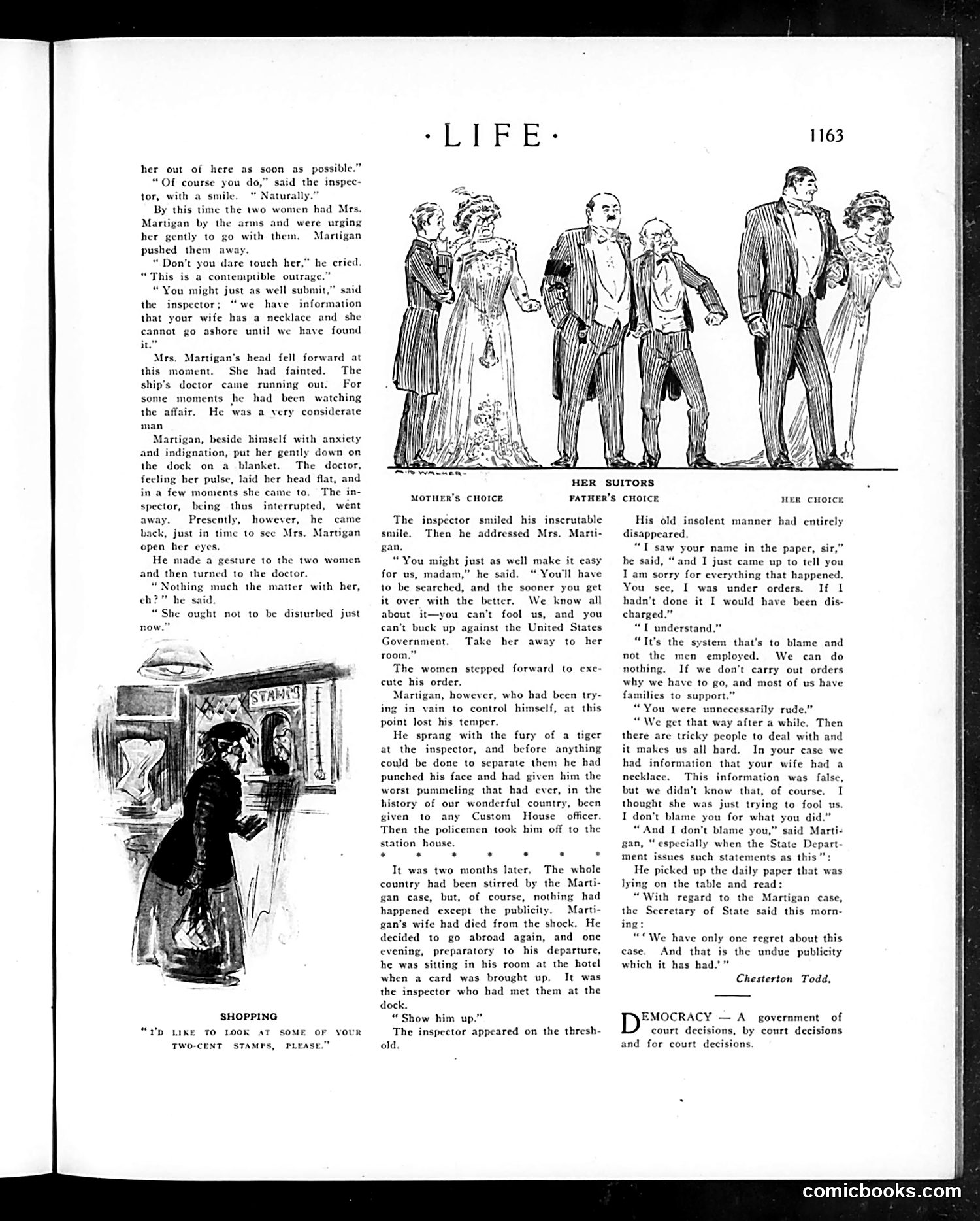
This page depicts a satirical story about government overreach and bureaucratic abuse. A customs inspector humiliates Mrs. Martigan at a dock, searching for a necklace he suspects she's smuggling. When her husband assaults the inspector in protest, he's arrested. Two months later, the inspector visits Martigan, now apologetic and claiming he was "just following orders"—a defense the story presents as hollow. The inspector blames "the system," not himself. The satire targets American customs officials' arbitrary power and their dehumanizing treatment of citizens. The "shopping" cartoon below mocks customs agents' absurd focus on trivial items (two-cent stamps). The broader critique: government employees hide behind bureaucratic necessity while citizens suffer unjust treatment. The story ends with a State Department statement, implying official hypocrisy about protecting citizens' rights—a common target of *Life* magazine's political commentary.
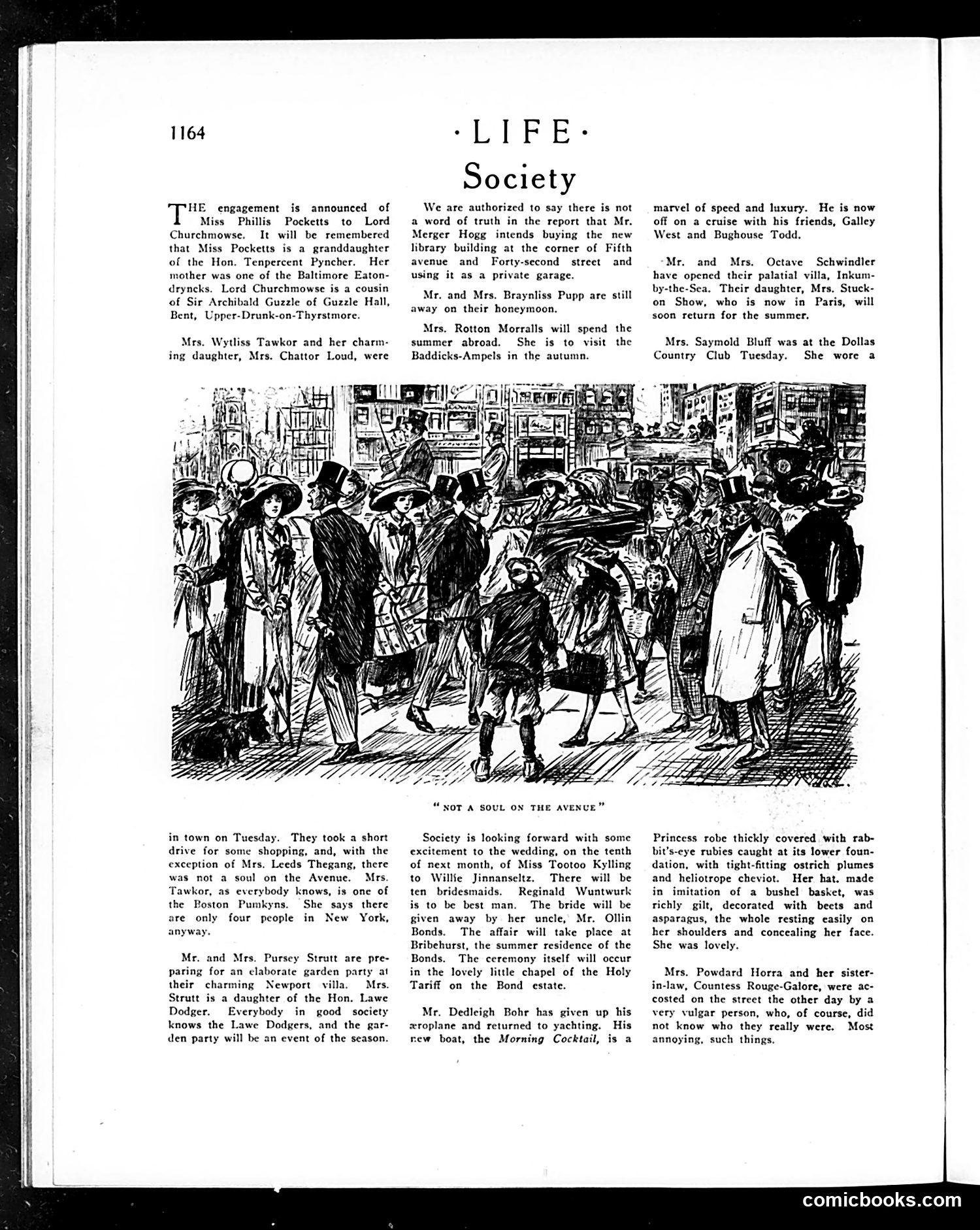
This page mocks upper-class society gossip and pretension through fake society announcements and an illustration showing a crowded city street. The satire targets several absurdities: ridiculous aristocratic names ("Lord Churchmowse," "Tenpercent Pyncher") and fabricated genealogies; vapid social concerns (an engagement, a wedding with ten bridesmaids); and the self-important exclusivity of wealthy people claiming exclusion from the masses—the irony being Mrs. Tawkor insists "there are only four people in New York" while the street scene shows it packed with humanity. The cartoon's caption "NOT A SOUL ON THE AVENUE" directly contradicts the crowded street depicted, emphasizing how the wealthy inhabit a delusional bubble of their own importance, oblivious to the actual crowds around them. Additional mockery includes yacht names like *Morning Cocktail* and absurd fashion descriptions (a hat "in imitation of a bushel basket" decorated with beets and asparagus), ridiculing both conspicuous consumption and the pretentious magazine language that celebrates it.
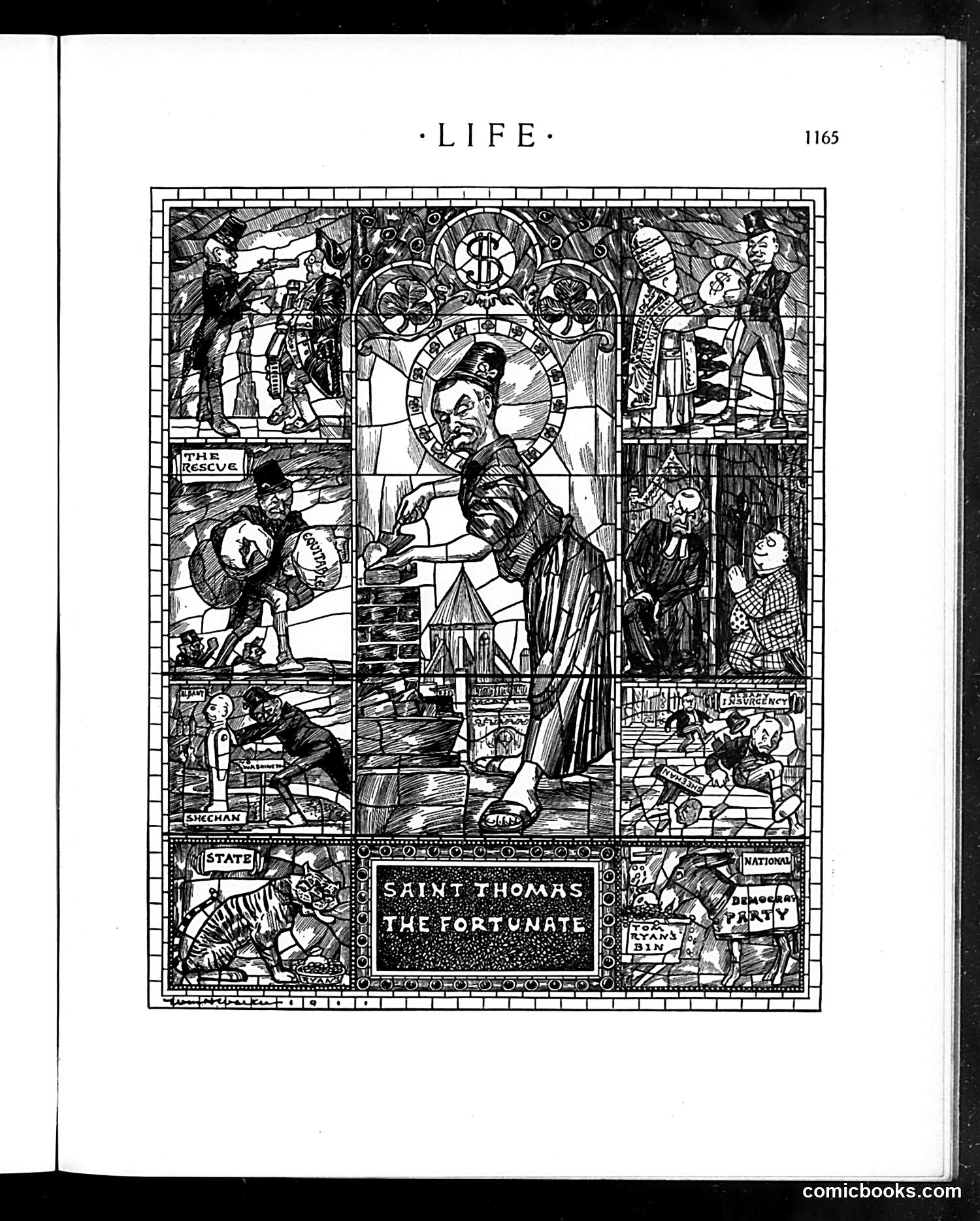
This is a woodcut-style religious satirical illustration titled "Saint Thomas the Fortunate," appearing in *Life* magazine (page 1165). The central figure is a robed saint or holy man surrounded by various smaller scenes in a medieval manuscript style. The surrounding vignettes appear to depict fortune, luck, and chance scenarios—consistent with the title's ironic reference to "fortune." Without clearer OCR text labeling the specific scenes, the exact satirical targets are unclear, but the composition suggests commentary on luck, providence, or perhaps the randomness of fate versus religious faith. The ornate border and medieval aesthetic create an intentional contrast between sacred imagery and mundane fortune-telling themes.
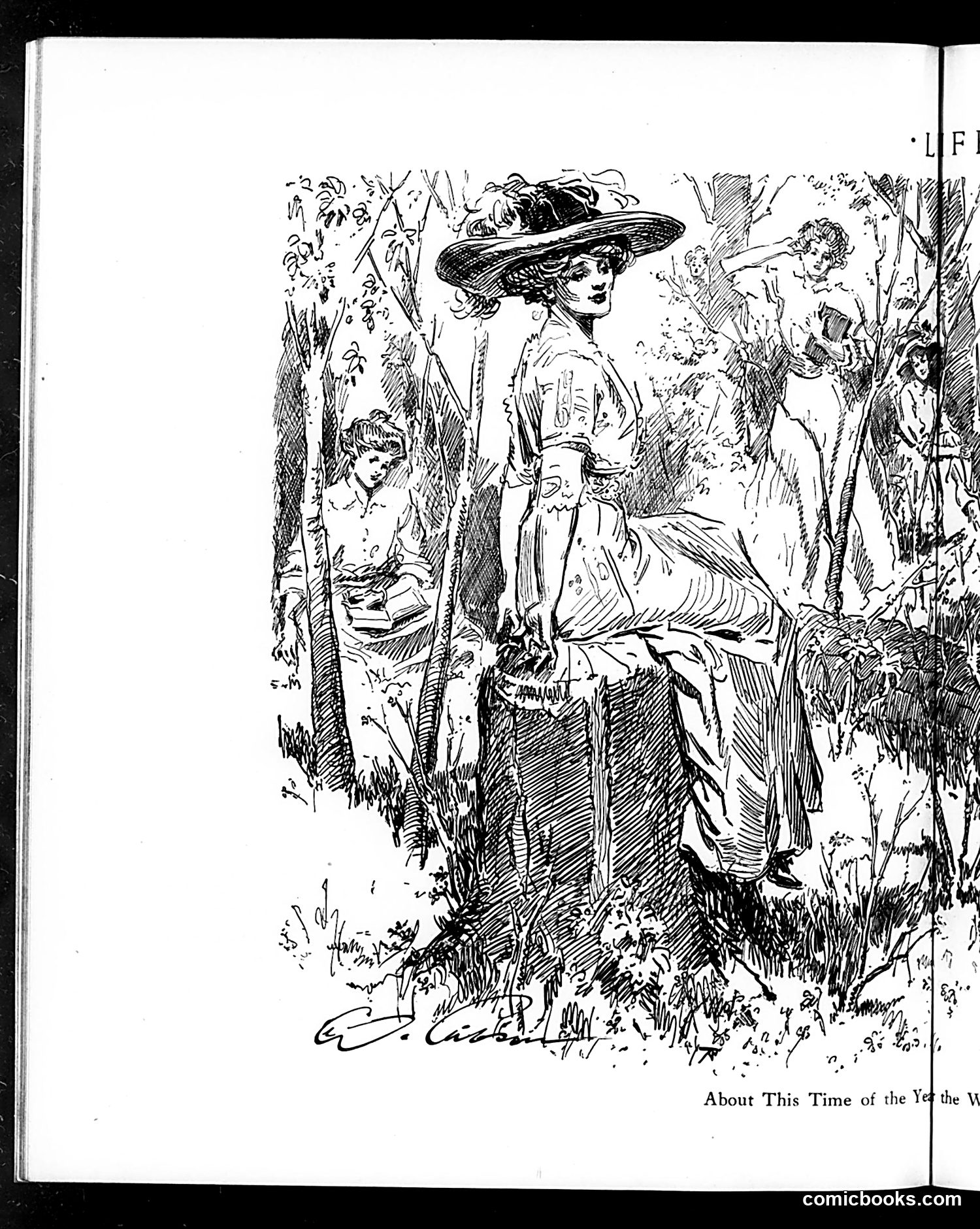
This is an ink sketch showing a woman in early 20th-century dress (wide-brimmed hat, long skirt) standing outdoors with foliage around her. A young boy stands beside her. The artistic style and signature suggest this is editorial illustration rather than political cartoon. The OCR text is largely corrupted ("Yef the V"), making the caption unreadable. The partial visible text reads "About This Time of the Ye[ar]..." suggesting seasonal content. Without a legible caption, I cannot definitively identify the figures or explain the satirical intent. The image appears to be a domestic or social scene illustration typical of *Life* magazine's genteel humor, but the specific context and point remain unclear from the corrupted text alone.
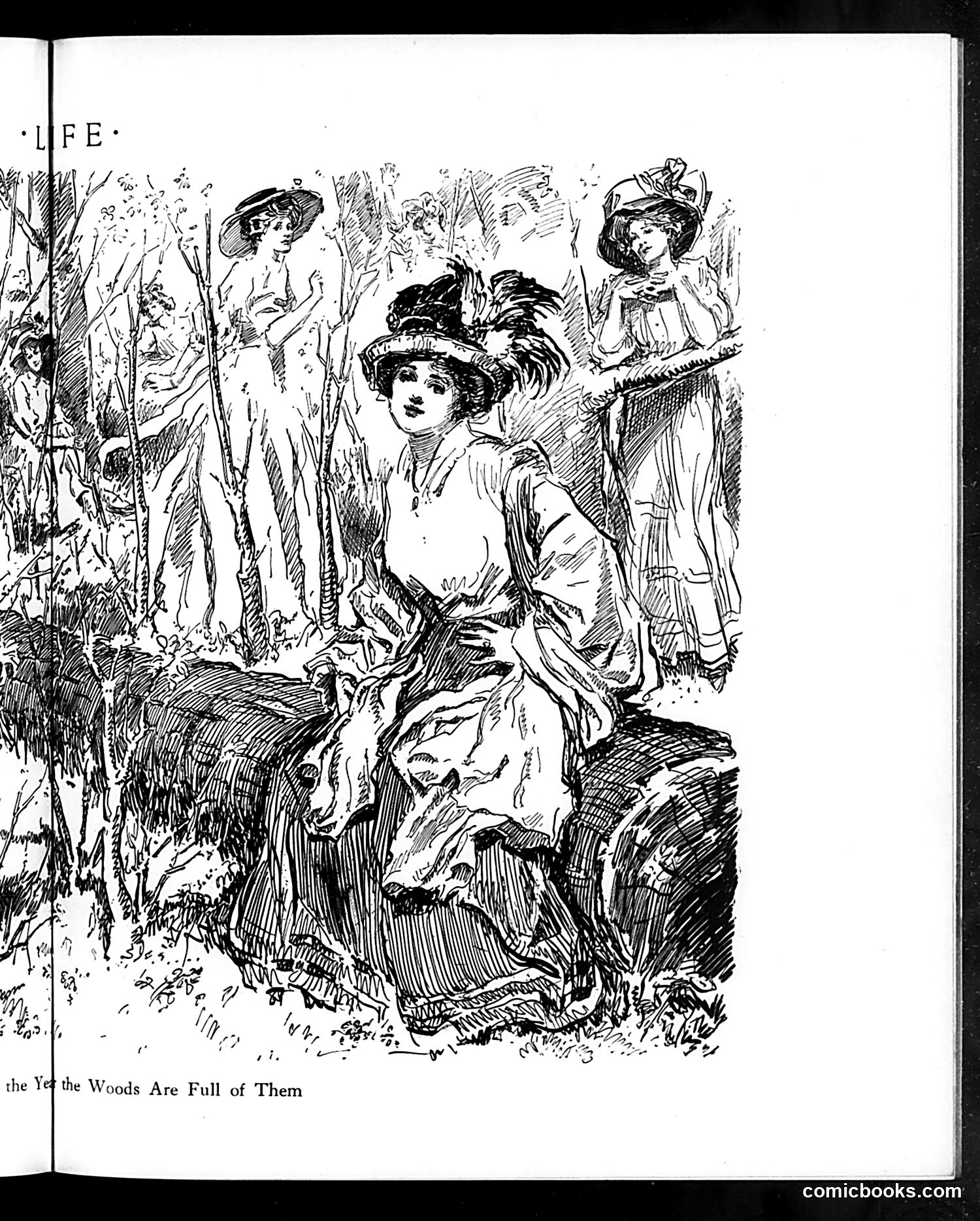
This illustration from *Life* magazine shows a social scene in a wooded setting with fashionably dressed women in early 1900s attire (large hats, elaborate clothing). The caption "the Ye[a]r the Woods Are Full of Them" suggests commentary on a seasonal social phenomenon. The drawing likely satirizes the popular practice of women visiting or vacationing in natural settings during this era—a leisure activity associated with the wealthy and fashionable classes. The crowded composition and the caption's wry tone suggest the humor comes from how these supposedly private woodland escapes have become so fashionable that they're now overcrowded with society women, undermining their appeal as retreats into nature. The satire targets upper-class social pretension and the herd mentality of fashion-conscious society.
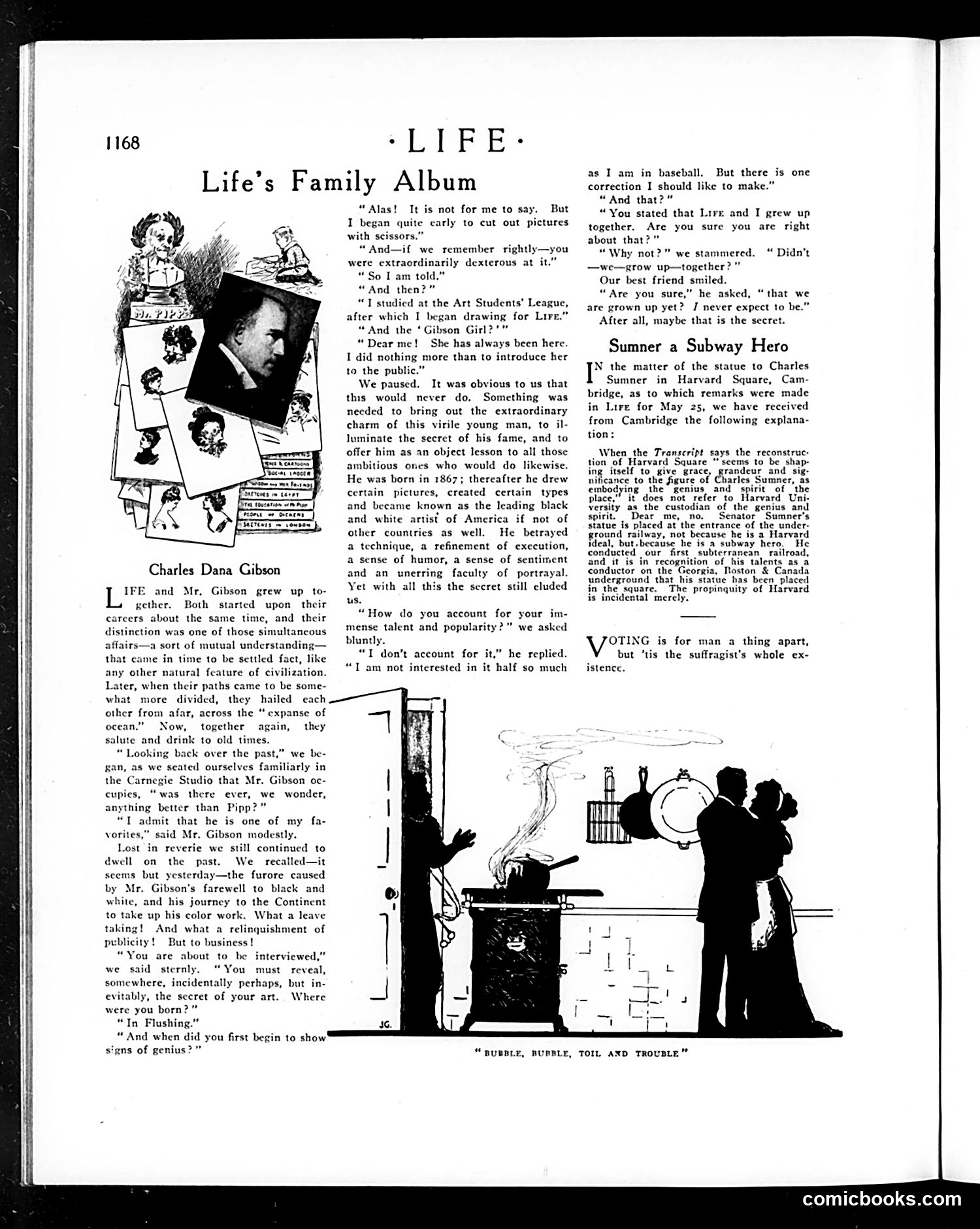
This page features a celebrity interview with **Charles Dana Gibson**, the renowned illustrator famous for creating the "Gibson Girl" — an idealized feminine type that defined American beauty standards in the early 1900s. The interview reveals Gibson's modest, somewhat evasive personality. When pressed about the secret to his immense talent and popularity, he deflects, claiming he's more interested in baseball. He corrects the interviewer's assumption that he and *Life* magazine grew up together, joking that neither he nor the magazine has truly "grown up yet"—a humorous critique suggesting both remain youthful or juvenile in spirit. The lower section includes a satirical note about a statue of Senator Charles Sumner at Harvard Square, facetiously arguing he's a "subway hero" rather than a Harvard ideal, mocking the pompous language used to justify its placement. The cartoons throughout use Gibson's own illustration style to enhance the piece's self-referential humor.
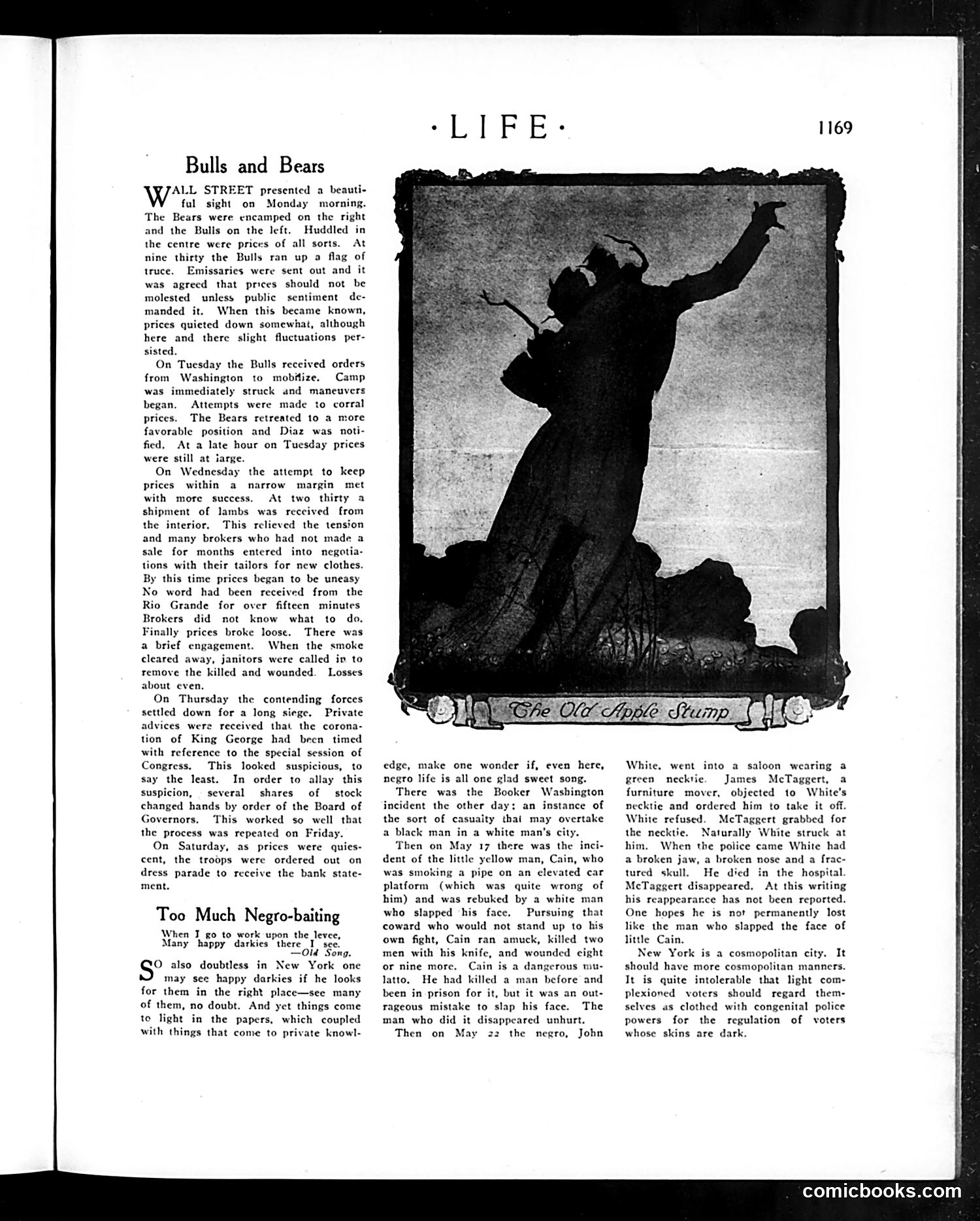
**The Main Cartoon:** The illustrated silhouette titled "The Old Apple Stump" uses Wall Street's "Bulls" and "Bears" as military forces fighting over stock prices—personified as innocent victims caught between them. This is satirical commentary on stock market volatility and the dramatic, almost militaristic language brokers use. **The Text Article:** "Too Much Negro-baiting" critiques racial violence in New York City. It catalogs three incidents where Black men faced unprovoked assault by white men: the Booker Washington incident, the case of "Cain" (struck for smoking on an elevated platform, leading to his violent retaliation), and John White (beaten to death by furniture mover McTaggert over a green necktie). The author sarcastically notes that despite the "Old Song" suggesting happy Black workers, these incidents reveal systemic racial violence where white perpetrators escape accountability while Black victims suffer lethal consequences.
This page reviews recent literary works, primarily focusing on novels by Mary S. Watts. The main text discusses her three novels—"The Tenants," "Nathan Burke," and "The Legacy"—which chronicle Ohio society across different historical periods (1880s, Mexican War era, and the present). The reviewer notes that while critically praised, her books achieved uneven commercial success, wondering whether the public simply overlooked "The Tenants" or actively rejected it. The "Confidential Book Guide" section provides brief notices of other current publications, including Hiram Bingham's travel account "Across South America" and works by Maurice Hewlett and George Cram Cook. There are no political cartoons visible on this page. It is primarily a literary review and advertising section for contemporary books aimed at educated American readers interested in fiction and travel literature.
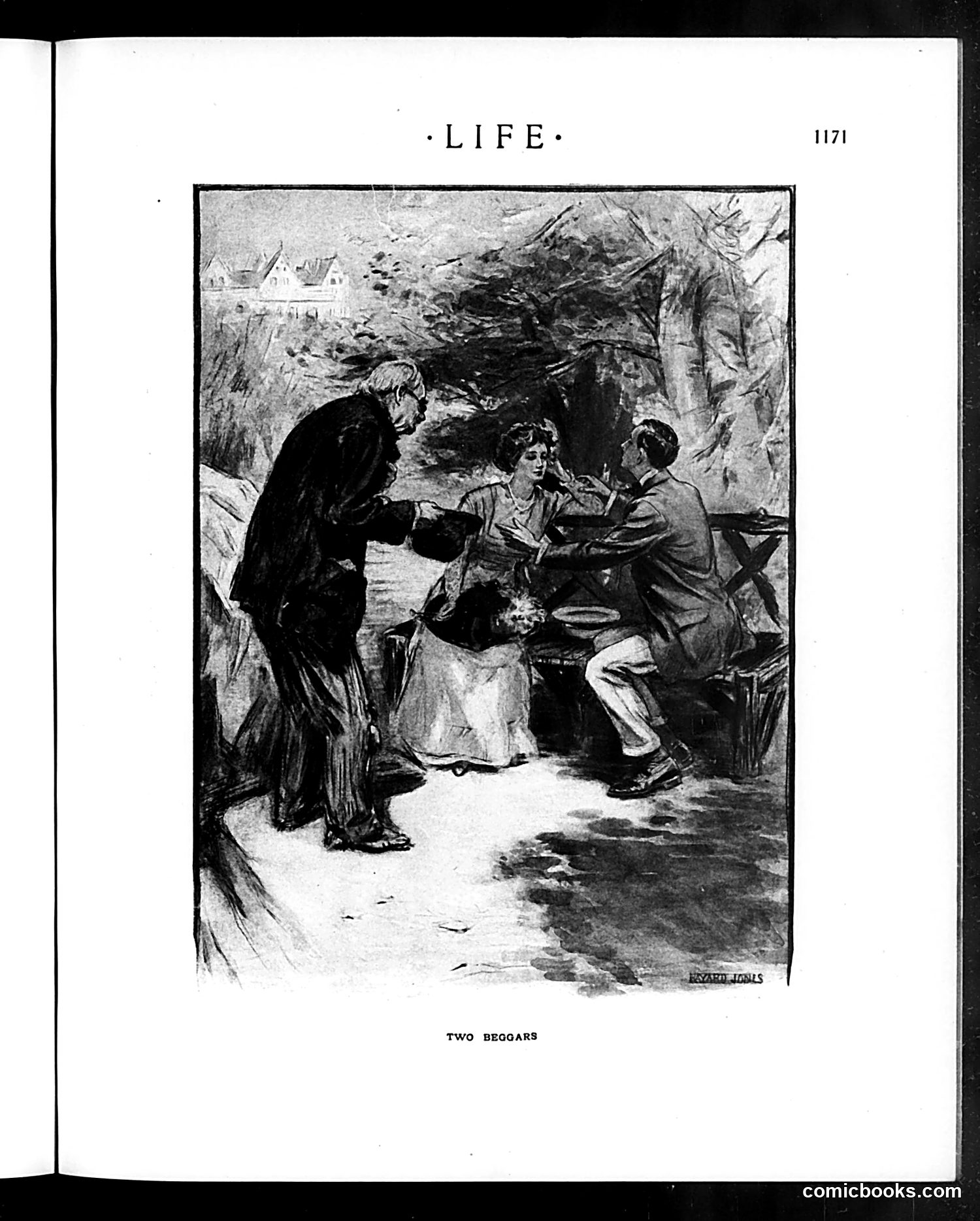
This illustration depicts two figures in tattered clothing engaged with a well-dressed woman in what appears to be an alleyway or impoverished setting. Based on the title and visual composition, this appears to be social satire about poverty and class disparity, likely commenting on beggary as a social phenomenon during the early-to-mid 20th century. The sketch-style artwork emphasizes the contrast between the poorly-clothed individuals and their apparent interaction with a woman of apparent means. Without additional context from the magazine's original publication date or accompanying text, the specific satirical point remains unclear—whether it critiques the wealthy's response to poverty, romanticizes beggars, or makes another social commentary. The scene suggests Life magazine's typical focus on American social conditions and class commentary.
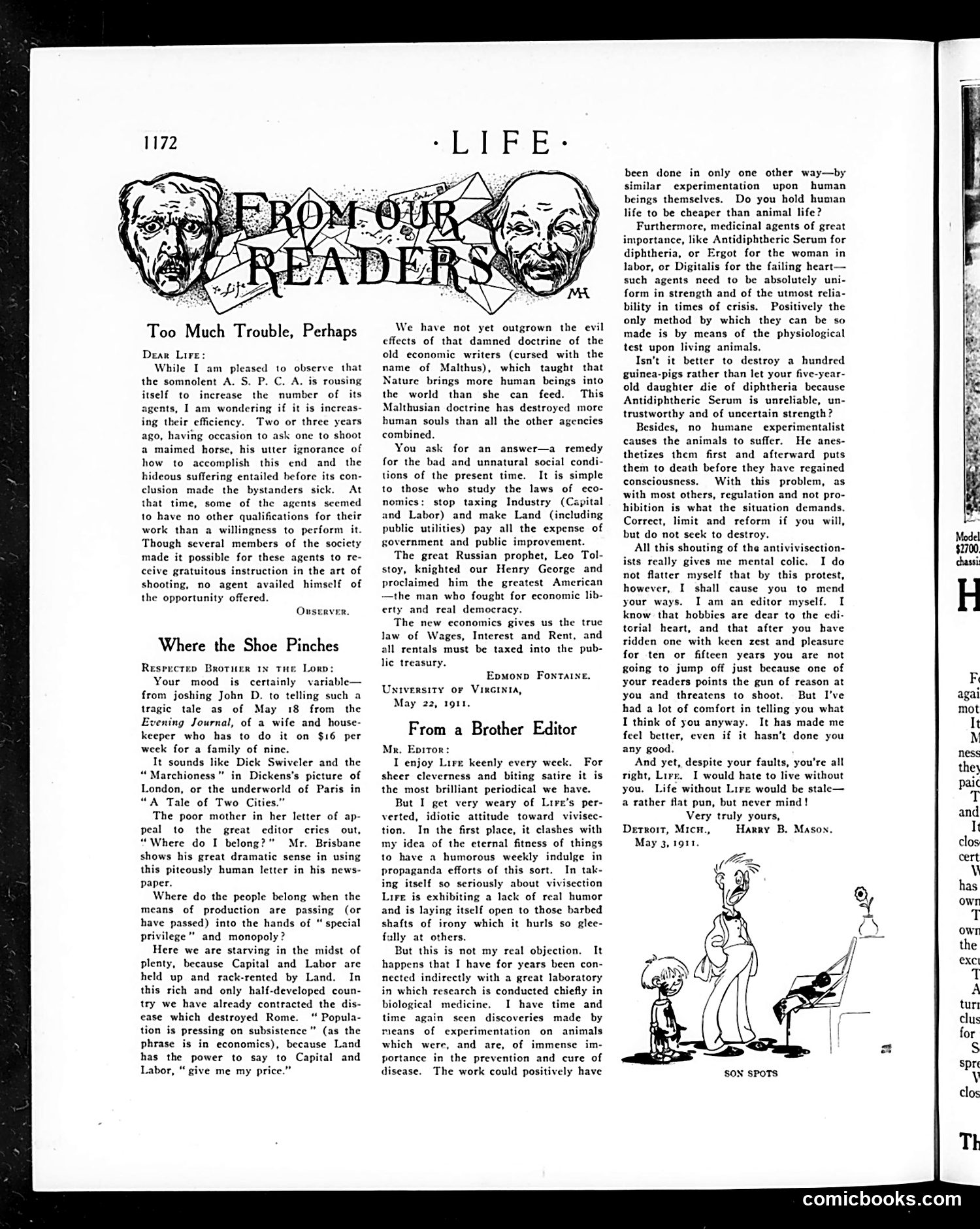
This page collects reader letters responding to *Life* magazine's editorial positions. The key content concerns **animal experimentation (vivisection)**. The "Son Spots" cartoon (bottom right) depicts a child confronting an adult, likely satirizing debates over medical research on animals—a major controversy in early 1900s America. The third letter, from "a Brother Editor," criticizes *Life's* "perverted, idiotic attitude toward vivisection." The writer defends animal experimentation as necessary for medical advancement, arguing that *Life* undermines its satirical credibility by taking a serious moral stance rather than remaining humorous. The tension reflects genuine Gilded Age conflict: animal welfare advocates (represented by references to the ASPCA) versus medical/scientific researchers who viewed animal testing as essential. The letter-writer essentially tells *Life*: stick to satire, not activism—your preaching weakens your jokes.
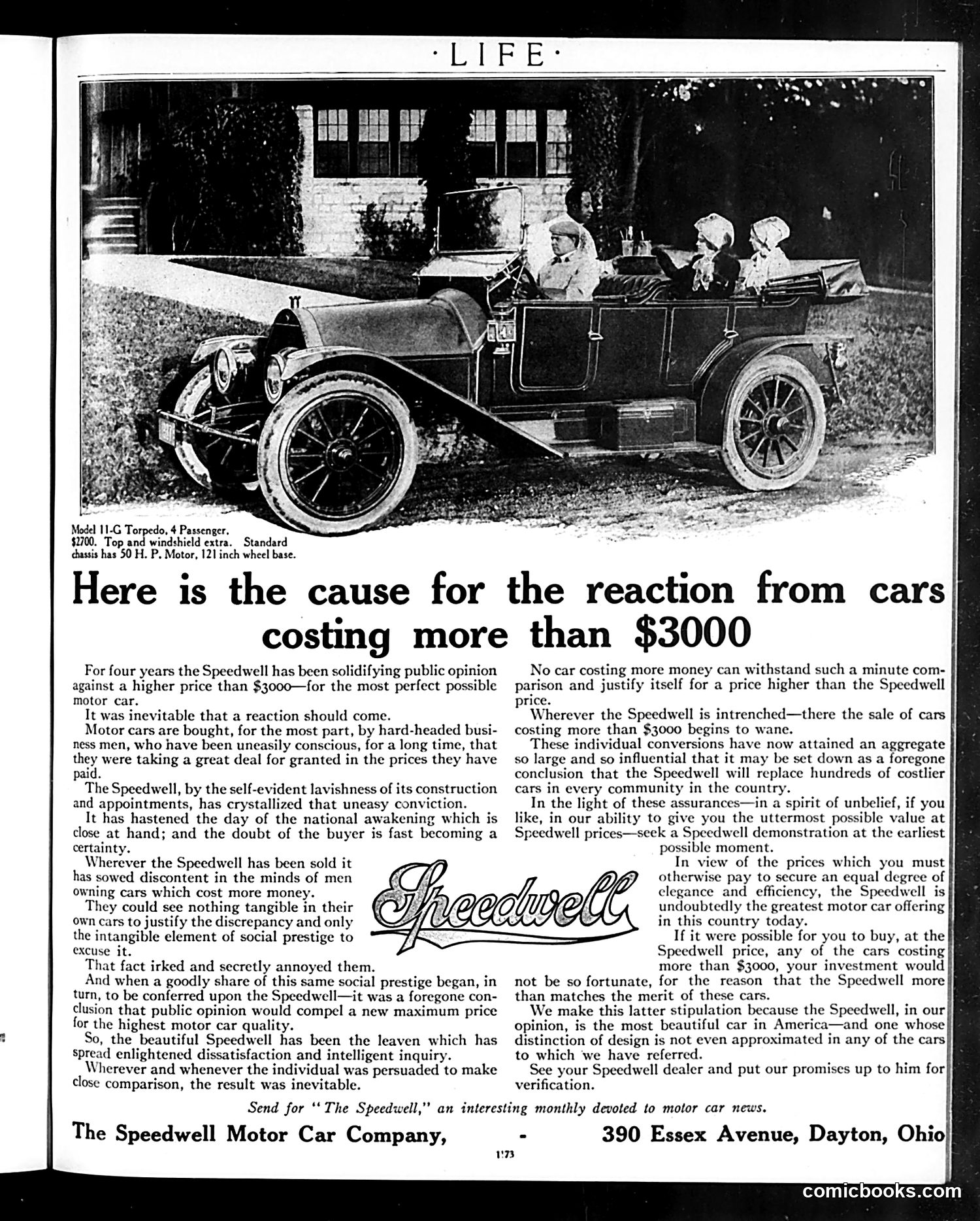
This is primarily a **car advertisement**, not a satirical cartoon. The Speedwell Motor Car Company uses a paradoxical sales pitch: they argue that their car's $2,700 price point is so competitively superior that it's causing customers of more expensive cars ($3,000+) to feel buyer's remorse. The ad claims the Speedwell has "sowed discontent" among owners of pricier vehicles by proving you don't need to spend more for quality. Rather than traditional bragging, Speedwell suggests their car demonstrates that luxury cars command inflated prices based on social prestige rather than genuine merit. The photograph shows a touring car with passengers in period dress, illustrating the vehicle's practical elegance. The lengthy text functions as aspirational marketing—flattering potential buyers' intelligence while implying that choosing Speedwell marks you as savvy and discriminating, not cheap.
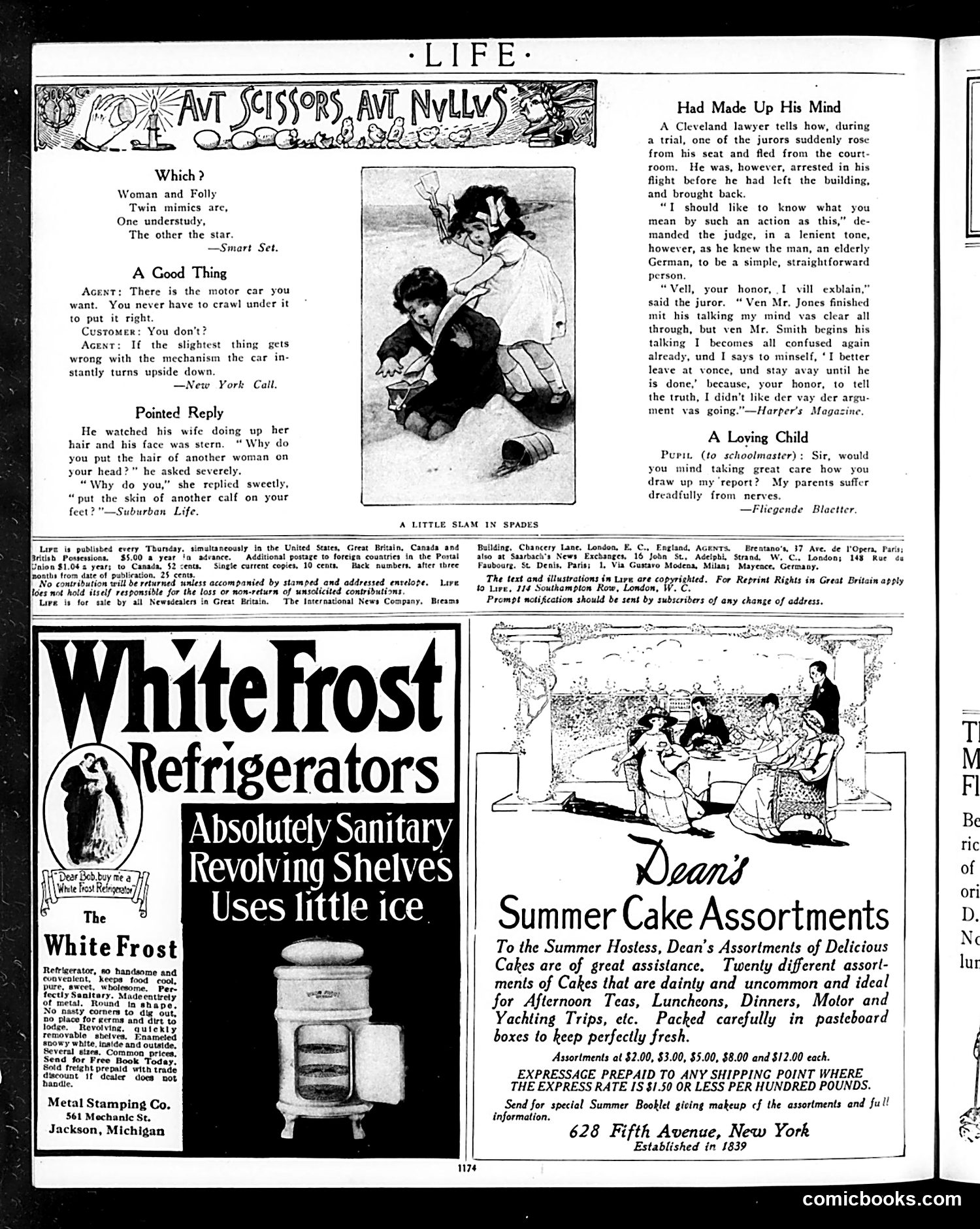
This page contains four satirical humor pieces typical of early 20th-century American comedy magazines: **"Which?"** — A riddle about indistinguishable things (woman/folly, understudies/stars). **"A Good Thing"** — A salesman's absurd pitch: a car so perfectly engineered that any mechanical problem causes it to flip upside down. The joke mocks exaggerated advertising claims. **"Pointed Reply"** — A wife deflects her husband's criticism about wearing false hair by asking why he wears a calf-skin shoe. A domestic squabble resolved through witty comebacks—common humor of the era. **"Had Made Up His Mind"** — An elderly German juror flees the courtroom during trial, explaining to the judge that one lawyer's arguments confused him too much, so he left to avoid hearing more. His broken English and straightforward logic create the humor. The page is primarily **humor and advertising**—White Frost Refrigerators and Dean's Summer Cake Assortments occupy significant space. The jokes reflect genteel, middle-class sensibilities of the period.
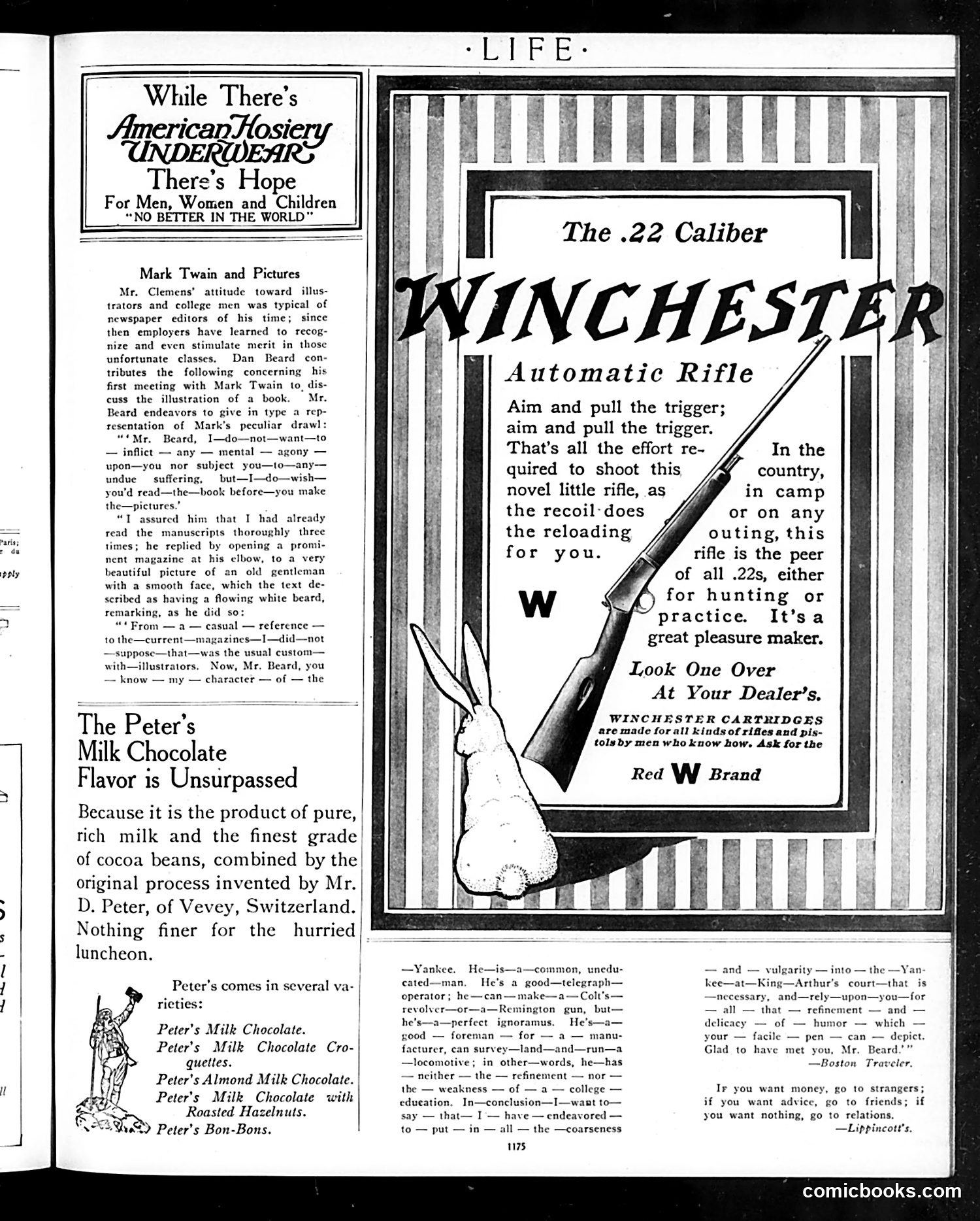
This page contains **advertisements and editorial content**, not political cartoons. The main elements are: **Left column:** An anecdote about Mark Twain's meeting with illustrator Dan Beard, presented in Twain's distinctive drawl. Twain humorously complains about illustrators who misread source material—he points out an old man depicted with a smooth face despite text describing a white beard. The story illustrates Twain's sardonic wit about professional carelessness. **Right side:** A Winchester .22 Caliber Automatic Rifle advertisement featuring an illustration of the gun and a rabbit. The copy emphasizes ease of use ("aim and pull the trigger") and versatility for hunting and practice. **Bottom left:** Peter's Milk Chocolate advertisement promoting Swiss-made chocolate products. **No satire or political commentary is present.** This appears to be a standard Life magazine page mixing leisure reading (Twain anecdote), product advertising, and period quotations.
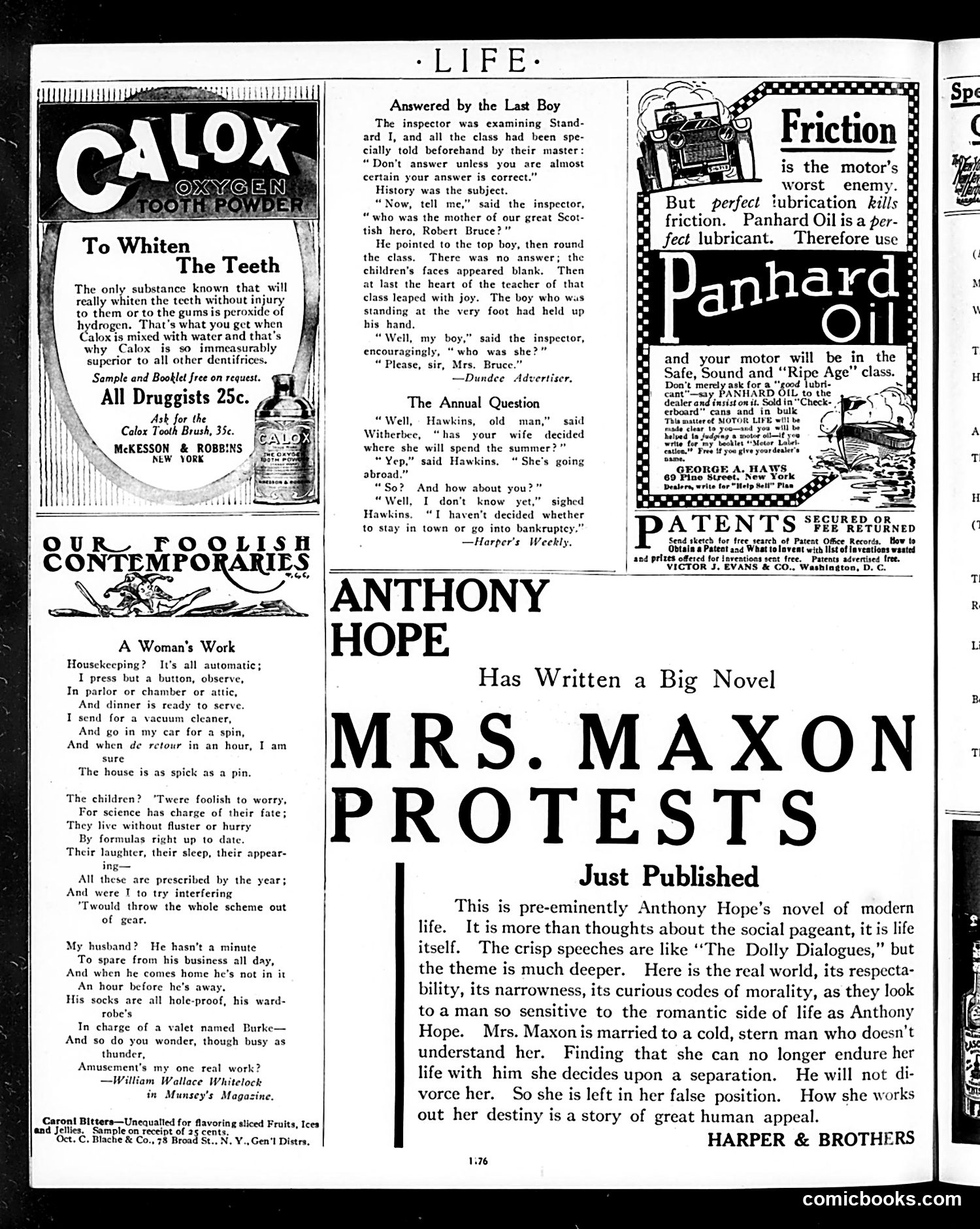
This page is primarily **advertisements and light humor** rather than political satire. The main content includes: 1. **"A Woman's Work"** — A satirical poem mocking early 20th-century domestic automation. It portrays an ironic woman who claims modern conveniences (electric buttons, vacuum cleaners, scientific childcare formulas) have made housekeeping "automatic," yet her "one real work" remains entertainment/amusement. The satire targets both labor-saving technology's overpromising and the tension between modernization and women's actual workloads. 2. **Two brief humorous anecdotes** about history exams and marital finances—simple jokes with no political content. 3. **Product advertisements** for Calox tooth powder, Panhard Oil, and a patent notice. 4. **Book announcement** for Anthony Hope's novel *Mrs. Maxon Protests*, describing a woman trapped in an unhappy marriage who seeks separation (notable for the era's divorce stigma). The page reflects early 1900s concerns about gender roles, modern conveniences, and marriage—but offers satire and advertising rather than political commentary.
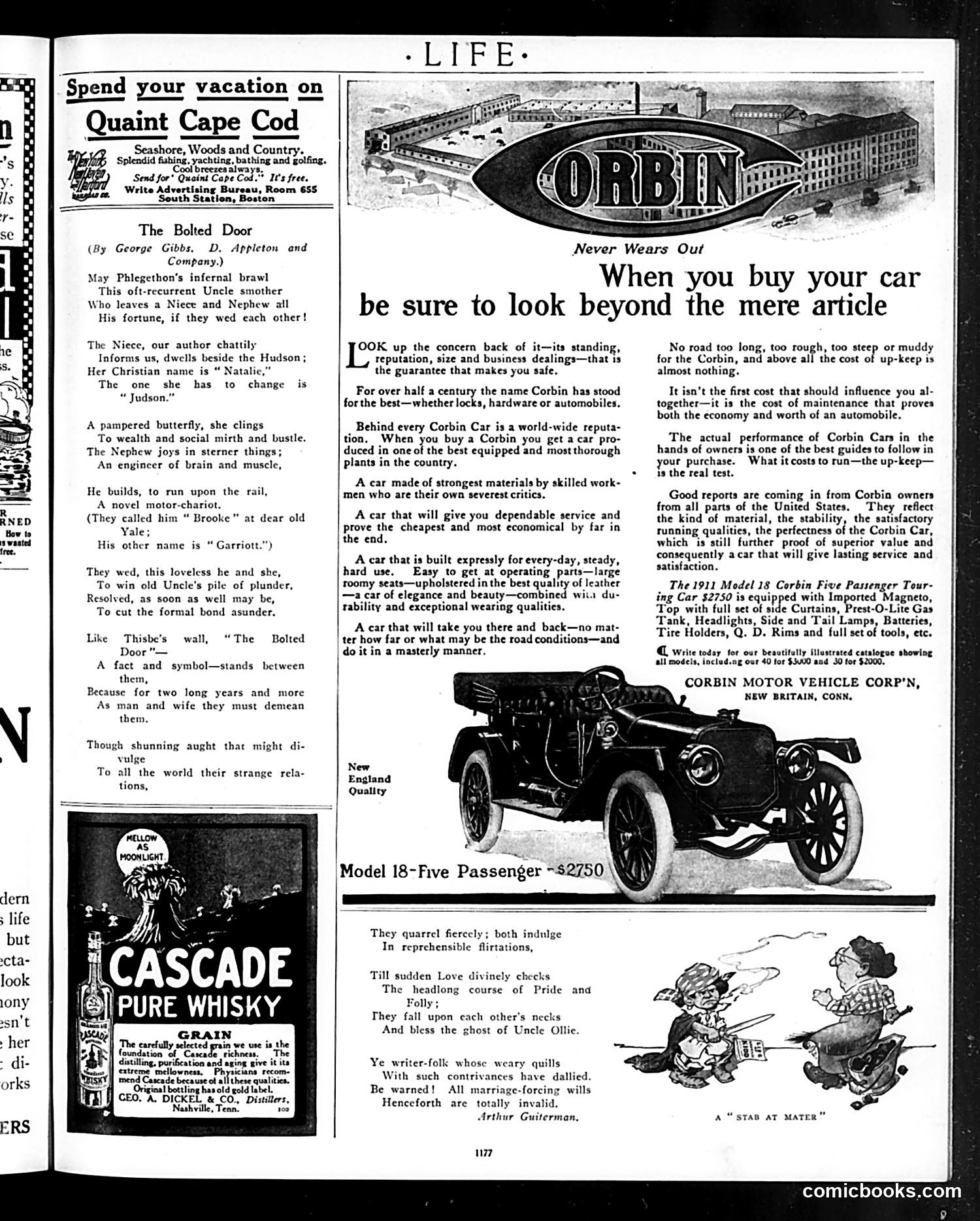
This page is primarily **advertising**, not satire or political commentary. The dominant content is a **Corbin automobile advertisement** emphasizing reliability and long-term value over initial purchase price. The ad targets practical buyers concerned with maintenance costs, appealing to middle-class consumers by highlighting the car's durability, ease of repair, and strong reputation. A secondary advertisement promotes **Cascade Pure Whiskey**, marketed to physicians and emphasizing careful grain selection and distillation quality. The only narrative content is "The Bolted Door," a serialized fiction excerpt about two young people (Natalie and Brooke/Garriott) who marry to inherit their uncle's fortune but must remain married for two years before divorcing. This appears to be **light romantic fiction** typical of Life's literary serialization, with no satirical intent visible. The bottom illustration, captioned "A 'Star at Mates,'" is unclear without fuller context but appears to be a whimsical drawing related to the serialized story.
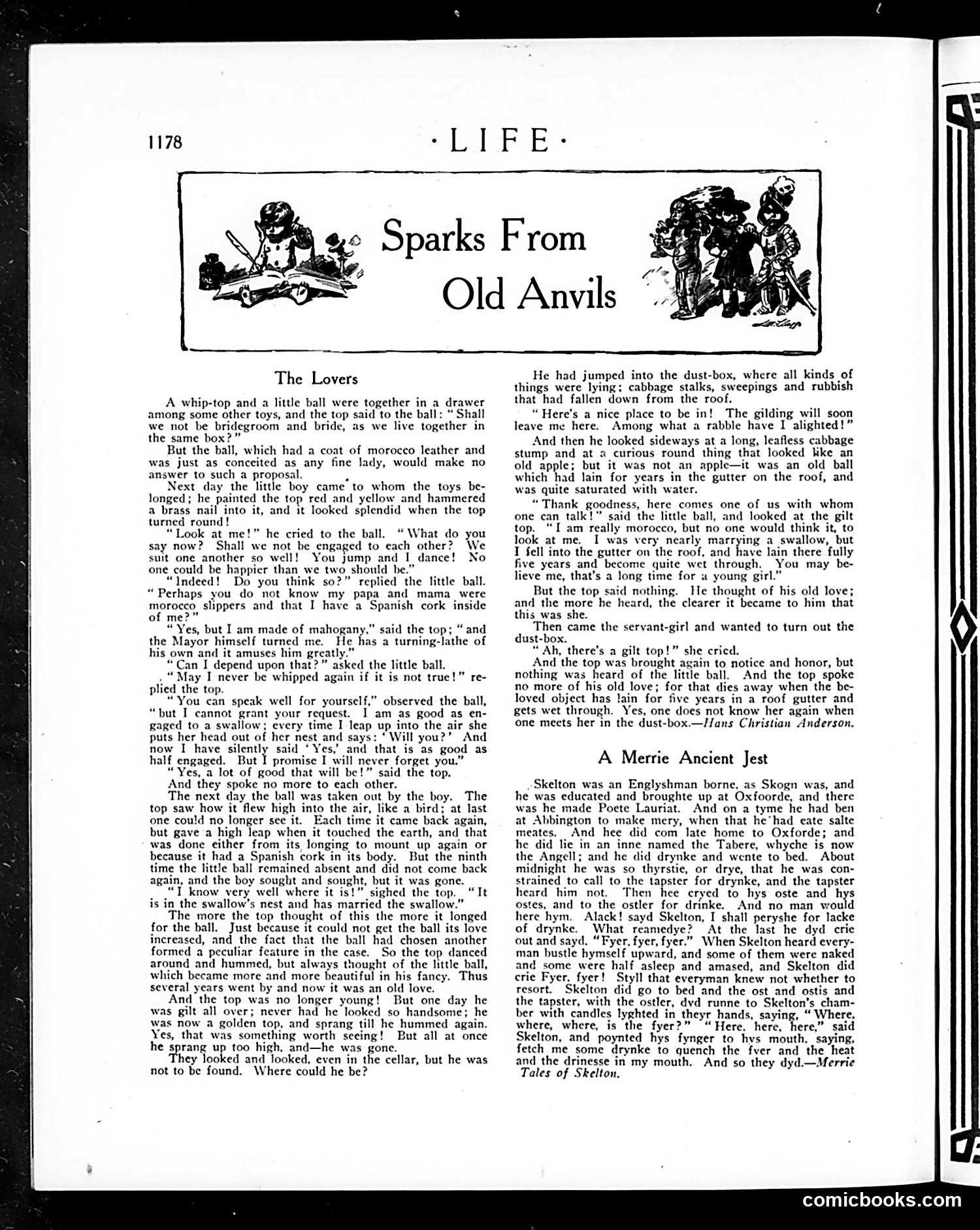
This page contains two Hans Christian Andersen-style fables, not political cartoons. "The Lovers" tells of a whip-top and ball who live together in a toy drawer. The conceited ball rejects the top's marriage proposal, claiming superior parentage (moroccan slippers, Spanish cork). The top boasts of being mahogany, turned by the Mayor himself. The ball chooses a swallow instead. Years pass; the top, now gilded and beautiful, searches endlessly for the ball. He finally lands in a dustbox where—ironically—he reunites with the ball, also aged and weathered in the gutter. The second story, "A Merrie Ancient Jest," depicts an Englishman named Skelton and a Skogn (unclear reference) engaging in drunken merrymaking at Abington, with comic consequences involving various characters demanding drinks. These are genteel, moralistic tales emphasizing themes of loss, regret, and the passage of time—typical *Life* magazine literary content for educated, middle-class readers.
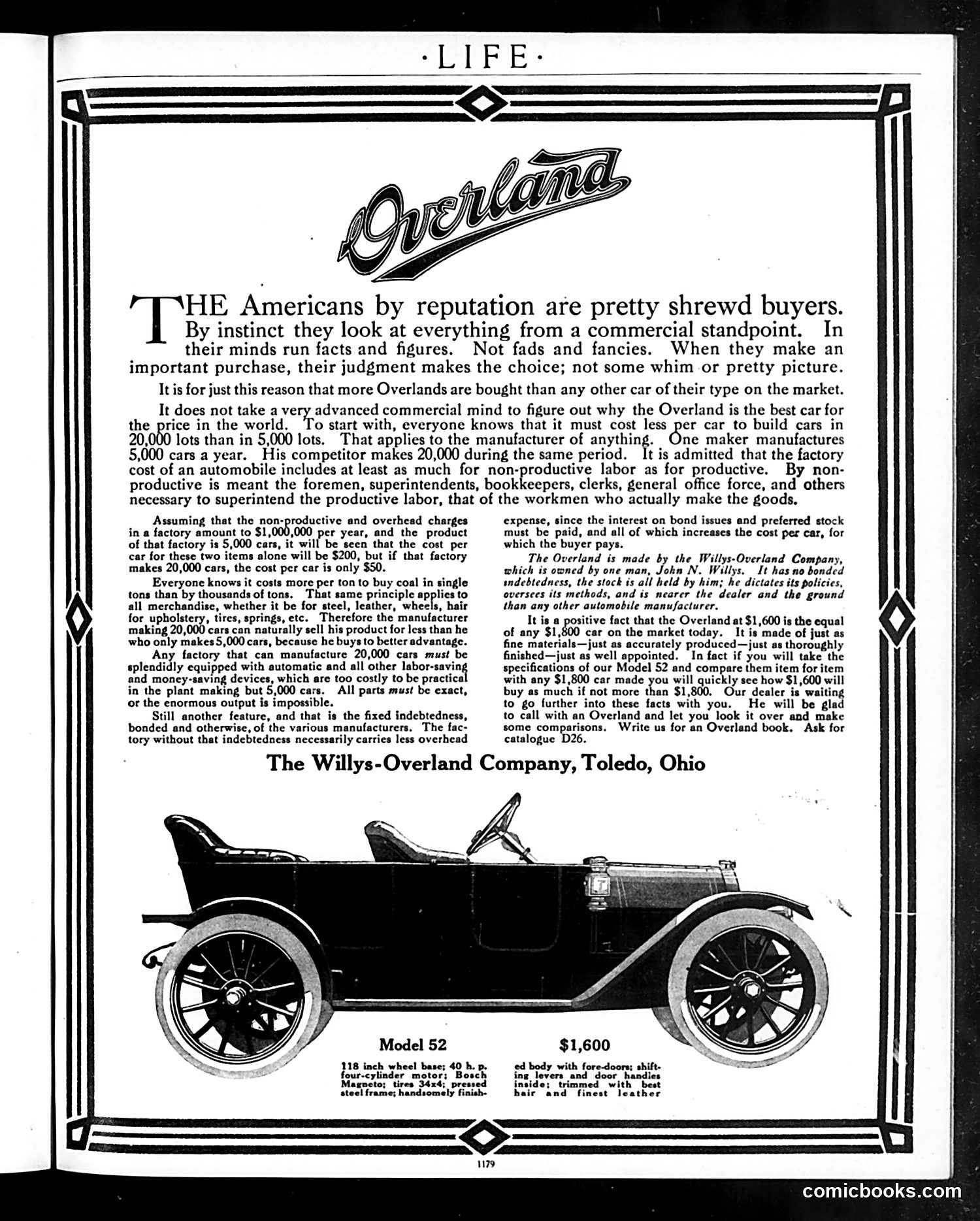
This is not a cartoon but a **car advertisement** for the Overland Model 52, priced at $1,600. The ad appeals to American buyers' rationality and business sense rather than emotion. It argues that Overland offers superior value because manufacturer John N. Willys owns the company outright with no bonded debt, reducing overhead costs. The company produces 20,000 cars annually versus competitors' 5,000, spreading fixed expenses ($200 per car vs. $50) across more vehicles. This economy of scale allows bulk purchasing of materials at better prices. The ad claims the $1,600 Overland equals $1,800 competitors in quality and specifications, positioning it as the shrewd buyer's choice. It invites dealers to demonstrate the car and requests inquiries for a catalog—standard early automotive marketing targeting practical, cost-conscious consumers during the competitive early automobile era.
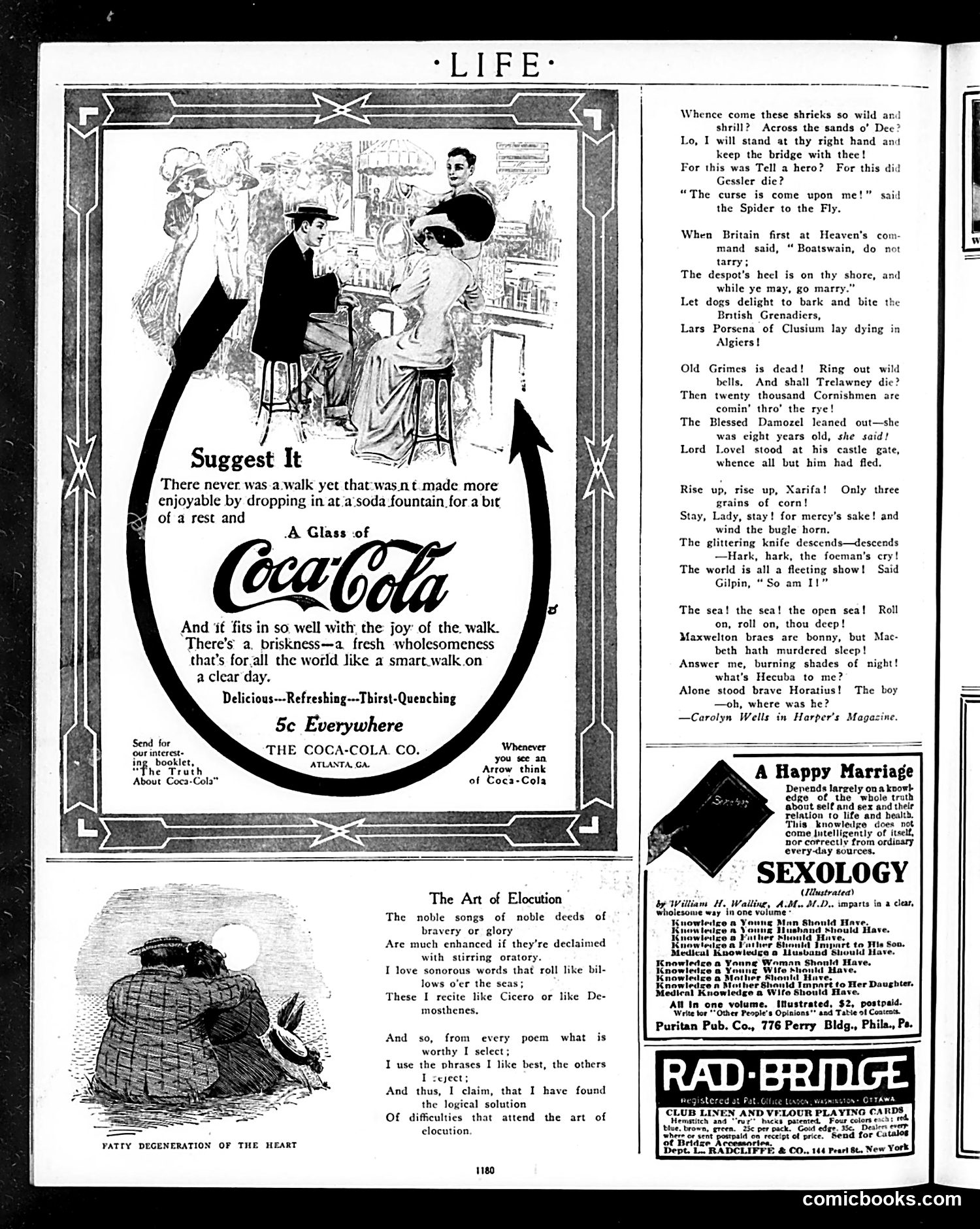
This page mixes **advertisement with literary satire**. The dominant feature is a **Coca-Cola ad** promoting soda fountains as rest stops during walks—a common early-20th-century marketing approach emphasizing refreshment and wholesomeness. The main satirical content is **"The Art of Elocution"** by Carolyn Wells (credited to Harper's Magazine). It mocks overly dramatic recitation by deliberately *mashing together famous literary and poetic lines* out of context—mixing classical references (Cicero, Demosthenes), Romantic poetry, and ballads. The joke: someone claims to have "solved" elocution by simply cherry-picking the most sonorous phrases they like, regardless of coherence. This ridicules both pretentious public speaking and selective, superficial engagement with literature. Secondary ads include **"Sexology,"** a medical guide promising frank sex education for married couples—typical of early-twentieth-century progressive literature marketed as health knowledge. The illustration labeled **"Fatty Degeneration of the Heart"** appears to be unrelated filler imagery.
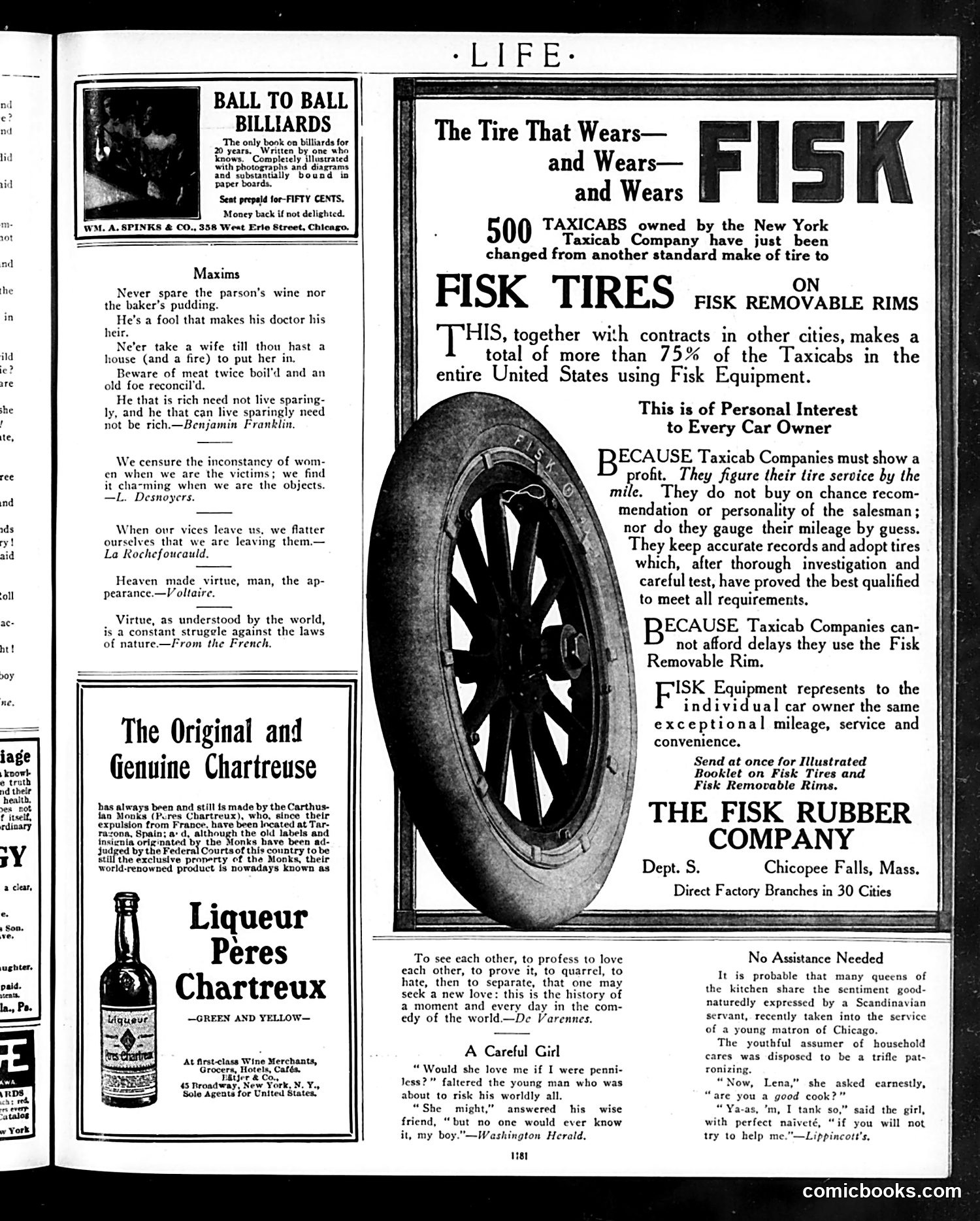
This page is primarily **advertising** mixed with philosophical maxims and brief humorous anecdotes. The main advertisements are: 1. **Fisk Tires** (dominant, right side): A pitch to car owners highlighting that NYC's taxicab companies switched to Fisk tires because they provide reliable, measurable mileage—not based on salesman personality or guesswork. The appeal: if professional fleet operators trust Fisk, individual owners should too. 2. **Ball to Ball Billiards**: A how-to book advertisement. 3. **Chartreuse Liqueur**: Clarifying that genuine Chartreuse is still made by Carthusian monks in Spain (after French expulsion), distinguishing it from imitations. The **left column contains classical maxims** attributed to Benjamin Franklin and French philosophers—traditional wisdom about avoiding foolish decisions (don't marry hastily, trust doctors too much, etc.). The **brief anecdotes** at bottom are gentle domestic humor about romance and household servants. The page reflects early 20th-century *Life* magazine's blend of sophisticated wit, advertising, and practical consumer guidance.
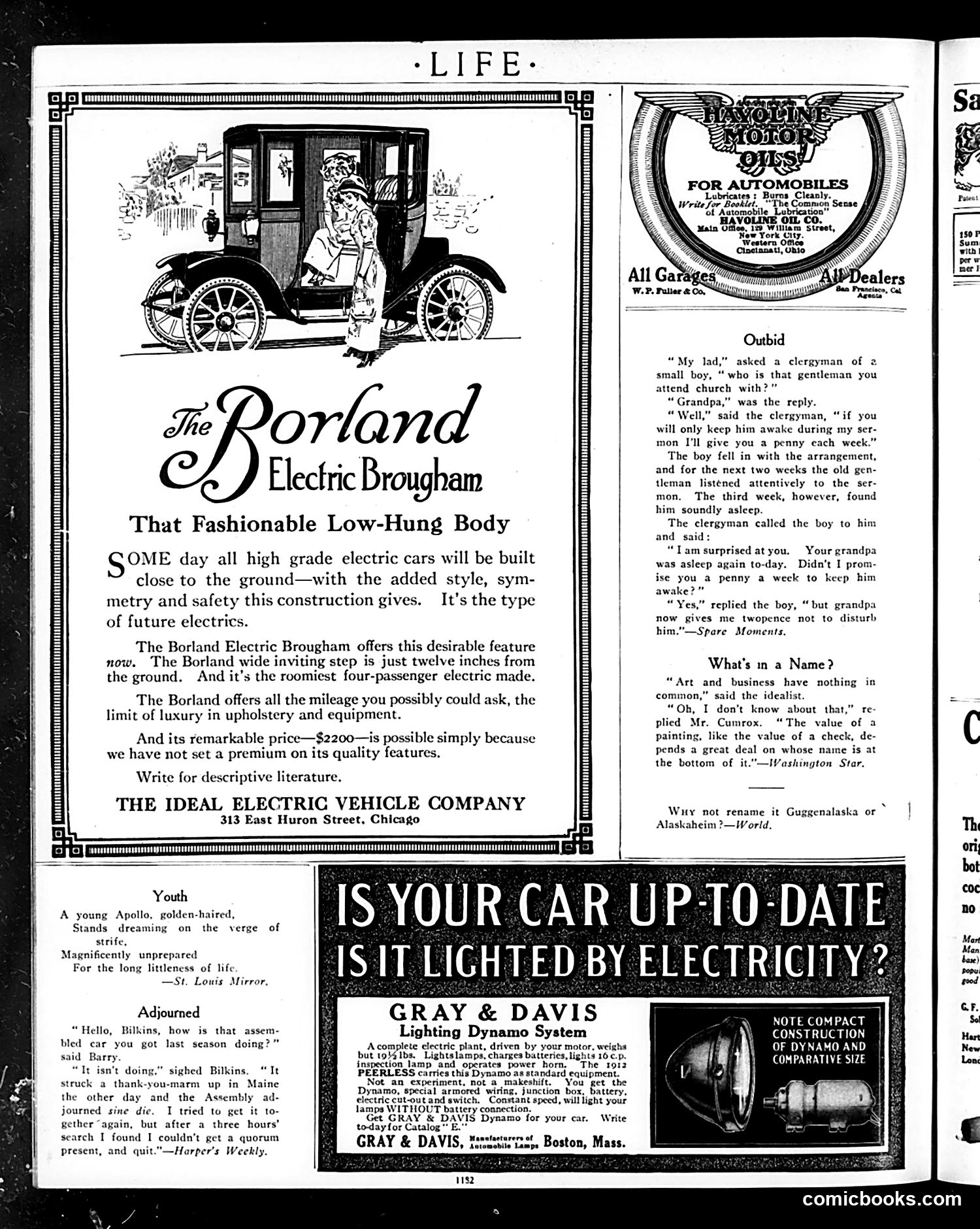
This page is primarily **advertising** for early electric automobiles (circa 1910s), with humorous filler content typical of the era. The main advertisement promotes the **Borland Electric Brougham**, emphasizing its low-slung chassis (12 inches from ground), luxury features, and affordable $2,200 price point. Electric cars were fashionable at this time before gasoline engines dominated. The page includes period humor pieces ("Oubid," "Adjourned") playing on common situations—clergy bribing children, cars breaking down on rough roads. These reflect contemporary concerns: automobile reliability was still questionable, and even assembled vehicles would literally fall apart. Secondary ads promote **Gray & Davis lighting dynamos** for cars and lubricating oil, addressing practical needs of early motorists. The satirical content is mild by modern standards—gentle jokes about human nature rather than political commentary. The overall page reflects a time when **electric vehicles were considered modern luxury items** before becoming obsolete.
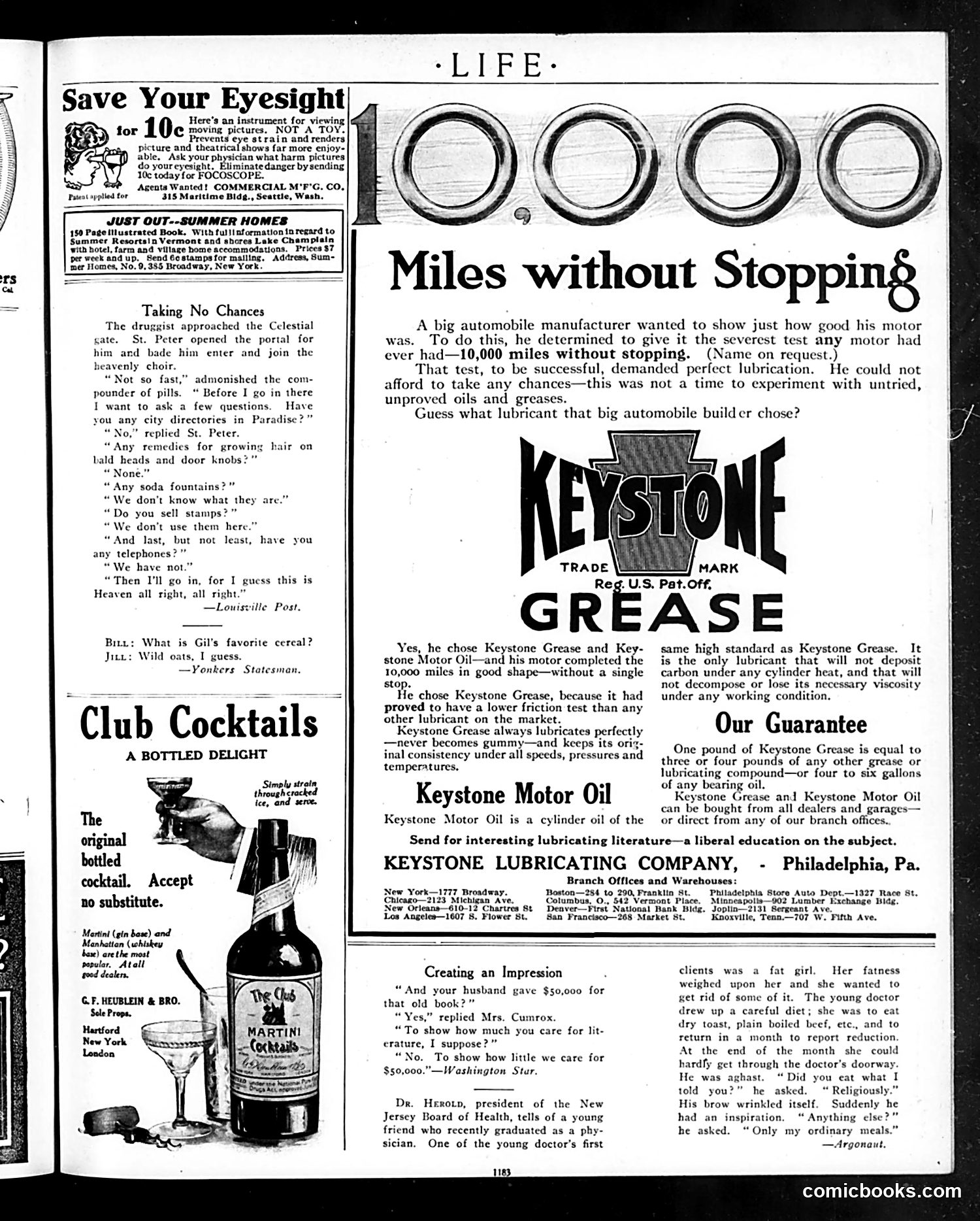
This page is primarily **advertising-driven**, featuring products typical of the 1920s era. The satirical content is minimal. The small jokes ("Taking No Chances," "Gil's favorite cereal") are light anecdotes with dated humor—a druggist enters heaven and lists things he's glad won't exist there (city directories, remedies, soda fountains, stamps, telephones), reflecting early-20th-century commercial annoyances. The dominant feature is a **Keystone Grease advertisement** disguised as editorial content. It presents a fictional narrative: an unnamed automobile manufacturer conducted a 10,000-mile non-stop motor test, succeeding through Keystone lubricant. This is native advertising—marketing material formatted to resemble journalism. The "Club Cocktails" ad (Heublein & Bro.) and various classified ads (Focoscope eyepiece, summer homes) round out the page. There's no political satire here; this reflects Life's business model of mixing light humor with paid promotional content typical of 1920s magazines.
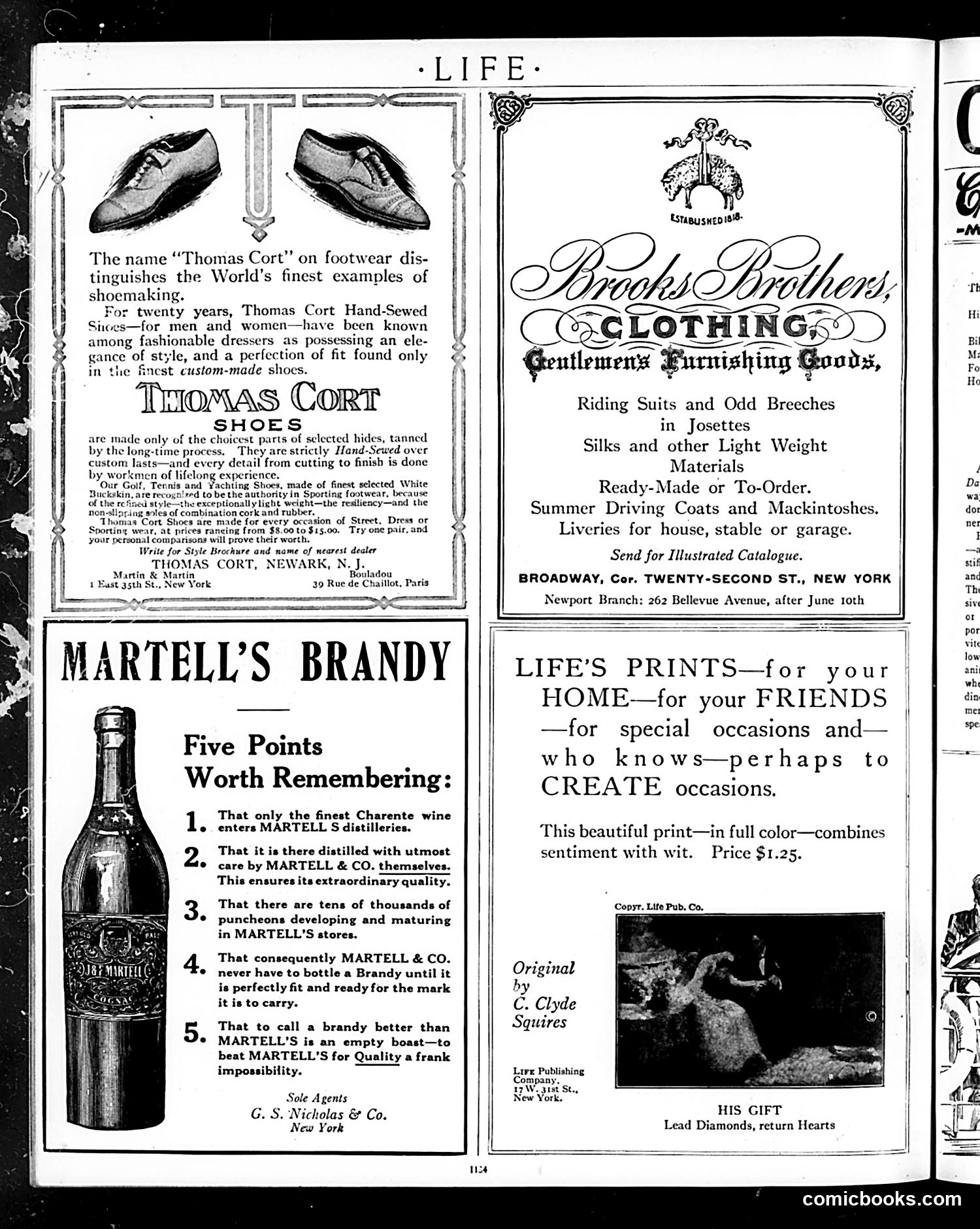
This is primarily an **advertising page** from Life magazine, not a satirical cartoon. It contains four luxury product advertisements targeting wealthy early 20th-century consumers: 1. **Thomas Cort Shoes** — hand-sewn footwear for fashionable dressers, priced $8-$15 2. **Martell's Brandy** — emphasizing quality control and aging processes 3. **Brooks Brothers Clothing** — gentlemen's furnishings including riding suits and liveries for servants 4. **Life's Prints** — decorative home prints, including one titled "His Gift" (Lead Diamonds, return Hearts) by C. Clyde Squires The page reflects Gilded Age consumer culture: ads showcase custom-made luxury goods, imported French brandy, and items suggesting wealth (stable liveries, yachting shoes, summer driving coats). The content assumes an affluent readership interested in status signaling through refined consumption and European imports. There is no political satire present—this is straightforward period advertising.
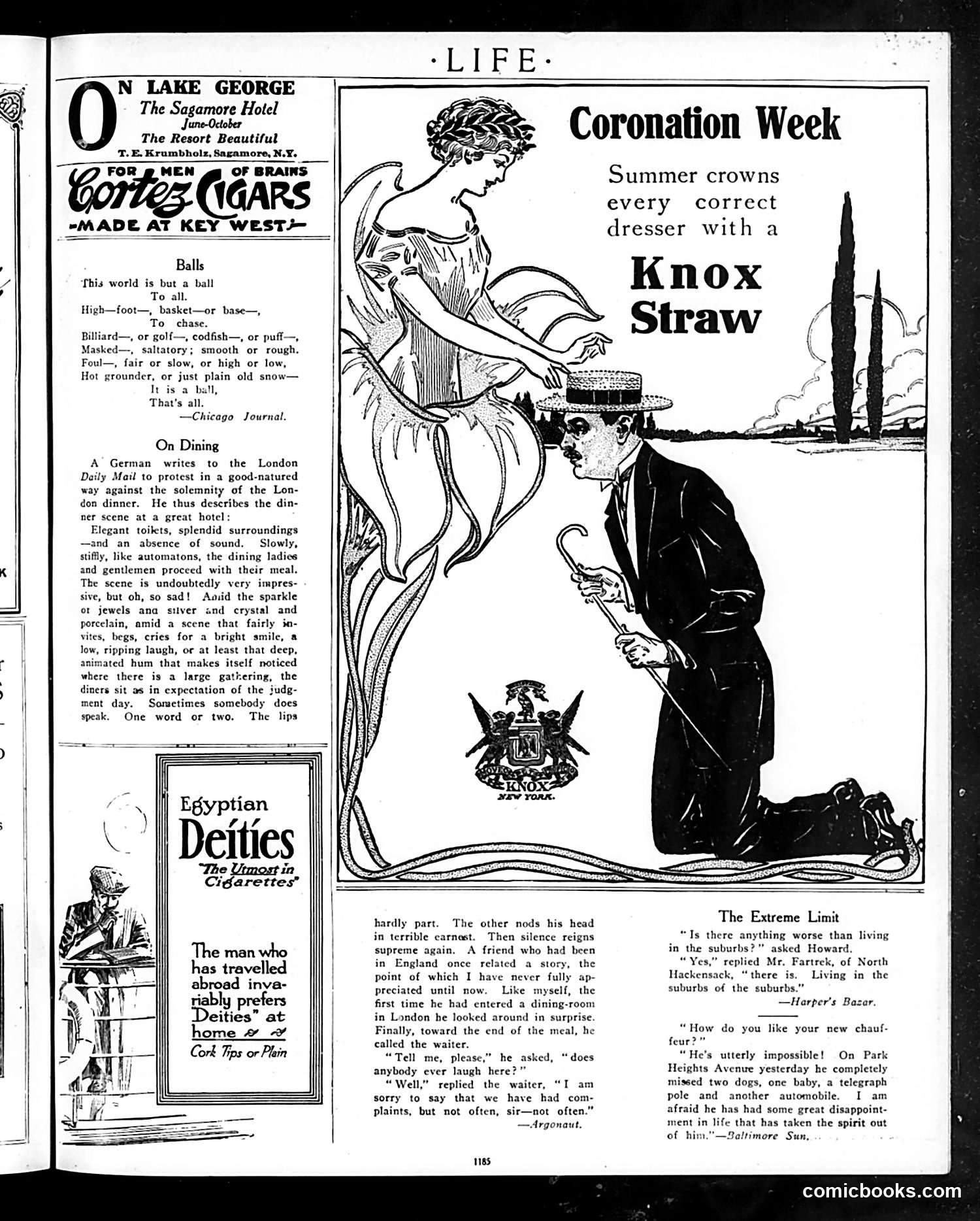
The main cartoon advertises Knox Straw hats for the coronation season. It depicts a elegantly dressed woman (representing fashionable society) being admired by a man in formal attire and straw hat. The satire targets upper-class fashion consciousness—the idea that correct summer headwear is essential to being a "correct dresser" during coronation festivities. This is straightforward product advertising using social aspiration as its appeal. The surrounding content includes humorous essays on balls, dining etiquette (mocking the stiff formality of London dinners), and jokes about suburban life. The German correspondent's complaint that London dinner scenes lack laughter and animation contrasts sharply with the vivacious femininity celebrated in the hat advertisement above—highlighting period attitudes about propriety, gender, and social performance.
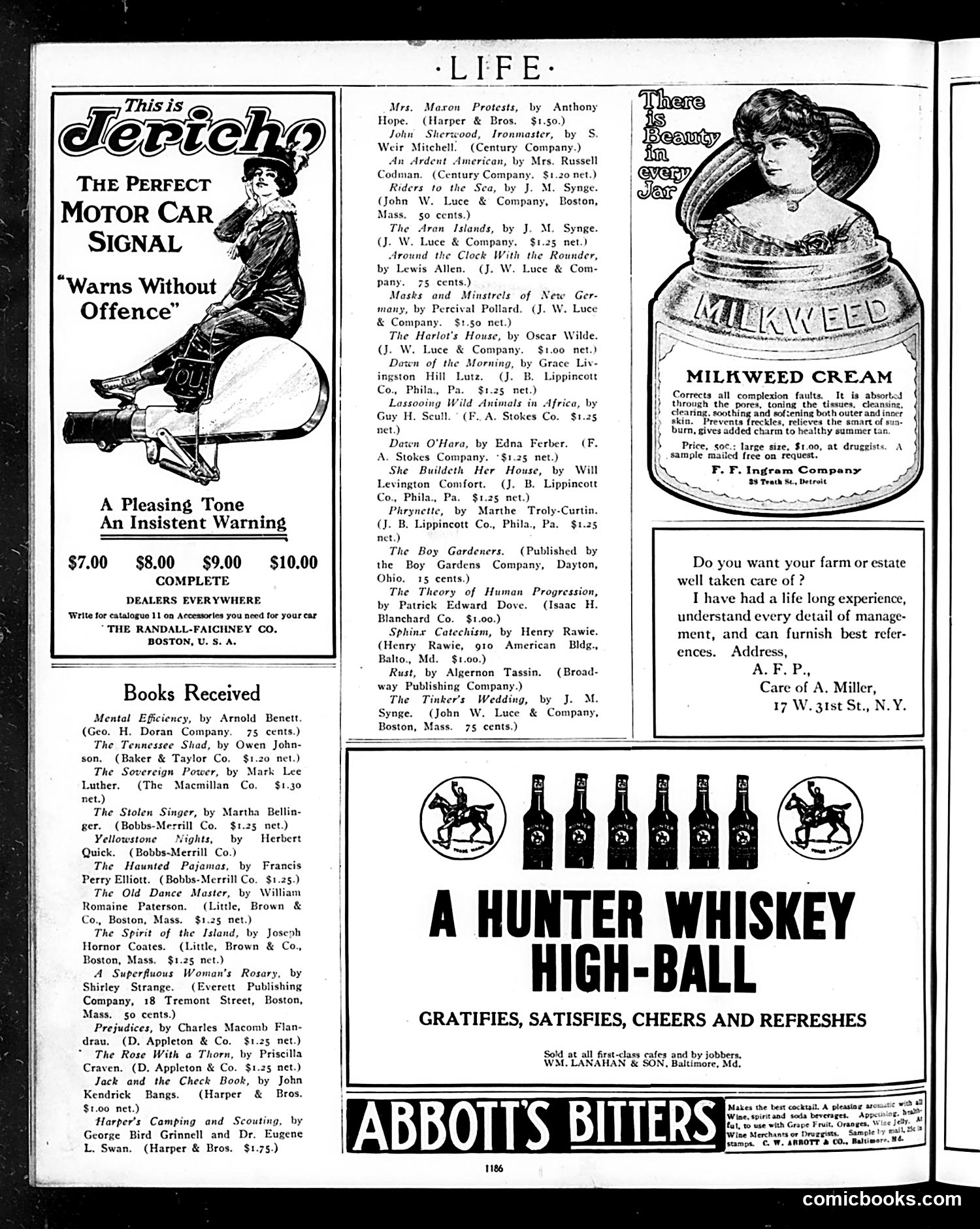
This page is primarily a **book review section with advertisements**—not primarily satirical content aimed at modern political analysis. The **cartoon** at top-left depicts "Jericho," a car horn, as a woman striking a large bell with text "Warns Without Offence"—a straightforward advertisement claiming the horn provides effective warning without being rude or unpleasant. It's a product pitch rather than satire. The page otherwise lists contemporary books (works by Oscar Wilde, J.M. Synge, and others from the early 1900s), alongside period product advertisements: Milkweed Cream (cosmetics), a farm management service, Hunter Whiskey, and Abbott's Bitters. **The satire is minimal or absent.** This is a standard magazine page of literary notices and commercial advertising typical of Life during its era as an illustrated periodical. The bottle imagery and products reflect early 20th-century consumer culture but don't appear to mock it—they're genuine advertisements.
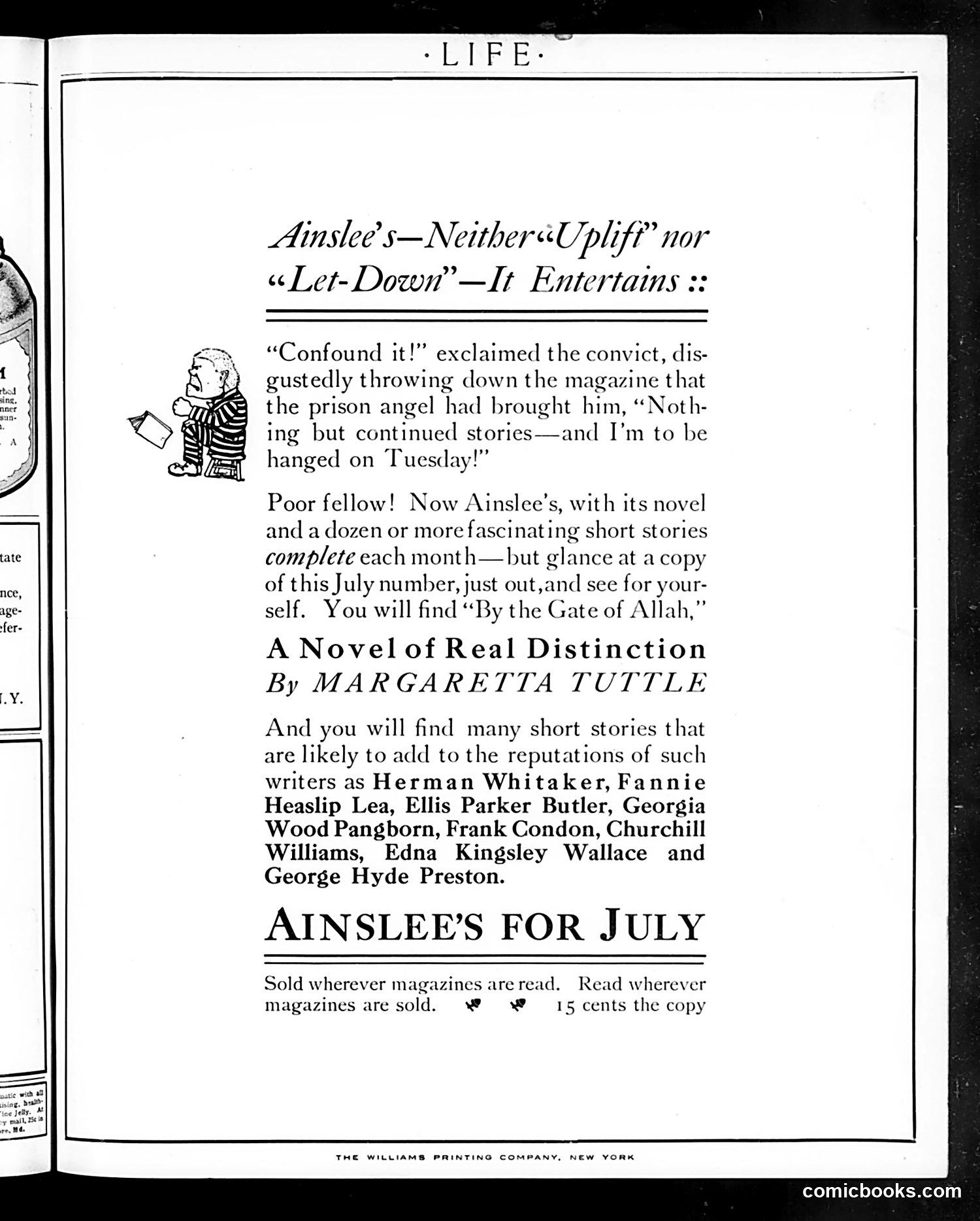
This is an advertisement for *Ainslee's* magazine, not political satire. The humor is a straightforward joke about magazine content preferences. **The Setup:** A convict awaiting execution on Tuesday complains bitterly about being given a magazine with only continued stories—he'll never finish them before his hanging, making them useless to him. **The Pitch:** *Ainslee's* solves this problem by offering complete stories each month, so even a condemned man could actually finish reading something. The joke plays on the absurdity of the convict's complaint while positioning *Ainslee's* as reader-friendly. **The Appeal:** The ad then lists prestigious fiction writers (Whitaker, Butler, etc.) and promotes a serialized novel ("By the Gate of Allah"), claiming *Ainslee's* balances both complete and ongoing stories—neither purely uplifting nor disappointing ("neither Uplift nor Let-Down"). This is straightforward commercial advertising using dark humor as a sales technique, typical of early 20th-century magazine marketing.
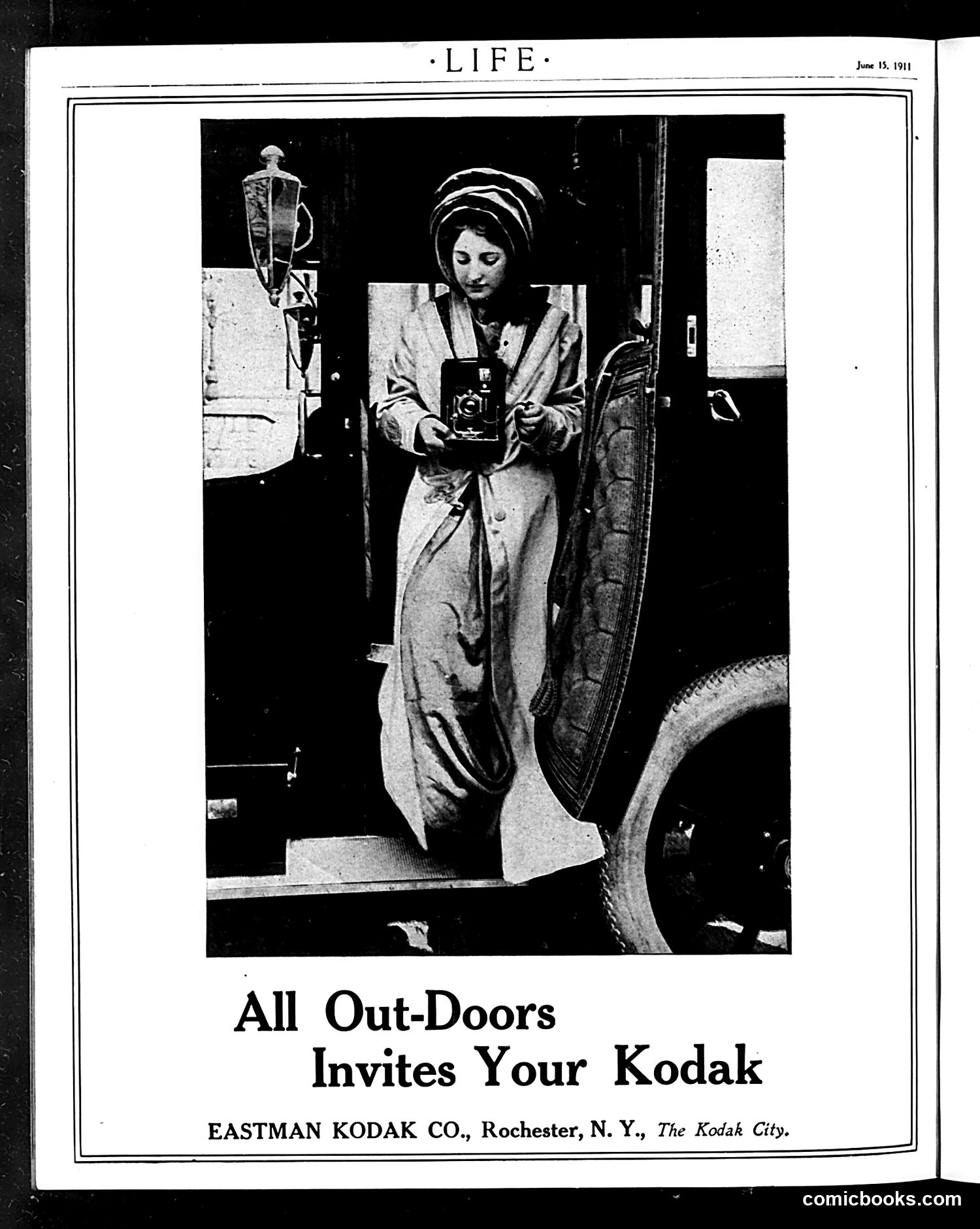
This is a full-page advertisement for Eastman Kodak cameras, not satirical content. The headline "All Out-Doors Invites Your Kodak" promotes portable photography for outdoor activities. The image shows a woman in early 1910s attire (turban-style hat, long coat) holding what appears to be a folding camera while standing in or near an automobile. The setting suggests leisure travel—she's positioned as if documenting an outdoor excursion by car, which was a novel activity for the era. The ad's appeal targets affluent consumers who could afford both automobiles and cameras, encouraging them to document their modern outdoor experiences. There is no political satire or social commentary visible—it's straightforward product marketing capitalizing on emerging automotive culture and amateur photography trends of the period.