
Life, 1911-06-15 · page 26 of 44
Life — June 15, 1911 — page 26: what you’re looking at
What you’re looking at
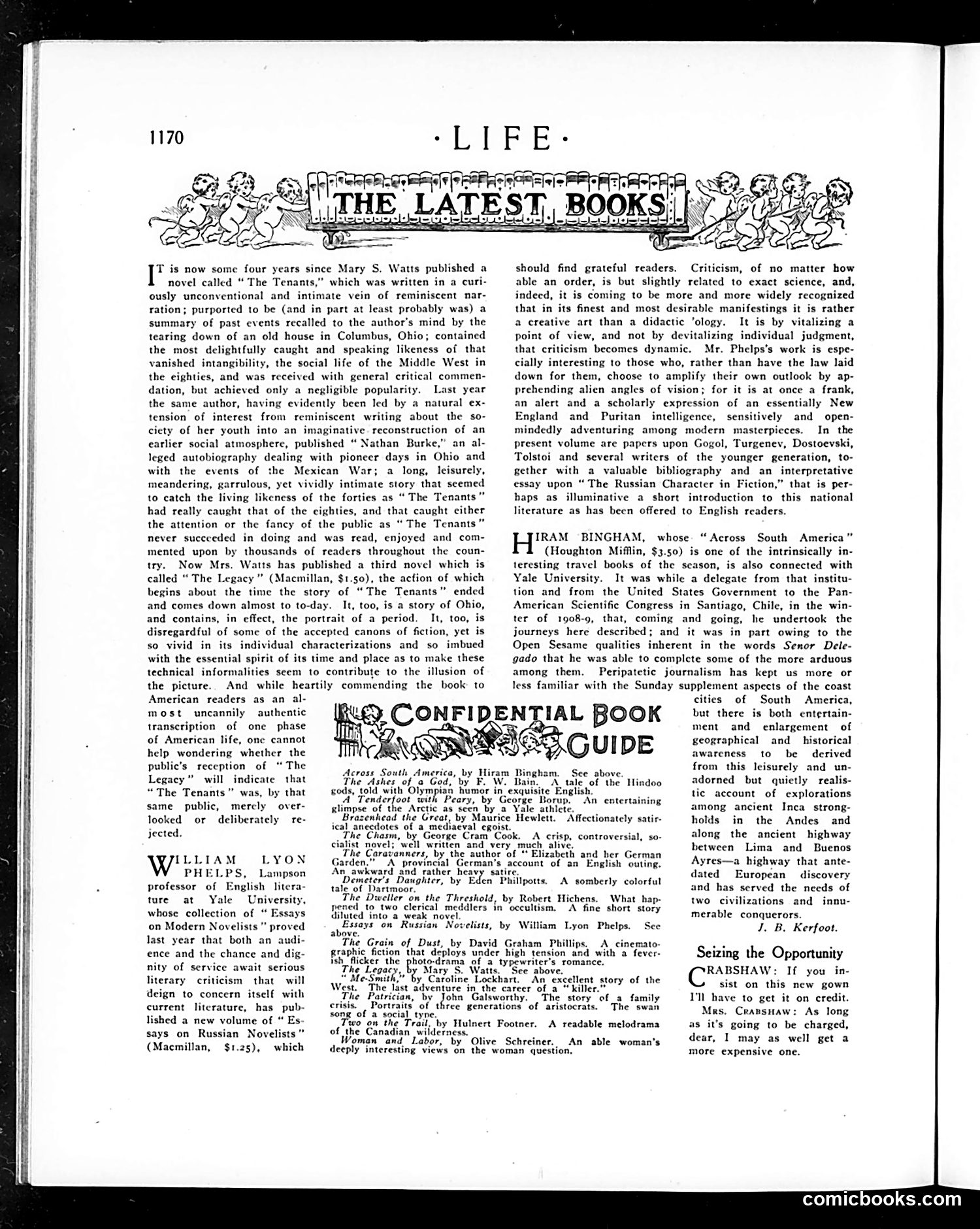
This page reviews recent literary works, primarily focusing on novels by Mary S. Watts. The main text discusses her three novels—"The Tenants," "Nathan Burke," and "The Legacy"—which chronicle Ohio society across different historical periods (1880s, Mexican War era, and the present). The reviewer notes that while critically praised, her books achieved uneven commercial success, wondering whether the public simply overlooked "The Tenants" or actively rejected it. The "Confidential Book Guide" section provides brief notices of other current publications, including Hiram Bingham's travel account "Across South America" and works by Maurice Hewlett and George Cram Cook. There are no political cartoons visible on this page. It is primarily a literary review and advertising section for contemporary books aimed at educated American readers interested in fiction and travel literature.
📄 Transcribed text from this page (OCR, searchable)
Machine-transcribed from the original scan — historical spelling and the odd misread are preserved.
T is now some four years since Mary S, Watts published a novel called “ The Tenants,” which was written in a curi ously unconventional and intimate vein of reminiscent nar- ration; purported to be (and in part at least probably was) a summary of past events recalled to the author's mind by the tearing down of an old house in Columbus, Ohio; contained the most delightfully caught and speaking likeness of that vanished intangibility, the social life of the Middle West in the eighties, and was received with general critical commen- dation, but achieved only a negligible popularity. Last year the same author, having evidently been led by a natural ex- tension of interest from reminiscent writing about the so- ciety of her youth into an imaginative reconstruction of an earlier social atmosphere, published “ Nathan Burke,” an al- leged autobiography dealing with pioneer days in Ohio and with the events of the Mexican War; a long, leisurely, meandering, garrulous, yet vividly intimate story that scemed to catch the living likeness of the forties as “ The Tenants” had really caught that of the eighties, and that caught cither the attention or the fancy of the public as “The Tenants” never succeeded in doing and was read, enjoyed and com- mented upon by thousands of readers throughout the coun- try. low Mrs. Watts has published a third novel which is called “ The Legacy ” (Macmillan, $1.50), the acfion of which begins about the time the story of “The Tenants” ended and comes down almost to to-day. It, too, is a story of Ohio, and contains, in effect, the portrait of a period. It, too, is disregardful of some of the accepted canons of fiction, yet is so vivid in its individual characterizations and so imbued with the essential spirit of its time and place as to make these technical informalities seem to contribute to the illusion of the picture. And while heartily commending the book to American readers as an al- most uncannily transcription of one phase of American life, one cannot help wondering whether the public’s reception of “ The Legacy” will indicate that “The Tenants” was, by that same public, merely over- looked or deliberately re- jected. oe A’ Tenderfoot wit The Chasn ILLIAM LYON PHELPS, Lampson Garden.” A pro An awkward and rather heay authentic CONFIDENTIAL BOOK ‘\ Across South America, by Hiram Bingham. The Asher of a God, by F. W. Bain. sods, told with Olympiad) humer in exquisite: English. I’ Peary, by George Borup. An entertaining glimpse of the Arctic as seen by a Vale athlete. Brazenhead the Great, by Maurice Hewlett. Affectionately satir- ical anecdotes of a mediaeval egoist. aT by George Cram Cook. A crisp, controversial, so- cialist novel; ‘well written and very much. alive. The Caravanners, by the author of cial German's account of an English outing. satire . Demeter's Daughter, by Eden Phillpotts, dated European should find grateful readers. Criticism, of no matter how able an order, is but slightly related to exact science, and, indeed, it is coming to be more and more widely recognized that in its finest and most desirable manifestings it is rather a creative art than a didactic ‘ology. It is by vitalizing a point of view, and not by devitalizing individual judgment, that criticism becomes dynamic. Mr. Phelps’s work is espe- cially interesting to those who, rather than have the law laid down for them, choose to amplify their own outlook by ap- prehending alien angles of vision; for it is at once a frank, an alert and a scholarly expression of an essentially New England and Puritan intelligence, sensitively and open- mindedly adventuring among modern masterpieces. In the present volume are papers upon Gogol, Turgenev, Dostoevski, Tolstoi and several writers of the younger generation, to- gether with a valuable bibliography and an interpretative essay upon “The Russian Character in Fiction,” that is per- haps as illuminative a short introduction to this national literature as has been offered to English readers. IRAM BINGHAM, whose “Across South America” (Houghton Mifflin, $3.50) is one of the intrinsically in- teresting travel books of the season, is also connected with Yale University. It was while a delegate from that institu- tion and from the United States Government to the Pan- American Scientific Congress in Santiago, Chile, in the win- ter of 1908-9, that, coming and going, he undertook the journeys here described; and it was in part owing to the Open Sesame qualities inherent in the words Senor Dele- gado that he was able to complete some of the more arduous among them. Peripatetic journalism has kept us more or less familiar with the Sunday supplement aspects of the coast cities of South America, but there is both entertain- ment and enlargement of geographical and historical awareness to be derived from this leisurely and un- adorned but quietly realis- tic account of explorations among ancient Inca strong- holds in the Andes and along the ancient highway between Lima and Buenos Ayres—a highway that ante- discovery and has served the needs of GUIDE See above. A tale of the Hindoo Elizabeth and her German A somberly colorful professor of English lite ture at Yale Universit whose collection of “ Essays on Modern Novelists ” proved last year that both an audi- ence and the chance and dig- nity of service await serious literary criticism that will deign to concern itself with current literature, has pub- lished a new volume of “ Es- says on Russian Novelists” (Macmillan, $1.25), which tale of Dartmoor. The Dweller on the Threshold, by Robert Hichens. What hap- ened to two clerical meddlers in occultism. A fine short story -d into a weak novel Estaxs on Russian Novelists, by William Lyon Phelps. See above. The Grain of Dust, by David Graham Phillips, A cinemato- graphic fiction that deploys under high tension and with a fever- Ish flicker the photo-drama of a typewriter’s romance. The Leoacy,,by Mary S. Watts. "See above. * Me-Smith,” by Caroline Lockhart. An excellent story of the West. The last adventure in the career of a “killer.” The Patrician, by John Galsworthy. The story of a family crisis. Portraits of three generations of aristocrats. The swan song of a social tyne. Two on the Trail, by Hulnert Footner. A readable melodrama of the Canadian wilderness. Woman and Labor, by Olive Schreiner. An able woman's deeply interesting views on the woman question, two civilizations and innu- merable conquerors. J. B. Kerfoot. Seizing the Opportunity RABSHAW: If you in- sist on this new gown I'l have to get it on credit. Mrs, Cransiaw: As long as it's going to be charged, dear, I may as well get a more expensive one. comicbooks.com